
Ever found yourself wondering if that old round pound coin jangling around in your purse or pocket is worth more than its face value? Well, you might be surprised to learn that the answer is often a resounding yes. Many £1 coins are highly prized by collectors, with some rare examples fetching impressive sums far beyond their simple one-pound worth.
Your Quick Guide To Valuable £1 Coins
Finding a 1 pound coin worth money isn't just a matter of luck; it's about knowing exactly what to look for. Think of yourself as a detective, and your spare change is the crime scene. While most of the millions of pound coins out there are worth exactly £1, a select few have unique quirks that turn them into treasures hiding in plain sight.
So, what makes a regular coin a valuable collectible? It all comes down to a mix of three key things: how many were made, the specific design on the coin, and any mistakes that happened when it was being minted. These factors create demand among collectors, which is what really drives up the coin's value.
Understanding Mintage and Rarity
The single most important factor is mintage. This is just a simple term for the total number of coins of a specific design made in a particular year. The fewer coins that were minted, the rarer they are. It’s the classic rule of supply and demand.
For example, some £1 coin designs have mintages in the tens or even hundreds of millions, so they’re incredibly common. Others, however, have mintages of less than two million, which immediately puts them on a collector’s radar. This is why getting to know the mintage figures is your most powerful tool.
The Importance of Design and Condition
Beyond how many were made, the coin's design plays a massive part. The old round pound, which was in use from 1983 to 2016, had 24 different reverse designs, many celebrating the home nations of the United Kingdom. Some of these sets, like the Capital Cities or Floral Emblems series, contain some exceptionally rare coins that are now highly sought-after.
Finally, the physical state of the coin is crucial. A pristine, uncirculated coin that looks as fresh as the day it left the Royal Mint will always be worth more than one that's been heavily scratched and worn down from years of use. Collectors use a formal grading scale, but for a quick check, just look for sharp details and some of its original shine.
Key Takeaway: A valuable £1 coin is typically a perfect storm of low production numbers (low mintage), a desirable design, and excellent physical condition. Getting your head around these three concepts is the foundation for spotting treasure in your change.
To make things even clearer, here’s a quick summary of what you should be keeping an eye out for.
At-a-Glance Guide to Valuable £1 Coin Features
| Feature | What to Look For | Why It Adds Value |
|---|---|---|
| Low Mintage | Check the coin's date and design against official mintage figures. Anything under 2 million is a great find. | Basic supply and demand. Fewer coins in circulation mean they are harder for collectors to find. |
| Specific Designs | Look for coins from sought-after series like the Capital Cities (e.g., Edinburgh, Cardiff) or certain Floral Emblems. | Collectors often try to complete entire sets, making the rarer designs in those series particularly valuable. |
| Minting Errors | Inspect for mistakes like off-centre strikes, incorrect inscriptions (e.g., "Piedfort" on a standard coin), or mismatched dates. | Errors are accidental and often unique, creating one-of-a-kind collectibles that are highly prized for their rarity. |
| Excellent Condition | A coin with sharp details, minimal scratches, and original lustre. Look for "Uncirculated" or "BU" (Brilliant Uncirculated) quality. | Collectors will always pay a premium for coins that look as close to new as possible, as they are much scarcer than worn examples. |
Use this table as your pocket guide. When you get a round pound in your change, a quick glance for these features could be the difference between spending it on a coffee and finding a small treasure.
The Rarest Round Pound Coins You Can Find
Diving into the world of coin collecting often feels like a real-life treasure hunt. For anyone with a soft spot for British currency, the old round pound coins offer some of the most exciting finds. While millions of these coins were minted over the years, a handful are genuinely scarce, making them the ultimate prizes for a collector.
The key to spotting a truly rare 1 pound coin worth money is knowing which designs and dates to look out for. It almost always comes down to one simple thing: the mintage figure. This is just the official number of coins made for a specific design in a given year. The lower that number, the harder the coin is to find, and the more valuable it becomes.
Many round pounds have mintages in the tens of millions, but the ones that get collectors excited have figures well below two million. These aren't just rare; they often represent unique moments in UK history, celebrating the heritage of the home nations. It's this blend of scarcity and story that makes the hunt so addictive.
The Undisputed Champion of Rarity
When we talk about rare round pounds, one coin stands head and shoulders above all others: the 2011 Edinburgh City £1. This is the holy grail for collectors, and for a very good reason. It holds the title for the lowest mintage of any circulating £1 coin ever produced.
With an incredibly low mintage of just 935,000, it's the only round pound design with fewer than one million pieces ever released into circulation. To put that in perspective, the very common 1983 Royal Arms design had a mintage of over 443 million. Finding an Edinburgh City coin is, statistically, hundreds of times harder.
This coin was part of a series celebrating the capital cities of the UK, with the Edinburgh design featuring the iconic thistle and Edinburgh Castle badge. Its extreme rarity has given it a perfect score of 100 on Change Checker's Scarcity Index – the highest possible rating. You can learn more about the history of the one pound coin and its various designs through public records.
A 2011 Edinburgh City £1 in circulated condition can easily fetch between £10 and £15. If you're lucky enough to find an uncirculated one with no signs of wear, it could command £25 or even more.
Other Notable Rarities to Watch For
While the Edinburgh coin is the undisputed king, it isn't the only rare round pound worth searching for. The Capital Cities series it belongs to also contains other valuable pieces that are highly sought after by numismatists.
The chart below breaks down the key factors that contribute to a £1 coin's value.
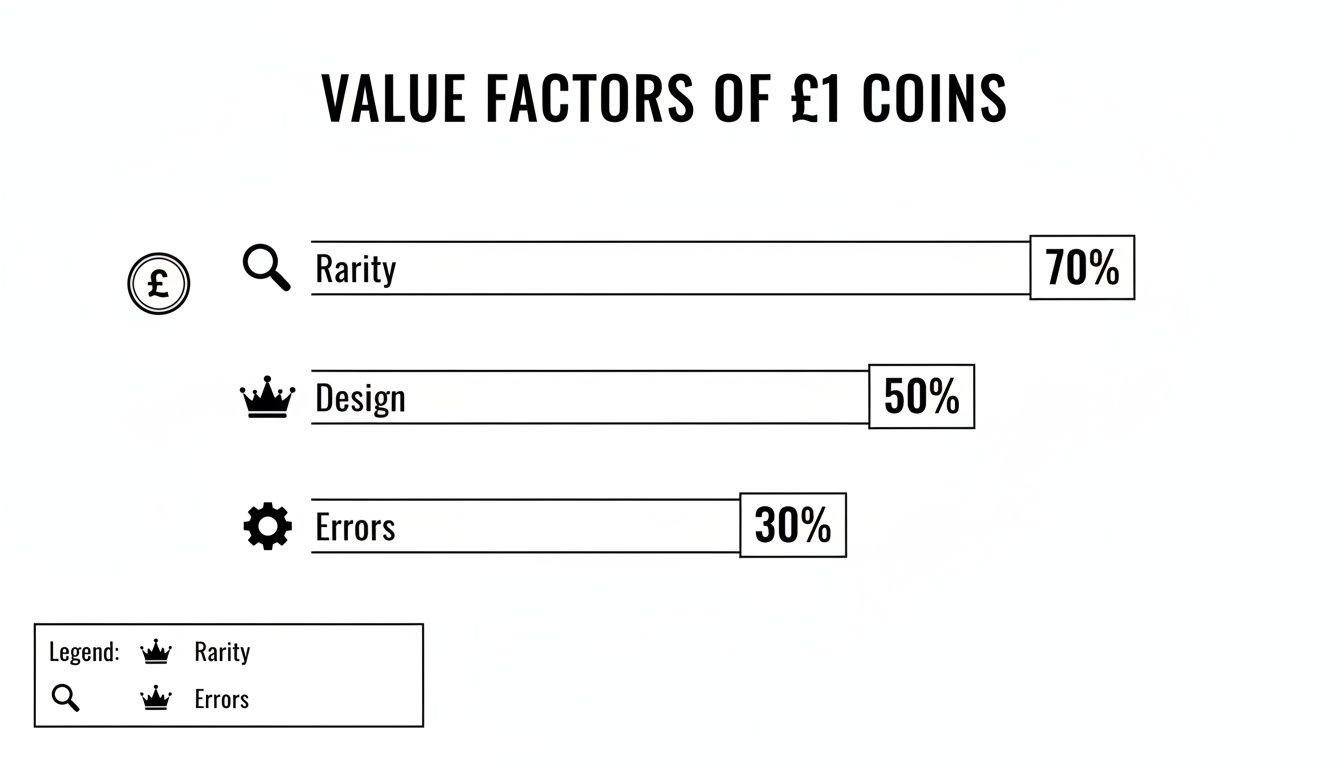
As you can see, rarity from a low mintage is by far the most significant factor, followed by the specific design and any potential minting errors.
Here's a quick look at the top contenders, which all happen to come from that same Capital Cities series.
Top 5 Rarest UK Round £1 Coins by Mintage
The table below ranks the rarest round £1 coins based on their official mintage figures. These are the coins that every serious collector is looking for to complete their set.
| Rank | Year and Design | Mintage Figure | Estimated Value (Circulated) |
|---|---|---|---|
| 1 | 2011 Edinburgh City | 935,000 | £10 - £15 |
| 2 | 2011 Cardiff City | 1,615,000 | £8 - £12 |
| 3 | 2010 London City | 2,635,000 | £6 - £10 |
| 4 | 2008 Royal Arms | 3,910,000 | £4 - £6 |
| 5 | 2011 Royal Arms | 4,784,900 | £3 - £5 |
Keep this list handy when you're checking your change. Finding any of these coins is a great achievement for any collector.
Here are a few more details on the other key coins from the Capital Cities series to add to your checklist:
- 2011 Cardiff City: The second rarest, this coin features the circular Cardiff City coat of arms. With a mintage of just 1,615,000, it’s still a massive challenge to find and a prized possession for any collector.
- 2010 London City: Representing England's capital, this coin has the third-lowest mintage of the set at 2,635,000. Its design showcases the intricate City of London coat of arms.
- 2010 Belfast City: The final coin in the Capital Cities series features the Belfast coat of arms. While a bit more common with a mintage of 6,205,000, it's still a desirable piece, especially for those looking to complete the full set.
Think of this as your treasure map. By carefully checking the dates and designs on any round pounds you come across, you have a real chance of discovering a valuable piece of history hiding in plain sight.
Identifying Valuable Mint Errors And Trial Coins
While a coin's rarity is often down to its official mintage figures, some of the most exciting and valuable finds are actually born from simple mistakes. The Royal Mint is an incredibly precise operation, but it's still a factory producing billions of coins. Every now and then, things go wrong, creating unique "error coins" that collectors absolutely love to hunt down.
Finding a 1 pound coin worth money isn't just about spotting a rare date; it's about training your eye to notice the little things that are out of place. Think of these error coins as accidental limited editions. Their value comes directly from this unintentional uniqueness, turning what should be a common coin into a real collector's piece. These aren't just damaged coins from being in circulation—they are genuine mistakes made during the minting process itself.
These errors can range from glaringly obvious to incredibly subtle and easy to miss. For the budding coin detective, learning to spot these oddities is one of the most thrilling parts of the hobby.
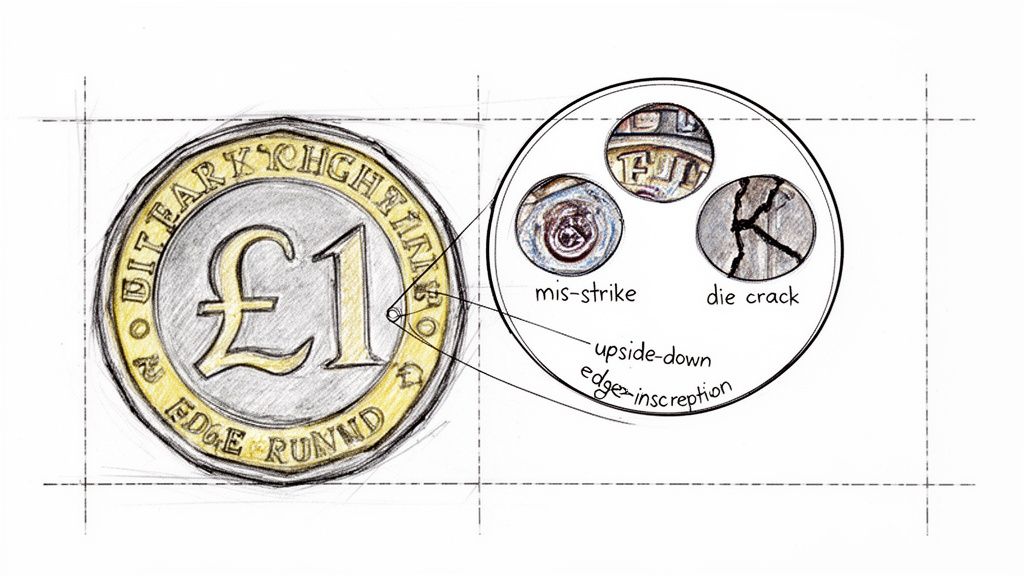
Common Minting Errors to Look For
Spotting an error takes a keen eye and a bit of patience. The next time you're checking your change, slow down and have a proper look at each coin. Here are some of the most common types of errors you might find on £1 coins:
- Mis-Strikes: This happens when the blank coin (known as a planchet) isn't sitting perfectly when it gets stamped by the dies. The result is a design that's off-centre, sometimes with a part of it missing completely.
- Die Errors: The dies used to stamp coins can crack or break under immense pressure. These tiny cracks then show up as raised, squiggly lines on the finished coin. A famous example is the 2016 round pound, which can sometimes feature a tiny 2017 date in a 'micro-engraving'—a die error that definitely commands a premium.
- Edge Inscription Errors: The lettering around the edge of the round pound was a separate step in the process. Sometimes this went wrong, leading to inscriptions that are upside-down compared to the Queen's head. While not incredibly rare, clean, well-defined examples are still sought after.
- Mules: A 'mule' is a major mix-up where a coin is struck with the wrong dies. Imagine the 'heads' side of one coin paired with the 'tails' side of another. While incredibly rare for £1 coins, they are the holy grail for error collectors.
Expert Insight: "Error coins offer a unique window into the minting process. Each flaw tells a story of what went wrong on the production line, transforming a piece of currency into a historical artefact. It’s this story, combined with rarity, that makes them so compelling to collectors."
The Allure of Trial Pieces
Beyond accidental errors, you also have trial pieces. These are special coins made by The Royal Mint simply to test out new designs, metals, or minting techniques. They were never meant for circulation, which makes them exceptionally rare and valuable if they ever find their way out of the mint.
A great example is the 1994 'Silver Piedfort' trial £1 coin. This was created to test the design for the Scottish Lion Rampant coin. A handful of these trial strikes, which have a different edge inscription and composition, have surfaced in private hands over the years. They can be worth hundreds, if not thousands, of pounds. Identifying one requires specialist knowledge, but they really are the pinnacle of modern coin collecting. For a deeper dive, you can learn more about how to discover valuable error coins and their hidden treasures in our detailed guide.
A Special Case: The 1985 Royal Arms Pound Coin
Sometimes, a coin's value isn't just about its rarity or a glaring error. It’s about the story it tells. The 1985 Royal Arms £1 coin is the perfect example. On the surface, it might not seem as scarce as the legendary Edinburgh City coin, but its unique backstory makes it a fascinating and highly sought-after piece for any serious collector.
This particular coin captures a pivotal moment for modern UK currency. It was issued just two years after the £1 coin first landed in our pockets in 1983, part of the big push to phase out the old, flimsy £1 banknote. The design, a grand and ornate Royal Arms, was meant to be a symbol of strength and tradition for the new, durable coinage.
But there’s more to the story of the 1985 coin than just its design. It’s all about its journey.
From Trial Piece To Circulation
While the 1985 Royal Arms pound has a lower mintage than many of its counterparts, its appeal gets a major boost from its connection to the coin's early trial phases. Back in the early 1980s, The Royal Mint was busy experimenting with different designs and metal compositions, and any pieces from that era are now seen as important historical markers.
What’s more, the 1985 coin was one of the first to feature Queen Elizabeth II's third official portrait, designed by Raphael Maklouf. This transitional period makes it a true cornerstone piece, representing the evolution of the UK’s flagship coin in its infancy.
A coin's value isn't just in its numbers; it's in its narrative. The 1985 £1 coin tells the story of a currency in transition, making it a tangible piece of numismatic history that captures a specific moment in time.
The journey of the 1985 £1 coin, from an early production run to a coveted collectible, really shows how a 1 pound coin worth money can be defined by its unique place in history.
Context and Collectability
The historical context adds another compelling layer to its story. The 1985 UK £1 coin really grabs collectors' attention because its circulation figures were so much lower than its 1983 predecessor, which had a colossal mintage of over 443 million. This coin was struck not long after the new pound's debut, designed to replace the Bank of England £1 notes that remained legal tender until 1988. After some trials in 1984, only a small number of these coins actually made it into general circulation, which seriously dials up their scarcity.
Its rarity is so profound that pristine examples have fetched astronomical prices at auction. One was reported to have sold for an incredible £9,500 at Heritage Auctions simply because of its exceptional condition. You can dive deeper into the story of the transition from notes to coins at Coincraft.com.
This historical significance, combined with the later, widespread fears over counterfeit "round pounds," has accidentally boosted the value of genuine, well-preserved early issues like the 1985 Royal Arms. Collectors prize it as an authentic benchmark from a time when counterfeiting was less of a problem, making it a truly special case in the world of modern coin collecting.
How To Grade And Value Your £1 Coins
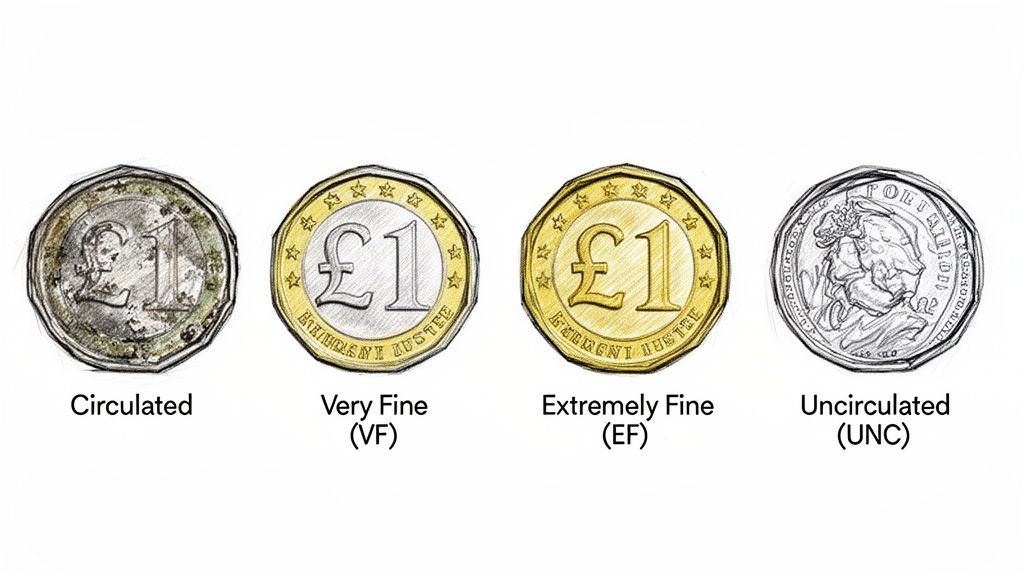
Spotting a rare date is a brilliant start, but it's only half the story. To figure out if you're really holding a 1 pound coin worth money, you have to look closely at its physical condition. In the world of coin collecting—or numismatics, as we call it—this is known as grading, and it's easily the biggest factor in what a coin is actually worth.
Think of it like a classic car. A vintage Mini in showroom condition, with its original paint gleaming, is worth a fortune. The same model with a few dings, scratches, and a tired engine? Not so much. It's exactly the same with coins; their state of preservation is everything.
Understanding The Basics Of Coin Grading
Coin grading can feel a bit technical at first, but the idea behind it is simple. It's all about judging how much wear and tear a coin has picked up since it left The Royal Mint. A coin fresh from the press has a bright, almost cartwheeling shine known as mint lustre, and every single detail of the design is perfectly sharp. As it gets passed from hand to hand, that lustre dulls and the details begin to soften.
These are the main grades you’ll come across:
- Uncirculated (UNC): This is a coin in perfect nick. It shows zero signs of wear, still has all of its original mint lustre, and looks just like it did the day it was struck.
- Extremely Fine (EF): A coin with this grade has only the slightest touch of wear on the very highest points of the design. You can still see most of the original lustre, and the details are crisp and clear.
- Very Fine (VF): This coin has definitely seen a bit of action. The high points of the design, like the Queen's hair or the delicate parts of the reverse image, will show clear wear, but the overall design is still strong.
- Fine (F) and Below: These coins have been around the block. There's significant wear across the whole surface, the main design is visible but lacks the finer points, and almost all of the original lustre has gone.
How To Examine Your Own Coins
You don't need to be a professional to get a rough idea of your coin's grade. A good place to start is by looking at the highest points of the design, as these are always the first to show wear. On the "heads" side (the obverse), that usually means the Queen’s hair, her cheek, and the very top of the crown.
On the "tails" side (the reverse), it all depends on the design. For the Royal Arms, check the fine details on the lion and unicorn. For a Thistle design, have a look at the delicate flower petals. Any smoothness or flattening in these areas is a dead giveaway that the coin has been in circulation. Once you’ve picked out some potential keepers, effective coin collection management is key to protecting their condition and value.
A coin's grade is its biography. An Uncirculated coin tells a story of careful preservation, while a circulated one shows a history of countless transactions. For collectors, the less "lived" a life the coin has had, the more it is worth.
For a really rare or valuable coin, getting it professionally graded can make a huge difference. If you're thinking about it, it’s a good idea to read up on how to get coins graded to see what’s involved. An official grade from a trusted service authenticates your coin and removes any guesswork about its condition, making it far easier to sell for its true market price. It’s the final step in turning a great find into a certified asset.
Where To Sell Your Valuable Pound Coins
So, you’ve hunted through your change and found it: a 1 pound coin worth money. That’s the thrilling part. The next, equally important step is figuring out how to turn that potential into actual cash in your bank account.
Choosing where to sell your coin isn't a one-size-fits-all decision. The best path depends on the coin itself, its value, and how much work you’re willing to put in. From the sprawling digital marketplaces to the quiet expertise of a specialist dealer, you have options.
Online Auction Sites
For most people, the first place that springs to mind is a giant like eBay. It makes sense – with millions of users, your coin gets in front of a massive audience of both casual collectors and serious numismatists. This can spark a bidding war, sometimes pushing the final price far higher than you expected.
But going it alone comes with its own set of responsibilities. To succeed on these platforms, you need to get a few things right:
- Top-Notch Photos: Your phone camera is probably good enough, but make sure your pictures are sharp, well-lit, and show everything. Capture both sides (obverse and reverse) and the milled edge. A buyer needs to feel confident about the coin's condition before they'll place a bid.
- A Detailed Description: Be honest and thorough. List the year, design, its condition (the grade), and point out any errors or interesting features. The more information you give, the more trust you build.
- Factor in the Fees: Don't forget that online platforms take a slice of the pie. Be aware of listing fees, final value fees, and payment processing charges, as they will all eat into your profit.
Specialised Coin Dealers and Numismatic Auctions
If you have a particularly high-value coin, your best bet is often to work with the experts. A specialised dealer or a numismatic auction house brings a level of knowledge and a network of dedicated buyers that you just can't find on a general marketplace.
A reputable dealer can make you a fair, direct offer for an immediate sale. This is a brilliant option if you want a straightforward, hassle-free transaction without the waiting game of an auction.
Expert Tip: If you suspect you have something truly special on your hands, getting an expert appraisal is non-negotiable. A professional can authenticate your coin and give you a realistic valuation, ensuring you don't accidentally sell a treasure for a fraction of its true worth.
Here at Cavalier Coins, we live and breathe this stuff. We offer a couple of tailored services for sellers. Our weekly auctions are a great platform for individual rare coins, putting them in front of an engaged audience of collectors who know exactly what they're looking for. For larger collections, we also offer a direct purchase service, giving you a simple way to sell multiple coins at once.
Getting the best price is all about having the right strategy. To learn more, take a look at our complete guide on how to sell coins in the UK. Choosing the right partner can make all the difference in realising the true market value of your pound coins.
Your £1 Coin Questions Answered
Diving into the world of coin collecting always sparks a few questions. Whether you're a seasoned collector or just starting to check your spare change, getting clear answers is the best way to move forward. Here, we'll tackle some of the most common queries about finding a 1 pound coin worth money, giving you the practical info you need for the hunt.
We’ll cover everything from the modern 12-sided coins to spotting those tricky fakes and making sure your collection stays in top-notch condition.
Are The New Bimetallic £1 Coins Worth Anything?
Most of the 12-sided £1 coins you'll find in your pocket, introduced back in 2017, are worth exactly their face value. But that doesn't mean you should stop looking. The real prize lies in finding error coins.
One of the most famous examples is the trial coin mistakenly dated 2016 that slipped into circulation with the 2017 issues. These are incredibly rare and a huge find for any collector.
Keep an eye out for other manufacturing mistakes, too. Look for misaligned dies, where the inner silver-coloured part isn't perfectly centred in the outer gold-coloured ring. You might even find a coin struck on the wrong kind of blank metal disc (a planchet). Anything that looks a bit off or unusual could be the manufacturing flaw that turns a modern coin into a collector’s item.
How Can I Tell If My £1 Coin Is A Fake?
The old round pound coins were a massive target for counterfeiters. At one point, it was estimated that as many as 1 in 30 coins in circulation were complete fakes! Thankfully, there are a few tell-tale signs you can look for to spot one.
A poor-quality strike is usually the biggest giveaway. If the details on the Queen’s portrait or the design on the back look soft, blurry, or "mushy," you should be suspicious. The writing on the edge might also be badly stamped, off-centre, or even have the wrong text for that specific year's design.
Quick Tip: One of the most common blunders on fakes is a date and design mismatch. Counterfeiters often paired the wrong "heads" (obverse) and "tails" (reverse) dies. This means the date on the front doesn't match the design that was officially released on the back for that year. Always have a genuine example to compare against if you're unsure.
The coin's colour can be another red flag. It might look too brassy, too shiny, or just dull and lifeless compared to a real one. Ultimately, trust your gut—if a coin just doesn't feel or look right, it probably isn't.
How Should I Store My Valuable Coins To Protect Them?
Looking after your coins properly is crucial for preserving their condition and, by extension, their value. Whatever you do, don't keep them in soft PVC plastic wallets. Over time, these release chemicals that create a green, sticky film on the coin, causing permanent damage to its surface.
For the best protection, you'll want to use storage solutions made specifically for archival.
- Acid-free coin holders: These are simple cardboard squares with a clear window. You just pop the coin in and staple it shut.
- Capsules: These hard plastic cases offer fantastic protection from knocks, scratches, and the environment.
- Collector's albums: A great way to keep your whole collection organised and safe in one place, with dedicated slots for each coin.
Always keep your collection somewhere cool and dry, away from big swings in humidity, to stop any tarnishing or corrosion. For your most valuable finds, think about getting them professionally graded and "slabbed." A third-party service will authenticate your coin and seal it in a tamper-proof case, which offers the best protection and officially verifies its condition for any future sale.
Ready to turn your coin discoveries into a valuable collection? At Cavalier Coins Ltd, we offer a wide range of rare and collectible coins and provide expert services to help you buy or sell. Visit us today to explore our weekly auctions or get a fair offer for your collection at https://www.cavaliercoins.com.