
That old £1 coin rattling around in your pocket could be worth a whole lot more than you think. While most are, of course, worth just a pound, a handful of them with certain dates, unusual designs, or quirky minting errors can sell for up to 20 or 30 times their face value—sometimes even more. The trick is simply knowing what you’re looking for.
Unlocking the Hidden Value of Your One Pound Coins
Ever found yourself sifting through a jar of loose change and wondering if there’s a hidden gem inside? Well, you might be surprised. The truth is, not all pound coins are created equal.
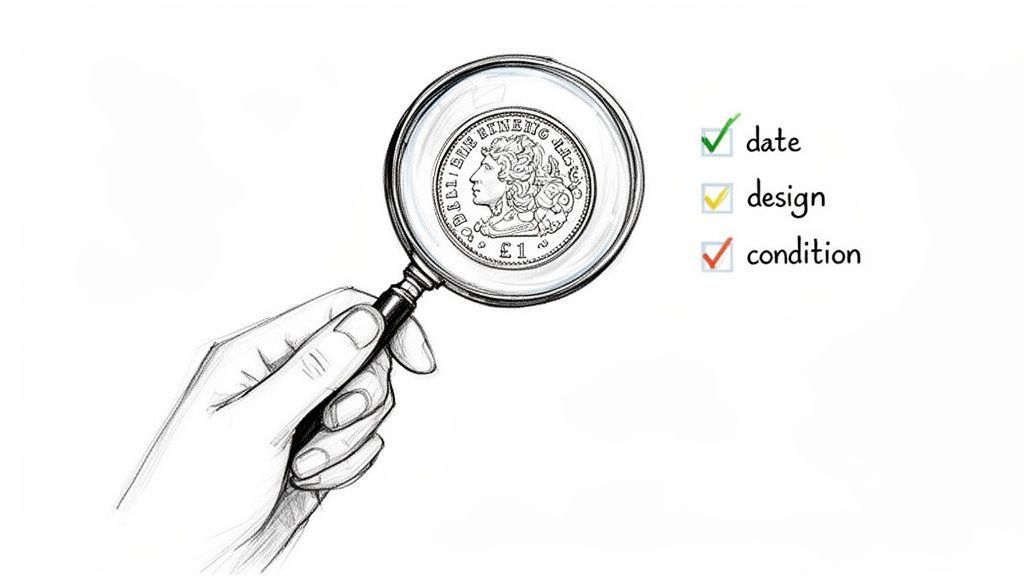
To find out if you're holding a treasure, you need to understand the three pillars that give a coin its value: rarity, condition, and demand. It’s a bit like collecting rare books; a first edition in pristine condition will always be more valuable to a collector than a common, dog-eared paperback. The exact same logic applies in the world of coin collecting, or numismatics.
A coin's backstory, its design, and crucially, how many of them were ever made, all feed into what it's ultimately worth. This guide will give you a clear roadmap, helping you spot the tiny details that separate everyday pocket change from a collector's prized possession.
Key Factors That Influence Value
Before you start checking your change, it helps to know what collectors are actually looking for. Each of these elements plays a huge role in determining the final 1 pound coins value.
- Mintage Figures: This is just a fancy term for how many coins of a particular design were made in a specific year. The rule is simple: the lower the mintage, the rarer the coin, and the higher its potential value. Coins like the 2011 Edinburgh City are legendary among collectors for this very reason.
- Condition (Grade): A coin in "uncirculated" condition—meaning it looks like it just left the mint, with no scratches or scuffs—is far more desirable than one that’s been jangling around in pockets for years. Any wear and tear can dramatically reduce its appeal to a serious collector.
- Minting Errors: Mistakes happen, even at The Royal Mint! These slip-ups can create exceptionally rare and valuable coins. Imperfections like a mismatched design, a misaligned strike, or even missing text are prized by collectors because they are truly one-of-a-kind.
Understanding these factors is the first step in your journey as a collector. It shifts your perspective from seeing a simple pound coin to recognising a miniature piece of history with a story to tell and a potential value far beyond what’s stamped on its face.
Before you start digging through that coin jar, let’s quickly summarise what to look for with a handy checklist.
Quick Checklist for Valuing Your £1 Coin
This table breaks down the key factors that determine if a one pound coin is worth more than its face value. Use it as a quick reference to assess the coins you find.
| Factor | What to Look For | Potential Impact on Value |
|---|---|---|
| Date & Mintage | Check the year. Is it a known low-mintage date like 2008 (Royal Arms) or 2011 (Edinburgh)? | High Impact: Low numbers mean high rarity and collector interest. |
| Design | Is it a commemorative or regional design? Look for the less common floral and city series. | High Impact: Designs with low circulation are always sought after. |
| Condition | Look for sharp details, original lustre, and a lack of scratches, scuffs, or rim damage. | Significant Impact: A pristine, uncirculated coin is worth far more. |
| Minting Errors | Check for off-centre strikes, incorrect edge inscriptions, or design mule errors. | Very High Impact: Errors create unique and highly valuable coins. |
| Edge Lettering | Is the inscription clear, correctly oriented ("upside down" is normal), or missing? | Moderate Impact: Errors or variations can add a premium. |
Remember, a coin doesn’t need to tick every box to be valuable. Sometimes, a single rare feature is enough to make it a fantastic find. Happy hunting!
If you want to dive deeper into the valuation process, you can find more expert strategies that actually work on our blog. This knowledge will equip you to spot potential treasures hiding in plain sight, transforming your spare change into an exciting hunt for numismatic rarities.
The Story of the Modern Pound Coin
To really get why some pound coins are worth more than a quid, you have to rewind the clock a bit. Before 1983, the pound wasn't a coin at all—it was a rather flimsy banknote that would be tatters in no time. The average lifespan was just nine months, which meant a constant, costly cycle of printing and replacing. It just wasn't working.
The answer was a complete change of tack: from paper to metal. The UK £1 coin was born out of this necessity. The switch was announced in 1981, and the new coin officially launched on 21 April 1983, which happened to be Queen Elizabeth II's 57th birthday. To make sure the transition went off without a hitch, they minted an astronomical number of them—a staggering 443,053,510 in that first year alone. That's still the record for any single £1 coin design. You can find more detail on the coin's backstory on its detailed history page.
This new coin was a different beast entirely. It was thicker, heavier, and built to last for decades, not months. This durability also gave The Royal Mint a fantastic opportunity to start a tradition: creating a rotating series of designs on the reverse, celebrating the different countries of the United Kingdom.
The Era of the Round Pound
From its debut in 1983 until it was retired in 2017, the 'round pound' was a staple in every pocket and purse. Over those three decades, The Royal Mint released a whole host of designs, each telling its own story and, crucially for collectors, each with its own mintage figures.
The reverse designs changed almost every year, cycling through various themes that captured a slice of British heritage:
- Royal Emblems: Designs like the Royal Arms, a classic symbol of the UK.
- National Flora: Beautiful depictions of the English Oak, Scottish Thistle, Welsh Leek, and Northern Irish Flax Plant.
- Bridges of the UK: A series celebrating engineering marvels like the Forth Bridge and Menai Bridge.
- Capital Cities: One of the most popular and sought-after series, with unique designs for London, Cardiff, Edinburgh, and Belfast.
It’s in the fine print of these different series that the real story of 1 pound coins value starts to unfold. Because each design had a different production run, The Mint inadvertently created a landscape of scarcity. A coin from a low-mintage year, like the 2011 Edinburgh design, is naturally much harder to find than the common-as-muck 1983 Royal Arms.
A New Chapter: The 12-Sided Coin
By the 2010s, the trusty round pound had a serious Achilles' heel: fakes. It was estimated that as many as 1 in 30 round pounds doing the rounds were counterfeit, and that was a huge blow to public trust in our money. Something had to be done, and it had to be radical.
The answer arrived in March 2017: the 12-sided, bi-metallic pound coin. Hailed as the 'most secure coin in the world', it's packed with anti-counterfeiting tech, like a hidden image and micro-lettering, making it a nightmare for forgers to copy.
This wasn't just a new coin; it was the end of an era. The round pound was officially demonetised and pulled from circulation on 15 October 2017. While you can't spend them anymore, they've become a fascinating field for collectors, a tangible piece of over 30 years of British history. Understanding these two distinct chapters—the classic round pound and the secure 12-sided coin—is the first step in learning to spot which coins are just change, and which are genuine treasures.
Spotting the Valuable Round Pounds (Before 2017)
The original ‘round pound’ was in our pockets from 1983 to 2016, and for many collectors, this is where the real treasure hunt begins. This era gave us a fantastic range of designs, but more importantly, it created a natural landscape of scarcity. Pinpointing the most valuable round pounds is usually a simple case of checking the mintage figures – the fewer coins that were made, the more collectors want them.
Think of it like a limited-edition art print. The Royal Mint might churn out millions of one design but only a few hundred thousand of another. It’s only natural that the rarer print becomes more sought-after. When it comes to the value of 1 pound coins, this principle is everything. The coins with the lowest production numbers are the undisputed stars of the show for anyone collecting the pre-2017 series.
The Holy Grail of Round Pounds
When collectors talk about rare round pounds, one coin always seems to pop up first: the 2011 Edinburgh from the 'Capital Cities' series. Only 935,000 were ever minted, making it the scarcest round £1 coin ever put into general circulation. Finding one of these in your change today is a genuinely rare moment, which is exactly why its value has shot up among numismatists.
Its scarcity makes it the undisputed king, but it doesn't stand alone. The Edinburgh coin was part of a brilliant four-coin set celebrating the UK's capital cities, and its siblings are also highly desirable.
- 2011 Cardiff City: The second rarest, with a mintage of just 1,615,000. It’s more common than the Edinburgh coin, but it’s still a key piece for any serious collector.
- 2010 London City: Part of the same series, this one had 2,635,000 made, making it another one to keep a sharp eye out for.
- 2010 Belfast City: The most common of the set, with over 6.2 million minted. Even so, it's a crucial part of finishing the much-prized Capital Cities collection.
Getting your hands on all four coins from this set is a major goal for many enthusiasts. While an individual coin like the Edinburgh pound is valuable on its own, a complete, top-quality set of all four cities can fetch a serious premium. In the collecting world, the whole is often worth more than the sum of its parts.
Beyond the Capital Cities Themed Coins
While the Capital Cities series tends to steal the limelight, several other round pound designs are well worth hunting for. They might not be as rare as the Edinburgh issue, but their relatively low mintage figures still give them a value well beyond their original one pound.
The 2008 Royal Arms is a perfect example. The design itself is very common, but the 2008 version had an unusually low mintage of only 3,910,000. This makes it the fifth-rarest round pound overall and a sleeper hit that many people might miss, assuming it’s just another standard coat of arms coin.
Collector's Tip: Always check the date on Royal Arms £1 coins. The design was used in many different years, but only a handful, like 2008, had low enough production numbers to make them genuinely interesting to a collector.
Other series have their hidden gems, too. The Floral Emblems series, for example, includes the 2014 Thistle and Bluebell coin with a mintage of 5,165,000 and the 2013 Rose and Oak Branch coin at 5,260,000. These beautiful designs are not only lovely to look at but are also becoming tougher to find in good nick.
The table below breaks down the top five rarest round pounds by their official mintage figures, giving you a clear checklist for your next coin hunt.
Top 5 Most Valuable Round £1 Coins by Mintage
This table ranks the rarest round pound coins based purely on how many were made by The Royal Mint. A lower mintage figure almost always means a higher value among collectors.
| Year & Design | Mintage Figure | Estimated Value Range |
|---|---|---|
| 2011 Edinburgh City | 935,000 | £10 - £15 |
| 2011 Cardiff City | 1,615,000 | £8 - £12 |
| 2010 London City | 2,635,000 | £6 - £10 |
| 2010 Belfast City | 6,205,000 | £4 - £7 |
| 2008 Royal Arms | 3,910,000 | £5 - £8 |
Bear in mind, these values are just estimates for coins you might find in your change. An 'Uncirculated' version, one that looks brand new with no signs of wear, could be worth a great deal more. The value of 1 pound coins is always shifting based on market demand and, of course, the condition of the coin itself.
Spotting Rare 12-Sided Pound Coins and Errors
When The Royal Mint rolled out the 12-sided pound coin in 2017, it was more than just a facelift for our change—it kickstarted a whole new chapter for collectors. While the old round pounds gave us a rich history of planned scarcity, the modern bi-metallic coins offer a different kind of treasure hunt. Most are common, but certain issues and—even more excitingly—minting errors can fetch a pretty penny and add real intrigue to the 1 pound coins value.
The initial excitement around the new coin was all about its launch year. Coins dated 2016, which were trial pieces never meant for public hands but sometimes slipped into special collector sets, are highly prized. Likewise, some early 2017 issues with specific die pairings can pique interest. But for the average person checking their change, the real thrill is in spotting the unexpected mistakes that happened during the minting process.
Finding an error coin is a bit like discovering a misprinted stamp or a book with a printing flaw. It's the very imperfection that makes it rare and valuable. These aren't just damaged coins; they are genuine production hiccups that slipped past quality control, creating one-of-a-kind collectibles that, by all rights, shouldn't even exist.
Demystifying Minting Errors
"Minting errors" might sound a bit technical, but the ideas behind them are actually pretty simple. They offer a fascinating peek behind the curtain of coin production, showing where something went just a little bit wrong. Spotting one can turn an ordinary pound into something genuinely special.
- Mule Coins: This is probably the most famous type of error. A 'mule' is a hybrid coin struck with a pair of dies that were never meant to be used together, like using an old 'heads' side with a new 'tails' side. While no confirmed £1 mule has ever entered circulation, the very possibility keeps collectors checking every coin.
- Off-Centre Strikes: Picture the coin's design not being perfectly centred on the metal blank. This can range from a tiny shift to a major misalignment where parts of the design are missing entirely, often leaving a blank, crescent-shaped area.
- Die Cracks and Cuds: The dies used to stamp coins can wear out and develop cracks. These show up as raised, squiggly lines on the finished coin. A 'cud' is what happens when it gets worse—a piece of the die breaks off, leaving a raised, unstruck blob of metal on the coin.
Finding a significant error on a modern 12-sided £1 coin is exceptionally rare, thanks to The Royal Mint's state-of-the-art quality control. This scarcity is exactly what drives their value—the more obvious and unusual the mistake, the more a specialist collector is likely to pay for it.
The chart below shows just how scarce some of the most sought-after round pounds are, making it clear how low mintage figures create value.
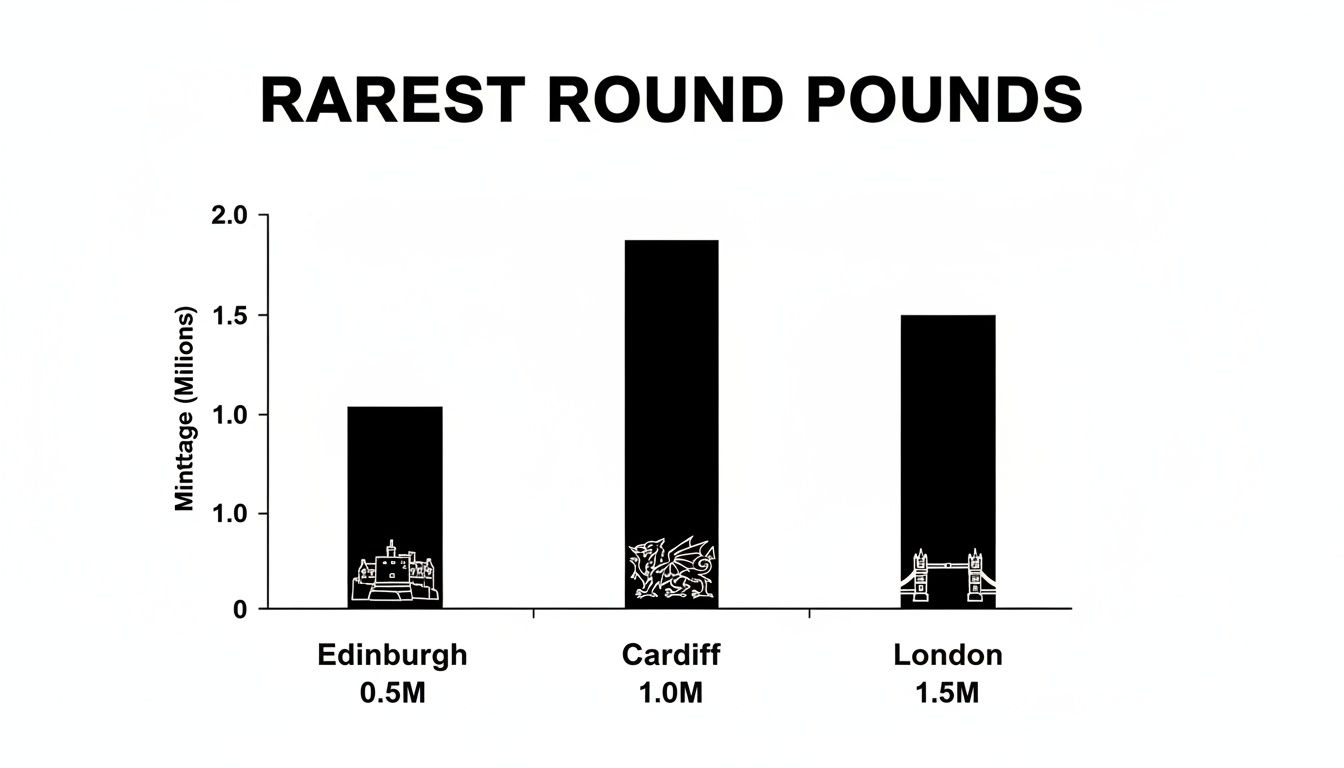
You can see at a glance just how few Edinburgh coins were struck compared to the London and Cardiff ones, which explains why it’s a top-tier coin for collectors.
What to Look for on Your 12-Sided Coins
While finding a dramatic error is the ultimate prize, there are a few specific things to check for on the new pound coins. It pays to keep an eye out for any kind of oddity, no matter how small it seems. Sometimes, what looks like minor damage is actually a recognised minting error.
One of the most talked-about variations involves the two-part metal construction. Look for coins where the inner silver-coloured core is poorly aligned with the outer gold-coloured ring. When it’s really pronounced, this is sometimes called a 'fried egg' error and can seriously boost a coin's appeal.
Also, take a close look at the tiny micro-lettering around the rim of the inner core. One side should say 'ONE POUND', and the other should show the minting year. Any errors where this lettering is faint, missing, or even doubled up can also add value.
If you're keen to learn more, you can discover valuable error coins and their hidden treasures in our dedicated guide. The hunt for these fascinating imperfections adds a whole new dimension to coin collecting.
How Coin Condition Impacts Its Final Value
Ever wondered why two seemingly identical rare coins—let's say a pair of 2011 Edinburgh pounds—can have wildly different price tags? The answer isn’t hiding in the date or the design. It's all about the life each coin has lived. In the world of collecting, a coin's condition, or ‘grade’, is one of the biggest drivers of its final value.
Think of it like a vintage comic book. A perfect, unread copy that’s been sealed away since day one is worth a fortune compared to a dog-eared, well-read one. The story is the same, but the physical state tells its own tale, and that’s what collectors are willing to pay for.
It's exactly the same principle in numismatics. A coin that looks like it just rolled off the minting press, with all its original shine and crisp details, is far more desirable than one that’s been jangling around in pockets and tills for years.
Understanding Coin Grading
Coin grading is simply the process of determining a coin's physical condition. While official grading is a highly specialised skill, just knowing the basics will help you size up your own collection. Experts are really looking for a few key things when they assign a grade.
- Mint Lustre: This is the original, frosty sheen a coin has when it's brand new. It's not about being shiny; in fact, cleaning a coin destroys this lustre and can completely wreck its value.
- Surface Marks: These are the little battle scars—scratches, dings from clinking against other coins (called 'bag marks'), and any other scuffs on the surface.
- Wear on High Points: The first parts of a coin's design to show wear are the highest points, like the Queen’s cheek or the tiny details on the reverse emblem.
The difference in value between an 'Uncirculated' coin and one graded as 'Very Fine' can be staggering. For a common coin, it might be a few pence, but for a genuinely rare one, that difference could easily be hundreds of pounds.
This hierarchy of condition is what separates a good find from a truly great one. Let's break down the most common grading terms you'll come across.
From Poor to Perfect
While the professional grading scale has many fine-tuned levels, you can sort most coins into a few main categories. Getting a feel for these will give you a much clearer idea of what a coin might be worth.
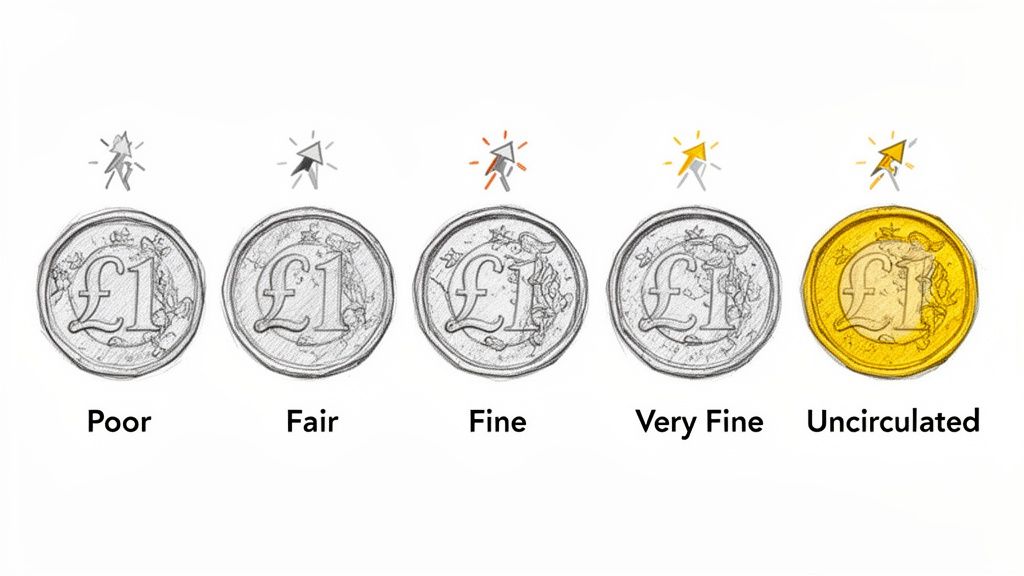
- Uncirculated (UNC): A perfect coin. It has absolutely no signs of wear, still has its full original mint lustre, and looks just as it did the day it was struck.
- Extremely Fine (EF): This coin has only the slightest traces of wear on the very highest points of the design. You can still see much of the original mint lustre with the naked eye.
- Very Fine (VF): The design details are still sharp, but there's noticeable light wear on the high points. It’s clearly been in circulation but has been looked after.
- Fine (F): This coin shows moderate wear all over. Many of the finer details in the design are starting to look a bit flat.
- Poor/Fair: The coin is heavily worn down. The date and main designs are barely readable. These coins, no matter how rare the design, usually hold little value beyond their face value.
A final tip: how you handle your coins is crucial. Always hold them by the edges and keep them in protective holders. It's the best way to preserve their condition and safeguard any potential value for the future.
Expert Tips for Selling Your Coin Collection
So, you've found a valuable coin. That's the exciting part. Now comes the real challenge: turning that find into actual cash. Navigating the coin market isn't just about listing an item online; it requires a bit of strategy to make sure you get a fair price. Your best approach will really depend on the coin's rarity, how quickly you need to sell, and frankly, how much effort you're willing to put in.
Choosing where to sell is your first, and most important, decision. Each option has its pros and cons, and what works for one coin might be a disaster for another. Understanding these differences is the key to getting the most out of your sale.
Where to Sell Your Valuable Coins
Figuring out where to list your coins can make a huge difference to the final price you get and how quickly it sells. There’s no single ‘best’ place; the right choice is all about matching the platform to your specific coin.
- Online Marketplaces (like eBay): These sites give you access to a massive audience, potentially millions of buyers all over the world. The downside? They’re incredibly crowded and competitive. You'll need fantastic photos and a great description to get noticed, and don't forget to factor in the high fees that can take a chunk out of your final profit.
- Specialist Coin Dealers: Going to a dealer is the route for a quick, straightforward sale. They know their stuff and can value your collection on the spot. You might get a slightly lower price than you would at auction (they have to make a profit, after all), but it’s a fast, no-fuss option, especially if you’re selling a whole bunch of coins at once.
- Auction Houses: If you have an exceptionally rare or high-value coin, a proper auction house is often your best bet. They have a network of serious, pre-vetted collectors who are prepared to pay top prices for the right pieces. The only trade-off is that the process is slower and the commission fees are higher.
The key takeaway is to match the selling venue to your coin's value. A coin worth £10-£15 might do well on eBay, but a truly rare piece worth hundreds would be better served by the expertise and audience of a specialist auction.
Presenting Your Coins for Sale
How you present your coin is just as important as where you sell it. In the online world, your photos and description are your sales pitch. A high-quality listing builds trust and helps potential buyers see the real value in what you're offering.
First up, photography. Always use natural, diffused light to avoid harsh glare. Take high-resolution, sharply focused shots of both the obverse (heads) and the reverse (tails). It's also crucial to get clear photos of the coin's edge and any unique features or flaws. Being transparent like this helps buyers assess the condition for themselves and feel confident in bidding.
Next, write a detailed and honest description. Make sure you include the year, the design, and any history you know about the coin. Most importantly, be totally upfront about its condition, using standard grading terms if you're familiar with them. A well-written, factual listing attracts serious buyers and dramatically reduces the chance of any problems after the sale. For more in-depth tips, our article on selling coin collections offers some great additional advice.
Protecting Your Investment with Insurance
Finally, as your collection starts to grow in value, please don't overlook insurance. Your standard home insurance policy probably won't provide enough cover for valuable collectibles like coins. Most policies have a pretty low limit for a single item, which means a rare coin could be seriously underinsured.
Take a moment to check your policy documents. If the total value of your collection is more than a few thousand pounds, it’s a very good idea to speak to your insurer. You might need to add a specific rider to your policy or even look into a specialist collectibles insurance policy. This simple step ensures your valuable assets are fully protected against loss, theft, or damage, giving you complete peace of mind.
Your Top Questions Answered
When you're sifting through your change, a few questions always seem to pop up. Let’s tackle some of the most common ones we hear from fellow collectors and curious minds, giving you the clear answers you need to understand the real value of your £1 coins.
Are Old Round Pounds Still Worth Anything?
Yes, but probably not how you imagine. The old round pound coin was taken out of circulation back in October 2017, so you can’t pop down to the shops and spend it. However, most high street banks and Post Offices will still let you deposit them straight into your account.
For a collector, though, that’s a different story. Their worth has nothing to do with face value. A rare design or a coin in truly exceptional condition is still a prize, actively bought and sold on the collectors' market.
Is It a Good Idea to Clean My Coins?
In a word: no. It might be tempting to give a grubby-looking coin a bit of a polish to make it shine, but cleaning is one of the fastest ways to completely ruin its value. Serious collectors treasure the coin's original surface, or patina, which is the delicate layer that develops over decades.
Polishing a coin, even with a soft cloth, strips away its original mint lustre and leaves behind a network of tiny scratches. This damage is permanent and can turn a genuinely rare coin into something worth little more than its face value.
How Can I Tell If a High eBay Price Is Real?
The wild west of eBay can be very deceptive. You'll often see sellers listing perfectly ordinary coins for thousands of pounds, hoping to catch someone out. The trick is to always use the "Sold Items" filter in the search options.
This simple click shows you what people have actually paid for a coin, not the fantasy prices someone is asking for. You'll quickly see that a coin listed for £1,000 might only be consistently selling for a couple of quid.
What Should I Do If I Find a Rare Coin?
First things first, handle it with care. Always hold it by its edges to avoid getting fingerprints on the faces. The oils from your skin can cause damage over time. Then, get it into a protective holder – a simple plastic sleeve or a coin capsule will do the trick, keeping it safe from knocks and scratches.
Once it's secure, you can start digging into its value. A quick look at sold prices online or a chat with a reputable coin dealer will give you a solid idea of what you've discovered. From there, you can decide whether to keep it, sell it, or perhaps even get it professionally graded.
At Cavalier Coins Ltd, we're passionate about helping collectors at every stage of their journey. Whether you're trying to identify a potential treasure, looking to add rare pieces to your collection, or seeking a trusted buyer, our expertise is always at your service. Come and explore our curated selection of coins and banknotes from across the globe at https://www.cavaliercoins.com.