
A worn 1948 half crown is generally a modest collector's coin, while lustrous, nearly unmarked examples can command a meaningful premium. Its historical face value isn't a reliable guide to what a collector will pay today.
The expensive mistake is to value the date before inspecting the surfaces. A bright coin might have been polished, and a darker example might retain far better original detail. Before buying, selling or paying for grading, establish what actually survives.
What Decides the Value of a 1948 Half Crown
Most ordinary circulated examples aren't rare-date treasures. For someone sorting a change jar, an old tin or an inherited collection, the useful question isn't whether the coin is old. It's whether a collector would struggle to replace it in the same condition.
The price rests on grade, originality and demand. Grade describes preservation, originality concerns what's happened to the surfaces, and demand determines whether someone wants that particular standard of coin at the asking price. A sharp-looking example with cleaning scratches doesn't deserve the same treatment as an undisturbed coin with comparable detail.
The price you need to establish
There isn't a single interchangeable value. Distinguish between:
- Dealer retail price, what a business asks after selecting, describing and stocking a coin.
- Dealer buying price, an offer that leaves room for resale costs and a trade margin.
- Private sale proceeds, what you retain after fees, postage and other selling expenses.
A dealer's offer below a retail listing isn't automatically unfair. Equally, an ambitious online asking price doesn't establish that buyers will pay it.
Practical rule: Value the coin you own, not the finest-looking example you can find advertised.
I would start with a conservative grade and recent completed sales, then make allowances for damage. Use the Royal Mint's specifications as the identification baseline, rather than relying on colour or an old handwritten envelope.
A short inspection can tell you whether you have an ordinary collection filler or something worth closer attention. It won't replace a firm offer from someone who's examined the coin.
Value of a 1948 Half Crown by Grade
Prices for a 1948 half crown depend heavily on grade, originality and recent demand, so the bands below show which condition to look for and which completed sales to compare, rather than fixed buying or selling quotes. The date stays constant across every coin; the surface does not. Two half crowns struck in the same year can sit far apart in price because one is worn flat and the other still carries mint lustre.
| Grade | What survives | How to value it |
|---|---|---|
| Fair (FR) | Portrait outline clear, detail flat, lettering worn | Price against worn examples sold individually or in low-grade lots |
| Fine (F) | Some hair detail visible, shield design recognisable but worn | Use completed sales of similarly worn coins |
| Very Fine (VF) | Clear detail with wear on raised areas | Match against coins with equally strong portrait and shield detail |
| Extremely Fine (EF) | Slight wear on the highest points, strong lettering | Check that apparent sharpness is not paired with cleaning before accepting a price |
| Uncirculated (UNC) | No wear, possible contact marks, original lustre | Match lustre and surface marks closely, since contact marks lower the outcome |
| Choice Uncirculated | Full lustre and exceptionally clean portrait, shield and fields | Require comparable completed sales; the label alone supports nothing |
What the grades mean in practice
Fair and Fine coins serve collectors who want a recognisable example without paying for preservation. Don't read Fine as a compliment meaning excellent. It's a condition description, and a Fine coin can show substantial wear.
Very Fine should offer substantially clearer design detail. Extremely Fine should show only slight circulation wear, though the quality of the strike can complicate the comparison. A weakly struck detail isn't necessarily a worn detail.
Uncirculated means no wear, not no marks. Coins pick up contact marks during handling without ever entering circulation. Choice Uncirculated describes a more attractive unworn example, but a seller's choice designation needs support from photographs and surface quality.
Here, condition rarity does the work. The 1948 half crown turns up regularly in lower grades, so worn examples compete on price with plenty of substitutes. Clean, unworn surfaces are the scarcer commodity, and that scarcity is what a premium reflects.
Historical money isn't collector value
The Royal Mint's half crown history records the denomination's 2 shillings and 6 pence face value, equivalent to 30 pre-decimal pence, with eight half crowns making a pound, and its demonetisation in 1970.
Those are monetary facts, not modern valuations. A historical conversion tells you nothing about what a dealer should offer, what a collector should pay or what you'll receive after selling costs.
The long circulating life also matters when assessing preservation. This was everyday money, not a commemorative made principally to sit untouched in a presentation case, which is why truly unworn survivors command attention.
To place your coin sensibly:
- Assign a provisional grade from observable wear, not shine.
- Find comparable completed sales, excluding different grades, mixed lots and coins with unclear photographs.
- Allow for defects, especially cleaning, rim damage and scratches absent from the comparison coin.
Record whether each result includes postage or auction charges. Otherwise, you may compare a buyer's total cost with another seller's net proceeds and mistake the difference for a change in value.
How to Confirm a Genuine 1948 Half Crown
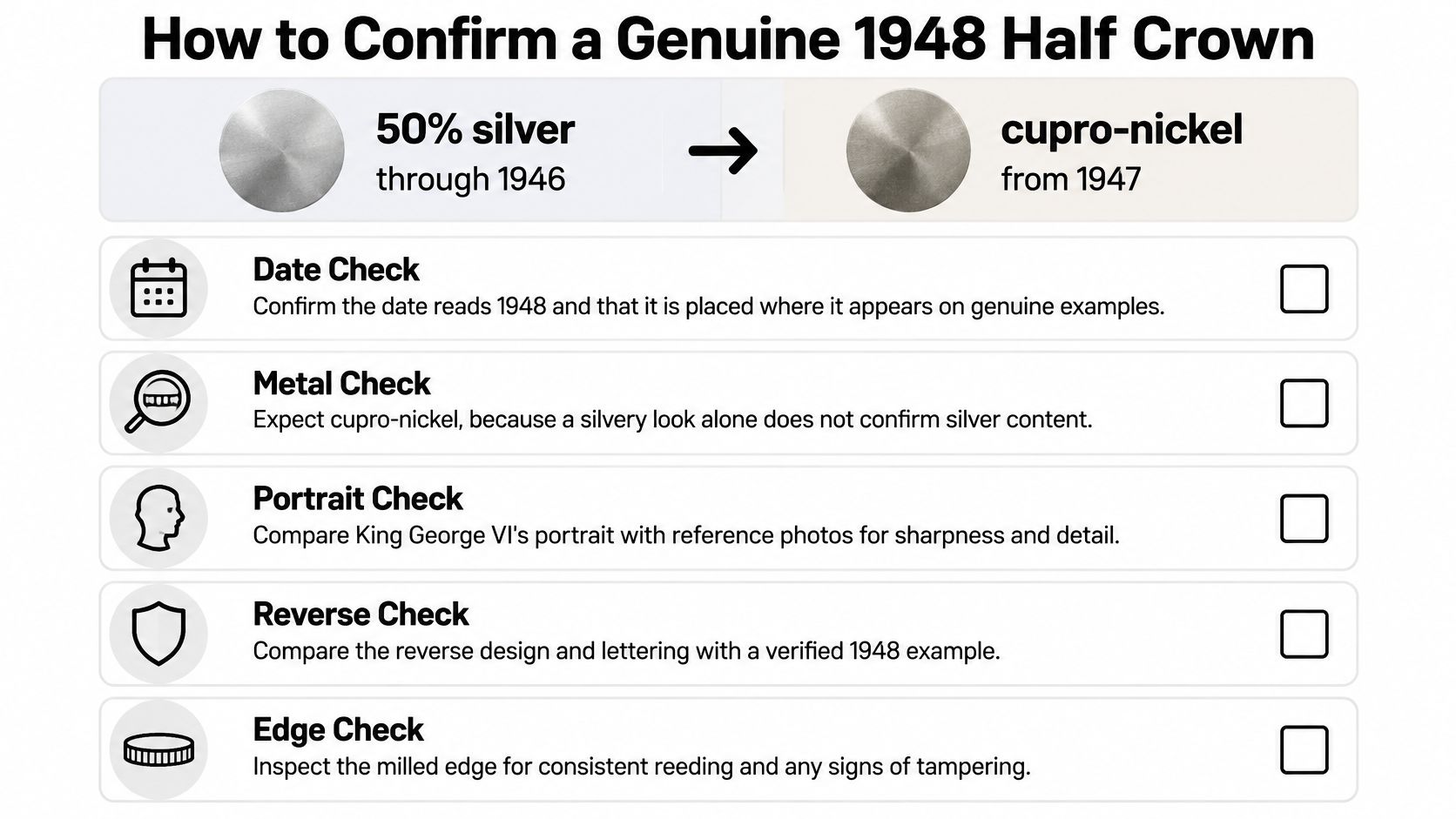
A 1948 half crown should be judged as a cupro-nickel George VI coin first, not as silver and not as a rare date. The Royal Mint's coinage collection specification records 50% silver through 1946, replacement by cupro-nickel from 1947, and the genuine issue's 14.140 g weight and 32.31 mm diameter. Those figures are the baseline; surface quality still decides whether a correct coin earns more than a small premium.
The same specification names Thomas Humphrey Paget for the portrait and George Kruger-Gray for the royal-shield reverse. A silvery colour proves nothing after 1946, so I would refuse any story that prices the date as bullion.
Royal Mint specification checklist for the 1948 half crown
| Attribute | Royal Mint specification | Practical check |
|---|---|---|
| Metal | Cupro-nickel, no silver | Compare appearance with a known example, but don't treat colour as an alloy test |
| Weight | 14.140 g | Use a digital scale; investigate a noticeable discrepancy |
| Diameter | 32.31 mm | Measure across the widest point with digital calipers |
| Obverse design | Portrait by Thomas Humphrey Paget | Compare the profile and lettering with a reliable reference photograph |
| Reverse design | Royal shield by George Kruger-Gray | Compare shield structure, lettering and date placement |
| Date and monarch | The stated date with King George VI | Check the date on the reverse and the monarch's portrait and legend on the obverse |
Treat the checklist as a sequence: alloy, measurements, then design. A coin that fails early on metal or size does not need a debate about grade.
How to take useful measurements
Place the scale on a level, stable surface and check its calibration before weighing. A display reading to hundredths of a gram is useful, but don't confuse the number of displayed digits with guaranteed accuracy.
Close caliper jaws gently across the coin without scraping the rims. Rotate the coin and repeat the measurement if the first reading looks doubtful. Dirt, damage, poor positioning and instrument error can all complicate a home check.
Weight alone can't authenticate a coin. Wear can reduce mass, while a counterfeit can approximate the correct dimensions. Compare measurements with the portrait, reverse, lettering and edge rather than declaring a pass from a single reading.
Inspect the milled edge for seams, filing or disturbed areas. The guide to detecting counterfeit coins provides additional checks, but an unresolved mismatch calls for examination before you pay a premium.
How to Grade Your 1948 Half Crown at Home
Handle the coin by its edge over a soft, clean surface. Don't wipe away fingerprints, polish dark patches or rub the fields to make the coin easier to photograph. Those interventions can remove the evidence you need to judge originality.
Use a modest magnifier and a movable lamp. Strong magnification helps reveal hairlines, but it can also make trivial marks look disproportionately serious. Begin with the overall appearance, then investigate the details.
A repeatable inspection routine
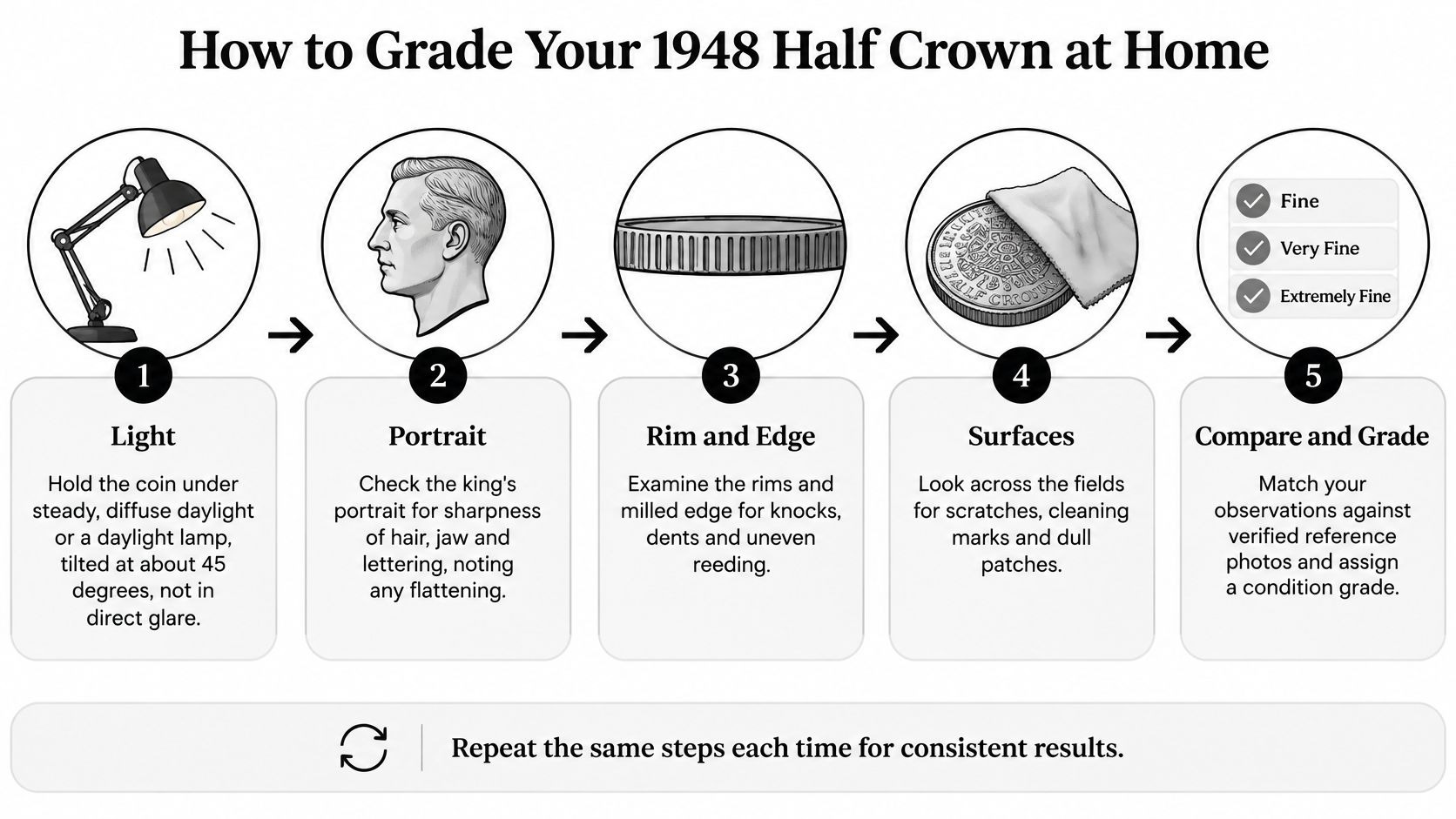
- Set the light. Use diffuse daylight or a daylight lamp, then tilt the coin gradually. Direct glare can hide wear and make polished surfaces appear more impressive than they are.
- Examine the portrait's raised areas, particularly the hair, cheek and neck. Look for flattening accompanied by a change in surface texture, rather than assuming every soft detail proves circulation.
- Turn to the shield. Compare fine internal lines, borders and raised points with a clear reference image. Judge both faces, because an attractive reverse doesn't cancel obvious wear on the portrait.
- Read the lettering, then inspect the rim and edge. Note dents, flattened sections and scratches separately from the wear grade, so a technically sharp coin doesn't receive a clean-coin valuation despite damage.
- Search for cleaning evidence. Rotate the fields beneath the lamp and look for groups of parallel hairlines, smeared-looking brightness or lifeless patches. A reflective surface isn't necessarily original mint lustre.
- Consider the colour without making it a verdict. Grey, gold or rainbow toning can develop naturally, but colour alone can't prove originality; blotching deserves investigation rather than automatic rejection.
- Weigh the coin last. Use the result as a supporting identification check, not a grading scale. A balance can't tell you whether the high points have lost their original surface.
The visual sequence below provides a compact reminder.
Separate wear from contact marks
A contact mark is a local disturbance caused by impact. Wear is loss of surface through friction, often apparent across exposed areas. Contact marks alone don't turn an Uncirculated coin into Extremely Fine, although they can make an unworn coin much less desirable.
An honest lower grade is more useful than an optimistic label that buyers won't accept.
Write a short condition description alongside the grade. For example, note strong shield detail, slight portrait friction and a rim knock rather than hiding everything inside a single abbreviation.
The explanation of how coins are graded helps distinguish technical preservation from overall appeal. For professional certification, compare the likely benefit with grading, delivery and insurance costs before submitting an ordinary example.
Why a 1948 Date Does Not Make a Coin Rare
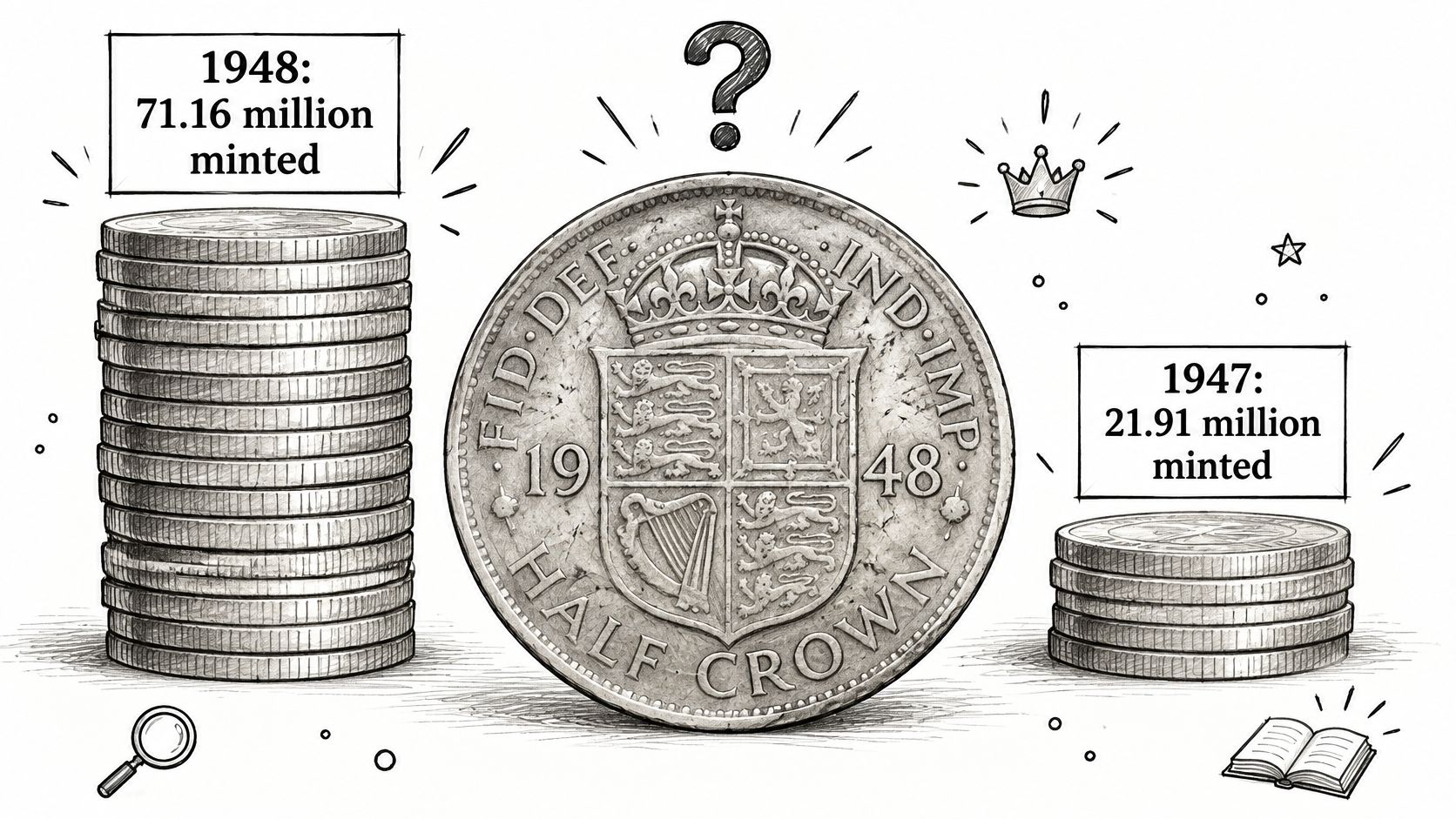
Old doesn't automatically mean scarce. The Collectorists half crown catalogue records production at roughly 71.16 million for 1948, compared with about 21.91 million for 1947.
That comparison undermines a rare-date sales pitch for a normal circulated example. It doesn't tell us exactly how many survive today, and it certainly doesn't tell us how many retain exceptional surfaces.
Mintage and survival answer different questions
Date rarity concerns how difficult an issue is to obtain, informed by its original production and subsequent survival. Condition rarity concerns how difficult it is to obtain in a particular state of preservation.
Think of a large apple harvest. Plenty of fruit can exist while relatively little remains unbruised after transport and handling. The analogy works for coins because repeated use changes the available quality, although no mintage figure by itself measures today's unworn survivors.
Collectors assembling a circulated date run have different requirements from collectors seeking exceptional original pieces. The former may accept obvious wear. The latter may reject a technically sharp coin because of distracting marks or an altered surface.
Why apparently similar coins sell differently
Say a seller offers a bright example with a clear portrait, while another offers a subdued coin with attractive grey colour. Brightness alone makes the first look better in a small photograph, but close inspection reveals polishing hairlines. The darker example may be the more desirable purchase.
Edge damage creates another distinction. A deep knock remains a defect even where the central design is sharp, and buyers don't have to overlook it just because the seller assigns a high grade.
Toning requires more judgement. Attractive, undisturbed colour can suit a collector's preferences, while stains or residues can make the same nominal grade less appealing. Don't assume that every coloured surface deserves a premium, or that every dark surface needs cleaning.
Buying test: Ask what makes this particular example difficult to replace, not what makes its date sound interesting.
A seller who can show preserved lustre and clean surfaces has a stronger case than one relying on age. Beginners should judge scarcity at the standard they're buying, while resisting unsupported claims about exceptional surviving populations.
Buying, Selling and Spotting Fakes Safely
Choose the selling route by likely net proceeds and effort, not by the highest advertised price. A quick dealer sale can be sensible for an ordinary coin, while an attractive specialist example may justify the work of reaching individual collectors.
A dealer buys stock, not merely the object in isolation. Describing, storing and reselling it takes time, and slow-moving material ties up money. Ask for the offer and its basis rather than expecting the dealer to match a retail ticket.
Selling routes for a 1948 half crown compared
| Route | What it pays | Costs and reach |
|---|---|---|
| Local coin dealer | Immediate agreed offer allowing a trade margin | Limited selling work; the offer reflects stock needs and resale prospects |
| Auction | The winning bid under the auction's terms | Seller charges and possible other costs; audience suitability matters |
| Online marketplace | The price an individual buyer accepts | Listing work, fees, packing, delivery and potential returns |
| Bulk lot of circulation coins | A negotiated lot price rather than full individual retail prices | Less work per coin, but attractive pieces can be overlooked |
Don't assume a bulk lot should sell near historical face value. That isn't a meaningful modern pricing floor. Equally, adding together optimistic individual asking prices won't establish a realistic lot valuation.
Prepare evidence buyers can use
Photograph both faces square-on under neutral light. Add an edge photograph where there's damage or an authenticity concern, and include close-ups of anything you've described as exceptional.
Keep the images consistent. Don't increase contrast until lustre looks artificial or crop away a damaged rim. State cleaning concerns plainly rather than using vague descriptions such as shiny condition.
For purchases, request clearer images when the existing ones don't support the grade. Certification can help with a premium coin, but the holder doesn't remove the need to inspect the actual example. The collectable coin buying guide offers further checks before committing.
Warning signs worth investigating include:
- Measurement discrepancies, particularly when both mass and diameter look wrong.
- Unconvincing design detail, such as distorted lettering or soft shapes inconsistent with normal wear.
- Edge abnormalities, including seams, filing and unexplained changes in finish.
- Seller pressure, especially refusal to provide photographs or time for inspection.
These aren't automatic proof of forgery. A damaged genuine coin can look odd, and a poor photograph can conceal perfectly normal detail. Treat uncertainty as a reason to pause, not as a reason to accuse someone.
If an apparently exceptional coin is offered at an implausibly attractive price, check it carefully before sending payment. A bargain is only useful if the coin is what you intended to buy.
Decide Whether to Keep, Sell or Get It Valued
Fair to Fine examples usually suit a modest date collection, a family keepsake or a sensibly assembled bulk lot. Paying for certification is hard to justify unless there's a specific feature that deserves specialist examination.
For Very Fine to Extremely Fine, compare completed sales with equivalent detail and defects, then obtain competing offers if selling. Don't spend more time chasing a marginal improvement in price than the likely difference warrants.
For Uncirculated or choice-looking examples, seek an informed opinion before choosing certification. The important question is whether professional authentication and grading are likely to improve confidence or sale proceeds enough to cover the costs.
Before contacting a dealer, prepare:
- Identification details, including the date and your provisional grade.
- Measurements, taken carefully with the tools available.
- Clear photographs, showing both faces and any damage.
- An honest surface description, including suspected cleaning or other alterations.
Keep sentimental value separate from resale value. A common coin can still be worth keeping because it belonged to someone important.
Tonight, weigh and measure your coin, then compare its visible wear with the grade table without cleaning it first.
Cavalier Coins Ltd offers fixed-price coin listings, weekly eBay auctions and options for selling bulk collections, making it one business to compare when buying or selling half crowns. Visit Cavalier Coins Ltd to browse available stock or contact the team with clear photographs and details of your collection.