
Let's get straight to the point: the 1969 50p coin you have is almost certainly worth just 50p. With over 188 million of these coins originally minted, they are incredibly common, and their age doesn't automatically make them valuable.
But don't be discouraged just yet. This guide will walk you through the rare exceptions that can elevate this piece of everyday change into something a collector would genuinely want.
Your 1969 50p Is Probably Worth 50p
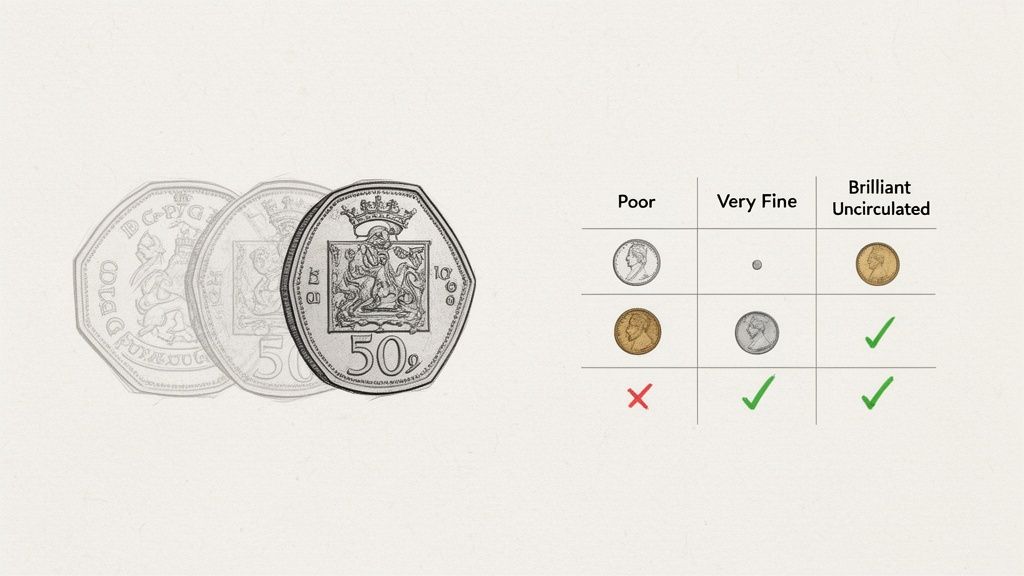
It's a common myth that any old coin must be a valuable one. While the 1969 50p marked a huge moment in currency history, its rollout was a massive exercise in mass production. Getting your head around this fact is the first step to understanding what truly gives a coin its value.
This coin represents a fascinating time in Britain, being the first-ever 50 pence piece to enter UK circulation and setting the stage for decimalisation. To make sure the transition went smoothly, The Royal Mint produced a colossal 188,400,000 of them. This sheer volume means that even over five decades later, they simply aren't scarce. That huge supply directly suppresses the modern collector market, keeping the 1969 50p coin value stubbornly close to its face value, even for coins in decent shape. There's a great video on YouTube that explains the history of this iconic coin if you're curious to learn more.
Condition Is Key
While scarcity is the number one driver of a coin's value, its physical condition is a close second. A coin that has been rattling around in pockets and purses for over 50 years will have plenty of scratches and wear, making it worth no more than 50p. On the other hand, an uncirculated example that looks as pristine as the day it was made can fetch a small premium from collectors.
Think of it like a classic car. A rusty, high-mileage model from the 60s is really just a piece of old metal. But an immaculate, low-mileage example that's been stored in a garage for decades? That's a collector's dream. The same logic applies to coins.
To help you figure out what you've got, the table below is a quick reference guide showing how a coin's condition affects its potential value. It outlines the visual clues to look for, from a heavily worn piece to a "Brilliant Uncirculated" specimen.
Quick Guide to 1969 50p Coin Value
| Coin Condition | What to Look For | Estimated Value Range (£) |
|---|---|---|
| Heavily Worn / Poor | The design is flat, Britannia's details are gone, and the date may be difficult to read. The coin's surface is covered in scratches and marks. | 50p |
| Circulated / Good | Most details are visible, but there is clear wear on high points like the Queen's hair and Britannia's helmet. The coin has lost its original mint lustre. | 50p – £1.50 |
| Almost Uncirculated | Only very light friction is visible on the highest points of the design. Much of the original mint lustre remains, and details are sharp. | £2.00 – £4.00 |
| Brilliant Uncirculated | The coin shows no signs of wear at all. It retains its full, original mint lustre and has sharp, clear details as if it just left the mint. | £4.00 – £8.00 |
Use this table as your starting point to assess your coin. As you can see, even a perfect, top-grade example is only worth a handful of pounds. The real value for a 1969 50p lies in finding rare errors or varieties, which we'll explore in the next section.
The Story Behind Britain's First Seven-Sided Coin
Every coin tells a story, and the 1969 50p tells a particularly important one. To really get a feel for its place in history, you have to rewind to the late 1960s. Britain was on the brink of a massive monetary shake-up: decimalisation. The old, wonderfully confusing system of pounds, shillings, and pence was on its way out, and the country was gearing up for a much simpler system based on units of 100.
This huge change meant a whole new set of coins was needed. One of the biggest headaches was how to replace the popular 10-shilling note. The new coin had to be valuable enough to do the job, but different enough from the existing coins to avoid confusion. Just making another round coin was out of the question—it would feel too much like a half-crown or a florin in your pocket.
A Shape Born from Innovation
The solution they came up with was brilliant and completely new. The Royal Mint's Decimal Currency Board, working with designer Hugh Conway, created what's known as an equilateral curve heptagon. Don't let the fancy name put you off; this seven-sided shape was a masterclass in practical design.
It had a constant diameter, which meant it could roll smoothly and work perfectly in vending machines, just like a round coin. But its seven distinct sides made it instantly recognisable by touch. This was a critical feature, not just for the visually impaired, but for anyone fumbling for change without looking.
This innovative shape solved a complex problem with pure elegance. It perfectly balanced the needs of automated machines with the human need for easy, tactile identification, setting a new global standard for coin design.
This wasn't just a random shape they pulled out of a hat. It was carefully engineered to tick several boxes:
- Visually Distinct: It had to look completely different from any other coin in circulation.
- Tactilely Unique: You had to be able to identify it by feel alone.
- Machine Compatible: It needed to work in vending and counting machines without a hitch.
The genius of the design speaks for itself—the seven-sided shape is still the hallmark of the 50p today. For a deeper dive, you can learn more about the delightful and colourful history of the British 50p coin in our dedicated article.
Artistry Meets History
With the shape sorted, the coin needed its faces. The obverse (the "heads" side) carried the second official portrait of Queen Elizabeth II, a graceful design by the artist Arnold Machin. This iconic portrait appeared on British coins from 1968 all the way through to 1984, making it instantly familiar to millions.
For the reverse ("tails"), the renowned artist Christopher Ironside was given the task of creating something quintessentially British. He landed on the powerful and historic figure of Britannia.
Ironside’s design shows Britannia seated next to a lion, holding a trident (a nod to Britain’s naval power) and an olive branch (symbolising peace). It was modern, yet deeply traditional, linking the new decimal currency to centuries of British heritage. Just below her, the words "NEW PENCE" and the number "50" made its value crystal clear.
When the 1969 50p was released on 14th October 1969, it was more than just money. It was a tangible piece of the future, put into circulation well ahead of Decimal Day in 1971 to help people get used to the new system. Its journey from a tricky design problem to a much-loved piece of daily life is what gives it a cultural weight far beyond its face value.
Understanding Why Mintage Is King in Coin Collecting
When you're new to collecting, it’s easy to assume that age equals value. A coin that's over 50 years old must be worth a bit, right? It seems logical, but in the world of numismatics, the reality is much simpler and boils down to one golden rule: supply and demand. For any coin, the single most important factor determining its rarity—and ultimately its value—is the mintage figure.
Simply put, the mintage tells you how many coins of a specific design and year were ever produced. If the number is low, the coin is scarce, and collectors will compete for it. If the number is high, the coin is common, and its value stays low.
The 1969 50p is the perfect example of this principle in action. A jaw-dropping 188,400,000 of them were struck by The Royal Mint. Their goal was to flood the country with the new seven-sided coin to get everyone comfortable with it before decimalisation kicked in. Because of that massive supply, a standard 1969 50p is still only worth its face value today.
A Tale of Two Coins
To really see how much mintage matters, let's compare the 1969 50p with another coin from the exact same Britannia series: the 1985 50p. Side-by-side, they look almost identical. Both feature Christopher Ironside's iconic Britannia on the reverse and Arnold Machin's portrait of the Queen on the obverse. The only real difference is the date.
So why are their values so dramatically different?
It all comes down to the production numbers. After the huge launch in 1969, The Royal Mint's strategy changed. Production dropped to 19,461,500 in 1970, and by 1985, they only minted a tiny 682,103 coins. That's a staggering 99.2% drop from the 1969 peak! You can see the full story of these fluctuating 50p mintage figures to get a better sense of the scale.
This massive difference in supply means the 1985 50p is incredibly rare compared to its 1969 cousin. You might still find a 1969 coin in your change, but stumbling upon a 1985 Britannia is a genuinely exciting find for any collector.
This diagram shows the key design elements that were consistent across the entire original Britannia series.
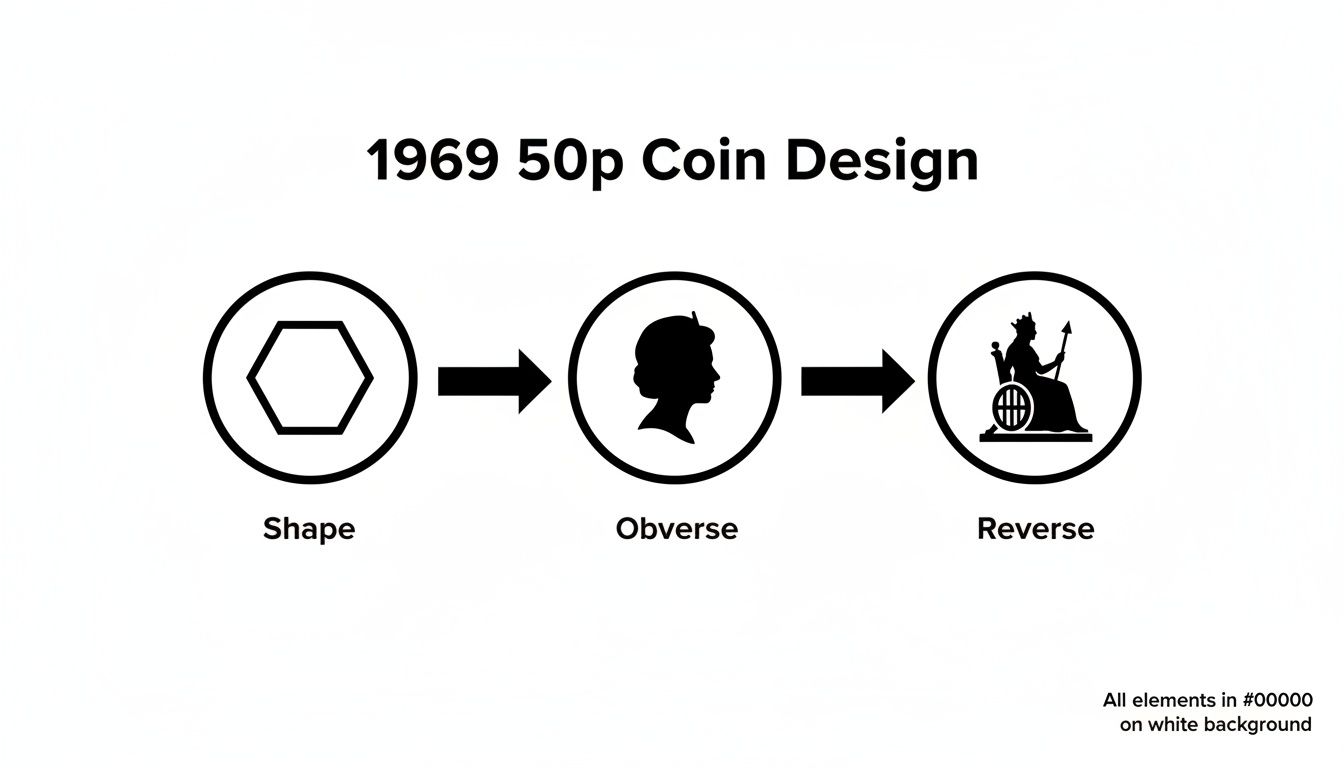
It’s a great reminder that a coin’s appearance doesn't drive its value; the story is told by the production numbers behind the date.
How Rarity Compares Mintage Figures of Early Britannia 50p Coins
Seeing the numbers next to each other makes the concept crystal clear. The table below compares the mintage of the very common 1969 50p with a few other key dates from the same Britannia series.
| Year of Issue | Mintage Figure (Number of Coins Struck) |
|---|---|
| 1969 | 188,400,000 |
| 1970 | 19,461,500 |
| 1983 | 6,012,000 |
| 1985 | 682,103 |
As you can see, the drop-off is immense. This simple comparison powerfully shows why collectors will pay a premium for a 1985 coin while a 1969 piece barely raises an eyebrow.
Mintage is the bedrock of coin valuation. A coin can be ancient, beautiful, and historically significant, but if millions of them exist, it will never be a high-value piece for collectors. Scarcity is, and always will be, king.
Once you grasp this principle, you’ve taken the first big step towards becoming a savvy collector. It trains you to look past the date and focus on the numbers that tell the real story of a coin's rarity and potential worth. It’s why checking the mintage is always the first thing a seasoned numismatist does.
How to Grade Your Coin Like an Expert
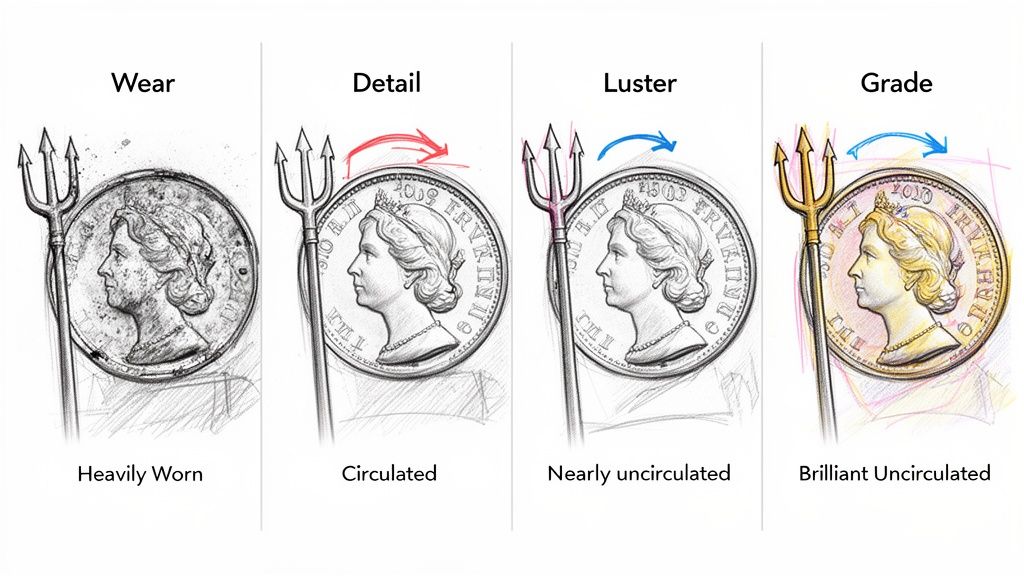
You could have two 1969 50p coins that, from a distance, look identical. Yet one might be worth just its face value, while the other fetches a tidy little premium. The difference? It all comes down to its physical condition, what collectors call the coin's grade.
After mintage figures, the grade is easily the most important factor driving the 1969 50p coin value.
Think of it like a first-edition book. A well-loved copy with a broken spine and dog-eared pages is still a great story, but its monetary value is almost nothing. A pristine copy, however, with crisp, unmarked pages, is a genuine collector's prize. It’s exactly the same principle with your coins.
Learning to assess your coin's condition is a game-changer. It gives you the power to spot hidden value and appreciate the tiny details that separate everyday pocket change from a true collectible. It’s a skill that elevates a quick glance into an expert evaluation.
The Spectrum of Coin Condition
Coin grading isn't just "good" or "bad." It's a whole spectrum, running from heavily battered to absolutely perfect. For a common coin like the 1969 50p, climbing this ladder is the only way it gains any value beyond 50 pence.
Each step up the grading scale has specific visual clues you can learn to spot. You'll need decent lighting and a magnifying glass will be a huge help. You’re looking for two main things: how sharp the original design is, and how many marks or dings it has picked up over the decades.
Let's break down the main grading bands you're likely to come across.
From Worn to Uncirculated
The journey from a battered old coin to a flawless specimen is all about the gradual disappearance of wear and tear. Here’s what you should be looking for at each stage, using your 1969 50p as the model:
-
Poor / Worn: The coin is flat, almost smooth to the touch. On the reverse, Britannia's trident might just be an outline, and the details on her helmet are long gone. The Queen's portrait on the obverse will be faint, with some of the lettering around the rim hard to read. A coin in this state is worth 50p.
-
Circulated (Fine / Very Fine): This is how you'll find most 1969 coins. The main designs are clear, but the high points are obviously worn down. Check the Queen's hair and Britannia's shield—these areas will look noticeably smooth. The coin has lost its original mint lustre and will have countless little scratches from its time in circulation. Its value is still hanging around 50p.
-
Almost Uncirculated (AU): Now we're getting into collector territory. At first glance, the coin looks sharp. Most of its original mint lustre—that silky, cartwheel-like sheen you see when you tilt it—is still there. Wear is minimal, confined only to the highest points of the design, like the very top of Britannia's helmet. This grade could bring £2 to £4.
-
Brilliant Uncirculated (BU): This is the top tier. A BU coin looks like it just rolled off the press at The Royal Mint. It has a full, blazing lustre and shows zero signs of wear. Every detail, from the prongs on the trident to the individual strands of the Queen's hair, is sharp and crisp. A genuine BU 1969 50p could sell for £4 to £8.
For a collector, a coin's journey is a story told on its surface. Every scratch, ding, and worn-down detail is a mark of its time in circulation. An uncirculated coin is a perfect, unread chapter, preserved exactly as the artist and the mint intended.
For those wanting to take their grading to the next level, professional services offer a definitive assessment. You can find out more in our detailed guide on how to get coins graded professionally. This process, often called 'slabbing', involves an expert formally evaluating and sealing your coin in a protective case, assigning a certified grade that's recognised right across the market.
Searching for Rare and Valuable Error Coins
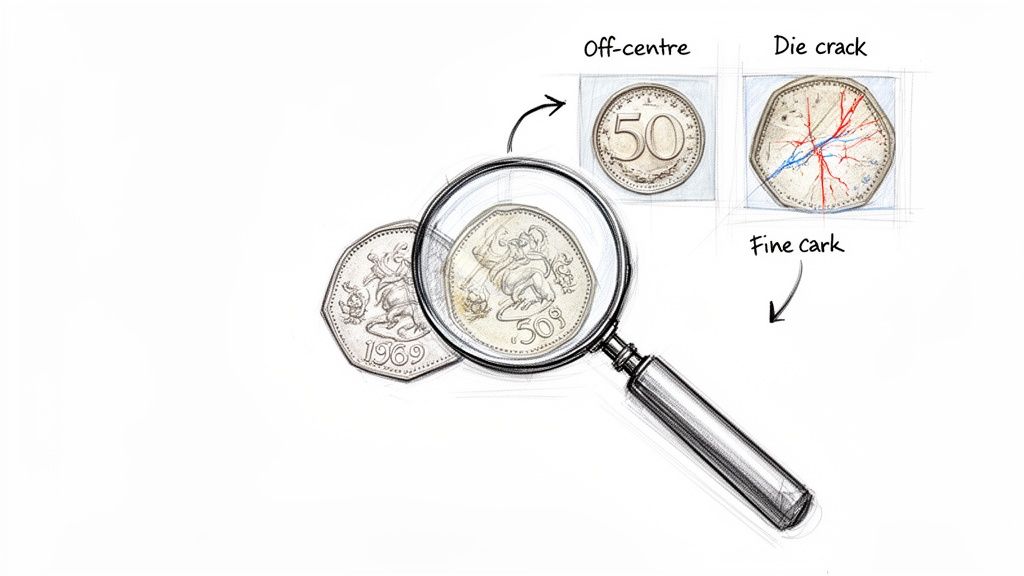
While any standard 1969 50p is a common find, the real thrill for many collectors is the hunt for a rare "error" coin. This is where the ordinary becomes extraordinary, and a piece worth 50p can transform into something far more desirable. It's the dream of finding a coin struck incorrectly at the mint that keeps us all checking our change.
An error coin is a genuine mistake made during the manufacturing process. The Royal Mint has an incredibly rigorous quality control system, but when you’re striking millions of coins at high speed, tiny imperfections can occasionally slip through. These aren't just damaged coins; they are unique specimens that tell the story of a momentary mechanical hiccup.
It’s important to manage expectations, though. Major, documented errors for the 1969 50p are almost unheard of, thanks to its high mintage and the quality control of the era. Still, knowing what to look for turns every inspection into a potential treasure hunt and deepens your understanding of the numismatic world.
What Is a Genuine Minting Error
Before you start searching, you need to learn the difference between a true minting error and simple post-mint damage (PMD). Damage happens after a coin leaves the mint—think scratches, dents, or corrosion from being buried. These marks will always decrease a coin's value.
A genuine error, on the other hand, is part of the coin's creation. Think of it like finding a book with a page printed upside down. It’s a flaw from the factory, not damage caused by the reader. This distinction is precisely what gives an error coin its collectible status and potential value.
A minting error is a fingerprint of a fleeting imperfection in a highly controlled process. It captures a moment when the machinery faltered, creating a genuine numismatic rarity that was never intended to exist.
Identifying these subtle flaws takes a keen eye and, more often than not, a good magnifying glass. By learning to spot the signs of a true error, you can filter out the noise of everyday wear and focus on what might just be a valuable find.
Common Types of Errors to Look For
While the chances are slim, several types of minor errors could theoretically pop up on any coin, including the 1969 50p. Here are some of the classic imperfections you should train your eye to spot:
-
Off-Centre Strikes: This happens when the coin isn't perfectly aligned with the dies during striking. The result is a design that's shifted to one side, leaving part of the coin's surface completely blank. Even a slight off-centre strike is a notable find.
-
Die Cracks: The dies used to stamp coins are under immense pressure and can develop tiny cracks. These cracks transfer to the coin's surface as raised, irregular lines, almost like tiny lightning bolts. Look for them radiating from the edges or across the main design.
-
Cuds or Die Breaks: This is a more dramatic version of a die crack. When a small piece of the die breaks away entirely, it leaves a raised, unstruck blob of metal on the coin's surface, which is typically connected to the rim.
-
Rotated Dies: All UK coins are struck with "medal alignment," meaning the top of the obverse ("heads") lines up with the top of the reverse ("tails"). If a die comes loose and rotates, this alignment gets thrown off. A significant rotation can make a coin quite desirable to specialist error collectors.
Searching for these elusive imperfections is a patient game. It requires you to closely examine every coin that passes through your hands. Even if you never find a major error on a 1969 50p, the process itself will make you a much more skilled and knowledgeable collector.
Selling Your 1969 50p: The Honest Options
So, you’ve taken a close look at your coin, checked its condition, and hunted for any unusual errors. The big question now is, what’s it actually worth, and what should you do with it?
When it comes to the 1969 50p coin value, let’s be brutally honest. For a single, well-worn coin that’s been rattling around in pockets and tills for decades, the most straightforward option is simply to spend it. It’s worth exactly 50p.
But hold on. If you’ve got a coin that looks like it just left the Royal Mint – a crisp, Brilliant Uncirculated example – or you’ve spotted a genuine error, spending it would be a real shame. In those cases, you’ve got a few pathways to get a much better return.
Online Marketplaces vs Specialist Dealers
For most people, the first port of call is eBay. It makes sense; you get your coin in front of a massive audience. But that route comes with its own headaches. You’ll be stung by hefty seller fees, you have to faff about with taking good photos and posting it, and you’re up against a sea of other listings for common coins.
The alternative is to talk to a specialist coin dealer or an auction house. It might sound a bit formal, but it's often the quickest and cleanest way to sell a coin that has real quality.
- Pros of eBay: Huge audience and you’re in total control of the listing.
- Cons of eBay: High fees, it’s a time sink, and you can get messed around by non-paying bidders.
- Pros of Dealers: A quick, professional valuation and you get paid on the spot with no fees.
- Cons of Dealers: The offer will always be below retail price – they have to make a profit, after all.
If you're weighing up your options, our guide on where to sell old coins gives a full rundown of the best choices for 2025, helping you figure out what’s right for you.
How Cavalier Coins Can Help
If you're dealing with more than just one coin, professional services really come into their own. At Cavalier Coins, we’ve got solutions to help you get a fair price, whether you have a little shoebox of random change or a collection that's been put together over years.
We regularly buy bulk coin collections. It's a simple, no-fuss way to sell many coins at once without the grind of listing them all one by one. This is perfect for inherited collections or if you’re just looking to cash in your holdings without the hassle.
For coins of exceptional quality, a direct sale isn't always the best route. Placing a high-grade or rare error coin in a specialised auction can create competition among serious collectors, often driving the final price far beyond a standard valuation.
If your 1969 50p is a top-tier, Brilliant Uncirculated specimen, it could be a perfect candidate for one of our weekly auctions. This gets your coin in front of dedicated numismatists—the very people who understand its quality and are willing to pay for it. It's all about getting your coin in front of the right crowd to unlock its true market value.
Got Questions About the 1969 Britannia 50p?
We've covered the history, grading, and the exciting world of errors, but a few key questions always seem to come up about this iconic coin. Let's tackle them head-on, giving you quick, clear answers to solidify your understanding of the 1969 50p coin's value.
Think of this as a final run-through, making sure you've got all the essential facts down pat.
Is the 1969 50p Coin Made of Silver?
It's a common assumption, but no, the 1969 50p is not made of silver. It’s actually made from cupro-nickel, which is a blend of 75% copper and 25% nickel. This has been the standard for the UK's "silver" coloured coins since way back in 1947.
The shiny appearance comes entirely from its nickel content, meaning it has no precious metal value. This is one of the biggest misconceptions out there and often leads people to think the coin is worth more than it really is.
Why Is the 1969 50p So Much Bigger Than Modern 50p Coins?
If you place a 1969 50p next to one from today, the size difference is immediately obvious. The original is noticeably larger and heavier because it was minted to the original specifications laid out for decimalisation.
Fast forward to 1997, and The Royal Mint decided our pockets could do with a break. They introduced a smaller, lighter 50p to make the currency more convenient, and this is the version we still use today. As a result, all the old, chunky 50p coins, including the 1969 issue, were officially demonetised and taken out of circulation in 1998.
How Much Is a 1969 50p Coin From a Proof Set Worth?
A 1969 50p that started life in an official Royal Mint proof set will always command a higher price than a standard coin you’d find in your change. Proof coins are special collector's items, struck with highly polished dies to create a flawless, mirror-like finish.
A proof coin is the absolute pinnacle of the minting process. Think of it as the difference between a standard photo print and the original, high-resolution master image.
Depending on its condition and whether it's still in its original packaging, a proof 1969 50p can be worth between £3 and £8. That's a tidy premium over its face value.
My 1969 50p Is Old – Doesn't That Make It Rare?
Unfortunately, age doesn't automatically equal rarity in the coin world. While the 1969 50p holds huge historical significance as the very first of its kind, it's anything but rare. The Royal Mint churned out a staggering 188 million of them to get the public used to the new shape.
This enormous mintage makes the 1969 50p one of the most common fifty pence pieces you can find. Its value is more historical than monetary, unless you happen to have a perfect uncirculated example or a particularly unusual error coin.
Whether you're just starting your collection or looking to sell, understanding the nuances of your coins is key. At Cavalier Coins, we provide expert valuations and a trusted platform for buying and selling. Explore our collections or get in touch for a professional appraisal at https://www.cavaliercoins.com.