
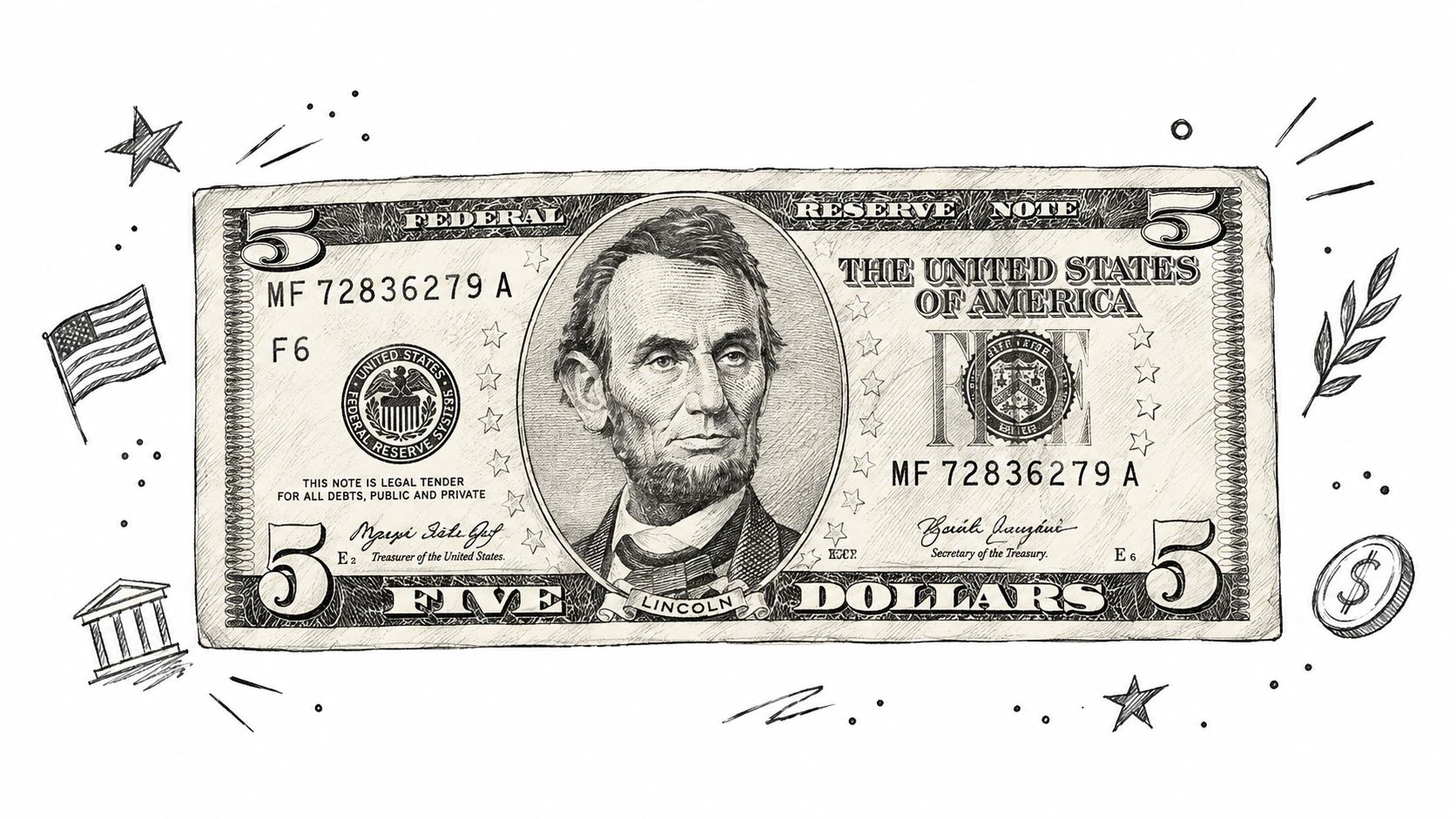
The first $5 note appeared in 1861, and the modern series gained its defining redesign on 13 March 2008. Those dates mark the main divide between traditional and modern collectible eras.
But what is a 5 dollar American bill worth to someone in the UK? The answer isn't found by converting five US dollars into pounds alone. A note may be ordinary foreign cash, a useful historical object, or a desirable piece of notaphily, depending on its era, condition, design, authenticity and route to market.
A casual holder might try to spend it, exchange it or put it in a drawer. A collector asks different questions. Is it a large-size note from an early era? Does its paper show the correct security features? Has it suffered folds, stains or trimming? Is the asking price based on a genuine rarity, or just an optimistic online listing?
For UK collectors, that distinction matters because a US $5 bill is generally treated as a foreign collectible rather than everyday currency. The practical journey is therefore different from collecting Bank of England notes. You need to understand the history first, then inspect the physical note, protect it correctly and choose a sensible buying or selling channel.
Introduction to US Five Dollar Collecting
What can a single 5 dollar American bill reveal beyond its printed value? Its denomination opens a path through several stages of US monetary history. The first US $5 note appeared as a Demand Note in 1861, followed by the first Federal Reserve Note in this denomination in 1914. The redesigned $5 note entered circulation on 13 March 2008, marking a clear visual boundary between earlier portrait layouts and the newer security-focused design. These milestones are documented in the Bureau of Engraving and Printing's history of US currency.
For a new collector, this timeline provides a practical sorting method. Treat each note as part of a broad era rather than as an interchangeable five-dollar object:
- Pre-Federal Reserve large-size notes, from the earlier and more varied tradition of US paper money.
- Early small-size issues, reflecting the standardised format introduced in the modern collecting era.
- Modern redesigned notes, familiar to dealers and built with layered anti-counterfeit elements.
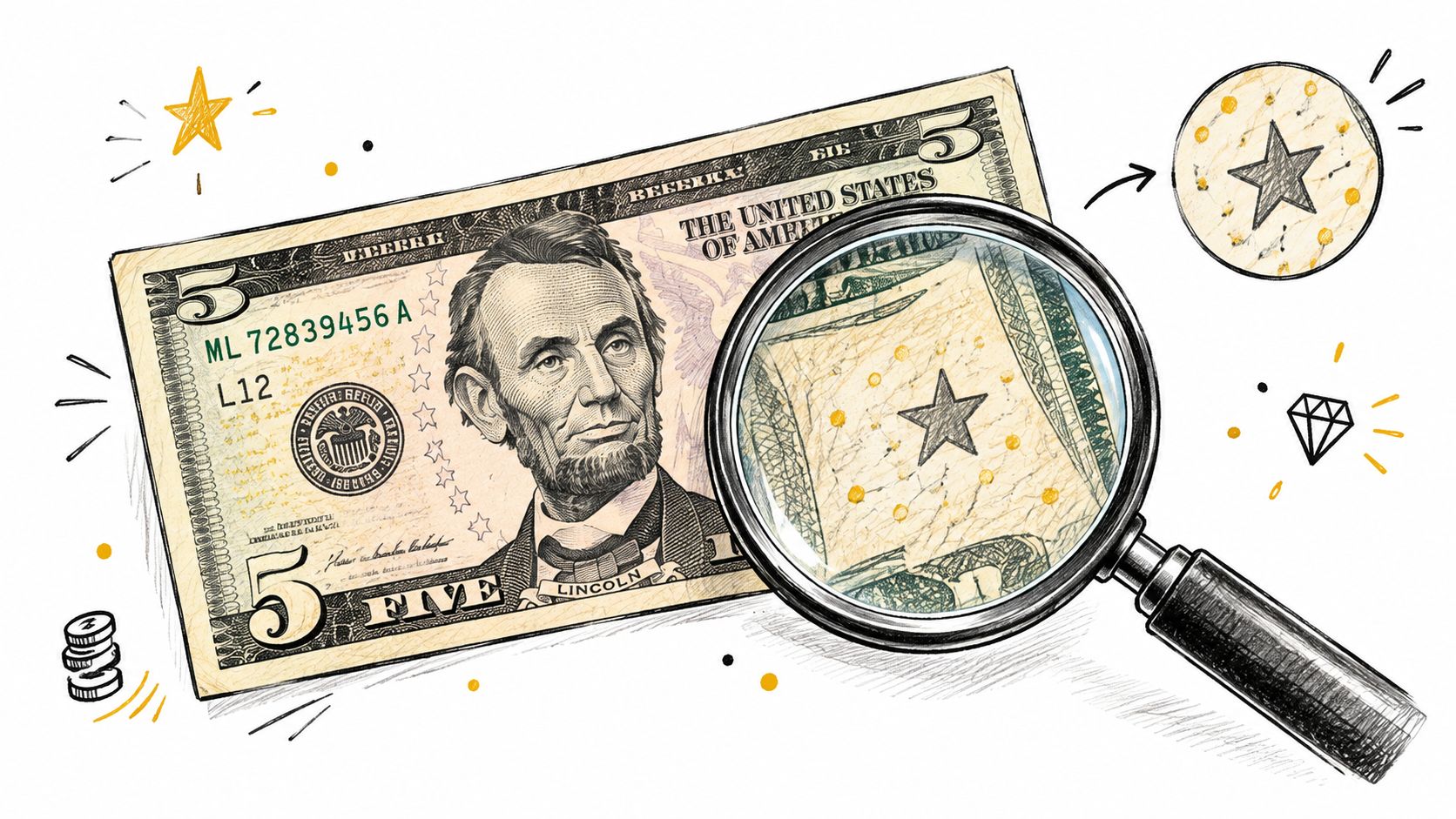
A UK buyer might find two US $5 bills in an inherited envelope. One could be a modern note with ordinary circulation wear. The other might have an unfamiliar layout and a much larger format. Their face values match, yet the collecting work differs completely. The modern note offers practice in checking design and security details, while the older example may require specialist research before anyone estimates its value.
Age, issue type, condition, rarity and provenance determine collectability together. For UK collectors, the route to market also matters. A US note is usually a foreign collectible rather than everyday currency, so its value may depend on specialist dealers, auction access, authentication and the cost of converting funds into pounds.
A foreign five-dollar note can attract serious attention in British auctions when its historical importance is exceptional. BBC coverage of a Hong Kong $5 note sold in Scotland recorded a £130,000 hammer price, describing it as a 161-year-old banknote and the earliest known fully issued Hong Kong banknote of any denomination. Although it was not a US note, the example shows how age and rarity can outweigh a low printed denomination in an international market.
Collector's principle: Treat the printed denomination as the beginning of your investigation, not the conclusion.
Start by recording what you can observe without unnecessary handling. Note the size, apparent era, portrait, serial details, seals, signatures and condition. Then compare those observations with specialist references or reputable dealer descriptions. This method helps separate an interesting design from a genuinely scarce issue and reduces the risk of paying for an optimistic listing.
Once you have placed a note in one of these three eras, the next question is how its physical format changed across those stages.
The History and Design Evolution of the $5 Bill
The history of the US five-dollar denomination is best understood as a sequence of format changes. Early large-size notes belong to a period when American paper money used more varied layouts and elaborate visual compositions. They can look unfamiliar to collectors accustomed to the portrait-led notes found in circulation today.
Large-size notes and the move to standardisation
Before the small-size format became standard, US notes were physically larger and often displayed artwork that differed sharply from modern currency. For a UK collector, the first visual clue is therefore not necessarily the portrait. It may be the overall paper area, the arrangement of borders, the typography and the relationship between seals and printed text.
The shift to small-size notes in 1929 gave collectors a practical dividing line. A large-size note should not be judged against a modern note just because both carry a five-dollar denomination. Their proportions, design conventions and collecting markets belong to different historical settings.
| Feature | Earlier large-size issues | Later small-size issues |
|---|---|---|
| Physical impression | Noticeably larger and more expansive | Standardised, compact format |
| Design character | More varied artwork and layouts | More consistent institutional design |
| Collecting approach | Research issue, era and rarity carefully | Compare series, condition and security details |
| UK handling | Requires suitably sized archival storage | Easier to accommodate in modern banknote systems |
The first Demand Note in 1861 and the first Federal Reserve Note in 1914 provide particularly useful historical anchors. They help distinguish the denomination's early monetary history from the modern notes that dominate contemporary dealer inventories.
Why the 2008 redesign matters
The redesign that entered circulation on 13 March 2008 created another clear boundary. It separated earlier portrait arrangements from a newer layout built around modern anti-counterfeit technology. That makes the date useful to UK buyers comparing auction photographs, dealer descriptions and inherited notes.
A redesign doesn't automatically make a note rare. It does, however, help you establish where an example sits in the broader collecting timeline. Start with the design era, then investigate the exact issue, condition and provenance. That sequence is more reliable than assuming that an unfamiliar appearance must indicate scarcity.
Understanding Physical Dimensions and Storage
Paper money needs storage that fits the object precisely. The US $5 note has a fixed size of 156 × 66.3 mm, a specification recorded in banknote reference data. For UK collectors, that measurement matters because the note is close in overall proportions to familiar British currency but isn't interchangeable with every album pocket or sleeve.
The comparison becomes especially useful beside the current Bank of England polymer £5 note, which measures 125 × 65 mm. The difference in length is substantial even though the widths are relatively close. A holder that seems to fit by eye may press an edge, allow movement or force a fold.
A safe storage routine
- Measure before buying holders. Use millimetres, not a vague description such as “wallet size”. The note should lie flat without pressure at the corners.
- Choose archival-quality materials. Use inert sleeves designed for banknotes, avoiding materials that can transfer chemicals or trap moisture against the paper.
- Support the whole note. A pocket that is too short can catch the edge during insertion. Repeated friction causes damage even when the note initially appears strong.
- Keep handling controlled. Hold the note by its edges with clean, dry hands. Don't flatten a fold aggressively, and never use adhesive, tape or household laminating film.
A suitable paper money storage guide can help you select holders and organise a collection without relying on generic coin-album compartments. Coin albums aren't designed for flexible paper objects, and their pockets may encourage bending or corner contact.
Practical rule: Measure the note and the holder separately. A nominally universal pocket isn't proof of a safe fit.
Store sleeves upright or flat according to their design, away from direct sunlight, damp conditions and sudden temperature changes. The objective is simple: preserve the paper, edges, surface and original shape so that later examination remains possible.
Authentication and Security Features
A modern redesigned US $5 bill should be checked as a layered object. The watermark, security thread and microprinting each answer a different question, so relying on one feature alone can produce false confidence. The official US currency security training material identifies these features as part of the note's anti-counterfeit system.
Start with the physical structure
Begin with a careful visual inspection under ordinary light. Look for suspicious surface printing, uneven alignment, blurred detail or paper that feels unlike a genuine US note. This first pass doesn't prove authenticity, but it can identify reasons to stop and investigate further.
Next, hold the note against transmitted light. The watermark should appear through the paper rather than looking like an image sitting on top of it. This distinction matters because embedded features interact with the note's structure, while a reproduction may imitate only the visible pattern.
Use UV light and magnification together
A UV inspection adds a separate test. The embedded security thread should glow blue under ultraviolet light. Check the result in a controlled, darker environment and compare it with a trusted genuine example where possible. A glow alone isn't enough to certify the note, because authentication depends on the complete combination of design, paper, placement and print quality.
Magnification then helps you inspect microprinting in its expected locations. Look for sharply formed tiny lettering rather than a soft line or decorative imitation. A basic magnifier is useful for preliminary screening, while a specialist should handle any note that may be valuable or disputed.
The most dependable sequence is therefore:
- Surface inspection: Check overall design, alignment and paper behaviour.
- Transmitted light: Look for the watermark within the paper.
- Ultraviolet inspection: Confirm the embedded thread's blue response.
- Magnification: Examine microprinting and fine detail.
- Comparison: Match the result against a reliable reference or expert opinion.
Cavalier Coins' guide to essential banknote security features is a practical reference for collectors building this inspection habit. A suspicious note shouldn't be altered, cleaned or passed on casually. Set it aside, record where it came from and seek qualified advice before offering it for sale.
The UK counterfeit context also helps keep the risk in proportion. The Bank of England says counterfeit banknotes are rare, while recent UK commentary recorded about 200,000 counterfeit notes in 2025, still less than 0.0041% of notes in circulation. Those figures don't authenticate an American note, but they reinforce the practical point for UK collectors: the main challenge is usually establishing condition, provenance and a sensible selling route, not assuming every imported note is fraudulent.
Identifying Rare Errors and Varieties
Errors attract collectors because they show where the production process failed. A genuine printing or cutting mistake can make an otherwise ordinary denomination more interesting, but online listings often use “error” loosely. A crease, stain, ink mark or damaged corner is usually damage, not a manufacturing variety.
Compare the anomaly with the expected design
Start by photographing the note without altering it. Compare the suspected feature with a trusted example from the same design family. Ask whether the difference is:
| Observation | Likely interpretation |
|---|---|
| A fold through the design | Circulation damage unless evidence shows it occurred during production |
| Uneven edge | Possible cutting issue, but trimming must be ruled out |
| Misaligned printed element | Potential genuine error if the paper and surrounding print support it |
| Missing or unusual feature | Requires comparison with the correct issue and series |
| Colour difference | Could be lighting, wear, alteration or a printing fault |
The distinction between a printing error and post-production damage matters. A shifted seal, incomplete printed element or unusual alignment may deserve specialist attention when the surrounding paper remains consistent and the feature appears mechanically produced. A stain that covers part of the design doesn't become an error just because it looks unusual.
Why varieties need careful evidence
Collectors may encounter descriptions involving double denominations, missing stars or inverted seals. These terms can describe genuine anomalies, but they can also appear in poorly researched listings. Don't buy on the label alone. Ask for clear images of both sides, the edges and the relevant serial or seal area.
A useful comparison method is to place the note beside a confirmed example, keeping both flat and using the same lighting. Check whether the suspected difference repeats in the expected location, whether it affects more than one printed layer and whether the edge shows evidence of cutting or mechanical disturbance.
A genuine error should explain itself through the printing process. If the mark looks like something that happened after the note left the press, treat it as damage until evidence says otherwise.
Don't clean, trim, press or repair a suspected error. Those actions can destroy the evidence that a specialist needs to assess it. A credible appraisal depends on the note's original state, clear provenance and an accurate description of what differs from a normal example.
Grading and Preservation Standards
Condition affects how collectors compare banknotes, but grading isn't just a synonym for appearance. A note can look bright while carrying a hidden fold, a repaired edge or surface damage that changes its classification. Terms such as Uncirculated and About Uncirculated describe the degree of handling and preservation, not a seller's general impression.
Raw notes versus professionally graded examples
A raw note is sold without encapsulation or an independent grade. That can make it less expensive to acquire, but the buyer must judge folds, corner quality, paper strength, stains and repairs. Two people may describe the same raw note differently, especially when photographs hide a faint centre fold or edge weakness.
A professionally graded, encapsulated note offers a standardised opinion and physical protection. It can be easier to compare with other slabbed specimens, particularly when the issue is scarce or the purchase price justifies the added cost. Encapsulation isn't a guarantee of value, though. The grade still needs to be considered alongside rarity, demand, provenance and design.
Preserve before you decide
Use a clean archival sleeve for ordinary examples and handle the note by its edges. Keep it away from direct light and damp storage areas. Never use pressure, heat, glue or household chemicals to improve its appearance.
For a more detailed explanation of condition terminology, this banknote grading guide provides a useful reference. Before buying a slabbed specimen, check that the holder is intact and that the label matches the note. Before submitting a raw note for grading, ask whether the issue has enough rarity or market interest to justify the cost.
A sensible decision rule is straightforward:
- Common modern note: Protect it carefully, but professional grading may not be necessary.
- Older or unusual issue: Obtain specialist advice before cleaning or selling.
- Possible error or scarce variety: Preserve the original state and document both sides.
- High-value purchase: Prefer independent grading or a return arrangement that gives you time to inspect the note.
Preservation protects more than appearance. It retains the evidence that lets a future buyer assess what the note is and how it has been treated.
Market Values and Trading Guidance
What does a US $5 bill represent to a collector in Britain? Its face value is only one reference point. Historical era, condition, scarcity, provenance and buyer demand may matter more than its ability to purchase goods. UK sellers present American five-dollar notes as a distinct collectible category, including older and uncirculated examples, but a listing price is not the same as a completed sale.
Decide what you own before choosing a route
Work through the note in this order:
- Identify the era. Separate early large-size material, small-size issues and modern redesigned notes.
- Record the condition. Note folds, stains, edge wear, repairs and writing. Do not try to correct them.
- Check authenticity. Use transmitted light, UV inspection and magnification for modern notes.
- Research comparable offerings. Compare similar notes, rather than measuring a common circulated example against an exceptional auction result.
- Choose the selling channel. A specialist dealer, banknote auction or established marketplace may suit different notes.
For a casual holder in Britain, exchanging a low-denomination US note can be inconvenient. UK banks and bureaux de change serve domestic cash needs, and some exchange services may not accept small US notes or coins. A $5 bill may therefore have greater practical value with a foreign-currency collector than at a general cash counter.
Buy and sell with evidence
Ask sellers for photographs of the front, back, edges and any feature described as rare. Confirm whether the asking price reflects a confirmed variety, graded condition or an attractive design. Keep the invoice, listing description and provenance with the note. These records give a future buyer evidence about what was purchased and how it was described.
Cavalier Coins Ltd offers world banknotes, fixed-price listings and weekly eBay auctions, so it can be one option for collectors assessing an American five-dollar note.
Keep conversion, collecting value and auction value separate. Conversion asks whether a service will accept the note and at what practical rate. Collecting value asks whether another enthusiast wants that specific issue. Auction value depends on presentation, provenance, competition and the note's precise characteristics.
A circulated 2013-series $5 note may be refused by a high-street bureau de change yet still attract a small premium from a US-notes specialist. Those are different forms of value, so do not treat an exchange quote as a collector valuation or an auction result as a guaranteed selling price.
If you're ready to identify, protect or sell a 5 dollar American bill, visit Cavalier Coins Ltd to browse world banknotes or discuss a valuation. Their team also handles bulk collections and auction opportunities, giving UK collectors a practical route for unusual American notes.