
More than just another coin, the 5 shillings 1951 is a celebrated piece of British history known as the Festival of Britain Crown. It wasn't struck by the Royal Mint for popping into a pocket or spending at the shops; this was a special commemorative issue, a tangible symbol of hope for a nation pulling itself out of the shadow of the Second World War.
A Memento of a Nation Reborn
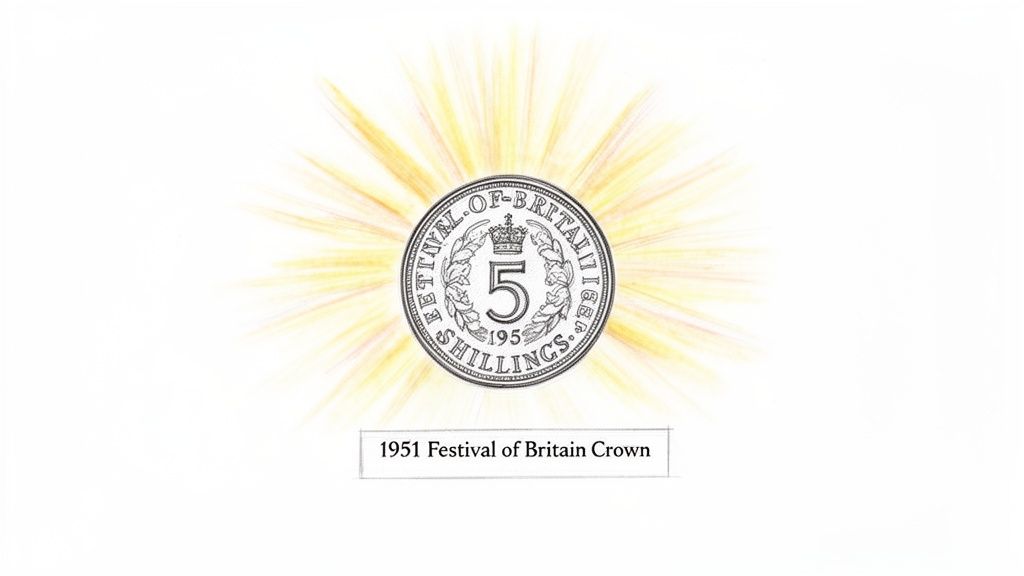
Holding a 1951 five shillings coin is like holding a time capsule. It captures the spirit of a country determined to build a brighter future after years of conflict and rationing. You could almost call it a ‘tonic for the nation’, minted in cupro-nickel.
This special crown was issued to mark the Festival of Britain, a massive national exhibition that opened on 3rd May 1951. It was a grand affair designed to showcase British prowess in science, technology, and the arts—a real morale booster for the entire country.
The festival’s iconic centrepiece, the Skylon on London's South Bank, drew over 8 million visitors in just five months, becoming a powerful symbol of Britain's forward-looking aspirations. To get a better feel for the event and the coin's place in it, the archives on Colnect.com are a great resource.
Your Guide to This Historic Coin
Whether you're new to collecting or a seasoned numismatist, you can't fully appreciate this crown without understanding its unique context. It was, after all, only the second crown coin issued during the entire reign of King George VI, which makes it a pretty significant release.
This guide will walk you through its story, design, and value, helping you appreciate every detail of this remarkable piece of history.
1951 Five Shillings Quick Facts
To get us started, here’s a quick rundown of the essential details for the Festival of Britain Crown.
| Attribute | Details |
|---|---|
| Common Name | Festival of Britain Crown |
| Face Value | Five Shillings (Crown) |
| Year of Issue | 1951 |
| Issuing Authority | The Royal Mint |
| Monarch | King George VI |
| Composition | Cupro-Nickel (75% Copper, 25% Nickel) |
| Weight | 28.28 grams |
| Diameter | 38.61 mm |
Think of this table as your at-a-glance reference. As we continue, we’ll dive deeper into each of these points, building a complete picture of what makes the 5 shillings 1951 crown such a cherished collector's item.
The Story Behind the Coin in a Nation Rebuilding
To really get a feel for the 5 shillings 1951 crown, you have to transport yourself back to Britain just after the Second World War. The country had won the war, but it was on its knees—exhausted, grieving, and still living with the daily grind of rationing and reconstruction. It was a time of real austerity, but also a time of incredible resilience and a deep desire for a better, more modern future.
This powerful mix of hardship and hope was the perfect breeding ground for a grand national project. The government, under Clement Attlee, had an idea for an event that would be a "tonic for the nation." It would showcase the absolute best of British innovation, art, science, and industry. That vision blossomed into the legendary Festival of Britain.
A Tonic for the Nation
Kicking off in the summer of 1951, the Festival was a nationwide party. It was designed to send a clear message: Britain wasn't just surviving; it was rebuilding with genuine creativity and spirit. The main exhibition on London's South Bank, with its futuristic Dome of Discovery and the almost impossibly slender Skylon tower, absolutely captured the public’s imagination. It was a spectacle that looked firmly forward, a deliberate shift away from the post-war gloom towards a new age of optimism.
This event is precisely why the 1951 crown exists. The coin was never meant for your pocket money; it was created as an affordable, physical keepsake of this national moment. It was a piece of the celebration that everyday people could own, a symbol of recovery they could literally hold in their hands.
The Festival of Britain Crown was more than just currency; it was a carefully crafted piece of public relations, minted to encapsulate a pivotal moment of national renewal and shared hope for the future.
A Unique Place in Numismatic History
What really makes this particular crown stand out is just how unusual it was for King George VI's reign. It was only the second crown design issued during his entire time on the throne, which ran from 1936 to 1952. The only other one was the 1937 Coronation Crown, struck to celebrate him becoming king.
Putting the two side-by-side really shines a light on the 1951 coin's special purpose. The 1937 issue was a traditional affair, tied to the ancient rituals of the monarchy. The 1951 crown, on the other hand, was a thoroughly modern commemorative, celebrating the achievements and spirit of the British people themselves. This distinction cements its status as a powerful piece of history, bridging the gap between royal tradition and public celebration. For those curious about the bigger picture, exploring a brief history of British coins provides fantastic context on how commemorative coins like this fit into the nation's story.
Decoding the Design Artistry and Symbolism
Every coin tells a story, but the 5 shillings 1951 is a full-blown narrative captured in metal. To really get a feel for this piece, you have to look closely at both sides. Each was chosen with incredible care, loaded with symbolic meaning for a Britain finding its feet in a new era.
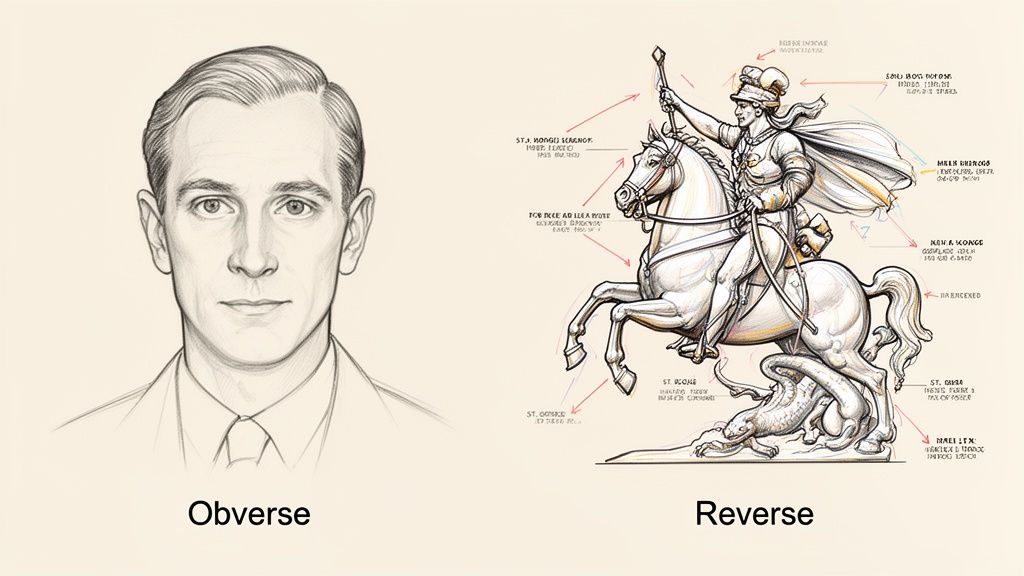
Think of the coin as a miniature gallery. One side shows the quiet strength of the monarchy, while the other channels a classic legend of good conquering evil.
The Obverse: A Portrait of a King
The 'heads' side, or the obverse, presents a striking portrait of King George VI, crafted by the talented artist Thomas Humphrey Paget. Now, you might be used to seeing monarchs decked out in crowns and robes on coins, but Paget's design went in a completely different direction.
The King is shown bare-headed, facing left, with a look that’s dignified yet very human. This wasn't an accident. It was a deliberate choice to portray a monarch who stood with his people through immense hardship and was now leading the recovery. It was a symbol of a more modern, less formal sovereign, focused on the future, not on past imperial glory.
The design of the 1951 Crown is a powerful snapshot of Britain's post-war mindset. The bare-headed portrait of George VI, used from 1936 to 1952, was a world away from the grand, crowned effigies of old. It resonated deeply with a nation still grappling with economic challenges.
The Reverse: A Legendary Tale of Triumph
Flip the coin over, and you get to the dramatic heart of the piece: the legendary image of St. George slaying the dragon. This incredible design wasn't new. It was the masterpiece of Benedetto Pistrucci, an Italian gem engraver who first created it for the British Sovereign coin way back in 1817.
Bringing it back for the Festival of Britain Crown was a stroke of genius. The powerful story of good defeating evil was the perfect symbol for a country celebrating its survival and recovery after the war. This timeless image connected the optimism of 1951 directly to a long history of British grit and resilience.
The design of the 5 shillings 1951 was chosen to inspire, linking the festival's theme as a 'tonic for the nation' to this iconic scene of victory. You can discover more about the coin’s historical context on NGCcoin.com.
Getting to Grips with Mintage and Tech Specs
To really understand the 5 shillings 1951 coin, you have to get into the nuts and bolts—the numbers and metals that make it what it is. For any serious collector, these details aren't just trivia; they're the vital stats that tell you about a coin's rarity, its story, and how well it's likely to have survived over the years.
The Festival of Britain Crown is a proper handful. It weighs a solid 28.28 grams and measures 38.61 mm across. That impressive size gives it a satisfying heft and presence, making it a real standout piece in any collection.
A Post-War Change in Metal
One of the most important things to know about this coin is what it's made of: cupro-nickel, an alloy of 75% copper and 25% nickel. This might sound like a dry fact, but it's a huge clue to the coin's place in history.
Before the Second World War, British crowns were silver. But the sheer economic cost of the war changed everything. The Coinage Act of 1946 forced The Royal Mint to stop using silver for everyday coins and switch to the much cheaper cupro-nickel. This move tells a story of post-war austerity and makes the 1951 crown a true product of its time.
The Official Mintage Figure
When you're trying to figure out how rare a coin is, the mintage—the total number of coins ever made—is king. For the 5 shillings 1951, we have a definitive, official number that every collector should commit to memory.
The Royal Mint struck exactly 1,983,540 Festival of Britain Crowns. This isn't an estimate; it's the confirmed production total, giving us a rock-solid baseline for figuring out how common it is today.
For a commemorative crown, that's a pretty low number. Compare it to something like the 1953 Coronation Crown, which had a mintage of nearly six million, and you start to see the difference.
These coins were only struck in a single year to coincide with the festival's launch in May 1951, an event celebrating the best of British science, industry, and art. If you'd like to dive deeper, you can explore the history behind the 1951 Crown online. It's this relatively modest production run, combined with its historical significance, that gives the coin its lasting appeal and separates it from more common commemorative pieces.
How to Grade and Value Your 1951 Crown
When it comes to your 5 shillings 1951 coin, forget the face value. Its real story—and its market value—is all about its condition. For any collector, the true worth of a coin lies in how well it has survived the decades. A coin’s condition, known as its grade, is the single biggest factor that determines what it’s worth.
Think of grading as a way to describe how much wear and tear a coin has seen. It’s a bit like judging a classic car: one that's been a daily driver will have its fair share of dings and scratches, while one that’s been kept under a dust sheet in a garage is in a whole different league. That same idea separates a common piece of pocket change from a prized collector's item.
Before we dive into grading, let's look at the coin's basic stats. These technical details are the foundation for understanding its place in the world of coin collecting.
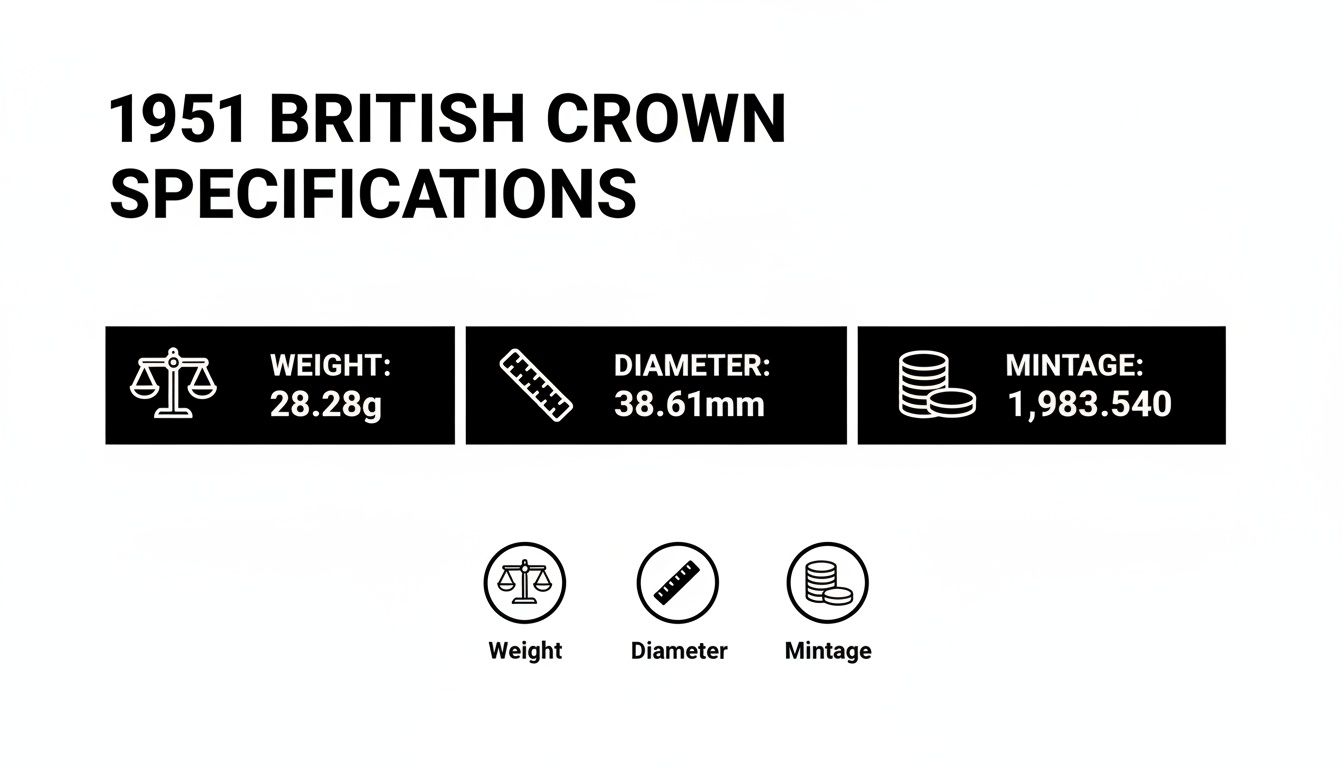
As you can see, this was a large, heavy coin produced in massive numbers. That's precisely why its state of preservation is what makes all the difference.
Understanding the Grading Scale
Coin grading is a spectrum, running from heavily worn, almost unrecognisable coins all the way up to flawless, mint-perfect examples. For the 1951 Crown, you'll most likely come across these grades:
- Circulated Grades (Fine to Extremely Fine): These are coins that have clearly been handled. They show obvious signs of wear, especially on the high points of the design like the King’s hair or the details on St. George’s helmet. They’re still collectible, but their value is quite modest.
- Uncirculated (UNC): An Uncirculated coin is a beauty. It looks like it just rolled off the press at the Royal Mint, with no wear at all and a lovely satiny sheen known as mint lustre. Every detail is crisp and sharp.
- Proof-Like (PL): These are the true showstoppers. Proof-Like coins were struck early on using brand-new, polished dies, which gives them stunning mirror-like fields and frosted designs. They are exceptionally beautiful and what every serious collector is looking for.
Estimated Value of 1951 Five Shillings by Grade
The grade has a massive impact on the coin's market value. A small step up in condition can mean a huge jump in price, especially at the higher end of the scale.
Here's a table to give you a rough idea of what you might expect for your 1951 Crown based on its grade.
| Grade | Description | Estimated Value Range (£) |
|---|---|---|
| Fine (F) | Heavy wear, major details are flat but the design is visible. | £1 - £2 |
| Very Fine (VF) | Moderate wear, with clear details remaining. | £3 - £5 |
| Extremely Fine (EF) | Light wear on the highest points, most of the mint lustre is gone. | £6 - £10 |
| Uncirculated (UNC) | No signs of wear, full original mint lustre is present. | £15 - £25 |
| Proof-Like (PL) | A top-quality strike with mirror-like fields and frosted devices. | £50 - £100+ |
These values are just a guide, of course. Market prices can fluctuate, but it clearly shows just how critical condition is.
The Special Case of Original Packaging
There's one more thing that can send the value of a 5 shillings 1951 soaring: its original box. The Royal Mint sold many of these crowns in a small cardboard box, sometimes with a little paper information card inside.
If you find a coin still in its original box, and the box itself is in decent shape, you’ve got something special. It’s proof that the coin was bought as a souvenir right from the start and is far more likely to be in top-notch condition. The packaging adds a layer of history and provenance that makes the whole set much more desirable than the coin on its own.
If you're serious about confirming a high-grade coin, professional authentication is the next step. You can read more about how to get coins graded to understand how the experts certify a coin’s condition and guarantee its authenticity.
Practical Tips for Collectors and Sellers
Whether you're looking to add a 5 shillings 1951 crown to your collection or hoping to sell one for the best possible price, a bit of preparation goes a long way. The right approach can be the difference between securing a prized piece at a fair price and overpaying, or achieving a great sale versus getting a disappointing return.
For collectors, patience and a keen eye are your best friends. Reputable coin dealers and established online numismatic communities are excellent places to start your search. When you're looking at a potential purchase, pay close attention to the coin's edge. The incuse lettering should be sharp and well-defined; wear in this area is often the first sign of a lower-grade, circulated coin.
Strategies for a Successful Sale
If you're on the selling side, presentation is everything. High-quality, well-lit photographs that clearly show both the obverse and reverse are non-negotiable. You’ll want to capture the fine details of the King’s portrait and St. George, as this helps potential buyers accurately assess the coin's grade from afar.
Online marketplaces like eBay can connect you with a global audience, but for a high-grade example—especially one still in its original box—approaching a specialised dealer is often the better route. Dealers can offer immediate payment and have an established client base who are actively looking for premium coins. If you're new to the process, you might find our complete guide on how to sell coins in the UK for the best results helpful.
A Special Note for Charities
Charities frequently receive coin collections as donations, and these can be a fantastic, often overlooked, source of revenue. If your organisation has been given a collection that includes a 5 shillings 1951 or other numismatic items, resist the temptation to just take them to a bank or scrap metal dealer.
The collector value of these coins almost always far exceeds their face value or metal content. A professional appraisal is the first step towards maximising the return on these donated assets and turning them into vital funds for your cause.
By partnering with a numismatic expert, you can ensure a fair and accurate valuation. It’s the best way to turn donated history into meaningful financial support for your work. We specialise in helping non-profits evaluate and get the most from their donated collections.
Got Questions About the 1951 Crown?
To wrap things up, let's run through some of the most common questions collectors ask about the 5 shillings 1951 coin. These are the practical bits of information and curiosities that always come up, so having the answers handy is a must.
Is the 1951 Five Shillings Coin Made of Silver?
This is probably the number one question people ask, and the answer is no. The 1951 Festival of Britain Crown is not made of silver. After the massive economic strain of the Second World War, the UK had to make some tough choices, and the Coinage Act of 1946 was one of them.
This act ordered the switch from silver to a much more affordable cupro-nickel blend. This alloy—75% copper and 25% nickel—was used for all circulating British "silver" coins from 1947 onwards. It’s a key fact that firmly plants this coin in the post-war era of British coin collecting.
How Can I Tell if My 1951 Crown is Rare?
When it comes to the 5 shillings 1951, value is almost entirely down to one thing: its condition. A standard, circulated coin is incredibly common, but a pristine Uncirculated (UNC) example that still gleams with its original mint lustre is a different beast altogether.
To spot a top-grade coin, you'll want to look for razor-sharp details on St. George's helmet and the King's portrait. The most valuable examples are known as 'Proof-Like' (PL), which have stunning mirror-like fields and frosted designs that really pop.
The real prize for many collectors is a high-grade 1951 Crown still tucked away in its original Royal Mint cardboard box, often with the little paper information card inside. This original packaging can send its desirability and market value through the roof.
While there are no major, officially recognised varieties, some dedicated specialists hunt for tiny differences in the alignment of the lettering on the coin's edge.
Is the 1951 Five Shillings Coin Still Legal Tender?
Technically, the answer is yes. After the UK went decimal in 1971, the five-shilling crown was re-valued to 25 pence, and it remains legal tender to this day.
However, its value as a collector's item is miles ahead of its face value. Even a well-worn, heavily circulated coin is worth many times more than 25p, so you should absolutely never spend it. It's a numismatic piece, and its real worth is set by the collector's market.
Where is the Best Place to Sell a 1951 Crown?
The right place to sell really depends on your coin's condition and what you're hoping to achieve.
- For high-grade, uncirculated, or boxed examples, a reputable coin dealer or a specialist numismatic auction will almost certainly fetch the best price.
- Online platforms like eBay are fantastic for reaching a huge audience, especially for circulated or mid-grade coins.
- If you've inherited a large collection or are dealing with one for a charity, contacting a dealer directly for a bulk valuation is often the simplest and most profitable way forward.
If you're looking to sell your coin collection or need a professional valuation, Cavalier Coins Ltd offers expert services for collectors, sellers, and charities. Visit us online to learn more or get in touch for a consultation.