
Before reaching for a price guide or an online database, the best clues are right there in your hand. The simplest and quickest 50p coin checker is your own eyes. Just flip the coin over to the 'tails' side.
Is it the standard Royal Shield design, or is there a picture? This one simple check instantly tells you if you're holding regular pocket change or something that might be special.
Your Essential 50p Coin Checklist
Learning to do a quick, methodical physical check is the most practical skill any collector can develop. It lets you sift through your change efficiently and spot the coins that deserve a closer look.
Think of it as a quick sorting process. The first question is always the same: what’s on the reverse?
- Royal Shield Design: If you see a piece of the Royal Shield of Arms, it’s a standard circulation 50p. It's still legal tender, of course, but it’s not a commemorative design.
- Commemorative Design: Is it an animal, a famous character like Peter Rabbit, or something celebrating a national event? If so, you're looking at a commemorative coin. This is your cue to investigate further.
This basic visual filter is your starting point every single time you find a 50p.
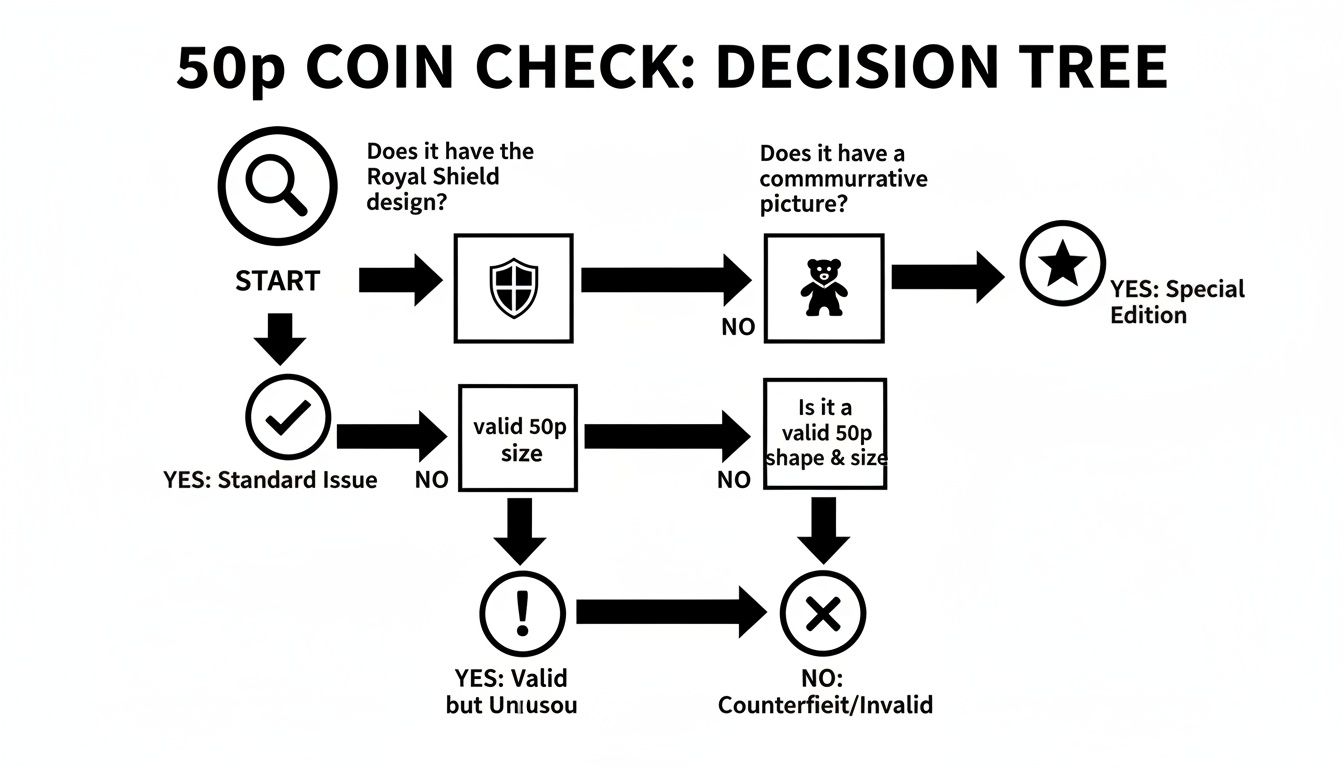
This flowchart gives you a great visual for that initial sorting process, showing how a simple observation can lead you down the path to identifying a potentially valuable coin.
Examining the Date and Monarch
So, you've found a commemorative design. Fantastic. The next thing to check is the date, which you'll find stamped on the coin (usually on the reverse side). The year it was minted is a massive clue to its story and potential rarity.
After you've got the date, flip it back over to the 'heads' side and look at the monarch's portrait. Most coins in circulation will feature one of the various portraits of Queen Elizabeth II, but you'll also find the newer portrait of King Charles III. Each portrait corresponds to a specific minting period, giving you another piece of the puzzle. Our guide on which 50p coins are rare dives deeper into how specific dates and designs affect a coin's collectability.
Here’s a quick-glance table to help you with these first checks.
Key Features for Initial 50p Coin Identification
This table breaks down the fundamental visual checks that every collector should get used to performing on any 50p coin they come across.
| Feature to Check | What to Look For | Why It Matters |
|---|---|---|
| Reverse Design | A picture (commemorative) or a segment of the Royal Shield (standard). | This is the primary filter. Commemorative designs are the only ones with potential collector value beyond their face value. |
| Date | The four-digit year stamped on the coin, usually on the reverse. | The year directly correlates to the coin's mintage figures, which is a key indicator of rarity. |
| Monarch's Portrait | The specific effigy of Queen Elizabeth II or King Charles III on the obverse. | Different portraits were used in different eras, helping to confirm the coin's age and authenticity. |
| Size and Weight | Modern 50ps are smaller (27.3mm, 8g). Pre-1997 coins were larger (30mm, 13.5g). | Any of the older, larger 50ps are instantly interesting as they were withdrawn from circulation. |
Mastering these basic checks will quickly become second nature and dramatically speed up the process of sorting through your change.
A Legacy of Collectibility
Ever since it was first introduced, the 50p has become one of Britain’s most collected modern coins. With over 100 different designs released by The Royal Mint, it’s no wonder a nationwide treasure hunt has sprung up around them.
It's also worth remembering that the original, larger 50p coins were replaced on 1 September 1997 by the smaller version we use today. This means any of the old, chunky pre-1997 coins you might find are automatically worth a second look.
Collector's Tip: Don't be too quick to dismiss a coin just because it looks a bit grubby or worn. Some of the rarest 50p coins have been knocking about in people's pockets for years. Always identify the design and date first—you can worry about the condition later on.
Decoding Mintage Figures to Find True Rarity
So, you've found a cool commemorative 50p. The first question that pops into your head is always the same: is it actually rare? The answer almost always boils down to one critical piece of information: the mintage figure.
This is simply the total number of a specific coin that The Royal Mint produced for circulation. It's the single most important factor in determining how rare a coin is and, ultimately, what it might be worth.
A coin's design can be absolutely stunning, but if millions upon millions were made, it's unlikely to ever be worth much more than its face value. On the flip side, a coin with a relatively simple design but a tiny mintage can become incredibly sought-after. It’s a classic case of supply and demand.
Mintage Numbers in the Real World
Let's talk about the most famous example of all: the 2009 Kew Gardens 50p. Its design, featuring the iconic Chinese Pagoda, is lovely. But what makes it the holy grail for collectors is its astonishingly small mintage of just 210,000.
To give you some perspective, most commemorative 50p coins are minted in the millions. This extreme scarcity is what turned an ordinary 50p into a numismatic legend. Finding one in your change is the ultimate prize for many collectors, and its value has soared purely because so few exist. Getting your head around this concept is how you level up your 50p coin checker skills from just identifying designs to genuinely understanding value.
For 15 years, the Kew Gardens 50p proudly held the title of the rarest 50p. That record was only recently broken by the Atlantic Salmon 50p released in 2023, which had an even smaller mintage of just 200,000 coins.
To see the other end of the scale, look at the 2022 Queen Elizabeth II Memorial 50p. A staggering 9.6 million of these were released, highlighting the massive difference between a common issue and a truly rare find. For a deeper dive, it's worth checking out a detailed list of the top ten rarest 50p coins to see how these numbers stack up.
Comparing 50p Coin Mintage Figures High vs Low
Seeing the numbers side-by-side really drives home the difference between a common coin you'll find every day and a genuinely scarce one. This table illustrates just how dramatic that contrast can be.
| Coin Name | Year of Issue | Mintage Figure (Approx.) | Relative Rarity |
|---|---|---|---|
| Atlantic Salmon | 2023 | 200,000 | Extremely Rare |
| Kew Gardens | 2009 | 210,000 | Extremely Rare |
| 2017 Sir Isaac Newton | 2017 | 1.8 Million | Scarce |
| 2018 Peter Rabbit | 2018 | 1.4 Million | Scarce |
| Queen Elizabeth II Memorial | 2022 | 9.6 Million | Very Common |
| Brexit "Peace, Prosperity..." | 2020 | 10 Million | Very Common |
As the table shows, finding a coin with a mintage under two million is a fantastic find. Anything with a mintage under 500,000 is truly exceptional.
Key Takeaway: Always check the mintage figure for any commemorative coin you find. A quick search of the official Royal Mint mintage figures can instantly tell you if you've found something common or something worth setting aside. This simple habit separates casual hobbyists from serious collectors.
How to Grade Your Coins Like a Pro
Ever wondered why two identical rare coins, same design, same date, can have completely different values? It all comes down to one thing: condition.
A sharp, gleaming coin fresh from a Royal Mint set will always be worth more than its twin that's spent a decade being knocked about in pockets and tills. Learning to judge the condition—or 'grade'—of your finds is a crucial skill for getting the most out of any 50p coin checker.
Grading is more than just spotting a few scratches. It's about looking at the coin as a whole and seeing how much of its original detail has survived. Think of it like a brand-new book with crisp, untouched pages versus a well-read favourite with a softened spine. They're the same story, but one is in a far more collectible state.
Key Details to Examine
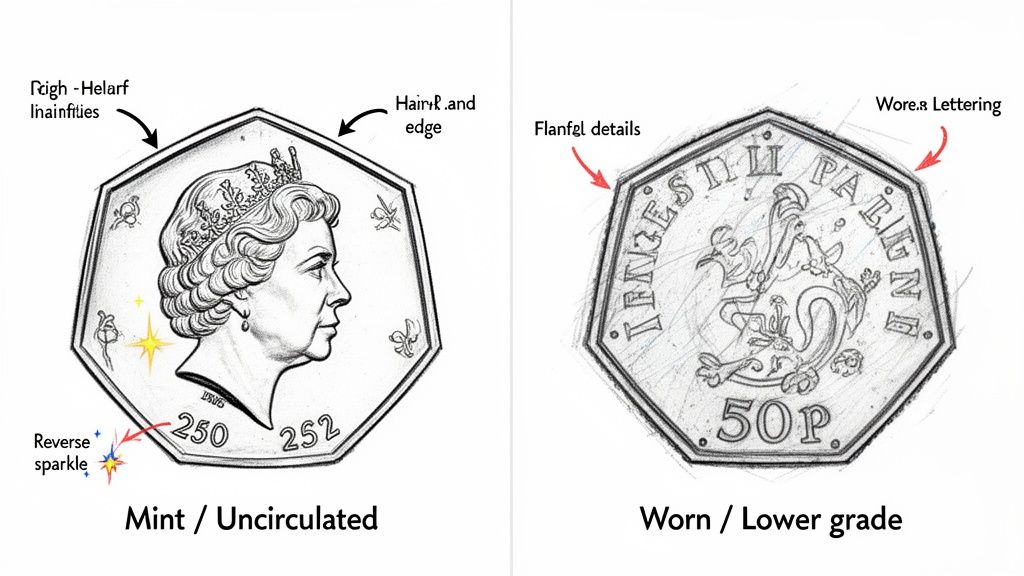
When you start grading, the first thing you need to train your eye on are the 'high points' of the design. These are the raised areas that get worn down first from being handled. On 50p coins, these key areas are pretty consistent no matter the design.
Start with the Queen's (or King's) portrait on the obverse—the 'heads' side. The hair is your best indicator. On a top-quality coin, you should be able to make out the fine, individual strands and clear contours. On a well-circulated coin, these details will look flattened, almost blurred together.
Now, flip it over to the reverse. This is where you look for the tiny, intricate details. It could be the texture of Peter Rabbit's fur, the delicate veins on the Kew Gardens pagoda leaves, or the fine patterns within a shield. The more of these little details that remain sharp and distinct, the better the coin's grade.
Understanding Common Condition Levels
In the world of coin collecting, you'll hear specific terms thrown around to describe a coin's condition. While the professional grading system is incredibly detailed, you can get a really good handle on things by understanding a few basic tiers. For a much deeper dive, our coin grading guide for beginners and experts breaks down all the specific terminology.
Here’s a simple way to think about it:
- Brilliant Uncirculated (BU): This is a coin that has never seen the inside of a wallet. It looks exactly as it did the day it was minted, with full lustre and zero signs of wear. You’ll usually only find these in special collector sets.
- About Uncirculated (AU): This coin might have been in circulation, but not for long. You’ll see just the slightest hint of friction on the very highest points of the design, and most of its original mint shine is still there.
- Fine to Very Fine (F-VF): This is the state of most older coins you’ll pull from your change. The main parts of the design are clear, but there's obvious wear on high points like the Queen's hair and cheeks. A lot of the finer details will be smoothed out.
- Good: At this level, the coin is heavily worn. You can still make out the main design, but most of the intricate details have vanished completely. The rim might even be worn down and less distinct.
Grading in Practice: Imagine you find two 2017 Sir Isaac Newton 50p coins. One has really sharp lines in his hair and the text is crisp. The other feels smooth to the touch, and the details in his hair have all merged into one. That first coin is in a much higher grade, making it far more desirable—and valuable—to a collector.
Using Online Price Guides and Checkers Wisely
So, you think you’ve got a potential treasure in your hand. The natural next step for most people is to jump online. A quick search for a "50p coin checker" will throw up a dizzying number of websites, apps, and marketplace listings, all promising to tell you what your coin is worth.
But this is where you need to be careful. Navigating these digital resources requires a bit of savvy to avoid the most common pitfalls.
The Asking Price vs. Sold Price Trap
The single biggest mistake new collectors make is confusing an asking price with a sold price. An asking price, particularly on a marketplace like eBay, is nothing more than what a seller hopes to get for their coin. It can be wildly optimistic and, frankly, often has no basis in reality.
To get a true feel for a coin's value, you have to dig a little deeper. Most major online marketplaces, including eBay, have a filter that lets you see only "Sold Items" or "Completed Listings." This is where the real gold is.
This simple switch cuts through all the noise. It shows you what people have actually paid for a specific coin in a condition similar to yours. A seller might have a common commemorative 50p listed for £50, but a quick look at the sold listings will probably show it consistently selling for just £1.50. That's its genuine market value.
A coin is only worth what someone is willing to pay for it. Sold listings are your direct window into the current market, giving you a dose of reality that cuts through the hype of inflated asking prices.
Cross-Reference Everything for Accuracy
You should never, ever rely on a single source for a valuation. It’s a bit like getting a second opinion from a doctor. To get a balanced view, I always recommend checking at least three different places. This process, often called triangulation, helps you spot any oddities and build a much more accurate picture of your coin's potential worth.
I'd suggest using a mix of these resources:
- Specialist Coin Dealer Websites: Reputable dealers (like us!) often have price guides or sell coins at established market rates, giving you a solid baseline.
- Marketplace Sold Listings: eBay is the go-to, but always, always filter by "Sold" to see what people are actually paying.
- Dedicated Collector Forums: Online communities and blogs are brilliant for getting context. Members often discuss recent sales and market trends, which is invaluable information.
Let's take a real-world example. Say you find a 2017 Sir Isaac Newton 50p. You might see a dealer listing a nice one for £4. A search on eBay's sold listings might show it averages around £3.50. Then, a quick check on a collector forum confirms it's a popular coin but not exceptionally rare.
Putting it all together, you can be pretty confident its value is somewhere in the £3-£4 range. This simple bit of research protects you from both overpaying if you're buying and underselling if you're looking to part with it.
Identifying Counterfeits and Demonetised Coins
With the boom in 50p coin collecting, there's been an unwelcome rise in fakes hitting the market. An absolutely essential part of checking any 50p, whether you're using a fancy online tool or just your own eyes, is learning how to spot a dud. These counterfeits can range from laughably bad copies to replicas that are surprisingly convincing at a glance, but they nearly always have tell-tale signs if you know where to look.
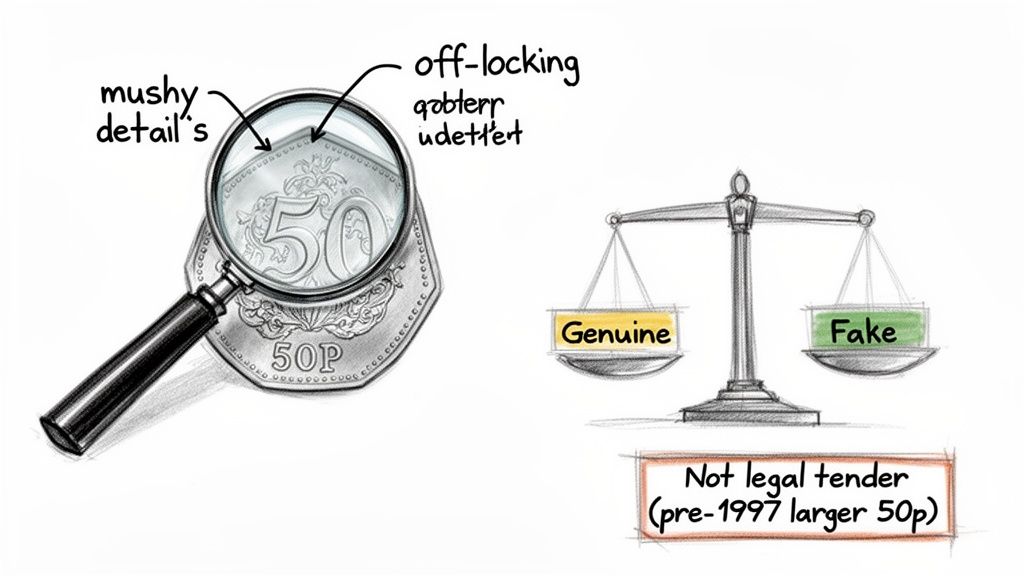
A genuine coin struck by The Royal Mint has incredibly sharp, crisp details. Fakes, on the other hand, often look a bit 'mushy' or soft, especially on intricate areas like the Queen's hair or the fine lines of a shield design. The lettering is another dead giveaway; keep an eye out for dodgy fonts, weirdly spaced letters, or edges that just aren't clean and defined. Stepping back for a moment, understanding the broader principles of fighting fraud with verified evidence can give you a better mindset for authenticating any collectible.
Common Red Flags for Fake Coins
One of the most reliable tests? Its weight. A standard, modern 50p coin should weigh exactly 8.00 grams. Fakes are often made from cheaper metals and will feel noticeably lighter or, in some cases, heavier. If you have a sensitive digital scale, this is one of the fastest and most definitive checks you can do.
Here are a few other key things to watch for:
- Poor Edge Quality: Take a close look at the seven-sided edges. They should be clean and precise. Counterfeits often have rough, uneven, or inconsistent edges.
- Incorrect Magnetic Properties: A genuine 50p is made of cupro-nickel, which isn't magnetic. If a coin snaps to a magnet, you've got a fake on your hands. Simple as that.
- Mismatched Obverse and Reverse: This is a classic blunder by counterfeiters. They sometimes pair a monarch's portrait with a reverse design from an entirely different era. A quick search will confirm if the pairing is correct.
For a much deeper dive into this, you might find our guide on 7 proven methods for detecting counterfeit coins helpful, as it’s packed with more professional tips.
Understanding Demonetised Coins
It's also really important for new collectors to get their heads around the difference between a rare coin and one that's been demonetised. This is a common trip-up, especially when it comes to the older, larger 50p coins.
The big change happened back in 1997 when The Royal Mint made the 50p smaller and lighter. As a result, the original, larger 50p coins that had been jangling in our pockets since 1969 were officially demonetised and pulled from circulation on 28 February 1998.
What this means for you is that while these big old coins can still be very collectible and feature some fantastic designs, you can no longer pop down to the shops and spend them. Their value is purely numismatic, not legal currency. Knowing this protects you from overpaying for a coin under the mistaken belief it also holds spendable value.
So You've Found a Treasure. What's Next?
Okay, so you've done the groundwork. You’ve sifted through your change, used a 50p checker to identify a rare design, and given it a good look over to confirm it’s in decent shape. The real question is, what do you do now? This is where the fun of coin collecting moves from simple identification to making some smart decisions.
For many of the scarcer 50p coins you’ll come across, their value is pretty well-established online. This makes selling them directly fairly straightforward. But if you’ve stumbled upon something truly special – say, a genuine Kew Gardens 50p that looks like it just left the mint – then getting a professional appraisal is a very wise move. Think of it as an investment. A formal valuation not only authenticates your coin but is essential if you ever need to insure it or sell it for a significant sum.
Deciding How to Sell Your 50p
Once you know exactly what you’re holding, you’ve got two main paths you can take to sell your find. Neither is right or wrong; it just depends on what you're looking to achieve.
- Selling to a Dealer: This is your fastest and simplest route. A good, reputable dealer will give you a fair market offer and you get your money on the spot. You might get a little less than you would at an auction, as they need to make a profit too, but for a secure and totally hassle-free sale, it's hard to beat.
- Selling at Auction: Putting your coin up for auction, whether online or at a physical auction house, opens it up to a much bigger pool of keen collectors. This is where you have the potential to get a brilliant price, especially if a couple of bidders get competitive. The flip side is that it takes longer, and you will have to pay commission fees from the final sale price.
A Quick Tip: Your choice really comes down to speed versus potential profit. A quick sale to a dealer means instant cash in your hand. An auction could bring a bigger payday, but it demands more patience and you'll have to account for the fees.
As your collection starts to get more impressive, don't forget about protecting it. It’s worth taking a moment to understand content insurance for storage to make sure your valuable 50p coins are properly covered against any unexpected mishaps.
Got Questions About Your 50p Coins?
Getting your head around 50p coins can bring up plenty of questions. It happens to everyone, from brand new collectors to seasoned pros. Let's run through some of the most common queries I hear.
What's the First Thing I Should Be Looking For?
Always, always flip it over to the reverse – the 'tails' side. The coin you'll see most often, by a long shot, is the one showing a small section of the Royal Shield.
If you spot anything else – an animal, a famous person, a building, a logo for an event – stop right there. You've found a commemorative coin. The next move? Check the date immediately. Those two things, the design and the year, are your starting block for figuring out exactly what you've got.
Are the Coins from Royal Mint Sets Actually Worth More?
The short answer is yes, almost every time. Coins sold in official Royal Mint sets are usually struck to what we call a 'Brilliant Uncirculated' (BU) standard.
This just means they're in mint condition. They've never been jumbled around in a pocket or a till, so they’re free from the dings and scratches of everyday life. This superior quality makes them far more appealing to collectors. Even if the design itself is common, a BU version from a set will always fetch a higher price than one from your change because it’s crisp, clean, and has all its original detail.
Collector's Insight: Think of it like this: a coin from a set is a first edition hardcover book, pristine and untouched. A coin from your change is a well-loved paperback that’s been passed around. Both tell the same story, but one is in a much more collectible state.
I Think My 50p Has a Mistake on It. Is It Valuable?
It certainly can be, but you have to be realistic. Genuine, valuable errors are incredibly rare. A major blunder during the minting process, like a coin being struck way off-centre or with mismatched designs (what we call a 'mule'), can be worth a serious amount to the right collector.
However, most of what people find are just the bumps and scrapes of circulation, or tiny variations from the production line. A weak strike or a small mark isn't the kind of error that makes a coin valuable. It takes a trained eye to spot a true minting error, so it’s always a good idea to get a professional opinion before you start celebrating.
At Cavalier Coins Ltd, we live and breathe numismatics. Whether you're just starting your collection or searching for that one elusive piece, explore our curated selection of rare and fascinating coins from around the world at https://www.cavaliercoins.com.