
You've found a banknote collection for sale, perhaps in an online auction, a private social-media listing, or an estate clearance. The photographs show a pile of old notes, the seller says they're “rare”, and the asking price looks either suspiciously cheap or impossible to justify. Without a method, you're not buying a collection. You're buying the seller's description.
The smart approach starts with two questions. Which country and era do the notes belong to, and has their condition been properly assessed or merely assumed? Those answers determine whether you're looking at face-value currency, an interesting historical group, or a collection containing genuine premiums.
What You Need to Know Before Buying a Banknote Collection
Start with the country and era, not the claimed value. A group of modern UK polymer notes needs a different assessment from handwritten or engraved Bank of England issues, wartime emergency currency, or foreign notes from a discontinued monetary system. The Bank of England has issued banknotes since 1694, with first printed notes appearing in 1725, the first monarch portrait arriving in 1960, and the first polymer note released on 13 September 2016, as recorded in the Bank's official history of banknotes.
The modern UK timeline is particularly clear. The polymer Series G rollout began with the £5 note in 2016 and was completed with the £50 note in 2021. The first notes featuring King Charles III were issued on 5 June 2024, giving collectors a defined transition between Elizabeth II and Charles III issues. That framework supports themed sets, date-based collecting, and focused searches for early examples.
Dealer's rule: Never price a mixed box until you know what has been mixed together.
Condition is the second question, and sellers routinely get it wrong. “Old but excellent” tells you nothing. A note may be visually attractive while carrying a light central fold, rounded corners, handling marks, staining, or evidence of pressing. Those defects separate an uncirculated note from a circulated one, and the price difference can be substantial.
You must also separate face-value recovery from collector value. The Bank of England states that genuine withdrawn notes retain their face value and can be exchanged, but the Bank itself pays no collector premium. A collector or specialist dealer may pay more for rarity, condition, serial numbers, or desirability. That's why one note can be worth only its printed denomination to a bank yet attract a much higher offer in the collecting market.
Before committing, decide whether you're buying for a focused collection, resale inventory, historical interest, or a quick face-value recovery. A useful guide to collecting banknotes will help you establish that focus before you start bidding.
Where to Find a Banknote Collection for Sale
The source affects both price and risk. A collection bought from a specialist auction house may come with descriptions, provenance and professional photography, but you'll pay for access and must still understand the grading. A private seller may offer a better price, yet you'll carry nearly all the authentication and condition risk.
Specialist auctions suit disciplined buyers
UK auction houses such as DNW, Noonans and Spink are appropriate when you can read descriptions critically and calculate the full landed cost. Auction listings can reveal serial numbers, signatures, varieties and provenance that private adverts often omit. The drawback is competition, plus the buyer's premium and any delivery or handling charges.
Set a maximum all-in price before bidding. Don't let a low hammer estimate persuade you that you've found a bargain if the final bill changes the economics. Auction buying works best for experienced collectors who already know the relevant series and can distinguish a meaningful variety from a routine issue.
Established dealers reduce uncertainty
A reputable online dealer usually gives you clearer photographs, a defined return policy and a more consistent description of condition. You'll often pay more than for an unresearched auction lot, but that premium buys convenience and lower execution risk.
This route suits new collectors, buyers seeking a particular note, and resellers who need predictable stock. Ask whether photographs show the exact note, whether the note has been pressed or repaired, and how the seller handles authenticity disputes. Don't accept stock images for a supposedly scarce serial-number variety.
Private sales can produce the strongest buys
Private estate sales, local collecting groups and social-media listings sometimes contain overlooked material. Sellers may value the whole group by face value or by a rough internet search, leaving room for an informed buyer to identify pieces they've missed.
That opportunity comes with a strict condition. You need to inspect the actual notes, both sides, before paying whenever possible. If the seller refuses clear images, avoids serial-number questions, or insists on irreversible payment, walk away. A private sale only works when the discount compensates for the additional uncertainty.
Charity and institutional clearances deserve attention
Charities and organisations sometimes receive donated coin and banknote collections and prefer a single buyer rather than spending staff time sorting and listing every item. That can create legitimate opportunities for resellers and bulk purchasers, particularly when the buyer can make a prompt offer and collect the material efficiently.
The right approach is a fast triage. Separate modern common notes, older paper issues, unusual denominations, high-grade pieces and anything with distinctive serial numbers. Offer on the group only after estimating its composition and condition. Charities need a clear transaction, not a speculative promise that the collection might be valuable.
For more practical selling and sourcing options, compare the methods in this guide to where to sell old banknotes. The right channel depends on whether you value maximum price, speed, professional descriptions or the ability to inspect everything before purchase.
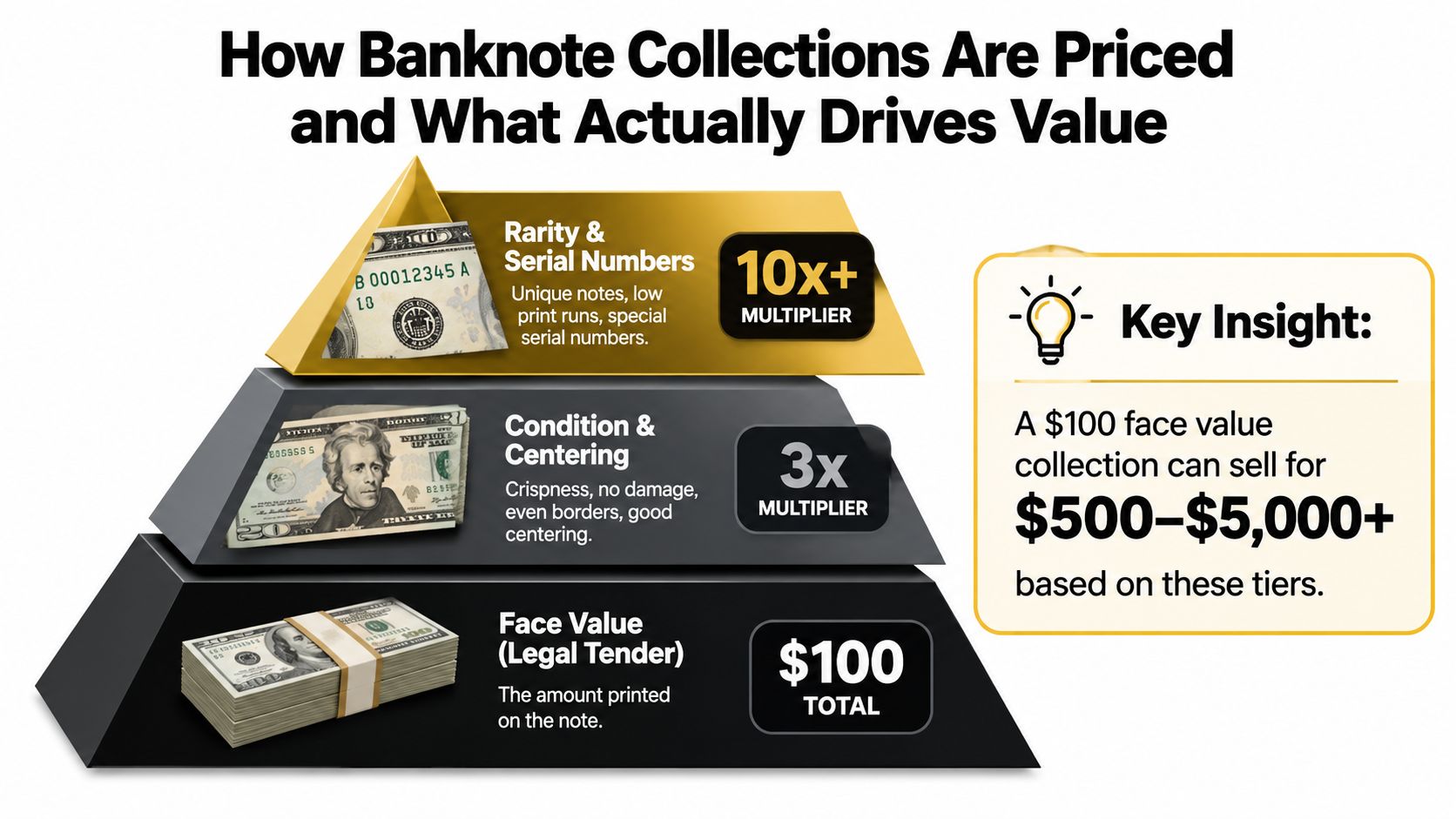
How Banknote Collections Are Priced and What Drives Value
The Bank of England will exchange a genuine withdrawn note at face value. That helps with recovery, but it does not establish collector value. A specialist buyer prices the note as a scarce, well-preserved and desirable object, not as money.
The strongest premiums in a UK banknote collection for sale often hide in details that a casual photograph fails to show. First-run prefixes, low serials, fancy serials, matched sets and genuine printing errors can separate an ordinary group from a collection worth substantially more than face value.
Serial numbers can change the entire calculation
First-run prefixes provide a sensible starting point. Early prefix combinations from a new issue attract collectors seeking the beginning of a series. A polymer £5 with an early AA01 prefix is a different proposition from a routine note with an ordinary serial sequence. Verify the prefix on the note itself. Never rely on a listing title.
Low serial numbers also command attention. A low four-digit serial can interest collectors across denominations, particularly on an early issue or within a recognised collecting theme. Fancy serials, including repeating digits, ladders and radar-style sequences, appeal because they are visually distinctive. Their value depends on demand, appearance and genuine scarcity. Do not pay extra just because a seller labels an unusual number “fancy”.
Matched sets can add structure to otherwise ordinary notes. Consecutive serials, denomination runs and coordinated prefix groups make a collection easier to understand and sell as a coherent set. The notes should be consecutively numbered and in comparable condition. A partial group with missing pieces deserves a lower valuation.
Genuine printing errors can create scarce varieties. Miscuts, significant misalignment and ink errors may be valuable, while trimming damage, ink wear and photographic distortion are not errors. Request sharp images of the margins and compare the feature with known examples before making an offer.
Era and grade still dominate the result
Pre-1957 white Bank of England £5 notes show the gap between ordinary and exceptional material. Circulated examples typically sell for around £40 to £100, while uncirculated examples can realise £300 or more, depending on signatures, serial ranges and condition, according to Warwick & Warwick's collecting guide. A single crease on an otherwise mint note can cut value by as much as half, depending on the issue and grade. Treat “nearly perfect” as a description, not a formal grade.
| Value driver | Example | Potential premium |
|---|---|---|
| Series and era | Pre-1957 white £5 or an early polymer issue | Can move a note beyond face value |
| Condition | Genuine uncirculated paper with sharp corners | Often the decisive pricing factor |
| Prefix | First-run prefix such as AA01 | Depends on demand and authenticity |
| Serial number | Low, repeating, ladder or radar-style sequence | Can create collector interest |
| Matched group | Consecutive or coordinated notes | Adds set appeal when complete |
| Printing error | Genuine miscut, misalignment or ink error | May create a scarce variety |
Third-party grading from services such as PMG or PCGS Currency makes sense for rare, high-value notes where authentication and a standardised grade improve buyer confidence. It adds unnecessary friction for a common circulated note that can be sold with clear photographs and an accurate description.
How to Inspect and Grade Banknotes Before You Buy
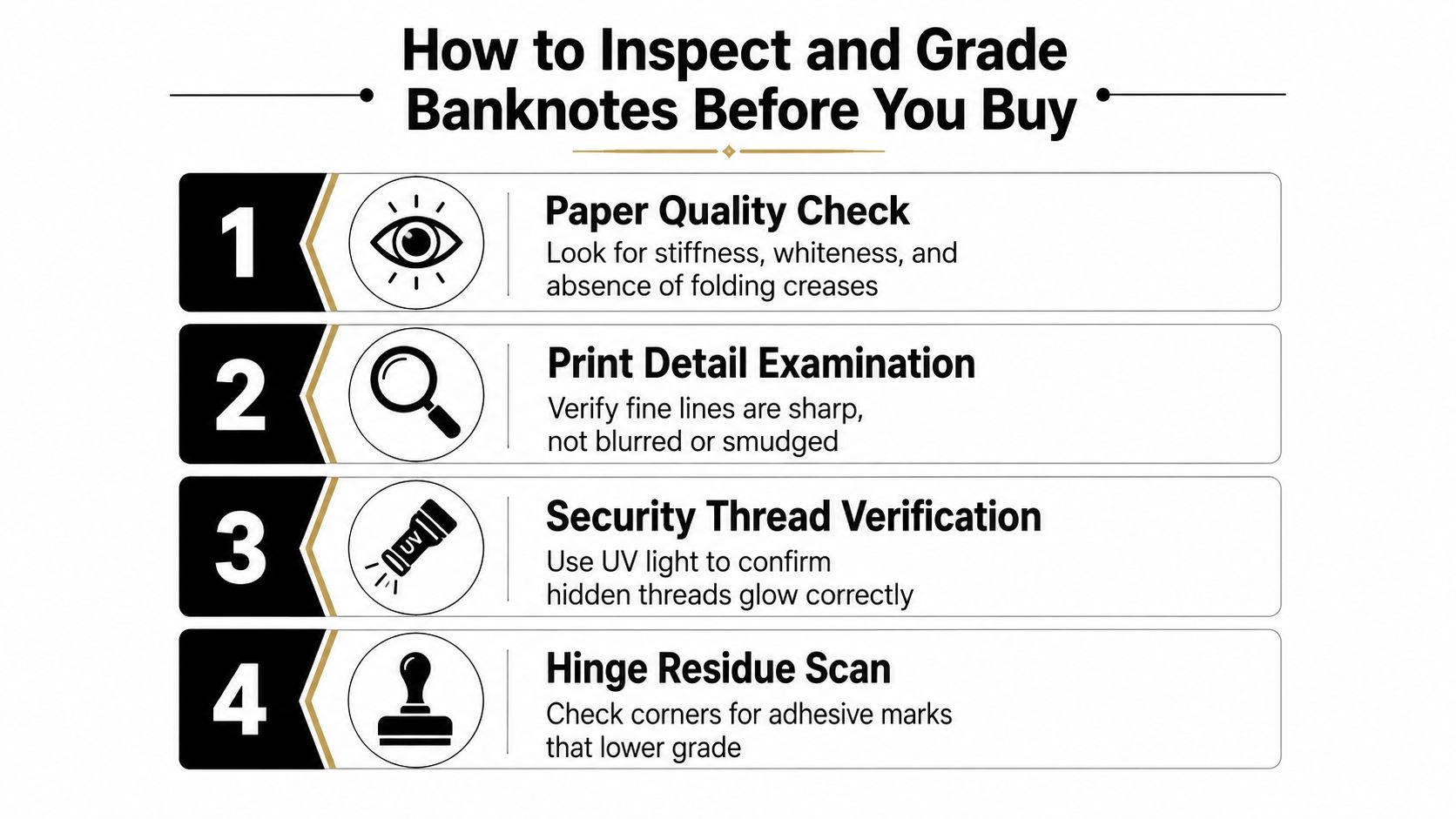
A note can look flawless in a sleeve and reveal a crease, repair or trimmed edge once it is out. Remove it carefully, hold only the edges, and place it on a clean surface. Inspect both sides under strong angled light, because folds and reverse-side defects can disappear when viewed flat-on, as explained in this inspection guidance for Bank of England notes.
Begin with the paper or polymer surface. Check for stiffness, limpness, discolouration, stains, dirt and unnatural gloss. Older paper notes should feel consistent with their issue, with sharp printed detail. On polymer notes, examine the transparent window, holographic elements, raised print and colour-shifting features. Blurred, flat or poorly aligned security details require further investigation.
Use a repeatable physical workflow
- Remove the holder: Take the note from its sleeve without dragging it across rough plastic. Hold the edges and never pull from a corner.
- Check the front under angled light: Rotate the note until the light catches folds, pressure marks, hairlines and surface disturbance.
- Turn it over: Inspect the reverse for stains, repairs, tape, writing, pinholes and edge damage hidden from the front.
- Examine corners and margins: Look for rounding, splits, short tears, trimming and uneven margins. Compare the design margins from side to side.
- Photograph before negotiating: Take sharp, evenly lit images of serial numbers, signatures, security features and defects.
UK buyers commonly use grades such as UNC, AU, VF and F. UNC means uncirculated, with no folds or handling wear and sharp corners. AU may show slight handling. VF shows clear circulation but retains strong detail, while F has more obvious folds, softness and wear. Treat these labels as shorthand only. The photographs and the note in hand determine whether the grade is credible.
Authenticity comes before value
The Bank of England reported that counterfeit Bank of England notes in 2025 were typically less than 0.0041% of notes in circulation, fewer than 1 in 24,390, according to its counterfeit banknote statistics. A counterfeit rate below one in 24,000 does not remove the buyer's responsibility. Most fakes encountered will be modern polymer attempts rather than convincing paper replicas, so scrutinise the security features counterfeiters most often miss.
For modern polymer notes, compare the see-through window, hologram, raised lettering and colour-changing elements with a confirmed genuine example. For older notes, examine the paper, watermark, engraving, registration and fine-line printing. A magnifier helps, but it cannot replace experience. Pause a purchase if a valuable note has unclear provenance or unusual features, and have a specialist review it.
Use a written condition report for a large group. Record the grade, defects, serial number and photograph reference for every significant note. This creates evidence for negotiation, resale or an insurance discussion.
A practical guide to grading banknotes helps keep terminology consistent, but do not let a label overrule what the note shows in hand.
Navigating the Purchase Process from Offer to Delivery
A good transaction starts before the price is discussed. Ask for an inventory or at least a useful breakdown of denominations, series, condition and serial-number highlights. A seller who can explain what's present is easier to negotiate with than someone offering an unexamined “rare collection”.
The UK market includes over 4.98 billion Bank of England notes in circulation, worth approximately £91.5 billion, across the four active denominations of £5, £10, £20 and £50, according to the Bank of England's banknote statistics. That scale is why denomination alone proves little. A bulk buyer needs to understand how much of the group is common circulated material and how much contains worthwhile series, condition or scarcity.
Negotiate from defects, not emotion
Separate the inspection from the offer. First document folds, stains, rounded corners, repairs, missing notes and uncertain authenticity. Then compare the strongest pieces with sold auction results or established dealer pricing for the same issue and grade. The seller's asking price is not a comparable.
For a mixed lot, value the collection in layers:
- Face-value layer: Identify genuine withdrawn notes that can still be recovered at face value.
- Collector layer: Isolate older, scarce or historically desirable issues.
- Premium layer: Flag low serials, early prefixes, matched sets and genuine errors.
- Risk layer: Discount anything with uncertain authenticity, inaccessible notes or unverified condition.
A single offer for the entire collection can be attractive to an estate or charity because it avoids sorting and listing work. Make that offer clear, explain the main deductions, and state how quickly you can complete the purchase. Bulk pricing from an established dealer may also be available, but ask directly rather than assuming an item-by-item list price is final.
Protect payment and delivery
Use a payment method that leaves evidence and offers recourse. For high-value purchases, a bank transfer provides a clear record when the seller is established and verified. PayPal Goods and Services or a protected card payment can be more suitable when buying online from an unfamiliar seller. Cash may work for a low-value face-to-face transaction, but it gives you little protection if the contents differ from the description.
Require flat packing. Notes should travel in protective sleeves inside rigid card-backed packaging, not folded into a soft envelope. Use tracking, signature on delivery and insurance for the full replacement value. Keep the listing, photographs, messages, invoice and dispatch details together until you've checked every item.
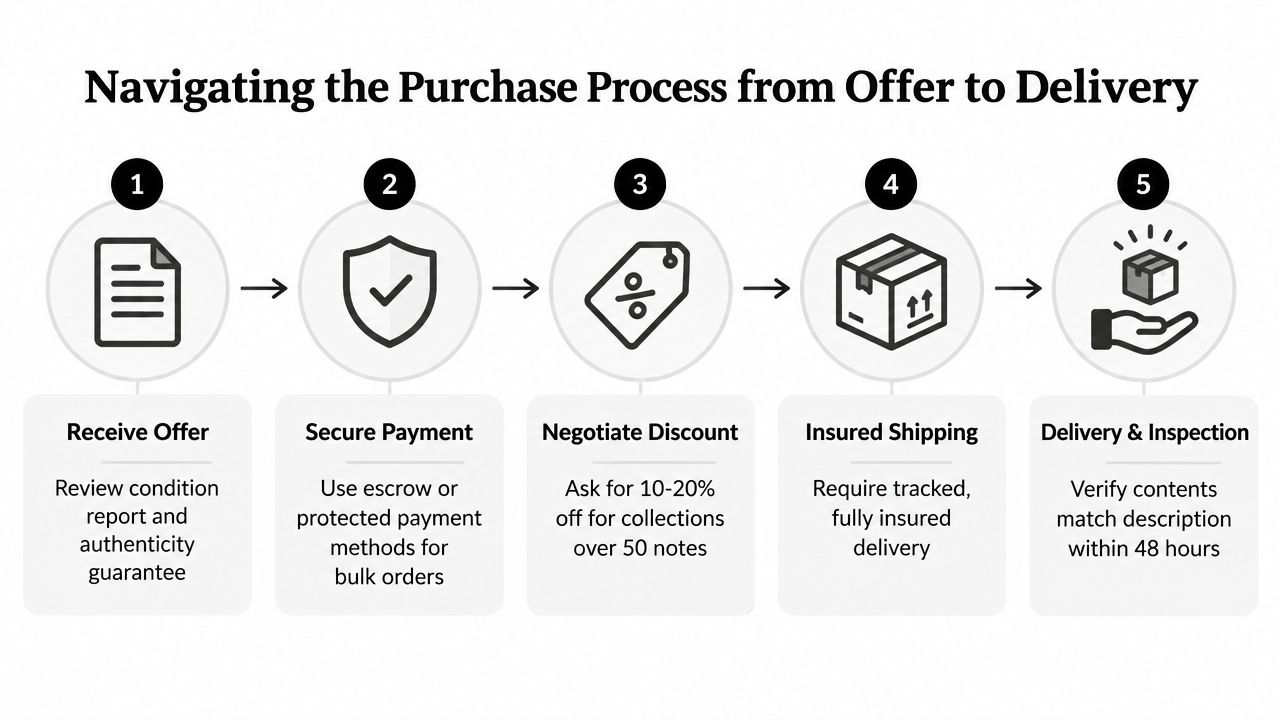
Inspect the shipment promptly. Compare serial numbers, varieties, grades and quantities with the agreed description before you store the notes permanently. If something is missing or materially different, photograph the packaging and contents before contacting the seller.
Red Flags to Watch For and a Pre-Purchase Checklist
A low price isn't automatically a bargain. It may reflect circulated condition, common material, incomplete sets, hidden damage or a seller who wants payment without scrutiny. Treat urgency as a warning sign, not proof of scarcity.
Reject listings that refuse clear photographs of both sides, use inflated grades, claim famous provenance without paperwork, or keep individual notes sealed inside an uninspectable lot. Be especially cautious with notes described as “mint” when the images show a fold, soft corner or suspiciously flat surface. Pressed and washed notes can look better at first glance, but the treatment damages collector value.
Payment matters just as much. Cryptocurrency, gift cards and direct transfers to an unknown account remove practical recourse. A seller who won't provide a name, address, return terms or authenticity position isn't offering a professional transaction.
Run this checklist before paying:
- Identify the issue: Confirm country, denomination, series, date and signatures.
- Record the serial: Check prefixes, low numbers, repeating patterns and consecutive runs.
- Inspect both sides: Use angled light and remove the note from its holder.
- Assess the grade accurately: Match UNC, AU, VF or F to visible wear.
- Check authenticity: Compare security features and fine printing with a genuine reference.
- Separate the lot: Distinguish face-value notes from collector and premium candidates.
- Confirm the terms: Get the price, returns, shipping, insurance and authenticity position in writing.
- Use protected payment: Don't send irreversible funds to an unverified seller.
The expensive mistake: Paying a rarity price for an ordinary note because the listing title sounds authoritative.
A collection is only as good as its weakest assumptions. If the seller won't let you test those assumptions, the correct decision is to leave the lot behind.
Cavalier Coins Ltd offers fixed-price world and vintage banknotes, weekly eBay auctions, discounted direct pricing for bulk buyers, and bulk collection purchasing for charities. Visit Cavalier Coins Ltd to inspect current banknote listings or discuss a collection that needs a practical valuation.