
Whether you're just starting your collection or you're ready to sell a rare find, tracking down trustworthy banknote dealers in the UK is the most important first step. The journey usually involves a mix of specialist online shops, traditional auction houses, and local numismatic societies. The goal is to build a shortlist of credible experts you can rely on for a secure and fair transaction.
Where to Begin Your Search for UK Banknote Dealers
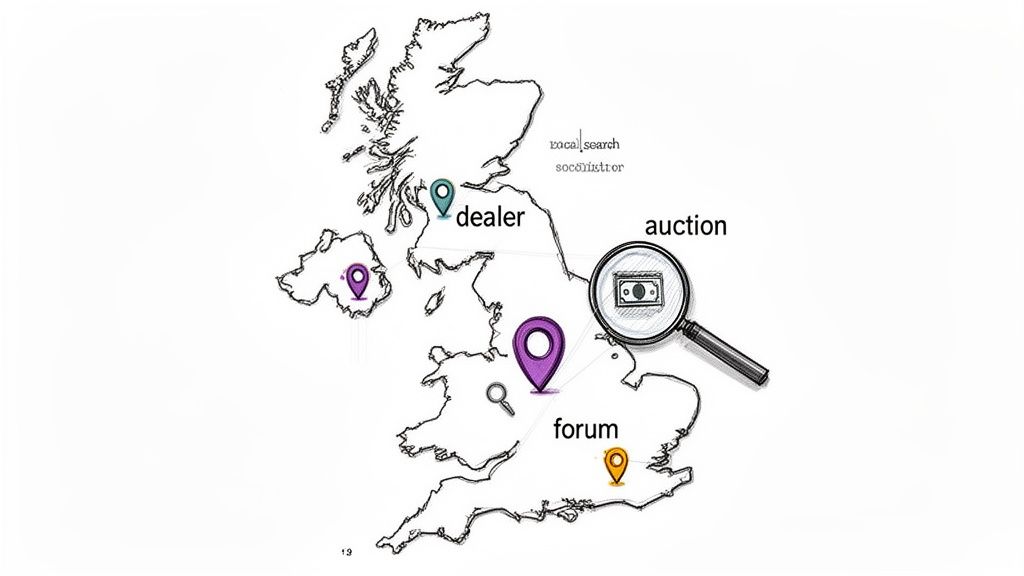
Jumping into the search for the right banknote dealer can feel a bit overwhelming, but breaking it down into a few key areas makes it much more manageable. The digital world is often the best place to start, as most established dealers now have a solid online presence.
Online Dealers and Digital Storefronts
Many of the UK's best banknote dealers now operate primarily online. This is great for collectors, as it gives you easy access to a huge inventory of notes, from common issues to exceptionally rare pieces.
Look for websites that look professional, are simple to navigate, and—most importantly—provide high-quality, clear images of the notes for sale. A well-maintained digital footprint is usually a good sign of a reputable business that values transparency and isn't trying to hide anything.
One of the big advantages of shopping with online dealers is the ability to browse their stock at your own pace. You can compare prices, look closely at different grades, and read up on the history behind various notes without feeling the pressure of an in-person visit.
Auction Houses Both Big and Small
Auction houses are another crucial resource, particularly if you’re dealing with high-value or exceptionally scarce banknotes. Big names like Spink & Son or Dix Noonan Webb (now known as Noonans) hold regular auctions dedicated to coins and paper money. Just following these sales is a fantastic way to get a feel for current market values and see what sort of items are generating a buzz.
But don't just focus on the major players. Smaller, regional auctioneers can sometimes be a source of hidden gems and often have less competition than the big London-based houses.
Expert Tip: Get on the email newsletter lists for a few different auction houses and online dealers. It’s a simple way to stay in the loop about upcoming sales and new stock, helping you spot opportunities right when they pop up.
Numismatic Societies and Collector Forums
Finally, never underestimate the power of the collector community. Joining a local numismatic society or getting active in online forums puts you in touch with experienced people who are almost always happy to share their knowledge and point you in the right direction.
Forums like The Coin Forum or Pre-Decimal.com have sections specifically for paper money where members chat about dealers, show off recent purchases, and offer solid advice. Getting first-hand recommendations from fellow collectors is one of the most reliable ways to build a list of trusted professionals.
If you're still looking for broader advice on where to sell old banknotes, starting with an introductory guide can give you a great foundation. This kind of community-based vetting is often the best way to find reputable banknote dealers in the UK.
Vetting Dealers and Verifying Authenticity
You’ve got a shortlist of potential dealers. Now for the important part: separating the seasoned pros from the opportunistic amateurs. Taking the time to do this properly is the single best way to protect your money and make sure you’re treated fairly, whether you're buying or selling.
Your first port of call should always be to check for professional memberships. It’s one of the clearest and quickest ways to gauge a dealer’s commitment to their trade.
Look for Professional Affiliations
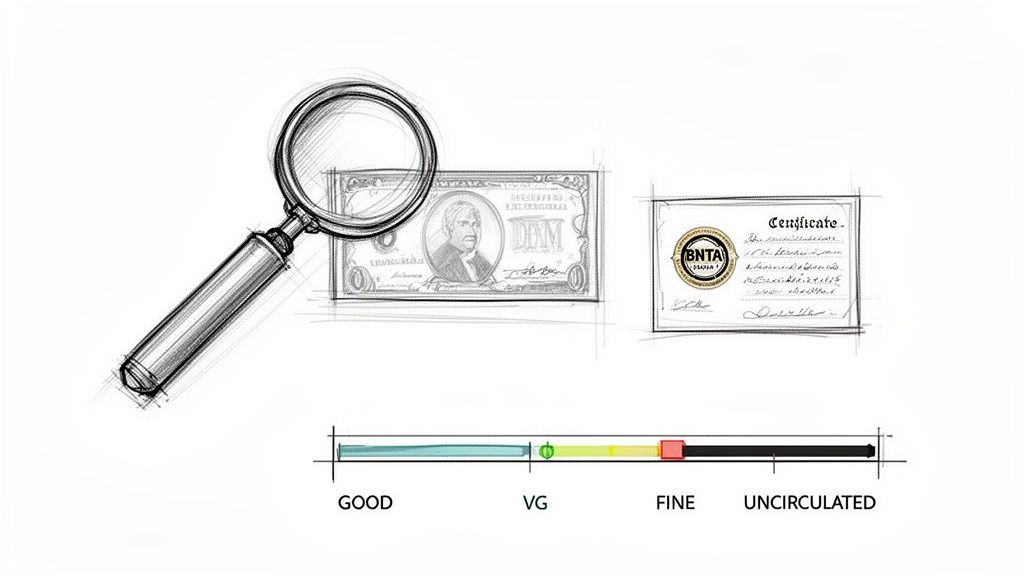
When you're looking at banknote dealers UK, the most important affiliation to see is membership in the British Numismatic Trade Association (BNTA). This isn't just a fancy logo for their website; it's a genuine mark of credibility.
BNTA members are held to a strict code of conduct, a key part of which is guaranteeing the authenticity of every item they sell. If something goes wrong, the BNTA even offers a mediation service, giving you an extra safety net. A dealer's membership tells you they are a serious, recognised professional in the numismatic world.
Membership in an organisation like the BNTA shows that a dealer is invested in their reputation and is accountable to a governing body. It’s a powerful trust signal that you shouldn't overlook.
Beyond the BNTA, look for other signs of professional life. Do they attend trade shows? Do they write for numismatic magazines or participate in online forums? This kind of activity shows a real passion and deep knowledge that goes far beyond simply running a business.
Reading Between the Lines of Reviews
Customer reviews can offer a peek behind the curtain, but you have to read them with a critical eye. Don't just glance at the star rating; dive into what people are actually saying.
- Look for specifics: Reviews that mention the accuracy of the grading, the quality of communication, or how securely the notes were packaged are far more useful than a simple "great service."
- Watch for patterns: A single generic negative comment might not mean much. But if you see consistent complaints about slow replies, inaccurate descriptions, or a difficult returns process, that’s a major red flag.
- Check their replies: How does the dealer handle feedback, particularly the negative stuff? A professional, helpful response shows they care about their customers. A defensive or aggressive one tells you everything you need to know.
This process helps you build a much clearer picture of who you’ll be dealing with.
To help you stay organised, use this checklist to quickly assess any potential dealer.
UK Banknote Dealer Vetting Checklist
Use this quick reference to assess the credibility and expertise of any potential banknote dealer.
| Verification Point | What to Look For | Why It Matters |
|---|---|---|
| BNTA Membership | A clear, verifiable BNTA logo or mention of membership on their website. | Guarantees adherence to a strict code of ethics and authenticity. |
| Customer Reviews | Detailed, specific feedback on platforms like Google, Trustpilot, or forums. | Provides real-world insight into their service, accuracy, and reliability. |
| Response to Feedback | Professional and constructive replies to both positive and negative reviews. | Shows accountability and a commitment to customer satisfaction. |
| Grading Transparency | Clear, consistent use of standard UK grading terms (e.g., UNC, EF, VF). | Demonstrates expertise and allows you to accurately compare prices. |
| Authentication Process | Willingness to explain how they verify the authenticity of their banknotes. | A confident expert will have a clear process and be happy to discuss it. |
| Community Involvement | Participation in trade shows, forums, or numismatic publications. | Indicates a deep passion for the hobby and a strong industry reputation. |
By running through these points, you can build confidence that you're working with a trustworthy and knowledgeable expert.
Understanding Banknote Grading and Authenticity
A good dealer will always be completely upfront about a note's condition. Getting to grips with the basics of banknote grading yourself will empower you to have a proper conversation and judge their expertise.
The grading scale is the common language for collectors everywhere, describing a note’s condition from heavily used to absolutely perfect.
- Good (G): A very heavily circulated note. Expect significant folds, dirt, and maybe even small tears or holes.
- Very Good (VG): Still very worn and limp from handling, but the main design is all there.
- Fine (F): Has seen a lot of use but is still a solid note. It will have multiple folds and creases.
- Very Fine (VF): The note is still quite crisp but has clear signs of use, like a few light folds or soft corners.
- Extremely Fine (EF): A really attractive note with just a hint of handling. Maybe one or two light folds, but that's it.
- About Uncirculated (AU): Looks uncirculated at first, but on close inspection, you might find a faint counting fold or a tiny corner flick from its time in a bank bundle.
- Uncirculated (UNC): A perfect note. No folds, no handling, no circulation at all. It looks and feels as fresh as the day it was printed.
Of course, authenticity is everything. Forgeries are always a concern, but any professional dealer worth their salt has the experience to spot them a mile off. To arm yourself with knowledge, have a read of our guide on the essential banknote security features to spot counterfeits.
And don't ever feel shy about asking a dealer about their authentication process. A true expert will be more than happy to explain what they look for.
Understanding How British Banknotes Are Valued
What's the difference between a banknote worth its face value and one a dealer might price at thousands of pounds? It’s not just about age. The valuation process is a fascinating blend of historical knowledge, meticulous inspection, and a sharp eye on current market trends.
A professional dealer’s first port of call is always the banknote's condition. This is arguably the most critical factor. A crisp, uncirculated note can be worth exponentially more than the exact same note with even a single fold. Dealers use a standardised grading scale, from ‘Uncirculated’ (UNC) right down to ‘Good’ (G), to paint a clear picture of its physical state.
The Impact of Rarity and Historical Context
Beyond its physical state, a banknote's rarity is a massive driver of its value. This isn't just a simple case of how many were printed; it’s about how many have survived in collectible condition over the decades. Most early notes were simply used until they fell apart and were destroyed, making any survivors genuinely scarce.
This is especially true for notes from periods of significant historical change. For example, the world of banknote dealing in the UK was transformed when the Bank of England gained a monopoly in 1921, ending the era of private banknote issuance. The sale of the David Kirch Collection by Spink Auctions, the largest provincial banknote collection ever to hit the market, highlighted this perfectly. Rarities like a Leeds Bank £5 note from 1891 fetched £1,740, showing just how much historical scarcity can fuel a collector's passion. You can find more on the history of Bank of England note issues on Wikipedia.
A key thing to remember is that scarcity isn't set in stone. A note that seems common today could become tomorrow’s rarity as collector tastes shift and the available supply diminishes. A good dealer has a feel for these long-term market dynamics.
Unique Features That Drive Up Prices
Sometimes, it's the tiny details that turn an ordinary note into a collector’s dream. These are the things that seasoned banknote dealers in the UK are trained to spot in an instant.
- Serial Numbers: An early serial number (like AA01 000001), a special pattern (such as a "radar" or "repeater" number), or a significant date can add a huge premium.
- Printing Errors: Thanks to modern quality control, mistakes made during production are incredibly rare. Notes with misprints, off-key colours, or missing design elements are highly prized.
- Signatures and Provenance: The signature of a specific Chief Cashier can place a note in a highly desirable, and often short, timeframe. A note with a documented history—its "provenance"—linking it to a famous person or event adds another layer of value and intrigue.
These unique features can throw standard price guides right out the window. For a deeper look at how condition and rarity play their part, check out our guide on how to value old paper money.
The Role of Market Demand
At the end of the day, any collectible is only worth what someone is willing to pay for it. The value of a banknote is ultimately dictated by the market. Collector demand can, and does, shift over time, with certain series or historical periods becoming more popular than others.
To get a true feel for the market, dealers rely on several key resources:
- Recent auction results from major UK auction houses.
- Published price guides and catalogues like the Coin Yearbook.
- Their own sales history and hands-on experience in the trade.
This multi-faceted approach ensures that any valuation you receive isn't just a guess; it's grounded in real-world, up-to-date market activity. Understanding these factors helps you see exactly how a dealer arrives at a specific price, making for a much more transparent and fair transaction.
The Practical Side: How to Buy and Sell Banknotes
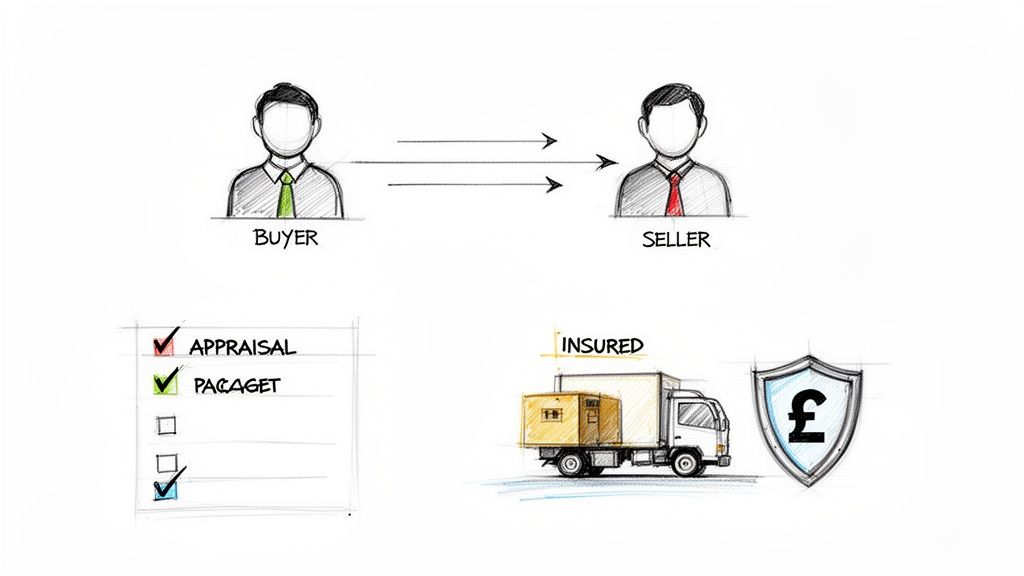
Once you’ve settled on a dealer you trust, it’s time to get down to the brass tacks of the transaction. Whether you’re buying or selling, a bit of preparation and clear communication will make the whole process go smoothly.
If you're looking to sell, getting an accurate valuation starts with you. Before you even draft an email, take some good, clear photos of your banknotes. Lay them on a plain, neutral background and make sure the lighting is good, capturing both the front and back of each note. This is the first thing a dealer will look at to get an idea of the condition.
When you reach out, a little detail goes a long way. Put together a simple list of what you have—denomination, date, and any standout features like an interesting serial number. Sending this along with your photos shows you’re serious and helps banknote dealers in the UK give you a much more accurate preliminary quote.
Choosing How You Buy: Fixed-Price or Auction?
For buyers, the journey usually splits into two paths: buying directly from a dealer's stock at a fixed price or trying your luck at an auction. Each has its own rhythm and suits different kinds of collectors.
- Fixed-Price Inventory: This is the most straightforward route. You see a price, you pay it, and the note is yours. It's ideal when you're hunting for a specific note to fill a gap in your collection. No fuss, no bidding wars—just a simple, clean purchase.
- Auctions: This is where the real thrill can be found. Auctions are brilliant for tracking down rare or highly desirable notes. You could snag a bargain, but there's always the risk of getting swept up in the moment and paying more than you planned. It’s a classic case of risk versus reward.
Your choice really boils down to what kind of collector you are. If you like certainty and speed, stick to fixed-price lists. If you live for the chase and have your eye on a truly unique piece, then an auction is probably where you'll find it.
Think about when the Bank of England first issued the polymer £5 notes. They printed 440 million of them, and most are just worth face value. But the ones with special serial numbers? Those can sell for 10-20 times their face value at auction. It's a perfect example of how the auction format can bring out the true market value for unique items that don't fit a standard price list. You can read more about what makes some serial numbers so special on BritishNotes.co.uk.
Locking It In: Finalising Your Transaction
Once you’ve agreed on a price, it's all about the logistics. Any reputable dealer will provide secure ways to pay, like a bank transfer or a protected online payment system. Don't be shy about this part.
For anything of significant value, you absolutely must insist on fully insured shipping. In the UK, Royal Mail Special Delivery is the go-to for a reason; it offers tracking and the right level of insurance to protect your investment while it's in transit.
Finally, just a quick word on taxes. For most casual collectors, buying and selling banknotes won't involve Capital Gains Tax. This usually only comes into play if you're trading in very high volumes or sell a single item for an exceptionally large profit. It's still good practice to keep a record of your major sales. A good dealer will be completely transparent about the whole process, making sure every step, from payment to delivery, is handled like the professional transaction it is.
Key Eras of British Banknotes Every Collector Should Know
To really get the most out of buying and selling, you need to know the story behind the notes. The history of British banknotes is a long and fascinating one, and having a grip on the key chapters helps you talk the same language as banknote dealers in the UK and spot where the real value lies. Each era has its own personality, its own rarities, and its own unique appeal to collectors.
The story starts with the Bank of England's earliest notes. These were essentially handwritten receipts for gold deposits – a far cry from the cash we use today. The first of these appeared way back in 1694, but it wasn't until 1855 that fully printed, bearer-payable notes became the norm. A huge moment in modern banknote history came in 1960 when Queen Elizabeth II first appeared on the £1 note, starting a tradition that continues to this day. You can get a great overview of the evolution of pound sterling banknotes on Wikipedia.
The Wartime Treasury Notes
For many collectors, one of the most compelling periods is the First World War. When war broke out in 1914, the government needed to hang on to its gold reserves. The solution? Issue its own emergency currency, known as Treasury Notes.
These notes, with their simple but iconic designs like St George slaying the dragon, were only meant to be a temporary fix. But they stuck around and represent a critical moment in Britain's economic history. That backstory makes them a perennial favourite, and early issues in decent condition are always sought after.
The Rise of Pictorial Designs
For a long time, British banknotes were pretty plain, dominated by text and the figure of Britannia. That all changed when the 'Pictorial' series arrived, putting famous historical figures in the spotlight for the first time.
-
Series C (1960s): This was a game-changer. It introduced the very first portrait of a reigning monarch, Queen Elizabeth II, on the £1 note. It was a total break from tradition and marked a new philosophy in currency design.
-
Series D (1970s-1980s): Often just called the 'Pictorial' series, these notes became a celebration of great Britons. We saw icons like William Shakespeare on the £20 and Isaac Newton on the £1, turning everyday cash into a gallery of national heroes.
-
Series E (1990s): This series carried on the theme but with updated designs and much better security features. It brought new faces like engineer George Stephenson and scientist Michael Faraday to our wallets, cementing the idea of honouring British achievement on our money.
Knowing the difference between these series isn't just trivia – it's crucial when you're dealing. If a dealer offers you a 'Series D Shakespeare £20', you'll instantly know they're talking about that classic note from the 1970s. It shows you know your stuff.
This historical context is what gives a note its soul and, ultimately, a lot of its value. Understanding why a WWI Treasury note is so significant, or why the first note with the Queen’s portrait is a landmark, helps you spot those undervalued gems and build a collection with real historical and financial weight.
Your Top Questions About UK Banknote Dealing Answered
Getting into the world of notaphily, or even just clearing out an old collection, naturally brings up a lot of questions. Whether you're a seasoned collector or have just stumbled upon a few old notes, it's easy to feel a bit lost. Here, we'll run through some of the most common queries we hear from people looking to buy or sell British banknotes.
To understand the market, it helps to appreciate the history. The story of British banknotes is a long one, full of design changes, security updates, and pivotal moments that created the rare and desirable notes collectors hunt for today.
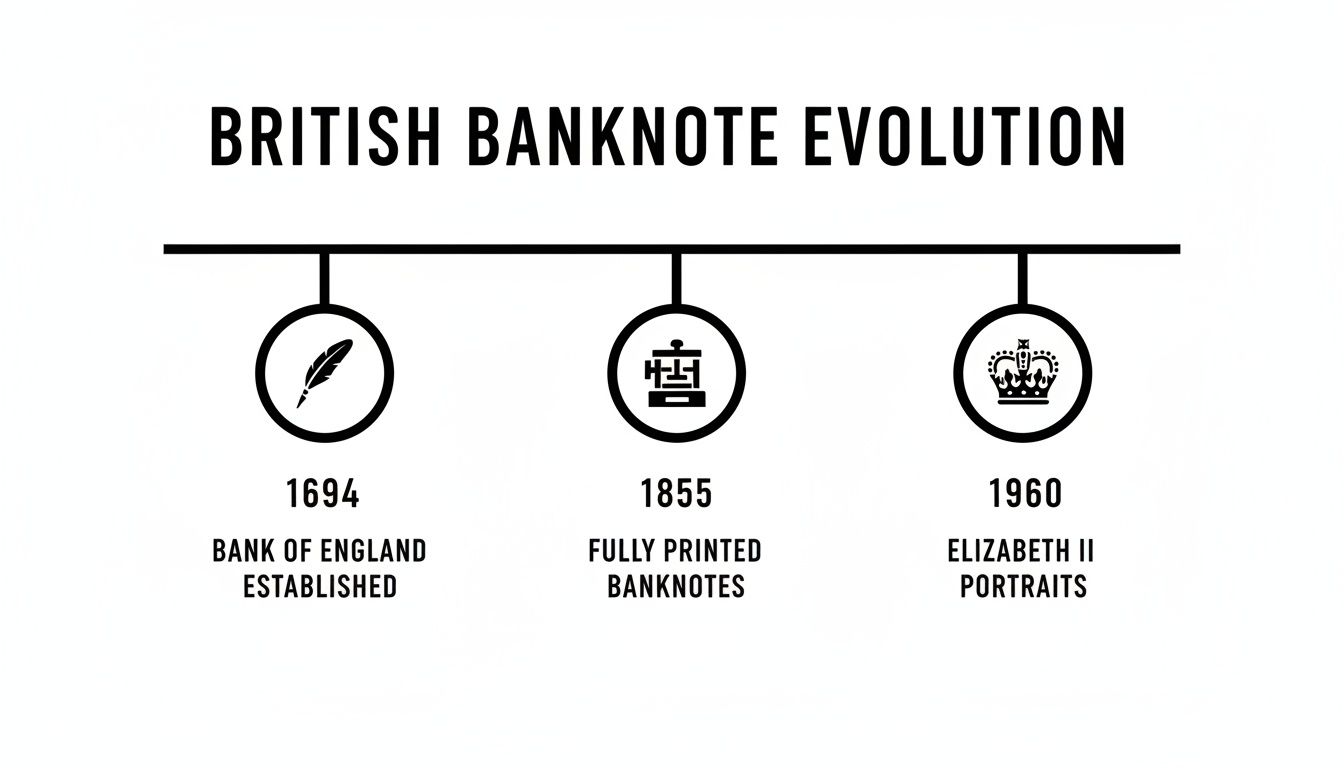
From the early, handwritten IOUs to the first notes featuring the monarch's portrait, each change created a new piece of history, and that's what makes this field so fascinating.
How Can I Get My Banknote Collection Valued?
The most straightforward and reliable way is to speak with a reputable dealer or an auction house that specialises in currency. Start by taking clear, high-quality photos of both the front and back of your notes. It's also helpful to jot down a basic inventory list.
Many banknote dealers in the UK are happy to offer a free preliminary valuation based on these images. If you have a particularly large or valuable collection, they'll likely suggest an in-person appraisal to give you the most accurate assessment. It's always a good idea to ask upfront if there are any fees for their valuation service.
Is It Better to Sell at Auction or to a Dealer?
This really comes down to what you have and what you're looking for. An auction can be the right stage for an exceptionally rare item, where competitive bidding might push the price to record highs. But remember, the final sale price is never guaranteed, and you'll have to factor in the seller's commission.
Selling directly to a dealer, on the other hand, gives you a firm, immediate offer and you'll get paid quickly. This is often the best route for less scarce notes or for when you simply want a clean, fast, and straightforward transaction. A good dealer will be honest with you and can advise which path makes the most sense for your specific notes.
Key Takeaway: A direct sale offers speed and certainty, making it a strong choice for most collections. Auctions are best reserved for unique, high-demand items where competitive bidding could significantly increase the final price.
What Are the Most Common Mistakes to Avoid?
Without a doubt, one of the biggest errors we see is people trying to clean their old banknotes. This almost always causes irreversible damage and absolutely tanks their value. Collectors prize original condition above everything else, so please, leave them as they are!
Another common pitfall is not doing your homework on the dealer. A quick sale to the first person you find could lead to a very disappointing valuation. Lastly, try to keep your expectations realistic. While some notes can be incredibly valuable, condition is king. Trust a professional's assessment—they have the experience to spot subtle flaws or special features that dramatically influence a note's final price.
Are My Old Withdrawn British Banknotes Worth Anything?
Yes, they almost certainly are! While they're no longer legal tender you can spend in the shops, withdrawn banknotes are the very heart of the collector's market. Their value all comes down to their condition, rarity, and historical significance.
Even common notes, if they're in pristine, uncirculated condition, can be worth more than their original face value. Keep an eye out for notes with printing errors, interesting serial numbers, or those from early, limited print runs—these can be particularly valuable. The golden rule is to always get them professionally appraised before you make any decisions.
Whether you're looking to value a single note or sell an entire collection, the experts at Cavalier Coins Ltd are here to help. Visit our website to explore our extensive inventory and get in touch for a free, no-obligation valuation today.