
Ever found a distinctive 50p in your change and wondered if it’s worth more than face value? The Benjamin Britten 50p is exactly one of those coins—a piece that beautifully merges everyday money with a sought-after collectible. It’s a real favourite among newcomers and seasoned collectors alike.
Why This 50p Is a Collector's Favourite
The Benjamin Britten 50p coin really hits the sweet spot for collectors. It has that perfect blend of artistic flair, historical weight, and what we call ‘achievable scarcity’.
Unlike the ultra-rare coins that you’re unlikely to ever see, this one strikes an ideal balance. It's just common enough to pop up in your change but distinctive enough to make it a thrilling find. This accessibility makes it a fantastic starting point for anyone just getting into the hobby, and a satisfying little discovery for the more experienced among us.
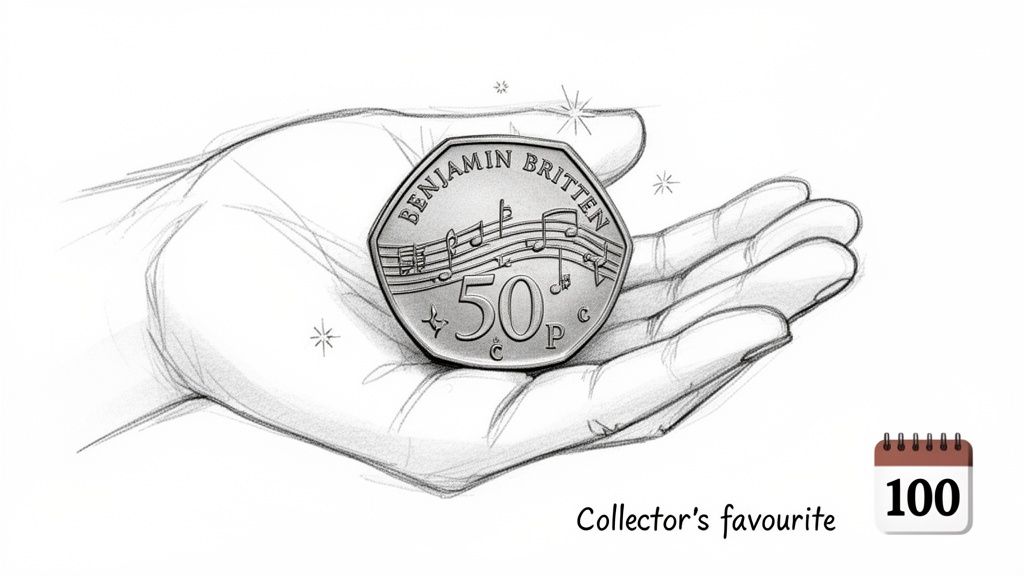
First released by the Royal Mint to mark the 100th anniversary of the composer's birth, the 2013 Benjamin Britten 50p had a circulation mintage of exactly 5,300,000. It entered general circulation back in November 2013, a standard cupronickel seven-sided coin but with a striking design by the renowned artist Tom Phillips CBE RA.
Bridging Art and History
What really captures the imagination, though, is the story this coin tells. It’s not just a lump of metal; it’s a tiny tribute to one of Britain’s greatest modern composers. The unique design, which we’ll get into later, is packed with musical and poetic references that lift it far beyond simple currency.
The coin serves as a tangible piece of British cultural heritage, celebrating the fusion of music and literature that defined Britten’s work. This artistic depth gives it a narrative quality that many other commemorative coins lack.
For a collector, this adds a whole other layer of meaning. Owning this 50p is like holding a little piece of musical history in your hand. This connection is a huge part of why it's remained so popular and why people are so keen to find one. It’s just one of many unique special 50 pence coins worth exploring for any collector.
Here’s a quick rundown of the coin's key details to get you started.
Benjamin Britten 50p Key Specifications
| Specification | Detail |
|---|---|
| Denomination | 50p |
| Year of Issue | 2013 |
| Issuing Authority | United Kingdom |
| Mintage for Circulation | 5,300,000 |
| Obverse Designer | Ian Rank-Broadley FRBS |
| Reverse Designer | Tom Phillips CBE RA |
| Metal | Cupro-nickel |
| Weight | 8.00g |
| Diameter | 27.30mm |
These specifications are the bread and butter for identifying a standard circulation coin, but as you'll see, there's much more to this piece than meets the eye.
Decoding the Coin's Musical Design
The Benjamin Britten 50p is so much more than just a commemorative piece; it's a miniature concert hall you can hold in the palm of your hand. The reverse, brought to life by artist Tom Phillips, is a masterpiece of symbolic design. He transformed the coin's surface into a powerful tribute to Britten's unique musical voice. This isn't just some random collection of notes; it’s a story told in metal.
At the very heart of the design, you'll see a double music stave, the foundation of any written score. But instead of a familiar melody, Phillips inscribed two powerful lines of text, creating a visual harmony between music and literature. This was a deliberate choice, and a clever one at that, directly reflecting Britten's own genius for setting English poetry to music.
The Poetic Inscriptions
The phrases weren't chosen by chance; they are deeply significant. The words come directly from Alfred, Lord Tennyson’s poem The Princess, which Britten famously used in his 1943 choral work, Serenade for Tenor, Horn and Strings.
The selected lines are:
- ·BLOW BUGLE BLOW·
- ·SET THE WILD ECHOES FLYING·
These evocative phrases perfectly capture the dramatic and atmospheric quality of Britten's compositions. They aren't just text on a coin; they are lyrics frozen in time, forever linked to the soaring melodies he created. Anchoring the whole design, his name, BENJAMIN BRITTEN, is inscribed above the staves.
This fusion of poetry and musical notation turns the coin into a multi-layered story. It tells us not just who Britten was, but how he created—by weaving the rich tapestry of English literature into the very fabric of his sound.
This approach was actually a groundbreaking moment for British coins. The Benjamin Britten 50p was the very first UK coin to feature both the date (2013) and the denomination (50 PENCE) on the obverse, or 'heads' side, alongside the Queen's portrait.
This clever shift gave the artist the entire reverse as a canvas, allowing for a pure, uninterrupted celebration of Britten's legacy. It's one of the many details that makes this coin so special and is part of a wider evolution explored in the colourful history of the British 50p coin. Understanding these subtle design elements is key to appreciating why this 50p remains such a firm collector’s favourite.
Understanding Its Mintage and Rarity
At first glance, a mintage figure of 5.3 million for the Benjamin Britten 50p might sound like a huge number. How could a coin made in the millions be considered special? It’s a fair question, and one many new collectors ask. The secret is all about perspective – in the world of coin collecting, context is everything.
To understand its place, think of the Britten 50p as sitting comfortably in the middle ground of scarcity. It’s not the sort of coin you'll find jangling in your change every other week, but it’s not an impossible find either. This balance makes it an exciting, yet perfectly achievable, goal for any collector.
Benjamin Britten 50p Mintage Comparison
To really grasp where this coin sits, let's compare it to some other well-known commemorative 50ps.
| Coin | Year | Mintage Figure |
|---|---|---|
| Kew Gardens | 2009 | 210,000 |
| Benjamin Britten | 2013 | 5,300,000 |
| NHS | 2021 | 10,010,000 |
As you can see, the Britten 50p is significantly harder to come by than a common commemorative piece like the 2021 NHS 50p, which had over 10 million struck. At the other end of the scale, you have the legendary Kew Gardens 50p, the undisputed king of 50p hunters with just 210,000 released. The Benjamin Britten coin carves out a fantastic sweet spot right between these two extremes.
This is a great time to distinguish between a truly 'rare' coin and a 'collectable' one. While the Britten 50p isn't officially rare, its unique design and moderate mintage make it highly collectable and sought-after, pushing its value far beyond 50p.
If you want to get a better feel for the landscape of valuable coins, our guide to the rarest 50p coins in circulation gives you the perfect context for where the Britten fits in.
The image below breaks down the key design elements that make this coin such a standout piece for any collection.
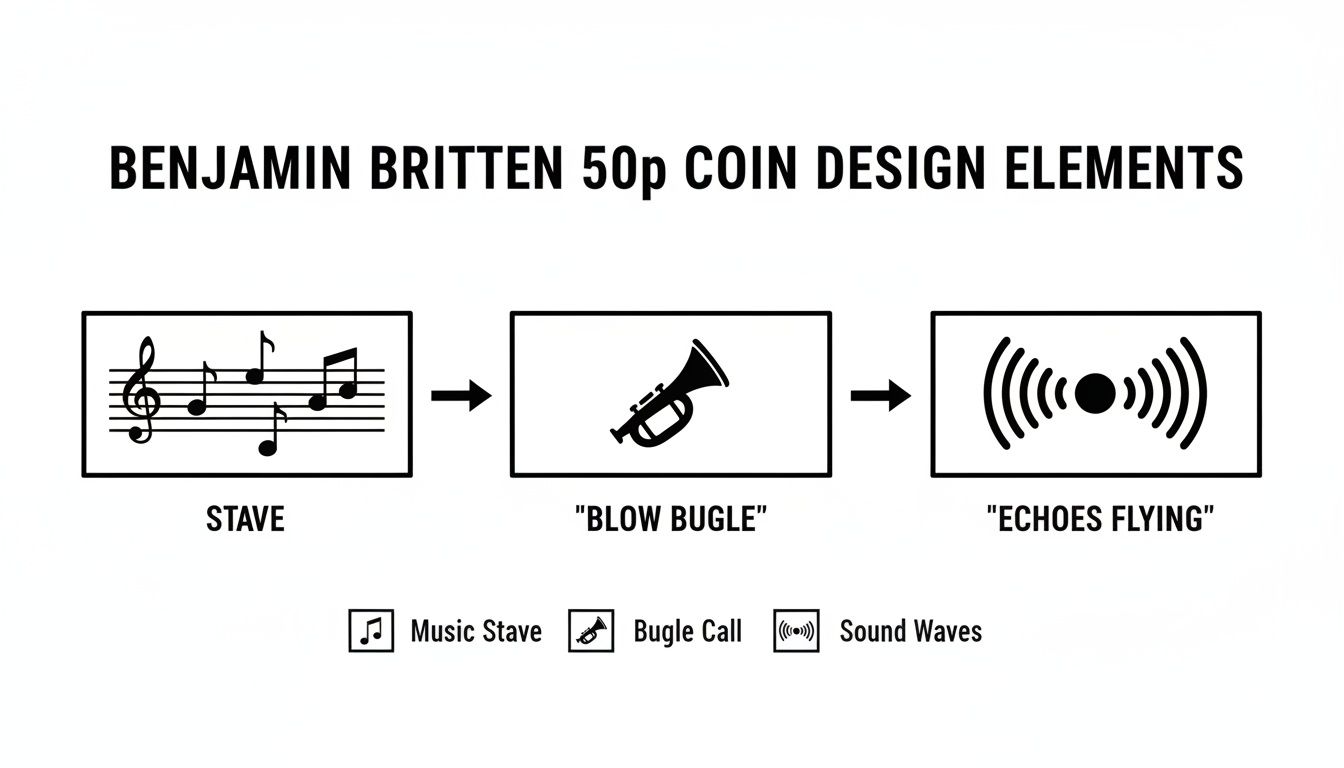
This visual really highlights the artistic fusion of music and poetry that gives the coin its undeniable charm.
Circulated vs Brilliant Uncirculated Versions
On top of the millions of coins made for wallets and tills, The Royal Mint also produced special versions specifically for the collector's market. These are known as Brilliant Uncirculated (BU) coins. They were never intended to see the inside of a cash register and were sold directly to collectors in protective packaging, keeping their finish as pristine as the day they were struck.
This distinction is crucial when it comes to value. Even with its relatively high mintage, a standard circulated Britten 50p can now fetch between £2.00 and £2.50 on the open market.
The Brilliant Uncirculated versions are a different story altogether. Originally sold for just a few pounds, these untouched examples have appreciated significantly. There were 5,098 sold in official presentation packs and another 8,239 included in annual sets or stamp covers. These are the versions that serious collectors hunt for, often commanding much higher prices due to their perfect condition and lower production numbers.
How to Value Your Benjamin Britten 50p
Found a Benjamin Britten 50p in your change and wondering if you've struck gold? While it's probably not going to fund an early retirement, it's definitely worth more than a quick trip to the sweet shop. Figuring out its exact price boils down to three things: its condition, the current collector demand, and whether it’s still in its original packaging.
Think of it like a vintage comic book. A well-read copy with a creased cover is still a great story, but it's the mint-condition first edition, still sealed in its sleeve, that collectors will pay a real premium for. The same idea applies here. The life your coin has lived directly impacts its worth.
Circulated Coins: The Everyday Finds
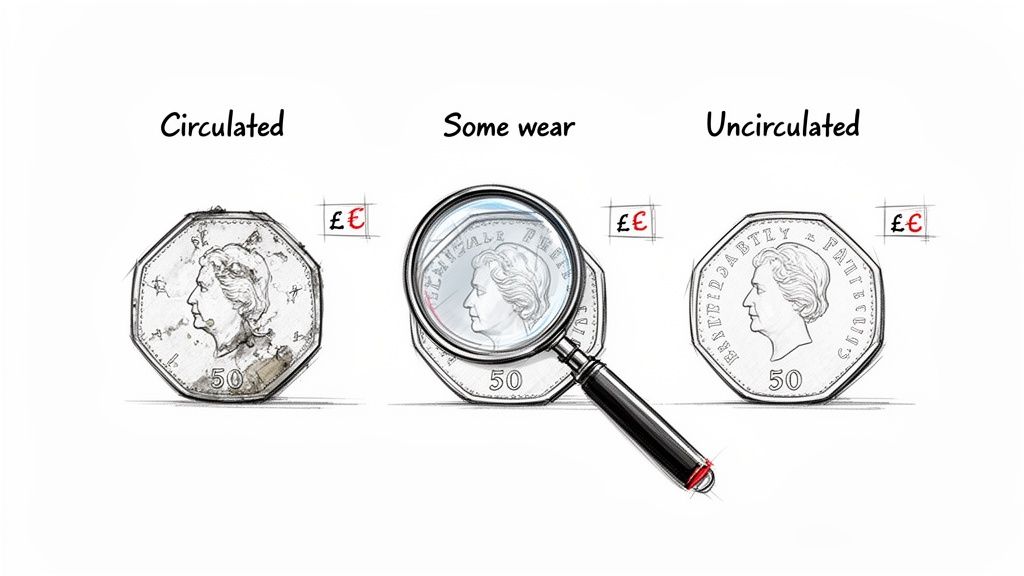
A circulated coin is one that's been out in the wild, doing its job. It's been jangling in pockets, rattling in tills, and passed from hand to hand. These coins will show the tell-tale signs of a life well-lived: minor scratches, softened details, and a duller finish. This is the version you’re most likely to find.
For a standard circulated Benjamin Britten 50p, you can expect a market value of around £2.00 to £2.60. A coin with sharper details and fewer dinks will command a price at the higher end of that scale, while a more worn-down example will sit at the bottom.
Uncirculated Coins: The Collector's Choice
An uncirculated coin, on the other hand, has never seen the inside of a purse. These coins were sold directly to collectors by The Royal Mint, often sealed away in protective packaging from day one. They look just as they did the day they were minted, with a brilliant shine and crisp, untouched details.
You'll find two main types of uncirculated versions for this particular coin:
- Brilliant Uncirculated (BU): These were typically sold in presentation packs and are the most common version for collectors. Their value has crept up over the years, and they now fetch between £10 and £15.
- Proof Coins: These are the absolute best-of-the-best. Struck multiple times with polished dies, they have a flawless, mirror-like finish. They were produced in much smaller numbers and are far more valuable, especially the silver and gold editions.
The key takeaway is simple: the less a coin has been handled, the more it's worth. A coin's condition, or 'grade', is the single most important factor in deciding its value beyond 50p.
Taking a moment to properly assess your coin's condition is the first step to knowing what you have. If it shows any signs of wear and tear, it's a circulated coin. But if it's sealed in official Royal Mint packaging and looks perfect, you might just have a more valuable uncirculated version on your hands. This distinction is crucial for getting an accurate valuation.
Exploring the Premium Silver and Gold Versions
While millions of Benjamin Britten 50p coins found their way into wallets and tills, a much more exclusive family of these coins was crafted for the serious collector. These aren't your everyday coins; they elevate the beautiful design into the realm of precious metals, creating genuine numismatic treasures that were never meant for spending.
For many, these special editions represent the pinnacle of The Royal Mint's craftsmanship. They weren't struck in the usual cupronickel. Instead, The Mint produced very limited runs using valuable materials like sterling silver and 22-carat gold, instantly transforming them from simple currency into significant assets. For a dedicated collector, owning one is the mark of a truly complete collection.
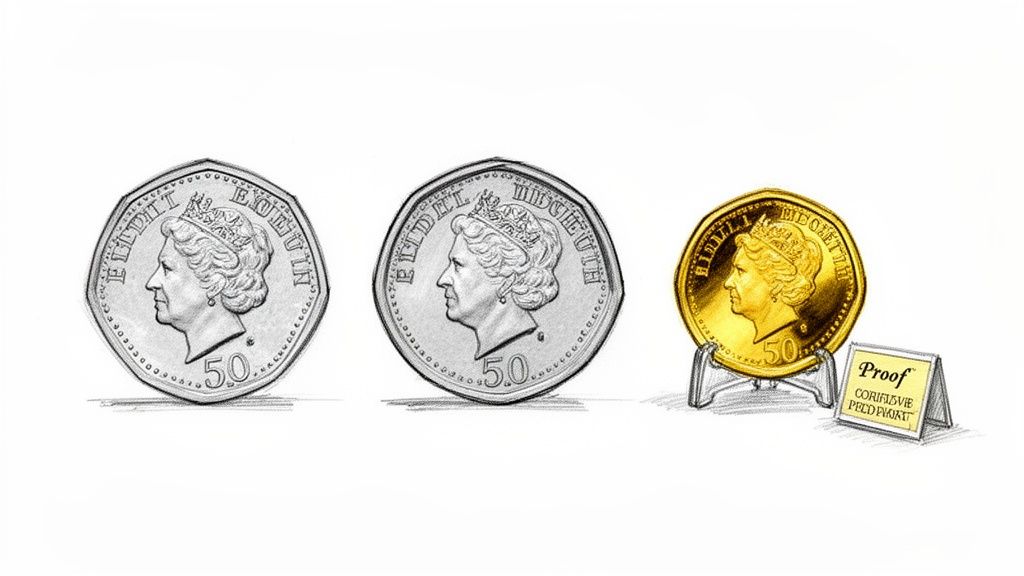
What really makes these coins stand out is the special proof finish. This isn't a quick single strike. It’s a meticulous process where the coin is struck multiple times with highly polished dies. The result is a stunning contrast between the frosted, intricate details of the design and a flawless, mirror-like background. It’s a finish that truly captures the light and shows off Tom Phillips's artwork in breathtaking detail.
Understanding the Precious Metal Variants
The Royal Mint issued three distinct precious metal versions of the Benjamin Britten 50p, and each one has its own specifications and rarity. The mintage figures here are incredibly low, which is why they are so sought-after by collectors.
- Sterling Silver Proof: Made from .925 sterling silver, this version weighs the standard 8.00g and boasts that beautiful proof finish. It's a fantastic, more accessible way to start collecting precious metal coins.
- Silver Piedfort Proof: This one is a truly impressive piece. 'Piedfort' literally means 'heavy foot'—a historical nod to these extra-thick presentation coins. It’s double the thickness and weight of the standard coin, tipping the scales at a hefty 16.00g.
- Gold Proof: The most exclusive of them all. This coin is struck in 22-carat gold and weighs 15.5g. With its extreme rarity and intrinsic value, it's the ultimate prize for any serious collector.
These elite coins were always sold in premium presentation boxes, complete with a numbered Certificate of Authenticity to guarantee their provenance.
The tiny production numbers really put their exclusivity into perspective. While the circulation version runs into the millions, these premium editions are counted in the hundreds.
To put some numbers on it, just 717 sterling silver proof versions were ever struck. There were only 515 of the heavier silver Piedforts made. The rarest of all is the gold proof, with a minuscule mintage of only 150 coins for the entire world. These figures are a world away from the circulation numbers, positioning these coins as coveted prizes. You can learn more about these rare editions by exploring the detailed breakdown from Copes Coins.
Tips for Buying and Selling Your Benjamin Britten 50p
Whether you’re hunting for a Benjamin Britten 50p to complete a collection or you've found one and are thinking of selling, a bit of know-how will make all the difference. Knowing what to look for is the key to getting a fair price, no matter which side of the transaction you're on.
For buyers, the big question is where to find one. Yes, there's always the thrill of discovering one in your loose change, but if you want to guarantee you get it, you'll need to buy it. Reputable online marketplaces and the websites of trusted coin dealers are your best bet. Always, and I mean always, check a seller's feedback and reviews. Think of it as a background check; you want to see a solid history of selling genuine coins that match their descriptions.
The golden rule for buying is simple: buy the coin, not the story. You should be looking at clear, high-quality photos of the exact coin you're purchasing. Be very wary of listings that use stock images or are vague about the coin's condition.
Smart Buying Strategies
One of the most common traps for new buyers is the "overgraded" coin. This is where a seller might describe a standard, circulated coin as being in 'near-perfect' condition to justify a much higher price tag. The best way to avoid this is to compare the coin you're looking at with photos of genuinely uncirculated examples. The difference will be obvious once you know what to look for.
Here are a few pointers to keep you right:
- Study the Details: Get to know what a crisp, fresh-from-the-mint Benjamin Britten 50p looks like. Pay close attention to the fine lines in the Queen's hair and the sharp, clean edges of the musical stave on the reverse.
- Question Poor Photos: Blurry or badly lit pictures can hide a multitude of sins, from heavy scratches to nasty knocks on the edge. If you can't see the detail clearly, it's safer to walk away.
- Check Market Prices: A quick look at recently sold listings on sites like eBay gives you a real-time snapshot of what people are actually paying for these coins in various conditions.
Getting the Best Price When You Sell
If you're selling a Benjamin Britten 50p, presentation is everything. Clear, well-lit photographs from several different angles are an absolute must. Make sure you capture both the front (obverse) and back (reverse). If there are any noticeable marks, it's far better to photograph them clearly than to try and hide them. Honesty builds trust and attracts serious buyers.
Your listing description needs to be just as honest and detailed. State the coin's condition clearly – is it a circulated find or a pristine Brilliant Uncirculated version? This transparency manages expectations and usually leads to a quicker, smoother sale at a better price.
A Special Note for Charities
Charities often receive donations of old coin collections and can, without realising it, be sitting on some surprisingly valuable pieces like the Benjamin Britten 50p. Sorting through bags of mixed coinage can feel like a mammoth task, but the first step is simply to pull out any of the commemorative designs.
Here at Cavalier Coins, we frequently work with charities to help them identify the valuable coins hidden away in their donated collections. By partnering with specialists, charities can turn these overlooked gifts into vital funding. It’s a brilliant way to make sure every single donation is maximised for its true worth and supports a fantastic cause.
Your Britten 50p Questions Answered
When you're digging into the world of coin collecting, a few questions always pop up, especially for a piece as distinctive as the Benjamin Britten 50p. To clear up some of the common uncertainties, we've pulled together the queries we hear most often about its rarity, value, and the special collector's editions.
Think of this as your go-to cheat sheet. It’s here to give you straightforward answers, whether you’ve just spotted a Britten 50p in your change or you're thinking about buying one for your collection.
Is the Benjamin Britten 50p Actually Rare?
With 5.3 million of these coins minted, the Benjamin Britten 50p isn't officially 'rare' in the same league as the legendary Kew Gardens 50p. That said, you certainly won't find one in your pocket every day.
A better word for it is 'uncommon'. It occupies that sweet spot for collectors – it's a genuinely exciting find in your change, but not so scarce that it's impossible to track down. Its unique design alone keeps it in high demand.
How Much Is a Circulated Benjamin Britten 50p Worth?
For a circulated coin – one that’s been out and about in the world – you can expect a value of between £2.00 and £2.60. Where your coin falls in that range really comes down to its condition.
A coin with crisp, clear details on the musical stave and the Queen's portrait, and with minimal scratches, will always command a price at the top end of that bracket.
Always remember: condition is king. The less wear and tear a coin shows, the more a fellow collector will want it, and that directly pushes up its value beyond the 50p stamped on it.
How Do I Know if My Coin Is a Valuable Silver Version?
This is a question we get all the time, and thankfully, the answer is simple. The premium silver and gold versions of the Britten 50p were never intended for your weekly shop. They were produced purely for the collector's market and sold in special presentation packs.
There's a dead giveaway if you have them side-by-side: the silver Piedfort version is noticeably thicker and heavier, tipping the scales at 16g compared to the standard coin's 8g. So, if you found your coin rattling around in your change, it's the standard cupronickel version.
At Cavalier Coins Ltd, we specialise in helping collectors, both new and seasoned, to find exceptional pieces and understand their true worth. Why not explore our curated selection of rare and commemorative coins to find the next centrepiece for your collection today?