
You find a large old coin in a drawer, estate box or inherited collection. It looks too broad to be an ordinary penny, too substantial to ignore, and the word CROWN seems to promise a story as much as a denomination. The natural question follows: is it a valuable silver coin, a modern commemorative £5, or a limited proof issue that belongs in a different part of the market?
That uncertainty is understandable. British crown coins aren't one single product. They're a family of coins linked by a large format and a five-shilling or £5 denomination, but their metal, purpose, scarcity and packaging can vary sharply. A worn historic crown and a boxed modern silver proof may share the same name while attracting very different buyers.
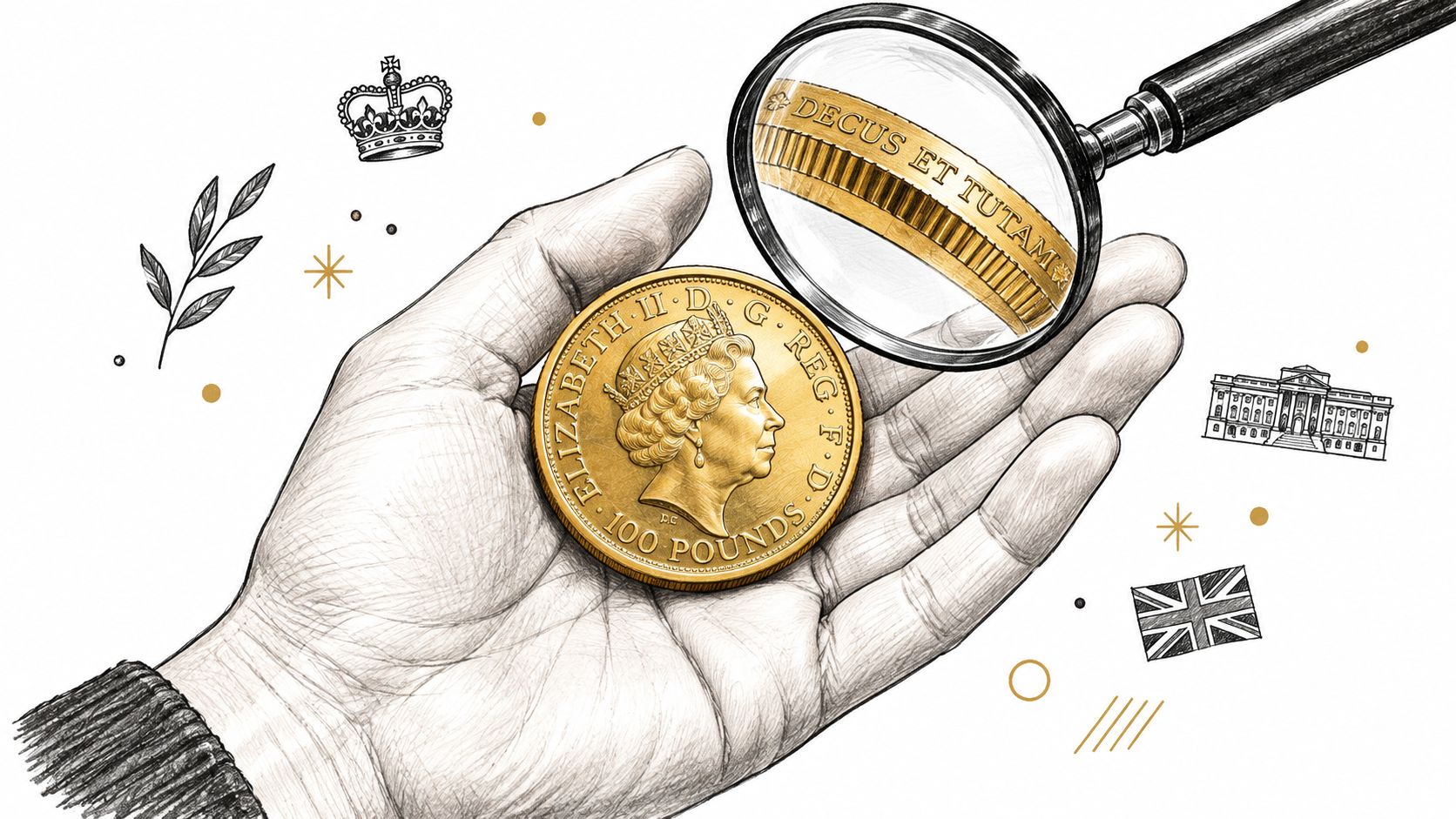
Introduction to British Crown Coins and Why Collectors Love Them
Hold a British crown beside a penny and the difference is immediate. Its broad face, raised portrait and generous space for lettering, heraldry or a commemorative scene give it the presence of a small historical object rather than loose change. That physical scale is the first clue, but it does not identify the market or determine the price.
Start with the question, “Which crown is this?” A historic 5-shilling crown is judged through its date, monarch, silver content, condition and collector demand. A modern £5 commemorative crown depends more on its subject, finish, packaging and appeal as a presentation piece. A low-mintage proof or bullion-adjacent issue may be influenced most by its authorised quantity, precious-metal specification and availability through particular sales channels.
Three distinct markets
The category divides into three distinct markets:
- Historic silver crowns: Older 5-shilling pieces, especially those struck in silver alloys, attract collectors interested in monarchs, dates, portraits and the development of British coinage. Their value can be easier to understand as a combination of historical interest, metal and condition.
- Modern commemorative £5 crowns: These use the large crown format for royal anniversaries, cultural subjects and national occasions. Buyers often care about the design and presentation, so a boxed example may appeal to a different audience from a worn historic coin.
- Proof and bullion-adjacent crowns: These target collectors seeking a superior finish, precious-metal content, a complete series or a tightly limited issue. Original packaging and clear issue information can matter because they help buyers assess what they are purchasing and how readily it may resell.
The denomination's history explains why one name covers such different objects. The crown began as a gold coin under Henry VIII in 1526, valued at five shillings. Edward VI introduced a large silver coin of the same value in 1551. Gold and silver crowns circulated together until the early reign of Charles II, and the English crown became a British crown after the creation of Great Britain in 1707. The Royal Mint's history of the silver crown provides the historical foundation.
For a practical example, two crowns can share a large format yet behave very differently in the market. The historic piece may trade through specialist coin dealers, while a modern proof may rely on its certificate, case and limited issue details. Identifying the market first makes later judgments about value, condition and liquidity far less confusing.
What Makes a Crown a Crown
A newcomer may find two large British crowns in the same box and assume they belong to one market. Their denomination connects them, but metal, issue limit and presentation can lead to very different prices and levels of buyer interest. Start by identifying which kind of crown you are holding.
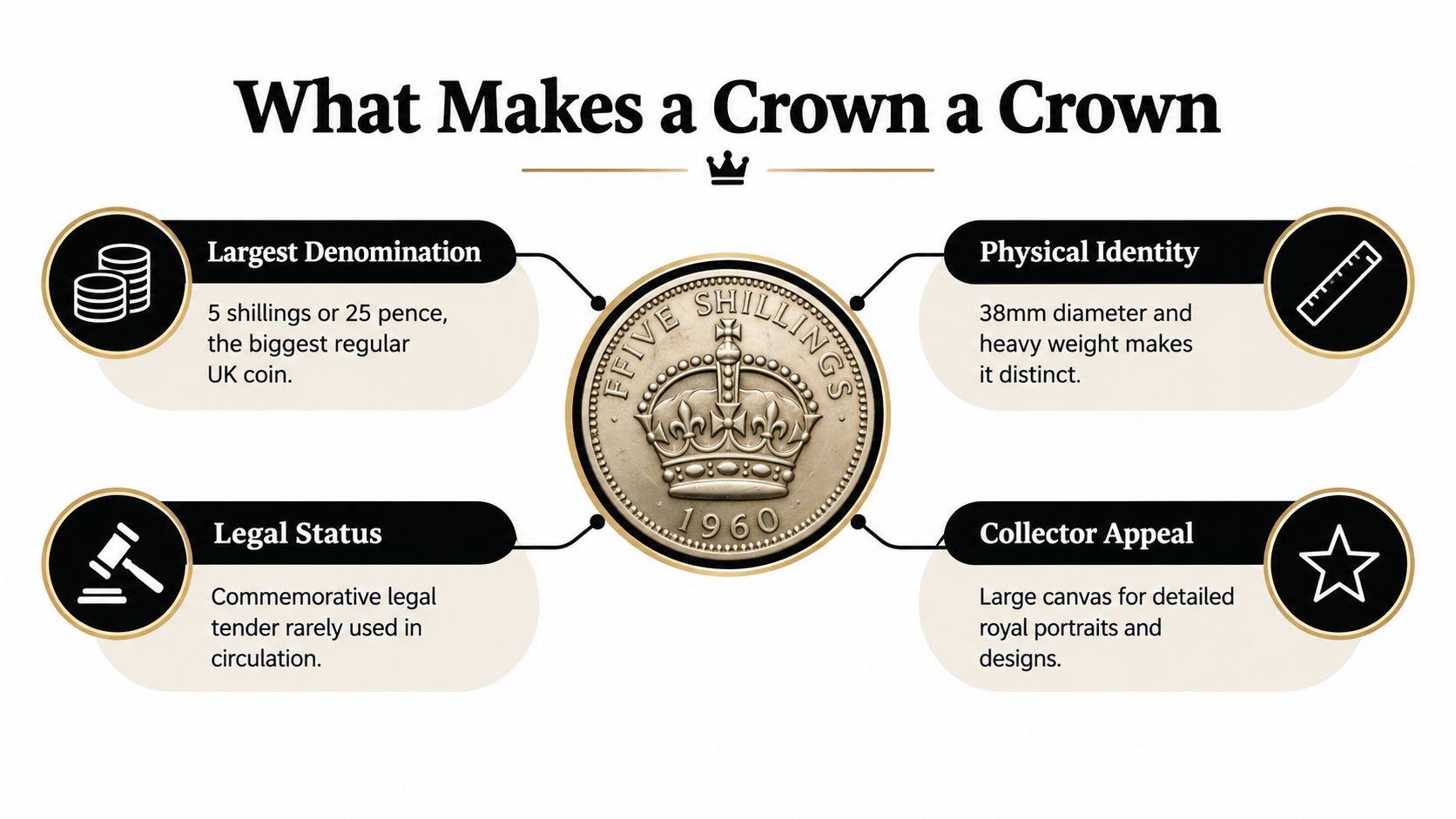
Historically, the crown represented five shillings. In the decimal era, it was revalued at 25p in 1971, then given a legal-tender face value of £5 in 1990. That history explains why a modern £5 crown may carry a familiar denomination while remaining a collector issue rather than an ordinary coin used in shops.
A useful comparison is a worn historic five-shilling silver crown beside a modern £5 commemorative or a low-mintage proof or bullion crown. The first is judged mainly through date, rarity, metal and condition. The others may depend more heavily on design, issue limit, finish, certificate and original case. The face value is therefore only the label on the door, not a guide to the contents inside.
The physical identity
The modern UK crown specification provides a practical reference point:
- Diameter: 38.61 mm
- Weight: 28.28 g
- Thickness: 2.89 mm
- Composition: cupro-nickel, made from 75% copper and 25% nickel
These details appear in the Royal Mint's five-pound coin design guide. At roughly the diameter of a small drinks coaster, but much thinner, a crown offers a broad canvas for portraits, lettering and complex reverses. In the hand, it feels closer to a miniature plaque than a small circulating coin.
The broad flan, meaning the prepared metal surface, is part of the appeal. It gives the engraver room to show detail and gives the collector more to examine. Since 1990, this format has supported commemorative issues rather than ordinary circulation.
Practical rule: A large coin marked with a crown denomination is a starting point for identification, not a complete valuation. Read the date, monarch, edge, metal and finish before judging it.
Small details can separate one issue from another. This guide to mint marks explains how marks and their placement help position a coin within a series. Turn the crown under strong light, inspect the edge, and compare its lettering with a trusted reference before assessing its market.
How British Crown Coins Evolved Through History
A Victorian crown and a modern £5 crown may share the same broad format, yet they belong to different collecting markets. One reflects five-shilling coinage and historical changes in silver. The other is a commemorative product, where issue limits, finish and presentation packaging can matter as much as the design. Their shared name connects them, but their values and ease of resale can differ greatly.
The story begins with Tudor monetary ambition. In 1526, Henry VIII introduced the crown as a gold coin worth five shillings. It was made for a system in which precious metal had practical monetary importance, so the original crown was not an oversized version of a familiar small coin.
Edward VI changed the material while keeping the nominal value. In 1551, he introduced a large silver crown worth the same five shillings. Gold and silver versions then circulated together until the early reign of Charles II. From the beginning, a crown had a split identity: its value and format could stay consistent while its intrinsic metal changed.
From English crown to British crown
The political map changed the coin's name. After the creation of Great Britain in 1707, the English crown developed into the British crown. This helps explain why wording, royal portrait and title matter during identification. The denomination links the issues, while the issuing authority and political setting place each coin in its proper series.
Production methods changed too. Earlier crowns may show hammered or milled manufacture, while later examples display more controlled machinery, refined portraits and elaborate edge treatments. A date acts like a signpost, placing the coin within a particular technical, political and artistic period.
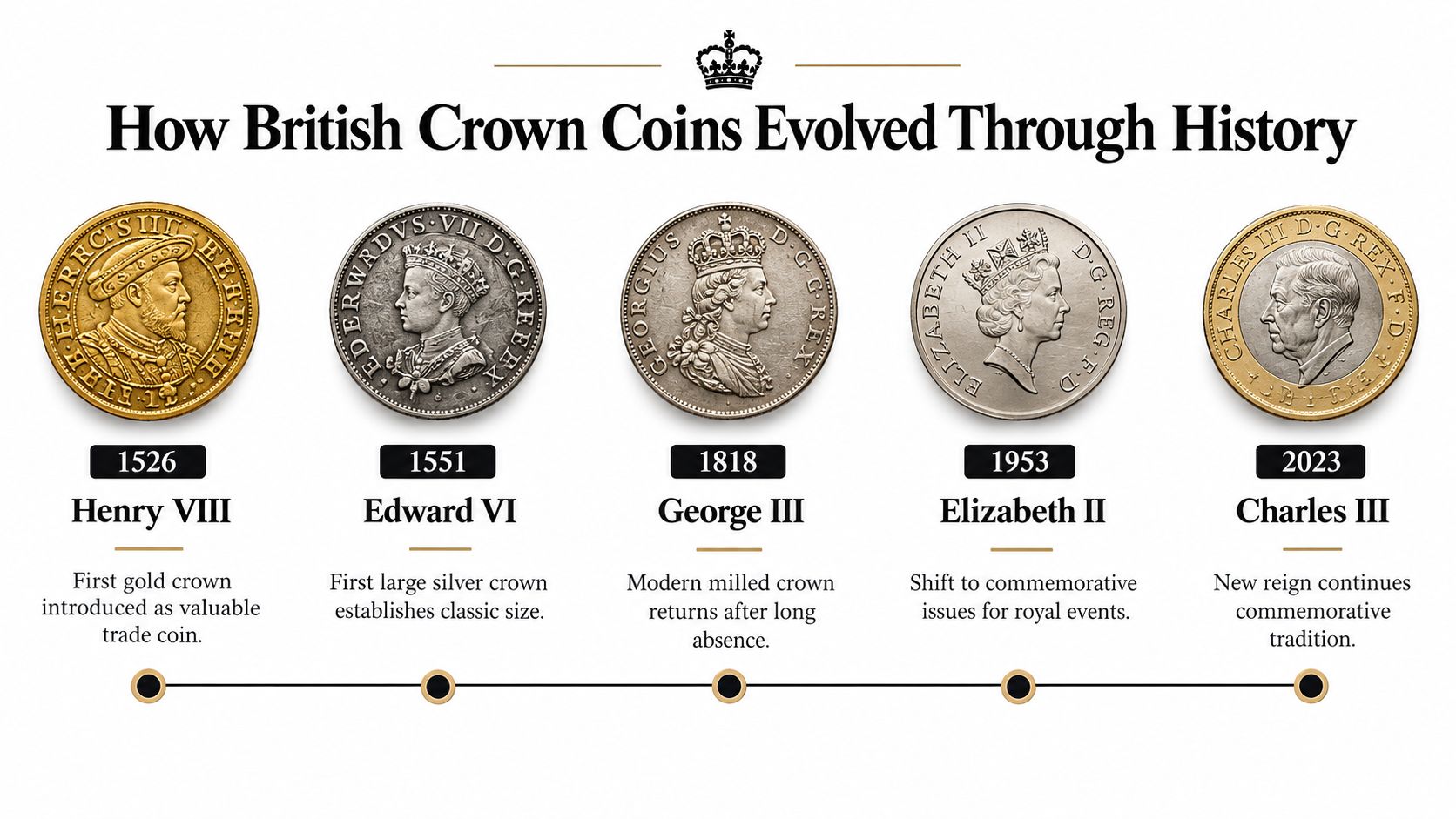
Decimalisation brought another important change. In 1971, the crown was revalued at 25p. In 1990, its legal-tender face value rose to £5, reflecting the shift from ordinary spending toward commemorative use.
That change helps separate the three markets collectors meet today. Historic five-shilling silver crowns are judged through date, metal, rarity and condition. Modern £5 commemoratives often depend more on subject, mintage and presentation. Proof and bullion-oriented crowns add precious metal, limited production and specialist packaging, which can attract focused buyers but may not trade as easily as widely recognised historic pieces.
For wider context on the development of British coinage, see this brief history of British coins.
The Main Types and Series You Will Encounter
The easiest way to avoid confusion is to classify the coin before estimating its value. The following table provides a working map, not a price list.
| Crown Type | Face Value | Typical Metal | Primary Purpose |
|---|---|---|---|
| Historic 5-shilling crown | 5 shillings | Silver or cupro-nickel, depending on period | Circulation, historical collecting and type collecting |
| Modern £5 commemorative crown | £5 | Often cupro-nickel, with other specifications available | Commemorative collecting and presentation |
| Proof or bullion-adjacent crown | Usually £5 for modern issues | Precious metal or specialist proof composition, depending on issue | Limited collecting, series completion and metal-focused ownership |
Historic 5-shilling crowns
These are the coins most newcomers associate with the word crown. They carry older monarchs, historic dates and the broad five-shilling format. Their value depends on more than age. A worn, widely available example may attract a different audience from a sharply preserved coin with a desirable date or design.
Metal is particularly important here. Historic crowns moved through different alloy standards, so two coins with similar appearances can have very different bullion implications. You should never assume that every old-looking crown contains the same amount of silver.
Modern £5 commemoratives
Modern commemorative crowns cover a wide range of themes. The Royal Mint's 2026 programme, for example, includes a broad mixture of commemoratives and annual sets, illustrating how modern crown collecting can involve designs, presentation types and release groupings rather than a single standard series. The Royal Mint's 2026 release announcement is useful for seeing that breadth.
Some buyers want a particular monarch or event. Others collect a theme, such as royal portraits, music, national stories or engraved design. Brilliant uncirculated, proof and boxed presentations can sit beside simpler versions of a related design, so packaging and finish need to be recorded with the coin.
Proof and bullion-adjacent crowns
Proof coins are made with a presentation finish and are usually sold to collectors. Bullion-adjacent products may attract buyers who care about precious-metal content, but they aren't automatically interchangeable with historic silver crowns. The coin's specification, authorised issue limit, certificate and original packaging all influence how the market treats it.
The word “crown” identifies the format and denomination family. It doesn't, by itself, tell you whether you're buying history, design, silver or scarcity.
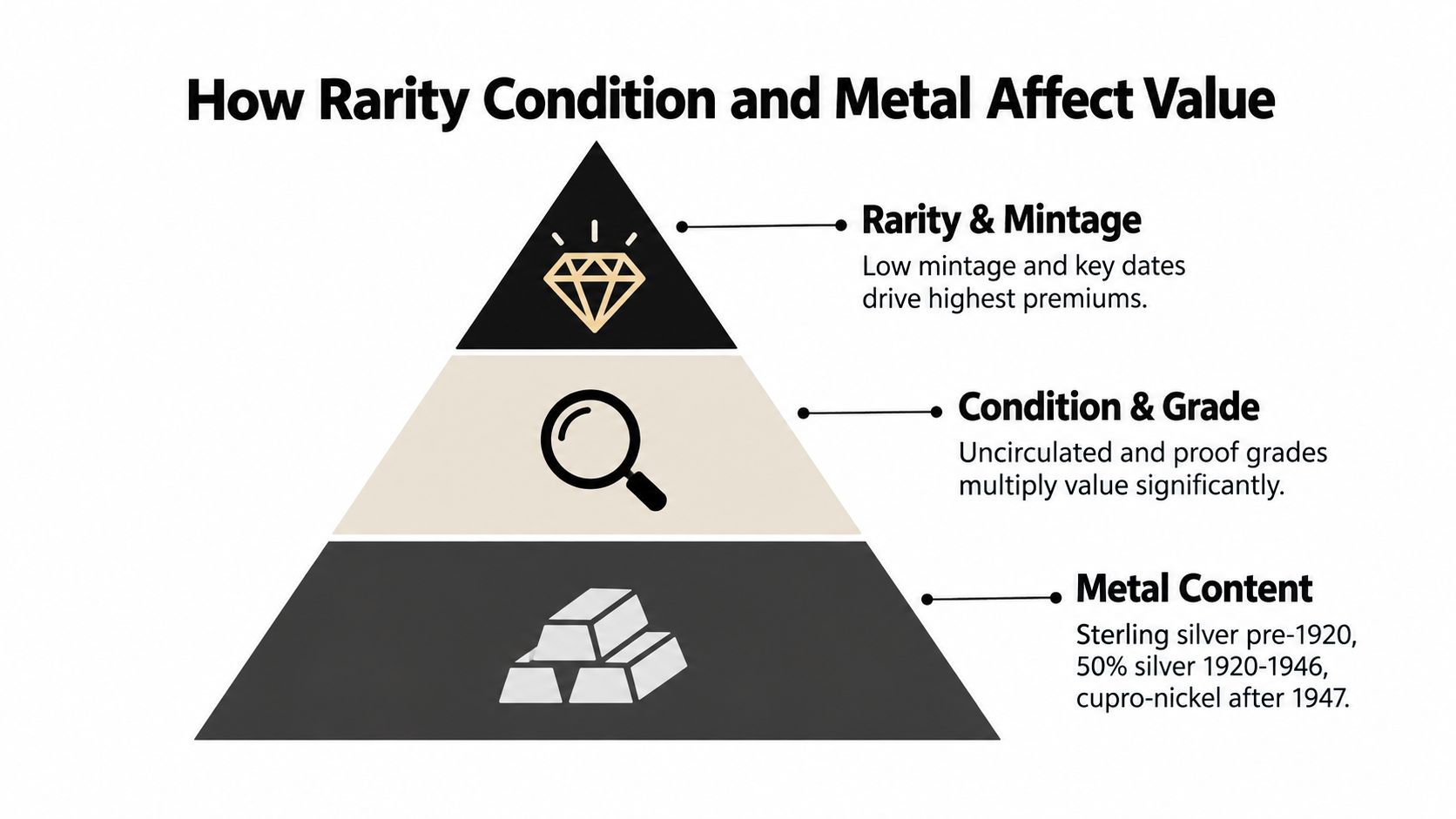
How Rarity Condition and Metal Affect Value
Age is only one clue. A crown's value emerges from several factors that work together, and the most important one can change depending on the market you're entering.
The historic alloy sequence is a good example. Pre-1920 crowns were sterling silver at 92.5% silver, 1920 to 1946 issues were 50% silver, and post-1947 crowns were cupro-nickel, as recorded in the British coinage reference. This transition reduced the dependence of postwar crowns on silver value while preserving the large crown format.
Metal sets the starting conversation
Sterling silver gives a pre-1920 crown a clear bullion dimension, but bullion isn't the whole valuation. Collectors may pay attention to the date, monarch, design, edge lettering and condition. A damaged or heavily worn coin can remain historically interesting while being less attractive to a buyer seeking a high-grade example.
A 1920 to 1946 crown requires a different mental calculation because its silver content is lower than the earlier sterling standard. Post-1947 cupro-nickel crowns generally appeal through collectability, design and condition rather than precious-metal weight.
Rarity and presentation can overturn expectations
Issue limits matter strongly in modern collecting. Recent Royal Mint releases include published maximum mintages such as 4,836 for the 2026 gold proof sovereign and 20,010 for the 2026 silver proof sovereign, while the 2026 William IV Crown 5oz silver proof has an authorised quantity of just 350 pieces, according to the published sovereign mintage information. These are not interchangeable products, but they demonstrate why a modern limited issue can operate in a scarcity market rather than a general commemorative market.
A limited piece may be difficult to obtain at launch, yet easier to find later if early buyers resell it. That makes liquidity, packaging and buyer awareness important. Keep the original capsule, box and certificate together where supplied, and don't describe a coin as scarce without checking the official issue information.
Use this checklist before forming an estimate:
- Type: Is it a historic 5-shilling coin, a modern £5 commemorative or a proof or bullion-adjacent issue?
- Metal: Which alloy applies to that date and issue?
- Condition: Are the fields clean, the relief sharp and the original surface undisturbed?
- Scarcity: Is there a mintage or authorised issue limit that buyers can verify?
- Presentation: Are the capsule, box and certificate present and matched to the coin?
- Market channel: Are comparable pieces selling through an auction, specialist dealer or general resale listing?
How to Authenticate Buy and Sell With Confidence
Authentication starts before money changes hands. Ask for clear photographs of both faces, the edge, the date and any packaging. A seller who can't show the edge or provides only a heavily edited image hasn't given you enough information to assess the piece properly.
For older silver crowns, physical checks matter. Compare the weight and diameter with the documented specification for that issue, but don't treat measurements as proof on their own. A counterfeit can imitate size while failing in design quality, surface texture or edge detail.
Inspect the coin like a specialist
Use a loupe and a single light source rather than relying on a phone photograph. Look for soft relief, porous surfaces, unnatural lettering, uneven rims and details that appear melted instead of sharply struck. On a Victoria Old Head crown, diagnostic areas include the eye, earring, horse's head, sword grip, dragon wings and the ground line. A trusted reference such as a professional coin authentication service can help when the purchase is significant or the coin presents conflicting clues.
Don't clean the coin to improve its appearance. Abrasive cleaning can leave hairlines and an unnatural surface, reducing its appeal to collectors even when the coin itself is genuine.
Choose the selling channel deliberately
A fixed-price specialist listing suits a buyer who wants a clearly described example and a straightforward transaction. An auction can expose a scarce proof or unusual historic issue to competitive bidders, but the final result depends on presentation, timing and the audience. General marketplaces offer reach, though they also require stronger due diligence.
For sellers, record the date, monarch, alloy, condition, diameter, weight and packaging before writing the listing. Avoid promising rarity unless you can support it with an official issue limit or a recognised catalogue reference. If you're handling a large donated collection, separate obvious silver, modern proofs and ordinary commemoratives before requesting a valuation. That simple sorting step prevents a limited boxed issue from disappearing into a bulk lot.
Starting and Growing Your Crown Collection
A satisfying collection doesn't need to begin with the rarest crown. Start by choosing the question you want your collection to answer. You might follow monarchs, compare metal standards, collect royal commemoratives, study engraving or build a complete type group.
A practical first purchase is one you can identify confidently. Read the date, note the monarch, inspect the edge and establish whether the coin belongs to the historic 5-shilling, modern £5 or proof and bullion-adjacent market. Then record the purchase details in a simple catalogue, including photographs, condition notes, seller and packaging.
Build around a clear collecting aim
- For history: Choose crowns from different royal periods and study how portraits and designs changed.
- For metal: Compare sterling silver, lower-silver and cupro-nickel issues, keeping alloy distinctions separate.
- For design: Select commemoratives with subjects that interest you, rather than buying every release.
- For scarcity: Focus on verified issue limits, proof quality and complete original presentation.
The strongest collections often combine these approaches. A historic crown can provide the sense of continuity, while a modern limited proof shows how the denomination still functions as a collector format. You don't need to pretend they belong to the same price segment. Their differences are precisely what make the collection educational.
Review new purchases after a cooling-off period. If the coin still interests you once the initial excitement fades, it probably has a place in your cabinet. If not, accurate notes and intact packaging make a later resale more orderly.
Cavalier Coins Ltd offers British crown coins including pre-1947 silver crowns, post-1947 cupro-nickel pieces and commemorative issues, alongside fixed-price listings and weekly eBay auctions. Visit Cavalier Coins Ltd to explore suitable crowns, compare collecting options and find pieces for building or monetising a collection.