
British silver coins are far more than just money. They’re tangible pieces of history, art, and economics that you can hold right in your hand. From the early hammered silver pieces to modern bullion, every coin tells a story about the monarch on the throne, the era it came from, and the nation's fortunes at the time. This guide is here to help you navigate this fascinating world with confidence.
Why British Silver Coins Captivate Collectors
Stepping into the world of British numismatics is like opening a direct link to centuries of royal legacies and societal shifts. For those of us who collect, it’s much more than a hobby; it’s an exploration of history itself. You’re not just acquiring bits of metal—you’re preserving the very stories that shaped a global empire.
Imagine holding a heavy, solid silver Crown from the Georgian era, or a delicate Maundy threepence. Each piece carries the portrait of a monarch and reflects the artistic styles and minting technologies of its day. The journey of these coins is a story of evolution, from the crudely struck hammered issues of medieval England to the precisely engineered bullion coins produced by The Royal Mint today. This progression beautifully mirrors Britain's own journey from a feudal kingdom to an industrial powerhouse.
More Than Just Metal Content
While the intrinsic silver value is certainly a draw, the real appeal for seasoned collectors often lies somewhere else entirely. The magic comes from understanding the context behind each issue—the economic pressures, the political turmoil, or the celebratory milestones that led to its creation. That worn shilling in your hand might have passed through countless others, paying for goods at a bustling Victorian market or funding a soldier's wages.
For many collectors, the story is the real treasure. A coin's history—who might have held it, what it could have purchased, and the era it survived—adds a layer of value that far exceeds its metallic worth.
This connection to the past is what transforms a simple collection into a personal museum. As you learn to identify different monarchs, mint marks, and historical periods, you start to appreciate the subtle details that make each and every coin unique.
What You Will Discover
This guide is designed to give you the knowledge to build a collection you're truly proud of. We'll explore the essential skills you need to thrive, making sure you can navigate the market with skill and assurance.
You will learn to:
- Identify Key Eras: Easily tell the difference between coins from the Georgian, Victorian, and modern periods.
- Understand Silver Content: Learn how to differentiate between 92.5% Sterling, 50% silver, and contemporary bullion coins.
- Grade and Value Coins: Gain the confidence to assess a coin's condition and get a good handle on its market value.
- Buy and Sell Smartly: Discover the best practices for acquiring new pieces and, just as importantly, how to avoid common pitfalls.
A Journey Through the Eras of British Silver
To truly appreciate British silver coins, you have to travel back in time. Think of each coin as a miniature time capsule, perfectly capturing the art, technology, and economic realities of its day. The story of British silver is one of remarkable change, moving from rustic, individually hammered pieces to the perfectly uniform coins of the industrial age.
Our journey starts with the iconic pre-decimal coinage, a system that served Britain for over a thousand years. Familiar names like the Crown, Half-Crown, Florin, Shilling, and Sixpence were the lifeblood of daily trade. A silver Crown, worth five shillings, was a serious amount of money—often a whole week's wages for a labourer. These weren't just currency; they were symbols of national pride and economic muscle.
This visual timeline gives you a great overview of the evolution from early hammered coins to modern milled and bullion issues.
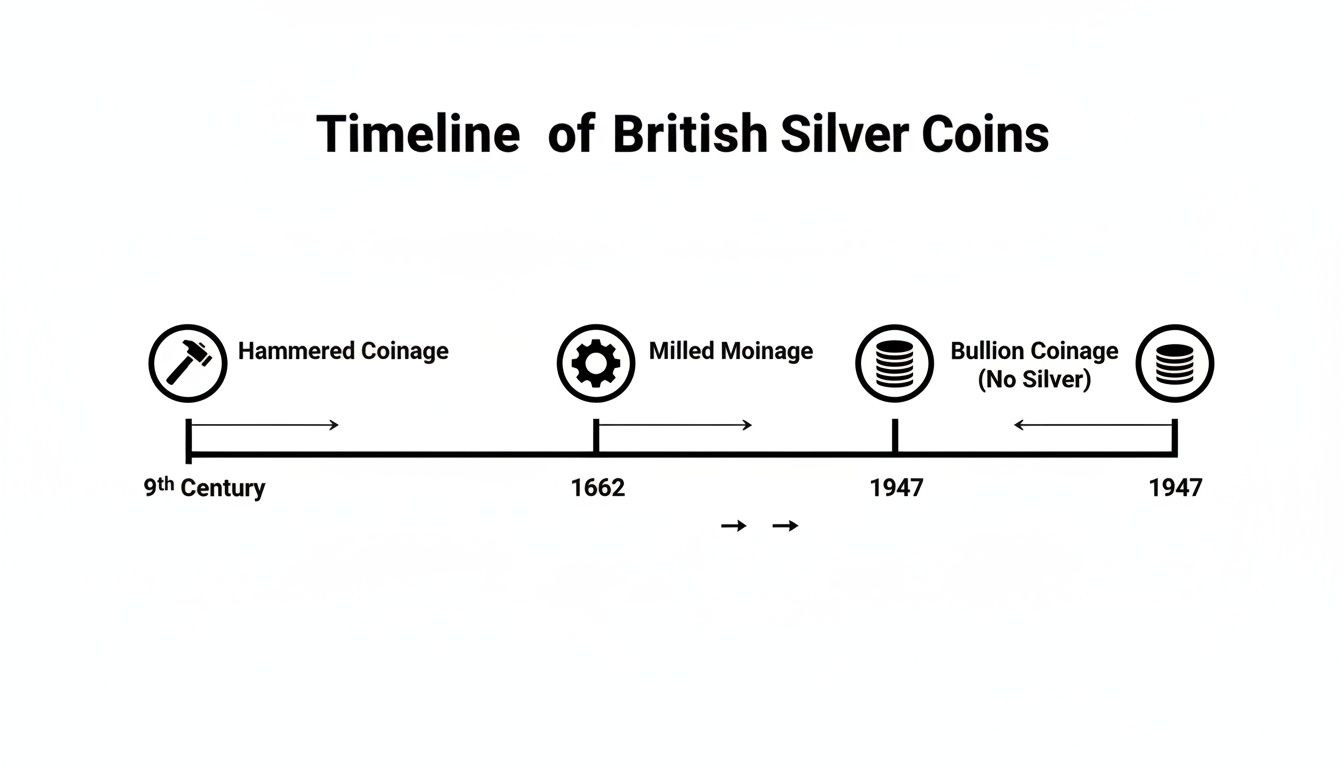
As you can see, minting technology didn't stand still. It moved from manual, often imprecise methods to mechanised production that brought consistency and much-needed security against counterfeiting.
The Georgian Era: A Time of Crisis and Change
The Georgian period (1714–1830) was a whirlwind of social and industrial upheaval, and its coinage tells a story of real struggle. The Royal Mint was creaking at the seams, burdened by outdated machinery. This led to a severe shortage of official silver coins. In fact, the last standard silver issue was struck in 1787, after which the supply for public circulation simply dried up.
This vacuum created a full-blown currency crisis. To stop the economy from seizing up, the government had to get creative. From 1804, the industrialist Matthew Boulton was contracted by the Bank of England to strike silver 'Bank Tokens' at his cutting-edge, steam-powered Soho Mint. These weren't legally coins, but they circulated widely and kept the economy moving. By 1811, things were so desperate that private silversmiths even started minting their own shillings.
This chaos eventually forced one of the most important events in British numismatic history.
The Great Recoinage of 1816
This landmark act completely overhauled Britain's currency. It officially put the country on a gold standard, with silver coinage becoming 'token' money—meaning its face value was higher than its actual silver content. This masterstroke stabilised the currency and set the standard for generations.
Victorian Silver: The Height of Empire
The Victorian era (1837–1901) is often seen as the absolute golden age for British silver coins. With the reforms of 1816 firmly established and the empire's industrial power at its zenith, the Royal Mint churned out enormous quantities of high-quality Sterling silver coinage.
The coins from this period are famous for their beautiful artistry and iconic designs. When you're looking at Victorian silver, you'll come across these key portraits of Queen Victoria:
- The Young Head (1838–1887): A classic and elegant depiction of the young queen.
- The Jubilee Head (1887–1893): Introduced to mark her Golden Jubilee, though its design wasn't universally loved at the time.
- The Old or Veiled Head (1893–1901): A mature, stately portrait that became a beloved symbol of the era.
Each portrait change gives collectors a clear timeline to follow. If you're just starting out, Victorian silver shillings and florins are a fantastic entry point. They're relatively easy to find but are absolutely steeped in history. To get a broader perspective on these changes, you might be interested in our article which provides a brief history of British coins.
Edwardian Elegance and a Farewell to an Age
After Queen Victoria's long reign, the Edwardian era (1901–1910) was short but distinct. The silver coinage of King Edward VII is known for its classical, clean designs, crafted by George William de Saulles. These coins represent the final chapter of an era of undisputed British global influence.
They were also the last full series of British coins struck in 92.5% Sterling silver for general circulation. The immense economic pressures of the First World War would soon force a dramatic change. Collecting Edwardian silver is like capturing the last moments of a bygone age, just before the 20th century reshaped the world—and its money—forever.
How Modern Silver Coinage Changed the Game
The 20th century was a turbulent time for Britain, and its silver coinage tells a dramatic story of that change. For centuries, the silver in a person's pocket was a trusted store of value, but the immense economic pressures of the First World War would change that forever. This period marks a clear dividing line for collectors, separating the long history of traditional silver currency from its modern counterparts.
For hundreds of years, people knew the silver coins they carried were worth their weight. But by 1920, the price of silver bullion had shot up, making the metal in the coins more valuable than their face value. This created a huge problem: people could simply melt down coins for a profit, threatening to completely unravel the currency system. The government had to act fast.
The Coinage Act of 1920 was the first major blow to traditional silver. It slashed the silver content in all circulating coins from the historic 92.5% Sterling standard down to just 50%. On the surface, the coins looked the same, but their intrinsic value was almost cut in half overnight. For any collector, 1920 is a critical date to remember.
The End of Silver in Circulation
This new 50% silver standard didn’t last long. The economic fallout from the Second World War dealt the final blow. Britain was saddled with enormous war debts to the United States, and these had to be repaid in silver bullion.
To find the silver it needed, the government made a historic decision. In 1947, silver was completely removed from all new circulating coins. It was replaced with cupro-nickel, a durable but far cheaper alloy. Just like that, the silver coins that had been a part of daily British life for over a thousand years became a thing of the past.
This shift from 92.5% to 50%, and finally to 0% silver, is one of the most important timelines a collector can learn. It directly affects the value and numismatic story of every 20th-century coin you find.
Knowing these dates is crucial for identifying and valuing modern British coins. For example, a 1919 shilling is made of Sterling silver, but a 1921 shilling is only 50% silver, and a 1948 shilling has no silver at all.
This table breaks down the key changes in silver content, a vital piece of knowledge for any collector or investor.
Silver Content in British Coins: A Timeline of Key Changes
This table illustrates the major changes in the silver fineness of British circulating coinage over the last century, a crucial factor for collectors and investors.
| Period | Silver Fineness (%) | Key Denominations Affected |
|---|---|---|
| Pre-1920 | 92.5% (Sterling Silver) | Threepence, Sixpence, Shilling, Florin, Half Crown, Crown |
| 1920–1946 | 50% | Threepence, Sixpence, Shilling, Florin, Half Crown, Crown |
| 1947–Present | 0% (Cupro-nickel) | All denominations previously made of silver |
As you can see, the transition happened quickly, forever changing what it meant to have "silver" in your pocket.
The Dawn of Modern Bullion: The Silver Britannia
Just as silver vanished from everyday circulation, it found a new life with investors and collectors. For decades, the only way to own a piece of British silver was to find historic coins. That all changed with the rise of the global bullion market.
The Royal Mint responded by launching the now-iconic Silver Britannia in 1997. This was a completely new type of coin, designed specifically for the precious metals market. It marked the triumphant return of silver to British coinage, not as money for buying groceries, but as a beautiful store of value.
Initially, the Britannia was struck in 95.8% fine silver, a historic alloy known as the "Britannia standard" that gave the coins a distinct look. However, to stay competitive on the world stage, The Royal Mint made a significant change. In 2013, the coin's purity was upgraded to 99.9% pure silver, putting it in line with other major bullion coins like the Canadian Maple Leaf and American Silver Eagle.
For collectors, there are always interesting variations to hunt for, like the small batch of 2,337 coins from 2011 with a unique matte finish, which now sell for huge premiums. You can dig deeper into the Britannia's rich history and its many variants over at britannia-uk.com.
Today, the Silver Britannia stands as a cornerstone for anyone interested in modern British silver, offering a perfect mix of investment appeal and pure numismatic art.
Your Toolkit for Identifying and Grading Coins
Holding a piece of history in your hand is a fantastic feeling. But the real thrill comes from understanding its story and condition. This section is all about getting you confident with the practical side of collecting. We'll get into the essential skills of identification and grading, moving you from simply owning coins to truly understanding them.
First things first: identification. Think of a coin's surface as a historical document, and your job is to learn how to read it. You're looking for three key pieces of information: the monarch’s portrait, the date, and any mint marks.
The portrait is your quickest clue, instantly placing the coin in a specific reign—whether it’s the unmistakable profile of Queen Victoria or the familiar effigy of George V. The date, of course, pins it to a precise year.
Mint marks, which are often just tiny letters, tell you where the coin was made. Most British coins were struck in London, but finding one from a branch mint in a colony can mean you've got something significantly rarer on your hands. Put these three details together, and you can pinpoint your coin's exact origin and begin to uncover its unique past.
Distinguishing Silver Content
One of the most critical skills you can develop is figuring out a coin's silver content. As we've mentioned, the years 1920 and 1947 are the big turning points. Any British "silver" coin dated before 1920 is made from 92.5% Sterling silver. Between 1920 and 1946, that purity drops to 50%. From 1947 onwards, they contain no silver at all.
So, how can you tell the difference by looking?
- Check the Date: This is your most reliable and straightforward method. The date tells the story.
- Observe the Colour: Pre-1920 coins often have a brighter, whiter shine. The 50% silver coins from 1920-1946 tend to have a slightly duller, greyer appearance.
- Listen to the Sound: This is a classic trick used by experienced collectors. If you gently drop a Sterling silver coin on a hard surface, it produces a clear, high-pitched ring. A 50% silver coin, by contrast, has a noticeably duller thud.
Getting these simple checks down is fundamental. It not only helps you sort your collection but also gives you an immediate sense of the coin's intrinsic metal value.
Making Sense of Coin Grading
Once you know what coin you have, the next step is to judge its condition. This is what collectors call grading. It’s simply a standardised way of describing the amount of wear and tear a coin has seen. A higher grade means less wear, which almost always translates to a higher value.
Picture a coin fresh from The Royal Mint. The details are crisp, the surfaces are lustrous, and there are no marks from being handled. That's the top of the scale. As a coin circulates, passing from pocket to pocket, its highest points wear down, details become soft, and scratches inevitably appear. The longer it's been out in the world, the lower its grade will be.
The grade of a coin is the single most important factor, after rarity, in determining its numismatic value. Two identical coins from the same year can have vastly different values based solely on their condition.
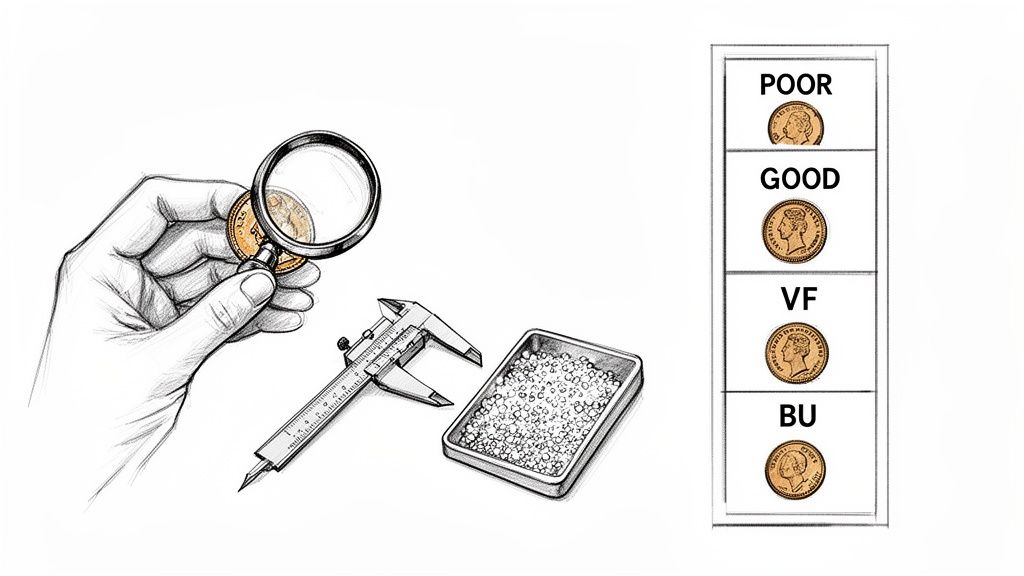
To get you started, here’s a simplified rundown of the main grading tiers used in the UK, from the most worn to the best preserved:
- Poor (P): The coin is barely identifiable. Large parts of the date and lettering have worn away completely.
- Fair (F): Very worn and smooth, but you can still make out the main design and the date.
- Good (G): Heavily worn, but all major features and legends are visible.
- Very Good (VG): Shows significant wear, but with more detail remaining than a "Good" coin.
- Fine (F): Moderate wear on the high points of the design, but many of the finer details are still sharp.
- Very Fine (VF): Light wear is visible across the coin, but it still retains much of its original detail.
- Extremely Fine (EF): Very light wear that you can only really see on the highest points of the design.
- Uncirculated (UNC): A coin that has never been in circulation and shows no signs of wear at all.
- Brilliant Uncirculated (BU): A perfect, uncirculated coin that still has its original, brilliant mint lustre.
For a much deeper dive into these standards, you can find a fantastic resource in this expert UK coin grading guide. Learning to accurately grade your own British silver coins is a skill that will pay dividends throughout your collecting journey, helping you make smarter purchases and truly appreciate the quality of your collection.
Building Your Collection the Smart Way
Now that you’ve got a handle on identification and grading, it's time to actually start buying some coins. Building a collection of British silver is a fantastic journey, but knowing where to buy and sell is crucial to doing it well. Getting to know the landscape—from trusted local dealers to the wild west of online auctions—is what separates a smart collector from one who makes costly mistakes.
There's no single "best" way to acquire coins; the right path really depends on what you're after, your budget, and how hands-on you want to be. Each route offers its own set of pros and cons.
Where to Buy British Silver Coins
Understanding your options is the first step towards building a collection you can be proud of. Each venue provides a completely different buying experience.
- Reputable Coin Dealers: For most beginners, this is the safest bet. An established dealer's reputation is built on authenticity and accurate grading. They can offer brilliant advice and usually have a well-chosen selection of quality British silver.
- Coin Fairs and Shows: These events are a collector's playground. They’re a fantastic opportunity to see a massive variety of coins in person, chat with numerous dealers, compare prices, and—most importantly—hold a coin before you buy it.
- Online Auctions (e.g., eBay): You can find some real gems and competitive prices on auction sites, but be warned: this is where the highest risks lie. You need to be confident grading from photos and vetting sellers, as the market is flooded with fakes and poorly described items.
Building a relationship with a trusted dealer is one of the best investments you can make in this hobby. Their expertise will save you from expensive errors and help you find pieces that perfectly match your collection's goals.
No matter where you end up buying, always remember the golden rule: buy the coin, not the story. A seller’s tall tales are worthless, but the coin's actual grade, rarity, and condition are everything. Do your own homework before you part with your cash.
How to Spot Fakes and Avoid Pitfalls
Unfortunately, the enduring popularity of British silver coins makes them a favourite target for forgers. Learning to protect yourself is essential. A fake coin isn't just a waste of money; it's a harsh lesson. Keep an eye out for these common red flags.
First, get familiar with a coin's proper weight and dimensions. Fakes, particularly those made from cheaper metals, are often underweight or the wrong size. A simple set of digital scales and callipers are two of the most important tools in your kit.
Next, get up close and personal with the details. Genuine coins have sharp, crisp lettering and design features. Fakes often look "soft" or "soapy" because they’ve been cast from a mould instead of being struck with a die. The edge is another big giveaway—check that the reeding (the little grooves) is correct for the coin's era.
Finally, trust your gut. If a deal on a supposedly rare coin seems too good to be true, it absolutely is. Stick with dealers you trust until you feel 100% confident in your ability to spot a dud.
Strategies for Selling Your Coins
Sooner or later, you might want to sell some pieces, perhaps to upgrade your collection or simply cash in. To get the best possible return, you need to see the market from a seller's point of view.
For individual rare or high-grade coins, your best options are usually a specialised auction house or consigning them to a top-tier dealer. These are the places where serious collectors gather, and they're prepared to pay top whack for real quality.
For bulk pre-1947 "junk" silver, the value is almost entirely tied to its silver content, or its melt value. You can sell these to local coin shops or bullion dealers. They'll offer a price based on that day's silver spot price, but it pays to shop around, as offers can differ from one dealer to the next.
Knowing how to sell your coins is just as important as knowing how to buy them. Proper identification, an honest grade, and choosing the right sales channel will make sure you get a fair price for your historic treasures.
How to Properly Care for Your Silver Coins
Your collection of British silver coins is more than just a hobby; it’s an investment of time, passion, and money. Protecting these tangible pieces of history is paramount, and thankfully, it’s simpler than you might think. It’s less about constant maintenance and more about creating a safe, stable environment where your coins can rest undisturbed.
The biggest enemies of silver are environmental factors. High humidity, sudden temperature changes, and airborne chemicals (especially sulphur) can cause irreversible damage. It helps to think of your coins like delicate historical documents—they need to be shielded from the elements to prevent unwanted toning, spotting, or even corrosion.
Choosing the Right Storage
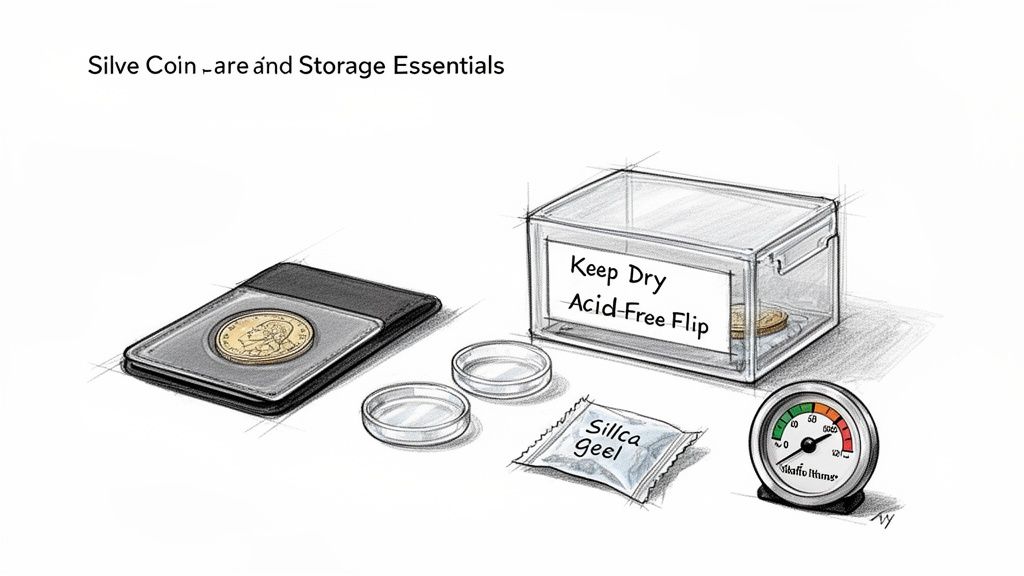
Your first line of defence is choosing the correct storage materials. It's a common mistake to use everyday plastics, cardboard, or paper, but these often contain acids or PVC (polyvinyl chloride). Over time, these chemicals can leach out and leave a damaging, sticky green residue on your coins.
Instead, you should always opt for archival-quality, inert materials made specifically for numismatic use. These options provide a safe home for your collection:
- 2x2 Mylar Flips: An affordable and popular choice. These acid-free plastic holders let you see both sides of the coin and have a paper insert for notes.
- Hard Plastic Capsules: For your more valuable coins, individual airtight capsules offer fantastic protection against bumps, drops, and environmental exposure.
- Coin Albums: High-quality albums with inert plastic slides are perfect for organising and displaying a growing collection, keeping everything secure in one place.
A stable environment is non-negotiable for long-term preservation. A cool, dark, and dry place like a cupboard or a safe is ideal. Avoid attics or basements where temperature and humidity can swing dramatically.
The Golden Rule: Never Clean Your Coins
It’s incredibly tempting to polish a tarnished silver coin to bring back its original shine, but this is almost always a disastrous mistake. That dark toning, known as patina, is a natural layer that forms over decades and is actually prized by collectors. It acts as a protective skin and is considered part of the coin's unique history.
Improperly cleaning a coin strips away this patina and leaves behind thousands of tiny, abrasive scratches called hairlines. This single action can instantly and permanently destroy its numismatic value, often reducing a rare collector's piece to its basic silver melt value.
While specialist conservation methods do exist, it's a field best left to professionals. To get a deeper understanding of this crucial topic, you can learn more by exploring the best ways to clean coins safely in our detailed guide. In short, when it comes to your collection, the best approach is hands-off.
Your Top Questions About British Silver Coins Answered
Getting into the world of coin collecting is a thrilling journey, but it naturally comes with a lot of questions. We get it. Below, I’ve answered some of the most common queries we hear from new and seasoned collectors alike, helping you build your confidence and refine your focus.
Which British Coins Are Made of Silver?
This is probably the number one question we're asked, and the answer is all about the date on the coin. It’s simpler than you might think.
- Before 1920: Any crown, half-crown, florin, shilling, sixpence, or threepence you find is made from 92.5% Sterling silver.
- 1920 to 1946: The same coins from this period contain 50% silver. Economic pressures after the First World War forced this change.
- After 1946: Regular circulating British coins contain no silver at all. The only exceptions are modern investment coins like the Silver Britannia, which are crafted from very high-purity silver specifically for collectors and investors.
How Can I Tell If My Old British Coin Is Valuable?
Age is just one piece of the puzzle. The real value of a coin rests on three pillars: rarity, condition, and silver content.
Every coin minted before 1947 has a baseline value just from the silver it contains – what we call its melt value. But the collector value, or numismatic value, can be much, much higher. A coin in fantastic condition from a year when very few were made will always be in high demand.
The key is to check the date and be honest about the coin's level of wear. A rare date in poor condition might be worth less than a common date in pristine shape.
Is It Better to Buy Graded or Raw British Silver Coins?
This really comes down to your personal goals and what you're comfortable spending.
For the big-ticket items—the rare dates, the high-value pieces—buying a professionally graded coin is the safest bet. It comes sealed in a protective case (a "slab") with a guarantee of its authenticity and an expert's opinion on its condition. It's the best way to protect a serious investment.
On the other hand, if you love the thrill of the hunt and are building a collection of more common coins, buying 'raw' (ungraded) from a dealer you trust is a brilliant way to go. This is where learning to grade for yourself becomes a vital and rewarding skill, ensuring you always pay a fair price.
Beyond just the physical care of your coins, it's wise to think about protecting your investment from the unexpected. For larger collections, you might want to look into options like specialized insurance for valuable collections for complete peace of mind.

At Cavalier Coins Ltd, we stock a huge range of authenticated British silver coins for every type of collector, from affordable Victorian shillings to slabbed rarities. Take a look at our curated collections and find the next centrepiece for your own numismatic journey at https://www.cavaliercoins.com.