

In an ever-changing philanthropic landscape, relying on a single source of income is no longer a viable option for charities. The most resilient organisations diversify their income streams, combining traditional methods with innovative digital tactics. This guide presents ten proven charity fundraising strategies, offering a comprehensive blueprint to help you build a more robust and sustainable financial future for your cause. We move beyond generic advice to provide actionable frameworks you can implement immediately.
This article offers a deep dive into a variety of powerful approaches. We will explore everything from cultivating major donors and securing corporate sponsorships to launching effective peer-to-peer campaigns and monetising often-overlooked assets like donated foreign currency. Each strategy is broken down into practical steps, realistic return on investment considerations, and clear tips to measure your success. For a broad overview of practical fundraising methods and strategies for sustainable growth, consider exploring these 10 Easy Ideas for Fundraising That Actually Work.
Our goal is to equip you with the tools needed not just to raise funds, but to build a thriving, engaged community of supporters around your mission. Whether you are part of a large non-profit, a small community group, or even a numismatist looking to support a cause through currency donations, these insights will help you refine your approach. From grant writing and legacy programmes to cause-related marketing and grassroots campaigns, the following sections detail the specific tactics that drive meaningful and lasting financial support. This is your blueprint for creating a diversified and resilient fundraising model.
1. Harnessing Community Power: Peer-to-Peer (P2P) Fundraising
Peer-to-peer (P2P) fundraising is a powerful strategy that transforms your supporters into active advocates for your cause. This decentralised model empowers individuals to create personalised fundraising pages and rally their own networks, including friends, family, and colleagues, to contribute. It leverages the immense power of social proof and personal connections, creating an exponential ripple effect that can significantly expand your donor base far beyond your organisation's direct reach.
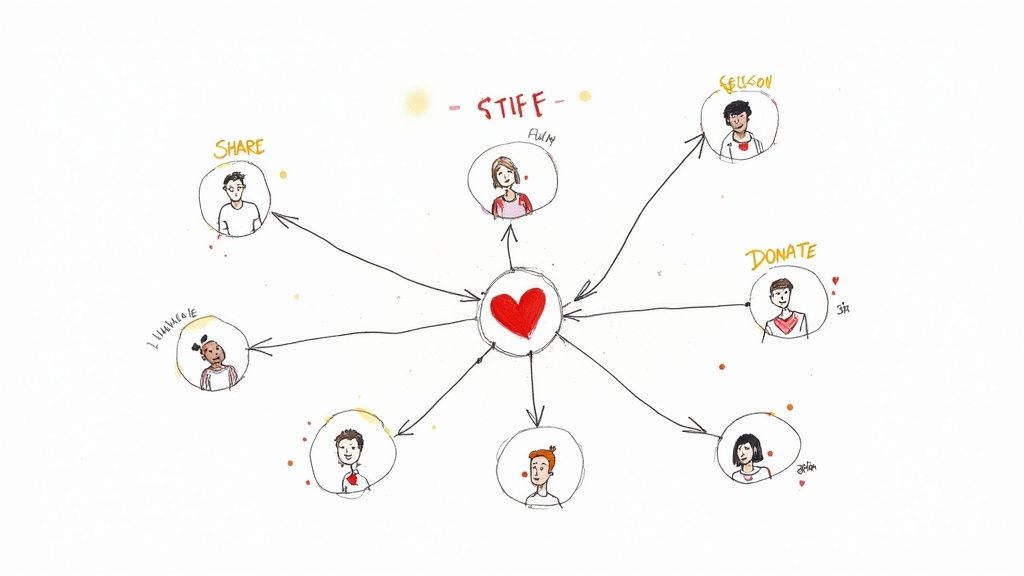
This approach is particularly effective for time-bound campaigns linked to specific events, such as marathons, sponsored challenges, or awareness months. The personal stories shared by fundraisers resonate more deeply within their own social circles than a generic appeal from the charity ever could.
How to Implement a P2P Campaign
A successful P2P campaign requires robust tools and clear communication. Your primary role is to empower your fundraisers, not to manage their donors directly.
- Choose the Right Platform: Select a user-friendly P2P fundraising platform like JustGiving or Enthuse. Key features to look for include easy page setup, social sharing integrations, and clear progress tracking.
- Create a Fundraiser Toolkit: Equip your supporters with everything they need to succeed. This digital kit should include your brand guidelines, key messages, impact statistics, high-quality images, and template social media posts.
- Offer Support and Motivation: Keep your fundraisers engaged with regular check-ins, milestone celebrations, and tips for boosting their efforts. A dedicated contact person for questions can make a significant difference.
Measuring Success and ROI
The return on investment for P2P campaigns is often high because the primary effort is distributed among your supporters. Key metrics to track include:
- Number of active fundraisers: How many people created a page?
- Average amount raised per fundraiser: This helps you understand engagement levels.
- Total number of new donors: P2P is a fantastic tool for acquisition.
- Social media reach and engagement: Monitor shares, likes, and comments related to your campaign hashtag.
By harnessing the passion of your existing community, P2P fundraising stands out as one of the most effective charity fundraising strategies for reaching new audiences and building authentic connections.
2. Grant Writing and Foundation Funding
Grant writing is a strategic approach to securing substantial funding from institutional sources like private foundations, government agencies, and corporate grant programmes. Unlike individual giving, this method involves developing detailed, evidence-based proposals that align your charity’s mission with the specific funding priorities of the grantor. Success relies on meticulous research, compelling storytelling, and robust project planning.
This strategy is best suited for established charities with well-defined programmes and a clear theory of change. Foundations such as the Gates Foundation, which funds global health initiatives, or community foundations that support local projects, seek organisations that can demonstrate long-term impact and organisational stability. Securing a grant not only provides significant financial support but also lends credibility and validation to your work.
How to Implement a Grant Funding Strategy
A systematic and relationship-focused approach is crucial for navigating the competitive world of grant funding. It requires dedicated time and resources beyond simple applications.
- Build a Grant Pipeline: Create a calendar of potential grant opportunities, tracking deadlines, reporting requirements, and contact information. Start by researching local and regional foundations where competition may be lower.
- Develop a Master Proposal: Create a comprehensive document that outlines your organisation's history, mission, key programmes, budget, and evaluation methods. This can be adapted for each specific application.
- Cultivate Funder Relationships: Connect with programme officers before applying. A brief introductory call or email can provide valuable insights into their priorities and help your application stand out.
Measuring Success and ROI
The return on investment for grant writing can be immense, but the process is often long and resource-intensive. The primary cost is staff time for research, writing, and relationship management.
- Submission and Success Rate: Track the number of proposals submitted versus the number funded. This ratio helps you refine your strategy over time.
- Total Grant Revenue: The most direct measure of financial success.
- New vs. Repeat Funders: A balance of both indicates a healthy, sustainable programme.
- Average Grant Size: Monitor this to understand which types of funders are most receptive to your appeals.
By treating grant applications as a core part of your fundraising portfolio, you can unlock one of the most transformative charity fundraising strategies for scaling your impact.
3. Major Donor Cultivation and Stewardship
Major donor cultivation is a highly personalised, relationship-based strategy focused on identifying, engaging, and stewarding individuals with the capacity to make transformative gifts. Unlike mass-market appeals, this approach prioritises building deep, long-term trust and aligning the donor's personal values with your organisation's mission. It is a patient, bespoke process that can lead to foundational support for capital projects, endowments, or core programmes.

This method is fundamental for organisations seeking sustainability and growth, as seen in the patron programmes of institutions like the Metropolitan Museum of Art or the endowment-building initiatives of major universities. The focus is less on the transaction and more on the partnership, treating donors as key stakeholders in your success.
How to Implement a Major Donor Programme
A successful major donor programme is systematic and requires dedicated resources. It is about understanding motivations and creating meaningful engagement long before a financial request is ever made.
- Identify and Qualify Prospects: Use wealth screening tools and analyse your existing donor database to identify individuals with high giving capacity and a history of affinity for your cause.
- Develop Personalised Cultivation Plans: For each top prospect, create a unique plan with multiple touchpoints. This could include private briefings with the CEO, site visits, or invitations to exclusive, non-ask events.
- Assign Relationship Managers: Dedicate senior staff or board members to build authentic relationships with prospects. Their role is to listen, understand the donor's philanthropic goals, and connect them to your work.
Measuring Success and ROI
The return on investment for major donor fundraising is exceptionally high, although the timeline is often longer than other strategies. Success is measured by the quality of relationships, not just the amount raised.
- Number of meaningful interactions: Track calls, meetings, and personalised communications per prospect.
- Portfolio progression: Monitor how prospects move from identification to qualification, cultivation, and solicitation.
- Gift size and impact: The ultimate metric is securing transformational gifts that significantly advance your mission.
- Donor retention and upgrades: A strong programme will retain major donors and often see them increase their giving over time.
By investing in relationships, major donor cultivation stands out as one of the most impactful charity fundraising strategies for securing the future of your organisation.
4. Corporate Sponsorship and Cause Marketing
Corporate sponsorship and cause marketing are strategic partnerships that align your charity with a commercial business for mutual benefit. This model goes beyond a simple donation; the company provides financial support, in-kind goods, or promotional power in exchange for brand visibility and an enhanced public image. It allows businesses to demonstrate corporate social responsibility while your organisation gains vital funding and access to a much broader audience.
This approach is highly effective for funding specific projects, events, or programmes where a corporate partner’s brand can be naturally integrated. Think of a local construction company sponsoring a new community centre build or a tech firm backing a digital literacy programme. These authentic connections resonate with consumers who increasingly prefer to support businesses that give back.
How to Implement a Corporate Partnership
Building a successful corporate partnership requires a professional, business-minded approach. You are not just asking for money; you are offering a valuable marketing and PR opportunity.
- Identify Aligned Partners: Research companies whose brand values, customer base, and corporate social responsibility (CSR) goals align with your mission. A local focus can be a great starting point.
- Develop Customisable Packages: Create tiered sponsorship packages (e.g., Gold, Silver, Bronze) with clearly defined benefits, such as logo placement, event tickets, social media mentions, and employee engagement opportunities.
- Craft a Professional Proposal: Your pitch should be data-driven, outlining your audience demographics, reach, and the specific return on investment (ROI) the company can expect. To successfully secure financial backing from businesses, consider exploring proven strategies for obtaining corporate sponsors.
Measuring Success and ROI
For corporate partners, the ROI is crucial. Providing them with clear, measurable results is key to securing long-term relationships.
- Sponsor Recognition Metrics: Track website traffic from the sponsor’s logo, social media engagement on collaborative posts, and media mentions.
- Audience Growth: Measure the increase in your own social media followers, email subscribers, and website visitors during the partnership period.
- Lead Generation (for the sponsor): If applicable, track how many leads or customers were generated for the partner through your joint campaign.
- Programme Impact: Deliver a detailed impact report showing exactly how their funds were used and the difference they made.
Corporate partnerships are one of the most sustainable charity fundraising strategies as they can evolve into multi-year alliances that provide consistent and predictable revenue.
5. Events and Experiential Fundraising
Events and experiential fundraising centre on creating memorable, engaging experiences that connect supporters to your mission on an emotional level. This strategy moves beyond simple donation requests by offering value in return, from elegant galas and community fun runs to exclusive workshops and thought-provoking lectures. The goal is to build a strong sense of community and loyalty while generating significant revenue.
This approach is highly versatile, suiting organisations of all sizes. A large charity might host a high-profile event like the American Red Cross Gala, while a local non-profit could achieve great success with a community walk or a sponsored challenge. The shared experience fosters a deeper connection between attendees and the cause, making them more likely to become long-term advocates.
How to Implement Fundraising Events
Successful events demand meticulous planning and execution, often beginning 6-12 months in advance. Your focus should be on creating an unforgettable experience that justifies the ticket price and encourages further giving.
- Set Clear Objectives and Budgets: Define what success looks like beyond just revenue. This could include media mentions, new supporter acquisition, or volunteer recruitment. Create a detailed budget that accounts for all potential costs, from venue hire to marketing.
- Secure Sponsorships Early: Approach corporate partners well in advance to secure anchor sponsors. This provides foundational funding and adds credibility to your event. Offer tiered sponsorship packages with varying levels of benefits.
- Leverage Technology: Use event management software to streamline ticketing, guest communication, and check-in processes. Promote the event heavily on social media before, during, and after to maximise reach.
- Plan the 'Ask': Integrate a clear and compelling fundraising appeal into the event's programme. This could be a live auction, a pledge drive, or a text-to-donate moment. Similar to how online coin auctions create urgency, a well-timed appeal at an event can drive immediate action.
- Follow Up Promptly: Send a personalised thank you to all attendees, sponsors, and volunteers within 48 hours. Share photos, highlight the amount raised, and reiterate the impact of their support.
Measuring Success and ROI
The return on investment for events can be complex, involving both tangible and intangible benefits. Key metrics to track include:
- Net Revenue: Total income minus total expenses.
- Cost Per Pound Raised: This helps gauge the financial efficiency of the event.
- Attendee Acquisition: How many new supporters attended the event?
- Post-Event Engagement: Track subsequent donations or volunteer sign-ups from attendees.
By offering a tangible experience, this approach stands out as one of the most powerful charity fundraising strategies for building lasting relationships and a dedicated community of supporters.
6. Monthly Giving and Donor Retention Programs
Monthly giving programmes are a cornerstone of sustainable fundraising, shifting the focus from one-off donations to long-term, predictable revenue streams. This model encourages supporters to commit to a smaller, recurring automatic donation, creating a reliable financial foundation that allows for better long-term planning and operational stability. It cultivates a deeper relationship with donors, transforming them from occasional givers into consistent, engaged partners in your mission.
This strategy is effective for charities of all sizes, from local food banks to international organisations like Doctors Without Borders. The power of this approach lies in its accessibility; a modest monthly gift of £5 or £10 feels more manageable to a donor than a single £120 donation, yet it delivers greater lifetime value to the organisation. This predictability is invaluable for budgeting and scaling impact.
How to Implement a Monthly Giving Programme
Building a successful recurring giving programme is about making the process seamless for the donor and demonstrating ongoing value. The emphasis should be on simplicity and consistent communication.
- Simplify the Sign-Up Process: Your donation form should make it incredibly easy to select a monthly giving option. Use clear calls to action and consider a one-click setup to minimise friction.
- Create a Sense of Community: Establish a named group for your monthly givers, such as "Community Guardians" or "Hope Builders." Provide them with exclusive content, like insider impact reports or early access to event tickets.
- Show Tangible Impact: Connect monthly donation amounts to specific, understandable outcomes. For example, "Your £10 a month provides a warm meal for 15 people" is far more compelling than a general appeal.
Measuring Success and ROI
The return on investment for monthly giving programmes is measured over the long term, focusing on donor lifetime value (LTV) rather than individual transaction size. Key metrics to track include:
- Donor retention rate: What percentage of monthly givers remain active year-on-year?
- Average monthly gift amount: This helps you understand giving trends.
- Donor Lifetime Value (LTV): The total revenue a donor generates over their entire relationship with your charity.
- Churn rate: The rate at which monthly donors cancel their subscriptions.
By prioritising donor loyalty, this approach stands out as one of the most effective charity fundraising strategies for building a resilient and predictable financial future.
7. Online and Digital Fundraising
Online and digital fundraising encompasses every strategy that leverages digital platforms to connect with supporters and solicit donations. This approach moves beyond physical events, using your website, social media, email campaigns, and crowdfunding platforms to engage a global audience. It allows charities to meet donors where they are, gather valuable behavioural data, and create seamless, instant giving experiences.

This method is essential in the modern fundraising landscape, where a strong online presence is non-negotiable. From a simple "Donate Now" button on your homepage to sophisticated, multi-channel campaigns like those seen from Charity: Water on Instagram, digital tools offer unparalleled reach and scalability. It is the backbone of consistent, year-round giving and rapid response appeals.
How to Implement Digital Fundraising
A successful digital strategy requires a cohesive, user-centric approach across all your online channels. The goal is to make giving as easy and compelling as possible.
- Optimise Your Website: Your website is your digital headquarters. Ensure it's mobile-first, as over 60% of traffic often comes from mobile devices. The donation process should be frictionless, ideally taking no more than two or three clicks.
- Leverage Email Marketing: Build and segment your email list to send targeted, personalised appeals. Tell compelling stories, share impact updates, and create a clear call-to-action in every email. Test different subject lines and send times to maximise open rates.
- Engage on Social Media: Use platforms like Facebook, Instagram, and LinkedIn to build a community. Utilise integrated giving tools, run targeted ad campaigns, and partner with influencers who align with your cause to amplify your message.
Measuring Success and ROI
The return on investment for digital fundraising can be precisely measured, allowing for continuous optimisation. Key metrics to track include:
- Website conversion rate: What percentage of visitors to your donation page complete a gift?
- Cost per acquisition (CPA): How much does it cost in ad spend or resources to acquire one new donor?
- Donor lifetime value (LTV): Track how much a donor gives over their entire relationship with your charity.
- Email open and click-through rates: These indicate how well your messaging resonates with your audience.
By creating a robust digital ecosystem, you can build one of the most sustainable and data-driven charity fundraising strategies available today.
8. Planned Giving and Legacy Programs
Planned giving, often referred to as legacy giving, is a forward-thinking fundraising strategy that secures future major gifts through donors' wills, trusts, and other estate plans. It allows supporters to make a more significant and lasting impact than they might be able to achieve with lifetime donations. This approach is built on long-term relationships and a deep connection to your mission, ensuring the sustainability and future of your organisation.
This long-game strategy moves beyond immediate fundraising needs to cultivate a pipeline of transformative future income. Donors who make planned gifts often see it as the ultimate expression of their values, cementing their life's legacy through the continued work of a charity they cherish. Organisations like the American Red Cross and Sierra Club have well-established legacy programmes that provide a stable foundation for their future operations.
How to Implement a Legacy Programme
Building a successful planned giving programme requires patience, sensitivity, and a focus on relationships rather than transactions. The key is to make the process accessible and meaningful for your supporters.
- Educate and Inspire: Clearly communicate the different ways donors can leave a gift in their will. Use storytelling to show the perpetual impact of past legacy gifts and create dedicated materials that explain options without complex legal jargon.
- Build Relationships: Identify and nurture relationships with loyal, long-term donors. Often, the best candidates are those who have given consistently over many years, regardless of the amount. A dedicated planned giving officer can be invaluable here.
- Partner with Professionals: Establish connections with local solicitors, estate planners, and financial advisors. They are trusted sources for their clients and can introduce the idea of charitable bequests during key life planning moments.
- Recognise and Appreciate: Create a legacy society, like Princeton University's Legacy Society, to honour and recognise individuals who have pledged a future gift. This creates a sense of community and encourages others to join.
Measuring Success and ROI
The return on investment for planned giving is realised over the long term, making it one of the most cost-effective charity fundraising strategies available. Success is not just measured in bequests received.
- Number of confirmed pledges: Track how many supporters have formally notified you of their intention to leave a gift.
- Number of enquiries: Monitor interest in your legacy programme through website visits, brochure requests, and event attendance.
- Estimated value of future gifts: While not exact, this provides a forecast for long-range financial planning.
- Lifetime value of legacy donors: These supporters often remain active lifetime donors even after making their pledge.
By making planned giving a core part of your fundraising, you invite your most dedicated supporters to become partners in securing your charity's future.
9. Cause-Related Marketing and Social Impact Campaigns
Cause-related marketing is a mutually beneficial partnership between a charity and a for-profit company, linking the sale of a product or service directly to a charitable donation. This strategy taps into consumer conscience, allowing everyday purchases to contribute to a good cause. It aligns a company's brand with your mission, enhancing its public image while creating a new, often passive, revenue stream for your organisation.
These campaigns transform consumer transactions into acts of giving. By integrating charitable giving into the point of sale, whether online or in-store, you make it incredibly simple for people to support your work. Well-known examples include "give at the checkout" prompts at major retailers, programmes where a percentage of a sale is donated (like Target's RedCard Giving), or co-branded products that highlight the charitable partnership.
How to Implement a Cause-Related Marketing Campaign
Success in this area hinges on finding the right corporate partner and creating a campaign that is clear, compelling, and easy for consumers to understand.
- Identify Aligned Partners: Research companies whose customer demographics and brand values resonate with your charity's mission. A local animal shelter partnering with a pet supply store is a natural fit.
- Propose a Simple Mechanism: Create a straightforward giving proposition. Ideas include a fixed donation per product sold, a percentage of total sales during a specific period, or a simple "round up your purchase" option at the till.
- Provide a Compelling Narrative: Equip your partner with the tools to tell your story. This includes powerful images, impact statistics, and brief case studies that their staff and customers can connect with.
Measuring Success and ROI
The return on investment for cause-related marketing extends beyond pure financial gain; it also includes significant brand exposure and new supporter acquisition. Key metrics include:
- Total funds raised: The most direct measure of financial success.
- Number of participating transactions: This indicates the campaign's reach and consumer engagement.
- Brand awareness metrics: Track social media mentions, press coverage, and website traffic originating from the partner's channels.
- New donor acquisition: Monitor how many campaign participants sign up for your newsletter or make a direct donation later.
As one of the most visible charity fundraising strategies, this approach builds powerful alliances and embeds your cause into the daily lives of consumers, driving both funds and awareness.
10. Community Fundraising and Grassroots Campaigns
Community fundraising and grassroots campaigns represent a bottom-up approach that empowers your most passionate supporters to take the lead. This strategy encourages volunteers, local groups, and community members to organise their own events and activities with minimal direct oversight from your organisation. It fosters a powerful sense of local ownership and can build a sustainable, self-perpetuating fundraising engine.
This method thrives on the creativity and dedication of your base, turning supporters into fundraising leaders. Think of local bake sales organised by school PTAs, neighbourhood walk-a-thons, or workplace giving campaigns. These initiatives build deep community roots and demonstrate authentic, localised support for your cause, making it one of the most trusted charity fundraising strategies.
How to Implement a Grassroots Campaign
Your role is to facilitate and empower, not to micromanage. Providing the right resources is crucial for encouraging volunteers to step up and organise successful events on your behalf.
- Develop a Comprehensive Toolkit: Arm your community champions with everything they need. This should include brand guidelines, fundraising ideas, template marketing materials, and clear instructions for handling donations.
- Establish Easy Registration: Create a simple online system for volunteers to register their event. This allows you to track activity, offer support, and gather valuable data on what works.
- Celebrate and Recognise: Publicly acknowledge the efforts of your community fundraisers. Feature their stories on your social media, mention them in newsletters, and recognise top-performing groups at your annual events. For example, a coin drive is a fantastic grassroots activity; learn more about how to donate coins to charity on cavaliercoins.com.
Measuring Success and ROI
The return on investment for grassroots campaigns is measured not just in funds raised, but also in community engagement and brand awareness. The decentralised nature means your initial investment in resources can yield widespread results.
- Number of community-led events: A direct measure of the scale of your grassroots movement.
- Funds raised per event/group: Helps identify the most effective types of community activities.
- Volunteer engagement and retention: Are your community fundraisers returning to host events year after year?
- Local media mentions: Tracks the increase in brand visibility within specific communities.
Top 10 Fundraising Strategies: Comparison
| Strategy | Implementation Complexity 🔄 | Resource Requirements ⚡ | Expected Outcomes 📊 | Ideal Use Cases 💡 | Key Advantages ⭐ |
|---|---|---|---|---|---|
| Peer-to-Peer (P2P) Fundraising | Medium–High 🔄: platform + training and continual support | Moderate ⚡: tech platform, volunteer coordination, social media | High reach & engagement 📊; revenue varies ⭐ | Community-driven campaigns, awareness months, team challenges 💡 | Exponential reach, low acquisition cost, strong community ties ⭐ |
| Grant Writing and Foundation Funding | High 🔄: proposal cycles, compliance, long timelines | High ⚡: skilled grant writers, research tools, reporting capacity | Large multi-year awards 📊; predictable but competitive ⭐ | Program expansion, research, capacity building 💡 | Access to substantial funding, credibility boost, strategic planning ⭐ |
| Major Donor Cultivation and Stewardship | High 🔄: personalized, long-term relationship work | High ⚡: senior staff time, prospect research, exclusive events | Transformational gifts and retention 📊; high impact per donor ⭐ | Capital campaigns, endowment, transformational projects 💡 | Secures large flexible gifts, deep advocacy, legacy giving potential ⭐ |
| Corporate Sponsorship and Cause Marketing | Medium 🔄: negotiation, brand alignment, deliverables | Moderate ⚡: relationship management, recognition assets, reporting | Significant funds + in‑kind support 📊; increased audience reach ⭐ | Events, program sponsorships, co-branded campaigns 💡 | Access to corporate budgets, marketing lift, employee engagement ⭐ |
| Events and Experiential Fundraising | Medium–High 🔄: logistics, vendor and volunteer management | High ⚡: venue, AV, catering, staff, marketing | Immediate revenue & buzz 📊; attendance-dependent results ⭐ | Galas, runs/walks, auctions, hybrid events 💡 | Memorable donor experiences, sponsor opportunities, community building ⭐ |
| Monthly Giving and Donor Retention Programs | Low–Medium 🔄: setup of recurring systems + retention work | Moderate ⚡: payment processing, CRM, ongoing communications | Predictable recurring revenue 📊; high lifetime value and retention ⭐ | Sustaining support, steady-operating revenue, retention strategies 💡 | Stable cashflow, high donor lifetime value, reduced acquisition cost ⭐ |
| Online and Digital Fundraising | Medium 🔄: campaign management, continual optimization | Moderate ⚡: digital tools, analytics, content production | Broad reach, rapid testing, 24/7 giving 📊; variable conversion ⭐ | Crowdfunding, youth engagement, rapid-response appeals 💡 | Cost-effective scale, real-time data, mobile-first giving ⭐ |
| Planned Giving and Legacy Programs | Very High 🔄: legal/financial complexity, very long cycle | High ⚡: planned giving specialists, advisor networks, stewardship | Transformational future gifts; long-term stability 📊; slow realization ⭐ | Endowment building, legacy societies, estate-based support 💡 | Large multi‑year/legacy gifts, tax advantages, perpetual impact ⭐ |
| Cause-Related Marketing and Social Impact Campaigns | Medium 🔄: partner negotiation and campaign setup | Moderate ⚡: retail coordination, marketing materials, tracking | Wide consumer reach but low per-transaction revenue 📊 ⭐ | Retail partnerships, point-of-sale drives, product cause tie-ins 💡 | Low-effort donor participation, brand exposure, incremental revenue ⭐ |
| Community Fundraising and Grassroots Campaigns | Low–Medium 🔄: volunteer-led with organizational support | Low ⚡: toolkits, minimal staff, volunteer time | Local visibility and steady small-scale revenue 📊; variable outcomes ⭐ | Neighborhood events, school fundraisers, volunteer-led drives 💡 | Low overhead, scalable volunteers, builds long-term local supporters ⭐ |
Building Your Integrated Fundraising Engine
The journey through these diverse and powerful charity fundraising strategies reveals one overarching truth: no single method is a silver bullet. The most resilient and successful non-profits are not those that master just one technique, but those that skilfully weave multiple approaches into a cohesive, integrated fundraising engine. This isn't about doing everything at once; it's about strategic synergy.
Imagine your fundraising efforts as a sophisticated ecosystem. Your digital campaigns and social media outreach act as the wide-reaching canopy, capturing attention and drawing in new supporters. Below this, your grassroots community events and peer-to-peer campaigns create a vibrant undergrowth, fostering deep engagement and localised impact. The steady, reliable streams of your monthly giving programmes are the rivers that nourish the entire system, ensuring consistent cash flow. Finally, your major donor cultivation and corporate partnerships are the deep roots, providing stability and the capacity for transformative growth. Each element supports the others.
Key Takeaways for Sustainable Growth
Reflecting on the strategies covered, several core principles emerge as vital for long-term success. First, donor-centricity is non-negotiable. Whether you are writing a multi-million-pound grant proposal or organising a local coin drive, understanding and respecting your supporter's motivations is paramount. Your communication must be tailored, your gratitude must be genuine, and the impact of their contribution must be crystal clear.
Second, diversification is your greatest defence against volatility. Over-reliance on a single income stream, such as event-based fundraising or a handful of major donors, leaves your organisation vulnerable to economic shifts or changing trends. By building a balanced portfolio that includes recurring donations, grant funding, corporate support, and even niche income streams like monetising donated currency, you create a more shock-absorbent financial foundation.
Finally, data and adaptation are the fuel for your engine. The fundraising landscape is in constant flux. The most effective charity fundraising strategies are those that are measured, analysed, and refined. Track your donor acquisition costs, monitor retention rates, and A/B test your digital appeals. This data-driven approach transforms guesswork into strategy, allowing you to allocate your limited resources where they will generate the greatest return for your mission.
Your Actionable Next Steps
Moving from theory to practice can feel daunting, but progress is built on incremental steps. Don't attempt to implement all ten strategies tomorrow. Instead, use this guide to catalyse a focused, strategic evolution of your fundraising programme.
- Conduct a Fundraising Audit: Start by evaluating your current activities. Where are you strongest? Where are the most significant gaps or opportunities? Perhaps your events are strong, but you lack a structured monthly giving programme. This analysis is your starting point.
- Select a Strategic Pilot: Choose one or two new strategies from this article that align with your organisation's strengths and goals. If you have a strong volunteer base, a peer-to-peer campaign could be a natural fit. If you have unmonetised assets like donated coins, partnering with a specialist buyer is a clear, high-ROI action.
- Create a Clear Plan: For your chosen pilot strategy, define what success looks like. Set specific, measurable, achievable, relevant, and time-bound (SMART) goals. Who is responsible for implementation? What is the budget? What are the key performance indicators (KPIs) you will track?
- Embrace the Cycle of Learn, Test, and Refine: Launch your pilot, gather data, and solicit feedback. Not every new initiative will be a runaway success, and that's okay. The goal is to learn what resonates with your unique audience and continuously optimise your approach.
By adopting this methodical and integrated mindset, you move beyond simply 'fundraising'. You begin architecting a sustainable, dynamic, and powerful engine for social change. This strategic approach ensures that your vital work not only continues but thrives, allowing you to serve your community more effectively and build a lasting legacy of impact.
Ready to turn those dusty donation jars and boxes of foreign currency into a powerful new revenue stream? Cavalier Coins Ltd specialises in helping charities unlock the hidden value in donated coins and banknotes. Visit Cavalier Coins Ltd to learn how their straightforward, transparent process can seamlessly integrate into your charity fundraising strategies and boost your mission's funding.