
Welcome to the captivating world of Russian coinage, where every single piece tells a story of empires, revolutions, and the forging of a national identity. This guide is your starting point for understanding coins from Russia, from the early silver wire kopecks of Tsarist rule to the iconic designs of the Soviet Union and the modern currency in circulation today.
A Journey Through Russian Numismatic History
We'll explore how centuries of political turmoil and sweeping change are stamped directly onto these metal artefacts, giving you a tangible connection to the past. Think of this journey not just as collecting, but as uncovering a timeline of a nation's soul.
To get started, we'll lay out a clear roadmap of the key eras you'll encounter. For those new to the hobby, it's also worth taking a moment to understand what numismatics is all about before diving into a specific country's history. Appreciating the field is the first step towards truly hearing the stories these coins have to tell.
The Ruble: A Monetary Pioneer
One of the most fascinating aspects of Russian coinage is its sheer longevity and innovation. The Russian ruble is one of the oldest currencies still in use, with a history stretching back to the 14th century. This incredible lifespan puts it in the same league as the British pound sterling in terms of continuous circulation.
A defining moment arrived under Peter the Great, who in 1704 introduced the first silver ruble coin. This bold move established the world's first decimal currency system, with one ruble equalling 100 kopecks—a structure that was truly years ahead of its time.
Here is an example of an early silver ruble from 1704, a coin that was instrumental in modernising Russia's economy.
This coin's standardised weight and decimal division represented a huge leap forward from the irregular and inconsistent "wire money" that came before it.
Collecting coins from Russia is like holding a physical piece of its turbulent and grand history. Each coin, from an Imperial silver ruble to a Soviet kopeck, is a miniature monument to the era that created it.
To help you get your bearings, let's take a quick look at the major periods that define Russian numismatic history.
Major Eras of Russian Coinage at a Glance
This table provides a simple overview of the key periods, their time frames, and the metals you'll commonly find. It's a great reference as you start to identify and categorise your first coins.
| Era | Time Period | Ruling Body | Primary Coinage Metals |
|---|---|---|---|
| Imperial Russia | 1721-1917 | House of Romanov | Gold, Silver, Copper, Platinum |
| Soviet Russia/USSR | 1917-1991 | Communist Party | Gold, Silver, Copper, Nickel, Aluminium-Bronze |
| Russian Federation | 1992-Present | Russian Government | Nickel, Bimetallic, Steel |
Having this timeline in mind will make it much easier to place each new discovery into its proper historical context.
Your Path to Collecting
Embarking on this journey requires a blend of genuine curiosity and solid knowledge. Building a collection of Russian coins means you are not just acquiring metal discs; you are becoming a custodian of stories about tsars, revolutionaries, and the everyday people who used them.
If you're just starting out, a comprehensive guide on antique collecting for beginners can provide a fantastic foundation, with practical tips that apply well beyond just coins.
There are countless ways to structure your collection, and the best approach is the one that excites you the most.
- By Era: You could focus on one specific period, such as the powerful Romanov dynasty or the sprawling Soviet Union.
- By Denomination: Why not aim to collect every denomination from a particular currency reform?
- By Theme: Many collectors enjoy pursuing commemorative coins that celebrate major events like the Olympics or the space race.
Whatever path you choose, this guide will provide the framework you need to get started.
Imperial Coins: The Era of Tsars
Step back into a time of opulence and empire. The coinage of Imperial Russia, spanning from Peter the Great's ambitious reforms in the early 18th century to the final issues under Nicholas II in 1917, offers a breathtaking window into a bygone era. These weren't just pieces of currency; they were potent symbols of power, national identity, and incredible artistic achievement.
Each coin from this period is a miniature historical document. The iconic double-headed eagle, a powerful symbol of Byzantine heritage and imperial authority, features prominently on most denominations. Portraits of the ruling tsars and tsarinas are often rendered with stunning detail, showcasing the skill of the mints and asserting the monarch's absolute power across their vast empire.
This timeline provides a visual guide to the major shifts in Russian coinage, placing the Imperial era in context with the Soviet and Modern periods that followed.
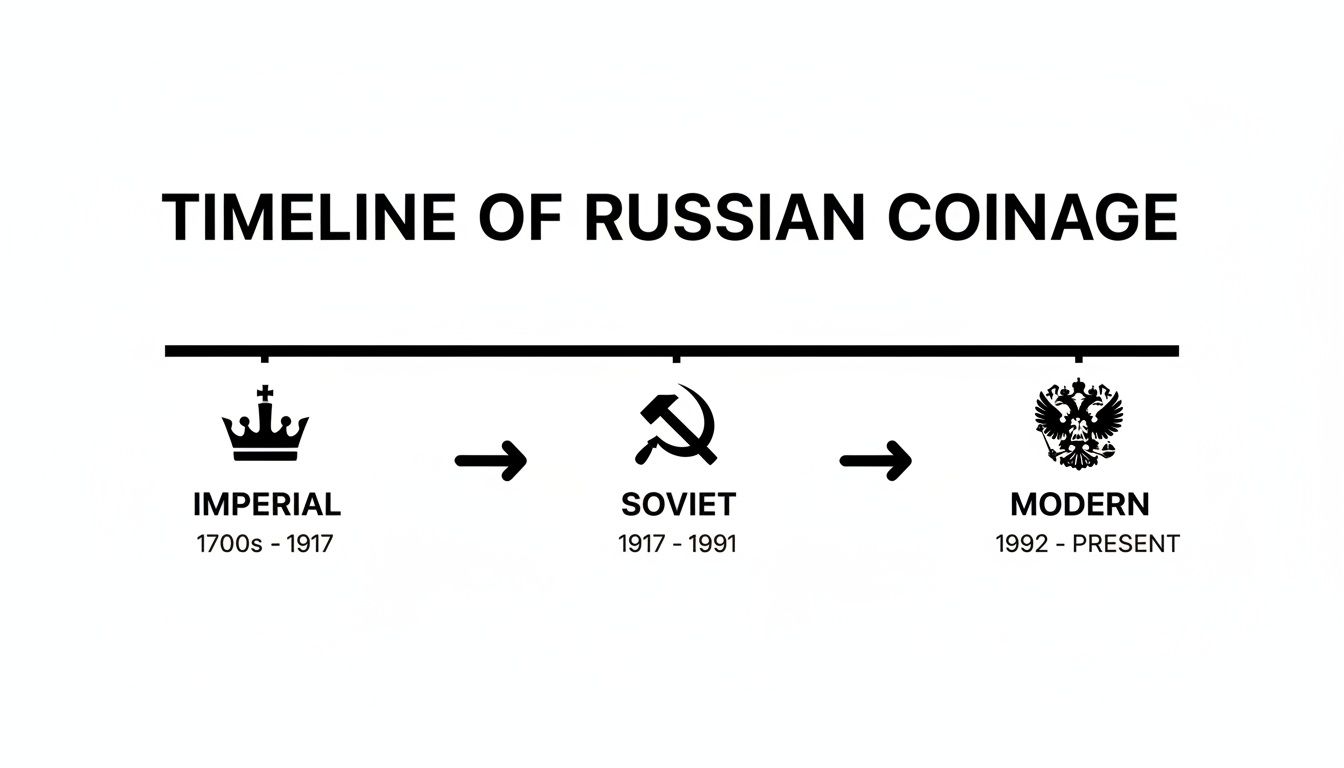
The visual progression from the Imperial crown to the Soviet hammer and sickle, and finally to the modern eagle, starkly illustrates the profound political changes that directly influenced the nation's currency.
Understanding Imperial Denominations
Getting to grips with the denominations of Imperial Russia is a key first step for any collector. The system, formalised by Peter the Great, was a decimal one—quite advanced for its time. It revolved around the rouble, which was the primary silver unit.
The system was structured logically, making it relatively straightforward to understand:
- Kopeck: The smallest copper unit. 100 kopecks equalled one rouble.
- Poltina: A silver coin worth 50 kopecks, or half a rouble.
- Rouble: The standard large silver coin, forming the backbone of the currency.
- Chervonets: A gold coin, typically valued around three roubles initially, though its value fluctuated over time.
Beyond these core units, you will encounter a wide variety of other denominations, including fractional kopecks (like the polushka, or ¼ kopeck) and larger gold coins, such as the 5 and 10 rouble pieces introduced later.
The Rise of Gold and International Influence
The introduction of gold coinage during the Romanov dynasty had a profound and lasting impact on European monetary systems, including in the UK. Beginning in 1701, Russia minted gold Chervonets using advanced methods partly inspired by British minting techniques. By 1755, new 5 and 10 rouble gold coins were introduced with intricate designs, establishing Russia as a major player in the European economy and creating a fascinating area of study for UK numismatists. You can discover more about the history of Romanov gold coins and their international connections.
One of the most remarkable chapters in Russian numismatics is the brief but spectacular issuance of platinum coins. Between 1828 and 1845, Russia was the only country in the world to mint circulating coins from platinum, in denominations of 3, 6, and 12 roubles. These pieces are highly sought after today for their rarity and unique story.
The platinum experiment was ultimately short-lived due to the metal's fluctuating price and the difficulty of striking the coins. However, their existence adds another layer of intrigue to the already rich tapestry of Imperial coinage.
Decoding the Mint Marks
Identifying where a coin was produced is crucial for determining its rarity and value. The Imperial Russian mints used Cyrillic letters to denote their location, a practice that can seem daunting at first but is easy to learn with a little practice.
Understanding these marks allows you to trace a coin's journey from its creation to your collection.
| Mint Mark | Cyrillic | City | Notes for Collectors |
|---|---|---|---|
| СПБ | Санкт-Петербург | St. Petersburg | The primary mint of the Russian Empire, responsible for the vast majority of coinage. |
| ММД/МД | Московский Монетный Двор | Moscow | An important mint, especially in earlier periods. Its marks varied over time. |
| ЕМ | Екатеринбургская монета | Ekaterinburg | Located in the Ural Mountains, this mint often processed locally sourced copper and gold. |
Other, less common mint marks exist, such as those from Warsaw (ВМ) for Polish territories or Tiflis (ТФ) for Georgia. Recognising these key marks, however, will unlock the origin of most Imperial coins from Russia that you encounter. This knowledge is essential, as the same coin and date can have vastly different values depending on its mint of origin.
Soviet Coins from Revolution to Collapse
The 1917 revolution didn't just bring down an empire; it completely reshaped Russia's identity. This seismic shift is powerfully captured in its currency. The lavish, imperial designs of the Tsars were swept away, replaced by stark, ideological symbols of a new workers' state. For collectors, Soviet-era coins from Russia open a distinct and fascinating chapter, a time when numismatics became a tool for political messaging.
This period marks a dramatic break from the past, with new emblems and materials defining the nation's coinage for over seventy years.
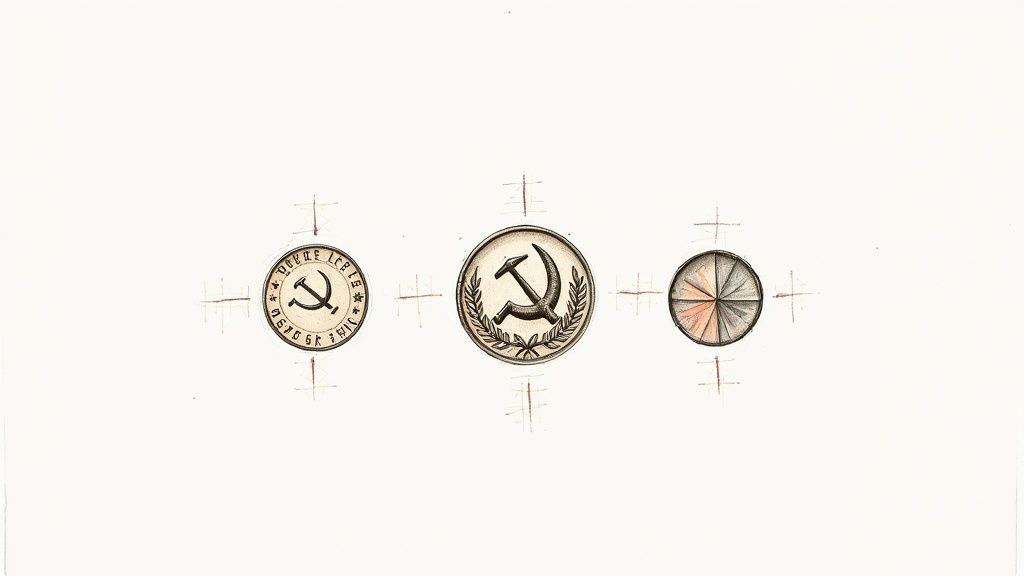
The transition didn't happen overnight. The earliest coins from this era tell a fascinating story of a nation in flux, building a bridge from the old world to the new.
From Imperial Silver to Soviet Idealism
In the chaotic years after the revolution, the new government of the Russian Soviet Federative Socialist Republic (RSFSR) was staring down immense economic challenges. To try and stabilise the economy, they issued their first silver coins in 1921, which included roubles, poltinas (50 kopecks), and smaller denominations down to 10 kopecks.
Interestingly, these first coins were struck to the exact same weight and silver purity standards as their Tsarist predecessors. This was a purely practical move, designed to build public trust and ensure people would actually use the new money. The designs, however, were a world apart, replacing the imperial eagle with the new state emblem of a hammer and sickle inside a wreath of wheat.
This initial use of silver represents a critical transition for collectors. These RSFSR coins are the only silver issues of the early Soviet period and are highly sought after for their historical importance and precious metal content.
By 1924, the Union of Soviet Socialist Republics (USSR) was formally established, and the coinage was updated to reflect this. The state emblem was tweaked, and the inscription changed from "RSFSR" to "USSR," marking the true start of standardised Soviet numismatics.
A Currency of Base Metals and Big Ideas
The age of silver was fleeting. By the early 1930s, the USSR had moved away from precious metals for its everyday currency, shifting towards more practical and cost-effective base metals. This cemented the look and feel of Soviet coins for decades.
The main materials you'll see from this long period include:
- Aluminium-Bronze: Used for the smaller kopeck denominations, giving them a distinct golden colour.
- Copper-Nickel: This was used for the larger denominations, including the rouble, giving them a durable, silvery look.
This shift also lined up with a major currency reform in 1961, which introduced a fresh series of coins that would stay largely the same until the Soviet Union fell apart in 1991. These coins, featuring the Soviet coat of arms with its 15 ribbons for the constituent republics, are the ones most people are familiar with and are a very accessible starting point for new collectors.
Commemoratives Celebrating Soviet Achievements
While the everyday coins were built for purpose, the USSR also had a popular line of commemorative one-rouble coins. These pieces were struck to celebrate key events, anniversaries, and achievements, offering a unique window into what the state held dear.
Struck in copper-nickel, these commemoratives became hugely popular with both the public and collectors. Some of the most notable themes include:
- The 20th Anniversary of Victory in WWII (1965): This was the very first commemorative rouble, featuring the iconic statue The Motherland Calls.
- The 1980 Moscow Olympics: A much-loved series showing off various Olympic sports and city landmarks.
- Space Exploration: Coins were minted to honour Yuri Gagarin's historic first flight and other milestones of the Soviet space programme.
These commemorative coins are a fantastic and visually engaging way to get into collecting from the Soviet era. They're generally affordable and tell compelling stories of a nation's triumphs and ambitions, making them a perfect entry point into the world of coins from Russia.
Modern Coins of the Russian Federation
The collapse of the Soviet Union in 1991 threw Russia into a new and often chaotic era. This turbulent transition is captured perfectly in its coinage. For any collector, the coins of the modern Russian Federation tell a fascinating story of economic upheaval, a search for national identity, and a deliberate return to long-lost historical symbols. It's an accessible area of collecting that bridges the gap between Soviet history and the Russia we know today.
Those first few years were defined by hyperinflation and constant change. The first coins issued after the fall of the USSR, in 1992, still said "Bank of Russia," but the Soviet hammer and sickle was gone. In its place was the double-headed eagle of the Tsarist era—a powerful statement that Russia was breaking with its immediate past and reconnecting with its deeper history.
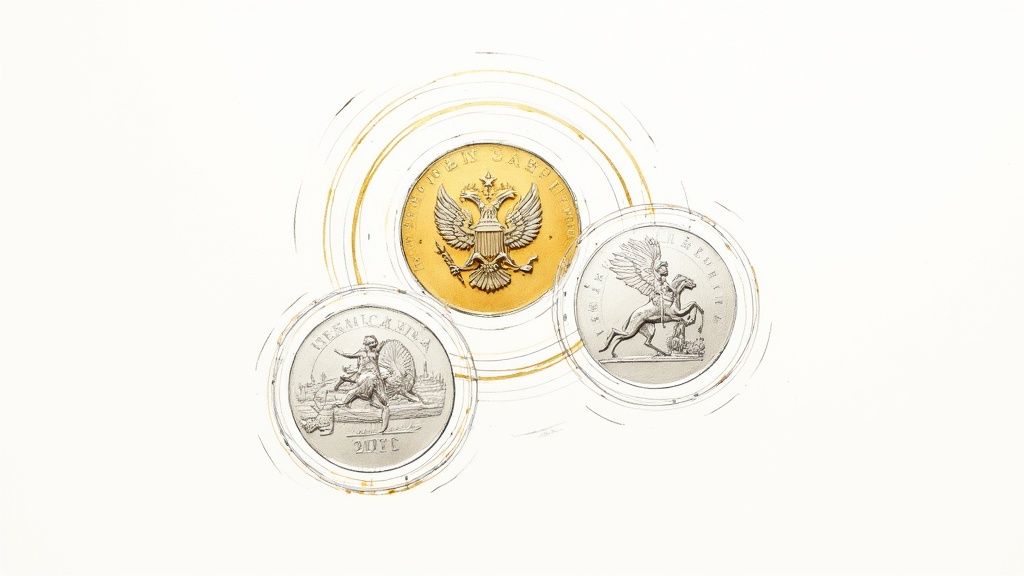
Of course, these early issues were quickly ravaged by inflation, leading to several changes in denominations and metal composition throughout the 1990s. This period of instability finally led to the landmark 1998 redenomination.
The 1998 Redenomination and Modern Designs
To get a grip on rampant inflation and make commerce simpler, Russia redenominated its currency in 1998. One new rouble was suddenly worth 1,000 old roubles, effectively knocking three zeroes off every price tag in the country. This move stabilised the currency and introduced the coin designs that are, for the most part, still in circulation.
These modern coins brought back clear and consistent national symbols:
- Kopecks (1, 5, 10, 50): The front of these smaller coins shows St. George on horseback, slaying a dragon. It's an ancient symbol of Moscow and a powerful image of Russian strength.
- Roubles (1, 2, 5): The larger rouble coins feature the double-headed eagle, which is now the official coat of arms of the Russian Federation.
The imagery on modern Russian coins is a very deliberate revival of pre-Soviet national symbols. Bringing back St. George and the double-headed eagle was a conscious choice to restore a sense of historical continuity after seventy years of communist iconography.
It's worth noting for collectors that since 2016, the design of the rouble coins has been updated. The Bank of Russia's double-headed eagle was replaced with the national coat of arms of the Russian Federation—a subtle but important change.
Commemoratives and Bullion Coins
It isn't just about the coins in your pocket. The Russian Federation has a very active programme of issuing commemorative and bullion coins. These pieces celebrate key moments in Russian history, culture, and major achievements, and they've become a huge focus for many who collect modern coins from Russia.
One of the most popular series is the bimetallic 10-rouble coin. First released in 2000, these coins have a distinctive look with an outer brass ring and an inner copper-nickel centre. They commemorate all sorts of themes:
- Ancient Towns of Russia: Celebrating historic cities from across the vast country.
- Regions of the Russian Federation: Honouring the diverse federal subjects that make up Russia.
- Ministries of the Russian Federation: Marking the anniversaries of various governmental bodies.
On top of this, the Bank of Russia also mints precious metal bullion coins for investors and collectors. The most well-known is the Saint George the Victorious gold coin, which is typically issued in quarter-ounce weights of .999 fine gold. These modern issues are a great way to combine numismatic interest with the tangible value of an asset, connecting today's collectors to Russia's long and storied history of precious metal coinage.
How to Identify and Value Your Russian Coins
Moving from just owning coins to truly understanding them is where the real thrill of collecting kicks in. Think of this section as your practical toolkit, designed to help you assess any coins from Russia in your collection. With a bit of know-how, you can start to unlock the stories and secrets hidden in each piece.
The first step on this journey is simply learning to read the coin. For Russian coins, that means getting comfortable with the Cyrillic alphabet. It’s essential for reading dates, mint marks, and other legends. Without it, a coin’s identity can remain a frustrating mystery.
Decoding Dates and Mint Marks
Learning to read the date is probably the single most important skill you can develop. On Imperial coins, you’ll often find the date under the double-headed eagle or the monarch’s portrait, usually following the word ‘ГОДА’ (GODA), which means ‘year’. For example, a coin might be marked "1898 ГОДА".
Soviet and modern coins also feature the date prominently. Just getting to grips with a few key Cyrillic letters will make the process feel much more natural over time. If you'd like to broaden your skills, our guide on how to identify old coins covers techniques that apply to all sorts of numismatics.
Just as important are the mint marks, which tell you exactly where the coin was struck. As we've seen, marks like СПБ (St. Petersburg) or ММД (Moscow) can have a huge impact on a coin's rarity and, ultimately, its value.
Understanding Coin Condition and Grading
Once you’ve figured out what a coin is, the next question is always, "What's it worth?" Apart from its rarity, the single biggest factor influencing a coin's value is its condition, or grade. A flawless, uncirculated coin can be worth hundreds or even thousands of times more than the very same coin in poor, heavily worn condition.
Grading is simply a standardised language for describing a coin's state of preservation—think of it as a quality score. While the system has many subtle levels, the basic scale is easy to get your head around:
- Poor (P) / Fair (F): The coin is extremely worn, with most details smoothed out. It’s identifiable, but that’s about it.
- Good (G): You can see the main design elements, but there's significant wear across the entire surface.
- Very Good (VG): Most of the details are clear, and the main lettering and date are readable.
- Fine (F): There’s moderate wear on the highest points of the design, but the major details are still sharp.
- Very Fine (VF): You’ll see minor wear on the high points, but the coin is still crisp and looks great.
- Extremely Fine (EF): The design is sharp, with only the slightest hints of wear on the very highest points, usually only visible with a magnifying glass.
- Uncirculated (UNC) / Mint State (MS): The coin shows no signs of wear whatsoever. It looks just as it did the day it left the mint, though it might have minor marks from being in a bag with other coins.
A coin's grade is its biography. An Uncirculated coin tells a story of careful preservation, while a "Good" grade coin tells a story of a long life passing through countless hands in commerce. Both have their own charm, but only one commands a high price.
Factors Influencing Russian Coin Value
To make sense of it all, it helps to see how these different elements come together. The value of a Russian coin isn't down to just one thing, but a combination of factors that collectors look for.
| Factor | Description | Impact on Value |
|---|---|---|
| Rarity | The number of coins originally minted and how many are thought to have survived. | Very High: The single most important driver. A low-mintage coin is always desirable. |
| Condition (Grade) | The physical state of the coin, from heavily worn (Poor) to pristine (Uncirculated). | Very High: An identical coin can be worth £10 or £10,000 based solely on its grade. |
| Metal Content | Whether the coin is made of gold, silver, platinum, or a base metal like copper. | High: Precious metal content provides a base "melt" value, but rarity often pushes it far higher. |
| Historical Significance | Coins linked to major events, famous rulers (like Peter the Great), or unusual circumstances. | Moderate to High: Adds a layer of desirability and can significantly increase demand. |
| Mint Mark | The mark indicating which mint produced the coin (e.g., St. Petersburg vs. Moscow). | Moderate: Certain mints produced fewer coins, making their issues rarer and more valuable. |
| Errors & Varieties | Mistakes made during the minting process, such as double strikes or incorrect dates. | Varies: Can dramatically increase value for sought-after errors, but minor varieties have less impact. |
Ultimately, a coin's market price is determined by the interplay of these factors. A common date in poor condition might only be worth its metal value, whereas a rare date in superb condition can achieve record-breaking prices at auction.
Rarity: The Ultimate Value Driver
Beyond condition, rarity is the final, crucial piece of the value puzzle. It’s a common misconception that age equals rarity. In reality, it’s all about how many were made and, crucially, how many are still around today. A coin can be 200 years old but still common, while another from just 50 years ago could be incredibly rare due to a low mintage or being melted down.
Famous examples prove this perfectly. The legendary Constantine Rouble of 1825 is one of the world's most valuable coins precisely because only a handful were ever struck as test pieces for a tsar who never actually took the throne. Its astronomical value comes from this incredible rarity and its unique historical backstory.
Even within the UK coin market, rare Russian coins are highly prized. Take the 1835 'family rouble', an exceptionally rare silver coin minted in St. Petersburg, with just 36 pieces ever produced. This presentation piece, showing Tsar Nicholas I and his family, was never meant for circulation, making it one of the rarest Russian silver coins on the planet.
Figuring out the value of your own coins means combining these three elements: identification, grading, and rarity. To get a feel for how these principles apply more widely, it’s worth consulting resources like a pro's guide to identifying valuable antiques, as the core concepts of assessing condition and scarcity are universal.
Building Your Collection Safely
Putting together a great collection of coins from Russia is as much about wisdom as it is about passion. Think of this final section as a friendly guide, filled with practical advice to help you acquire and protect your coins. It’s all about making sure your collecting journey is both rewarding and secure.
First things first: where do you find the good stuff? Online marketplaces can seem like an endless treasure trove, but they aren't without their risks. I always tell new collectors to stick with sellers who have a long history of positive feedback and offer clear, no-fuss return policies. Your safest bet is almost always a reputable dealer, whether you find them online or at a coin fair. Their entire business is built on trust and expertise.
Spotting Fakes and Forgeries
Sadly, wherever there's value, forgeries are sure to follow. The world of Russian numismatics is no different, and some very high-quality fakes of both Imperial and rare Soviet coins are out there. Learning to spot them is a skill you'll want to develop early on.
Here are a few tell-tale signs to look out for:
- Weight and Dimensions: Real coins are made to incredibly precise standards. A good digital scale and a set of callipers are indispensable tools for a serious collector. Always check a coin’s measurements against the official data from the mint.
- Mushy Details: Get a good look at the fine details, like the feathers on the Imperial eagle or the shape of the lettering. Fakes often have a soft, 'mushy' look and lack the sharp, clean strike of a genuine coin.
- Incorrect Lustre: Counterfeits made from casts can have a pimply or strangely dull surface. Others might have an almost soapy, slippery feel to them, which is very different from the natural gleam of a real mint lustre.
When you're considering a high-value purchase, especially something like a rare silver rouble or a gold chervonets, getting it professionally authenticated isn't just a good idea—it's essential. Services like PCGS or NGC offer that crucial peace of mind, guaranteeing a coin's authenticity and grade. It's the best way to protect your investment.
The Essentials of Proper Storage
The moment a new coin enters your collection, you become its custodian. Storing it properly isn't just an option; it's a necessity if you want to prevent damage that can slash its value over time. Your main enemies are moisture, chemicals from cheap plastics, and simple physical scuffs and scratches.
The goal is to create a stable, inert environment for your coins. A great starting point is using high-quality, acid-free holders like 2x2 cardboard flips or hard plastic capsules. From there, you can organise them in albums or storage boxes made specifically for coin collections. To dive deeper into choosing the right gear, take a look at our detailed guide on the top coin collection storage solutions for 2025.
Here at Cavalier Coins, we're dedicated to helping collectors like you build their portfolios with confidence. Whether you're hunting for your very first Russian kopeck or a sought-after Imperial piece, our curated selection and unwavering commitment to authenticity give you a secure foundation for your collecting journey.
Your Questions on Russian Coins Answered
Diving into Russian numismatics for the first time? It’s a fascinating field, but it naturally comes with a few questions. We’ve put together some straightforward answers to the most common queries we hear, helping you build your collection with confidence from day one.
How Should a Beginner Start Collecting Russian Coins?
The best way to start is to pick a specific, manageable area and dive in. Don’t try to collect everything at once! A fantastic entry point is the late Soviet era (1961-1991). These coins are generally affordable and easy to find, plus their consistent designs make them simple to identify and organise.
Another great strategy is to build a "ruler set." Try collecting one coin from each of the last Romanov Tsars, from Alexander I to Nicholas II. This gives you a clear historical path to follow and an achievable goal that won't break the bank. You’ll find yourself learning about a crucial period of Russian history, one coin at a time.
How Can I Read the Date on an Imperial Coin?
This is one of the first hurdles for many collectors, but it's easier than it looks. Imperial coins from Russia use the Cyrillic alphabet, and the date is usually found right under the Imperial eagle or the monarch's portrait. Look for the word ‘ГОДА’ (goda), which means ‘year’. A coin might read "1898 ГОДА", for example.
Getting comfortable with the Cyrillic alphabet is a massive help. While most later coins use numerals we recognise, pieces minted before Peter the Great's reforms sometimes used a system where letters stood in for numbers. For those, you'll need a special conversion chart to decipher the date correctly.
Cracking the code of the date is the first step to unlocking a coin's story. It instantly places it in a specific time and place, connecting it to the reigning monarch, the events of the era, and the art style of its time.
Are All Old Russian Coins Valuable?
Absolutely not. This is a common misconception in coin collecting. A coin’s value is a blend of its rarity, condition (or grade), metal content, and what collectors are actually looking for. Just because a coin is old doesn’t automatically make it valuable.
Take the hefty copper 5 kopeck coins from Catherine the Great's reign. They're over 200 years old, but millions were struck, so you can often buy one in average condition for a very reasonable price. On the flip side, a silver rouble from the early Soviet period might be much newer but incredibly valuable because very few were made. Always look into specific dates and mint marks to figure out what truly makes a coin rare.
At Cavalier Coins Ltd, we believe every collector deserves to build a collection they can trust. That's why we provide authenticated, high-quality coins from around the world. Explore our curated selection and start your own numismatic adventure today at https://www.cavaliercoins.com.