
A worn coin with Henry VIII's face can look straightforward until you turn it over and notice an unfamiliar mintmark, a damaged legend or an unexpectedly thin silver surface. That moment captures the central problem with the coins of Henry VIII: identifying the king's name is only the beginning.
Henry VIII and the Coinage That Built a Reputation
Henry VIII used coinage as both royal image-making and financial policy. Earlier Tudor coins often presented the monarch in a comparatively restrained medieval style, but Henry's issues increasingly made the king's face the centre of the design. A coin could therefore carry political authority in a very literal form, passing Henry's portrait and titles through everyday transactions.
The early part of his reign belongs to a monetary system that still relied heavily on established medieval denominations. Gold pieces expressed royal prestige, while silver groats, half-groats and pennies supported ordinary commerce. The sovereign became the flagship gold denomination, and its changing standards later provide some of the clearest evidence for the pressure placed on the Tudor treasury.
For wider context on how British coinage developed across successive reigns, this history of British coins provides a useful chronological introduction.
Portraits as evidence
A portrait isn't merely decoration when you're trying to attribute a Tudor coin. Henry's appearance changes across his issues, from a younger, more composed ruler to the heavy-set monarch familiar from later portraits. The style of the crown, hair, beard and clothing can help establish where a coin belongs in the sequence, especially when no date appears.
The full-face portrait on the testoon is particularly important. It departed from the more familiar profile approach and gave the coin an immediately recognisable royal presence. That design also became associated with the coin's later physical deterioration, because wear exposed the cheaper metal beneath the surface around the king's nose.
Collector's principle: A portrait can suggest a period, but it shouldn't be used alone. Mintmarks, legends, fabric and metal must support the attribution.
The two questions behind every attribution
Collectors usually begin with a simple question, “Is this a coin of Henry VIII?” In practice, that question contains two separate issues. First, was the piece genuinely struck under Henry's authority? Second, was it physically struck during his lifetime?
Those aren't always the same. Some coins continued to be issued in Henry's name after Edward VI became king, creating pieces that are legitimately catalogued under Henry VIII while belonging to a later phase of Tudor production. The absence of dates on many coins makes the distinction harder, so rarity and attribution depend on reading the whole object rather than trusting the royal name.
That uncertainty is what makes Henry's coinage so rewarding. A catalogue entry, mintmark or portrait can open a historical investigation into fiscal policy, workshop practice and the changing relationship between a coin's face value and its metal.
Denominations and the Tudor Monetary System
Before examining debasement, it helps to translate the denominations into a working Tudor vocabulary. The face value tells you how people were expected to use a coin, while the metal tells you how much intrinsic material the Crown had put into it. Under Henry VIII, those two ideas increasingly pulled apart.
Gold for prestige and larger payments
The sovereign was the principal gold piece discussed in the later Tudor monetary story. The Royal Mint Museum records that Henry VIII's gold sovereigns issued from 1544 to 1550 had a face value of 20 shillings and were produced at changing standards in this period. Half-sovereigns formed the smaller companion denomination and were issued from 1544.
Other gold denominations broadened the system. The George noble was introduced in 1526 at 6 shillings and 8 pence, while the Crown of the Rose appeared in the same year at 4 shillings and 6 pence. The gold crown and half-crown followed in 1544, valued at 5 shillings and 2 shillings 6 pence respectively. These details are recorded in the Royal Mint Museum's account of debasement and Tudor coinage.
Silver for daily exchange
The groat was a familiar silver denomination, valued at 4 pence. The testoon was valued at 12 pence, making it three times the value of the groat. Half-groats and pennies filled out the smaller end of the silver system, allowing transactions to be made without relying on gold.
A Tudor subject wouldn't have thought of these coins only as historical categories. Each denomination represented a practical payment level, although the public's confidence also depended on whether the metal matched the stated value. That distinction becomes important once the Crown began reducing precious-metal content.
Reading a catalogue description
When a listing names a denomination, start by asking three questions:
- What was the face value? This tells you where the coin sat within Tudor commerce.
- What metal was expected? Gold and silver issues carried different levels of status and purchasing power.
- What design identifies it? Portrait format, reverse imagery, legend and mintmark help distinguish related types.
A sovereign, a testoon and a groat weren't interchangeable merely because they carried royal imagery. Their values, materials and intended uses differed, and that hierarchy explains why reducing the precious-metal content of a prominent denomination could affect confidence in the entire system.
The Great Debasement Explained Step by Step
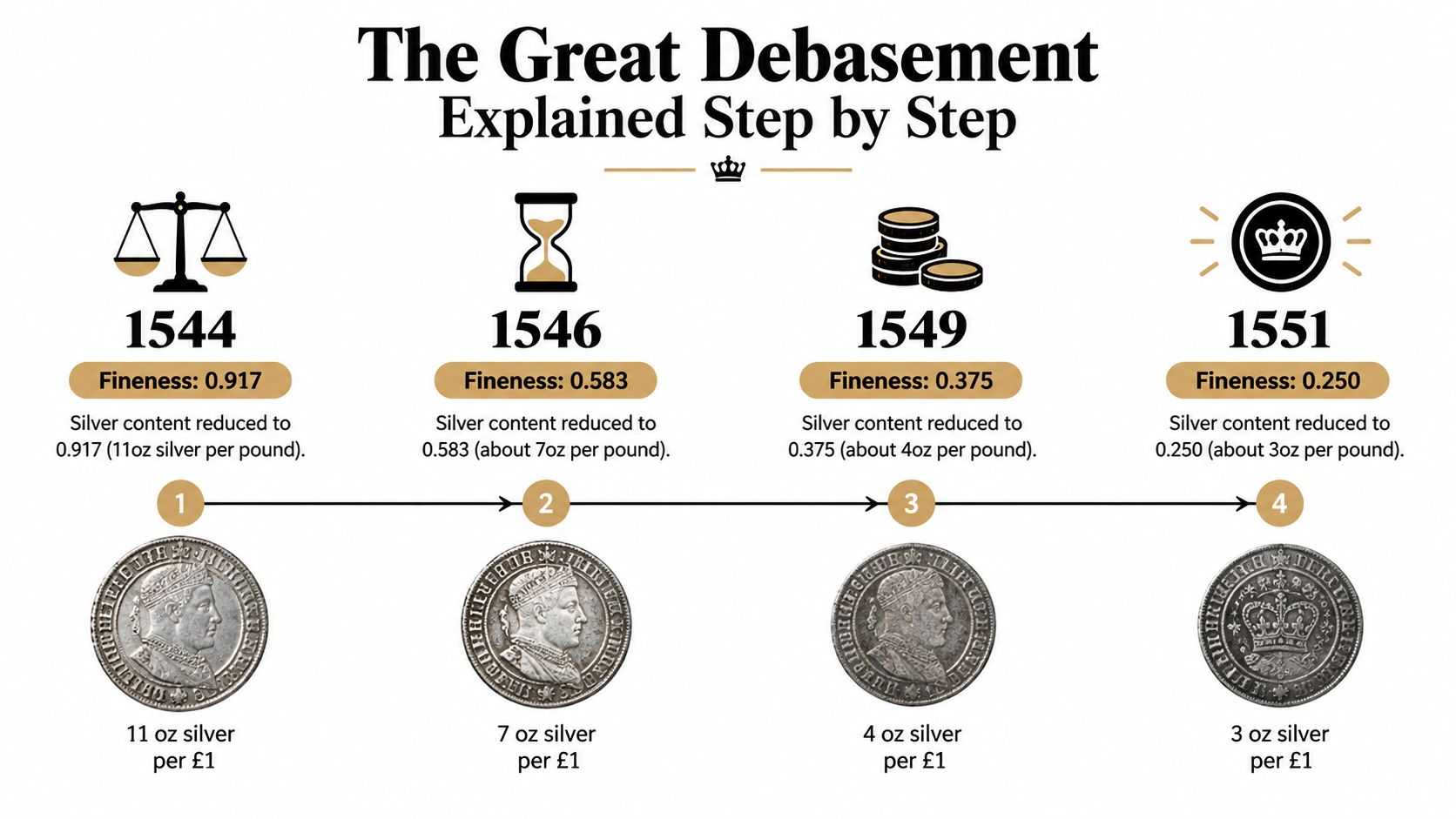
The Great Debasement began in 1544 and continued through 1551, with the most significant changes occurring during the final years of Henry VIII's reign. The Crown replaced part of the precious metal with cheaper copper to increase revenue, particularly to support military expenditure. The result was not merely a change in colour or weight. It altered the relationship between the number stamped on a coin and the material inside it.
The gold standards changed in stages
Henry VIII's sovereigns provide a precise record of this policy. According to the Royal Mint Museum's research on the Tudor sovereign, the first standard, used in 1544–45, was 23-carat gold, or fineness 958, with a weight of 12.96 grams.
The next standard, used in 1545–46, fell to 22-carat gold, or fineness 916. The third, used in 1546–47, fell again to 20-carat gold, or fineness 833. The latter represented only about 87% of the fineness of the original 23-carat standard, while the Museum describes the worst debased gold coins as containing effectively only three-quarters of the gold found in earlier issues.
A programme that required more than one mint
The scale of the operation is visible in the locations that struck the coins. Debased sovereigns were produced at the Tower of London and at temporary mints in Southwark and Bristol Castle, showing that the Crown needed an organised production programme rather than an isolated alteration to the coinage.
For collectors, this matters because mint location and mintmark can help distinguish related issues. It also explains why a coin's appearance may vary even when the denomination and royal authority are broadly the same. Different workshops, standards and stages of the programme can leave different evidence in the fabric.
Practical rule: Treat fineness as historical evidence, not as a simple quality label. A lower standard may make a coin less precious in metal, but more important for understanding Tudor fiscal policy.
The Great Debasement also changed the meaning of condition. Surface wear could reveal the base metal below a thin precious-metal layer, while clipping, corrosion and later cleaning might obscure the original fabric. A modern observer may see only a dark or coppery patch, but attribution requires asking whether that appearance fits the issue, the wear pattern and the known standard.
For a broader introduction to how changing precious-metal content affects British coinage, this guide to silver content in UK coins offers helpful background. The Henry VIII material is especially valuable because the alteration can be followed through documented standards rather than guessed from colour alone.
The Testoon and the Story of Old Coppernose
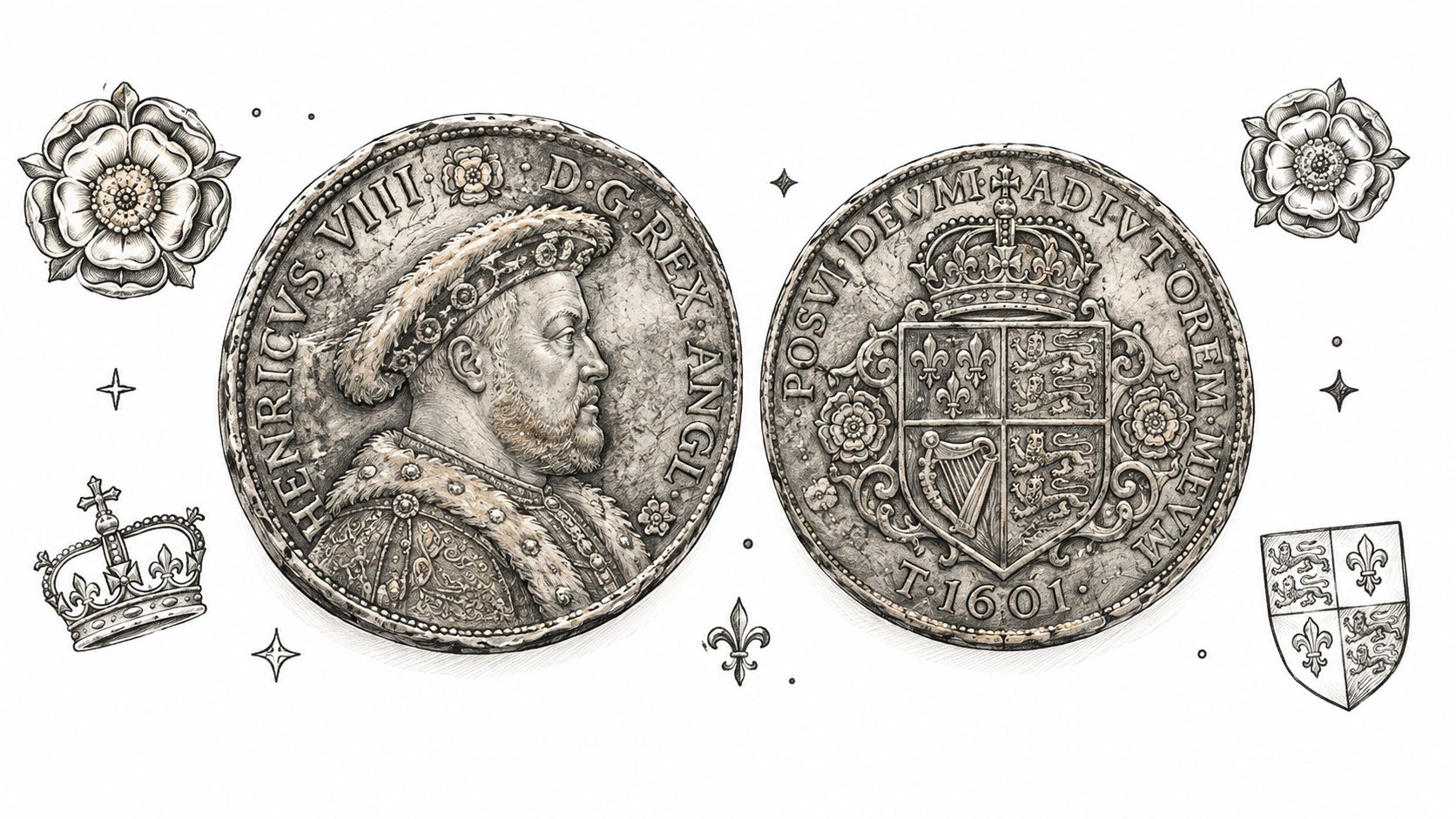
The testoon is the clearest single example of how denomination, portrait and debasement came together. It became a permanent circulating denomination during the 1540s programme and was valued at 12 pence, three times the value of the widely used groat. Its full-face portrait of Henry VIII gave the coin an unusually direct royal presence.
That high face value also made the testoon a useful instrument for raising revenue. If the Crown could issue a coin that people were required to accept at 12 pence while reducing the silver contained in it, more coins could be made from the available precious metal. The policy increased the quantity of money available to the Crown, but it weakened the connection between nominal value and intrinsic value.
Why the value collapsed
The Royal Mint Museum explains that the testoon's silver content was reduced so severely that, by the mid-sixteenth century, its value fell from 12 pence to 6 pence. That collapse created the historical origin of the sixpence, introduced under Edward VI in 1551, as described in the Museum's account of Tudor debasement and coin history.
This wasn't just a matter of a coin becoming unpopular. The reduction affected what the metal itself was worth in relation to the stated denomination. A testoon might still carry the king's portrait and legal authority, yet its silver content no longer supported the same market value.
The nose that exposed the policy
The nickname “Old Coppernose” emerged because the thin silver surface often wore away first around the raised features of Henry's full-face portrait. The king's nose became the visual point where the cheaper copper beneath could show through.
That detail is useful, but it can also mislead new collectors. A copper-coloured nose may fit the historical story, yet colour alone doesn't prove that a coin is an authentic testoon or an original debased issue. Environmental damage, old cleaning, surface loss and modern imitation can all change a coin's appearance.
Look beyond the nickname: The exposed nose is a consequence of wear on a plated or surface-treated coin. It isn't a substitute for examining the legend, portrait, fabric and overall attribution.
The testoon therefore belongs in any serious study of the coins of Henry VIII. It shows why a royal portrait could become a record of financial policy, and why a failed monetary experiment could leave behind one of the most memorable names in British numismatics.
How to Tell a Genuine Henry VIII Coin From a Later Issue
Attribution works best as a sequence of checks rather than a snap judgement. A coin bearing Henry's name may be associated with his reign, but that doesn't automatically establish when the metal was struck. Some pieces continued to be issued in Henry VIII's name for several years after Edward VI's accession, so the name on the legend is evidence of authority, not always proof of lifetime production.
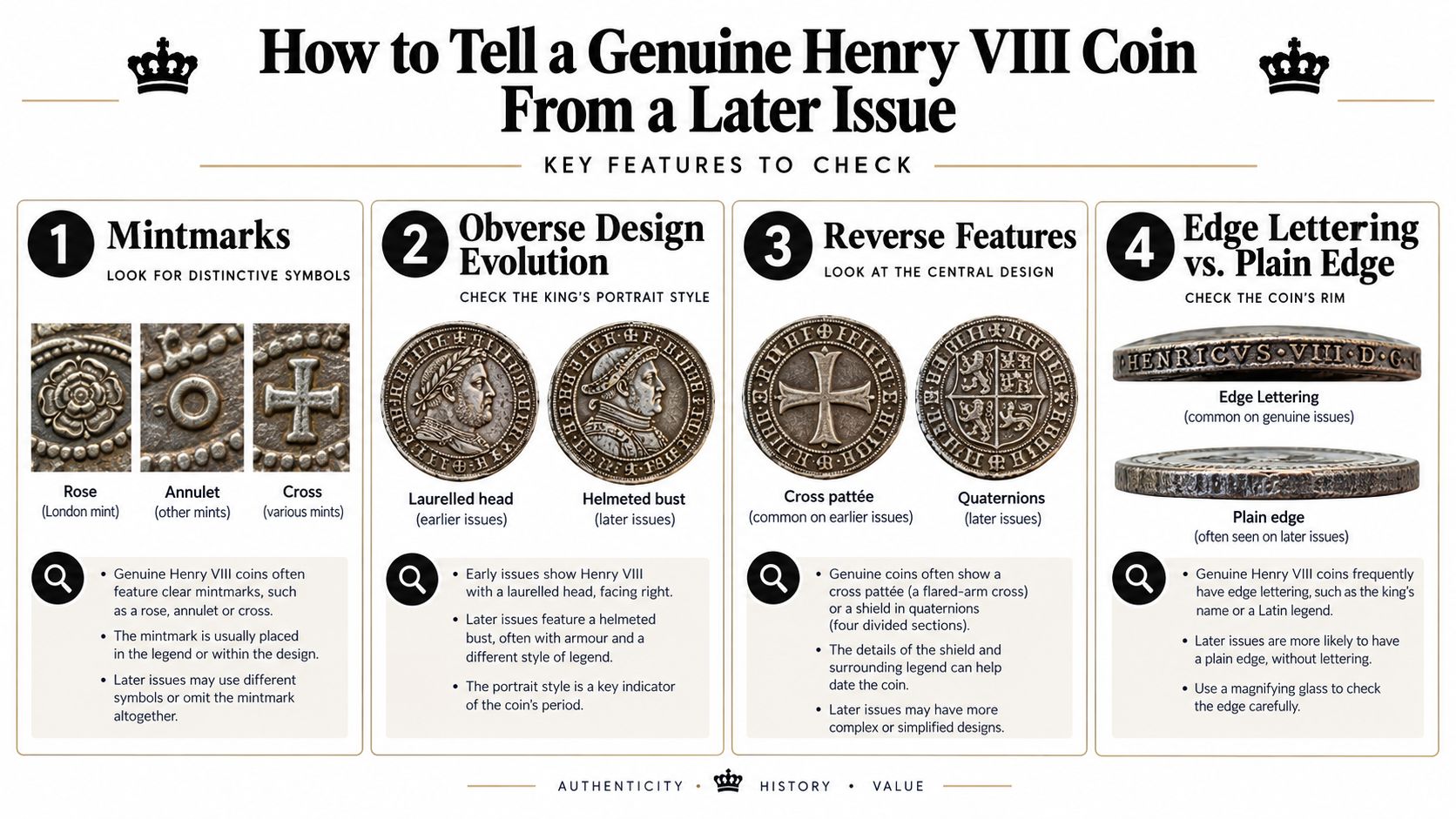
Start with the mintmark
Mintmarks are small symbols placed in the design or legend area. They can include forms such as a rose, annulet or cross, and their position and style may help identify a particular issue or workshop. A weak or clipped mintmark can be frustrating, but it may matter more than a partly readable royal title.
Look at the coin under angled light and record what you can see before comparing it with a catalogue. Don't force an uncertain mark into a familiar symbol. A mistaken mintmark can send the entire attribution in the wrong direction.
Then read the portrait and design
Henry's portrait developed as his reign progressed. Compare the shape of the head, crown, beard, clothing and overall treatment with established types. The reverse matters just as much. Cross pattée designs, quaternions and the arrangement of heraldic elements can separate related issues that share a monarch's name.
The legend supplies another layer of evidence. Abbreviations, spelling, punctuation and the relationship between letters and design elements can help identify a type, especially when the portrait is worn. Fabric also matters. Hand-struck Tudor coins may show irregular flans, uneven centres and variable striking, while a suspiciously uniform modern piece deserves careful scrutiny.
Allow for missing dates
Many Tudor coins carry no date, so collectors reconstruct their sequence through mintmarks and stylistic progression. The Royal Mint Museum's discussion of the Tudor half-sovereign records that only five Henry VIII sovereign types are known to have survived, and that the order of sovereign types must be rebuilt from these combined clues.
A useful working order is:
- Identify the denomination from size, design and likely value.
- Transcribe the visible legend without filling in missing letters too quickly.
- Record the mintmark and compare its form with reliable references.
- Assess the portrait and reverse type together.
- Consider fineness and fabric, especially if the coin belongs to the debasement period.
- Separate reign attribution from striking date when post-accession issues are possible.
For practical guidance on examining legends, symbols and design details, this resource on medieval coin identification can help beginners develop a disciplined method. The aim isn't to sound certain at every stage. A careful attribution may properly state what is secure, what is probable and what remains unresolved.
Rarity, Value and What Collectors Should Look For
Rarity in Henry VIII coinage isn't a single quality. A surviving sovereign type may be far harder to find than a worn lower-value silver piece, but condition can transform the desirability of either. A coin with a clear portrait, readable legend and identifiable mintmark gives collectors much more historical information than a damaged example of the same broad denomination.
Begin with the object, not an advertised price. Check whether the surfaces look naturally worn, whether the edge has been damaged and whether the portrait retains enough detail for comparison. A strong provenance can support confidence, while an unexplained claim of rarity shouldn't replace physical evidence.
Henry VIII coinage at a glance
| Denomination | Face value (Tudor) | Rarity for collectors |
|---|---|---|
| Sovereign | 20 shillings | Scarce and highly significant, with surviving types requiring careful attribution |
| Half-sovereign | 10 shillings by denomination relationship | Specialist interest, especially where standard and issue can be established |
| George noble | 6 shillings and 8 pence | Historically important gold denomination |
| Crown of the Rose | 4 shillings and 6 pence | Desirable early Tudor gold type |
| Gold crown | 5 shillings | Collectable gold denomination |
| Gold half-crown | 2 shillings 6 pence | Smaller gold issue with specialist appeal |
| Testoon | 12 pence | Important portrait silver, with condition and debasement evidence central to interest |
| Groat | 4 pence | Accessible entry point when attribution and surfaces are sound |
The face values and named gold issues in this table follow the Royal Mint Museum's Tudor coinage record. The rarity descriptions are practical collecting categories, not fixed market guarantees.
What deserves your attention
- Portrait detail: A worn nose, beard or crown can prevent confident comparison.
- Legend clarity: Partial legends may still identify a type, but missing central letters reduce certainty.
- Mintmark visibility: A clear mark can be more valuable for attribution than a bright surface.
- Natural fabric: Avoid judging authenticity by colour alone, especially on debased silver.
- Provenance: A documented ownership history can support confidence, but it doesn't remove the need for examination.
There isn't a responsible universal price range without a specific coin, grade, attribution and market context. A damaged groat, a well-preserved testoon and a scarce sovereign type occupy very different collecting situations. If a seller cannot explain the denomination, issue, condition and basis for attribution, walking away is sensible.
Common Misconceptions Every New Collector Should Question
The most dangerous assumption is that every coin bearing Henry VIII's name was struck while he was alive. Some coins continued to be issued in his name after Edward VI's accession, so a catalogue may use Henry's reign name while acknowledging that production came later.
Nor does age alone determine value. Rarity, survival, condition, clarity of attribution and provenance all matter. A worn coin with an uncertain mintmark may be less useful to a collector than a less spectacular piece whose type and history can be securely established.
Surface colour creates another trap. Copper showing through can fit the story of debased Tudor coinage, but toning, corrosion, cleaning and reproductions can create similar effects. The correct response is comparison, not excitement.
Ask next: What denomination is this, which mintmark does it show, which portrait type fits, and does the fabric agree with the proposed issue?
The best collector descriptions also preserve uncertainty instead of hiding it. “Henry VIII” may identify the authority named on the coin, while the evidence may point to a later striking associated with the early Edwardian period. That distinction doesn't make the coin less interesting. It makes the historical question sharper.
Cavalier Coins Ltd offers collectors a changing selection of rare and unusual coins and banknotes, including themed UK pieces that can help place Tudor coinage within the longer British tradition. Visit Cavalier Coins Ltd to explore current listings, weekly auctions and practical options for building or refining your collection.