
The coins of Russia tell a dramatic story, charting a course through three distinct historical chapters: the grandeur of the Imperial period, the rigid ideology of the Soviet Union, and the modern-day Russian Federation. Each coin is a tangible piece of history you can hold in your hand, reflecting the nation’s political turmoil, economic experiments, and ever-changing identity.
Your Guide to Russian Numismatics
Starting a collection of Russian coins is like opening a history book written in metal. These aren't just bits of currency; they're tiny artefacts that narrate a story of immense power, revolutionary upheaval, and modern rebirth. Think of this guide as your map, helping you navigate the often complex but always fascinating world of Russian numismatics.
For many collectors, these pieces are a gateway into a much wider interest. Getting to grips with the distinct periods of Russian coinage provides a great foundation before exploring the fascinating hobby of collecting world coins, which ties together cultures from across the globe through their monetary history.
This timeline gives a bird's-eye view of the key periods, marked by powerful symbols that define each era—from the Imperial crown to the Soviet hammer and sickle, and finally, the modern double-headed eagle.
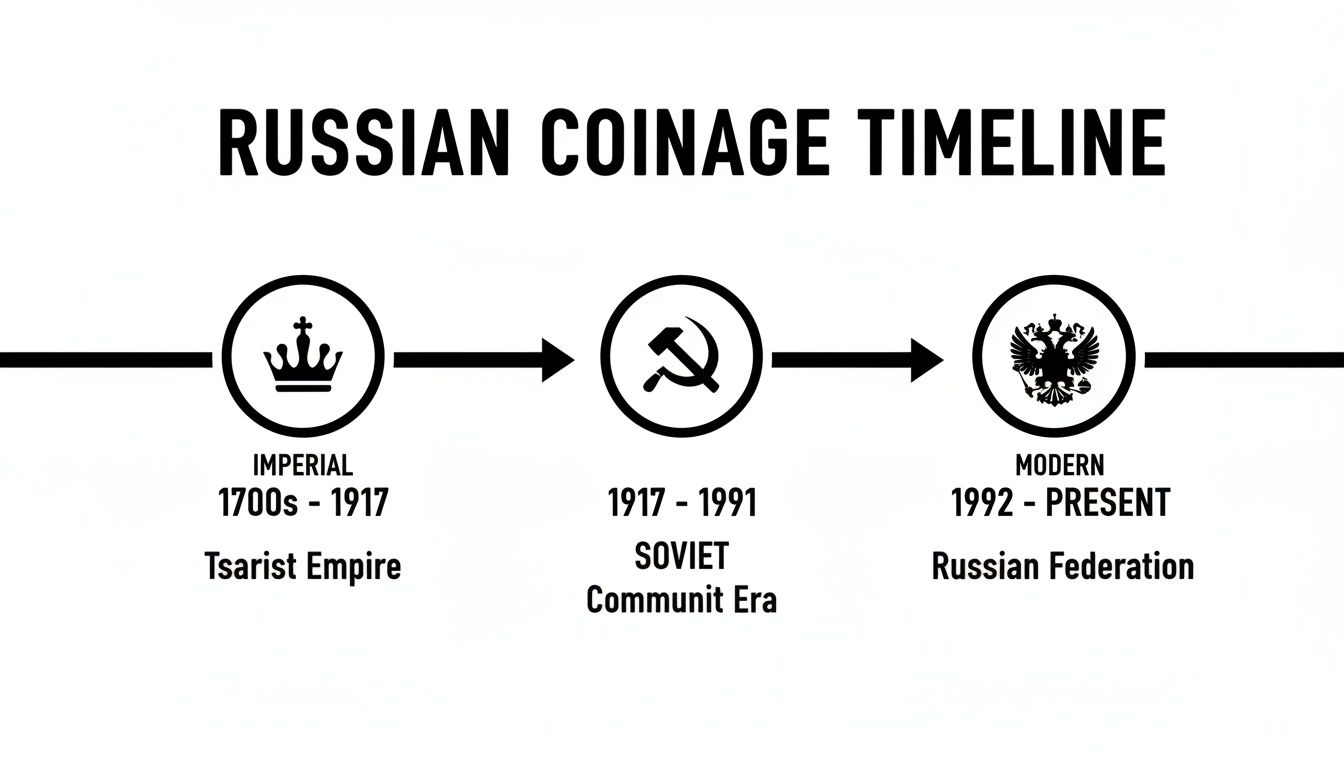
You can clearly see the dramatic shifts in national identity, where symbols of monarchy were swept away by communist iconography before the nation returned to its historical emblems.
The Three Major Eras of Russian Coins
To really understand any Russian coin you come across, you first need to place it in its historical context. Luckily, the vast majority of collectible Russian coins fall into one of three distinct periods, each with its own unique feel, metals, and designs.
To give you a quick overview, here's a breakdown of the three main chapters in Russia's numismatic story.
Key Eras in Russian Coinage
| Era | Approximate Period | Key Currency Units | Defining Characteristics |
|---|---|---|---|
| Imperial Russia | c. 1700–1917 | Rouble, Kopek, Poltina, Chervonets | Ornate designs, portraits of Tsars, use of gold, silver, and platinum. Double-headed eagle emblem is prominent. |
| Soviet Union (USSR) | 1921–1991 | Rouble, Kopek | Revolutionary symbols like the hammer and sickle, globe, and rising sun. No portraits of rulers, focus on workers and state emblems. |
| Russian Federation | 1992–Present | Rouble, Kopek | Return of the double-headed eagle, introduction of bimetallic coins, and a mix of historical and modern themes. |
Each period tells a completely different story, reflected in the very metal of the coins themselves.
-
Imperial Russia (c. 1700–1917): This is the age of the Tsars, from Peter the Great right up to Nicholas II. The coins feel opulent, often minted in precious metals like gold, silver, and even platinum. They feature intricate portraits of the rulers and the iconic double-headed eagle, reflecting a powerful empire with global ambitions.
-
The Soviet Union (1921–1991): After the revolution, everything changed. Coin designs were completely transformed. Imperial symbols vanished, replaced by the hammer and sickle, rising suns, and images of industrious workers. These coins tell a story of a brand-new political ideology and a state determined to forge its communist identity.
-
The Russian Federation (1992–Present): With the collapse of the USSR, modern Russian coinage was born. This period saw the return of the historic double-headed eagle and the introduction of new denominations and bimetallic coins, reflecting economic stabilisation and a fresh sense of national heritage.
Learning to spot the differences between these three eras is the most fundamental skill you can develop. It’s what transforms a simple piece of metal into a historical document, allowing you to read the story of the society that created it. This guide will walk you through each of these fascinating periods in more detail.
Imperial Coinage: Tsars and Triumphs in Metal
The story of Imperial Russian coins is one of raw ambition, raw power, and a relentless drive to stand shoulder-to-shoulder with the great powers of Europe. Under the Romanov dynasty, Russia’s currency transformed from crude medieval silver into sophisticated instruments of the state. These weren't just coins for buying and selling; they were miniature monuments, broadcasting the Tsar's authority and Russia's expanding influence to the world.
This incredible era, stretching from Peter the Great's reforms around 1700 to the fall of Nicholas II in 1917, saw the birth of the Russian rouble as we know it. Every coin struck was a statement of imperial might. Each piece featured a stunning portrait of the ruling monarch and the powerful double-headed eagle—a potent symbol of Russia's Byzantine heritage and its dominion over both East and West.
Peter the Great and the Coinage Revolution
Before Peter the Great, Russian money was wildly inconsistent. Most of it was crudely produced "wire money," made simply by snipping off pieces of silver wire and stamping them. Peter, a man obsessed with modernising his empire, launched a sweeping monetary reform that completely overhauled the nation's currency. He introduced new denominations, standardised weights, and—most importantly—adopted European-style milled coinage.
This was far more than just a technical upgrade. Adopting milled coinage, where coins are machine-struck for a perfect, uniform finish, was a deeply political statement. It announced to the world that Russia was a modern, technologically advanced nation, capable of producing currency on par with Britain or France. Peter's reforms also established the decimal system (100 kopeks to 1 rouble) that remains the foundation of Russian money today.
Gold Ambitions and European Standards
A huge part of Russia's entry onto the world stage was creating gold coinage that could hold its own in international trade. The mission was clear: produce a Russian coin that would be as trusted and accepted as the famous European ducat. This ambition led to the creation of the iconic gold chervonets.
For instance, Peter the Great's 1701 chervonets weighed exactly 3.46 grams, a deliberate move to match the ducat standard perfectly and smooth the wheels of international commerce. This embrace of global standards was also influenced by British methods, with Russia even adopting some shared machining techniques. Later, in 1755, Empress Elizabeth expanded this golden ambition by launching new 10- and 5-rouble coins, showcasing an impressive reverse eagle bearing the arms of Moscow, Kazan, Siberia, and Astrakhan. You can learn more about the golden age of Romanov coinage and its international connections.
This focus on high-quality gold and silver coinage continued for centuries, with each ruler leaving their personal mark. The coins of Catherine the Great, for example, are renowned for their artistic quality, beautifully reflecting the Enlightenment ideals she championed.
Imperial coins were more than currency; they were a projection of power. The sheer size of Catherine the Great’s copper 5-kopek coins—weighing a hefty 51 grams—was designed to impress upon the population the immense wealth and stability of her empire.
Russia's Unique Platinum Experiment
Perhaps one of the most unusual chapters in numismatic history is Russia's brief but fascinating experiment with platinum coins. In the 19th century, vast platinum deposits were discovered in the Ural Mountains. With no major industrial use for the metal at the time, Finance Minister Georg von Cancrin cooked up a novel plan: turn it into money.
Between 1828 and 1845, Russia became the only country in the world to issue circulating platinum coins, in denominations of 3, 6, and 12 roubles. These coins were incredibly durable but ultimately proved unpopular. They were difficult to mint, looked too much like silver, and their value was notoriously unstable.
This numismatic curiosity had a surprising knock-on effect far beyond Russia's borders. After the experiment ended, the Russian Empire offloaded its massive platinum stockpile to a British firm, Johnson, Matthey & Co. This single transaction flooded the UK market with the rare metal, effectively creating a British monopoly and sparking new industrial uses for platinum that continue to this day.
The Final Imperial Coins
The last coins of Imperial Russia, minted under Nicholas II, feel like a reflection of an empire teetering on the brink of collapse. While still beautifully crafted, these were the final issues of a 300-year-old dynasty. The outbreak of World War I put immense strain on the Russian economy, leading to a critical shortage of precious metals.
By 1915, the minting of silver and gold coins for everyday circulation had ground to a halt, replaced by paper currency. The small copper coins were the last metallic currency produced before the revolution swept the Tsarist regime away for good. For collectors, these final imperial issues represent the end of an era, holding a poignant place in the history of the coins of Russia.
Soviet Era Coins: From Revolution to Reorganisation
The 1917 revolution didn't just bring down a dynasty; it wiped the slate clean on Russia's national identity. You can see this transformation perfectly in its coinage. The ornate, Tsar-focused designs of the Imperial age were gone in a flash, swapped out for a stark, new visual language meant to broadcast a new world order. Soviet coins became tools of ideology, turning the loose change in your pocket into a miniature billboard for communist values.
Portraits of rulers and the iconic double-headed eagles completely disappeared. In their place came potent new symbols: the hammer and sickle to represent the unbreakable union of factory workers and farmers, the globe to signal a worldwide revolution, and a rising sun to herald a new dawn. These coins were designed to be in the hands of the masses, a constant, tactile reminder of the state’s message of collective strength and progress.
The Early Years: RSFSR Issues
In the turbulent aftermath of the revolution, the very first Soviet coins weren't actually issued by the USSR. They came from the Russian Soviet Federative Socialist Republic (RSFSR). Struck from 1921, these early silver roubles and kopeks acted as a bridge from the old system. They even kept the same weight and silver purity as their Imperial predecessors—a clever move to build public confidence in the new money.
But the designs were a world apart. The front featured the new RSFSR coat of arms: a shield with the hammer and sickle against a rising sun, all framed by sheaves of wheat. The back often showed a simple five-pointed star, another key symbol of the new government. These early pieces are a fascinating snapshot of a nation finding its new identity.
Currency Reforms and Metal Debasement
The story of Soviet money is one of constant change, with a series of reforms reflecting the often-harsh economic realities of a centrally planned economy. As the USSR cemented its grip, the metals used in its coins changed dramatically. Precious metals were gradually stripped out of circulation to help fund the state's massive industrialisation projects.
The move from silver to common base metals wasn't an accident; it was deliberate economic policy. By the 1930s, circulating coins were made from copper-nickel and bronze. This allowed the state to stockpile its silver reserves for more strategic uses, telling a clear story of a nation that valued heavy industry far more than monetary tradition.
This debasement was a theme throughout the Soviet period. Major currency reforms in 1947 and again in 1961 brought in brand new coin series, often smaller and made from even cheaper alloys like copper-zinc-nickel. For collectors, these frequent overhauls create a wonderfully rich and varied field to explore. Each reform gives us a distinct set of designs and denominations that chronicle the economic policies of the day.
Identifying Soviet Mints and Commemoratives
Figuring out where a Soviet coin was minted is usually quite simple, once you know what to look for. Most coins have a small mint mark, typically found near the date. During this era, two main mints were responsible for production:
- Leningrad Mint (ЛМД): Look for the Cyrillic letters "ЛМД" (LMD).
- Moscow Mint (ММД): This mint used the Cyrillic letters "ММД" (MMD).
While the vast majority of Soviet coins were purely functional, the state did issue commemorative one-rouble coins that gave a rare flash of artistic flair. These coins celebrated key anniversaries, national achievements, and major events. The most famous of these, especially outside Russia, are the coins struck for the 1980 Moscow Olympics, which featured designs for various sporting events. These commemorative pieces were often produced to a higher quality and have become a popular and affordable entry point for new collectors curious about Soviet-era numismatics.
Modern Coins of the Russian Federation
The collapse of the Soviet Union in 1991 didn’t just change the map; it sent Russia’s economy into a tailspin. The coinage from this era tells a dramatic story of hyperinflation, confusion, and eventually, a hard-won stability.
This turbulent period saw the death of the Soviet rouble and the birth of a new currency for a new nation. For a brief moment, coins issued from 1992 actually still bore the "Bank of the USSR" inscription—a fascinating holdover from a system that no longer existed. They were quickly replaced by coins featuring the double-headed eagle, a powerful symbol snatched from the Imperial era to signal a clean break from the communist past.
The 1998 Redenomination: A Fresh Start
By the mid-1990s, inflation had spiralled out of control. Kopeks were worthless, and people's pockets were weighed down with banknotes and coins carrying long strings of zeroes. To put a stop to the chaos and restore some faith in the currency, a drastic redenomination was carried out in 1998. Old roubles were swapped for new ones at a rate of 1,000 to 1.
This was a complete reset. The kopek was brought back from the dead, and the familiar denominations that are still in use today were established. The standard set of coins became:
- Kopeks: 1, 5, 10, and 50 kopek coins were minted, though you'd be hard-pressed to find the smallest values in your change today.
- Roubles: 1, 2, 5, and 10 rouble coins became the workhorses of everyday transactions.
The designs were finally standardised. The obverse proudly displays the double-headed eagle of the Bank of Russia, with the value clearly shown on the reverse. This clean, uniform look was a welcome sign of stability after years of monetary madness.
Commemorative and Bimetallic Coins
Away from the day-to-day currency, the modern era has become a golden age for collectors, thanks to Russia's incredible commemorative coin programmes. The Bank of Russia pumps out dozens of new designs every year, celebrating everything from historic battles to cultural icons and scientific breakthroughs. For new collectors, these modern coins of Russia are the perfect place to start.
The real beauty of collecting modern Russian coins is how accessible it is. You don't need the budget of a Tsar to get started. You can build an amazing collection of commemorative roubles, each with its own story, without breaking the bank.
The undisputed stars of the show are the bimetallic 10-rouble coins. First appearing in 2000, their striking design—a brass outer ring around a copper-nickel centre—made them an instant hit. Two major series have really captured the imagination of collectors:
- Ancient Towns of Russia: This ongoing series is a tribute to the historic cities that form the bedrock of the nation, like Derbent, Pskov, and Murom.
- The Russian Federation: A massive undertaking, this series dedicates a coin to each federal subject—every republic, oblast, and krai—showcasing their unique coats of arms.
These series are like a numismatic tour of the country. Each coin is a miniature lesson in Russian geography and history, and collectors eagerly await the new releases from the Moscow (MMD) and St. Petersburg (SPMD) mints every year. They've truly become a collecting field all on their own.
How to Identify and Value Your Russian Coins
Holding a Russian coin is like holding a key to the past, but knowing what you have is the first step to unlocking its story and value. Sorting through these pieces might seem intimidating, especially with the Cyrillic script and centuries of history, but a simple, step-by-step approach makes it far easier. Think of yourself as a detective; you're looking for specific clues that, when pieced together, reveal the coin's identity and ultimately, its worth.
The first clues are usually the most obvious—the date, the denomination, and any visible text or symbols. If you're not familiar with the Cyrillic alphabet, a quick online search for a chart will become your best friend. Learning to spot just a few key letters helps you decipher words like "РУБЛЬ" (Rouble) or "КОПЕЙКА" (Kopek), immediately telling you the coin's face value.
Decoding the Mint Marks
Once you have a general idea of the coin, the next crucial clue is the mint mark. This tiny symbol tells you exactly where the coin was made, a detail that can dramatically affect its rarity and value. Russian coins have been struck at various mints over the centuries, but a few pop up more frequently than others.
Learning to spot these marks is a fundamental skill for anyone getting serious about the coins of Russia.
Russian Mint Mark Identification
The table below is a quick reference guide to the most common mint marks you'll find on Imperial, Soviet, and modern Russian coins.
| Mint Mark (Cyrillic/Latin) | Mint City | Era(s) of Operation | Example Coin Types |
|---|---|---|---|
| СПБ, СПМ, СПМД | St. Petersburg | Imperial, Modern | Imperial Roubles, Modern Commemoratives |
| М, ММД | Moscow | Imperial, Soviet, Modern | Soviet Kopeks, Modern Roubles |
| ЕМ | Ekaterinburg | Imperial | Large Copper 5 Kopek Coins |
| Л, ЛМД | Leningrad | Soviet | Soviet-era Roubles and Kopeks |
For instance, finding an "ЕМ" on a large copper coin instantly places it in the Imperial era and points to the Ekaterinburg mint, which was famous for producing those hefty pieces. Likewise, an "ЛМД" mark confirms your coin is a Soviet issue from the Leningrad Mint. This small detail adds a whole new layer to the coin's story.
The Crucial Role of Coin Condition
Two seemingly identical coins can have wildly different values. The deciding factor is almost always their condition, or grade. Grading is simply the process of evaluating a coin's level of wear and tear. A coin that looks like it just left the mint, with sharp details and its original shine, is graded as "Uncirculated" (UNC). On the other hand, a coin that has clearly seen heavy use, with its design worn smooth, will get a much lower grade like "Good" (G) or even "Poor" (P).
The difference in value between grades can be staggering. A common 1899 silver rouble of Nicholas II might be worth £25-£30 in a heavily worn state, but an uncirculated example of the same coin could easily fetch over £300. This is why accurately assessing condition is paramount.
For high-value coins, it's often wise to seek professional grading from a third-party service. This provides an objective, standardised assessment that collectors trust. To understand this process in greater depth, you can learn more about how to get coins graded and see why it’s a worthwhile investment for serious collectors.
What Drives a Russian Coin's Value?
Beyond its condition, several key factors come together to determine a coin's market price. Understanding these drivers will help you spot a potential treasure hiding in a pile of old change.
- Rarity: This is the most straightforward factor. How many were minted? A coin from a year with a low mintage is almost always more valuable than one from a year when millions were produced.
- Historical Significance: Coins tied to major historical events—like the coronation of a Tsar or the final issues before a revolution—often carry a premium. They tell a more compelling story, and collectors are willing to pay for that connection to the past.
- Metal Content: The intrinsic value of the gold, silver, or platinum in a coin provides a solid price floor. For many Imperial coins, their precious metal content alone makes them valuable.
- Collector Demand: Some coins are simply more popular than others. A great example is the large "cartwheel" 5-kopek pieces of Catherine the Great; they are perennial favourites due to their impressive size and rich history.
Interestingly, the circulation of Russian coins has historical links that reach far beyond its borders. Archaeologists in England and Wales have uncovered Russian silver coins from the reigns of Ivan IV and Boris Godunov right in the middle of Tudor-era sites, despite them never being legal tender. These discoveries suggest early, perhaps unofficial, trade connections long before formal relations were established. You can explore more about these unexpected Tudor-era findings and their implications. This historical context just adds another layer of intrigue to the story these fascinating coins tell.
A Practical Guide to Buying and Selling
Navigating the market for Russian coins can be every bit as rewarding as building the collection itself. Whether you’re hunting down your first commemorative rouble or figuring out what to do with a multi-generational inheritance, understanding the landscape is essential. This guide will give you the practical knowledge to buy with confidence and sell with a solid strategy.
The journey of acquiring new pieces always starts with knowing where to look. The world of numismatics has several avenues, each with its own pros and cons. Your best bet will often depend on your goals, whether you're after a specific rare date or just hoping to add some variety to your collection of coins of Russia.
Where to Find and Acquire Russian Coins
Finding authentic Russian coins means tapping into a network of trusted sources. While the internet has thrown the doors open to global markets, it has also created a greater need for caution.
Here are the main places to find and buy coins:
- Reputable Coin Dealers: Specialised dealers are often your safest bet. They bring expertise to the table, guarantee the authenticity of their coins, and can help you track down specific pieces you’re looking for. Building a relationship with a trusted dealer is an investment that pays off in the long run.
- Auction Houses: For the high-end, rare, or professionally graded coins, major auction houses are the premier venues. It can get competitive, but auctions offer access to the finest known examples of Imperial and rare Soviet coins.
- Online Marketplaces: Websites like eBay can be a treasure trove, but they also carry the highest risk of fakes and doctored coins. It’s absolutely crucial to buy only from sellers with extensive, long-term positive feedback and a clear, no-fuss return policy.
- Coin Shows and Fairs: These events are fantastic because you get to inspect coins in person and chat directly with multiple dealers. They are an excellent way to learn, network, and stumble upon interesting pieces you might never have discovered online.
When buying—especially online—high-quality photos are non-negotiable. Always scrutinise the images for any signs of alteration. Look for odd-looking toning, tiny scratches around key features, or unnaturally smooth fields, as these can be red flags for harsh cleaning or polishing.
Buyer Beware: A Note on Forgeries
The market for Russian coins, particularly the rare Imperial issues, is unfortunately riddled with forgeries. Some are crude fakes that are easy to spot, but others are incredibly sophisticated copies designed to fool even experienced collectors. Always buy from sources you trust. For any significant purchase, it's wise to stick to coins that have been professionally graded and encapsulated by a reputable third-party grading service.
Preparing and Selling Your Collection
When it’s time to sell, a bit of prep work can make a huge difference to your final payout. Whether you’re a collector refining your focus or a charity managing a donation, a thoughtful approach is key. The first step is to simply organise and catalogue what you have. For each coin, note the date, denomination, mint mark, and a rough idea of its condition.
This initial inventory will help you decide on the best sales strategy. You generally have two main routes: selling directly to a dealer or using a consignment service.
- Direct Sale: This is the fastest way to liquidate a collection. You sell straight to a dealer and get paid immediately. The trade-off is that you might get a lower price, as the dealer needs to factor in their own profit margin.
- Consignment/Auction: Selling through an auction house or on consignment can fetch higher prices for desirable coins. However, the process is slower, and you will pay a seller's fee or commission on the final price.
For those handling larger quantities, understanding the options for selling coin collections in bulk is crucial for maximising returns and ensuring a smooth process. This is especially true for charities or resellers dealing with significant volumes.
The decision to sell can sometimes have historical echoes. After Russia's unique platinum coinage experiment ended in 1845, the government made a bulk sale of monumental scale. In 1846, the Russian Empire sold between 11 and 32 tonnes of platinum to the British firm Johnson, Matthey & Co. This single transaction, involving over 1.3 million three-rouble pieces, effectively gave Britain a monopoly on the metal and fuelled its industrial growth. You can discover more about how this Russian numismatic policy shaped British industry.
Storage, Conservation, and Insurance
Properly caring for your coins is non-negotiable if you want to preserve their value and historical integrity. The number one rule is simple: never clean your coins. Harsh cleaning, polishing, or using any kind of abrasive material will strip a coin of its natural patina and create microscopic scratches, absolutely destroying its numismatic value.
For storage, always use materials designed specifically for coins:
- Coin Flips: Stick to PVC-free plastic flips for individual coins.
- Albums: Acid-free albums are excellent for organising your collection and making it easy to view.
- Slabs: The encapsulated holders from professional grading services offer the best possible protection.
Finally, if your collection grows in value, insuring it is a critical step. A standard homeowner's policy may not cover the full value of a specialised collection. You may need a separate rider or a dedicated policy from a firm that understands collectibles. Keep a detailed inventory with photographs and purchase records in a secure, separate location—this will be essential to support any future claims and ensures your investment in history is protected for years to come.
At Cavalier Coins Ltd, we are passionate about connecting collectors with the coins that tell these incredible stories. Whether you are looking for rare Imperial gold or modern bimetallic commemoratives, our curated selection offers something for every enthusiast. Explore our collection and find the next centrepiece for your numismatic journey. Visit us today at https://www.cavaliercoins.com.