
Welcome to the fascinating world of Turkish numismatics. More than just bits of metal, each coin is a tiny piece of history you can actually hold in your hand. The coins of Turkey tell a sweeping story, from the intricate silver and gold of the mighty Ottoman Empire to the modern Lira and Kuruş of today's Republic. This guide is your starting point for understanding these incredible pieces.
Kicking Off Your Turkish Coin Journey
For many collectors, the pull of Turkish coins comes from their deep connection to the crossroads of Europe and Asia. This isn't just about collecting metal discs; it's about tracing the rise and fall of empires, the birth of a nation, and the evolution of a culture through its currency.
Think of each coin as a direct link to a specific moment in time. An old Ottoman Kuruş might bear the toughra—the calligraphic signature—of a Sultan who reigned centuries ago. By contrast, a modern 1 Lira coin proudly features the portrait of Mustafa Kemal Atatürk, the founder of the Turkish Republic. The journey from one to the other is a story of immense political and social change.
What You're About to Discover
I’ve structured this guide to build your knowledge from the ground up, whether you're a curious beginner or have been collecting for years. We’ll walk through the essential topics every collector needs to get to grips with, making sure you feel confident as you start or grow your collection.
Our exploration will cover:
- A Historical Timeline: We’ll travel from the Ottoman era, through critical reforms, to the establishment of the Republic and the modern Lira we see today.
- Identification Skills: You'll learn how to read the vital clues on both old and new coins, including dates, mint marks, and iconic symbols.
- Valuation and Rarity: Discover what makes certain coins more valuable than others, with a focus on condition, mintage numbers, and what other collectors are looking for.
- Collecting and Care: We'll get into the practical side of things—sourcing authentic coins and preserving them properly for the future.
For a collector, the story behind a coin is often as valuable as the coin itself. The coins of Turkey offer a particularly rich narrative, connecting numismatics directly to the grand sweep of world history.
By the end, you'll see why collecting these pieces is so much more than a simple hobby. It's an active exploration of art, economics, and history, all wrapped up in the fascinating coins of Turkey.
From Ottoman Kuruş to the Modern Lira
To really get to grips with the coins of Turkey, you need to travel back through a history packed with imperial ambition, revolutionary fervour, and economic grit. The story starts, not hundreds, but thousands of years ago in ancient Anatolia, where the Lydians first came up with the idea of coinage around 600 BCE. This incredible legacy of monetary innovation really set the scene for the powerful empires that would follow.
The Ottoman Empire, founded way back in 1299, developed a complex and truly fascinating system of money. In the early days, the main silver coin was the Akçe, a small but vital piece for everyday trade. As the empire grew, so did its currency. We saw the introduction of other denominations like the Para and the magnificent gold Sultani, a coin designed to broadcast the Sultan's immense wealth and authority across the known world.
These early coins were often struck by hand, which gives each one a unique, almost personal character. They weren't just money; they were symbols of raw power, bearing the Sultan's elaborate calligraphic signature, known as the toughra. This special mark was a guarantee of the coin's weight and precious metal content, making it a trusted medium of exchange far and wide.
The Shift to Modern Coinage
By the 19th century, the world was changing fast, and the Ottoman Empire knew it had to modernise. A series of sweeping changes known as the Tanzimat reforms were introduced, and this period marked a huge turning point for Turkish coinage. The traditional, irregular, hand-struck coins started to be replaced by machine-milled coins, churned out with modern presses.
This wasn't just a cosmetic upgrade. It represented a fundamental move towards a standardised, European-style monetary system. The Kuruş was introduced in 1844 as the standard unit of currency, with a fixed relationship to gold and silver, bringing a whole new level of order and predictability to the Ottoman economy. These newer coins featured much more uniform designs and precise inscriptions, making them easier to produce and regulate.
Even today, the historical weight of this era captures the imagination of collectors. Ottoman coins have long held a special appeal for enthusiasts in the UK, reflecting the old historical ties between Britain and the Ottoman Empire and a general British fascination with numismatics. Market reports consistently show Ottoman coins are among the most sought-after foreign coins here, with a huge chunk of the numismatic trade involving these historic pieces. You can discover more insights about the popularity of Turkish coins on cavaliercoins.com.
The move from hand-struck to milled coinage was more than a technological upgrade; it was a statement. It signalled the Ottoman Empire's ambition to integrate with the modern global economy, a change literally minted in metal.
The Birth of the Republic and the Lira
The collapse of the Ottoman Empire after the First World War led directly to the Turkish War of Independence and the founding of the Republic of Turkey in 1923. This massive political shift brought an equally profound change to the nation's currency. Out went the symbols of the Sultanate, replaced with new designs that celebrated a sovereign Turkish nation.
A brand-new currency, the Turkish Lira (Türk Lirası), was introduced, marking a clean break from the imperial past. The first coins of the Republic featured new national symbols and, crucially, used the Latin alphabet instead of Arabic script. This was a key part of the Atatürk reforms aimed at modernising the country. The portrait of Mustafa Kemal Atatürk, the founder of the Republic, soon became a permanent fixture on Turkish coins and banknotes, a tradition that stands to this day.
Taming Inflation: The New Turkish Lira
For a good part of the late 20th century, Turkey wrestled with periods of crippling inflation. By the early 2000s, the currency's value had dropped so dramatically that everyday shopping involved millions, sometimes billions, of Lira. Banknotes for 20,000,000 Lira were commonplace, and the currency even earned a spot in the Guinness Book of Records as the world's least valuable.
Something had to be done. To restore economic stability and public trust, Turkey undertook a major currency reform. On 1 January 2005, the 'New Turkish Lira' (Yeni Türk Lirası, or YTL) was introduced. This wasn't a totally new currency, but a redenomination—six zeros were simply lopped off the old Lira.
Here’s how it worked in practice:
- 1,000,000 old Lira became 1 New Turkish Lira.
- The old Kuruş, which had long been worthless due to inflation, was brought back.
- 1 New Lira was divided into 100 New Kuruş (Yeni Kuruş).
This bold move instantly simplified accounting, made cash transactions practical again, and psychologically reset how people viewed the currency's value. After a transitional period where both old and new Lira were accepted, the 'New' was officially dropped on 1 January 2009. The currency went back to its original name, the Turkish Lira, cementing the modern coin series we see in circulation today. This incredible journey, from the ancient Akçe to the modern Lira, makes the coins of Turkey a tangible chronicle of a nation's enduring story.
How to Identify Your Turkish Coins
Holding a Turkish coin is like holding a piece of a historical puzzle. Every mark, script, and symbol is a clue to its past, waiting to be understood. Learning to read these clues transforms you from a casual owner into a coin detective, able to unlock the story behind both imperial Ottoman pieces and modern Republic currency.
For a newcomer, the task can seem daunting. An old Ottoman coin with its elegant Arabic script feels worlds away from a modern, bi-metallic Lira. But if you know what to look for, you can quickly learn to spot the defining characteristics of each era.
This visual guide shows the distinct paths Turkish currency has taken, from the Ottoman Empire's intricate designs to the streamlined coins of the modern Lira.
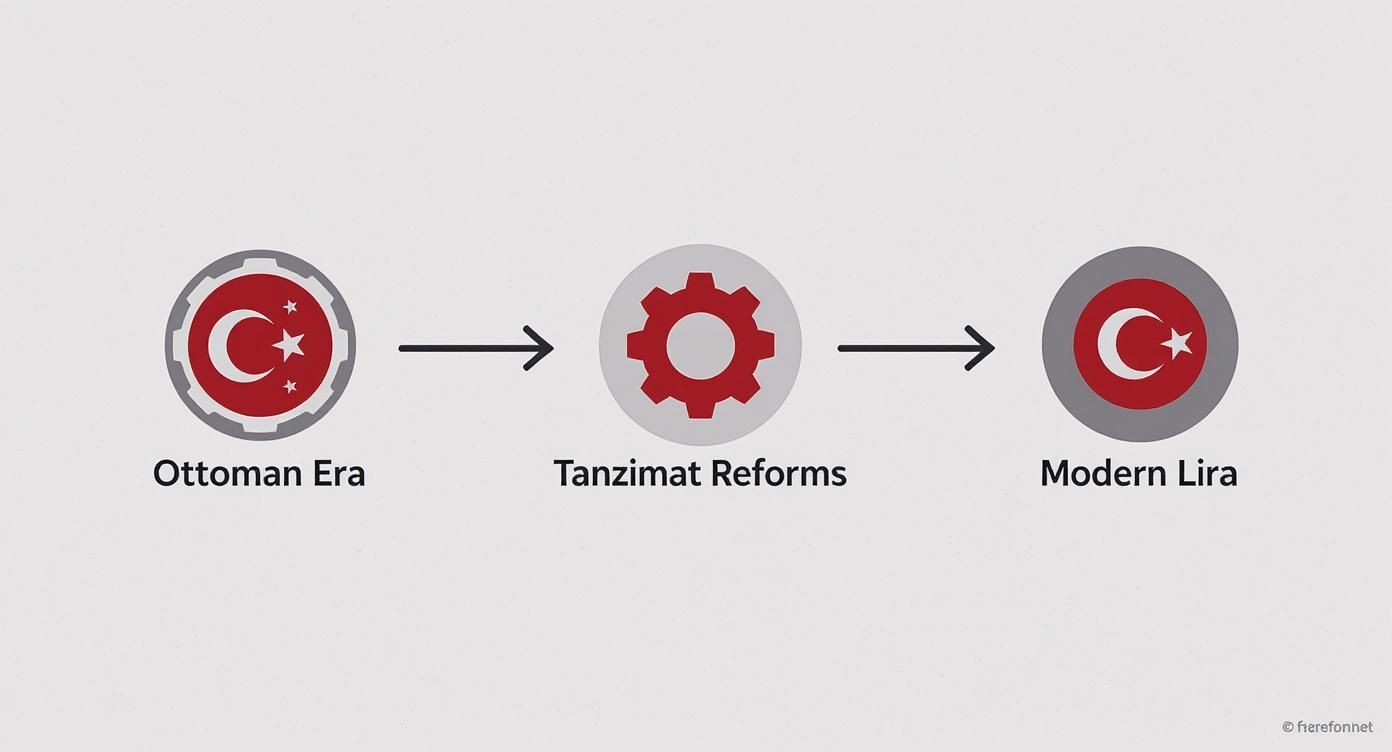
As you can see, symbols of imperial power, like the Sultan's Tughra, eventually gave way to symbols of national identity, such as the Lira sign—a clear reflection of the country's profound political shifts.
Decoding Ottoman Era Coins
Identifying Ottoman coins can feel like learning a historical code, but it’s incredibly rewarding once you crack it. The single most important feature to find is the Tughra—the unique calligraphic signature of the reigning Sultan. Think of it as the ultimate seal of approval, a guarantee of the coin's authenticity and authority.
Each Sultan had a distinct Tughra, so learning to recognise just a few key ones can help you date a coin to a specific reign. For instance, the Tughra of Sultan Abdülmecid I (1839-1861) is one of the most common you'll find on coins from the Tanzimat reform period.
The next crucial element is the date. Ottoman coins typically feature two important dates written in Arabic numerals:
- Accession Date: The year the Sultan ascended to the throne.
- Regnal Year: The year of the Sultan’s reign in which the coin was minted.
To find the actual minting year, you simply add the regnal year to the accession date. Just remember, these dates follow the Islamic Hijri calendar, so you'll need to convert them to the Gregorian calendar we use today. For broader advice, our guide on how to identify old coins provides expert tips for beginners that can be applied to many types of historical currency.
Identifying Modern Republic Coins
When the Republic of Turkey was established in 1923, its coinage underwent a complete transformation, making the coins much easier to identify today. The elaborate Tughra and Arabic script were swept away, replaced with symbols representing the new, modern nation.
The most prominent feature you'll see on nearly all Republic coins is the portrait of Mustafa Kemal Atatürk, the nation’s founder. His image is a constant, though its depiction has evolved over the decades. Another key change was the switch from Arabic script to the Latin alphabet, making inscriptions like "Türkiye Cumhuriyeti" (Republic of Turkey) instantly recognisable to most.
Dates on these coins are straightforward. They use the standard Gregorian calendar and are clearly displayed, usually on the reverse. Mint marks are also easier to find. The Turkish State Mint, the Darphane, is located in Istanbul, and its mark is often present, though some very early issues might lack one.
To help you tell them apart at a glance, here’s a quick comparison of the key features.
Key Identification Features on Turkish Coins
| Feature | Ottoman Era (pre-1923) | Republic Era (post-1923) |
|---|---|---|
| Primary Symbol | Sultan's Tughra (calligraphic signature) | Portrait of Mustafa Kemal Atatürk or national symbols |
| Script | Arabic script | Latin alphabet |
| Dating System | Islamic (Hijri) calendar with Accession & Regnal years | Gregorian (Western) calendar |
| Key Inscription | Sultan's name and titles | "Türkiye Cumhuriyeti" (Republic of Turkey) |
This table should make it much easier to quickly place your coin in the correct historical period before you dive into the finer details.
Understanding Metal Composition
The metals used to make Turkish coins also tell a story of economic shifts over time. Simply paying attention to what a coin is made of can give you immediate clues about its era and potential value.
Ottoman Era Metals:
- Gold (Sultani): Used for the highest denomination coins, signifying wealth and imperial power.
- Silver (Akçe, Kuruş): Formed the backbone of the monetary system for centuries of trade.
- Copper/Billon (Para): Used for smaller denominations essential for everyday transactions.
Republic Era Metals:
- Silver and Gold: Initially used for higher-value coins in the early Republic but were phased out for general circulation.
- Copper-Nickel and Bronze: Became the workhorse metals for much of the 20th century.
- Brass, Aluminium, and Bi-metallic alloys: Modern coins use these durable and cost-effective materials. The current 1 Lira coin, with its distinctive brass centre and nickel ring, is a perfect example.
This move from precious metals to industrial alloys mirrors Turkey’s economic journey from a vast empire to a modern industrial nation. By piecing together the date, symbols, and metal of your Turkish coin, you can accurately place it within this fascinating timeline.
Exploring Popular Coin Sets and Commemoratives
Once you've got the hang of identifying your Turkish coins, the real fun begins: deciding what to collect. Turkish numismatics is a wonderfully diverse field, offering everything from assembling the coins you'd find in your pocket today to hunting down beautifully crafted special editions. Each path is its own unique way to connect with the nation's rich culture and history.
For most people just starting out, the perfect entry point is collecting a "type set" of modern Turkish coins. It’s an achievable and deeply rewarding goal that builds a fantastic foundation for any collection. All it involves is gathering one of each denomination from the current series, which was introduced back in 2009.
The Modern Circulation Set: A Perfect Start
The contemporary set makes up the backbone of daily commerce in Turkey and is a brilliant way to get familiar with modern coin design. These coins are easy to find and won't break the bank, making them an ideal first project for any collector.
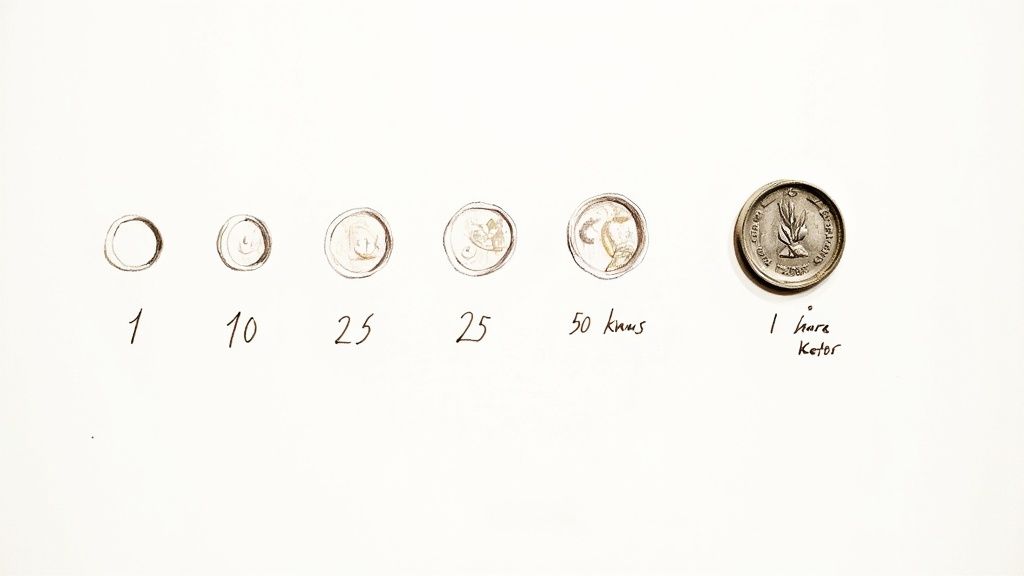
The standard circulation set is made up of six denominations:
- 1 Kuruş: The smallest coin, made of brass.
- 5 Kuruş: A slightly larger brass coin.
- 10 Kuruş: Also made of brass.
- 25 Kuruş: A copper-nickel piece.
- 50 Kuruş: A bi-metallic coin with a copper-nickel outer ring and a brass centre.
- 1 Lira: The largest coin in circulation, also bi-metallic but with its metals reversed—a brass outer ring and a copper-nickel centre.
Putting this set together gives you a real, tangible snapshot of Turkey's modern economy. It’s a simple yet satisfying achievement that gets you ready for more specialised collecting down the road.
The World of Turkish Commemorative Coins
Look beyond the standard pocket change and you'll discover the vibrant, artistic world of commemorative coins. These are special pieces minted to celebrate major events, honour historical figures, or showcase national treasures. Unlike everyday coins, commemoratives are often produced with higher quality finishes and in limited numbers, which makes them highly sought after by collectors.
The Turkish State Mint issues these coins to mark a huge range of themes, turning simple metal discs into miniature works of art. They're a fantastic way to explore specific parts of Turkish heritage without needing to take on a long and complex historical series.
Commemorative coins are like numismatic storytellers. Each one captures a specific moment or theme—from celebrating ancient Anatolian civilisations to honouring modern scientific achievements—offering a focused glimpse into the national identity.
These special coins often boast intricate designs and are struck in various metals, including silver and gold for the premium collector's editions. They represent a much more focused collecting area, where you can chase themes that genuinely interest you. You can learn more about how these special issues are valued by checking out our guide on the latest commemorative coin values.
Popular Commemorative Themes to Collect
Over the years, the Turkish Mint has released some incredible series that have captured the attention of collectors both in Turkey and abroad. Looking at these themes can give you some excellent inspiration for your own collecting goals.
Some standout series and themes include:
- Historical Turkish States: This series pays homage to the great Turkic empires of the past, long before the Ottomans. Each coin features symbols and iconography tied to a specific historical state, creating a fascinating numismatic link to ancient history.
- Flora and Fauna of Turkey: Celebrating the country's rich biodiversity, this popular series showcases native plants and animals. Designs often feature stylised depictions of species like the Anatolian leopard or the famous Turkish Van cat.
- National Anniversaries: Coins in this category mark important milestones, such as the anniversary of the founding of the Republic or significant historical battles. These pieces are deeply patriotic and historically important.
- Architectural Wonders: From ancient ruins to grand Ottoman mosques, these coins celebrate Turkey's incredible architectural heritage.
Whether you aim to complete a simple set of the six circulating coins of Turkey or decide to hunt for a beautifully designed commemorative series, your collection will be a personal testament to the nation's rich and enduring story.
Understanding the Value of Your Collection
Sooner or later, every collector gets to the big question: "What are my coins actually worth?" It’s a natural curiosity, but the answer is rarely a simple one. A coin's value isn't just about how old it is or what metal it’s made from. For the coins of Turkey, value is a fascinating mix of history, artistry, and good old-fashioned scarcity.
Most modern, circulating Turkish coins you'll come across are simply worth their face value—a 1 Lira coin is worth 1 Lira. But every now and then, a piece can hold a surprising value for other collectors. Understanding what makes a coin desirable is the key to appreciating your collection and knowing what you have. It really all boils down to three core factors.
The Three Pillars of Coin Value
Think of a coin’s value like a three-legged stool. If any one of those legs is weak, the whole thing wobbles. In the world of coin collecting, these three legs are condition, rarity, and demand. For a coin to be considered truly valuable, it needs a strong combination of all three.
Let's break down what each of these means for your Turkish coins.
- Condition (Grade): This is all about the physical state of the coin. A pristine, uncirculated coin that looks like it just rolled out of the mint will always command a higher price than one that’s been heavily worn by its journey through countless hands.
- Rarity (Mintage): This is purely a game of numbers. How many of that specific coin were ever made? A "key date" coin, struck in very small numbers, is naturally harder to find and, therefore, more valuable.
- Demand: This is the human element—the buzz. Are other people actively looking for this specific coin? A coin can be incredibly rare, but if no one is trying to buy it, its value will stay stubbornly low.
An old Ottoman silver coin might seem valuable because of its age, but if millions were minted and they’re easy to find in worn condition, its value will be modest. On the flip side, a modern commemorative coin with a low mintage, kept in perfect condition, could be quite valuable if it’s part of a popular series that people are keen to complete.
Understanding Coin Condition or Grade
A coin’s condition, or its grade, is probably the most important factor you can see with your own eyes. Grading is simply a standardised way of describing how much wear and tear a coin has suffered over its lifetime. Think of it like a book: a brand-new hardback is worth more than a dog-eared paperback that's been read a dozen times.
Coin grades range from poor and barely identifiable to absolutely perfect. Here’s a simplified way to look at it:
- Good (G): Don’t let the name fool you; this is a low grade. The coin is very worn down, but the main designs and the date are just about visible.
- Very Fine (VF): The coin shows some light wear on its highest points, but most of the details are still sharp and clear to the eye.
- Uncirculated (UNC): This coin has no signs of wear at all. It looks just as it did the day it was minted, often with its original shine, or lustre, still intact.
The difference in value between these grades can be staggering. A specific Ottoman Kuruş might be worth a few pounds in 'Good' condition, but that very same coin could fetch a hundred pounds or more if it's in a crisp 'Uncirculated' state.
A coin's grade is its biography written in scratches and wear. An Uncirculated coin is a story untold, while a well-worn piece has passed through countless hands, each one leaving a mark on its surface.
Rarity and Why It Matters
Rarity is simply a measure of how many of a particular coin exist. It's often determined by the original mintage—the exact number of coins produced in a specific year at a specific mint. As you'd expect, lower mintage numbers almost always translate to higher rarity and, in turn, higher potential value.
Certain years or mint marks are known as "key dates" because their production numbers were unusually low. This could have been due to historical events like wars, economic turmoil, or a change in government. These are the elusive coins that collectors hunt for to complete their sets.
Take, for example, a standard 25 Kuruş coin from the mid-20th century, which might be very common. However, if one particular year had a tiny mintage due to a metal shortage, that specific coin becomes the rare prize in the series. This is why researching the mintage figures for your coins is so crucial—it’s how you uncover those hidden gems.
How to Grow and Protect Your Coin Collection
A fantastic collection isn't just about what you own; it's built on two core principles: smart sourcing and careful preservation. Finding authentic Turkish coins can feel like a real treasure hunt, but it's how you protect them afterwards that truly preserves their value and history for the future.
Let’s dig into how you can grow your collection with confidence and keep it in top-notch condition.
The surest way to get your hands on genuine coins of Turkey is by going through reputable dealers. These specialists have spent years honing their expertise, so they can verify authenticity and give you the full story on a coin's history and condition. Coin shows and numismatic fairs are also brilliant places to look, as you can inspect the coins yourself and start building relationships with sellers you can trust.
Online marketplaces like eBay can seem like a goldmine, but they demand a healthy dose of caution. If you go this route, only buy from sellers with a long track record of glowing feedback and clear, high-quality photos. Always be sceptical of deals that seem too good to be true—the market for fakes, particularly for rarer Ottoman coins, is unfortunately very active.
Golden Rules for Coin Preservation
Once a coin is in your hands, how you handle and store it is everything. The natural oils and acids on your skin can do irreversible damage to a coin's surface, causing corrosion and leaving fingerprints that permanently ruin its appearance.
The cardinal rule of coin collecting is simple: handle your coins as little as possible. When you do need to touch them, always hold them by their edges between your thumb and forefinger. Never, ever touch the obverse (front) or reverse (back) faces.
For the best protection, every coin needs a safe home. Proper storage is all about creating a stable environment, shielding your collection from moisture, airborne nasties, and any physical knocks. Using the right materials is absolutely essential for long-term safety.
Choosing the Right Storage Solutions
Picking out the correct storage is one of the most important calls you'll make as a collector. You want to use materials that are chemically inert, meaning they won't react with and degrade your coins over time.
Here are some of the best and most trusted options available:
- 2x2 Cardboard Flips: These are a popular and inexpensive choice. Just make sure the little clear window is made of Mylar, not PVC (polyvinyl chloride). PVC can break down and release harmful chemicals that leave a nasty greenish film on your coins.
- Hard Plastic Capsules: For your more valuable individual coins, airtight capsules offer far superior protection. They guard against environmental changes and physical damage, creating a secure, transparent case so you can view the coin without ever having to handle it directly.
- Collector Albums: If you're putting together a series, like a full set of modern Turkish circulation coins, albums with inert plastic pages are perfect for keeping them organised and ready for display.
Investing in quality storage is a small price to pay to protect the historical and monetary value of your collection. For a more detailed look at your options, you can explore some of the top coin collection storage solutions available to collectors today. Taking these steps ensures your coins will remain something to be proud of for many years to come.
Your Turkish Coin Questions, Answered
Diving into Turkish coins is a fantastic journey, but it naturally brings up a few questions, especially when you're just starting out. Whether you’re wondering where to begin or trying to gauge the value of an old family heirloom, getting some clear guidance is always a good idea.
We've gathered some of the most common queries we hear from collectors. Think of this as a quick chat with an expert to help you build your collection with confidence and sidestep those rookie mistakes.
What’s the Best Way to Start a Turkish Coin Collection?
The perfect entry point, in my experience, is to build a "type set" of the modern coins currently in circulation. This means collecting one of each denomination from the second Lira series, which started in 2009. It's a really achievable goal: just find one of each of the 1, 5, 10, 25, 50 Kuruş, and 1 Lira coins.
Completing this little set gives you a genuine sense of accomplishment. From there, you have a brilliant foundation to branch out. You might find yourself drawn to the earlier 20th-century Republic coins or perhaps a specific series of commemoratives catches your eye.
Are Old Ottoman Coins Actually Worth Anything?
This is a classic "it depends" situation, but the variation is huge. Many common copper or low-purity silver coins from the 19th and early 20th centuries are surprisingly affordable, sometimes selling for just a few pounds each. They're a great way to own a piece of history without breaking the bank.
On the other end of the scale, you have the heavy hitters. Ottoman gold coins (known as Sultani), early silver pieces in fantastic condition, or coins struck at rare mints can be incredibly valuable. If you stumble upon a coin from a short-reigning sultan, you could be looking at a piece worth hundreds, or even thousands, of pounds at auction. It all comes down to rarity, metal, and, most importantly, condition.
How Should I Clean My Turkish Coins?
Here’s the single most important rule in all of coin collecting: never, ever clean your coins. It’s tempting, I know, but cleaning creates tiny, microscopic scratches called hairlines and strips away the coin’s natural toning (the patina). This patina is built up over centuries and is part of the coin's history—collectors prize it. Cleaning can absolutely destroy a coin's value.
If a coin is caked in loose dirt, the most you should ever do is give it a quick rinse under distilled water and gently pat it dry with a completely soft, lint-free cloth. Stay far away from polishes, chemicals, brushes, or anything abrasive.
What Is That Fancy Signature on Ottoman Coins?
That intricate, beautiful symbol is called a toughra. Think of it as the official calligraphic signature or seal of the ruling Ottoman Sultan. Each sultan had his own unique and complex toughra, which acted as his personal stamp of authority and guaranteed the coin was genuine.
A toughra typically contains the sultan’s name, his father’s name, the title 'khan', and often the phrase 'ever-victorious'. Learning to spot the differences between toughras is one of the most rewarding skills for an Ottoman coin collector, as it’s the key to identifying who issued the coin and when.
At Cavalier Coins Ltd, we are dedicated to helping collectors find rare and fascinating coins from around the world. Whether you're starting your first set or searching for a unique historical piece, explore our extensive selection at https://www.cavaliercoins.com.