
A commemorative dollar coin isn't automatically spendable foreign cash, and a famous design or low advertised mintage doesn't automatically make it a sound investment. For a UK buyer, the dollar sign alone tells you little about who issued the coin, whether it's legal tender, what it's made from or how a future buyer might value it.
Think of a coin sold chiefly to mark an event as a theatre ticket, and the money used to buy it as cash. Both can show a number, but only one was made to circulate as everyday payment. The same distinction matters when you're deciding whether a dollar-denominated coin is currency, a collectible or an investment, and what its presentation and condition can tell you.
The practical approach is to identify the issuer first, then check the finish, specifications, mintage wording, authenticity and tax status. That's more useful than starting with a list of supposedly valuable dollars. If you're unsure whether a particular issue was made to circulate, this guide to whether commemorative coins are legal tender is a useful starting point.
Why a Dollar Face Value Misleads Collectors
The face value is a denomination, not a verdict on a coin's purpose or market price. A commemorative dollar might be legal tender in its issuing jurisdiction, but a UK buyer still needs to establish who issued it and whether it was intended to circulate as ordinary money. Some pieces are made chiefly for collecting, presentation or historical remembrance. Their face value doesn't tell you what a collector will pay.
The other popular assumption is that a prominent event or attractive design makes the coin an automatic investment. It doesn't. A striking theme may help a coin find an audience, but the design alone doesn't establish rarity, condition, authenticity or resale demand. A coin can be a well-presented souvenir without being scarce, and an advertised limited issue isn't necessarily hard to find in the market.
Start with the issuer, not the symbol
For a UK collector, “commemorative dollar coins” may describe dollar-denominated pieces issued by a British Overseas Territory, rather than coins made for spending in the United Kingdom. Some are struck by a mint based in the UK for an overseas issuer. That production location doesn't make the coin UK legal tender.
This distinction is easy to miss if a listing highlights a familiar dollar sign, a British connection or an appealing subject. Record the issuing authority separately from the mint, and don't treat either as a substitute for checking legal-tender status. Those details help you understand what the coin is before you decide what it's worth to you.
Ask what the coin was made to do
A circulating legal-tender coin and a collector-focused issue can both carry a denomination, but they serve different purposes. The first is intended to function as money under the rules of its issuer. The second may be sold primarily as a keepsake or collectible, with price shaped by its material, finish, condition, packaging and appeal to collectors.
That difference also matters for UK tax questions. Face value alone doesn't settle whether a coin is treated as currency or as a collector's piece; legal status and the circumstances of the transaction can matter. The later buying discussion looks at that distinction more closely, so it's sensible to keep the questions separate: “What does the coin say?” and “What is its legal and commercial status?”
A buyer who works through those questions can make a clearer choice. You'll be better placed to name the issuer, distinguish a proof from a Brilliant Uncirculated piece, interpret a stated mintage, check for an altered or misdescribed coin, protect delicate surfaces and consider the tax implications. The aim is a repeatable collector's checklist, not a promise that a particular dollar will rise in value.
How Commemorative Dollar Issues Took Shape
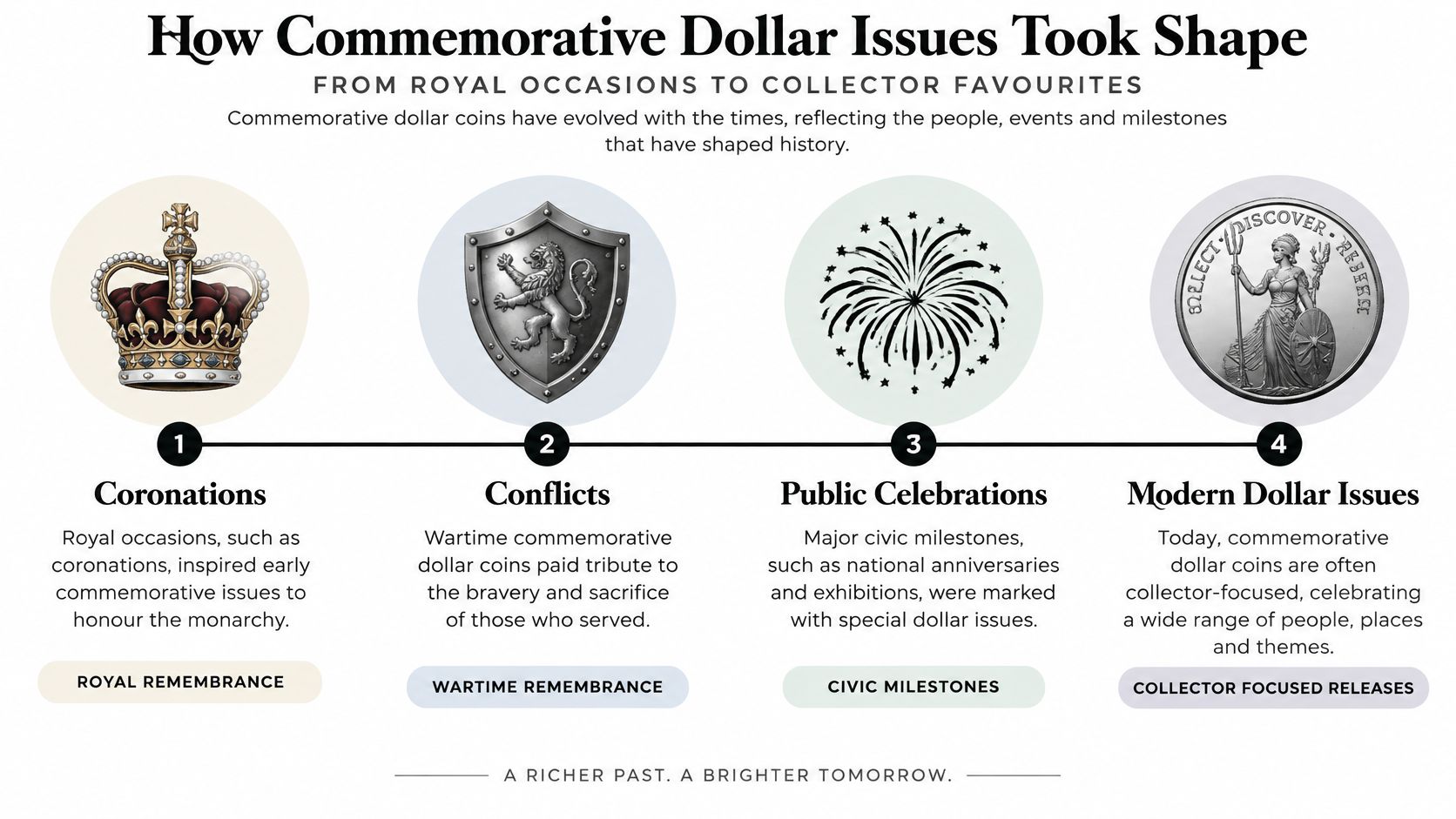
The UK has a long tradition of using coinage to mark events, institutions and cultural milestones. The Royal Mint says its history stretches back more than 1,100 years, and its account of commemorative coinage covers subjects from coronations and conflicts to major public celebrations (Royal Mint account of its commemorative history). That tradition isn't limited to royal occasions: modern UK themes include David Bowie, Winnie-the-Pooh, decimalisation and Team GB.
UK commemoratives appear in several formats, including crown-sized pieces, £5 and £2 coins, and higher-value collector products. Some are made primarily for collectors rather than for ordinary circulation. Their finishes can also differ from everyday coinage. The Royal Mint notes that commemorative pieces may be struck up to three times to achieve detailed finishes, a reminder that the object may be designed for careful viewing and presentation as well as for remembrance.
What “dollar” means in a UK collection
A UK-focused collector will often encounter dollar-denominated issues from British Overseas Territories, as well as pieces from other countries that use a dollar denomination. These aren't coins struck for spending in the UK. An overseas issuer may commission a UK-based mint to make its coin, so the mint's location and the issuer's legal authority are separate parts of the description.
A clear example is the British Virgin Islands Pegasus $1. The coin is identified as a non-circulating issue, and its mint is given as Pobjoy Mint in Surrey. That makes it a British-territory dollar coin made at a UK facility, not a UK pound coin and not evidence that the piece was intended for circulation in Britain. The distinction is useful whenever a listing uses “British” or “UK minted” without explaining the issuing authority.
Three kinds of issue you may meet
The dollar-denominated coins a UK buyer sees don't all belong to the same practical category:
- Precious-metal proof issues: These are made to show off detail and finish, often in silver or gold. Their price can reflect both their metal and their collector appeal.
- Brilliant Uncirculated presentation pieces: These are produced for collectors in a sharper presentation than ordinary circulation coins, but they aren't the same finish as a proof.
- Circulating legal-tender dollars: These are made as money for their issuing jurisdiction and may also mark a particular event or subject.
Before asking whether an issue is scarce or attractive, place it in the right family. Read the issuer, denomination, stated legal-tender status and finish as separate clues. That simple classification prevents “made in Surrey”, “dollar” and “collectible” from being treated as if they mean the same thing.
How to Identify and Grade Dollar Commemoratives
A good description begins with the coin, not the seller's headline. Write down the issuer, denomination and year, then record the metal and fineness, gross weight, diameter, thickness, edge and alignment. Include the mint if the coin's documentation identifies it. These details let another collector, dealer or valuer check whether the object matches the issue being described.
The 2021 British Virgin Islands Pegasus $1 is a helpful working example. Its published specifications identify .999 fine silver, a weight of 31.135 g, a diameter of 38.6 mm, a thickness of 3 mm, a reeded edge and medal alignment. Pobjoy Mint in Surrey is identified as its mint, and the issue is classified as non-circulating (Pegasus $1 specifications).
Read the finish before judging the surface
A coin may be described as circulating, Brilliant Uncirculated or Proof. A Proof is made using specially prepared dies and planchets to produce sharp detail and contrasting fields. This finish draws attention to marks that may be less noticeable on an ordinary uncirculated piece, so a hairline across a mirrored field can matter more than a similar disturbance on a less reflective surface.
Brilliant Uncirculated describes a collector presentation, not a guarantee that the coin is flawless. Compare the coin with its stated finish and published specifications instead of assuming that a box, capsule or certificate settles its grade. A stated maximum mintage is also not necessarily the number of coins produced or sold. Keep that figure distinct from a confirmed production or sales total.
The Pegasus measurements are close to the widely used one-troy-ounce silver collector format. Weight and fineness help check whether the metal claim is plausible, while diameter, thickness and edge design can help flag a substitution or alteration. These checks are evidence to compare, not a complete verdict on authenticity or value.
Make a record that someone else can use
Use a consistent description for an inventory, auction listing or valuation note. The contrast below shows which details are especially useful for a collector dollar and which may need checking on a circulated legal-tender coin.
| Field to record | Pegasus-style collector dollar | Circulated legal-tender dollar |
|---|---|---|
| Issuer | Name the overseas authority, not just the mint | Name the country or issuing authority |
| Denomination and year | Record both as shown for the issue | Record the denomination and date |
| Metal and fineness | Note the stated alloy or silver fineness | Check the coin's published specification |
| Weight and dimensions | Compare with the issue's stated specifications | Compare with the relevant circulating type |
| Edge and alignment | Record edge style and medal or coin alignment | Note the edge and alignment where known |
| Finish and status | State the finish and whether it's non-circulating | State the finish and legal-tender status |
| Mint | Record it only if identified | Record it if marked or documented |
A written description that separates these facts is more useful than “silver dollar, limited edition”. It helps a buyer see what's documented, what's been observed and what still needs confirmation.
What Drives Price After the Headline Theme
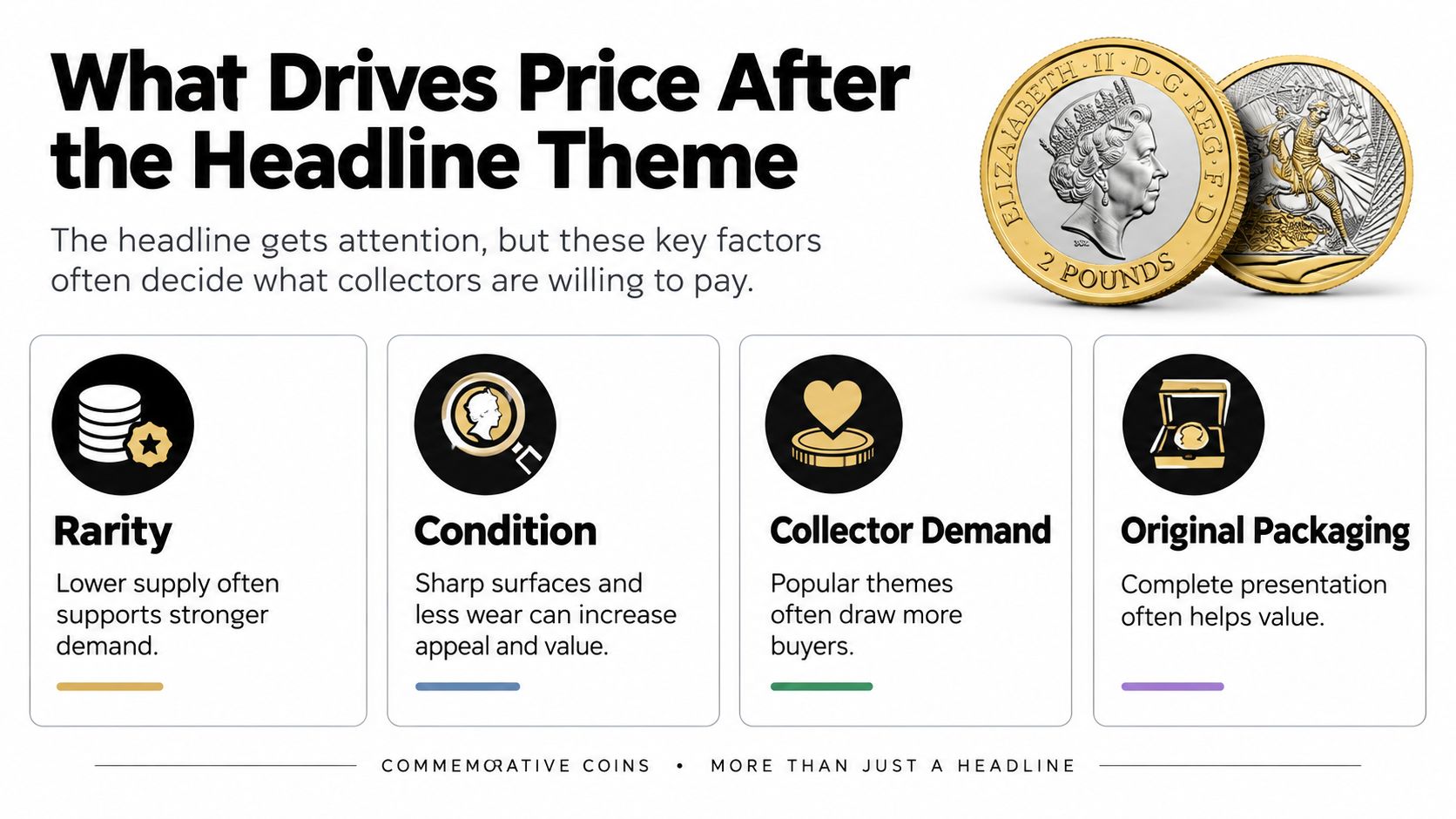
A commemorative theme can attract attention, but attention isn't the same as scarcity or resale value. The Royal Mint's UK sales history is useful as context, not as a price list for dollar coins. Its commemorative-coin sales rose 20%, from £177.5 million in 2012–13 to £213.7 million in 2013–14. The same annual report recorded £9.3 million in contribution to central costs from the commemorative-coin business that year.
A strong event can concentrate demand, too. The special-edition silver proof £5 crown and Sovereign issued for the birth of Prince George sold out within five days of arriving. That tells you the event and timing mattered to buyers at issue, but an initial sell-out doesn't establish what a coin later realised in a resale.
Later sales figures show why finish and sales channel matter. Royal Mint sales data for 2021 included 19,116 Brilliant Uncirculated £5 coins from the Queen's Beasts end-of-series issue. The Queen's 95th-birthday £5 design sold 23,984 standard Brilliant Uncirculated pieces and 41,700 trade-packaged pieces (Royal Mint commemorative coin sales for 2021). These UK figures don't predict dollar-coin prices, but they show that counts can vary by finish and packaging.
Separate an attractive story from supply
The word “commemorative” describes a design purpose, not a promise of appreciation. More than 400 million UK bi-colour £2 coins have entered circulation across 39 commemorative designs, according to Royal Mint collector material discussed in its guidance on accessible starter sets and historical presentation (HMRC guidance on collectors' items and valuation). Those figures concern UK £2 coins, not dollar issues, but they underline the point: a commemorative design can be widely available.
For a dollar coin, ask whether the published figure is a maximum mintage or an actual production total. Then consider the surviving population, condition, proof or bullion status, provenance, original capsule and certificate, and whether buyers are seeking the issue now. A tidy presentation can support a coin's appeal, but it doesn't prove that few examples remain or that a buyer will pay a premium.
Use resale evidence, not issue price alone
An issuer's original selling price tells you what the coin cost when released, not what a collector will pay later. Secondary-market realised prices are a better guide to actual resale interest, provided you compare like with like: the same issue, finish, condition and completeness. Don't compare a proof with a damaged example, or a complete set with a loose coin, and assume the difference comes from the theme.
Before paying a theme premium, ask:
- Supply: Is the figure an actual issue total or only a maximum?
- Condition: Does the surface match the stated finish and grade?
- Completeness: Are the capsule and certificate present where expected?
- Demand: Can you find completed sales for comparable examples?
- Exit: Would the likely resale justify the price you're considering?
A coin can still be worth collecting if its story matters to you. The point is to know whether you're paying for personal enjoyment, metal content or evidence of market demand, rather than assuming those are the same thing.
How to Check Authenticity Before You Pay
Price comes after identity. Before sending money, compare the seller's description with the coin's published specifications and inspect the object itself. A buyer can catch many inconsistencies with a scale, a careful look and the right questions, though a basic check can't replace a specialist opinion when something doesn't add up.
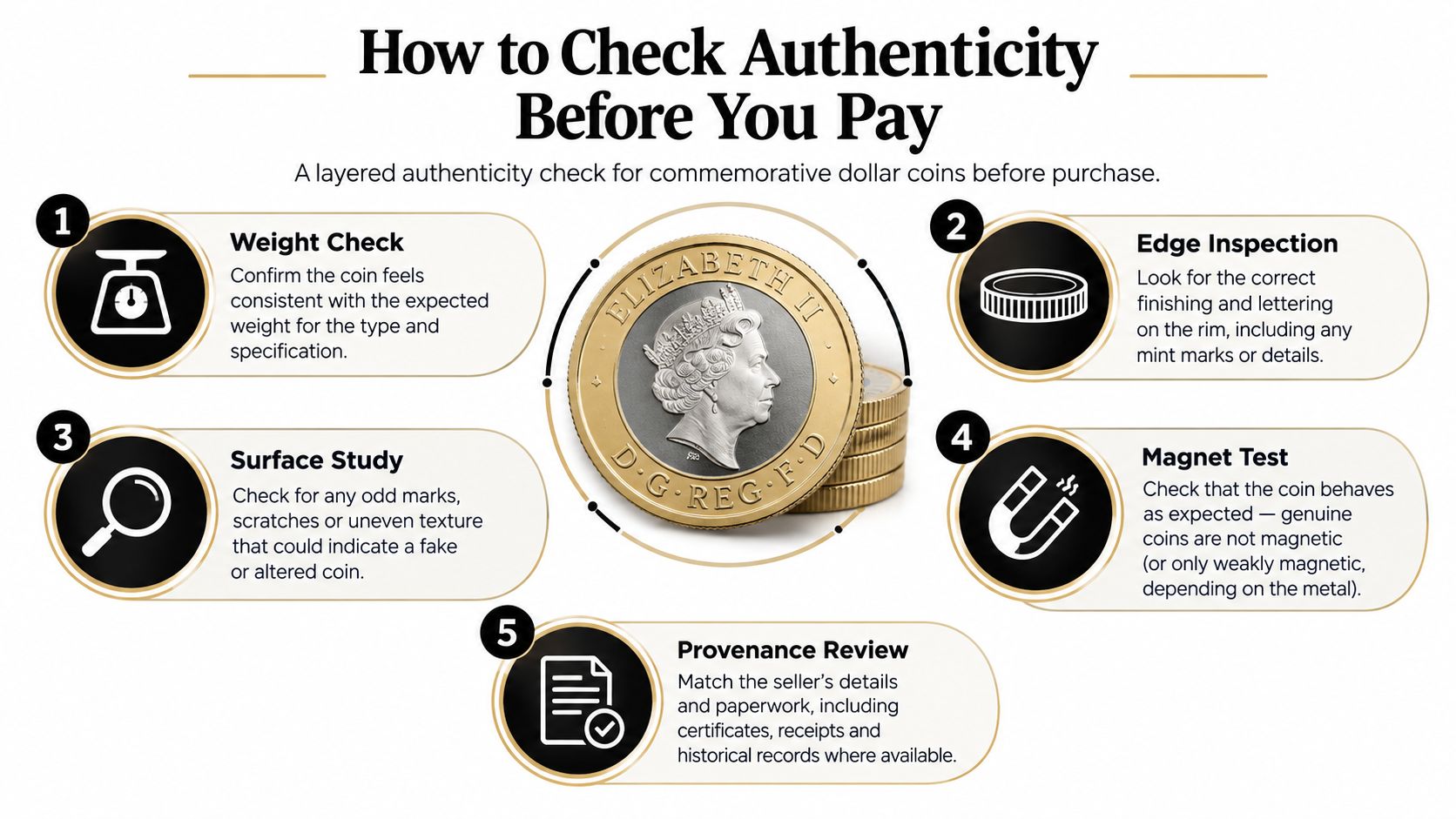
Start with the metal claim. The Pegasus $1, for example, is specified as .999 fine silver and weighs 31.135 g. Compare a coin sold under that description with the documented weight and dimensions; a difference may call for an explanation rather than an immediate conclusion. Silver-plated base metal and .999 silver aren't interchangeable descriptions.
Check the object and the paperwork together
Work through the evidence in a sensible order:
- Match the specifications: Compare weight, diameter, thickness and metal fineness with a reliable description of that exact issue.
- Inspect the edge: Check that the reeding, lettering or plain edge matches the published details. Look for signs of filing or unusual finishing.
- Study the surface: Look for inconsistent texture, suspiciously soft detail or marks that don't fit the claimed finish. Don't mistake a visual check for proof of metal content.
- Read the documents: Match the certificate, capsule and seller's description to the issuer and issue. Ask whether a stated mintage is a maximum or an actual total.
A magnet test may help identify a mismatch where the coin's stated material shouldn't behave as a magnetic object, but it can't establish authenticity on its own. Treat it as one clue, not a pass-or-fail test. For a Proof, the Royal Mint describes specially prepared dies and planchets and says its commemoratives are individually struck and inspected before release; that's a useful production benchmark, even when another issuer commissioned the dollar.
Practical rule: If the seller can't clearly separate the issuer, mint, denomination and legal-tender status, pause before buying.
Know when to walk away or ask for help
A coin described as a silver Proof should have a consistent story: the stated metal, finish, specifications, packaging and paperwork should make sense together. A very low price paired with cloudy fields, a missing certificate or specifications that don't match is a reason to ask questions, not to assume you've found a bargain. A certificate is useful evidence, but it isn't a substitute for checking the coin.
If the discrepancy affects a substantial purchase, or the piece appears altered, seek a specialist opinion or an appropriate third-party grade before committing. A specialist can assess details a new collector may not be able to judge from photographs. For further practical checks, see this guide to detecting counterfeit coins.
The outcome should be simple: buy when the coin and its description agree; ask for clarification when a detail is missing; walk away when the seller won't resolve a serious mismatch.
How to Store Proofs Without Adding Wear
A Proof can look untouched in its capsule and still be easy to mark if you handle it casually. Its polished fields show fingerprints and hairlines more readily than a circulated coin. Think of the difference between a polished table and a worn workshop bench: both can be sound, but the same light scratch stands out much more clearly on the polished surface.
Hold a loose coin by its edge, and work over a clean, soft surface so it can't fall onto a hard floor. Don't rub a Proof with a cloth or try to remove haze or toning using household polish. Cleaning can leave new marks and alter the appearance you're trying to preserve.
Match storage to the coin
A loose circulated dollar can be kept in a suitable holder that prevents unnecessary contact and rubbing. A Brilliant Uncirculated coin in a wallet card should stay in that card unless there's a reason to remove it. A Proof is usually safest in its capsule, with its certificate stored alongside the coin rather than folded inside the capsule.
Keep the certificate and packaging together, but don't force paper into a holder designed for the coin. Store the capsule where it won't roll or take a blow, and avoid repeatedly opening it just to inspect the surface. If you need to show the coin, use the capsule as the handling point rather than touching the metal.
A proof finish needs protection from careless handling. This practical introduction to what a Proof coin is can help new collectors recognise why its surfaces deserve different treatment from ordinary circulated change.
Make the handover part of the routine
UK buyers can face disagreements over a capsule cracked in transit, a certificate that didn't arrive, or a coin whose condition looks different from the listing photographs. Keep the packaging and documents together when a purchase arrives, and check them before discarding any outer materials. If something is damaged or missing, record it and contact the seller promptly.
The same care helps charities sorting donated collections. Keep proof-like pieces untouched, group coins by issuer and set them aside from a jar of spendable change. That avoids accidental cleaning or mixing, and gives someone a fair chance to identify the pieces before they're sold or valued.
How to Buy Sell and Auction with a Plan
Choose a buying route that fits the coin and the evidence available. A fixed-price listing makes the cost clear before you commit, which is useful when the issuer, specifications and certificate are all well documented. An auction lets the market set the bid and may suit a scarce or unusual piece, but you'll need to decide your limit before the bidding starts.
Bulk buying works differently. If you're building stock, buying several pieces at a discounted price may matter more than finding one standout coin. A charity collection sale also calls for a practical view: accurate sorting and a clear route to sale can matter more than presenting every coin as a rare find.
Choose the route that suits the lot
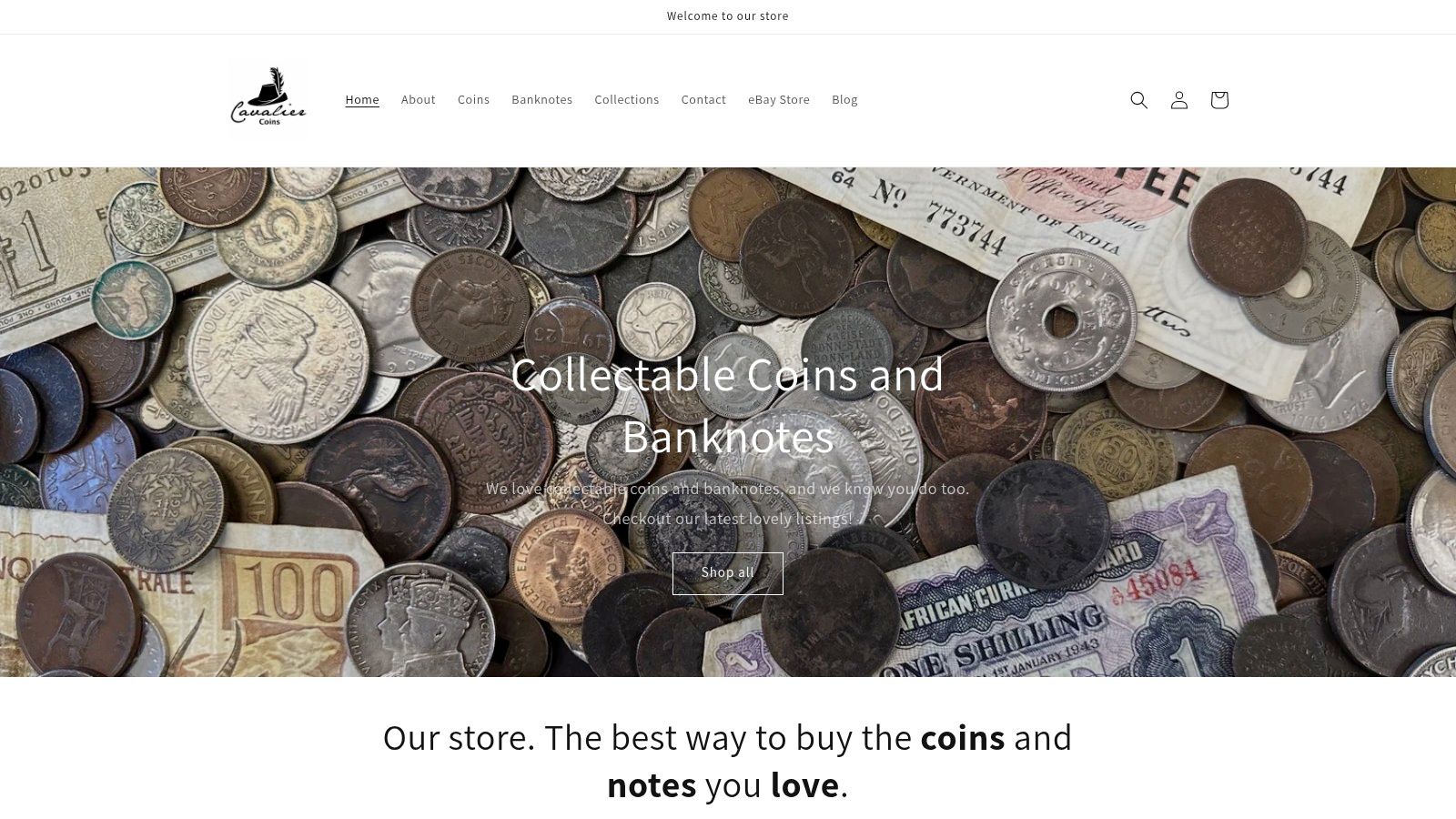
Cavalier Coins is a UK online retailer of world coins and banknotes, including commemorative dollar coins and themed sets. It offers fixed-price listings, weekly eBay auctions, discounted bulk purchases and purchases of donated coin collections to help charities raise funds. Those are different routes for different needs: a collector can consider a listed coin, a bidder can follow an auction lot, and a charity or reseller can ask about a larger parcel.
Before selling, write down the issuer, year, fineness, weight, finish, capsule and certificate status. Add a realistic view of the likely resale, rather than treating the original issue price as a current market value. If you're handling a mixed collection, separate identified pieces from coins that still need research and keep each description tied to the actual item.
Consider the UK tax fork
HMRC's distinction isn't simply “dollar coin equals foreign currency”. It states that a coin counts as currency for VAT purposes only when it's legal tender at acquisition or disposal. Foreign legal-tender coins can still be chargeable assets for Capital Gains Tax, while some non-legal-tender coins may qualify for the chattels exemption; VAT treatment can also differ when a coin is supplied as a collector's item (HMRC guidance on coins as currency and collectors' items).
Consider two different purchases. A circulated dollar that's legal tender where it was issued is not automatically free of UK tax questions just because it can be spent there. A Proof sold chiefly for numismatic interest may instead be treated as a collector's item, depending on the facts and applicable rules. The coin's face value doesn't settle the outcome. If you're importing, selling or investing, confirm your circumstances with HMRC or a professional adviser.
Before you commit to a purchase or sale, ask what the coin is, how it's described, how it will be sold and what records you need to keep. That applies whether you're buying one dollar coin, bidding on an unusual issue or sorting a donated collection.
Cavalier Coins Ltd offers fixed-price world coins, weekly auctions, bulk-purchase options and purchases of donated collections for charity fundraising. If you're weighing up a commemorative dollar coin or sorting a mixed parcel, visit Cavalier Coins Ltd to explore the available listings and selling routes.