
A portrait of Elizabeth I can make a coin immediately recognisable, but it can't tell you the whole story. Elizabeth 1st coins weren't uniform products struck to one unchanging recipe. Their meaning and collectability depend on the metal standard, denomination, issue phase, weight, condition and later history. A worn silver sixpence from a mixed hoard may tell a richer story than a sharper coin with a more attractive portrait, while a gold piece can be misidentified if its denomination and standard aren't examined together.
The safest approach is to treat every coin as evidence. Read the portrait, but then test what the coin says about Tudor monetary policy, mint practice and circulation. The result is a more reliable attribution, and a clearer understanding of why two coins from the same reign can have very different historical and market importance.
Tudor Coinage After the Great Debasement
Elizabeth inherited a currency damaged by policy, not a stable system awaiting a new royal portrait. Between 1544 and 1552, Henry VIII's government reduced the precious-metal content of English coins by replacing part of the silver with copper. Groats and pennies still carried their stated denominations, but confidence in their value weakened. The Royal Mint Museum's account of continuity and change describes Elizabeth's later reform as a major effort to restore the value and trustworthiness of England's money.
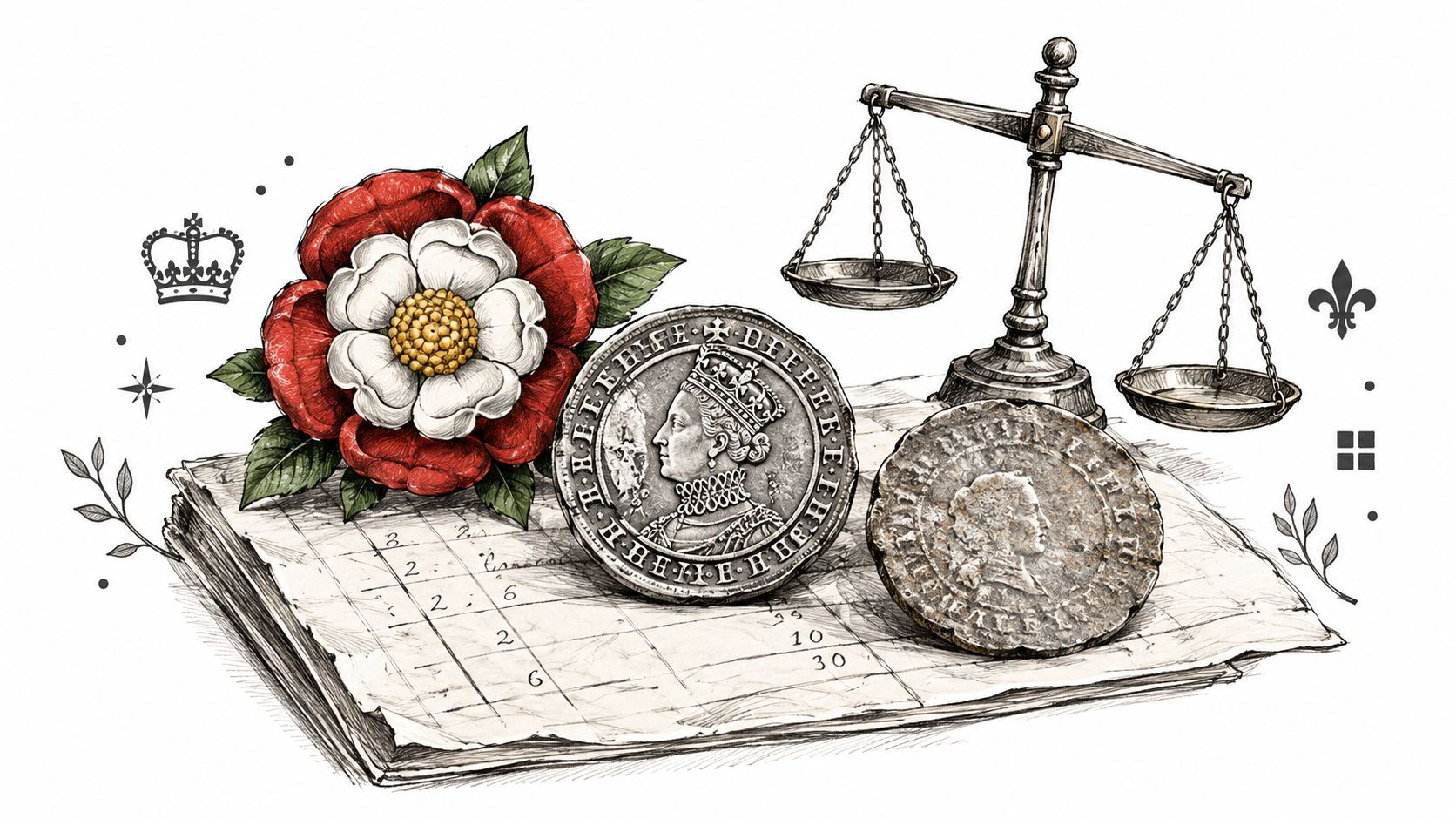
The central problem was the gap between a coin's face value and its metal content. A piece could still be called a penny or groat, while the public questioned whether the metal inside justified the denomination. For collectors, the broad label “Elizabethan coin” conceals the question that most affects attribution: Was the piece made before, during or after the restoration of the standard?
The reform behind the portrait
After Elizabeth's accession in 1558, the Crown ordered debased pieces to be withdrawn and replaced with coins made to the correct standard. The reform became publicly associated with Elizabeth's visit to the Royal Mint at the Tower of London on 10 July 1561, when she saw new silver and gold coins bearing her portrait being produced.
The silver sixpence of 1561 provides a useful example. Its importance lies beyond the image of the queen. It belongs to a reforming phase in which the Crown used both design and metal quality to rebuild confidence. The portrait expressed legitimacy, while the restored precious-metal standard made the denomination more credible in daily exchange.
Practical rule: Do not value an Elizabethan coin from its portrait alone. Establish its metal standard and issue context first.
A general grounding in the history of British coins helps place Elizabeth's reign within the longer development of English currency. The useful question is not just, “Does this look Tudor?” Ask instead, “What monetary problem was this coin intended to solve?”
Why this changes collecting decisions
A coin from the restoration period can serve as material evidence of national monetary stabilisation after the Great Debasement. That historical role may attract collectors even when the piece is worn or imperfect. A handsome portrait with uncertain attribution, altered surfaces or an incorrect metal standard deserves caution.
For UK collectors, the reform creates a focused theme. Compare pieces affected by earlier debasement with later issues made to the corrected standard, then examine how denominations, portraits and inscriptions communicated royal authority. The collection becomes more than a sequence of faces. It records policy, public confidence and the physical mechanics of money.
Understanding Elizabethan Denominations and Gold Standards
Elizabethan denominations are easier to understand when you separate nominal value from metal standard. A sovereign wasn't just any large gold coin with Elizabeth's name, and a half-sovereign wasn't interchangeable with every later ten-shilling issue. The Royal Mint Museum's discussion of the Tudor half-sovereign shows how denomination, weight and chronology work together during attribution.
A half-sovereign had a nominal value of 10 shillings, while the sovereign was identified as a 20-shilling coin in the Royal Mint Museum's account of the Tudor sovereign. Those values describe monetary denomination, not a promise that every issue used exactly the same gold recipe throughout Elizabeth's reign.
A working comparison
| Denomination | Nominal value | Metal type |
|---|---|---|
| Sovereign | 20 shillings | Gold |
| Half-sovereign | 10 shillings | Gold |
| Sixpence | Six pence | Silver |
| Shilling | One shilling | Silver |
The table is a starting point, not a complete identification system. Elizabethan gold coinage included different groups, including fine-gold issues, pieces connected with the Great Debasement and later crown-gold issues. The label “sovereign” can therefore conceal important differences in standard and period.
Weight as chronological evidence
Surviving specifications give the half-sovereign a standard weight of 5.66 grams from 1551 to 1601, reduced to 5.57 grams for issues dated 1601 to 1604. That small reduction can help distinguish a late issue from an earlier one, but weight should never be used alone. Wear, clipping, surface loss and damage can all move a surviving coin away from its expected standard.
The chronology also contains a major interruption. No half-sovereigns were struck for approximately 20 years in the middle of Elizabeth's reign, when fine-gold denominations were issued instead. Half-sovereigns returned in significant numbers in the final gold coinage, while later ten-shilling pieces became known as double-crowns.
This is why a collector should record more than the monarch's name. Note the denomination, date range, weight, gold fineness, portrait type, inscription and any relevant mint mark. A balance can flag an inconsistency, but it can't by itself identify the coin.
The value of careful terminology
Modern collectors often use familiar words loosely. “Elizabethan pound”, “sovereign” and “half-sovereign” may sound like straightforward equivalents, but their relationship depends on the issue and its standard. A coin's historical monetary value also isn't the same as its modern sale price. Market value reflects rarity, condition, authenticity, demand and the quality of the attribution.
For that reason, don't compare coins merely because both are gold or both show Elizabeth. Compare like with like. A correctly identified issue with a documented weight and clear surfaces gives buyers and sellers a much firmer basis for judgement than a broad royal attribution.
Decoding Hammered Coin Iconography and Mint Marks
Hammered coins demand a different reading method from modern milled currency. Their irregular flans, partial legends and uneven strikes can make a perfectly genuine piece look incomplete. Identification works best when you move from the general to the specific, rather than trying to recognise a coin from one attractive detail.
Start with the obverse
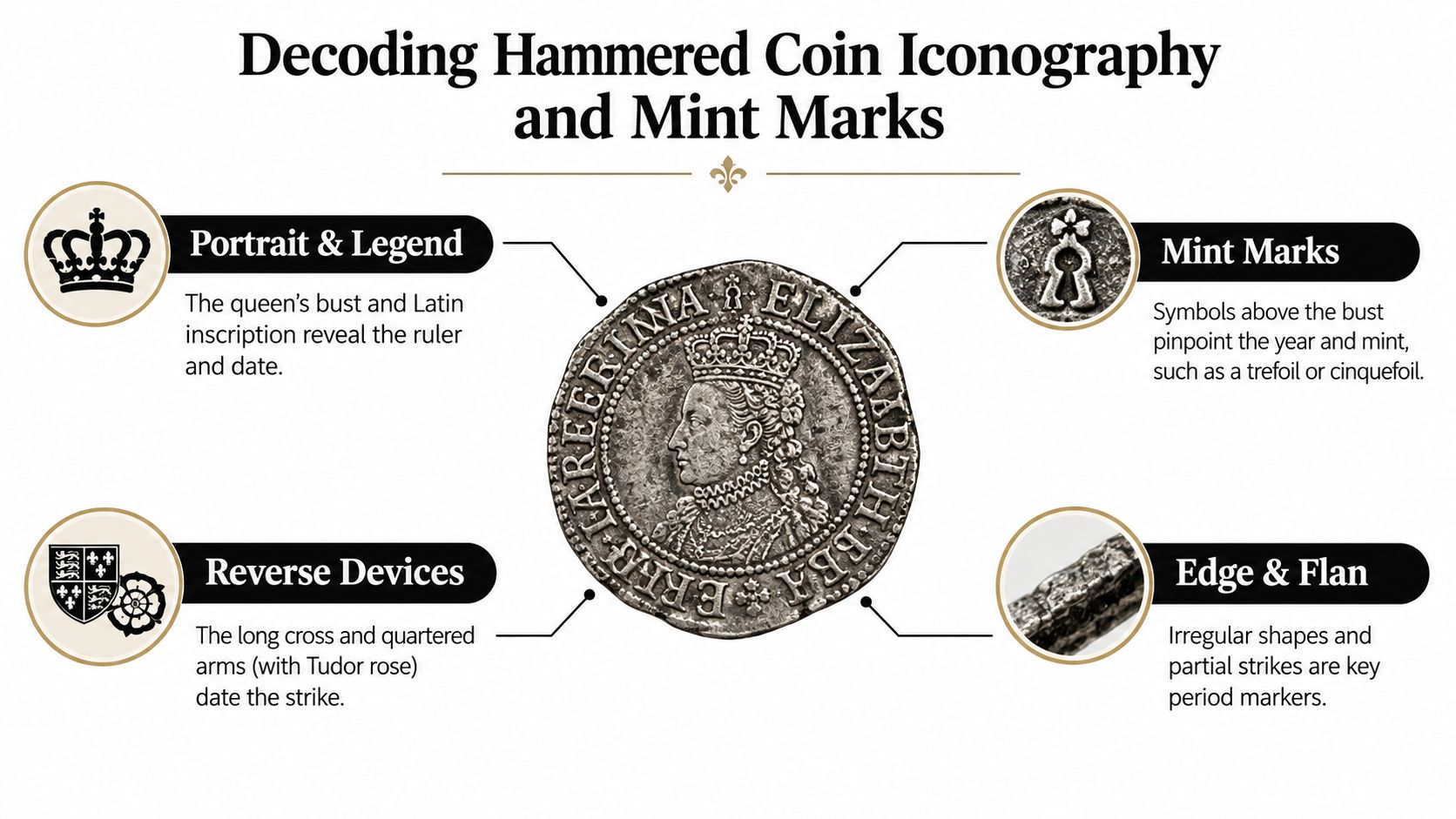
First, establish the ruler from the portrait and surviving legend. Elizabeth's bust, crown and surrounding Latin inscription form a connected group of evidence. If the legend is clipped, don't force a reading from one or two letters. Compare the visible letter forms, portrait style and denomination with a reliable catalogue or a museum reference image.
Then inspect the area above or around the bust for a mint mark. Symbols such as a trefoil or cinquefoil can identify an issue or minting phase, but only if the mark has been read correctly. A mark can be weak, obscured by a poor strike or confused with a surface defect.
Read the reverse as a design system
The reverse devices carry their own clues. A shield with the quartered arms, a Tudor rose and a long cross aren't random decoration. They communicate dynastic authority and provide a framework for comparing related issues. The placement of the cross, the shape of the shield and the surviving inscription should be considered together.
For collectors learning the language of hammered pieces, an introduction to hammered copper coins offers useful wider context on why irregular flans and hand-struck surfaces require patience. Elizabethan silver and gold need the same discipline, even though their metals and denominations differ.
Allow for the flan
A hand-hammered coin may not carry a complete date or legend because the blank was smaller than the design, the dies were not perfectly aligned or the strike failed to transfer every detail. That isn't automatically evidence of damage or forgery. Examine the edges, metal flow and relief before deciding whether a missing section was lost at the mint or later removed.
Keep a written attribution record with the visible portrait type, reverse device, mint mark, legend fragments, diameter, weight and condition. Photographs taken under consistent lighting can reveal details that disappear when a coin is held at an angle. Good attribution is assembled from several modest clues, not one dramatic feature.
Hoard Context and the Archaeological Life of Coins
An Elizabethan coin's history didn't end when it left the mint. It could pass through several reigns, acquire wear and clipping, then be hidden during a later crisis. The archaeological context can therefore change how you interpret the piece. A coin found alongside later monarchs may tell you more about circulation and household behaviour than about the moment of its original manufacture.
The British Museum documents a Hampshire hoard discovered in 2018, probably deposited around 1643 during the English Civil War. It contained 345 silver coins from Edward VI, Elizabeth I, James I and Charles I, including sixpences and shillings, with a contemporary face value of £13 4s 6d. The British Museum's recent acquisitions record provides the relevant archaeological context.
What a mixed hoard changes
A mixed-monarch group warns against a simple conclusion: finding an Elizabeth I coin doesn't prove that it was buried during Elizabeth's reign. The coin may have remained useful for decades, circulating while later monarchs appeared on newly issued money. Its wear can reflect prolonged use rather than poor manufacture.
Clipping adds another layer. Someone may have removed small amounts of precious metal from the edge, reducing the weight and damaging the design. A clipped coin can be historically revealing because it records an interaction between official standards and everyday economic pressure, but it may be less attractive to collectors who prioritise intact flans.
Reading burial evidence carefully
Hoard context can show what people selected, retained or concealed. It can also show that coins were valued as practical stores of money rather than as isolated portraits. When studying a hoard coin, record the monarchs represented, denominations, degree of wear, clipping and the reported deposition circumstances.
The later burial history can be as informative as the original issue date.
That principle helps separate museum evidence from casual metal-detector stories. Provenance, findspot documentation and associated objects support interpretation, while an unsupported claim about where a coin was found should not be treated as established history. For the collector, a documented hoard connection may add scholarly interest, but it doesn't automatically guarantee a higher price. Buyers still assess authenticity, condition and the quality of the evidence.
Authenticating and Grading Hammered Silver and Gold
Authentication starts with comparison, not confidence. A convincing portrait can be copied, and a damaged genuine coin can be misunderstood. The most dependable process combines visual examination, physical measurements, metal assessment and professional advice when the coin's value or rarity justifies further work.
A practical examination sequence
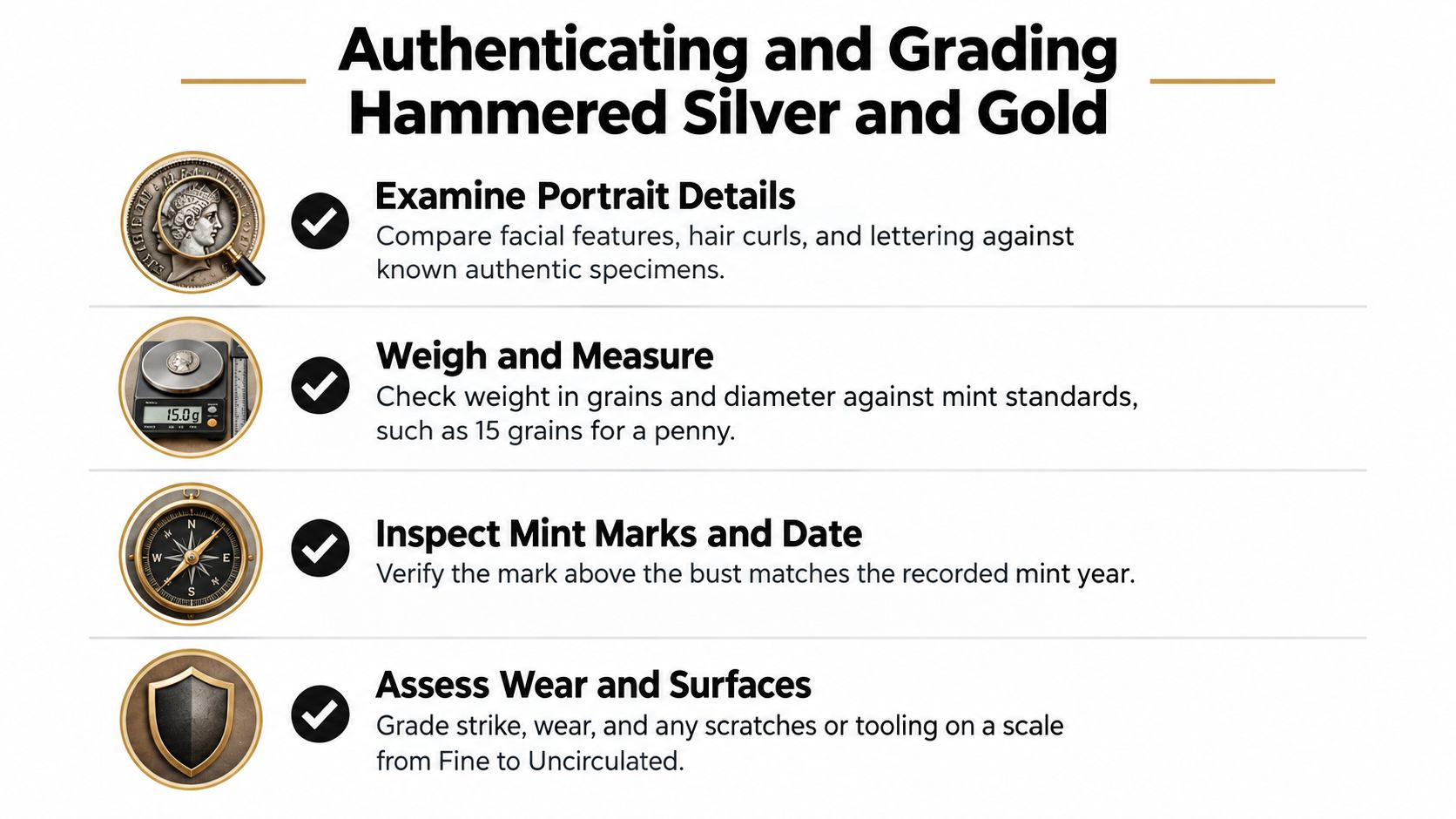
- Study the portrait and lettering. Compare facial features, hair, crown details and letter shapes with established examples of the proposed issue. Forgers often struggle to reproduce the relationship between portrait relief, legend and die style.
- Weigh and measure the coin. Use a calibrated balance and record diameter in several directions because hammered flans aren't perfectly round. Compare the result with the correct denomination and issue standard, allowing for documented wear or clipping. The half-sovereign standards discussed earlier are especially useful because their change within the reign can help test an attribution.
- Inspect mint marks and devices. Look for the mark above the bust, reverse cross, shield arrangement and surviving date or legend. A claimed issue should make sense as a complete design, not just match one isolated symbol.
- Assess metal and surfaces. Examine the edge, relief and colour under magnification. Casting can leave seam lines, rounded detail or surface bubbles, while tooling may create unnatural brightness in protected recesses. Non-destructive testing by a qualified specialist can help where visual evidence remains inconclusive.
Grading hammered material
Modern grading language can mislead when applied mechanically to hand-struck coins. A piece may have light wear but a weak strike, or strong central detail but a large area missing from the flan. Record strike quality, surface preservation, wear, clipping, edge condition and legend completeness separately before assigning an overall grade such as Fine or better.
Don't clean a suspect coin to reveal detail. Cleaning can remove original surfaces, introduce scratches and destroy evidence that an expert needs for authentication. If the coin is rare, unusually heavy or inconsistent with its apparent type, pause before buying or selling it and seek an opinion from a reputable numismatist or established grading service.
Sourcing and Conserving Your Tudor Collection
A sound purchase begins with a sound description. Ask for clear photographs of both sides and the edge, the recorded weight and diameter, the proposed denomination, the issue attribution and any known provenance. A seller who can explain uncertainty is often more useful than one who promises certainty without showing the evidence.
You can source Elizabethan material through specialist dealers, established auctions and carefully described collection dispersals. Fixed-price listings allow time for comparison, while auctions can expose unusual varieties but require a firm bidding limit. Bulk lots may suit experienced buyers who can identify misdescribed pieces, yet they carry greater uncertainty because individual coins may not be fully examined.
Questions to ask before purchase
- What exactly is the attribution? Request the denomination, issue phase, date range and mint mark, not merely “Elizabeth I hammered coin”.
- What measurements were taken? Weight and diameter should be stated, especially for gold.
- What has happened to the surface? Ask directly about cleaning, tooling, solder, holes, bends and edge damage.
- Can the seller explain returns? A clear return policy matters when an attribution depends on examination in hand.
Cavalier Coins Ltd offers fixed-price coins and banknotes, weekly eBay auctions, bulk purchasing options and collection purchases, so it can be one route for collectors comparing individual pieces or larger lots. Its catalogue should still be assessed coin by coin, with the same attention to attribution, measurements and condition used elsewhere.
Preserve the evidence
Handle coins by their edges with clean, dry hands, and store them in inert holders that don't press against the relief. Keep the collection in a stable, dry environment away from household chemicals, damp materials and unnecessary handling. A labelled holder should include the coin's attribution, measurements, purchase details and provenance.
Avoid abrasive cloths, dips and polishing compounds. Original toning and surface texture can carry information about age, treatment and storage, while amateur cleaning may leave permanent hairlines or an unnaturally bright appearance. Advice on coin collection storage solutions can help you choose a practical system without treating historical coins like ordinary loose change.
Strategic Approaches to Building an Elizabethan Collection
The strongest collection has a question behind it. You might study the restoration of English currency, compare silver denominations, follow the development of gold standards or trace how coins circulated into later hoards. That focus keeps buying decisions connected to research rather than allowing attractive portraits to dictate every purchase.
Choose a collecting route
A type-focused collector can begin with accessible silver denominations and learn how portrait, reverse design and mint marks vary. Another collector may specialise in gold, where the distinction between fine-gold issues, crown-gold issues, sovereigns and half-sovereigns requires close attention to weight and chronology.
A third route is archaeological. Coins associated with documented hoards can support research into circulation, concealment, wear and mixed reign groups. Such pieces should be collected for the quality of their evidence, not only because the word “hoard” appears in a sales description.
Build a record before expanding
For every acquisition, keep:
- An attribution: denomination, metal, issue, portrait, mint mark and legend.
- A physical record: weight, diameter, flan shape, strike quality and surface condition.
- A provenance note: seller, auction, collection history or documented archaeological context.
- A research question: what this coin adds that the previous piece didn't.
This method makes gaps visible. You may discover that you own several similar portraits but lack a clear example of a different denomination or reform phase. The next purchase can then answer a specific question instead of repeating familiar material.
Elizabethan coins reward slow looking. Their value lies not only in rarity or appearance, but in the connection between royal authority, precious-metal standards, mint practice and later human use. Learn to identify those connections, and your collection will become a historical archive rather than a group of attractive objects.
Cavalier Coins Ltd offers fixed-price coins and banknotes, weekly eBay auctions, bulk purchasing options and collection-buying services for people building or managing collections. Visit Cavalier Coins Ltd to explore available material and find pieces that fit your Elizabethan collecting focus.