

Have you ever held a £1 coin and felt something wasn't quite right? That spare change rattling in your pocket might just be a dud. Before the new 12-sided coin appeared in 2017, the UK had a serious problem with counterfeit money. In fact, it was estimated that a staggering 1 in every 30 of the old round pounds was a fake.
This wasn’t just a small-time issue; it was a huge headache that was quietly undermining the entire currency.
Just How Big Was the Fake £1 Coin Problem?
For years, millions upon millions of counterfeit round pound coins flooded into circulation, creating a persistent challenge for the public and businesses alike. If you ever suspected a coin felt too light or looked a bit off, you probably weren't imagining things.
The problem grew so big that it became a genuine threat to our national economic security. The sheer number of fakes in circulation started to chip away at the public's confidence. Every time you bought a coffee or fed a parking metre, there was a small but real risk you were handling a worthless piece of metal.
This was far from a victimless crime. The consequences were very real:
- Small Businesses: Your local corner shop often took the biggest hit. They'd accept fakes in good faith, only for the bank to later reject them, leaving the business out of pocket.
- Vending and Parking Machines: These machines were constantly being jammed or even damaged by poorly made counterfeits, causing all sorts of operational nightmares and repair bills.
- Public Trust: At its core, a currency only works if people believe in it. The high volume of fake £1 coins threatened this fundamental trust.
A Ticking Time Bomb That Forced a Change
The situation got progressively worse over several years. Between 2008 and 2014, the number of counterfeit one-pound coins in circulation shot up, forcing the government to rethink its currency policy. By 2013, official figures suggested that around 3.04% of all round £1 coins were fakes. In some areas, that meant you could find about 31 fakes in every 1,000 coins. If you're curious about the history, Wikipedia has a detailed article on the £1 coin) and its counterfeiting challenges.
These alarming statistics made it clear the problem was spiralling out of control. The old round pound, once a proud symbol of British currency, had become far too easy for forgers to copy. Its relatively simple, single-metal design made it a perfect target for criminals with increasingly sophisticated methods.
The Royal Mint had no choice but to take decisive action. It wasn't just about catching the crooks anymore; the coin itself had to be redesigned from the ground up to be fundamentally more secure for everyone.
This crisis set the stage for one of the biggest currency shake-ups in modern British history. The need for a more secure coin was no longer a theory but an urgent, practical necessity. Understanding just how bad things got is key to appreciating why the iconic round pound was retired and why spotting a fake became such an important skill.
Quick Visual Checks You Can Do in Seconds
You don’t need to be a numismatist with specialist gear to spot a fake £1 coin. In fact, your own eyes are often the best tool you have. With a bit of practice, you’ll start to instinctively recognise the subtle flaws that give away a poorly made fake in just a few moments.
Before it was retired, the old round pound became notoriously easy for counterfeiters to copy, but even their best efforts often failed on the small details. The newer 12-sided coin, introduced in 2017, was a game-changer, designed with advanced features specifically to make faking it a much harder job.
So, let's break down what you should be looking for on both versions of the coin.
This wasn't just a minor issue; the scale of the problem before the new coin came along was staggering. The sheer volume of fakes in circulation was a real headache.
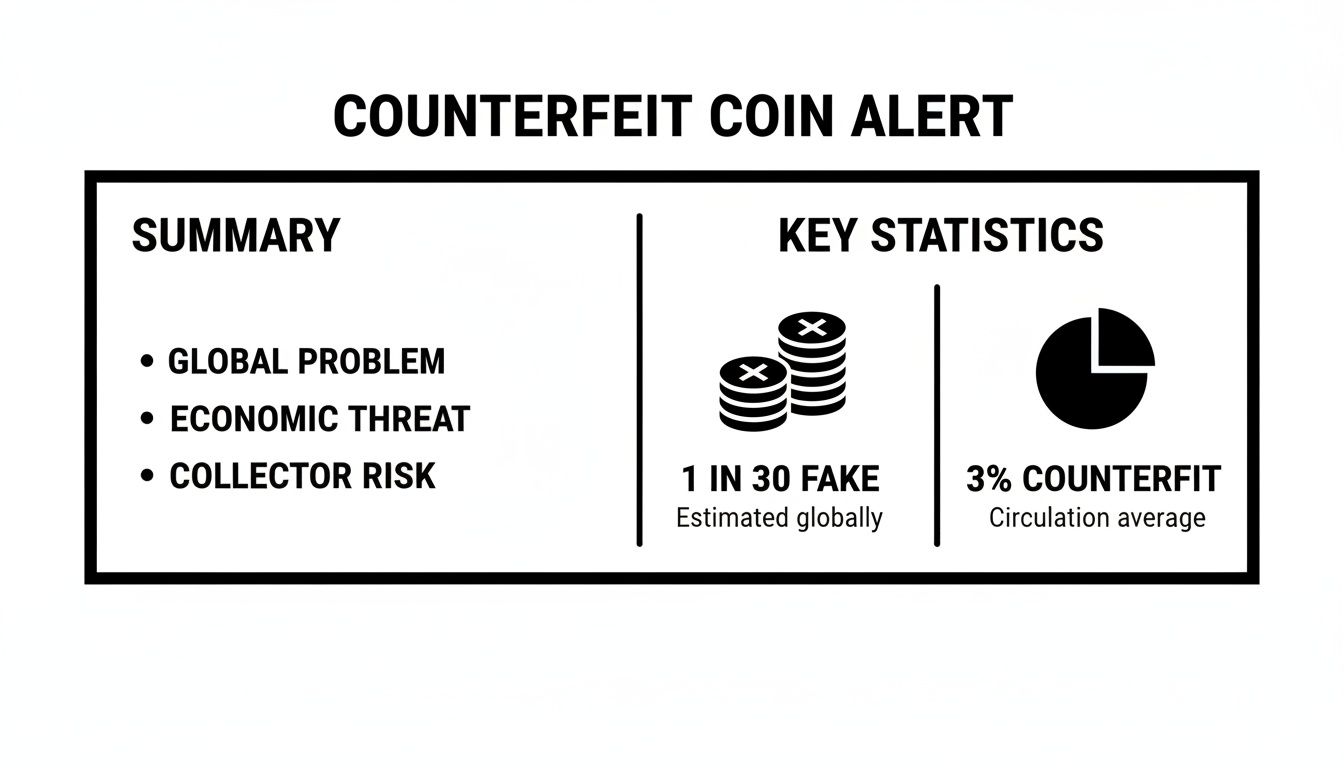
At its worst, it's estimated that a shocking 1 in every 30 of the old round pounds was a counterfeit. That’s about 3% of all those coins being completely worthless.
Examining the Finer Details
Whether you're holding an old round pound or the new 12-sided one, the first place to look is the Queen's portrait. A genuine coin will have a sharp, well-defined image with crisp details in her hair and crown. A lot of fakes just look 'soft' or blurry, almost like the mould used to make them was low quality.
Pay attention to the lettering around the portrait, too. It should be crisp, evenly spaced, and perfectly aligned with the edge of the coin.
Now, flip the coin over and give the reverse design a good look. Whether it's the thistle on a Scottish round pound or the intricate floral emblem on the 12-sided version, the lines should be distinct, not muddled or poorly defined. A common giveaway for a fake £1 coin is a real lack of sharpness in these patterns.
Counterfeiters nearly always struggle to replicate the high-quality, precise finish of a genuine coin. Always be on the lookout for blurry details, uneven surfaces, and a general lack of definition—these are the classic red flags.
These principles of spotting fakes aren't just limited to £1 coins. If you're keen to learn more, it's worth reading up on the basics of fake money detection, as many of the signs apply to other currency too.
Features Specific to Each Coin Type
Of course, the two versions of the £1 coin have their own unique visual tells that are vital for telling them apart from fakes. Knowing exactly what to look for on each can make your job much, much easier.
Below is a quick table to help you compare the key features at a glance.
Quick Visual Checklist for Genuine £1 Coins
| Feature | Genuine Round Pound (Pre-2017) | Genuine 12-Sided Pound (Post-2017) |
|---|---|---|
| Edge Detail | Clear, evenly struck inscription (e.g., "DECUS ET TUTAMEN"). | Alternating reeded and smooth edges. |
| Key Security Feature | The edge lettering itself was the primary security detail. | Latent image below the portrait that changes from a '£' to a '1'. |
| Micro-Lettering | None. | Tiny lettering on the lower inside rim of both sides. |
| Construction | Single metal (nickel-brass). | Bimetallic: gold-coloured outer ring, silver-coloured inner section. |
| Overall Finish | High-quality minting, sharp details on portrait and reverse. | Flawless join between the two metals, very sharp details. |
Let's dig into those points in a bit more detail, as this is where most fakes fall down.
For the Old Round Pound:
- Edge Lettering: Check the inscription on the edge (like "DECUS ET TUTAMEN"). On a real one, it’s clear and evenly struck. Fakes often have lettering that is poorly formed, badly spaced, or sometimes missing altogether.
- Date Alignment: The date on the reverse should sit perfectly within the design. You’ll often find that counterfeits have dates that are slightly crooked or off-centre.
- Colour and Wear: Fake coins often just look wrong. Their colour might not match a genuine coin of a similar age—perhaps it's too shiny, too brassy, or shows unusual patterns of wear and tear that don't look natural.
For the New 12-Sided Pound:
- The Latent Image: This is a truly brilliant security feature. Just below the Queen's head, there's a small panel. Tilt the coin, and it should change from a '£' symbol to a '1'. Most fakes can't replicate this effect properly, if at all.
- Micro-Lettering: This is a detail forgers hate. On the lower inside rim of both sides, there is tiny lettering. You’ll see 'ONE POUND' on the obverse (heads) side, and the year of production on the reverse (tails) side. This is extremely difficult to copy legibly.
- Bimetallic Construction: The coin is made from two different coloured metals – a gold-coloured outer ring (nickel-brass) and a silver-coloured inner disc (nickel-plated alloy). On a genuine coin, the join between them is absolutely flawless. On a fake, you might see a messy, poorly defined border or even discolouration between the two metals.
Simple Physical Tests to Confirm Your Suspicions
Sometimes, a quick visual inspection is enough to raise an eyebrow, but the real proof often comes from how a coin actually feels and behaves. A fake £1 coin might look the part at a glance, but counterfeiters rarely manage to replicate its physical properties with any real accuracy. These simple, hands-on tests are your next line of defence and can often give you a definitive answer without needing any special equipment.
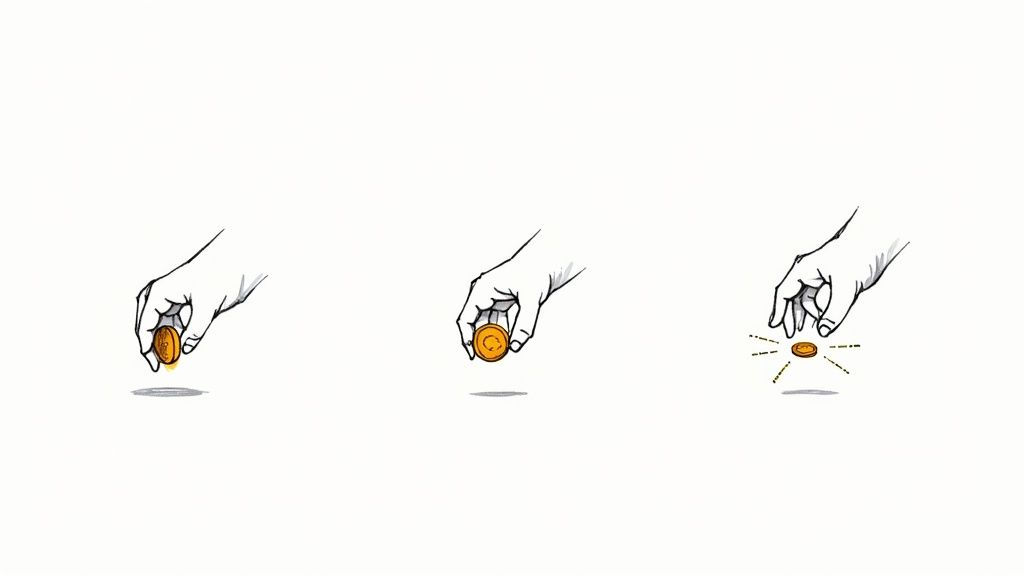
When you think you've got a dud, your senses are your best allies. Does it feel too light in your palm? Does it make the wrong sound when you drop it? These gut feelings are often spot on because they're based on your subconscious experience of handling countless genuine coins. Let’s turn those feelings into concrete checks.
The Weight and Size Test
This is probably the most reliable physical test you can do. Forging a coin with the exact weight, diameter, and thickness of a genuine one requires precision manufacturing that most counterfeit operations simply can't achieve. They typically use cheaper metal alloys or less accurate stamping processes, which almost always leads to noticeable discrepancies.
A genuine 12-sided £1 coin should weigh exactly 8.75 grams. The older round pound should be 9.5 grams. While you might not notice a half-gram difference just by holding it, a poorly made fake can be significantly off. If you have a set of kitchen scales, this is an easy and conclusive check.
It's the same story with the dimensions:
- Diameter: The new bimetallic coin measures 23.43mm from point to point.
- Thickness: It has a consistent thickness of 2.8mm.
The easiest way to check this is to compare the suspect coin directly against one you know is genuine. Lay them side-by-side on a flat surface. Is one thicker? Do their diameters match up perfectly when stacked? Any variation here is a massive red flag.
A genuine coin is a product of incredibly precise engineering. Counterfeiters, who are focused on speed and low costs, almost always cut corners on the metal composition and minting process. This directly impacts the coin's final weight and dimensions, making it an easy tell for a fake.
The All-Important Ring Test
This is a classic for a reason. It relies on the unique acoustic properties of the metals used by The Royal Mint and is a fantastic way to quickly assess a coin's composition without any tools.
Just hold the coin on the tip of your finger and give it a gentle tap with another coin. A genuine £1 coin, particularly the old nickel-brass round pound, will produce a clear, high-pitched ringing sound that sustains for a moment. Most fakes, on the other hand, are made from softer, cheaper lead-based alloys. These produce a dull, lifeless thud with no resonance at all. The difference is often surprisingly obvious once you hear it.
For those looking to deepen their knowledge, there are many established techniques for identifying fakes. You can learn more about these in this guide covering 7 proven methods for detecting counterfeit coins, which explores other valuable strategies.
Magnetism and Edge Milling
Finally, a couple of other quick checks can reveal even more about your coin. The old round pound coin was made of a solid nickel-brass alloy and is not magnetic at all.
However, the new 12-sided coin has a nickel-plated inner disc, which means the silver-coloured centre should be magnetic, while the outer gold-coloured ring should not be. Grab a fridge magnet and test it. If the whole coin sticks, or none of it does, you've got a fake on your hands.
Don’t forget to take a close look at the edge. The new coin has alternating reeded (milled) and smooth sections. This is a tricky detail to replicate with precision. Fakes often have poorly defined milling, with uneven gaps, rough patches, or a generally mushy appearance. The edge of a genuine coin will be crisp and perfectly executed, a clear sign of the quality behind the official minting process.
Why the UK Reinvented the Pound Coin
The arrival of the 12-sided £1 coin back in 2017 was much more than a cosmetic update. It was a direct and necessary strike against a serious security problem that had been chipping away at the UK’s currency for years. Put simply, the old round pound had become far too easy to fake, and the situation had reached a tipping point.
The scale of the counterfeit crisis was staggering. At its peak, it was estimated that an incredible 1 in every 30 round pounds changing hands was a forgery. This wasn't just a minor inconvenience; it was a real threat. Small businesses, in particular, were feeling the sting, losing money every time they unknowingly accepted a worthless coin. Vending machines were jamming, and public trust in our everyday change was slowly but surely eroding. Something had to be done.
Engineering a Solution to the Counterfeit Crisis
The Royal Mint’s answer was to engineer what many now call the most secure circulating coin in the world. Every single feature of the new 12-sided design was meticulously planned with one goal in mind: to make life for counterfeiters as difficult as possible. This was a masterclass in security design, not just a facelift.
The costs of the fake coin problem were huge. A counterfeit rate of around 3% meant that roughly 46 million fake coins were in circulation. This translated into direct cash losses for retailers and massive processing costs for banks. If you're interested in the details, the government released an in-depth report on the impact of counterfeit pound coins that lays out the full scope of the issue. The new coin was designed to stop this bleed.
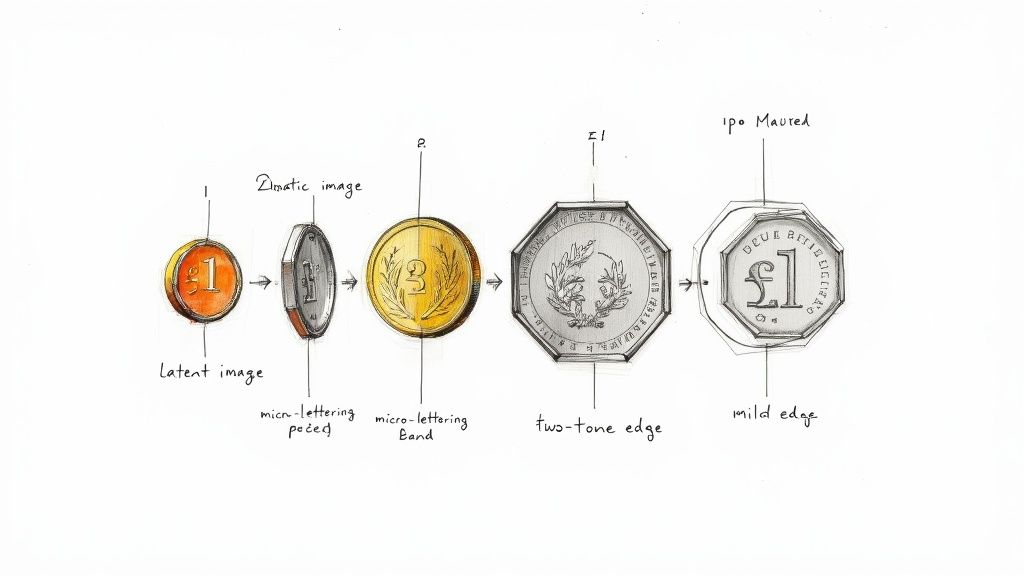
A few of the key innovations include:
- Bimetallic Composition: The coin is made from two different metal alloys—a gold-coloured nickel-brass outer ring and a silver-coloured nickel-plated inner disc. This alone makes it much harder and more expensive to copy convincingly.
- Latent Image: This is a really clever feature just below the Queen’s head. It works like a hologram, changing from a '£' symbol to the number '1' when you tilt the coin in the light.
- Micro-Lettering: Look closely and you’ll see incredibly small lettering precision-engraved on the inner rim of both sides. This is a tiny detail that crude forgery techniques just can't replicate clearly.
The new £1 coin wasn't just designed to look different; it was designed to be technically superior in every way that matters for security. Each element works together to create a formidable barrier against forgery.
Restoring Confidence in Our Currency
Ultimately, the redesign was about more than just clever technology. It was about restoring people’s faith in the money they carry every day. By retiring the vulnerable round pound and bringing in a successor packed with these cutting-edge features, The Royal Mint sent a powerful message.
The new coin effectively slammed the door on the counterfeiters who had profited from the old design for so long. This move protected businesses, shored up the integrity of our currency, and ensures that when you get a pound coin in your change today, you can be almost certain it’s the real deal.
What to Do If You Find a Fake Coin
Realising you're holding a fake £1 coin is an awkward moment, to say the least. Your first thought might be to just get rid of it in the next shop you visit, but that’s the worst thing you can do. Knowingly passing on counterfeit money is a serious offence. The right move is to take it out of circulation for good.
The official procedure is actually quite simple and helps the authorities get a better handle on the scale of the problem. Once you're certain you've got a dud, the correct place to take it is your local police station. While some banks might take them, the police are the designated authority for counterfeit currency. Whatever you do, don't try to post it—always deliver it in person.
When you hand it over, they'll ask you to fill out a form with a few details.
The Official Handover Process
Don't worry, the process is designed for intelligence gathering, not to put you under suspicion. You're the one doing the right thing, after all.
- Hand Over the Coin: Simply give the suspected fake £1 coin to the police officer.
- Fill Out a Form: You'll likely be given a receipt or form to fill out. They'll ask where and when you think you received the coin, if you can remember. This information is gold dust for them, as it helps map out where fakes are turning up.
- No Reimbursement: Here's the kicker—you will not be reimbursed for the coin. That £1 is gone. It's frustrating, I know, but the aim here is to protect the integrity of our currency for everyone, not to compensate individuals.
The main goal is to get that fake coin out of public hands. By reporting it, you're playing a small but vital part in the much bigger effort to keep UK currency secure and trustworthy.
Why Reporting Matters
It might seem like a lot of hassle for a single quid, but reporting a fake coin has a much wider impact than you'd think. Every counterfeit that's taken out of circulation and documented gives valuable data to law enforcement and The Royal Mint. This intel helps them understand the methods counterfeiters are using and pinpoint hotspots for fake currency.
Think of it as a bit of community service. You lose a pound, sure, but you also stop that same dodgy coin from causing a headache for a small business owner, jamming up a vending machine, or being passed on to someone else who can't afford to lose the money. It's this collective action that keeps our currency system secure.
While this guide focuses on coins, the same principles apply to banknotes. You can find out more by checking out our guide on how to check if money is real.
Your Questions Answered
Even with all the checks and tests under your belt, it's natural to have a few questions rattling around. Finding a coin you suspect is a fake can be a strange experience, so let's tackle some of the most common queries I hear.
A lot of people ask if they'll get their money back for a counterfeit. The short answer is, unfortunately, no. When you hand a fake coin over to the police or your bank, you’re doing the right thing by taking it out of circulation, but it won't be replaced. See it as your small contribution to keeping our currency trustworthy.
Another worry is about getting into trouble for simply having a fake. Rest easy. Just possessing one you've received in your change isn't illegal. The law only steps in if you knowingly try to pass it on as genuine. Your duty is to report it, not spend it.
Are the New Coins Still Being Faked?
It's a fair question: just how secure is the new 12-sided £1 coin? While no currency is ever 100% counterfeit-proof, this new design has been a game-changer. The sheer complexity of the bimetallic construction, the clever latent image, and the tiny micro-lettering make it a nightmare for forgers to replicate convincingly.
The difference it made after its 2017 introduction was staggering. Before the switch, the Royal Mint estimated that around 3.03% of the old round pounds in circulation were fakes. The new 12-sided coin effectively stamped out that widespread issue. You can read more about the statistics and the design's success on the Royal Mint's official website.
The takeaway is simple: while vigilance is always wise, the current £1 coin is one of the most secure pieces of currency in the world. The chances of receiving a fake today are vastly lower than they were a decade ago.
So, what’s the single most important thing to remember through all of this? Trust your gut. If a coin feels a bit light, looks poorly made, or just seems 'off', it probably is. The fastest way to confirm your suspicions is always to compare it side-by-side with one you know is real.
Whether you are a seasoned numismatist or just starting your collection, Cavalier Coins Ltd offers a vast selection of authentic coins and banknotes from around the globe. Explore our curated collections and find your next treasured piece at https://www.cavaliercoins.com.