

When most people think of German currency prior to the Euro, the Deutsche Mark (DM) immediately springs to mind. It was a powerhouse, a symbol of Germany's post-war economic miracle and stability. But the story of the nation's 20th-century money is far richer and more turbulent than that. It’s a journey of dramatic collapses and incredible recoveries, all told through the coins and banknotes that passed through millions of hands.
A Journey Through Pre-Euro German Currency
Welcome to the fascinating world of German money. This guide is your ticket to exploring 20th-century German history not through textbooks, but through its currency. We'll travel from the notorious Papiermark of the Weimar Republic's hyperinflation to the rock-solid Deutsche Mark, a symbol of prosperity. Each coin and banknote reflects a moment of economic chaos, bold recovery, national division, and eventual reunification.
Think of this as your roadmap, whether you're a seasoned numismatist or just dipping your toes into this compelling slice of European history. Getting to know the key currencies is the perfect place to start.
Germany's Major 20th Century Currencies
The road to the Euro wasn't a straight one. It was paved by four distinct currencies, each born from a pivotal moment in the nation's history:
- The Papiermark (1914–1923): Forever linked with the economic chaos and dizzying hyperinflation that followed World War I.
- The Rentenmark (1923–1924): The short-lived "miracle" currency, introduced to slam the brakes on hyperinflation.
- The Reichsmark (1924–1948): The official currency that saw Germany through the later Weimar years, the entire Third Reich, and World War II.
- The Deutsche Mark (1948–2002): The legendary symbol of West Germany's economic revival, which later became the currency of a reunified Germany.
This timeline helps visualise how these currencies followed one another, charting the distinct periods of the Papiermark, Rentenmark, Reichsmark, and Deutsche Mark.
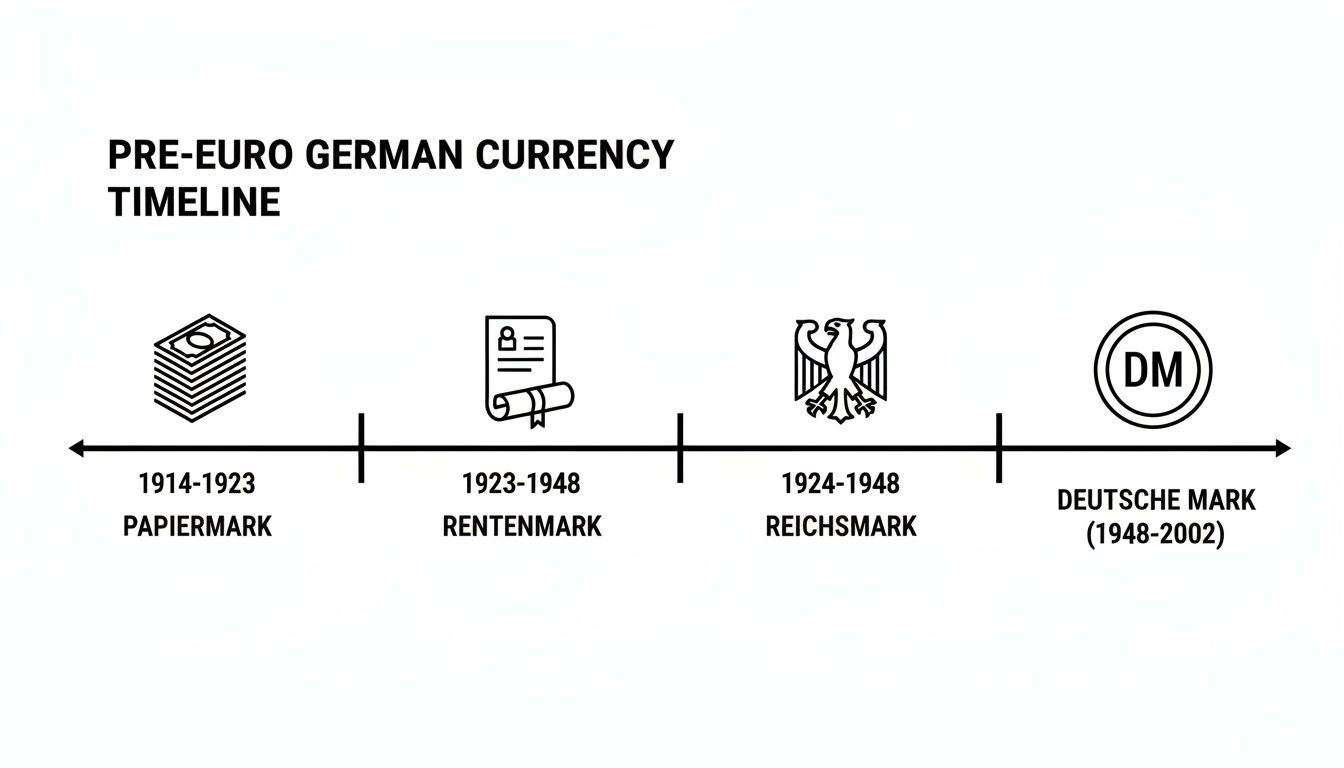
What stands out immediately is how rapidly things changed during times of crisis, especially in the 1920s, before settling into the long, stable era of the Deutsche Mark. Each of these transitions marks a massive turning point in German economic and political life.
For collectors, each of these currencies offers a unique window into a different chapter of the nation's story. The designs, denominations, and even the quality of the paper tell tales of war, economic hardship, political ideology, and eventual triumph.
To really appreciate these objects, you need to know the context behind them. You can dive deeper with a brief history of German banknotes to see just how the designs evolved. This guide will give you the foundation you need to identify, understand, and value these powerful historical artefacts.
Hyperinflation and Stability in the Weimar Republic
If there's one period that defines the drama of German currency prior to the euro, it's the Weimar Republic. This era gave us two currencies at opposite ends of the economic scale: the Papiermark, a byword for financial catastrophe, and the Rentenmark, the unlikely hero that pulled Germany back from total collapse. It's a story of economic chaos so profound it has become the textbook example of hyperinflation.
The scene was set in the aftermath of World War I. Germany, saddled with colossal war reparations and a crippled economy, turned to the printing presses. The government started churning out money at a breathtaking rate, and this currency, known as the Papiermark (or "paper mark"), quickly began to lose its value as the country was flooded with useless notes.
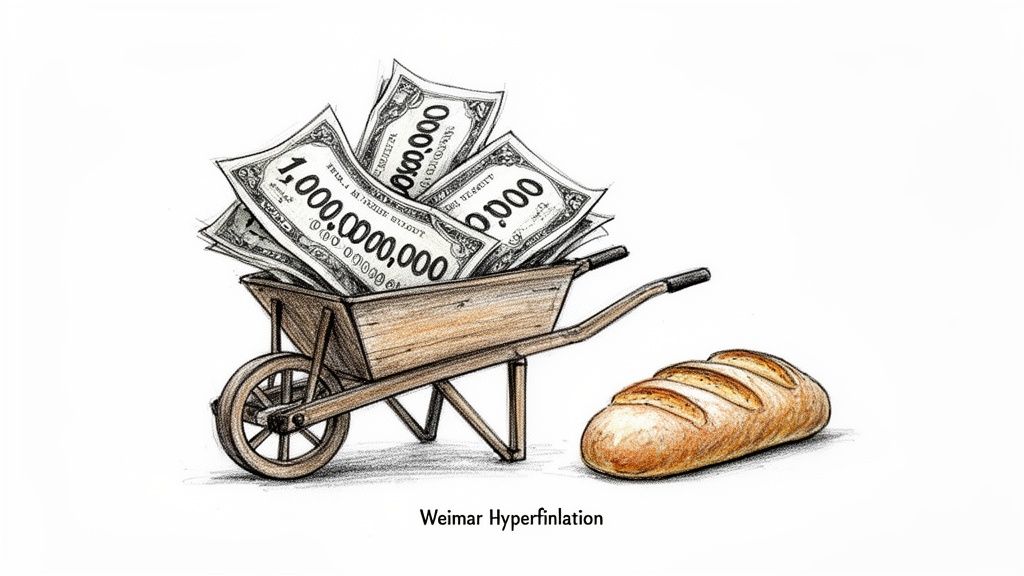
It’s hard to fathom today, but imagine needing a wheelbarrow stuffed with cash just to buy a loaf of bread. This wasn't some wild exaggeration; it was the grim reality for millions of ordinary Germans in 1923. Prices shot up not just daily, but hourly, making savings, pensions, and wages completely worthless almost overnight.
The Papiermark A Symbol of Collapse
The Papiermark's freefall was simply mind-boggling. By November 1923, the exchange rate hit an almost unbelievable 4.2 trillion Marks to one US dollar. To even attempt to keep up, the government began printing banknotes with ever-more absurd face values.
First came the thousands, which soon became millions. Before long, notes were denominated in billions (Milliarden) and, finally, trillions (Billionen). These notes are powerful historical objects, with some of the most famous examples being:
- 100 Trillion Mark Note: Often pointed to as the highest denomination banknote ever intended for general circulation.
- 50 Trillion Mark Note: Another stark reminder of the extreme figures needed just for daily transactions.
- Notes Overprinted with New Values: To save paper and printing time, older notes were often hastily stamped with new, astronomical values, creating fascinating variations for today's collectors.
These weren't just bits of paper; they were symbols of a nation in panic. The often rough, rushed printing quality tells its own story of desperation. For a collector, holding one is like holding a tangible piece of one of modern history's greatest economic disasters.
The speed of the collapse is what truly shocks. An item that cost one Mark in 1918 would have set you back roughly one trillion Marks by late 1923. This total destruction of value effectively wiped out the savings of the entire middle class, creating deep social scars and political instability.
The Rentenmark Miracle of 1923
Just as the economy was on the verge of complete implosion, a new plan was hatched. In November 1923, the government introduced the Rentenmark, a new currency designed to slam the brakes on hyperinflation. This wasn't just a new design; it was a radical concept aimed at rebuilding public trust from the ground up.
Germany had no gold reserves to back a new currency, so the government did something clever. They pegged the Rentenmark's value to something people could see and believe in: all the land and industrial property in Germany. The new currency was theoretically backed by mortgages on German agricultural and industrial assets. It was a brilliant psychological move that gave it the stability and credibility the Papiermark had utterly lost.
The redenomination rate was as dramatic as the inflation it was meant to cure. One new Rentenmark was exchanged for a staggering one trillion Papiermarks. With that single act, the German monetary system was reset, prices stabilised, and a sense of economic order returned.
The Rentenmark was only ever meant to be a temporary fix. But it worked so well that it paved the way for a more permanent currency the following year. Coins and banknotes from this brief but vital period are a cornerstone for any serious collector of German currency, representing a pivotal moment of recovery.
The Reichsmark Era: From Stability to War
The Rentenmark was a brilliant, stop-gap measure, but Germany needed something permanent to restore faith in its economy. So, in 1924, the Reichsmark (RM) was born. This was the currency that would see the nation through the fragile hope of the Weimar Republic, the rise of the Third Reich, and the utter devastation of the Second World War. Its story is really a tale of two halves.
At first, the Reichsmark was a symbol of renewed confidence. It was introduced at a one-to-one exchange with the Rentenmark, effectively locking in the stability its predecessor had worked so hard to achieve. The early coins and banknotes from this period feel hopeful, featuring traditional German symbols like oak leaves and the proud Weimar eagle.
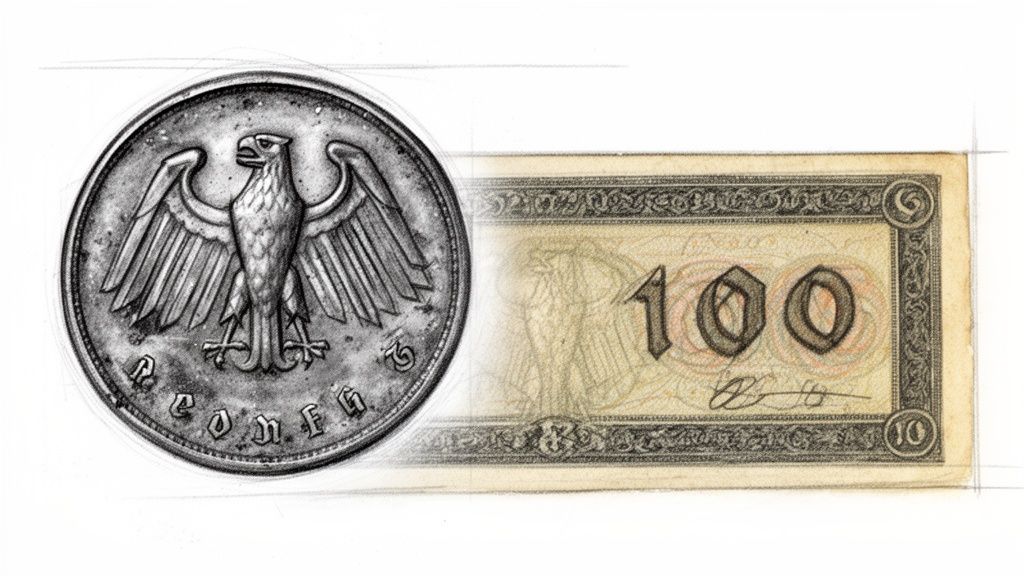
This calm before the storm, often called Germany's "Golden Twenties," gave the economy breathing room to recover. For collectors, coins struck between 1924 and the early 1930s represent this fleeting peace. They were made from higher-quality metals like silver and nickel, and their designs were republican, not yet tainted by ideology.
Currency as a Political Tool
The story takes a dark turn when the Nazi Party seized power in 1933. The new regime instantly grasped how powerful currency could be as a propaganda piece—a way to put their ideological stamp on every single purchase, every single day. The change was anything but subtle.
Almost overnight, the designs on coins and banknotes were overhauled to project the regime's authority. The key changes are impossible to miss:
- The Weimar Eagle Was Replaced: The republic's democratic eagle was cast aside for the Nazi Party's version, an eagle gripping a wreath that held a swastika.
- Hindenburg and the Garrison Church: The 2 and 5 Reichsmark silver coins from 1934 onwards often paired President Paul von Hindenburg with the new Nazi eagle, creating a visual link between the old order and the new.
- The Swastika Became Unavoidable: By the late 1930s, the swastika was a standard feature on almost every coin, from the lowly zinc Reichspfennig to the larger silver pieces.
This shift creates a chillingly clear timeline for any collector. A coin from 1935 looks drastically different from one minted just a few years earlier, acting as a tangible marker of Germany's descent into totalitarianism.
The coins and banknotes of the Third Reich are a stark reminder of how everyday objects can be co-opted for political messaging. Every time a person made a purchase, they were handling a small piece of state propaganda, reinforcing the regime's presence in their lives.
The Impact of War on Coinage
As Germany rearmed and then plunged Europe into conflict, the currency became a direct reflection of the nation's all-out war effort. The demands of a war economy meant precious metals were needed for weapons and industry, not for pocket change.
Silver, once used for the 2 and 5 Reichsmark coins, vanished from circulation entirely. It was replaced by much cheaper, utilitarian metals. Nickel was also phased out in favour of aluminium and, most famously, zinc. Zinc coins are notorious among collectors for their awful quality. They corrode at the drop of a hat and often have a dull, greyish look—a physical embodiment of wartime austerity.
For collectors, this debasement creates a fascinating puzzle. You can track the escalating pressures of the war economy simply by following the changes in metal from year to year. Mint marks (like 'A' for Berlin or 'F' for Stuttgart) also become incredibly important, as some mints produced far fewer coins, making certain year-and-mint combinations surprisingly rare.
Beyond this, the Third Reich also issued special currencies for occupied territories and payment notes for the military, opening up even more specialised avenues for numismatists. The Reichsmark's journey—from a symbol of stability to an instrument of war and a mirror of scarcity—makes it one of the most compelling chapters in the history of German currency prior to the euro.
Two Nations, Two Currencies After World War II
The end of World War II left Germany shattered, not just physically but financially. The old Reichsmark was essentially worthless, ruined by the war and propped up only by a rampant black market. To rebuild, the country desperately needed new, stable money. But with Germany now divided, a single unified currency was impossible.
What happened next was a monetary split that perfectly mirrored the ideological divide of the Cold War, giving birth to two very different German currencies.
In the Western zones, controlled by the Allied powers, a bold and secret plan was set in motion. On 20th June 1948, with almost no warning, the old Reichsmark was declared void and the Deutsche Mark (DM) was introduced. This radical move was the spark that ignited the Wirtschaftswunder—the "economic miracle"—and laid the groundwork for West Germany's incredible post-war recovery.
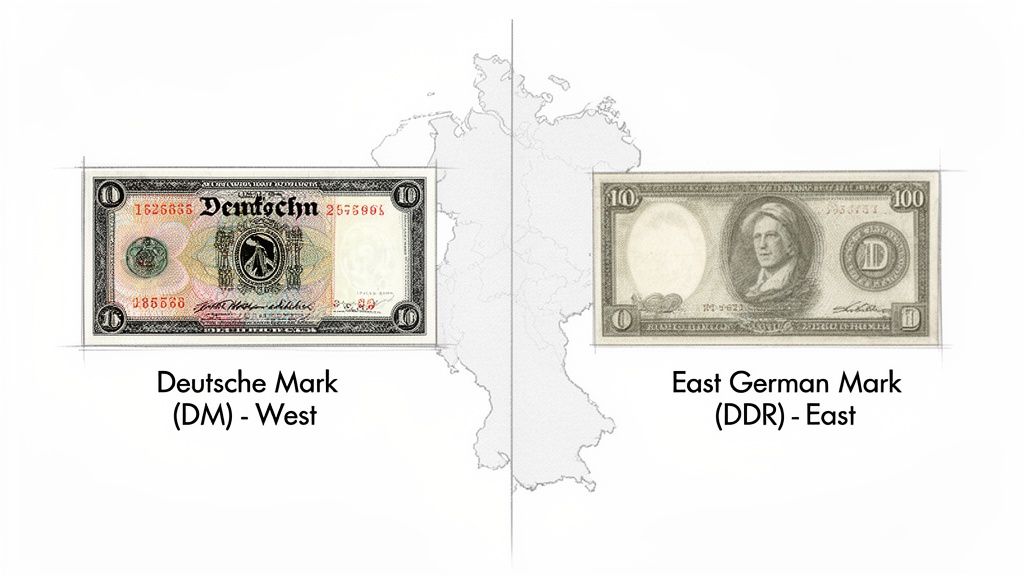
This currency reform was a clean slate. It stabilised the economy practically overnight, filled empty shop windows with goods, and created a currency that would eventually become a global symbol of stability. The Soviet Union saw this as an aggressive move and, just days later, responded by launching its own currency in the Eastern zone: the East German Mark, officially known as the Mark der DDR.
West Germany's Deutsche Mark: A Symbol of Prosperity
The Deutsche Mark quickly became more than just money; it was a powerful emblem of West German pride and economic strength. Managed by the fiercely independent Bundesbank, it earned a worldwide reputation for its rock-solid stability. Its banknotes were beautifully made, featuring complex designs, top-tier security features, and portraits of German cultural and scientific icons—a conscious effort to project a modern, peaceful, and sophisticated nation.
For collectors, a few key series stand out:
- The 1948 Series: The very first notes, actually printed in the United States. They're often nicknamed "dollar notes" for their resemblance to US currency.
- The 1960 Series (BBk I): An iconic and long-running series featuring famous portraits like the artist Albrecht Dürer.
- The 1990 Series (BBk III): This was the final series before the euro arrived, celebrating figures like the scientist Carl Friedrich Gauss and the poet Annette von Droste-Hülshoff.
The Deutsche Mark’s reputation even had a direct impact on British economic policy. Its role as the anchor of the European Exchange Rate Mechanism (ERM) in the late 1980s and early 1990s is a great example. The UK Treasury’s famous struggle to keep the pound sterling's value pegged to the dominant DM, which ended in "Black Wednesday" in 1992, cemented the Mark's status as Europe's ultimate "hard money" benchmark in the minds of many British commentators. This piece of shared history often makes the later DM series particularly appealing to UK collectors. Learn more about the journey towards the Euro.
East Germany's Mark: An Insular Currency
The East German Mark (Mark der DDR) was a completely different beast, reflecting a centrally planned, state-controlled economy. It was a non-convertible "soft" currency, meaning it was worthless outside the Eastern Bloc and couldn't be freely exchanged. Its job was purely internal, serving the state’s economic plans rather than competing on the world stage.
The two Marks existed in separate financial worlds. While the West German DM became a trusted global reserve currency, the East German Mark was a purely domestic tool. East German citizens were even forbidden from possessing Western currency, creating a monetary divide as stark as the Berlin Wall itself.
The designs of East German banknotes told their own story. Instead of artists and scientists, they featured idealised images of factory workers, farmers, and state symbols like the coat of arms with its hammer and compass. The designs were meant to celebrate the triumphs of socialism and reinforce state ideology. While they were well-produced, they generally lacked the artistic flair and advanced security of their Western cousins. For collectors today, these notes offer a fascinating window into the visual propaganda of a communist state.
A Practical Guide to Collecting German Currency
Diving into the world of historical German money is an incredible journey, but like any good adventure, it helps to know the local language. Understanding a few key details—like mint marks, grading, and common series—will transform you from a casual observer into a confident collector. You'll quickly learn how to spot real value and build a collection that tells a story.
The first thing to learn is how to identify where a coin was actually made. German coins from nearly every era feature tiny letters known as mint marks, which pinpoint their city of origin. These marks might be small, but they can have a massive impact on a coin's rarity and value.
Decoding Mint Marks
Think of a mint mark as a coin's postcode. For most of the 20th century, Germany used a consistent system that every serious collector needs to know by heart. Some mints simply produced far fewer coins than others, making certain year-and-mark combinations the ones everyone is looking for.
The main mint marks you'll encounter are:
- A: Berlin
- D: Munich
- F: Stuttgart
- G: Karlsruhe
- J: Hamburg
To put this into perspective, a 1939 2 Reichsmark coin from the Berlin mint (A) is fairly common. But find one from the same year with a 'G' for Karlsruhe, and you're holding a significantly scarcer piece. Always hunt for that tiny letter; it’s one of the most important details on any German coin.
Understanding Coin and Banknote Grades
Once you know a piece's origin, its condition is the next crucial factor. In the world of numismatics, grading is just the formal process of evaluating the physical state of a coin or banknote. It’s simple, really: a higher grade almost always means a higher value.
While official grading gets incredibly detailed, you only need a basic grasp of the scale to get started. The grades range from items that are barely identifiable all the way to pristine examples that look like they just came off the press.
A simple analogy is to think of it like a used car. A vehicle with high mileage and visible wear ('Poor' or 'Good') is worth far less than an identical model with almost no miles and a flawless finish ('Uncirculated'). The difference in value can be astronomical, even for the same coin or note.
Here’s a simplified breakdown to help you get your eye in:
| Grade | Description | What to Look For |
|---|---|---|
| Uncirculated (UNC) | Perfect condition, with no signs of wear. | Sharp details, original lustre, and no scratches or marks from handling. |
| Extremely Fine (EF) | Very light wear, visible only on the highest points of the design. | Most details are sharp, with only minor friction evident. |
| Very Fine (VF) | Light to moderate wear, but with all major design elements still clear. | Letters and key features are distinct, but higher points are worn smooth. |
| Good (G) | Heavily worn, with the main design visible but much of the detail gone. | The date and mint mark should still be legible, but the overall look is flat. |
Spotting Common Fakes and Reproductions
Just like with any valuable collectible, the world of German currency has its share of fakes. This is especially true for high-value items from the Third Reich or rare Weimar Republic pieces. Learning to authenticate is a key skill, but a few simple checks can help you steer clear of the most common traps.
Be suspicious of coins that look "too perfect" for their age, particularly zinc coins from the war era which should naturally show some corrosion. Look for casting seams on the edges—a dead giveaway of a modern replica.
For banknotes, reproductions often just feel wrong. They might be too crisp or printed on paper that doesn't have the right texture and feel of the original. For those interested in paper money, we offer a comprehensive beginner's guide to collecting world banknotes that delves into these topics further. Beyond traditional notes and coins, enthusiasts also engage in collecting different forms of currency, which can broaden a collector’s perspective. With these practical tips, you can navigate the market with much greater confidence.
How to Value and Sell Your Collection
So, you’ve got a collection of German currency from before the euro. The big question now is, what’s it all worth? Figuring out the value of these fascinating historical items is part art, part science. It’s a mix of understanding their face value, historical background, and what collectors are actually looking for. It’s never just about the number printed on the note or stamped on the coin; it's about the story it tells and how rare it is.
The value of any piece really comes down to four key pillars. These are the fundamentals every appraiser and seasoned collector uses to size up an item.
- Rarity: How many were actually made? A Papiermark note with a dizzyingly high denomination might sound impressive, but millions are still around, making most of them quite common. On the other hand, a specific mint mark on a humble Reichsmark coin can make it incredibly scarce and valuable.
- Condition (Grade): This is a huge one. A crisp, uncirculated banknote that looks like it just came off the press is worth many times more than the exact same note that's been folded, torn, and passed through countless hands.
- Historical Significance: Items tied to crucial moments in German history often carry a premium. Think of the notes from the short-lived Rentenmark period or the very first Deutsche Mark series issued after the war – these pieces capture a unique moment in time.
- Collector Demand: At the end of the day, value is driven by what buyers are willing to pay. The popularity of certain eras or specific types of currency can rise and fall over time.
Establishing a Baseline Value
For Deutsche Mark coins and banknotes, there's a very useful starting point. When Germany adopted the euro, a fixed conversion rate was set on 1 January 1999: 1 Euro = 1.95583 Deutsche Marks. This means that a 100 DM note is equivalent to about €51.13.
For UK collectors and dealers, this rate is a fantastic baseline. It gives you the intrinsic face value in pounds before you even start thinking about any collector premium. You can dive deeper into the official conversion rates on the European Commission's website.
This fixed rate provides a solid floor price for any common, circulated Deutsche Marks you might have. But for anything with real numismatic interest—like a perfect uncirculated note, a rare commemorative coin, or an older piece like a Reichsmark—the collector value will shoot well past this simple conversion.
Think of it this way: the face value is the raw material, but the numismatic premium is the craftsmanship. A common brick and a sculpted brick are made of the same clay, but their values are worlds apart.
Before we dive into the specifics of each currency, let's summarise the key periods we'll be exploring. This table offers a quick at-a-glance reference to the major currencies that shaped Germany's financial history before the arrival of the euro.
Key German Currencies Before the Euro
| Currency Name | Period of Use | Key Historical Context |
|---|---|---|
| Papiermark | 1914–1923 | Infamous for the hyperinflation of the Weimar Republic. |
| Rentenmark | 1923–1924 | A temporary currency to stabilise the economy after hyperinflation. |
| Reichsmark | 1924–1948 | The currency of the late Weimar Republic and the Nazi era. |
| Deutsche Mark (West) | 1948–2002 | Symbol of West Germany's "Economic Miracle" and a stable world currency. |
| Mark der DDR (East) | 1948–1990 | The official, non-convertible currency of East Germany. |
This overview sets the stage for understanding the distinct characteristics and collectible appeal of each currency, which we'll explore in more detail throughout this guide.
Finding the Right Place to Sell
Once you've got a handle on your collection's potential worth, picking the right place to sell is crucial. Your options range from direct sales to auctions, and each has its pros and cons. You could approach specialist dealers, list on online marketplaces, or work with a reputable retailer like Cavalier Coins. Even charities that receive donated German currency can use these avenues to get the best value for their collections.
If you're looking to build your knowledge further, our detailed guide on how to find the value of old paper money is a great resource. It covers valuation principles that apply to currencies from all over the world.
Your Questions Answered: A Guide to Old German Currency
Diving into Germany’s fascinating monetary history can bring up all sorts of questions. Whether you're a seasoned collector or just curious, this section tackles some of the most common queries we hear, giving you clear, straightforward answers.
What Was the German Currency Before the Euro?
The final currency used in Germany before the euro took over was the Deutsche Mark (DM). It was the powerhouse behind West Germany's post-war economic miracle from 1948 and became the currency for the reunified nation in 1990, right up until the euro was fully adopted in 2002.
But the story doesn't start there. Before the Deutsche Mark, you had the Reichsmark (1924-1948), which saw Germany through the interwar years and WWII. That was preceded by the short-lived but crucial Rentenmark (1923-1924), a currency created to stop the dizzying hyperinflation of the Papiermark.
Can I Still Exchange Old German Currency?
Yes, but with a big catch: you can only exchange the Deutsche Mark. Germany's central bank, the Deutsche Bundesbank, still swaps DM banknotes and coins for euros, with no fees and no deadline. The conversion is permanently fixed at €1 = 1.95583 DM.
However, any currencies before that—like the Reichsmark, Rentenmark, or Papiermark—have no monetary value today. They are purely historical artefacts, valued only by collectors.
It’s a common mix-up, but it's vital to remember that only the Deutsche Mark can be exchanged at the bank. For every other old German currency, its worth is entirely in the hands of the collector's market, based on its rarity and condition.
Is My Old German Money Worth Anything?
It certainly could be! But its value is all about the specifics. A common, well-circulated Deutsche Mark coin from the 1980s might just be worth its exchange value and little more.
On the other hand, a rare Papiermark banknote from the Weimar Republic's hyperinflation period or a Third Reich coin with an elusive mint mark could be worth hundreds, or even thousands, of pounds. The value always boils down to three key things: rarity, historical importance, and physical condition.
The best advice is to always get your collection looked at by an expert. Many pieces that seem ordinary to an untrained eye can hold surprising value, especially for those who don't know the subtle varieties and details that numismatists hunt for in German currency prior to the euro.
At Cavalier Coins Ltd, we specialise in helping collectors identify, value, and acquire fascinating pieces of world history. Whether you're just starting or looking to find a rare addition, explore our extensive collection today.