
Ever wondered why two seemingly identical coins can have such wildly different price tags? The answer, almost always, comes down to their grade. Coin grading is the language collectors speak—a universal shorthand for a coin's condition, which is the single most important factor that dictates its value.
Why Coin Grading Is Your Most Important Skill
Think about valuing a diamond. You wouldn't judge it on size alone; you'd look at its cut, clarity, and colour. It's exactly the same with coins. The grades of coins offer a standardised way to describe their physical state, taking everything from wear and tear to the sparkle of the original mint lustre into account.
For any collector in the UK, getting to grips with this language is the first real step toward building a collection you can be proud of. It’s the one skill that truly separates a casual hobbyist from a savvy investor.
Learning to grade properly means you can:
- Make smart purchases: You'll be able to confidently assess a coin's condition before you part with your money.
- Avoid costly mistakes: It helps you spot overgraded or damaged coins that might look like a bargain but are anything but.
- Accurately value your collection: You'll finally understand what your coins are genuinely worth on the open market.
Put simply, without a solid grasp of grading, you're flying blind. You could easily overpay for a common coin in poor shape or, worse, sell a rare gem for a fraction of its true value.
The Two Grading Systems Every UK Collector Must Know
Historically, collectors here in the UK have used a traditional, descriptive system. You’ll have seen words like 'Fine', 'Very Fine', and 'Extremely Fine' used to describe a coin's condition. While still common, the international market has largely moved to a more precise, numerical system.
The Sheldon Scale is a 70-point scale used to grade coins, which has become the international standard. It provides a much more granular and consistent method for evaluating a coin's condition compared to older, more subjective adjectival systems.
This means UK collectors today often need to be bilingual, fluent in both the classic British terms and the globally recognised Sheldon Scale. The British system itself has a fascinating history, starting with just 'Fine' and 'Extremely Fine' before collectors demanded more detail. This led to nuances like 'Almost Fine' or 'Good Fine' being added over the years.
There were attempts to modernise with a 100-point system, but the American-developed 70-point Sheldon Scale had already cemented its place as the world standard, adopted by the major certification services. You can actually read about the evolution of UK grading standards on Hattons of London if you fancy a deeper dive.
Understanding both frameworks is absolutely crucial. It’s what gives you the confidence to navigate dealer lists, online auctions, and international coin fairs. As we go on, we'll break down both systems to show you how they relate and how you can apply this knowledge to your own collection.
Mastering the Sheldon Scale From 1 to 70
Before the 1940s, describing a coin's condition was a messy, subjective business. Sellers relied on vague terms like "good" or "fine," which could mean one thing in London and something completely different to a buyer in Manchester. It was a recipe for confusion and disagreement.
That all changed when Dr. William Sheldon, an American psychologist and keen numismatist, introduced a groundbreaking concept: a 70-point scale designed to bring some much-needed objectivity to the art of grading.
Originally developed in 1949 for early American cents, the Sheldon Scale was so logical that it quickly became the international standard. It created a universal language for collectors everywhere, including here in the UK. Suddenly, anyone could understand a coin's precise condition with just a number, making the grades of coins far more consistent and trustworthy.
The scale starts at the very bottom with PO-1 (Poor), a grade for coins so heavily worn they’re barely identifiable. From there, it moves up through the circulated grades that most collectors will frequently come across, painting a clear picture of a coin's journey.
From Circulated Coins to Mint State Perfection
As a coin travels up the scale, its features become progressively sharper. The numbers tell the story of the coin's life in circulation, from a well-worn piece to one that barely saw any use.
- Good (G-4 to G-6): The design is heavily worn, but the main outlines are still there. You can make out the date and inscriptions, though some bits might be faint.
- Very Good (VG-8 to VG-10): Major design elements are clear, but the coin is still quite flat from significant handling.
- Fine (F-12 to F-15): There’s moderate wear on the highest points, but many of the finer details are starting to show through.
- Very Fine (VF-20 to VF-35): The coin shows light to moderate wear, but all the main details are sharp and clear.
- Extremely Fine (EF-40 to EF-45): Wear is very light and only visible on the very highest points of the design. Much of its original mint lustre is still there.
- About Uncirculated (AU-50 to AU-58): At first glance, it looks almost new. You'll only find the faintest traces of wear on a few high points.
Understanding this hierarchy is absolutely key, as it directly connects the traditional British grades and the Sheldon Scale to a coin's overall value.
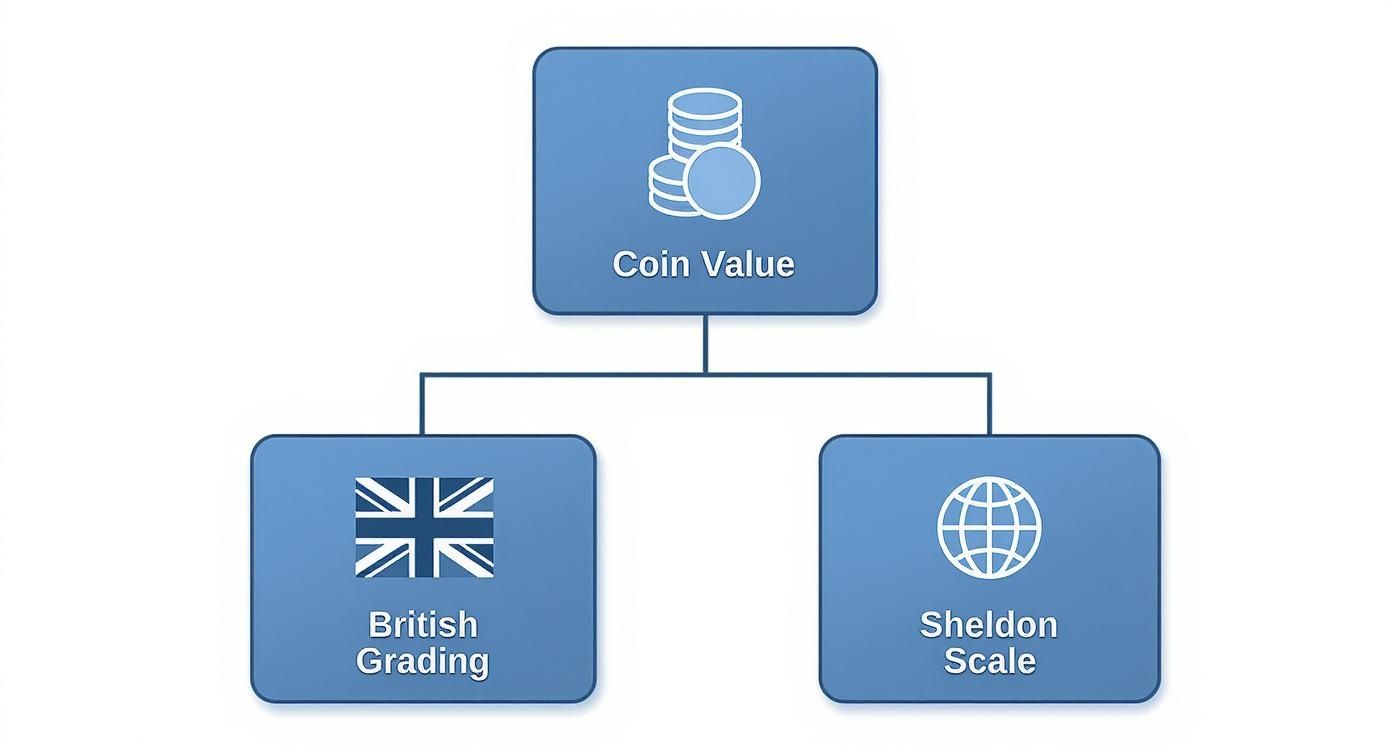
This diagram shows how both the British and Sheldon grading systems are fundamental pillars in determining a coin's ultimate market value.
The real pinnacle for collectors, though, lies in the Mint State (MS) grades, which run from MS-60 to MS-70. These are coins that never saw a day of circulation. The differences between these top-tier grades are incredibly subtle, often boiling down to the quality of the strike, the brilliance of the lustre, and the presence of tiny marks called "bag marks"—little dings that happen when coins jostle against each other in mint bags.
We have a whole guide that digs into the specifics of what makes a coin uncirculated if you want to explore this further.
A coin graded MS-70 is considered technically perfect. It has no visible imperfections, even under 5x magnification. It represents the absolute zenith of coin condition—a flawless specimen, exactly as it was meant to be.
How the Sheldon Scale Modernised UK Grading
While the UK has its own rich tradition of adjectival grading (Fine, Very Fine, etc.), the Sheldon Scale brought a new level of precision to the table. It allows for a much finer distinction between coins that might otherwise fall under the same broad verbal grade.
This simple table helps map the two systems together, showing how a number on the Sheldon Scale roughly corresponds to the traditional grades you'll see used in the UK.
Comparison of Sheldon Scale and Traditional UK Coin Grades
| Sheldon Scale Range | Grade Abbreviation | Traditional UK Adjectival Grade | General Description of Condition |
|---|---|---|---|
| MS-60 to MS-70 | MS | Uncirculated (UNC) | No trace of wear. May have minor bag marks or imperfections. |
| AU-50 to AU-58 | AU | About Uncirculated (AU) | Only the slightest traces of wear on the highest points. |
| EF-40 to EF-45 | EF/XF | Extremely Fine (EF) | Light wear on high points only. Most details are sharp, much lustre remains. |
| VF-20 to VF-35 | VF | Very Fine (VF) | Light to moderate wear, but major details remain clear. |
| F-12 to F-15 | F | Fine (F) | Moderate but even wear. Major design elements are visible. |
| VG-8 to VG-10 | VG | Very Good (VG) | Well-worn, but main features are clear. Rim is complete. |
| G-4 to G-6 | G | Good (G) | Heavily worn. Design is visible but faint in areas. |
| AG-3 | AG | About Good (AG) | Very heavily worn with lettering and date barely legible. |
| FA-2 | FA | Fair (Fair) | Identifiable as to type, but may be bent or have major problems. |
| PO-1 | PO | Poor (Poor) | Barely identifiable, with date and mintmark possibly worn away. |
As you can see, the Sheldon Scale provides a far more granular breakdown, especially at the higher end. For collectors chasing the best of the best, the difference between an MS-63 and an MS-65 can be enormous, both visually and in terms of value. This numerical system removes the guesswork and provides a clear, universally understood standard.
How Coin Grade Directly Impacts Market Value
Understanding the difference between an EF-40 and an AU-58 isn't just a technical exercise; it's the key to figuring out a coin's true market value. In the world of coin collecting, condition is everything. Even the slightest variation in grade can lead to huge differences in price, which is why knowing the grades of coins is so incredibly important.
Think about it this way. Imagine you have two identical coins from the same year. One has been jangling around in pockets for decades, its sharp details now soft and its original shine long gone. The other was carefully set aside the day it was minted, looking as fresh as it did back then. It's obvious the second coin is worth more, but the coin market takes this idea to a whole new level.
The link between a coin's grade and its value isn't a straight line—it’s exponential. The price jump from a Good (G-4) to a Very Fine (VF-20) coin might be noticeable, but the leap from a Mint State (MS-63) to a Mint State (MS-65) can be absolutely staggering. For some coins, that tiny two-point difference can mean an increase in value of hundreds, if not thousands, of pounds.
Why Rarity Magnifies the Importance of Grade
The impact of a coin's grade gets even more dramatic when you factor in rarity. For a common coin with millions minted, there are usually plenty of high-grade examples floating around. But for a "key date" coin—one with a very low mintage or where most were lost or damaged—every single grade point matters immensely.
Take a rare Victorian penny, for instance. An example in 'Fine' condition might be a fairly accessible find for many collectors. That very same penny in uncirculated condition, however, would be a genuine treasure. Its value could easily be 50 to 100 times higher than its circulated cousin. This happens because the supply of top-quality rare coins is tiny, while the demand from serious collectors is fierce.
In essence, a coin's grade determines its place in the "condition census"—a ranking of all known examples of that coin by how well they've been preserved. The higher the grade, especially for a rare coin, the fewer there are like it, pushing its market value higher and higher.
This dynamic is why collectors and dealers put so much effort into precise grading. For investors and serious collectors, getting the highest possible grade for a key date coin is the ultimate prize. If you're looking to understand your own collection better, learning how to value coins properly is the crucial next step.
A Real-World Example of Value and Grade
To see just how this works in practice, let's look at a popular British coin: the 1887 Victoria Jubilee Head Crown. This coin is widely collected, but its value is almost entirely down to its condition.
The table below gives you a clear picture of how dramatically its market price can shift based on its certified grade.
Illustrative Market Value Based on Coin Grade
| Grade (Sheldon/UK Adjectival) | Description of Key Features | Estimated Market Value Range |
|---|---|---|
| VF-20 (Very Fine) | Moderate wear on Victoria's hair, crown, and St. George. | £30 - £50 |
| AU-55 (About Uncirculated) | Only the slightest trace of wear on the highest points. Lustre is mostly intact. | £150 - £250 |
| MS-63 (Mint State) | A beautiful uncirculated coin with strong lustre but a few noticeable marks or scuffs. | £400 - £600 |
| MS-65 (Mint State/Gem) | A premium quality coin with brilliant lustre and only minor, non-distracting imperfections. | £1,500+ |
As you can see, jumping from a circulated grade like VF-20 to a low-end Mint State grade like MS-63 increases the value more than tenfold. Climbing just two more points to a stunning MS-65 can triple that value all over again.
This powerful connection between condition and price is the fundamental engine that drives the entire coin market.
Understanding Professional Grading Services
Getting a feel for grading your own coins is a vital skill for any collector, but when it comes to buying, selling, or investing in serious pieces, nothing beats the security of professional, third-party grading. This is where companies known as Third-Party Grading (TPG) services come in. Think of them as the impartial, expert referees of the coin world, offering an unbiased opinion on a coin's authenticity and condition.
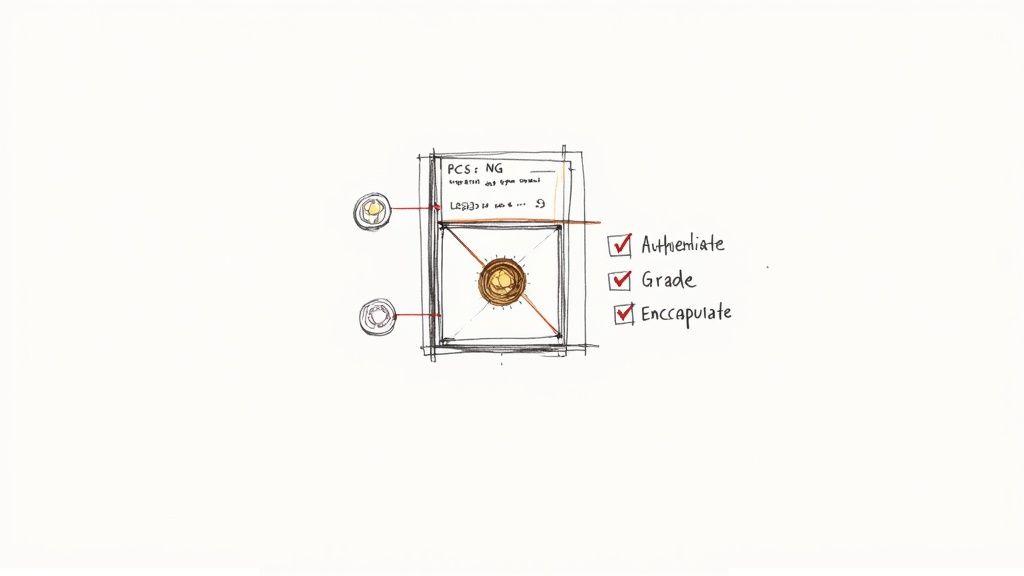
For collectors in the UK, two names really stand out from the crowd: the Professional Coin Grading Service (PCGS) and the Numismatic Guaranty Company (NGC). These two giants are the global gold standard, trusted by dealers and collectors everywhere for their consistency and unwavering standards. Buying a coin graded by one of them provides a level of confidence that a "raw," ungraded coin just can't offer.
The Journey from Raw Coin to Certified Slab
So, what actually happens when you send a coin off to be professionally graded? It’s a carefully managed, secure process designed to ensure fairness and accuracy from start to finish.
- Submission: It all starts when a collector or dealer submits a coin. This is often done through an authorised dealer, or directly if you're a member of the service.
- Authentication: Before anyone even thinks about a grade, a team of experts first confirms the coin is genuine. They scrutinise it for any hint of counterfeiting, alteration, or anything that looks a bit unnatural.
- Expert Grading: The coin is then graded independently by at least two seasoned numismatists. Crucially, neither grader knows what the other has decided, which guarantees a completely impartial assessment based on the 70-point Sheldon Scale.
- Encapsulation: Once they reach a final grade, the coin is sonically sealed inside a tough, tamper-evident plastic holder. In the hobby, we call this protective case a "slab."
This slab does more than just shield the coin from bumps, scrapes, and fingerprints. It also clearly displays all the important information: the official grade, a unique certification number, and details about the coin itself.
The Clear Advantages of Professional Certification
The benefits of getting a coin professionally graded are huge, making the market a much more transparent and trustworthy place for everyone. For buyers, it takes all the guesswork and risk out of the equation. You get an ironclad guarantee that the coin is real and that its grade has been assigned by the best in the business.
For sellers, professional certification can seriously boost a coin's market value. A slabbed coin nearly always fetches a higher price because it appeals to a much wider pool of confident buyers. It effectively turns a subjective opinion into a certified, tradable asset.
Professional grading services provide a universally trusted standard for the grades of coins, which stabilises the market and gives collectors the confidence to invest in high-value pieces without fear of misrepresentation or authenticity issues.
A key part of this whole system is the security that comes with the unique serial number on every slab. Anyone can go to the PCGS or NGC website, type in that number, and instantly check the coin's details in their official database. This online verification tool is a powerful defence against fraud, confirming that both the slab and the coin inside are legitimate. It’s that final, crucial check that secures the value and history of every certified coin, cementing trust in every transaction.
How to Assess Your Own Coins at Home
While getting a coin professionally certified is the final word on its grade, learning to assess your own collection is a fundamental skill for any collector. It gives you the power to sort through your holdings, spot potentially valuable pieces, and get a feel for what you've got without immediately spending money on certification. Think of it as your first, crucial step toward truly understanding your collection.
You don't need a high-tech lab to get started. In fact, just a few simple tools will completely change how you see your coins, allowing you to make a much more accurate first assessment.
Your Essential Home Grading Toolkit
The subtle details that separate a valuable coin from a common one are often microscopic. It's simply impossible to get a clear, detailed view with the naked eye alone.
Here’s what you’ll need to get set up:
- A Quality Magnifying Loupe: A standard magnifying glass just won't cut it. You need a proper jeweller's loupe with at least 5x to 10x magnification. This is the only way to inspect a coin's surfaces for the tiny imperfections and faint traces of wear that define its grade.
- Proper Lighting: A bright, adjustable desk lamp is perfect, especially one with a soft, diffused light source like an LED. Harsh, direct light can be misleading, creating glares that either hide flaws or create the illusion of lustre that isn't really there.
- A Soft Surface: This one's simple but critical. Always examine your coins over a soft, clean microfibre cloth or a velvet pad. It’s a simple precaution that prevents accidental scratches or dings if a coin slips from your fingers.
With these tools in hand, you're ready to start looking at your coins with a grader's eye. The next step is knowing exactly what to look for.
Identifying Wear Versus Damage
One of the biggest hurdles for new collectors is telling the difference between natural wear from circulation and post-mint damage (often abbreviated as PMD). They might look similar at first glance, but they have a massive impact on a coin's grade and value.
Circulation wear is the gentle, even smoothing of a coin’s highest points from being passed from hand to hand over the years. Picture the highest point on the Queen's cheekbone, the tips of a crown, or the fine details in a coat of arms. Wear appears as a subtle flattening in these specific spots.
Post-mint damage, on the other hand, is any problem that occurred after the coin left the mint and isn't from normal circulation. This includes things like:
- Scratches: Sharp, deliberate lines that cut across the coin's design.
- Rim Dings: Nasty dents or bruises on the coin's edge, usually from being dropped.
- Cleaning: This is a big one. Harsh cleaning leaves a web of fine, unnatural hairlines across the surface.
- Corrosion: Pitting, spotting or ugly discolouration from being exposed to moisture or chemicals.
Here's the key takeaway: Wear affects a coin's grade, moving it down the Sheldon Scale from Mint State to circulated categories. Significant post-mint damage, however, can make a coin ungradeable or earn it a "details" grade, which severely limits its value no matter how little wear it shows.
Recognising Original Mint Lustre
Finally, one of the most important things to train your eye to see is mint lustre. This isn't just about a coin being "shiny". It's the unique, satiny sheen that a brand new, freshly struck coin possesses. This effect comes from the way light reflects off the microscopic flow lines created when the metal was slammed by the dies.
To spot it, hold the coin by its edges under your lamp and gently tilt it back and forth. Real mint lustre will "cartwheel"—a band of light will seem to dance and rotate across the coin's surface. A cleaned coin might be bright, but its shine will be flat and lifeless, completely lacking this dynamic effect. Once you can reliably spot original lustre, you're well on your way to identifying uncirculated coins and avoiding those that have been improperly cleaned.
How to Preserve Your Coin's Grade and Value
Knowing the difference between an MS65 and an AU58 is one thing, but protecting that grade is where the real work of a collector begins. A coin’s condition is surprisingly fragile. A single clumsy moment can permanently downgrade its quality and, with it, its market value. Preserving your coin’s grade is about becoming a responsible guardian of its history and its future potential.
The first rule—and the most important one—is remarkably simple: never touch a coin's surface. The natural oils and acids on your fingertips might seem harmless, but over time they can cause irreversible corrosion. Always hold a coin by its edges. Better yet, wear soft cotton gloves to prevent any direct contact with its delicate obverse or reverse. This one habit is the absolute foundation of proper coin care.
The Dangers of Cleaning and Environment
One of the most common—and most costly—mistakes a new collector makes is trying to clean a coin. It’s tempting to want to polish away tarnish and make it look shiny and new, but cleaning almost always does far more harm than good. Abrasive polishes, chemical dips, and even vigorous rubbing can strip away a coin's natural patina, leaving behind a network of tiny, unnatural scratches known as hairlines. To an experienced grader, this kind of damage is immediately obvious and can absolutely slash a coin's value.
A coin's original surface is its most valuable attribute. An uncleaned coin with attractive, natural toning will almost always be worth more than a brightly polished but damaged specimen. Professional conservation is a delicate science and should only ever be handled by certified experts for very specific issues.
Beyond direct handling, the environment where you keep your coins plays a massive role. High humidity is a coin's worst enemy. Moisture can accelerate toning and turn it into destructive corrosion, which is especially damaging for copper and bronze coins. Storing your collection in a cool, dry place with a stable temperature is essential for long-term protection.
Choosing the Right Storage Materials
The materials you use to store your coins are just as important as how you handle them. For long-term safety, it's vital to use products that are chemically inert and free from any substances that could cause harm down the line.
Here are a few archival-quality options to consider:
- Acid-Free Flips: Stick to flips made from Mylar. Avoid any containing PVC, as it can break down over time and leave a damaging green residue on your coins.
- Archival Albums: High-quality albums with inert pages offer a safe and organised way to display your collection without risking chemical exposure.
- Slabbed Holders: For your high-value coins, the ultimate protection comes from the tamper-evident holders provided by professional grading services like PCGS or NGC.
Proper storage is a non-negotiable part of the hobby. You can learn more about the best way to store coins to ensure they last for generations. Keeping your coins safe not only protects their physical condition but also secures their financial and historical worth. Preserving the grades of coins in your collection is an active responsibility, and it’s one that truly pays dividends.
Common Questions About Coin Grades
Getting to grips with the world of coin collecting throws up a fair few questions, especially when you start digging into the crucial topic of grades. It doesn't matter if you're just starting out or have been at it for years; getting straight answers is the key to building confidence. Here are some of the most common queries we hear about the grades of coins.
What Is the Difference Between Grade and Condition?
You’ll often hear "condition" and "grade" used as if they mean the same thing, but in numismatics, there's a subtle but important difference. Condition is really a general, informal description of a coin's physical state. It covers things like wear and tear, any marks, and how much original lustre is left. It’s the kind of broad assessment you might make yourself when looking at a coin.
The grade, on the other hand, is the specific, formal rating given to that condition. It’s usually represented by a number from the Sheldon Scale (like MS-65) or a classic descriptive term (like Extremely Fine). A good way to think about it is that condition is the initial observation, while the grade is the official, expert diagnosis.
Can a Coin's Grade Change Over Time?
Absolutely, and this is something every collector needs to understand from day one. A coin's grade isn't set in stone. It can easily get worse through clumsy handling, poor storage, or a misguided attempt at cleaning. A single drop can leave a ding on the rim, and keeping a coin in a damp place can cause corrosion, permanently damaging its quality and lowering its grade.
The grade given by a professional service like PCGS or NGC is a snapshot of the coin’s condition at that exact moment. Once it's sealed in a slab, that grade is protected. But if you crack it open, the coin is once again at risk of damage that would lead to a lower grade if it were ever submitted again.
Why Do Some Coins Get a Details Grade?
When a third-party grader assigns a "details" grade, it means the coin has a serious problem that stops it from getting a normal numerical grade. The coin is still genuine, but the issue drastically hurts its value. The most common reasons for a details grade are:
- Improper Cleaning: Using harsh chemicals or abrasives that leave fine scratches (hairlines) or strip the coin's natural surface.
- Scratches: Deep or very obvious marks that aren't just from normal use in circulation.
- Environmental Damage: Problems like corrosion, pitting, or other decay on the surface caused by poor storage.
- Repairs: Any sign that someone has tried to fix or hide damage on the coin.
The slab will usually say what the problem is, for example, "AU Details – Cleaned." While these coins can be a cheap way to fill a gap in a collection, they’re worth much less than problem-free examples. An uncirculated coin that's been horribly cleaned, for instance, could easily be worth less than a circulated one that has been left in its original state.
At Cavalier Coins Ltd, we provide a vast selection of certified and raw coins to suit every collector's needs. Whether you are looking for that perfect Mint State sovereign or an affordable piece to complete a set, explore our collections at https://www.cavaliercoins.com.