
Coin grading is the formal process of evaluating a coin's physical condition to figure out what it’s worth on the market. Essentially, it's a standardised system that gives us a common language to describe a coin's state of preservation—the single most important factor that drives its price.
What Is Coin Grading and Why It Matters for Your Collection
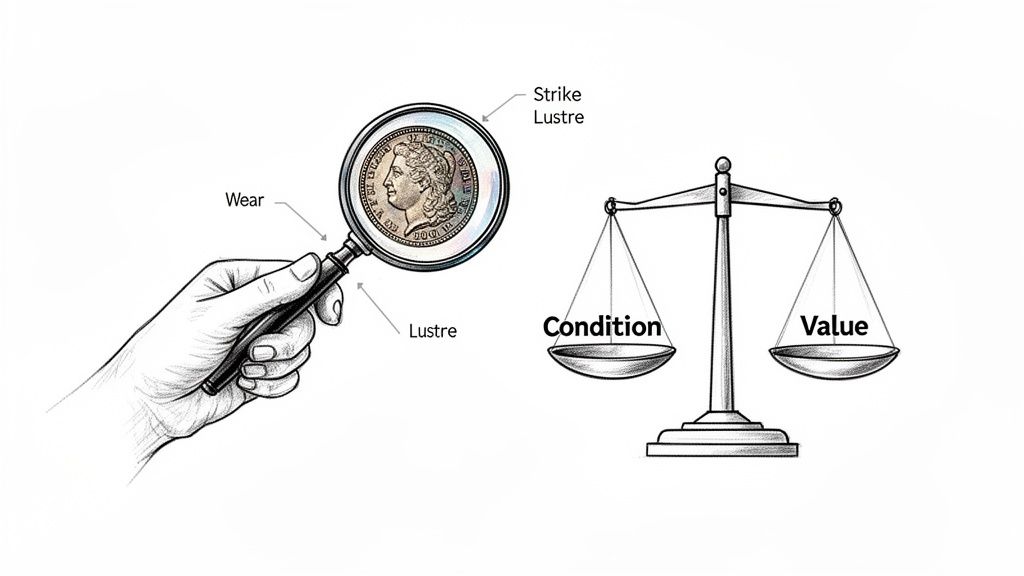
Think of coin grading a bit like appraising a piece of fine art or a classic car. Two paintings by the same artist can have completely different values if one is pristine while the other is faded and cracked. It’s exactly the same with coins; two identical coins can be separated by thousands of pounds in value based only on their condition.
This process gives us a consistent and reliable scale to assess a coin's physical characteristics. It’s not just about a quick look for scratches. It’s a detailed examination that turns a subjective opinion like "this looks nice" into an objective, market-accepted assessment.
The Foundation of a Coin's Worth
Without a shared understanding of a coin's condition, the market would be absolute chaos. Grading creates that common ground, making sure that a coin described as "Very Fine" in London means the exact same thing to a buyer up in Edinburgh. This standardisation is absolutely crucial for a few key reasons:
- Accurate Valuation: It allows collectors, dealers, and investors to put a precise market value on a coin.
- Buyer Confidence: It takes the guesswork out of buying, giving you real assurance about the quality of the coin you're adding to your collection.
- Protecting Your Investment: An official grade from a trusted service like PCGS or NGC authenticates your coin and protects its value.
- Historical Preservation: It helps identify the best-preserved examples of our history, highlighting coins that have survived the centuries with barely a mark.
Getting to grips with this system is the first and most important step for anyone who's serious about numismatics. It’s the framework that the entire hobby is built on.
From Casual Interest to Serious Collecting
Whether you've just inherited a tin of old pennies or you're actively hunting for rare sovereigns, understanding the basics of coin grading is essential. It gives you the power to make smarter decisions, spot valuable pieces hiding in plain sight, and truly appreciate the small details that make one coin so much more desirable than another.
For a collector, a grade is more than just a number or a word; it's a story. It tells you about the coin's journey—whether it passed through thousands of hands or was carefully put away the day it was minted.
Once you start looking at coins through the eyes of a grader, you'll begin to notice things you never saw before—the sharpness of the strike, the quality of the surfaces, and that beautiful original mint lustre. This knowledge completely changes how you see your collection. It transforms it from a simple pile of objects into a portfolio of historical artefacts, each with a specific condition and a corresponding value. It’s the key to unlocking the real potential and enjoyment of your hobby.
The UK Adjectival System vs The US Sheldon Scale
When you get into coin collecting, you quickly realise the global market speaks two different languages when it comes to grading. For any UK-based collector, learning to speak both isn't just a nice-to-have; it's essential for navigating auctions, figuring out valuations, and buying with confidence.
The two systems you'll constantly encounter are the traditional British adjectival grades and the American Sheldon Scale, which has become the dominant force worldwide.
Think of it like describing a classic car. You could use simple, descriptive words like ‘Good’, ‘Excellent’, or ‘Mint’. That’s exactly how the UK system works—it’s an intuitive, word-based method that has served British collectors for generations.
The American Sheldon Scale, on the other hand, is more like a high-resolution photograph. It uses a precise number from 1 to 70 to capture every tiny detail and subtle difference in quality. This numerical precision is why it’s become the international standard, especially for high-value coins traded across borders.
The British Adjectival Grading Tradition
Coin grading in the UK didn't just appear overnight; it evolved over time. Back in the nineteenth and early twentieth centuries, British dealers kept things incredibly simple. Coins were often just classed as either “Fine” or “Extremely Fine.”
As the hobby expanded, it became clear more detail was needed. Terms like ‘Good’ and ‘Very Good’ were added to create a more useful ladder of quality.
To add even more nuance, dealers started using qualifiers, which is why you see grades like “Almost Very Fine” (AVF) or the very common “Good Extremely Fine” (GEF). You'll still find these traditional grades used all the time in UK auction catalogues and by local dealers. They’re a huge part of Britain's numismatic heritage.
Here are some of the key adjectival grades you’ll come across:
- Fine (F): Shows quite a bit of wear, but the main design is still clear.
- Very Fine (VF): You'll see moderate wear on the highest points, but many of the finer details are still visible.
- Extremely Fine (EF): Only light wear on the very highest points, with plenty of the original mint lustre shining through.
- About Uncirculated (AU): Just a whisper of wear, so little that it's barely visible to the naked eye.
- Uncirculated (UNC): A coin with no wear at all. It looks just as it did the day it left the mint.
The Rise of the American Sheldon Scale
Dr. William Sheldon developed his 70-point numerical scale back in the 1940s, originally for early American cents. It was a revolutionary concept. He proposed that a coin graded 70 was 70 times more valuable than one graded 1, linking condition directly to value in a mathematical way.
It took a while to catch on, but the Sheldon Scale was adopted by the major third-party grading services like PCGS and NGC in the 1980s. Its rise to fame coincided with the boom of the international coin market, and it quickly became the universal language for serious collectors everywhere, including here in the UK.
The Sheldon Scale transformed coin grading from a descriptive art into a more objective science. By assigning a specific number, it allows for a direct comparison of quality and, consequently, value, no matter where in the world a coin is being sold.
Bridging the Two Systems
So, how do you square these two different approaches? While there’s no perfect, straight-line conversion, there are widely accepted equivalences that help collectors translate between them. Understanding this is crucial when you see a coin with a British grade and need to estimate its likely numerical counterpart.
| UK Adjectival Grade | Typical Sheldon Scale Range | Brief Description |
|---|---|---|
| Very Fine (VF) | VF-20 to VF-35 | Obvious circulation wear but still a very desirable coin. |
| Extremely Fine (EF) | EF-40 to EF-45 | Light wear on the high points of the design. |
| About Uncirculated (AU) | AU-50 to AU-58 | Traces of wear, often only visible under magnification. |
| Uncirculated (UNC) | MS-60 to MS-70 | No wear, though may have marks from the minting process. |
This dual-language environment is simply the reality for collectors in the UK today. It's also worth remembering that many European countries have their own traditional grading terms, adding another layer if you collect continental coins. If that's an area you're interested in, you might want to explore our guide to the European coin grading system.
Ultimately, a solid grasp of both the British adjectival terms and the international Sheldon Scale gives you the flexibility to operate confidently in any corner of the numismatic world.
How to Assess a Coin Like a Professional Grader
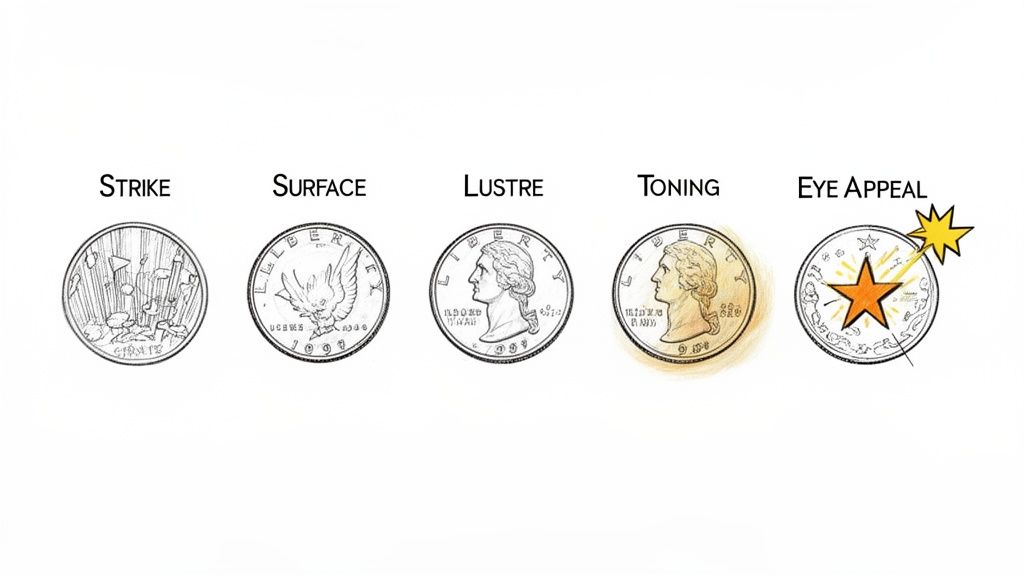
So, we've covered the theory behind the grading scales. Now, let's get our hands dirty. How does a professional grader actually land on a specific number like MS-65 or a descriptive term like 'Extremely Fine'? It’s not just a simple glance for wear and tear; it’s a detailed analysis across five critical factors.
Learning these five pillars is the secret to developing a truly discerning eye. It’s what separates a casual looker from a serious collector. Once you internalise these elements, you’ll start to see coins in a whole new light, evaluating them with much greater confidence and precision.
Let's break down exactly what the experts are looking for.
The Five Pillars of Coin Grading
When a professional grader examines a coin, they are essentially deconstructing its appearance into five key components. Understanding these allows you to follow their logic and start thinking like a grader yourself.
| Criterion | What Graders Look For | Analogy for Understanding |
|---|---|---|
| Strike | The crispness and completeness of the coin’s design. Are the highest points sharp? | Think of it like the focus on a photograph. A sharp strike is a high-definition image; a weak strike is a blurry one. |
| Surface Preservation | The presence of any marks, nicks, or scratches acquired after the coin was minted. | Imagine a new car’s paintwork. A pristine coin is like a flawless finish, while bag marks are like tiny car park dings. |
| Lustre | The original, cartwheeling shininess from the minting process. | This is the natural glow of a brand-new coin. Cleaning it is like polishing an antique—it creates an artificial shine and ruins the original finish. |
| Toning | The natural colouration the coin has developed over time due to its environment. | Like the patina on fine leather or antique silver, good toning can be beautiful and add character. Bad toning just looks like damage or dirt. |
| Eye Appeal | The overall aesthetic impact and “wow” factor of the coin. | This is the final gut feeling. Two coins might be technically similar, but one just looks better. That’s eye appeal. |
Each of these factors plays a crucial role in determining the final grade and, ultimately, the coin's desirability and market value. Let’s dive a bit deeper into each one.
The Sharpness of the Strike
The first thing a grader checks is the strike. This isn't about wear; it’s about how well the design was stamped onto the blank piece of metal (the planchet) in the first place.
A weak strike can make even a brand-new, uncirculated coin look soft or incomplete, simply because the minting press didn’t apply enough force. Graders look at the highest points of the design—the delicate strands of a monarch's hair, for example—to judge how sharp and defined the details are.
The Purity of Surface Preservation
Next up is surface preservation. This is an assessment of all the little knocks and bumps a coin has picked up since leaving the mint. Imagine a brand-new car rolling off the production line with perfect, gleaming paintwork. That's a coin with perfect surfaces.
Of course, life happens. Graders meticulously scan for things like:
- Bag marks: Little nicks and scrapes from bumping against other coins in mint bags.
- Scratches and hairlines: Fine lines often caused by someone trying to "clean" the coin.
- Rim dings: Dents on the edge, usually from being dropped.
The cleaner the surface, the higher the grade. It's a fundamental part of the grading of coins process.
A common misconception is that a coin without wear is automatically a high grade. However, an uncirculated coin can be covered in distracting bag marks, which would severely limit its final grade despite its lack of circulation.
The Original Mint Lustre
Lustre is that beautiful, satiny sheen a coin has the moment it's made. It’s not just a simple shine; it’s a unique cartwheeling effect as light reflects off microscopic flow lines in the metal created during the strike.
This original mint lustre is incredibly fragile. It’s the very first thing to go when a coin sees even a little circulation. More importantly, cleaning a coin completely strips this away, leaving behind an unnatural, deadened shine that any experienced grader will spot from a mile away.
The Character of Toning
Toning is the natural colour a coin’s surface develops over many years as it reacts with its environment. This is especially noticeable on silver coins, which can acquire a whole rainbow of colours, from subtle gold to vibrant blue and deep purple.
Toning is a real double-edged sword. Gorgeous, even toning can make a coin far more desirable and valuable. On the flip side, ugly, blotchy toning or dark carbon spots can seriously detract from its appearance and knock down the value. It’s all about aesthetics.
The All-Important Eye Appeal
Finally, the grader pulls everything together into one holistic judgement: eye appeal. This is the most subjective part of grading, but it’s absolutely crucial. It’s the coin's overall "wow" factor.
Does the sharp strike, clean surface, and beautiful toning all work together in harmony? Or is the coin just a bit… lacklustre? You can have two coins with the exact same technical grade, but the one with superior eye appeal will almost always be the one everyone wants, and it will fetch a higher price. It’s that intangible quality that makes a good coin a truly great one.
A Visual Guide to Coin Grades from Worn to Flawless
Talk of 'Very Fine' or 'MS-63' can feel a bit abstract until you actually see the coins side-by-side. You can read all the theory you like, but it’s training your eye to spot the subtle differences that really builds your skill in grading coins.
Think of this section as a practical, visual journey through the grading scale. We'll group the grades into four easy-to-understand tiers, starting with a coin that’s been heavily used and working our way up to one that looks like it just fell out of the press at the Royal Mint. By zeroing in on the specific visual clues for each level, you'll soon learn to spot the details that separate a run-of-the-mill coin from a genuine collector's piece.
Heavily Circulated Coins (Poor to Good Grades)
These are the coins that have truly lived. They’ve passed through countless hands, rattled around in pockets, and paid for who-knows-what over the decades. Their condition is a direct reflection of this long history, with most of their original design worn almost completely smooth.
At the very bottom of the scale, a Poor (PO-1) coin is often just a recognisable disc of metal. You can probably make out what type of coin it is and maybe even a date, but nearly all the lettering and design features have vanished.
Moving up a notch to Good (G-4 to G-6), the coin has a bit more definition. You can see the main design in outline and the rim is mostly there. But all the finer details—things like the individual strands of hair on a monarch’s portrait or the feathers on a bird’s wing—are completely gone. Coins in this state are usually valued more for their history than their condition.
Moderately Circulated Coins (Fine to Very Fine Grades)
This is where you'll find most of the older coins that turn up in family collections. They clearly show their age and use, but they've held onto enough detail to be easily identified and still look quite handsome.
A coin in Fine (F-12) condition has noticeable wear across the whole surface, but the main design elements are still bold. Picture a clear, but soft, version of the original design. You should be able to read all the lettering, and the main portrait features are there, even if they're not particularly sharp.
When you get to Very Fine (VF-20 to VF-35), things start to look much better. There's still moderate wear, especially on the highest points of the design, but many of the finer details are now coming through. For instance, some of the main lines in Queen Victoria's hair will start to be visible, giving the portrait a bit more depth.
For a lot of collectors, VF is the sweet spot. It offers a great balance between affordability and eye appeal. It’s a coin with a story from its time in circulation, but it's still attractive enough for a collection without commanding the high price of an uncirculated example.
Lightly Circulated Coins (Extremely Fine to About Uncirculated)
Now we're getting into coins that barely spent any time in circulation. They were likely put aside as a keepsake not long after being minted, which has preserved most of their original beauty. The differences between these grades can be incredibly small.
An Extremely Fine (EF-40 to EF-45) coin has just a whisper of wear, and only on the very highest points of the design. You'll see a lot of the original mint lustre—that unique, satiny shine—especially in the protected areas around the lettering. All the fine details are sharp and clear.
The next step up is About Uncirculated (AU-50 to AU-58). To the naked eye, an AU coin can look perfect, with a brilliant shine. But get a magnifying glass out, and you’ll spot the tiniest trace of wear on the highest points, like a cheekbone on a portrait or the very top of a shield. It’s often just this hint of friction that keeps it from being a full Mint State coin.
Uncirculated Coins (Mint State Grades)
This is the pinnacle of coin preservation. Mint State (MS) coins have absolutely no trace of wear from circulation. They are in the same condition as the day they were struck, though they might have small nicks or scratches from the minting and bagging process itself.
The Mint State category is really a scale within a scale, running from MS-60 all the way to a theoretically perfect MS-70.
- MS-60 to MS-62: These coins are uncirculated but might have a lot of 'bag marks', a weak strike, or dull lustre.
- MS-63 to MS-64: Known as "Choice Uncirculated," these have good eye appeal and a strong strike, with only moderate marks.
- MS-65 to MS-66: This is the "Gem Uncirculated" level. They are beautifully struck with fantastic lustre and only tiny, non-distracting marks.
- MS-67 and above: These are superb, almost flawless examples that are incredibly rare. They have virtually no visible imperfections and amazing eye appeal.
The difference between these top grades can be microscopic, yet it can mean a difference of thousands of pounds in value. This is precisely why professional, third-party grading is so crucial for any high-value uncirculated coin.
Understanding Professional Grading Services Like PCGS And NGC
While developing a keen eye for grading is a rewarding skill for any collector, when it comes to a significant or rare coin, the opinion that really counts in the market is that of an impartial, third-party expert. This is precisely the role that professional grading services, often called third-party graders (TPGs), play in the coin collecting world.
Think of them as the official authenticators and assessors of the numismatic community. Companies like the Professional Coin Grading Service (PCGS) and the Numismatic Guaranty Company (NGC) don't actually buy or sell coins themselves. Their entire purpose is to offer an unbiased, expert verdict on a coin's authenticity and condition, a service that builds the foundation of trust for the entire modern coin market.
The Role Of Independent Expertise
The most important job of these services is to act as a neutral referee. Before they came along, a coin's grade was whatever the seller said it was, which, as you can imagine, was often biased. Professional graders eliminate that conflict of interest entirely, making sure both buyer and seller are on the same page with a trusted, universal standard.
This independent verification gives collectors real confidence, especially when buying a pricey coin online or from an auction catalogue. It’s your guarantee that the coin is genuine and that its grade was decided by multiple experts following very strict and consistent criteria.
The introduction of professional "slabbing" by services like PCGS in 1986 was a true watershed moment for the hobby. It stabilised the market, protected collectors from fakes and overgraded coins, and helped turn rare coins into a globally recognised asset.
The Professional Grading Process Step By Step
Getting a coin professionally graded is a highly structured and secure process. Although the exact details might differ slightly between companies, the journey from a "raw" coin to a slabbed and certified collectable generally follows this path.
- Secure Submission: A collector or dealer sends the coin to the grading service, usually through an authorised dealer or directly if they have a membership.
- Verification and Authentication: As soon as it arrives, the coin is carefully examined by specialists to confirm it’s genuine and hasn't been tampered with or cleaned.
- Independent Grading: At least two professional graders will independently evaluate the coin against the five key criteria—strike, surface, lustre, toning, and eye appeal—before assigning it a numerical grade on the Sheldon Scale.
- Grade Consensus: The grades are then compared. If they don’t match, a senior grader steps in to make the final call, ensuring consistency across the board.
- Encapsulation: The coin is then sealed in a secure, tamper-evident plastic holder, known as a 'slab'. The slab includes a label displaying the coin’s official grade, a unique certification number, and other key details.
This flowchart gives a simple visual breakdown of the three main categories a coin falls into during this evaluation.
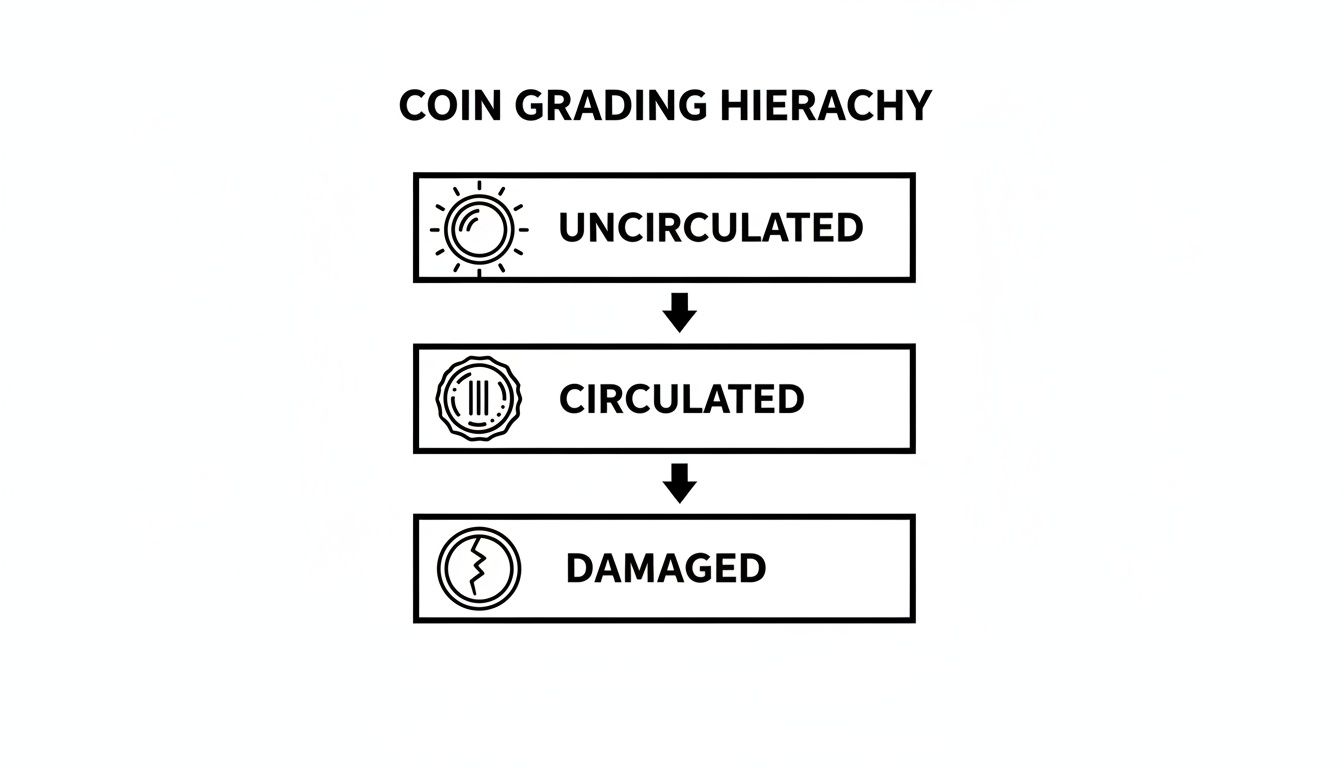
As the hierarchy shows, before any specific grade from 1 to 70 is assigned, the coin is first sorted as either Uncirculated, Circulated, or Damaged. This initial classification sets the stage for its final, more detailed assessment.
Benefits Of Getting Your Coins Graded
For any coin of real value, professional slabbing isn't just a nice-to-have; it's a crucial step for protecting your investment and maximising its worth. The benefits are massive for both collectors and investors. If this is new territory for you, you might want to read our detailed guide on how to get coins graded.
The key advantages include:
- Guaranteed Authenticity: The slab comes with a lifetime guarantee that your coin is the real deal.
- Market-Accepted Grade: Its grade is recognised and trusted by dealers and collectors all over the world.
- Increased Buyer Confidence: Buyers are almost always willing to pay more for a coin with a verified PCGS or NGC grade.
- Enhanced Value and Liquidity: Slabbed coins are much easier to buy, sell, and trade. They often fetch a significant premium over their raw, ungraded counterparts.
- Superior Protection: That tough plastic holder shields the coin from fingerprints, bumps, and environmental damage, preserving its condition for generations to come.
How a Coin's Grade Shapes Its Market Value
This is where the rubber meets the road—where the theory of grading translates directly into pounds and pence. A coin's grade isn't just some academic label; it's the single most powerful factor driving its price. It’s what can turn a simple piece of metal into a serious financial asset. A tiny jump on the grading scale can cause a massive leap in value.
Let's look at a real-world example. A classic George V gold sovereign in a circulated 'Very Fine' (VF-20) condition might fetch a price close to its gold melt value. But take that exact same sovereign, one that’s been perfectly preserved in a stunning 'Mint State 65' (MS-65) condition, and you’re looking at a completely different beast. Its market price could be 10 to 20 times higher, if not more.
Why the huge difference for what is essentially the same coin? The answer comes down to one crucial concept: population scarcity.
The Power of Population Scarcity
Population scarcity isn't about how many coins were originally minted. It's about how many have survived in a particular high grade. A coin might have an original mintage in the millions, making it seem common as muck. But the vast majority of those coins went straight into circulation, getting knocked about in pockets and tills.
As a result, while millions of a particular coin might still exist in lower grades, maybe only a tiny handful—sometimes fewer than ten—survived in a flawless, uncirculated state. These high-grade survivors are what serious collectors and investors are all fighting for, creating fierce demand for an incredibly limited supply.
Grading is the tool that identifies these rare survivors. It pinpoints the few pristine examples from a sea of common, circulated coins. This is why a single point difference, say from an MS-64 to an MS-65, can sometimes double a coin’s value—it means you’ve jumped into an even rarer population tier.
At its heart, coin grading is a measure of rarity in condition. Millions of pre-decimal pennies were struck between 1900 and 1967, and plenty survive in Fine or Very Fine condition. But examples in Uncirculated (UNC) condition? They are dramatically scarcer, often commanding price multiples of 10x to 100x. To really get your head around how a coin's grade impacts its worth, it helps to understand the wider concept of fair market value.
Grade as the Primary Value Multiplier
Although grading is all about quality, it's deeply connected to the mintage and survival rates of UK coinage. With around 27 billion coins currently in circulation in the United Kingdom, only a minuscule fraction will ever qualify for top-tier Mint State grades. This rarity at the top end creates a powerful value multiplier that is key to understanding the market.
Here’s a quick breakdown of how a grade typically drives value:
- Low Grades (Good to Fine): Here, the value is often tied to the coin's historical interest or its base metal content. They’re a great, accessible starting point for new collectors.
- Mid Grades (Very Fine to Extremely Fine): These coins offer a fantastic balance of visible detail and affordability, making them popular with a broad range of collectors. Their value is solid and tends to grow steadily.
- High Grades (About Uncirculated to Mint State): This is where the value starts to climb steeply. The price is now driven by condition rarity and serious collector or investor demand.
- Top Grades (MS-65 and above): In this stratosphere, value is almost entirely dictated by population scarcity. These are investment-grade coins where the smallest grading differences can lead to huge price jumps.
Ultimately, the grade tells you just about everything you need to know about a coin's place in the market. It determines whether you're holding a common piece of history or a rare and highly sought-after treasure. For a deeper dive, check out our complete guide on how to value coins and discover all the other factors that come into play.
Your Top Coin Grading Questions Answered
Even the most seasoned collectors run into questions about the finer points of coin grading. Let's tackle some of the most common queries to give you a clearer picture of the whole process.
Can I Grade My Own Coins at Home?
Yes, and in fact, you absolutely should! Getting a feel for grading your own coins is a vital skill. It helps you make smarter buys and get a real sense of what your collection is worth.
Think of it as your personal assessment. When it comes to selling a valuable coin or getting it insured, the market puts its trust in the official, unbiased grade from a professional service like PCGS or NGC.
Does Cleaning a Coin Improve Its Grade?
Never. This is probably the biggest and most painful mistake a new collector can make. Do not clean your coins.
Any attempt to clean a coin, even a gentle wipe with a soft cloth, leaves behind tiny scratches and strips away the natural surface, known as the lustre. Graders can spot this a mile away, and the coin will get a "cleaned" designation, which absolutely tanks its value.
There's a saying in the hobby: "The first cleaning is free, but it's the most expensive one you'll ever do." It's a stark reminder that once a coin's original surface is gone, it's gone for good.
What's the Difference Between Proof and Mint State Coins?
This often trips people up, but it's all about how the coin was made. A Mint State (MS) coin is your standard "business strike" coin. It was made for everyday circulation but just so happens to have never been used.
A Proof (PF) coin, on the other hand, is a special collector's edition from the very start. They are struck multiple times using highly polished dies on polished coin blanks. This process creates incredibly sharp details and often a beautiful, mirror-like finish in the background. They are two completely different products, graded on their own separate scales.
At Cavalier Coins Ltd, we believe in complete confidence. That's why we offer a wide selection of professionally graded coins. Take a look at our curated collection of certified numismatic treasures and buy with peace of mind.