
A half sovereign is far more than just a small gold coin with a fifty pence face value. At its heart, it contains 3.66 grams of pure gold, but its true worth lies in what it represents: a solid piece of British history, blending centuries of minting tradition with the security of a physical gold asset. Its handy size has made it a perennial favourite, an accessible starting point for new investors and a prized item for seasoned collectors alike.
The Half Sovereign: A Gateway to Gold and History
In the world of gold coins, the half sovereign has carved out a special niche for itself. It's not simply a downsized version of the legendary full sovereign; it's a coin with its own fascinating story and a very practical appeal. For many people, it’s the perfect first step into owning gold, offering a more affordable way to hold a piece of history struck by The Royal Mint.
Think of it as the versatile sibling in the sovereign family. While the full sovereign might get most of the limelight, the half sovereign has always been the reliable workhorse. It began life as a functional piece of currency, passed from hand to hand across the British Empire to settle daily accounts. Over the decades, it made the journey from a coin in a pocket to a treasured asset in a collection or investment portfolio. It’s this dual identity that makes it so compelling.
Balancing Investment and Collectability
To really get to grips with the half sovereign, you need to look at it through two different lenses: that of an investor and that of a collector. It's these two viewpoints that truly define its place in the modern market.
-
For the Investor: At its core, the half sovereign is a highly liquid and instantly recognisable gold bullion coin. Its 22-carat gold content makes it a dependable store of value, a classic hedge against inflation and the ups and downs of the economy. And for UK investors, there's a huge bonus: as legal tender, it’s completely exempt from Capital Gains Tax (CGT).
-
For the Collector: Every half sovereign is like a miniature time capsule. The monarch's portrait on the obverse (the 'heads' side) and iconic designs like St George slaying the dragon on the reverse tell you everything about the era it was made in. Factors like rarity, its condition, and specific mint marks can push its value far beyond the simple price of its gold content.
In essence, the half sovereign neatly bridges the gap between tangible wealth and historical legacy. It gives you the chance to own not just a piece of gold, but a piece of a story that's been unfolding for centuries.
This unique blend is precisely why the coin appeals to so many different people. A first-time gold buyer can appreciate its affordability and the financial security it offers, while a dedicated numismatist could happily spend a lifetime hunting down rare dates and interesting variations. As we delve into its origins, designs, and value, you'll see just how this small gold coin has kept its powerful allure, captivating new generations of enthusiasts.
The Enduring History of the Half Sovereign
To really get to grips with the half sovereign, you have to look back across its incredible five-hundred-year story. It’s a journey that starts not with the famous St George and the Dragon design we all know, but in the dramatic Tudor court of King Henry VIII. The very first half sovereign was struck in 1544—a much larger, hammered gold coin that looked nothing like its modern successor but gave us a name that would stick through the centuries.
That early version, however, was a product of its time and eventually fell out of use. The half sovereign coin we recognise today was truly born out of the Great Recoinage of 1817. This was a massive undertaking to stabilise Britain’s currency after the financial turmoil of the Napoleonic Wars.
This period was a real turning point for British money, setting up a system that would power a global empire. If you're curious about this era, you can dive deeper in our post covering a brief history of British coins. The 1817 Recoinage brought back both the sovereign and the half sovereign, cementing their place as the nation's gold standard.
The Victorian Workhorse
The Victorian era was the absolute golden age for the half sovereign in circulation. This wasn't a coin just for the wealthy; it was the backbone of everyday life. Its value, ten shillings, made it incredibly useful for everything from paying weekly wages to settling large bills. It was the go-to coin for doing business across the Empire, and millions were churned out by The Royal Mint and its new branch mints.
The sheer number of coins produced back then was staggering. Take Queen Victoria’s reign, for example. The 'Jubilee Head' half sovereigns, minted between 1887 and 1893, saw a total mintage of over 22 million coins. The 'Veiled Head' version that came after was even more common, with the London mint alone striking around 30 million before her death in 1901.
The half sovereign was more than just currency; it was a symbol of Britain's economic power and reliability. Its consistent weight and purity meant it was trusted everywhere, from the busy streets of London to the far-flung colonies of Australia and South Africa.
This infographic really shows the coin's remarkable journey over time.
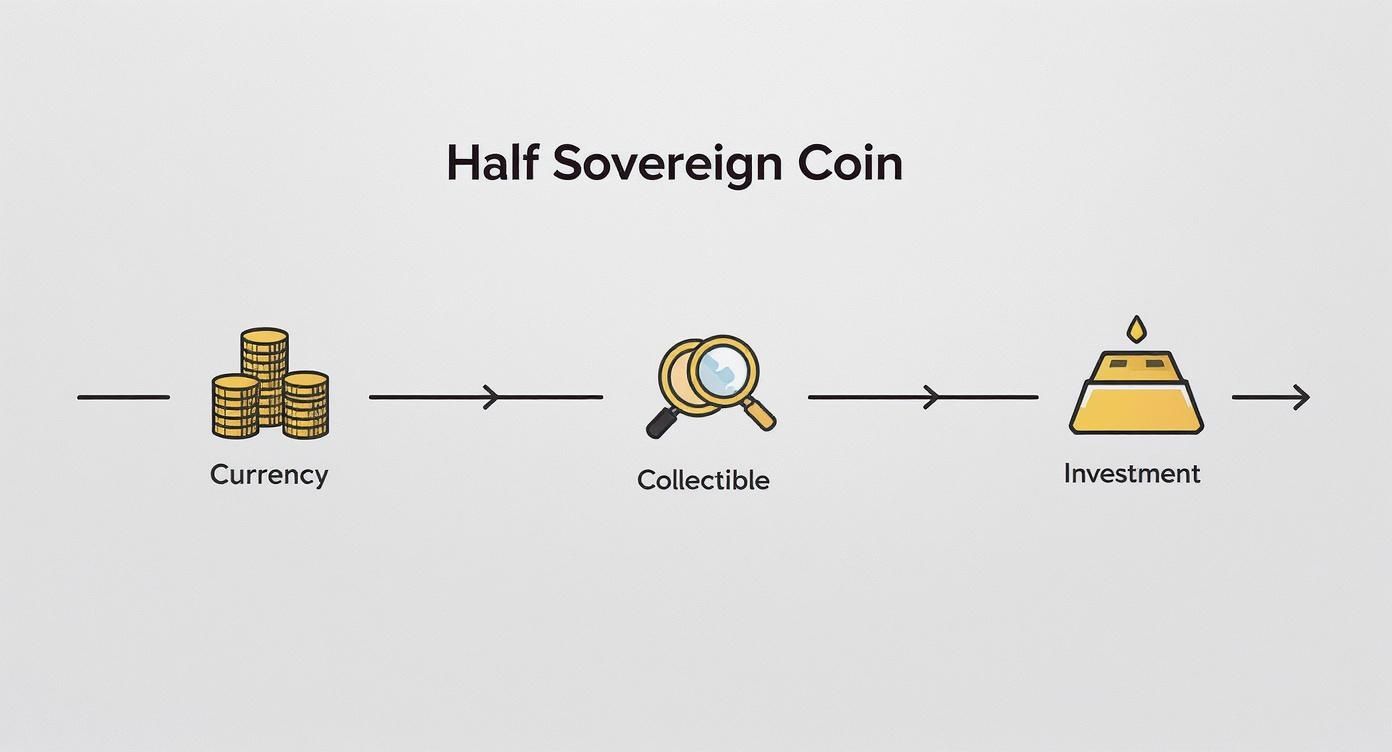
As you can see, the coin’s purpose has shifted dramatically, from a functional piece of everyday money to a sought-after item for collectors and investors.
From Circulation to Collection
The coin's time as pocket money came to a sudden halt with the start of World War I in 1914. The immense cost of the war forced the government to pull gold out of circulation to fund the military. People were encouraged, as a patriotic duty, to swap their gold sovereigns and half sovereigns for banknotes.
Production of half sovereigns for circulation in London stopped in 1915. While a few colonial mints kept making them for a couple more years—the last circulating issue came from Pretoria in 1926—the era of the half sovereign as an everyday coin was officially over. For decades, it simply became a relic of a past economic age.
A Modern Revival
But that wasn't the end of the story. In the second half of the 20th century, the half sovereign was brought back to life. The Royal Mint revived the coin, not for spending in shops, but for a new audience of collectors and investors. Starting in the 1980s, it was released in proof quality for collectors, and later as a bullion coin for those wanting to own physical gold.
Today’s half sovereign carries on this legacy. It keeps the classic specifications and iconic designs of its ancestors but serves a completely different role. It’s a tangible piece of British history, an accessible gold investment, and a beautifully made piece of numismatic art, ensuring it remains just as appealing in the 21st century.
Decoding Half Sovereign Designs and Specifications
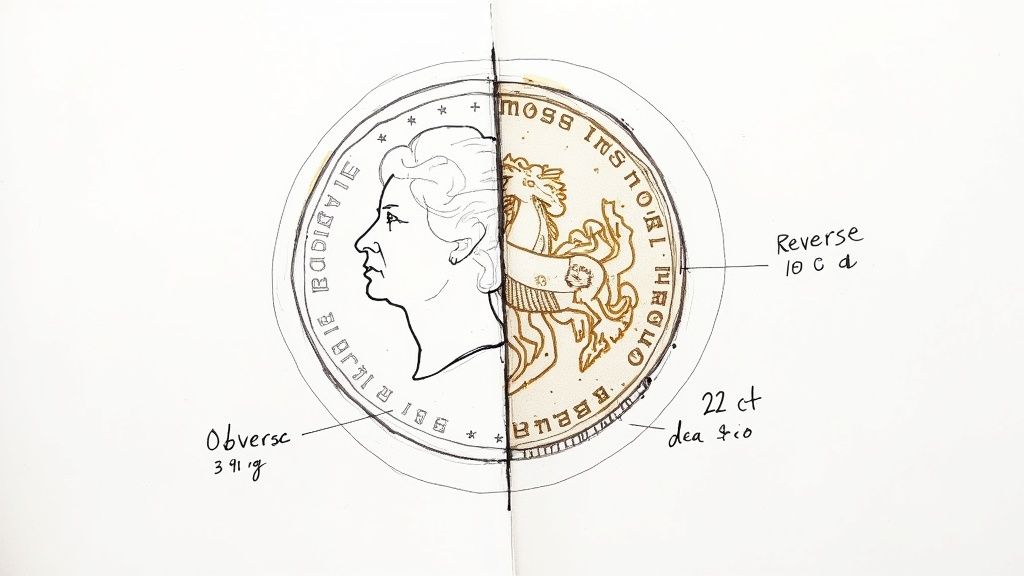
At a glance, a half sovereign coin might seem like just another small, unassuming piece of gold. But in reality, its identity is locked into a precise and unwavering set of standards. This consistent blueprint, which The Royal Mint has upheld for over two hundred years, is what gives the coin its trusted status among collectors and investors all over the world.
To really appreciate the craftsmanship, you first need to get to grips with these core specifications.
Every modern half sovereign is struck to exacting measurements. It must weigh precisely 3.99 grams and have a diameter of 19.30mm. These figures are non-negotiable. Any deviation is an immediate red flag, making them the quickest way for anyone to start verifying a coin's authenticity.
The gold itself isn’t pure, and for good reason. It’s made from a specific alloy known as 'crown gold', which is 22-carat gold. This means it’s 91.67% pure gold (a fineness of .9167) mixed with a small amount of copper. This isn’t a cost-cutting measure; the alloy actually makes the coin far more durable and resistant to scratches than pure 24-carat gold would ever be.
The Artistry on Obverse and Reverse
Beyond its technical DNA, the half sovereign is a canvas for some of Britain’s most iconic numismatic art. The two sides of the coin, the obverse and reverse, tell a story of royal lineage and national identity.
-
The Obverse (Heads): This side is always reserved for the portrait of the reigning monarch at the time the coin was minted. From Queen Victoria to King Charles III, each effigy is a snapshot of a specific era, capturing the changing styles of royal portraiture over the decades.
-
The Reverse (Tails): While you’ll find different designs on special issues, the classic reverse is dominated by Benedetto Pistrucci’s legendary masterpiece: St George and the Dragon. First created way back in 1817, this dynamic scene of the patron saint vanquishing the beast has become completely synonymous with the sovereign family of coins.
This enduring combination of a monarch’s head and Pistrucci’s epic design has made the half sovereign coin instantly recognisable across the globe.
The consistent specifications and iconic designs are more than just tradition; they are a guarantee of quality and authenticity. When you hold a half sovereign, you are holding a product of centuries of minting excellence, crafted to a standard that has barely changed since the Napoleonic Wars.
A Quick Reference Guide
To help these vital details stick in your mind, I've put together a clear breakdown of the key specifications for a modern bullion half sovereign. These are the stats that every owner and potential buyer should know by heart.
Half Sovereign Coin Key Specifications
| Specification | Measurement |
|---|---|
| Total Weight | 3.99 grams |
| Diameter | 19.30 mm |
| Gold Purity | 22 Carat (.9167 Fineness) |
| Pure Gold Content | 3.66 grams (or 0.1177 troy ounces) |
| Nominal Face Value | 50 Pence |
| Standard Obverse | Portrait of the reigning monarch |
| Standard Reverse | St George and the Dragon by Benedetto Pistrucci |
Think of this table as your simple checklist. By getting familiar with these details, you can confidently identify a genuine half sovereign, appreciate the incredible artistry, and understand the technical foundation that underpins its lasting value.
Determining the True Value of Your Half Sovereign
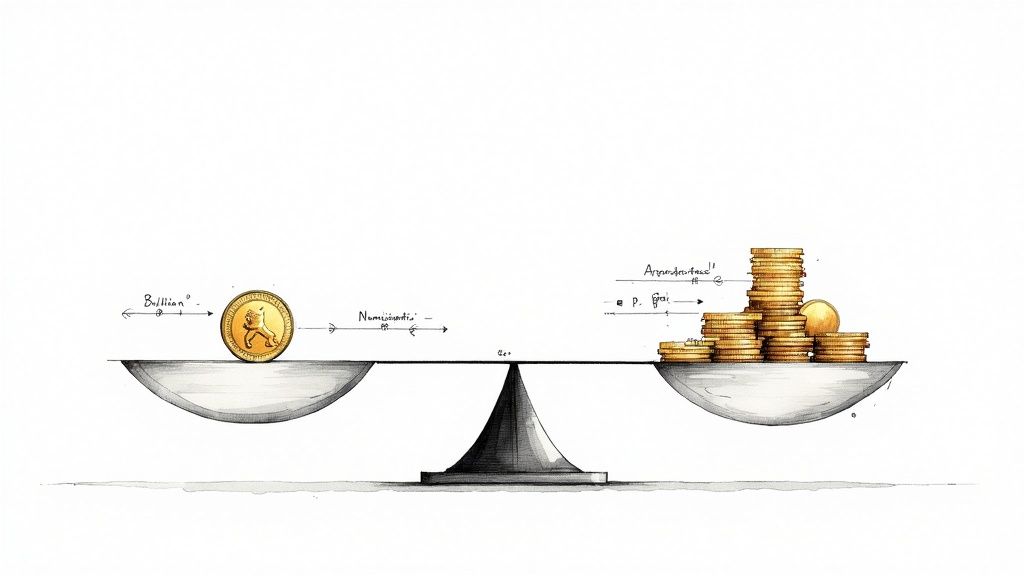
When you hold a half sovereign, you're holding more than just a piece of gold. While its precious metal content gives it a solid financial floor, the real story of its worth is often far more complex and exciting. To see a coin through an expert’s eyes, you first need to understand the two sides to its value: its bullion value and its numismatic value.
Think of bullion value as the coin's fundamental, baseline worth. It’s simply the market price of the 3.66 grams of pure gold it contains. This value moves up and down daily with the global gold market, making the coin a reliable investment asset. To get a handle on this, it's worth checking out an expert guide on how to calculate gold value, which breaks down how purity and weight translate into pounds and pence.
But for collectors, the bullion price is just where the story begins.
Unlocking Numismatic Value
The real magic happens when we talk about a coin's numismatic value. This is the extra premium a collector or historian is willing to pay, over and above the raw gold price. It’s a compelling mix of rarity, historical significance, and physical condition that can turn a common coin into a serious prize.
What drives this collectible premium? It usually comes down to a few key factors:
- Date and Mintage: In some years, millions of half sovereigns were struck, making them fairly common today. But in other years, production was tiny. A low mintage figure immediately makes a coin scarcer and, therefore, more desirable to collectors trying to fill a gap in their set.
- Mint Marks: At the height of the British Empire, half sovereigns weren’t just struck in London. Branch mints in Sydney (S), Melbourne (M), Perth (P), and even Pretoria (SA) produced them. A coin with one of these mint marks can carry a significant premium, especially for collectors aiming to build a complete set from every location.
- Historical Context: Was the coin struck during a major event, like a coronation or jubilee? Was it one of the last ever issued from a colonial mint before it closed its doors? These stories add a layer of fascination that cold, hard numbers just can't capture.
A half sovereign from a common year might only be worth a small percentage over its gold value. In stark contrast, a rare date from a colonial mint in perfect condition could easily fetch thousands of pounds at auction.
The Critical Role of Coin Grading
Of all the things that influence a coin’s numismatic value, one stands head and shoulders above the rest: its physical condition. The process of evaluating this is called coin grading, and it is without a doubt the single biggest factor in determining a collectible coin’s price. Even a tiny, barely-there scratch or a bit of wear can dramatically reduce what it’s worth.
Coin grading works on a detailed scale that assesses how well-preserved a coin is. Here’s a quick look at the levels you'll most often come across:
- Poor/Fair: The coin is so heavily worn that most of the details are gone. You can tell what it is, but it holds little to no numismatic value beyond its gold content.
- Fine (F): You can see considerable wear, but the main design elements and letters are still clear. This is a very common grade for Victorian-era coins that were actually used as money.
- Very Fine (VF): The coin has moderate wear on the highest points of the design, like the monarch’s hair, but the finer details are starting to show through.
- Extremely Fine (EF): There's only light wear visible on the very highest points. The coin still has much of its original mint lustre and the details are sharp.
- Uncirculated (UNC): This is a coin in perfect, as-minted condition. It has absolutely no signs of wear from being in circulation. It might have tiny marks from the minting process itself, but it has never been used as money.
Understanding these grades is absolutely crucial. An 1893 "Veiled Head" half sovereign in Fine condition is a common find, but the very same coin in Uncirculated condition is incredibly rare and will command a huge premium. To dig deeper, our expert guide to British coin grading offers a much more detailed look at how condition really drives value. This is the knowledge that helps you spot the true treasures.
Smart Strategies for Collecting and Investing
So, you’ve decided you want a half sovereign coin. That’s the easy part. The real question is why? Are you an investor looking for a solid way to protect your wealth, or are you a collector who gets a thrill from hunting down historical treasures? Figuring that out is the first and most important step, as it will guide every purchase you make and turn a random assortment of coins into a focused, valuable portfolio.
For the pure investor, the half sovereign is a fantastic little package. Its smaller size means you can build up your gold holdings gradually, without the hefty upfront cost of bigger coins or bars. This fractional nature also makes it incredibly liquid. It's far easier to sell a few half sovereigns to free up a specific amount of cash than it is to offload a large, expensive gold bar.
Better still, for UK residents, the half sovereign comes with a huge financial perk. Because it’s classified as legal tender sterling currency, any profit you make from selling these coins is completely exempt from Capital Gains Tax (CGT). This tax-free status is a massive incentive that can seriously boost your net returns over time, making the half sovereign a remarkably efficient investment. Many investors also explore our wider guide on investing in UK gold coins to see how they fit into a broader strategy.
Building a Meaningful Collection
If your heart lies more with history and rarity, then collecting half sovereigns opens up a world of possibilities. You could just buy what you like, but a more focused strategy often leads to a far more satisfying and valuable collection. Instead of just picking up coins at random, think about giving your collection a theme.
A focused approach gives your hobby structure and a sense of purpose. Here are a few popular ways to go about it:
- Collecting by Monarch: You could try to get one half sovereign from the reign of every monarch, from George IV all the way up to Charles III. This creates a fascinating visual timeline of British royalty.
- Focusing on a Single Reign: For a deeper dive, you could try to collect every single date issued during a specific monarch’s rule, like the long and varied reign of Queen Victoria.
- The Mint Mark Challenge: For a real challenge, you could hunt for coins from the various branch mints. Finding examples from London, Sydney, Melbourne, Perth, and Pretoria builds a collection that tells the story of the British Empire's global power.
Choosing a clear collecting goal not only brings discipline to your buying habits but also deepens your appreciation for the story each coin tells. It transforms a simple hobby into a curated historical journey, with each new coin filling a specific piece of the puzzle.
From Pocket Change to Prized Collectable
One of the most important things for any modern buyer to understand is just how much the half sovereign’s role has changed over the years. Back in the Victorian era, this coin was a workhorse. It was used in everyday commerce, and mintages often ran into the millions each year to keep up with demand. These coins were made to be spent, which is why finding one in top condition today is so rare.
Fast forward to today, and it’s a completely different story. The modern half sovereign coin isn’t for popping down to the shops; it's struck specifically for the bullion and collector markets. This has had a huge effect on production numbers. For instance, proof half sovereigns—which have been struck annually since the 1980s—typically have mintages in the low thousands. Some years have seen just 1,000–2,000 coins produced.
This deliberate scarcity means that modern proof and special edition half sovereigns are essentially born rare. While a Victorian coin's value often comes down to how well it has survived the years, a modern limited-edition coin gets its numismatic premium from its intentionally low mintage right from the start. Understanding this difference is key to making sure your strategy lines up with your goals, whether you’re preserving wealth with common-date bullion coins or hunting for the rarities of a bygone age.
Common Questions About the Half Sovereign
Dipping your toes into the world of gold coins always brings up a few practical questions. No matter how much you know about its history and value, specific queries about the half sovereign coin often pop up, especially for first-time buyers. I've put this section together to give you clear, straightforward answers to the most common ones.
Think of this as your quick-reference guide. We’ll cover everything from its legal tender status to the best ways to check if one is genuine and how to keep it safe.
Is the Half Sovereign Coin Legal Tender in the UK?
Yes, it absolutely is. Every half sovereign ever struck by The Royal Mint is official UK legal tender. It has a nominal face value of fifty pence (50p), but of course, that’s purely symbolic. The coin's real value is tied to its gold content, which is worth far more than 50p.
So why does this legal tender status matter? It all comes down to one massive advantage for UK residents.
Any profit you make when selling a half sovereign is completely exempt from Capital Gains Tax (CGT). This makes it a highly efficient way to invest, as your returns aren't chipped away by taxes—a benefit you don't get with gold bars or many other gold coins from around the world.
This CGT-free status is precisely why both the half sovereign and its bigger brother, the full sovereign, are cornerstones of so many UK investment portfolios.
How Can You Tell if a Half Sovereign Is Real?
Knowing how to authenticate a half sovereign coin is a crucial skill for any buyer. The good news is, you don’t need to be a seasoned expert to do a few basic checks that are surprisingly effective. The coin’s precise specifications are your best defence against fakes.
Here are three simple steps to start with:
- Check the Weight and Dimensions: A genuine half sovereign weighs exactly 3.99 grams and has a diameter of 19.30mm. You’ll need a precise digital scale (one that goes to two decimal places) and a pair of callipers to check these. Fakes rarely get both measurements spot-on.
- Examine the Design Details: Get a good look at the coin's design, paying close attention to the monarch's portrait and St George on the back. Real coins have sharp, intricate details. Fakes often look a bit soft, almost "mushy," and lack that crisp definition.
- Do the Magnet Test: Gold isn't magnetic. A real half sovereign won't react to a strong magnet at all. If the coin has even the slightest pull, it’s a fake, probably made from a gold-plated base metal.
If you’re looking at a particularly rare coin or one with a high numismatic value, it’s always a smart move to get a professional opinion from a reputable coin dealer just to be certain.
What Is the Best Way to Store Half Sovereigns?
Proper storage is key to protecting the condition and value of your coins. The right method really depends on the type of coins you have and how big your collection is. Scratches, fingerprints, and even air can all knock down a coin's grade and, with it, its value.
For individual coins, especially those in Uncirculated or Proof condition, archival-quality plastic capsules are your best bet. These hard, clear cases stop anything from touching the coin's surface. For larger numbers, you can then organise these capsules in special coin storage boxes.
When it comes to security, you’ve got a few solid options. A high-quality, bolted-down home safe is a popular choice for many collectors. For more peace of mind, especially with a high-value collection, you could consider a bank's safe deposit box or a specialised, insured vaulting service.
Finally, a quick note on cleaning. Most numismatists will tell you never to clean valuable coins, as it can easily damage the surface and slash their value. However, if a half sovereign has been made into a piece of jewellery, or you just have general questions, resources like this guide on how to clean gold jewellery can offer some useful tips.
At Cavalier Coins Ltd, we are passionate about connecting collectors and investors with authentic, high-quality coins from Britain and around the world. Explore our curated selection of half sovereigns and other historic treasures today. Visit us at https://www.cavaliercoins.com to find the next great addition to your collection.