
When someone asks, "how much is a halfpenny worth?", the honest answer is: it depends entirely on what you mean. As a piece of currency, it's now defunct, so its spending power is zero. But as a collector's item? Its value can swing from less than a pound to several thousand pounds. It all comes down to its rarity and condition.
What Is a Halfpenny Really Worth Today?
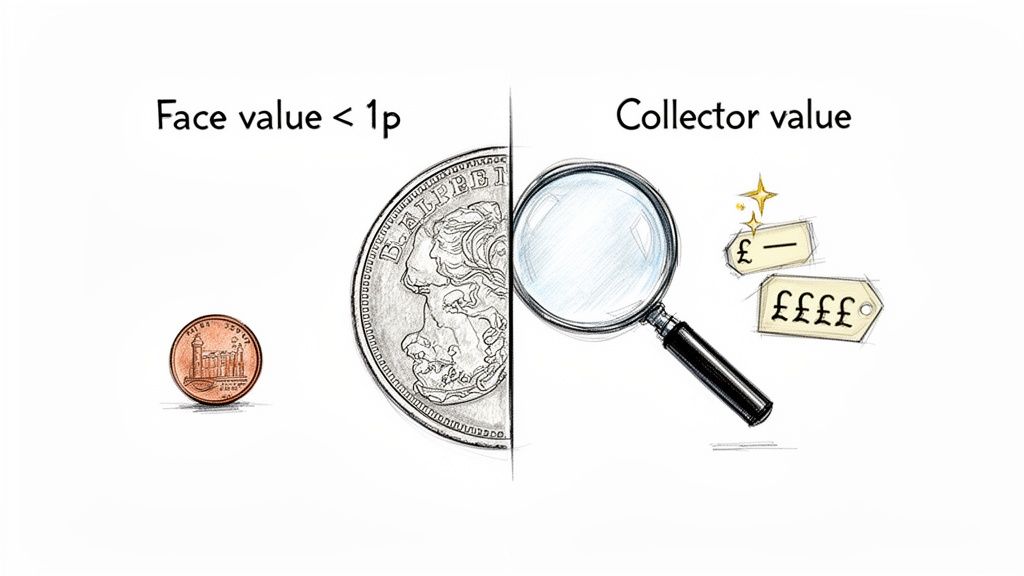
It's a common mistake to think an old coin’s value is somehow tied to what it used to buy. In reality, a halfpenny's modern worth has nothing to do with its old face value and everything to do with how much a collector wants it. This is the heart of numismatics—the fascinating world of collecting coins and currency.
Think of it this way: a first-edition book might have a cover price of a few shillings, but its real value is set by how many were printed and how many have survived in good shape. A halfpenny is exactly the same. Its story, its scarcity, and how well it has been preserved are what give it a price tag today. This same principle applies to other old coins, too. You can see a similar dynamic at play by checking out our guide on the value of old UK pennies.
Face Value vs Collector Value
To really get to grips with coin valuation, you need to understand the huge difference between these two concepts:
- Face Value: This is simply the monetary worth stamped on the coin itself. For a pre-decimal halfpenny (written as ½d), that was 1/480th of a pound. Today, that value is purely historical.
- Collector Value: This is the price someone is actually willing to pay for the coin as a collectible. This value is driven by factors we'll dig into later, like its date, mintmark, and condition.
This distinction is what turns a seemingly worthless bit of old metal into a potential treasure. A common, heavily circulated halfpenny might only be worth a pound or two. But a rare date in pristine, uncirculated condition? That could be worth hundreds, or even thousands.
The leap from face value to collector value is where the excitement lies. A coin once used for everyday purchases can become a significant historical artefact with a price tag to match, all based on its unique story and survival.
Here's a quick table to show you just how dramatic the difference can be.
Halfpenny Value at a Glance
This table gives a snapshot of how a halfpenny's nominal value compares to what a collector might pay.
| Coin Type | Original Face Value (Pre-Decimal) | Typical Collector Value (Common Date, Circulated) | Potential Collector Value (Rare Date, High Grade) |
|---|---|---|---|
| UK Halfpenny | ½d (Half a Penny) | £1 - £5 | £50 - £2,000+ |
As you can see, the story of a coin is far more important than the number stamped on it.
The Journey from Pocket Change to Prized Collectible
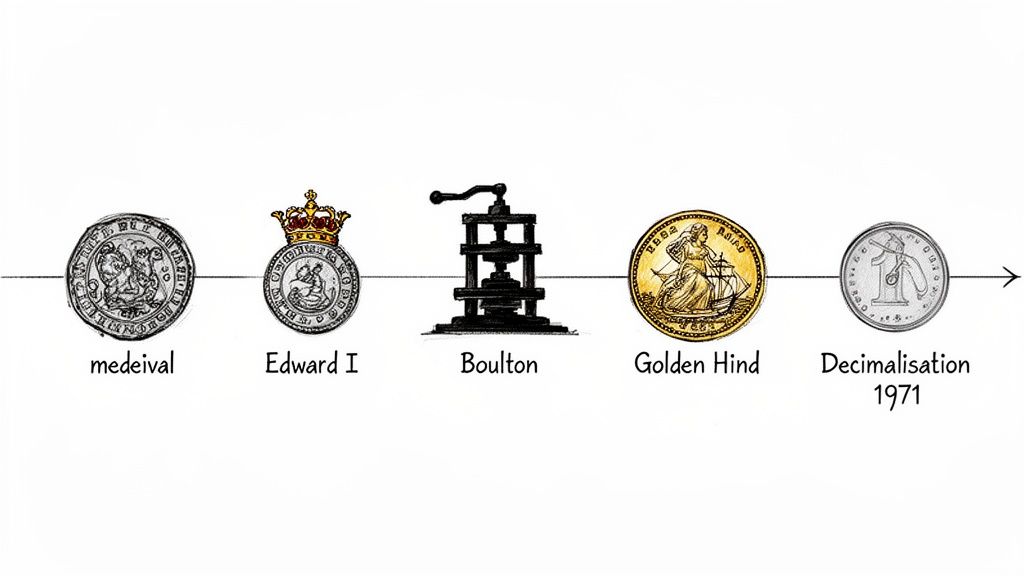
To really get a feel for a halfpenny's worth, you have to appreciate its incredible history. This isn't just a lump of old metal; it's a tangible link to centuries of British life, trade, and change. The story of the coin is the very foundation of its value to a collector today.
Long before an official halfpenny existed, the solution for small change was brilliantly simple, if a bit rough. Shoppers and merchants would literally take a silver penny and snip it into halves or quarters. It worked, but this crude method often led to wonky pieces and arguments over a fair cut.
From Hacked Silver to Royal Minting
Things got a lot more organised with the first official silver halfpennies. The ha'penny, as it became affectionately known, was worth just 1/480th of a pound sterling in the old pre-decimal system. Officially introduced under Edward I between 1272 and 1307, it finally put an end to the messy business of chopping up pennies in the marketplace. You can dig deeper into the history of the halfpenny's worth on bullionbypost.co.uk.
This was a huge leap forward in creating a reliable currency for the everyday person. For hundreds of years, the silver halfpenny was a fixture in daily transactions. But as the value of silver crept up, the coin itself simply became too expensive to make.
A major pivot happened in 1672 when the Royal Mint started striking halfpennies in copper. This change made the coin affordable for common use once again. It was then that the iconic image of Britannia, a powerful symbol of Britain's naval strength, first graced its reverse, starting a design tradition that would last for centuries.
The story of the halfpenny is a perfect miniature of Britain's own economic history—evolving from hand-cut silver to steam-powered copper and bronze, mirroring the nation's journey from a medieval kingdom to an industrial empire.
Another game-changing moment came in the late 18th century. Matthew Boulton's revolutionary steam-powered minting press allowed for the mass production of uniform, high-quality coins, setting a new global standard for currency.
The Final Chapter and Lasting Legacy
The halfpenny kept evolving, with its metal changing from copper to bronze in 1860. It served through the reigns of monarchs from Queen Victoria to Queen Elizabeth II, its design reflecting the art and mood of each era. One notable update came in 1937, when Britannia was temporarily replaced by Sir Francis Drake’s famous ship, the Golden Hind.
This long and storied journey finally came to an end with decimalisation. The halfpenny was officially withdrawn from circulation in 1969, clearing the way for the new decimal system. Its retirement was the end of an era, instantly transforming this humble piece of pocket change into a historical artefact, now sought after by collectors who value its rich and fascinating past.
Four Key Factors That Determine a Halfpenny's Worth
Ever wondered what makes one old halfpenny worth just a few pounds while another can fetch thousands? Think of it like appraising a vintage car. It’s not just about the model; it’s the specific history, unique features, and how well it has been preserved that create its value.
There are four key factors that work together to determine how much a half a penny is worth to a collector.
By looking at your coins through this framework, you’ll start to see them not just as old currency, but as historical artefacts with a hidden story and potential value. Getting a grip on these concepts is the first step towards becoming a knowledgeable collector. For a deeper look, you can explore our guide on how to value coins, which breaks down the entire appraisal process.
Date and Mintmark
The year a coin was struck is the most basic piece of information, but it’s absolutely crucial. Some years saw millions of halfpennies minted, making them very common. In other years, due to economic conditions or historical events, very few were produced. This scarcity makes them instantly rarer and more desirable.
Alongside the date, the mintmark is just as important. This is a small letter indicating which branch of the Royal Mint produced the coin. For much of British history, coins were only made in London, but at various times other mints operated. A halfpenny from a provincial mint with a low output can be significantly more valuable than one from London in the same year.
Condition and Grade
Imagine finding two identical vintage books from 1920. One is battered with torn pages, while the other looks like it has never been opened. The pristine one will always be worth more. The same principle applies directly to coins. The condition, or grade, is perhaps the single biggest influence on value.
Numismatists use a detailed grading scale to describe a coin’s state of preservation. Here are some of the basic levels:
- Poor/Fair: The coin is heavily worn, with most details completely smooth. It's identifiable but has little collector value.
- Fine (F): Significant details are visible, but the coin shows considerable wear from being in circulation.
- Very Fine (VF): More detail is present, with clear lettering and designs, but the high points are worn.
- Uncirculated (UNC): The coin has no signs of wear at all. It looks as it did the day it left the mint, with its original lustre.
A coin's grade is its biography. An Uncirculated coin tells a story of careful preservation, while a heavily worn one speaks of a long life passing through thousands of hands. That history is fascinating, but in the market, preservation almost always wins.
The difference in value between grades can be staggering. A common-date halfpenny in Fine condition might be worth £2, but the exact same coin in Uncirculated condition could fetch £50 or more. For a rare date, that jump could be from £200 to £2,000.
Rarity and Mintage
This factor is pure supply and demand. Mintage refers to the total number of coins of a specific date and mintmark that were originally produced. When the mintage number is very low, the coin is inherently scarce right from the start.
But rarity isn't just about low mintage numbers. It’s also about the survival rate. Many coins, particularly from older periods, were melted down, lost, or damaged over the centuries. A coin might have had a high mintage, but if very few have survived in good condition, it can become a key-date rarity that collectors eagerly compete for.
Errors and Varieties
This is where coin collecting gets really exciting. Occasionally, mistakes happen during the minting process, creating unique errors and varieties. These are the delightful oddities that can turn a common coin into a major prize.
Examples include:
- Double Die: The coin is struck twice, creating doubled lettering or images.
- Off-Centre Strike: The coin wasn't aligned properly, resulting in a blank crescent on one side.
- Mules: A coin struck with the wrong die pairing—for instance, an obverse from one denomination and a reverse from another.
These minting errors are almost always rare, as they were typically caught and destroyed. Finding one in circulation is like discovering a hidden treasure, and their value is often significantly higher than a standard coin of the same date.
Valuable Halfpennies: A Guide to Key Dates
Now that you know what makes a halfpenny valuable, it’s time for the fun part: the treasure hunt. Not every old halfpenny you find will be a hidden gem, but certain dates and mintmarks are famous for producing coins that collectors clamour for. Knowing what to look for can turn a dusty old coin jar into an exciting expedition.
Think of this as your field guide to the most important dates in the British halfpenny story. We’ll shine a light on the specific coins that command high prices, whether it's because of tiny mintage numbers, a unique historical backstory, or simply the fact that so few have survived in good nick.
Victorian and Edwardian Era Rarities
Queen Victoria’s long reign saw an enormous number of coins produced, but a few dates still manage to stand out from the crowd. The 1875H halfpenny, struck at the Heaton Mint in Birmingham, is a classic example. While millions of halfpennies were minted in London that year, the Heaton Mint's output was far smaller, making it a key date for anyone collecting the bronze series.
Likewise, the Edward VII era (1901-1910) has its own challenges for collectors. Most dates from his reign are quite common, but finding any Edwardian halfpenny in a high grade—anything close to Uncirculated condition—is a real find and will carry a serious premium over its more worn counterparts.
The Famous George V Key Dates
For many, the reign of George V (1910-1936) is where halfpenny collecting gets really exciting. This period produced some of the most famous rarities in modern British coin history, mostly down to exceptionally low mintage figures that made them scarce from the moment they left the mint.
The chart below breaks down the core ingredients that transform an ordinary coin into a collector’s prize.
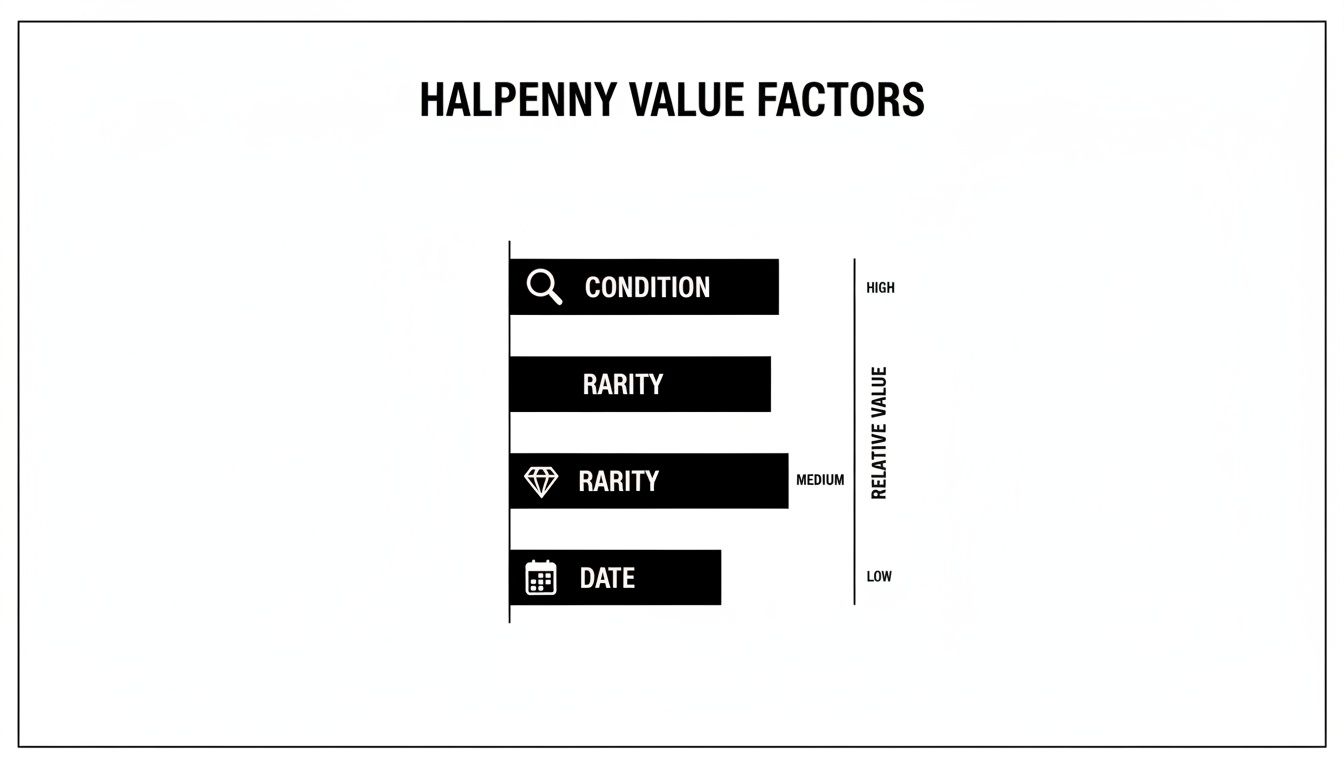
As you can see, it's that magic combination of a key date, fantastic condition, and genuine rarity that sends a coin's value soaring.
The holy grail from this era is undoubtedly the legendary 1923 halfpenny. In today's market, a halfpenny's worth can launch into the stratosphere, far beyond its old ½d face value. The 1923 is a prime example: with only around 1.6 million minted, its scarcity means that even a 'Fine' condition example can fetch up to £1,200 or more. You can get a feel for how these values shift by seeing how pre-decimal coin prices are tracked on Statista.com.
The 1923 halfpenny is the perfect example of how a coin's story creates its value. It was never really intended for mass circulation, making it a ghost coin of its time. Finding one is the dream of many British collectors.
Some other George V dates to keep an eye out for include:
- 1918H and 1919H: Struck at the Heaton Mint, their mintage figures are much lower than the London-minted coins from the same years.
- 1924: Another low-mintage year. It’s often overshadowed by the fame of the 1923, but it’s still a very collectible and valuable coin.
Of course, these are just a few of the dates that get collectors excited. The table below highlights some of the most sought-after halfpennies from different periods, giving you an idea of what to look for and why they're so special.
Key Date Halfpennies and Their Estimated Values
| Era / Monarch | Key Date | Reason for Rarity | Estimated Value Range (Fine to Uncirculated) |
|---|---|---|---|
| Victorian | 1860 (Toothed Border) | A rare transitional design issued for a very short period. | £150 - £1,500+ |
| Victorian | 1875H | Low mintage from the Heaton Mint in Birmingham. | £50 - £600+ |
| George V | 1919H | Another low-mintage issue from the Heaton Mint. | £20 - £400+ |
| George V | 1923 | Extremely low mintage, making it a legendary rarity. | £400 - £1,500+ |
| George VI | 1951 | Very low production numbers post-WWII. | £200 - £1,000+ |
| Elizabeth II | 1953 (Obverse 1) | Rare first obverse type, quickly replaced. | £50 - £500+ |
This is by no means an exhaustive list, but it shows how factors like mint location and design changes can create instant rarities that are worth hunting for.
Post-War and Pre-Decimal Scarcities
You might be surprised to learn that the years after the Second World War also produced some scarce halfpennies. Production was paused for a few years, and when it resumed in the early 1950s, the Royal Mint struck very few, creating instant rarities.
The 1950 and 1951 halfpennies were made in tiny numbers and are highly prized today. High-grade examples of these often realise £500-£2,000 in Very Fine to Extremely Fine condition. The 1952 halfpenny is another key date to watch for, as it was the final issue of George VI's reign and had a relatively small mintage.
Even the modern decimal halfpenny, introduced in 1971, can have some hidden value. While the coins that jingled in our pockets are worth very little, the proof versions issued in annual collector sets can be desirable, especially from the early 1970s and 1980s. The 1984 halfpenny is the key one to find; it was only issued in these sets and never entered circulation, making it the ultimate prize for decimal collectors.
How to Handle and Grade Your Halfpennies
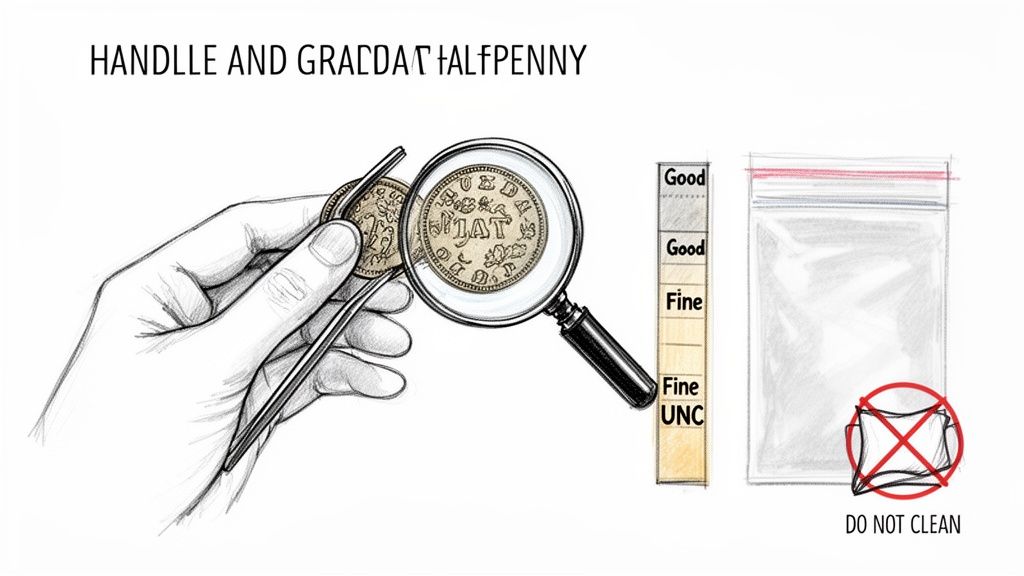
Getting hands-on with your halfpenny collection is one of the real joys of the hobby. But how you handle your coins can make or break their value. A single fingerprint, seemingly harmless, can permanently etch itself onto a coin's surface over time.
The golden rule? Always hold a coin by its edges. Never touch the flat faces. The natural oils and acids from your skin can cause irreversible damage, especially to the delicate lustre of older bronze and copper pieces. For best practice, use soft cotton gloves or a pair of rubber-tipped tweezers when you're examining your collection.
A good magnifying glass is your best friend here. It's the only way to spot the tiny mintmarks and subtle details on the date that often make the difference between a common coin and a rare find.
A Simplified Guide to Self-Grading
Grading is simply the art of assessing a coin's condition. While professional grading is a meticulous science, you can easily get a rough idea yourself. This helps you sort your collection and pinpoint which coins might be worth a closer look.
The easiest way to start is by comparing your halfpenny to pictures of graded examples you can find online. Think of it in these basic categories:
- Good (G): The coin has seen a lot of life and is heavily worn. You can make out the date and the main design, but most of the finer details have vanished.
- Fine (F): There's obvious wear across the whole coin, but the key features—like the monarch's hair or the details on Britannia's shield—are still distinct.
- Very Fine (VF): Wear is light to moderate, mostly noticeable on the highest points of the design. A lot of the original sharpness and detail is still there.
- Uncirculated (UNC): This coin looks like it just left the mint yesterday. It shows no signs of wear, has its original mint lustre, and is crisp and sharp.
Self-grading is a fantastic starting point, but for any coin you suspect might be valuable, getting it professionally authenticated is the way to go. If you're curious about that process, our guide explains how to get coins graded and what it involves.
The Number One Rule: Never Clean Your Coins
If you only take one piece of advice away from this, make it this one: never, ever clean your old coins. It's the single biggest mistake new collectors make, and it can instantly obliterate a coin's value.
Collectors treasure a coin's original surface and the natural patina it has built up over decades, or even centuries. Cleaning doesn't just remove dirt; it strips away this history, leaving behind microscopic scratches and an unnatural, dull look that any expert can spot from a mile away.
A rare coin that could have been worth £1,000 can be reduced to just £50 with a clumsy cleaning. Instead of reaching for the polish, focus on proper storage. Keep your halfpennies safe in acid-free coin flips, albums, or inert plastic holders. This is how you protect them from the environment and preserve their history—and their value.
Where to Sell Your Halfpennies for the Best Price
So, you've sifted through your collection and think you might have a valuable halfpenny on your hands. What now? The next step is figuring out the best way to sell it.
The right approach really depends on what you've got, how quickly you want to sell, and how much legwork you're willing to do. A common Victorian halfpenny that’s worth a few pounds doesn’t need the same grand sales strategy as a rare George V key date that could fetch hundreds.
Comparing Your Selling Options
You've generally got three main routes you can take to sell your coins, and each has its own set of pros and cons. Let's break them down.
-
Private Sales to Collectors: This is where you sell directly to another enthusiast, maybe through an online forum or a local coin club. The big plus here is that you can often get a great price because there are no hefty commission fees. The downside? You have to find a buyer you trust and manage the entire process – from payment to postage – all on your own.
-
Online Auctions (e.g., eBay): Platforms like eBay throw your coin into a massive marketplace with buyers from all over. This can spark a bidding war that drives the price right up. However, you'll have to give a cut to the platform in seller fees, and the final price can be a bit of a lottery.
-
Professional Coin Dealers: This is the most straightforward and secure route. Working with a reputable dealer like Cavalier Coins means you're tapping into genuine expertise. A dealer needs to make a profit, so their offer might be a bit under the coin's absolute peak retail value. But in return, you get a fast, secure, and completely hassle-free sale, which is often perfect for valuable items.
Expert Tip: If you have a particularly rare or high-value coin, getting a professional appraisal is a smart move. A dealer can properly authenticate your halfpenny and give you a solid valuation. This gives you a confident baseline price, no matter which way you decide to sell.
Preparing Your Coins for a Successful Sale
No matter where you choose to sell, a little bit of preparation can make a huge difference to the final price and attract the right kind of buyers.
First and foremost, never, ever clean your coins. It might seem like a good idea to make them shiny, but cleaning strips away the coin's natural patina and will absolutely plummet its value. Collectors want coins in their original state.
Instead, put your effort into great photography. Take clear, well-lit photos of both the obverse (the 'heads' side) and the reverse (the 'tails' side). A plain, neutral background works best. Zoom in on any important details like the date, mintmark, or any interesting errors you’ve spotted.
An accurate description is just as crucial. Be sure to note the monarch, the date, and your honest opinion of its condition. The more detail you can provide, the more confident a buyer will feel about making a good offer.
Frequently Asked Questions About Halfpenny Value
To wrap things up, let’s tackle some of the most common questions that come up when people start digging into the value of old halfpennies. Think of this as a quick-reference guide to help clear up any lingering confusion and give you a bit more confidence as you sort through your coins.
Are All Old Halfpennies Valuable?
Not quite. It’s a common assumption that age automatically equals value, but that's rarely the case with coins. Many halfpennies, especially those from the long reigns of Queen Victoria and George V, were struck in absolutely colossal numbers—we're talking hundreds of millions.
So, a common-date coin that’s seen a lot of wear and tear might only be worth a few pounds. The real answer to "how much is a half a penny worth" comes down to two things: rarity and condition. A coin’s value is driven by how few were made, how many survived in great shape, and how much collectors want it today.
Should I Clean My Old Halfpennies?
This is a big one, and the answer is an emphatic absolutely not. Giving an old coin a scrub is probably the single worst mistake a new collector can make. You might think you're making it look better, but you're actually destroying its value.
Cleaning strips away the natural patina—the subtle toning that a coin acquires over many decades—and leaves behind tiny, abrasive scratches. It permanently damages the coin’s surface and historical character.
Collectors prize originality above everything else. A cleaned coin, no matter how shiny it looks, is considered damaged in the numismatic world. It will always be worth significantly less than an untouched coin in the same grade.
What Is the Rarest British Halfpenny?
While there are a few contenders for that title, most collectors would point to the George V 1923 halfpenny. It's widely seen as one of the great rarities in the entire British coin series.
Its mintage was incredibly low, and very few were set aside at the time, meaning high-grade examples are almost mythical. Finding one is the dream of many a collector, and its value—often running into thousands of pounds even for worn examples—is a perfect illustration of how scarcity can turn a humble piece of copper into a serious treasure.
Ready to discover the true value of your collection? At Cavalier Coins Ltd, we offer expert appraisals and a wide selection of rare and collectible coins. Whether you're buying, selling, or simply curious, explore our world of numismatics today. Visit us at https://www.cavaliercoins.com to learn more.