
Found an old halfpenny tucked away in a drawer or a forgotten coin jar? You might be holding a small but fascinating piece of British history. The value of a common halfpenny isn't about what it used to be worth at the shop, but what a collector or historian might pay for it today. That price can swing from just a few pounds for a common 20th-century coin to potentially thousands of pounds for a truly rare, high-quality historical piece.
Understanding the True Value of a Halfpenny Today
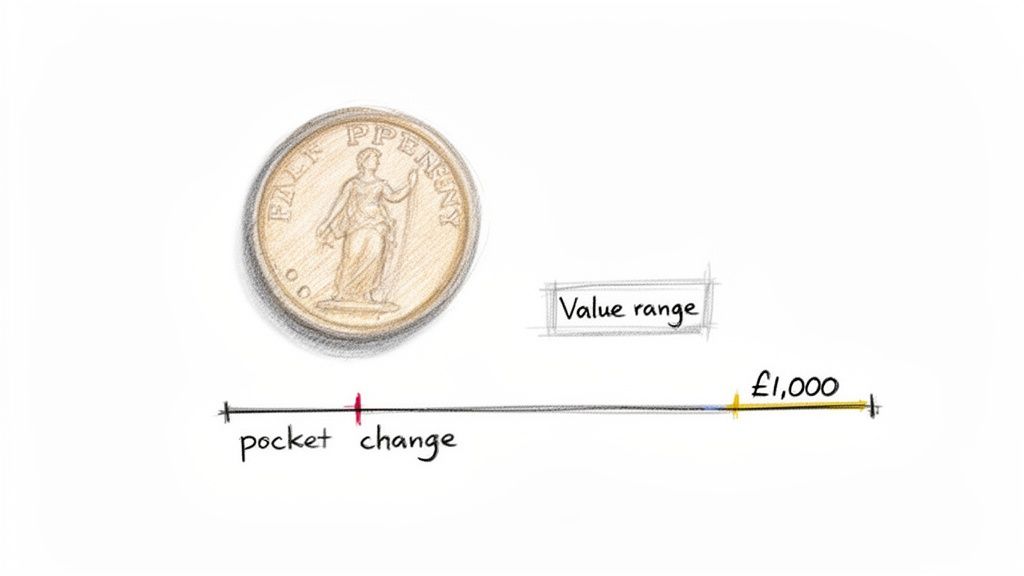
Before Britain switched to decimal currency in 1971, the humble 'ha'penny' was an everyday coin, worth 1/480th of a pound sterling. Now, its value is purely down to its collectability. This is driven by three key things: its age, its rarity, and the condition it’s in.
This guide will focus on the classic British halfpenny, exploring how a coin once used for daily purchases can transform into a prized asset. Whether you have a single coin or a whole collection, getting to know its story is the first step to figuring out what it’s really worth.
From Pocket Change to Prized Collectible
So, how does a simple coin make the leap from everyday pocket change to a collector's item? It all comes down to a few critical factors that separate the common from the coveted:
- Historical Era: A coin from the reign of an early monarch like Edward I is naturally going to be much scarcer than one from Queen Elizabeth II’s time.
- Rarity and Mintage: In some years, the Royal Mint produced very few halfpennies. Low production numbers automatically make those specific coins harder to find and, as a result, more valuable.
- Physical Condition: This is a big one. A coin that looks like it just left the mint, with sharp, clear details, will always fetch a much higher price than one that's been heavily worn down from years of use.
Before Britain's currency was reformed, this little bronze coin was a cornerstone of daily life. The first official halfpennies were minted way back under Edward I, between 1272 and 1307. Fast forward to the 20th century, and a common George VI halfpenny—the one with the iconic ship design reminiscent of Sir Francis Drake's Golden Hind—often sells for around £5 to £15 if it's in decent condition.
You can find more historical insights on the halfpenny's journey at BullionByPost.co.uk. It’s a perfect example of how yesterday's loose change can become a genuine asset for today's collectors.
A Journey Through Halfpenny History
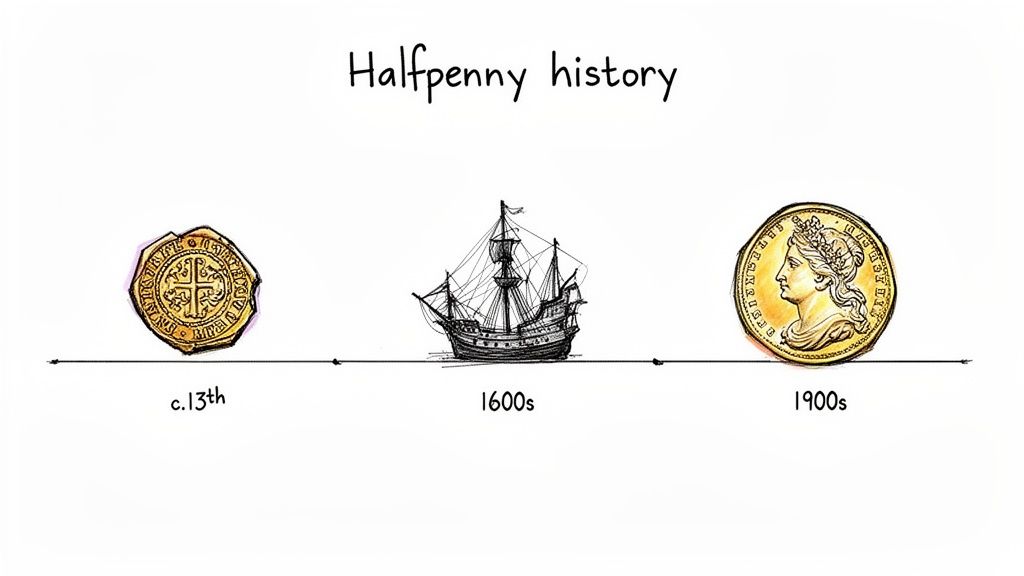
To really get to grips with what your halfpenny is worth, you need to understand its incredible story. It’s a journey that stretches back centuries.
Believe it or not, the halfpenny didn’t even start out as its own coin. Its origins are surprisingly literal—back in medieval times, the only way to make small change was to physically cut a silver penny into halves or quarters. A rough but effective system for its time.
That all changed during the reign of King Edward I in the late 13th century. It was then that the first official, round silver halfpennies were struck. These tiny coins were a huge leap forward, making everyday trade much simpler for everyone. Buying a loaf of bread or a pint of ale suddenly became a lot more precise.
The Evolution of Design and Metal
Over the centuries, the halfpenny transformed again and again. The early silver coins were eventually replaced by heavier copper and, later, bronze. This wasn't a random decision; it was purely practical. As the value of silver shot up, producing small coins from it just didn't make sense anymore, so cheaper, more durable metals took over.
The designs changed too, becoming powerful symbols of Britain’s identity.
One of the most iconic images is that of Britannia, the female personification of Britain. She first appeared on the halfpenny during the reign of Charles II in 1672 and remained a familiar sight for nearly 300 years. Her seated figure, holding a trident and shield, was a clear statement about Britain's growing naval power and command of the seas.
The design on a coin is more than just decoration; it’s a snapshot of a nation's priorities and self-image at a specific moment in history. Each monarch’s reign brought subtle changes, making every halfpenny a miniature historical document.
From Britannia to the Golden Hind
The 20th century saw one of the most beloved design changes in the coin's history. In 1937, under King George VI, the classic Britannia was replaced with an image of Sir Francis Drake's famous galleon, the Golden Hind.
This ship, which circumnavigated the globe in the 16th century, was a powerful symbol of exploration, adventure, and Britain's proud maritime heritage. The Golden Hind design sailed on through the reign of Queen Elizabeth II until the coin was finally withdrawn ahead of decimalisation in 1971.
This rich backstory is exactly why a halfpenny from one year can be worth so much more than another. A coin is never just a piece of metal; it’s a tangible link to a specific era, reflecting the art, politics, and technology of its time. To see the bigger picture, you can explore a brief history of British coins and understand how these pieces fit into the larger numismatic puzzle at https://www.cavaliercoins.com/blogs/news/a-brief-history-of-british-coins.
It’s the story behind the coin that elevates it from simple currency to a sought-after collectible.
Decoding What Makes a Halfpenny Valuable
Ever wonder why one halfpenny is worth just a few pence while another can fetch a small fortune? It’s a common question, and the answer isn't just about age. Think of it like a classic car—two models from the same year can have completely different price tags based on their condition, how many were made, and their ownership history.
The very same logic applies to your halfpenny. Its journey from the Royal Mint to your collection has left clues that tell its story and determine its value. Once you learn to spot these clues, you can start to piece together its potential worth. We'll walk through the five key factors every collector and dealer looks at: its date, mintage, condition, metal, and provenance. Each one is a critical piece of the valuation puzzle.
The Critical Trio: Date, Mintage, and Condition
First things first, the date and mintage go hand-in-hand. The date tells you when it was made, and the mintage tells you how many were struck that year. A halfpenny from a year with a tiny production run is naturally scarcer and, therefore, more interesting to collectors.
For example, a George V halfpenny from 1909 is a sought-after coin simply because only 3.4 million were ever minted. Stack that against the hundreds of millions produced in other years, and you quickly see why rarity is such a powerful driver of price.
But that's only part of the story. The coin's condition, or grade, is just as crucial. A grade simply describes how much wear and tear a coin has seen. A crisp, uncirculated coin with razor-sharp details is worlds apart from a heavily worn one where the monarch’s face has been smoothed over by time and touch. Even a common date can be surprisingly valuable if it’s in near-perfect condition.
A coin's grade is its biography written in scratches, dents, and lustre. An uncirculated coin is a story untold, preserved perfectly from the day it was minted, which is why collectors pay a premium for it.
To see just how much condition matters, let's look at how the same coin's value can skyrocket as its grade improves.
Coin Grading and Its Impact on Value
| Coin Grade (Abbreviation) | Description of Condition | Example Value (e.g., George V 1919) |
|---|---|---|
| Good (G) / Very Good (VG) | Heavily worn. Most details are flat, but the main design and date are visible. | £1 - £3 |
| Fine (F) / Very Fine (VF) | Moderate wear on high points. Major details are clear, with some finer lines visible. | £5 - £15 |
| Extremely Fine (EF) | Light wear on the highest points only. Details are sharp, and some original mint lustre may be present. | £20 - £50 |
| Uncirculated (UNC) | No signs of wear. The coin looks as it did when it left the mint, with full original lustre. | £100+ |
As you can see, a coin's condition isn't a minor detail—it's often the single biggest factor in its final valuation.
Beyond the Basics: Metal and Provenance
The metal used for a halfpenny also adds a layer to its story. The earliest halfpennies were silver, later shifting to copper and then bronze. While the scrap value of the metal is usually negligible, some incredibly rare "error" coins were accidentally struck on the wrong type of metal blank, making them exceptionally valuable.
Finally, there's provenance—the coin's history of ownership. Was it part of a famous collection or discovered in a significant historical hoard? A documented backstory can add a premium, much like a painting that once hung in a well-known gallery. To dig deeper into this idea, it’s worth exploring the concept of estate jewelry and its value, as many of the same principles for valuing pre-owned treasures apply.
The appreciation of these humble coins can be truly staggering. An 1860 halfpenny was worth a mere 1/480th of a pound back then, but today, rare examples can sell for hundreds or even thousands. A prime example is the 1967 large-date pre-decimal halfpenny, a rarity that can command an astonishing £38,000 in top condition, its value driven almost entirely by its scarcity. You can find more on historic coin values and conversions over on Statista.
How to Estimate Your Halfpenny Value
Now that you have a sense of what makes a halfpenny valuable, it’s time for the fun part—taking a closer look at your own coin. Figuring out what your halfpenny might be worth doesn't call for any fancy equipment, just a careful eye and a bit of method. It’s a bit like being a detective, searching for the little clues that tell your coin’s story and decide its place in the collectors' market.
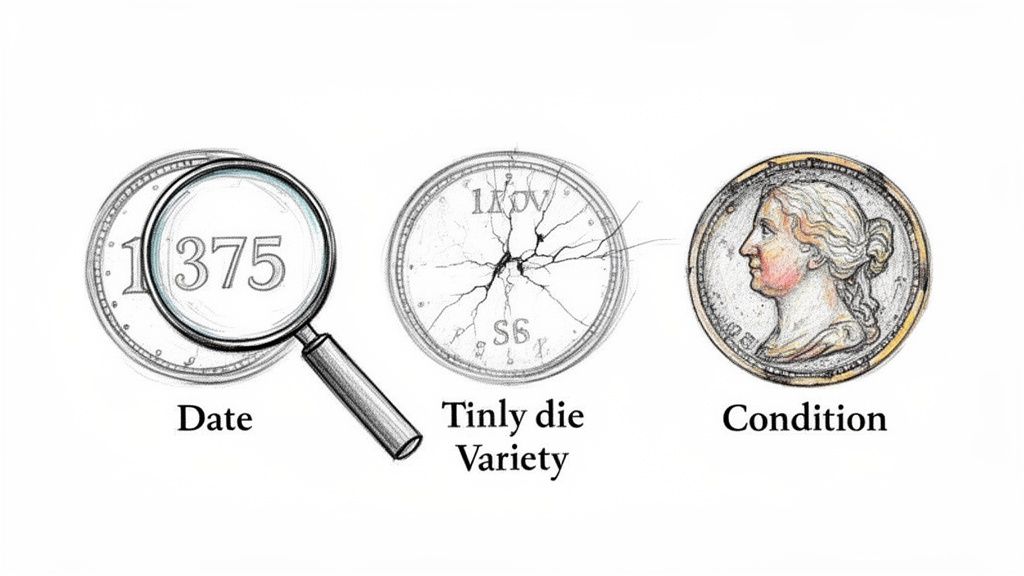
This straightforward, hands-on process will walk you through the most important checks. By following these steps, you'll turn the abstract ideas of mintage, date, and condition into a real, practical assessment. This visual guide breaks down the core factors that shape a halfpenny's final price tag.
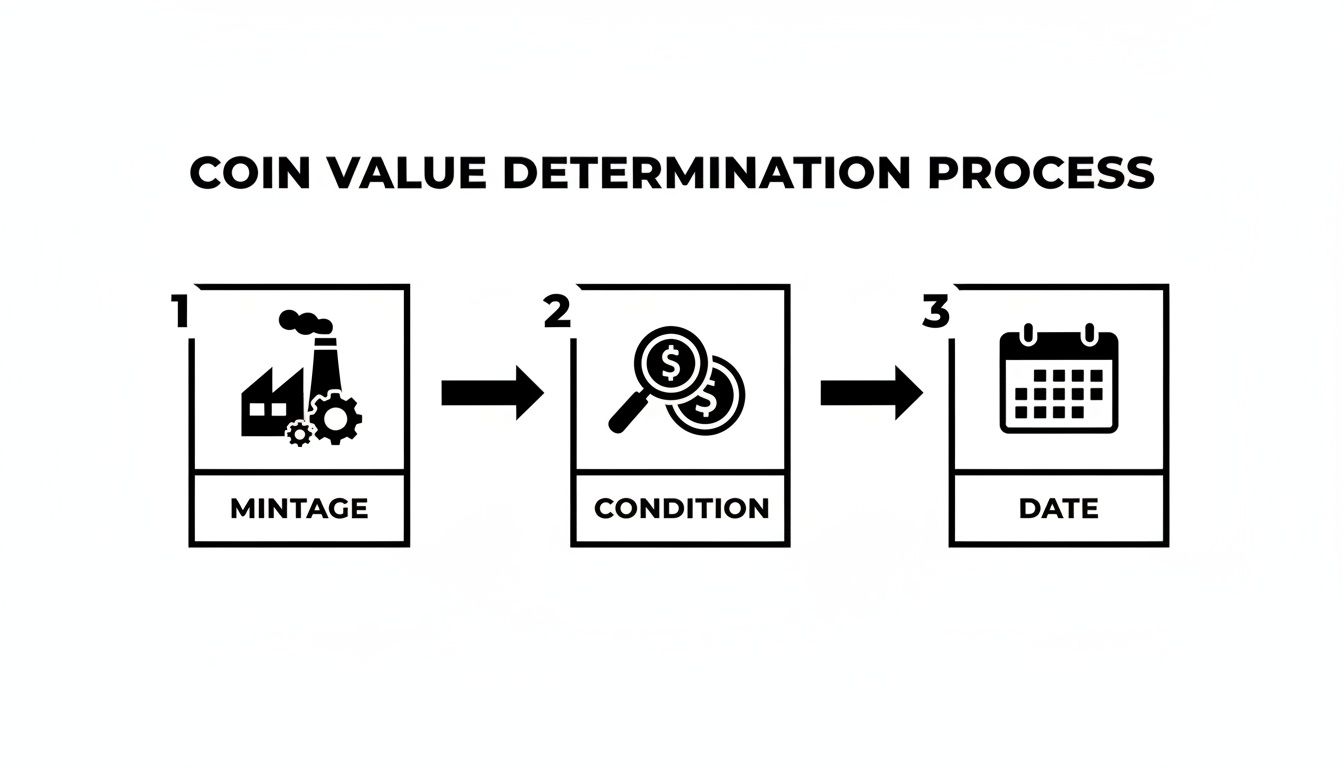
As you can see, the journey to finding a coin's value starts with how many were made (mintage), moves on to a close look at its preservation (condition), and finishes by confirming its place in history (date).
A Practical Checklist for Your Coin
Grab your halfpenny, and if you have one, a magnifying glass. Good lighting will also be a huge help in spotting those tiny details.
-
Identify the Monarch and Date: This is your first port of call. Find the year on the coin, which is almost always on the reverse (the "tails" side). The portrait on the obverse will tell you which monarch was on the throne. Are you looking at a young Queen Victoria or a bearded George V? This pairing of ruler and date is the first clue to its rarity.
-
Assess the Condition Honestly: Now, get up close and personal with the coin's surface. Can you read all the words clearly, especially "HALF PENNY"? How sharp are the details in the monarch's hair or on Britannia's shield? Compare what you see to the grading table we discussed earlier. Try to be objective—heavy wear and smoothed-down features will put a coin in the lower grades, whereas crisp, clear details point towards a higher value.
A common mistake is letting optimism cloud your judgement of a coin's condition. Collectors have very precise standards, so an honest assessment is vital for getting a realistic valuation. A coin that looks "old and nice" to the untrained eye might be seen as heavily circulated by an expert.
Look for the Unusual
Finally, check for anything that seems a bit different or out of place. This is often where the hidden value is lurking.
- Mint Marks: Scan for a tiny letter (like an 'H' or 'KN') tucked away somewhere. These marks can pinpoint a specific mint and, in some cases, a much rarer variety of the coin.
- Errors and Varieties: Are there any letters that look doubled, or parts of the design that seem misaligned? While not exactly common, these kinds of minting mistakes can make an otherwise standard coin far more interesting to specialist collectors.
Running through this checklist gives you a solid footing for understanding your coin. If you'd like a more detailed walkthrough, our guide on how to value coins explores the professional techniques numismatists use. By the time you're done, you’ll have a much better idea of whether you're holding a common piece of history or a genuinely valuable find.
Valuable Halfpennies to Look For
Once you’ve got a handle on what makes a coin valuable, the real fun begins: the treasure hunt. Some halfpennies are famous in collecting circles for being incredibly scarce, and they can fetch some seriously impressive prices. Knowing what to look for transforms a rummage through a random jar of coins into a proper, targeted quest.
These aren't just any old coins; they are particular issues with low survival rates, quirky minting errors, or a connection to a specific moment in history. Spotting one of these can turn a handful of bronze into a genuinely exciting find. Let’s go over a few of the key halfpennies that should be on every collector’s radar.
Key Dates with Low Mintage Numbers
The most straightforward path to finding a valuable coin is looking for a key date—a year when the mint produced very few coins. It's simple supply and demand; these low-mintage years are always in high demand among collectors.
- 1862 Halfpenny: The mintage figure for this year was exceptionally low. Finding one in decent condition is a real challenge. Even a well-worn example can be worth £10-£20, while high-grade versions will command a much higher price.
- 1902 Low Tide Halfpenny: This is a famous variety from the reign of Edward VII. You’ll need to look closely at the reverse side showing Britannia. On the standard coin, the sea is quite high up, but on the rare ‘Low Tide’ version, the water level is noticeably further from her body. That small detail can push the coin's value into the hundreds of pounds.
Think of a coin’s mintage number as its rarity certificate. A low number is your first clue that you might be holding something special, but it's the coin's condition that will ultimately seal the deal on its value.
Errors and Varieties That Create Value
Beyond the key dates, minting errors are where things get really exciting. These are one-off mistakes that should never have left the mint, and their accidental survival makes them exceptionally rare and sought-after.
Keep an eye out for these kinds of oddities:
- Re-punched Dates: Sometimes, a die-puncher would strike a digit for the date incorrectly, then punch over it to correct the mistake. This often leaves a faint shadow of the original number. The 1874-H halfpenny is known for sometimes having a re-punched ‘4’, a very desirable error.
- Die Cracks: The dies used to stamp coins are under immense pressure and eventually wear out. Sometimes they’d crack, leaving a raised, squiggly line on the coin’s surface. While many are minor, a significant or unusual die crack can add a nice premium to a coin’s value.
- Off-Centre Strikes: If the blank disc of metal wasn't perfectly aligned when it was struck, the design appears off-centre. A slight misalignment isn't worth much, but a dramatic off-centre strike is a rare and visually striking error that collectors love to find.
Searching for these specific coins gives your hunt a real purpose. The question "how much is half a penny worth?" changes completely when you find a coin with a known rarity. Any old 1902 halfpenny is common, but a 1902 Low Tide halfpenny is a collector’s prize. This is the knowledge that turns you from a casual owner into an informed treasure hunter.
Selling Your Halfpennies the Smart Way
Once you have a good idea of what your halfpenny might be worth, the next puzzle piece is figuring out how to sell it. The path you choose can make a huge difference to the final price you get, so it's worth taking a moment to think through your options.
There isn't a single "best" way to sell a coin. The right choice really depends on its value, how quickly you need the money, and how much hands-on effort you're prepared to put in.
Choosing the Right Sales Channel
For common, lower-value halfpennies, online marketplaces like eBay can be a great option. You get direct access to a massive pool of collectors hunting for that specific date to fill a gap in their album. The catch? You have to do the work yourself. Success on eBay comes down to taking crystal-clear, high-quality photos and writing a detailed, honest description. Be ready to field questions from potential buyers and handle all the packing and shipping.
If you have a more valuable or rare halfpenny, going directly to a reputable coin dealer is often a much better bet. A trusted dealer can assess your coin and make you a fair offer right there and then. It’s a quick, secure transaction without the waiting game or fees that come with auctions. For sheer speed and simplicity, this is often the go-to method.
What if you've stumbled upon a real gem? For a truly exceptional or rare coin, consigning it to a specialist numismatic auction house is the way to go. These auction houses have built up lists of serious, high-end collectors who are willing to pay top prices for the best items. They handle all the marketing and authentication, though they do charge a commission for their services.
No matter which route you take, remember that presentation is everything. High-quality photos and an accurate description of the coin's grade build trust and confidence with buyers, which is essential for getting the best possible price.
If you’re a charity or have a large collection to offload, it's worth contacting a dealer who specialises in bulk purchases. They can provide an efficient and fair valuation for the entire lot. For a deeper dive into these options, check out our guide on the top options for selling old coins, where we break down the pros and cons of each approach.
Got Questions About Your Halfpenny's Value?
When you start digging into the world of old coins, a few questions always pop up. Let's tackle some of the most common ones to give you a clear picture of what makes a halfpenny valuable.
Are All Old Halfpennies Valuable?
Not always. It's a classic rookie mistake to think age equals value. The truth is, rarity and condition are the real kingmakers in coin collecting.
A common 20th-century halfpenny, like one from George VI's reign that's seen a bit of life, might only be worth £1-£2. But a rare variety from the same era, or any coin in perfect, uncirculated condition, could fetch hundreds. Age is part of the story, but it rarely guarantees a big payday on its own.
Should I Clean My Halfpenny Before Selling It?
Please, don't! This is probably the most painful and costly mistake a new collector can make. No matter how carefully you try to clean a coin, you're creating tiny, microscopic scratches all over its surface.
Worse, you strip away the coin's original patina – that beautiful, subtle toning it develops over decades. Collectors see that patina as part of the coin's journey and history. An original, uncleaned coin is almost always worth more than a shiny one that's been damaged.
Think of a coin's patina like the original finish on a piece of antique furniture. Removing it might make it look newer, but you've just stripped away a huge part of its history and value.
How Can I Tell If My Halfpenny Is Bronze or Copper?
The big change happened in 1860. Any British halfpenny minted before that year was made of hefty, pure copper. From 1860 onwards, the Royal Mint switched to bronze, a tougher alloy of copper, tin, and zinc.
Bronze coins are more durable and have a slightly different colour. While it’s a fascinating bit of history, the coin's date, how many were made, and its condition are still the main things that determine its collectible value.
What Is the Difference Between a Pre-Decimal and Decimal Halfpenny?
These are two completely different coins from two different eras. The pre-decimal halfpenny (the classic 'ha'penny') was part of the old system until Britain went decimal in 1971. It was worth 1/480th of a pound.
The decimal halfpenny (½p) was a tiny new coin introduced in 1971, worth 1/200th of a pound. This guide is all about the older, pre-decimal coins, as they're the ones that hold the most interest and potential value for collectors today.
At Cavalier Coins Ltd, we live and breathe rare coins. We specialise in helping collectors and sellers navigate this fascinating world. Whether you're looking to value a single find or sell a large collection, our expertise can guide you. Explore our extensive selection and resources at https://www.cavaliercoins.com.