
First things first, let's get one thing straight: the ten shilling note you've found isn't worth its old face value of 50p. Its real value is tied up in its condition, rarity, and the story it tells. For a common, well-used note, you might be looking at £2-£5, but a flawless or particularly rare example could be worth several hundred pounds. It all comes down to what collectors are looking for.
Your Ten Shilling Note Value at a Glance
A great way to think about your note's condition is to compare it to an old book. A heavily folded, limp note is like a well-loved paperback—it has character, but not much monetary value. An uncirculated note, on the other hand, is the pristine, first-edition hardcover still in its dust jacket. It’s crisp, clean, and exactly what a serious collector dreams of finding.
This initial assessment of its physical state is absolutely crucial. The difference in value between a note with a few faint folds and one with none can be staggering. For instance, a common Queen Elizabeth II "ten bob" note in average, circulated shape might only fetch you a tenner. But take that exact same note—same design, same cashier—in perfect, untouched condition, and its value could easily jump to £100 or more. And that's before we even get to other rarity factors, which can send the price climbing even higher.
The visual guide below really hammers home how dramatically a note's condition can influence its worth.

As you can see, that leap from 'circulated' to 'uncirculated' is where the real money is. It's the single biggest jump in value, which is why getting the grade right is so important.
To give you a clearer picture, here’s a quick breakdown of what you might expect for different ten shilling notes based purely on their condition.
Estimated Ten Shilling Note Value Ranges
| Note Type / Era | Poor / Worn Condition | Good / Average Condition | Uncirculated / Mint Condition |
|---|---|---|---|
| Emergency 'White' Notes (WWI) | £20 - £50 | £100 - £300+ | £500 - £1,500+ |
| George V 'Britannia' | £10 - £30 | £50 - £150 | £300 - £800+ |
| George VI 'Blue Portrait' | £5 - £15 | £20 - £60 | £100 - £250+ |
| Elizabeth II 'Portrait Series' | £2 - £5 | £10 - £30 | £80 - £200+ |
Remember, these are just ballpark figures. A rare signature or a special serial number can change the game entirely, but this table gives you a solid starting point.
Understanding the Collector's Mindset
To really get a handle on what your ten shilling note is worth, you have to start thinking like a collector. They aren't just buying a piece of old paper; they're buying a tangible piece of history. Every little detail counts, from the signature of the Chief Cashier printed on the front to the unique serial number.
If you want to go a bit deeper, you can learn more about how to assess the value of old paper money and see how these core principles apply to all kinds of banknotes. As you start looking closer at your own note, it's also helpful to think about the potential hidden value you might be missing in other items you own. Adopting this mindset is what helps you spot the tiny details that separate a common "ten bob" note from a genuine treasure.
The Story Behind the Famous Ten Bob Note
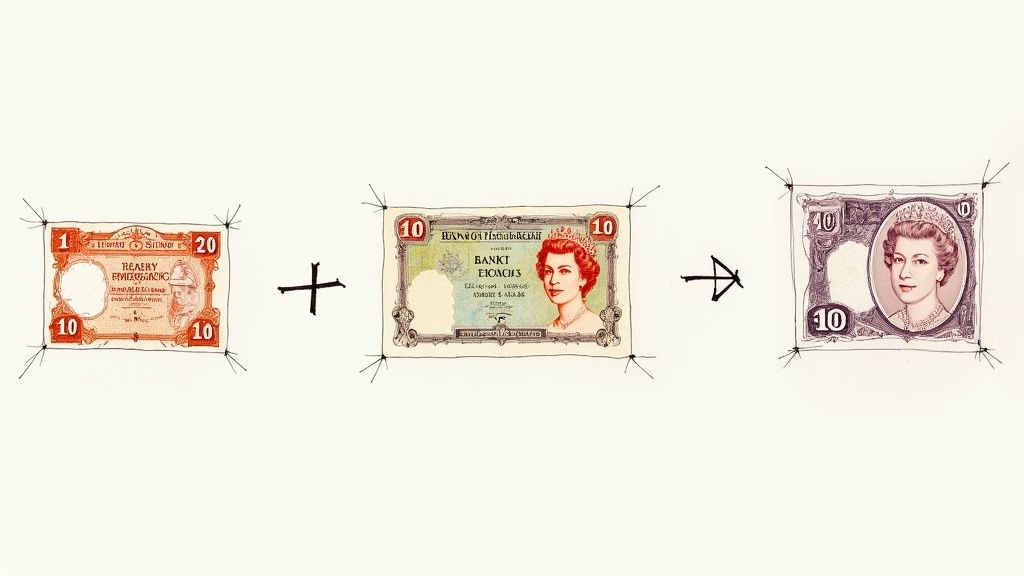
Before you can really get to grips with how much a ten shilling note is worth, you need to know its story. This isn't just a bit of old paper; it's a chapter of British history you can hold in your hand. The note, affectionately nicknamed the "ten bob," was part of daily life in Britain for over fifty years, and its journey is the key to figuring out its value today.
Believe it or not, before 1914, the smallest banknote the Bank of England issued was the £5 note—an absolute fortune for the average person back then. Everyday spending was all done with coins. But the outbreak of the First World War threw the nation's finances into chaos. To hold onto precious metals and stop a panicked run on the banks, the Government took a drastic step: it issued its own emergency Treasury notes for ten shillings and £1. These were the very first small-value notes the British public had ever used.
These early Treasury notes look a world away from the ones that followed. They were simple, often just black and white, and signed by the Treasury Secretary, not the Bank of England's Chief Cashier. It’s this unique history that makes them a real prize for collectors.
The Bank of England Takes the Reins
Once the war was over, the job of issuing these smaller notes was handed over to the Bank of England. The first official Bank of England ten shilling note finally appeared in 1928, sporting a beautiful, intricate design of a seated Britannia on the back. This was a huge moment, cementing the "ten bob" note as a permanent part of the nation's currency.
For decades, the design stayed pretty much the same, just with the signatures of different Chief Cashiers cycling through. The note became a familiar sight, used for everything from the weekly shop to the Friday pay packet. It was a reliable part of daily life through thick and thin, seeing the country through the Great Depression and the Second World War.
The arrival of the ten shilling note completely changed how people used money. For the very first time, a banknote was truly for everyone, not just the wealthy. It became a powerful symbol of economic change.
A New Era and a Royal Portrait
The biggest shake-up to its design came in 1961 with the "Series C" issue. This new note was a landmark for British money. For the first time ever, a portrait of the reigning monarch—Queen Elizabeth II—appeared on a banknote. This fresh, modern design with its bold colours and regal portrait is the version most people remember today.
This iconic note was in our pockets for nearly a decade. While the Bank of England had been issuing the ten shilling note since 1928, it was the 1961 series with the Queen's portrait that became its most famous face. Production carried on until 1969 as the country prepared for decimalisation, and the note was officially taken out of circulation on 22 November 1970. You can explore more details of the note's official timeline on Wikipedia.
So, the first step in valuing your note is working out which era it comes from. Is it one of the emergency Treasury issues from the Great War? A classic Britannia design? Or the famous portrait series? Each one tells a different story and carries a different value for a collector.
How to Grade Your Banknote's Condition

In the world of banknote collecting, condition is king. A single fold or a faint stain can mean the difference between a note worth pocket money and one that commands hundreds of pounds. Learning how to accurately grade your ten shilling note is probably the most important skill you can develop to understand its true value.
Think of it like judging a vintage car. A note in Poor condition is the equivalent of a barn find—it’s torn, stained, maybe even missing a bit, and has clearly had a tough life. A note graded as Good has definitely been around the block a few times. The paper is limp, it’s covered in heavy folds, and it shows all the signs of its journey from one wallet to the next.
At the very top of the ladder, you have the Uncirculated (UNC) note. This is the showroom model that’s never seen the road. The paper is perfectly crisp, the colours pop, the corners are razor-sharp, and there isn't a single fold or blemish to be seen. This is the absolute gold standard every collector dreams of.
From Good to Uncirculated: The Main Grading Tiers
Most ten shilling notes you'll come across will fall somewhere between these two extremes. While professional graders use a highly detailed scale, you can get a very good idea of your note's worth by focusing on a few key levels.
- Good (G): The note is very heavily worn and feels limp. It will have countless folds, creases, and possibly some small tears or stains.
- Very Good (VG): Still clearly well-circulated, but the main design is more distinct. The paper will feel soft and have plenty of folds, but it should be complete.
- Fine (F): There’s a bit of crispness left in the paper, but it’s still seen a lot of handling. You’ll find several obvious folds and other minor signs of wear.
- Very Fine (VF): Now we're getting into much more desirable territory. The paper is still crisp and has only light folds—maybe three or four—but no heavy, deep creases. The note looks clean and bright.
- Extremely Fine (EF): This is an almost-perfect note. It looks nearly new, with sharp corners and vibrant colours. It might have one or two very light handling folds or a single, faint centre crease.
- Uncirculated (UNC): The perfect specimen. Absolutely no folds, creases, tears, or handling marks whatsoever. It looks as fresh as the day it left the printers.
One of the most common mistakes collectors make is confusing an old but clean-looking note for an Uncirculated one. A note can sit in a drawer for 50 years and look fantastic, but if it has even one tiny fold from being briefly put in a wallet, it is no longer Uncirculated.
Your Practical Grading Checklist
To size up your own note, get it under a good, bright light and be brutally honest with your assessment. Even the smallest imperfections matter.
- Check for Folds and Creases: Are there hard folds that have broken the paper’s surface, or are they just light bends? A single, sharp fold right down the middle immediately drops a note from UNC to EF.
- Examine the Paper Quality: Is the paper crisp and stiff, or has it gone soft and limp? That original crispness is a tell-tale sign of a high-grade note.
- Inspect the Corners: Are they sharp and perfectly pointed, or have they become rounded and soft from being passed around?
- Look for Blemishes: Scan the surface for any stains, dirt, ink marks, or discolouration. A tiny pen mark can have a surprisingly big impact on its value.
Once you have a grade, keeping it that way is crucial. To find out more, take a look at our guide on how to store a paper money collection properly. Taking this step is the best way to prevent any further damage and preserve your note's value for years to come.
Spotting the Rare Features That Drive Up Value
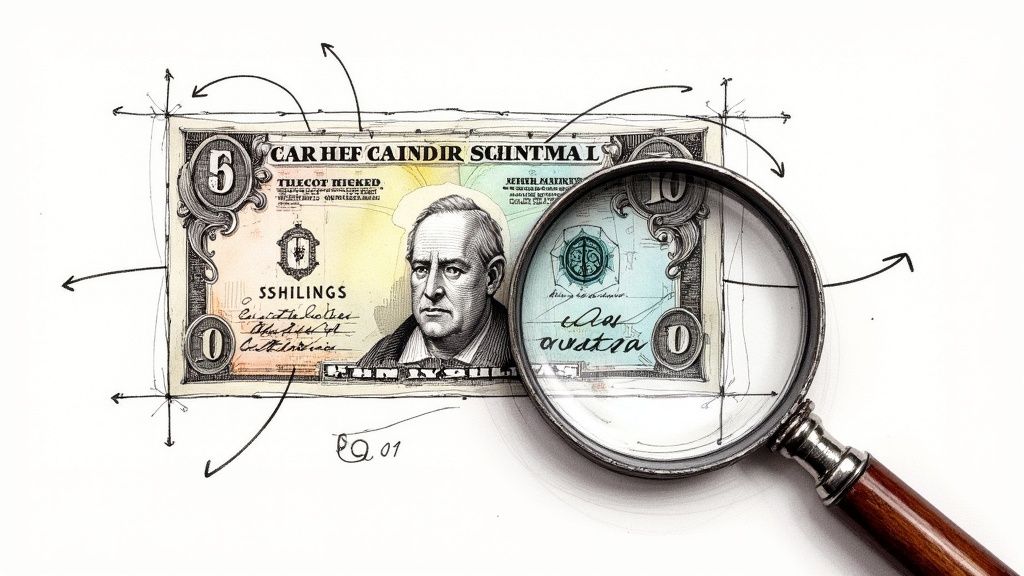
Once you’ve got a handle on the condition of your ten shilling note, the real detective work begins. Beyond the general state of the paper, certain specific features can turn an ordinary note into a serious collector's piece. The smallest details can have a massive impact on its value, so it’s time to look closer at the signatures, serial numbers, and even mistakes.
The first thing to check is the signature of the Chief Cashier. This name, printed right on the front, tells you who was running the show at the Bank of England when the note was issued. Some cashiers had surprisingly short tenures, which means far fewer notes bearing their signature ever made it into circulation. Scarcity, as always, equals value.
For instance, notes signed by K.O. Peppiatt (1934-1949) are often more sought-after than those from his successor, P.S. Beale. Another great example is comparing a note from J.S. Fforde (1966-1970), which is quite common, with one from the much shorter term of J.Q. Hollom (1962-1966). That four-year window makes Hollom’s signature much harder to find.
Deciphering Your Note's Serial Number
The serial number isn't just a random string of digits; it’s a treasure map hiding in plain sight. Collectors go absolutely wild for special numbers, and finding one can significantly boost your note's worth.
- Low Numbers: Think of the very first note off the printing press. A serial number like A01 000001 is the holy grail for collectors. In fact, any note with the first prefix and a number under 100 is exceptionally rare and valuable.
- Replacement Notes: During printing, some notes would inevitably get damaged. These were destroyed and replaced with special notes marked with a unique prefix, often an 'M', to keep the books balanced. These ‘replacement’ notes are much rarer than standard issues and are always in high demand.
- Fancy Numbers: Collectors also have a soft spot for what they call 'fancy' serial numbers. These are patterns that are just fun to look at, like 'solid' numbers (e.g., 222222), 'radar' numbers that read the same forwards and backwards (e.g., 123321), or 'ladder' numbers in sequence (e.g., 123456).
Hunting for Printing Errors and Historic Issues
Every now and then, a note with a mistake would slip past quality control. These errors could be anything from misaligned prints and ink smears to the wrong colours being used. Because each error is essentially a one-off, these unique notes can be incredibly valuable.
The very history of the ten shilling note created some of its rarest variants. The first ones weren't even from the Bank of England. In August 1914, with the economy teetering on the brink at the start of World War I, the Government issued its own Treasury notes for ten shillings. It was the first time such a small banknote was used across the country.
These emergency Treasury notes look quite different from the later Bank of England series and are highly prized by collectors. They represent a fascinating moment when the government had to step in directly to stabilise the currency. You can learn more about this crucial moment in British currency history on collectors-club-of-great-britain.co.uk.
Taking the time to check for these features is how you truly uncover what your ten shilling note is worth.
What's a Ten Shilling Note Worth Today?
Once you’ve figured out which series your note belongs to and have a good idea of its condition, we can get to the exciting part: the numbers. So, just how much is a ten shilling note worth? The answer really does span a massive range, all depending on that magic mix of history, rarity, and of course, collector demand.
A common Queen Elizabeth II "Portrait" note from the 1960s that has clearly been through a few pockets might only fetch £5 to £10. But take that very same note in crisp, uncirculated condition, and its value can jump to £80 or even £100. That's the power of preservation.
As you go back in time, the prices climb. A "Britannia" series note from the 1930s in Very Fine condition could be valued anywhere from £50 to £150. If you're lucky enough to have a pristine, uncirculated one, you could be looking at £300 or more.
The real heavy hitters are the early Treasury emergency notes from the First World War. Even in poor shape, these are worth holding onto, fetching £20 to £50. A top-grade, uncirculated example? We’re talking serious money—it can easily soar into the hundreds and sometimes break the £1,000 barrier at auction.
Detailed Valuation Guide by Series and Condition
To give you a clearer picture, I've put together a table that breaks down current market estimates. This connects the specific series and Chief Cashier to potential values, giving you a solid starting point.
Keep in mind these are solid estimates, but the market is always moving. Prices can shift based on recent auction results and what collectors are chasing at the moment.
| Banknote Series | Chief Cashier / Key Dates | Very Fine (VF) Condition Value | Uncirculated (UNC) Condition Value |
|---|---|---|---|
| 1st Treasury Issue | John Bradbury (1914) | £100 - £300 | £700 - £1,500+ |
| Britannia Issue | B.G. Catterns (1928-1934) | £70 - £150 | £400 - £800+ |
| Blue Portrait Issue | K.O. Peppiatt (1934-1949) | £20 - £60 | £150 - £250+ |
| Portrait Issue | J.S. Fforde (1966-1970) | £10 - £20 | £80 - £120+ |
This guide should help you narrow down the value of your particular ten bob note.
The Real-World Power of a "Ten Bob" Note
To really get a feel for its value, it helps to step back in time. In the 1960s, a "ten bob" note wasn't small change—it was a decent amount of cash with real buying power.
What could you get with it? Well, a single ten shilling note could buy you six pints of beer, ten loaves of bread, or a whopping seventeen pints of milk. If you adjust for inflation, its 50p equivalent from 1969 would be worth about £8.50 in today's money. You can dive deeper into the fascinating history of the ten bob banknote on this blog.
A note's monetary valuation is just one part of its story. Its historical purchasing power provides a nostalgic and tangible connection to the past, reminding us of its role in everyday British life.
If you discover you're holding a high-value note, knowing what it's worth is the first step. The next is figuring out the best way to sell it. For some pointers, check out our detailed guide on where to sell old banknotes for the best price.
Frequently Asked Questions
After delving into the history, condition, and special features that shape a ten shilling note's worth, you probably have a few practical questions left. This section cuts straight to the chase, answering the most common queries to help you handle your old banknote with confidence.
Can I Still Exchange a Ten Shilling Note at a Bank?
In a word, no. The ten shilling note was officially taken out of circulation and stopped being legal tender on 22 November 1970. That means your local high street bank won’t be able to swap it for its old 50p face value.
Even the Bank of England's exchange service won't cover it, as they only deal with banknotes from the current decimal system. Trying to cash it in at a bank would mean you'd lose its entire collectible value, which is almost always much, much higher than 50p.
What Is the Rarest Type of Ten Shilling Note?
The undisputed champions of rarity are the very first emergency Treasury issues printed right at the start of the First World War in 1914. These so-called "white notes" are incredibly hard to find, especially in good condition.
Beyond that specific series, a few other factors can make a ten shilling note particularly scarce:
- Early Chief Cashiers: Notes bearing the signatures of early figures like Mahon or Peppiatt are highly sought after. Fewer were printed, and even fewer have survived the decades.
- Replacement Notes: These were printed to replace faulty notes during the production run and can be spotted by a special serial number prefix. Their tiny print runs make them exceptionally rare.
- Error Notes: A banknote with a printing mistake—think misaligned prints, ink smears, or the wrong colours—is a unique one-off. These oddities can fetch seriously high prices at auction.
If your note has any of these features, you could be looking at something quite valuable.
How Should I Store My Old Banknotes to Preserve Value?
Looking after your banknote properly is absolutely vital. If you don't, you risk destroying its condition and its value. Light, dampness, and even household chemicals can cause damage that simply can't be undone.
To keep your note safe, just follow a couple of simple rules. First, pop it into an acid-free, PVC-free plastic sleeve made specifically for currency. This will guard it against dirt, fingerprints, and accidental creases. Then, find a cool, dark, and dry spot to store it, like a drawer or a box, well away from direct sunlight.
Never, ever use rubber bands, paper clips, or tape on a banknote. These will leave stains, create tears, or leave a sticky mess that will permanently ruin the paper and tank its value. It's just as important that you never try to clean, press, or iron a note.
Where Is the Best Place to Sell My Ten Shilling Note?
The right place to sell really depends on what you have. For a common note in average, circulated condition, online marketplaces like eBay are a great way to reach a huge audience of casual collectors.
However, if you think you might have something special—like an early issue, a note with a low serial number, or one in crisp, uncirculated condition—it’s time to talk to a professional. A reputable banknote dealer can give you a proper appraisal and make a fair offer. For the truly rare and valuable pieces, a specialised auction house is your best bet to connect with serious collectors and get the best possible price.
At Cavalier Coins Ltd, we are passionate about helping collectors find, value, and sell rare banknotes. Whether you are just starting or looking to part with a treasured collection, explore our extensive selection and expert services at https://www.cavaliercoins.com.