

You're often only a few seconds into the problem. A mixed lot arrives from a house clearance, a customer brings back change from a European trip, or a reseller tips a bag of circulation euros onto the counter and one or two pieces just feel wrong. Not dramatically wrong. Just slightly off in the hand, slightly flat at the edge, slightly clumsy in the join between centre and ring.
That's where most guides stop being useful. They give you a magnet test, tell you to weigh the coin, and leave you with a yes-or-no mindset that doesn't hold up in the world. If you want to know how to spot fake 2 euro coins properly, you need a workflow. Start with the legal specification, add physical checks in the order that catches the most failures quickly, then treat the result like evidence rather than a hunch.
Why the 2 Euro Coin Is the Most Counterfeited Denomination
A suspect €2 usually turns up in ordinary trade, not in some dramatic seizure. It is in a holiday-spend mix, a job lot from a clearance, or a tray of loose European change bought cheaply because nobody wanted to sort it. On the bench, the €2 is the denomination I treat first, because it is the one counterfeiters have targeted far more heavily than the rest.
The scale of that gap is not small. The European Commission's ETSC annual report for 20227775437.pdf) recorded 294,397 counterfeit €2 coins detected in circulation out of 322,074 counterfeit euro coins overall. That put the €2 at 91.4% of detected counterfeit euro coins in 2022, and 96.31% of the counterfeit face value. The same report also shows the jump from 195,286 counterfeit €2 coins in 2021 to 294,397 in 2022.
That pattern matters because counterfeiters are choosing the coin with the best payout and the best chance of passing in day-to-day use. A €2 piece carries the highest face value in regular euro coinage, but it still circulates constantly and receives less scrutiny than a note. Forgers get a better return per piece, while buyers, cash handlers, and small traders often give circulating coins only a quick glance.
UK dealers should not treat that as somebody else's problem. Euro coins still move through British auctions, house clearances, mixed foreign-change lots, antiques fairs, and postal trade. The enforcement side is cross-border as well. Europol's report on the postal operation against counterfeit cash describes seizures involving euros, pounds, and US dollars across Portugal, the United Kingdom, and the United States. In practice, the route into your stock can be completely ordinary.
That is why I do not rely on a single bench test and call it done.
Build a defensible workflow. Start from the legal specification, run the fastest physical checks, compare what you see at the edge and at the join, and keep the suspect coin separate from the rest of the lot so you can show where it came from if a buyer, insurer, or enforcement contact asks later. That chain-of-custody step gets missed in lighter guides, but it matters. Once a suspect €2 is mixed back into a bag of similar coins, you lose the easiest proof of how and where it entered the batch.
The Official Specification Every Check Starts From
A suspect €2 should be compared against the legal standard before anyone starts arguing over feel, colour, or sound. That keeps the check grounded and gives you something defensible if the coin later needs to be set aside, returned, or reported.
For a genuine €2, the benchmark is fixed by law: 25.75 mm diameter, 2.20 mm thickness, and 8.5 g weight. The coin is bimetallic, with a white outer ring and yellow centre, and the construction includes a three-layer sandwich structure and a lettered, fine-milled edge. Those are not decorative details. They are part of the anti-counterfeiting design set out in EU Regulation 729/2014 and the UK legislation text carrying it.
The national side matters too. A coin can meet the basic size and weight standard and still be wrong for its stated country, year, or edge inscription. Before calling anything fake, check that the design, date, and edge text belong together. A quick country reference such as this guide to 2 euro coins by country helps avoid easy mistakes with unfamiliar issues.
Official 2 Euro Coin Specification
| Attribute | Specification |
|---|---|
| Diameter | 25.75 mm |
| Thickness | 2.20 mm |
| Weight | 8.5 g |
| Colour layout | White outer part, yellow inner part |
| Construction | Bimetallic, three-layer sandwich structure |
| Edge | Fine-milled, lettered edge |
| Security focus | Edge lettering and bi-metal/sandwich technology are core anti-counterfeiting features |
What a deviation means
Treat the specification as a baseline, not a one-number verdict.
Single faults can come from wear, grime, minor damage, or bad measuring technique. Dealers see this constantly, especially in mixed foreign-change lots where coins have had a hard life. What matters is whether the coin departs from the official spec in a way normal circulation does not explain.
That is also where the UK context matters. In practice, if a €2 turns doubtful at the bench, the strongest position is to record which lot it came from, keep it separate, and note which parts of the legal specification it failed. That turns suspicion into a workflow someone else can follow later, instead of a hunch based on one quick test.
A light coin may be worn. A badly lettered edge combined with the wrong construction cues is a different conversation.
Physical Tests You Can Run on a Suspected 2 Euro
A suspect €2 usually reaches the bench in one of two ways. It either feels wrong in hand, or it turns up in a mixed lot with no clean chain back to the source. In both cases, run the same order of checks and write down what you find. That matters if the coin later needs to be isolated, returned to the lot record, or passed on for formal review.
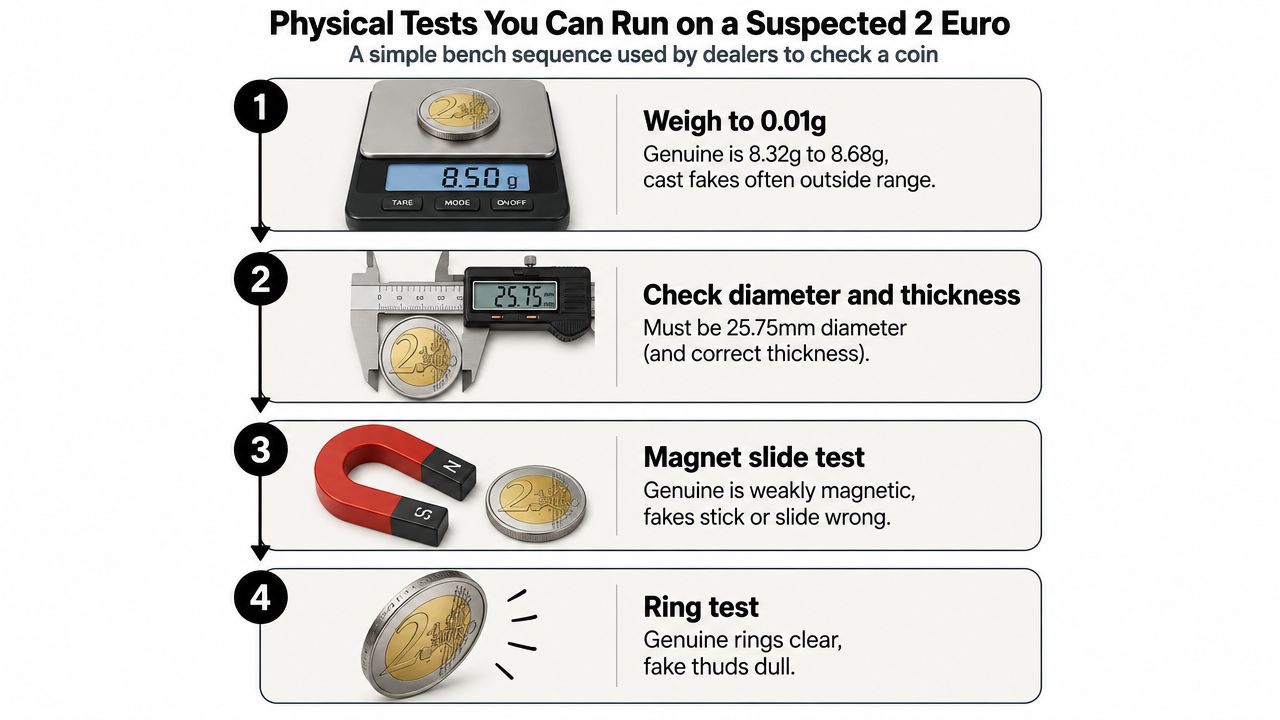
Start with weight and dimensions
Use a calibrated digital scale reading to 0.01 g and callipers that close squarely on the coin. Bench tools matter here because borderline pieces can sit close enough to spec to mislead anyone using kitchen scales or a ruler.
The legal baseline is fixed at 8.5 g, 25.75 mm, and 2.20 mm. Use those figures as reference points, then judge the pattern, not just one number in isolation. A lightly worn coin can drift a little. A coin that is light, slightly thick, and poorly made around the rim is a different case.
If you want to add one more layer beyond basic measurements, this guide to metal composition testing tools and methods gives a practical overview of what dealers use when weight and callipers are not enough.
Check the edge before you study the faces
Start with the edge. Under 5x to 10x magnification, check lettering depth, spacing, and how cleanly the milling meets the faces. Counterfeiters often get the general look right on the obverse and reverse, then lose control at the rim where tooling, pressure, and assembly flaws show up.
Look for shallow characters, crowded or stretched spacing, broken letter forms, and an edge profile that does not feel mechanically consistent all the way round. On genuine pieces, the edge work has order. On many fakes, one segment looks acceptable and the next goes soft or irregular.
A fake can pass a quick face check and still fail in seconds at the edge.
Inspect the ring-core join under a single light
The join between the outer ring and inner core should look engineered, not improvised. Rotate the coin slowly under one fixed light and watch the boundary line all the way around.
Problems here are high-yield because they catch more than one forgery method. Watch for ragged gaps, smeared metal, plating lift, glue-like residue, or a join that looks wider on one side than the other. Those faults show up on crude cast pieces, assembled counterfeits, and some altered coins made from mismatched components.
This is also the point where record-keeping pays off. If a suspect coin came from a bag, tray, or customer lot, note that source before you move on. A physical fault tied to a documented source is far easier to defend later than a memory that the coin "looked off."
Use the magnet test for exclusion, not authentication
The magnet test helps, but only when used for the right job. It can rule coins out. It cannot prove a coin is genuine.
Use a strong magnet and check for behaviour that clearly conflicts with the expected construction. If the coin reacts in a way that suggests the wrong metal is present, isolate it and mark the result in your notes. If it shows no obvious problem, that only means it passed one screen. Plenty of counterfeits are made to survive a casual magnetic check.
Treat magnetism the way dealers treat a UV lamp on banknotes. Useful, fast, and limited.
Add a controlled sound check only if the coin is otherwise clean
A ring test is a supporting check, not a primary one. Use it only on a coin that is free of heavy dirt, bends, or obvious damage, because impact noise changes quickly once a coin has taken abuse in circulation.
Tap the suspect coin lightly against a confirmed genuine €2 or let it settle on a hard surface beside one. Listen for a flat, short note versus a cleaner metallic ring. Cast fakes and poorly bonded bimetal pieces often sound dull. Good struck counterfeits can get closer than many collectors expect, so never let sound overrule hard failures in weight, dimensions, edge work, or construction.
Visual and Sensory Checks That Catch What Scales Miss
A suspect €2 often passes the first bench tests and still gives itself away the moment you put it under light and turn it in hand. That is why dealers do not stop at weight and diameter. We check whether the coin is built and finished the way a genuine bimetal €2 should be under the official specification, then we note what we saw so that the finding stands up later if the coin has to be handed over.
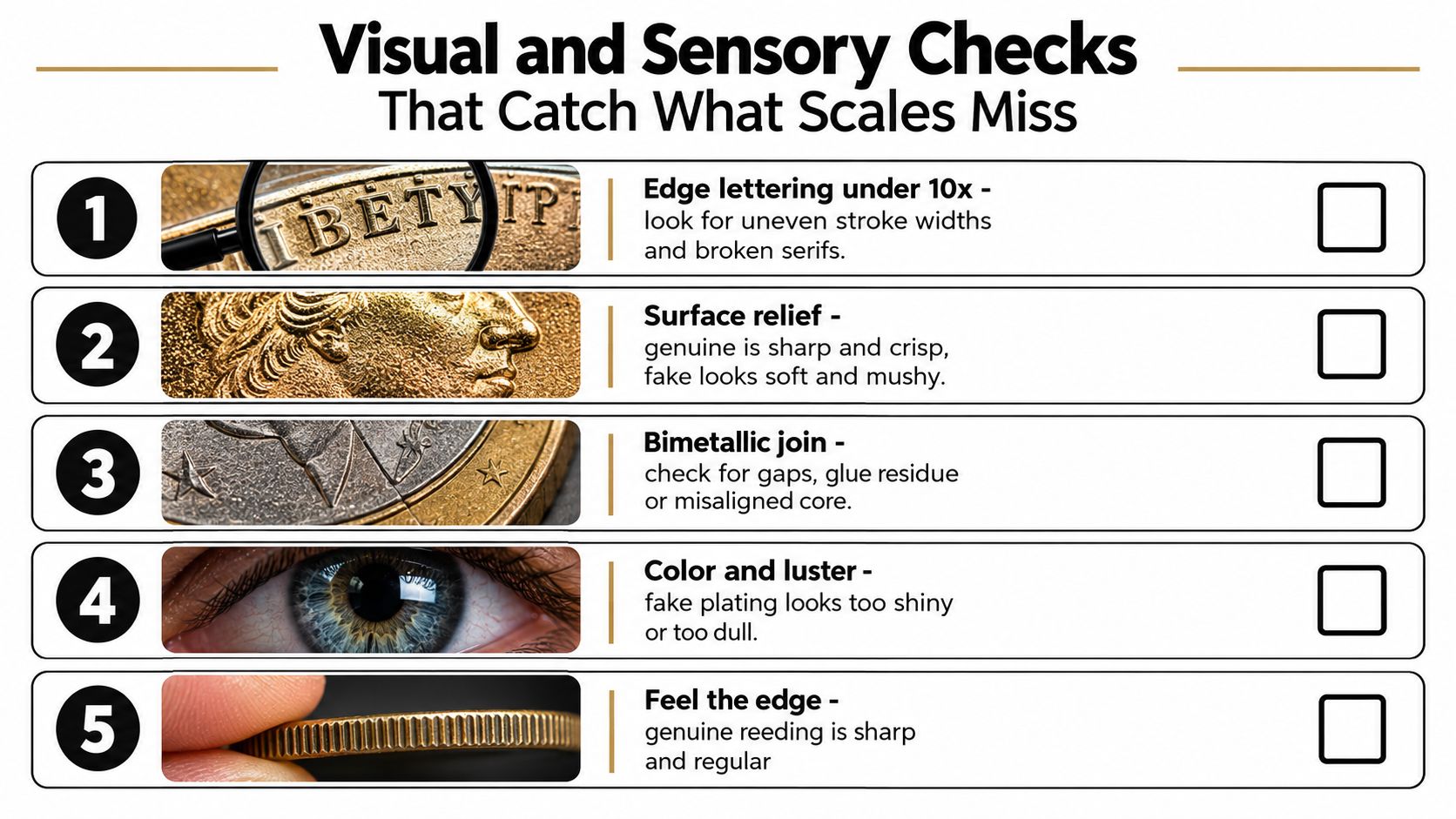
Read the edge like a dealer
Use a 5x to 10x loupe and rotate the coin slowly under angled light. The edge is where copied pieces often lose discipline. On a genuine €2, the inscription or pattern should look deliberate, evenly spaced, and properly struck into the circumference rather than pressed in vaguely or cleaned up after casting.
Look for these faults:
- Letter forms that run together instead of staying clean and separate
- Depth that changes for no good reason around the same edge inscription
- A fine seam or filing trace where a mould join was removed
- Irregular reeding or milling that drifts in spacing or sharpness
One warning from practice. Circulation damage can bruise an edge, so one damaged patch is not enough on its own. A repeating weakness around the circumference is much more suspicious.
Use touch to find the area that needs a closer look
Run a fingertip lightly across both faces, then around the join between centre and ring. Genuine coins usually feel settled. The relief rises and falls cleanly, the fields do not feel greasy or pebbled, and the transition between the two metals makes sense.
Counterfeits often feel wrong before they look obviously wrong. Cast pieces can feel slightly soapy or dead. Altered coins may have a harsh patch where tooling changed the design. Poorly assembled bimetal copies sometimes give a tiny step, looseness, or uneven transition where the parts meet.
Touch is a locating tool. It tells you where to put the loupe.
Check colour and surface finish as a construction test
The outer ring and inner core should show the expected contrast of white metal and yellow metal, but colour alone proves very little. Cleaning, tarnish, and lighting can all mislead. What matters more is whether the colour break looks natural for a struck bimetal coin.
Watch for a centre that looks too flat in tone, a ring with an odd plated brightness, or surfaces that reflect light differently from one area to the next. Those are the coins I separate for a second pass. If the finish, edge work, and metal join all look slightly off together, the case gets stronger.
Record what you saw before the coin leaves your bench
This step gets skipped in amateur guides and matters in the real world, especially if the coin came in through a UK business, market stall, arcade float, or mixed customer lot. Write down the date, source, and the exact visual fault. “Faint seam at 3 o'clock on edge, uneven inscription depth, flat yellow core” is useful. “Looked fake” is not.
If the coin later goes to bank staff, police, or another examiner, those notes preserve chain of custody and show that the suspicion came from identifiable features, not hindsight. That makes your workflow defensible, which is the standard you want once a simple bench check turns into an enforcement matter.
Common Forgery Types and How They Fail
A fake 2 euro rarely collapses on every test at once. It usually fails in a pattern. Once you recognise that pattern, you stop wasting time on hobbyist checks and start matching the coin against the official bimetal standard and the way real counterfeits are made.
At the bench, I group suspect pieces into three buckets. Cast copies, assembled or plated copies, and altered genuine coins. Each one leaves a different trail.
Cast copies
Cast counterfeits are the easiest type to spot once you know the look. The metal fills a mould instead of being struck under pressure, so the design loses the hard edges a genuine coin should show. High points look rounded. Small letters blur. Fields often show a sandy or pitted texture that a worn but genuine 2 euro usually does not.
The edge often gives them away fastest. A cast piece may show a fine mould line, broken reeding, or lettering that looks swollen rather than cut cleanly into the edge. If a coin passed a casual weight check but the portrait, stars, and edge inscription all look soft together, I treat it as a cast fake until proved otherwise.
Plated or assembled copies
These are more deceptive because the forger is trying to imitate the coin's two-metal construction rather than just its design. In practice, they fail at the join, the colour break, or the metal behaviour. The centre and ring can sit slightly wrong, show uneven bonding, or reflect light differently because the surfaces were plated or fitted rather than struck to spec.
This type is where amateurs often over-rely on the magnet test. A weak or odd response can help, but it is not enough on its own. What matters is whether the magnet response, edge finish, and bimetal join make sense together under the EU specification for a genuine 2 euro coin. One bad sign can be wear or damage. Three related faults usually mean construction fraud.
Altered genuine coins
Altered coins are a different problem because the base coin may be real. Someone starts with a genuine 2 euro, then retools details to imitate a scarcer commemorative or another national issue. Weight, diameter, and general metal appearance may stay close enough to pass quick screening.
The failure point is workmanship. Re-engraved lines sit awkwardly beside original ones. Letter shapes drift from the official style. Fine devices look cut back or rebuilt by hand instead of struck in one operation. On these, provenance matters more than many guides admit. If the coin came from a mixed lot, arcade float, market trader, or loose cash source with no clean chain of custody, the threshold for escalation should be lower.
Common 2 Euro Forgery Types vs Test Failures
| Forgery Type | Construction | Test That Catches It | Typical Error |
|---|---|---|---|
| Cast fake | Mould-made copy | Magnified edge and relief inspection | Soft detail, porous surface, mould seam, swollen edge lettering |
| Plated or assembled copy | Base metal core, plating, or separately fitted ring and centre | Join inspection, edge review, and metal behaviour checked together | Uneven colour break, suspect join, inconsistent magnetic behaviour, crude edge finish |
| Altered commemorative | Genuine coin reworked after issue | Close design comparison under magnification, backed by source notes | Tooling marks, wrong font forms, re-cut relief, details that do not match the issue |
That distinction matters if the coin later leaves your hands for bank review or police examination in the UK. “Failed magnet test” is a weak note. “Soft cast relief, seam on edge at 2 o'clock, lettering swollen and inconsistent with struck example” is the sort of description that supports a defensible handover.
Borderline Readings and When to Escalate
A borderline 2 euro coin is the one that wastes time and causes arguments at the counter. Weight is close, diameter is close, magnet response is not obviously wrong, yet the coin still does not sit right beside a known genuine piece. That is the point to stop treating authentication as a single test and switch to a recordable workflow.
Start from the official specification already set out earlier, then judge the coin as a pattern of evidence, not a pass or fail on one reading. Minor wear can soften detail and dirt can affect thickness at the high points, but wear does not explain a weak portrait, awkward edge lettering, and a doubtful ring-centre fit all at once. In practice, one slight variance can be tolerable. Two or three small problems together usually justify escalation.
When a coin needs a second opinion
Escalate when the coin shows one of these patterns:
- Readings cluster near tolerance limits and the coin also shows a visual concern, especially at the join or edge.
- Weight and size look acceptable, but the design appears re-cut, uneven, or wrong for the issue under magnification.
- Bench tests do not give a clean answer, and the coin still fails to match an authenticated reference coin in hand.
- The source is poor or mixed, such as loose cash, job lots, fairground change, or a batch that already produced one suspect piece.
That last point matters more than hobby guides usually admit. In the UK, if a coin later goes to a bank, police, or another reviewer, your notes on where it came from and what you observed can matter almost as much as the physical tests. “Slightly off weight” is weak. “Within near-spec weight, but edge lettering irregular, centre fit suspect, and taken from a mixed cash lot containing another questionable euro” is a defensible reason for holding it back.
If you need another set of eyes, use a recognised route such as professional coin authentication services. Borderline coins are where dealers damage their reputation, not the obvious cast copies. If the coin leaves you uneasy after measured checks and a proper comparison, isolate it and escalate it.
What to Do Once You Suspect a Fake
A suspect 2 euro usually stops being a coin problem the moment it leaves your tray. It becomes a record-keeping problem.
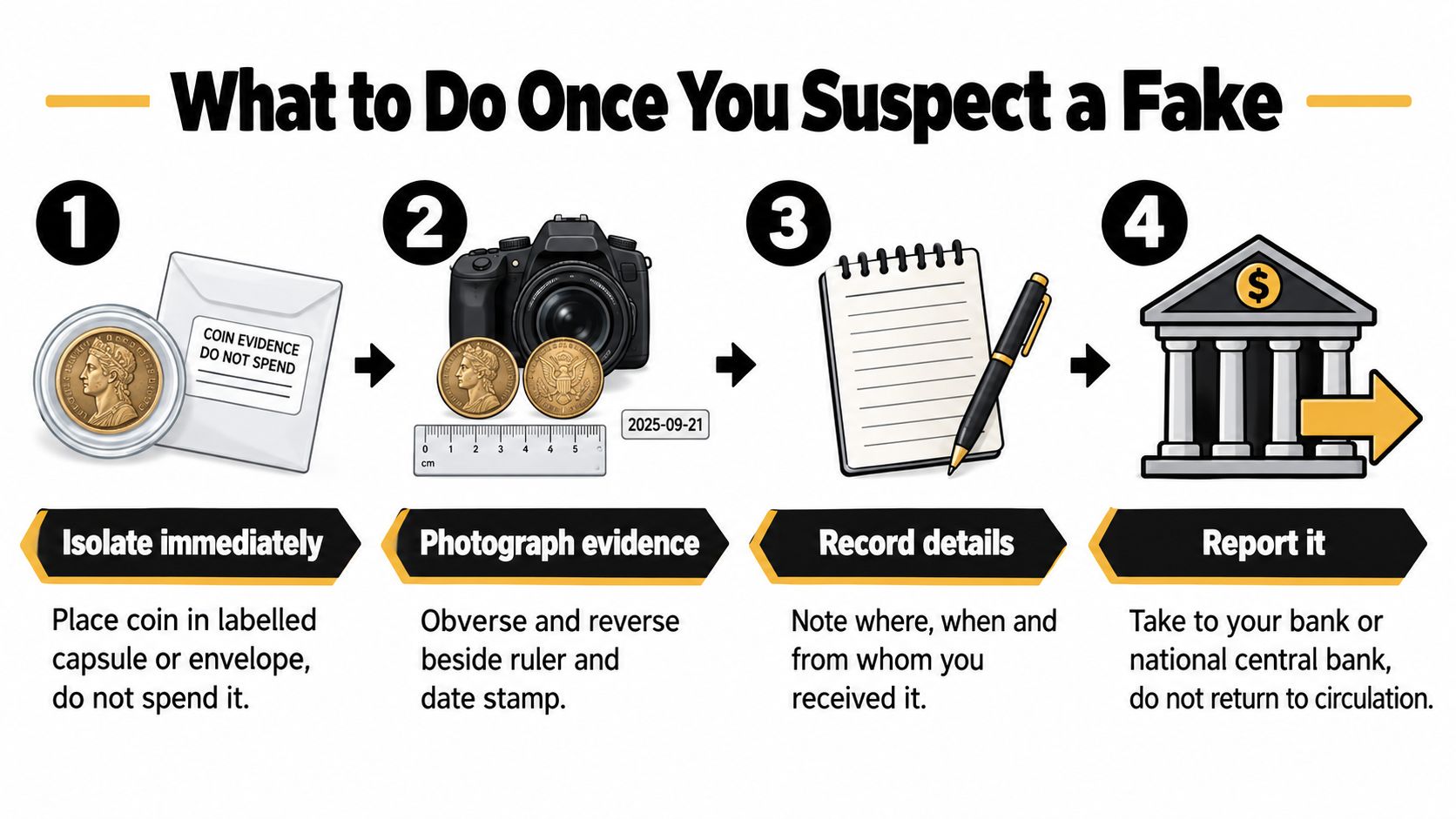
The practical mistake is letting a doubtful piece drift back into change, back into a mixed lot, or across the counter to someone else. That is how provenance gets lost and how a defensible suspicion turns into a vague hunch. Once the coin has failed enough checks to concern you, treat it as a held item and preserve what you observed.
That matters for euros in particular. EU rules expect suspected counterfeit euro coins to be withdrawn from circulation and passed through the proper official route rather than recirculated. In the UK, you are outside the eurozone but not outside the problem. Dealers, pawnbrokers, market traders, and anyone handling mixed foreign cash still need a clear record of where the coin came from, why it was set aside, and what happened to it next.
Hold it back properly
Use a simple workflow you could explain later without guessing.
- Isolate the coin at once in a paper envelope, 2x2, flip, or capsule labelled with the date.
- Record the source as specifically as you can. Till takings, holiday change, a named seller, an auction lot number, or a bulk purchase invoice is better than "mixed coins."
- Write down the reasons for concern in plain language. Near-spec weight, weak edge lettering, suspect centre-ring fit, odd colour, wrong style for the issue.
- Photograph both sides and the edge before the coin gets handled again. Include a scale reference if possible.
- Keep it out of circulation until a bank, police force, or specialist reviewer tells you otherwise.
One good note beats a confident memory. If I am looking at a returned coin a month later, I would rather see "bought in a world coin job lot, edge text broken and uneven, colour too yellow in the centre, compared against known genuine Italian issue" than "looked fake."
Do not try to prove your point by damaging it
Cleaning, filing, bending, scraping, or repeating rough magnet tests only makes the coin harder to assess and easier to dispute. A suspect coin does not need amateur forensics. It needs to stay in the same condition it was in when you first questioned it.
The handover route depends on how you came into possession of it. A private finder may start with their bank or local police guidance. A business that handles cash should follow its own counterfeit reporting procedure and keep the coin segregated from live stock. If the piece came in through a purchase, hold the invoice, screenshots, and seller details with your notes. That chain of custody is what many hobby guides miss, and it is often what protects a dealer if the question later becomes who passed the coin on.
For UK buyers and resellers, the sensible rule is simple. If you have enough reason to doubt the coin, stop trading it, document it properly, and pass it into the right channel rather than trying to make it someone else's problem.
If you buy or sell mixed world coin lots, this is exactly the sort of screening discipline that prevents expensive mistakes. Cavalier Coins Ltd offers world coins and banknotes for collectors and resellers, and its educational content covers the sort of practical comparison and authentication habits that matter when suspicious pieces turn up. If you want cleaner reference material, unusual stock, or a better feel for genuine versus suspect coins, it's worth a look.