

The Indian 50 rupee note is far more than just money; it’s a tangible piece of the nation’s unfolding story. Its design and security have evolved with every major chapter of Indian history, creating a rich legacy that stretches from the colonial era right up to the vibrant, modern banknote we use today.
Unpacking the History of the 50 Rupee Note
The story of the Indian 50 rupee note is a fascinating one, mirroring the country's own journey from a colonial subject to a modern, independent nation. It didn't begin as a purely Indian creation. In fact, its roots are deeply intertwined with the British administration, which is a big part of what makes its early history so appealing to collectors.
To really appreciate the notes in circulation today, you have to look back at where they came from. The denomination's history is directly tied to the United Kingdom, originating during the British Raj. The earliest banknotes meant for circulation in India, including the 50 rupee denomination, were actually printed in Britain and shipped over. Starting from 1861, these first imperial issues were produced in England using advanced printing techniques and the kind of specialised paper common to British currency at the time. You can see some great examples of these early British-Indian government issues over at Mintageworld.
From Colonial Symbol to National Pride
The shift from these early colonial notes to post-independence currency was a pivotal moment in the nation's history. The design of a banknote is incredibly powerful—it’s a small canvas that communicates national identity and values to millions of people every single day.
Understanding this transition is key for any collector. The changes over the decades tell a clear story:
- Colonial Era Designs: These notes featured portraits of British monarchs and symbols of the British Empire, leaving no doubt about who was in charge.
- Post-Independence Transition: Imperial symbols were replaced with distinctly Indian motifs. The most notable was the Ashoka Lion Capital, a powerful emblem of India's new sovereignty.
- Modernisation Efforts: Later series introduced more complex security features and celebrated national figures like Mahatma Gandhi, reflecting both technological progress and cultural reverence.
This evolution is what makes the note so collectable. Each series tells a different part of India’s story, from its colonial past to its aspirations as a growing global power. The changes in colour, size, and imagery aren't just cosmetic; they are deliberate choices reflecting the political and social climate of their time. For anyone interested in the bigger picture of how paper money began, you can learn more about the history of the first-ever banknote in our related article.
For a collector, a banknote is a historical document. The transition from a portrait of King George VI to the Ashoka Lion Capital on the Indian 50 rupee note isn't just a design change—it's the visual representation of independence.
By exploring this rich background, from its UK-printed origins to its modern fluorescent-blue form, you get a much deeper appreciation for why the Indian 50 rupee note is such a captivating item for numismatists worldwide.
Tracing the Evolution Through Major Series
The Indian 50 rupee note isn’t just a static piece of paper; it’s a living document that has transformed right alongside the nation itself. Each series tells a unique story, reflecting the political, cultural, and technological shifts of its time. For any serious collector, understanding this evolution is the key to appreciating the context and value of a particular note.
Think of the 50 rupee note's history as a series of distinct chapters. It started as a symbol of colonial power, then became an emblem of a newly independent nation, and finally evolved into the modern, secure banknote we recognise today. This progression offers a clear window into India's own story.
This timeline lays out the long journey of the Indian 50 rupee note, from its colonial beginnings way back in 1861 to its present-day form.
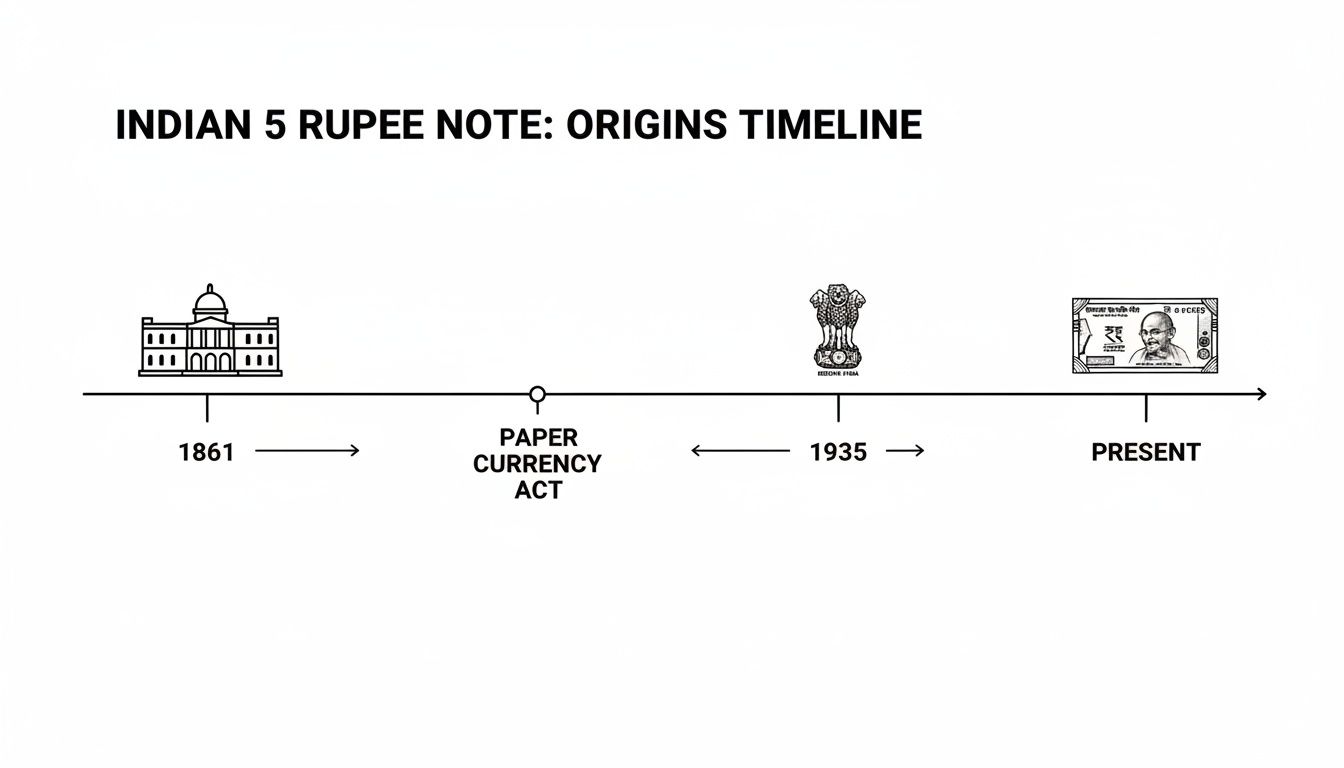
As you can see, the banknote's very identity has been continuously reshaped over more than a century and a half of history.
The British India Era
The first Indian 50 rupee notes were a product of the British Raj. These early versions, which began appearing in the second half of the 19th century, were actually designed and printed in the UK. They prominently featured portraits of British monarchs, like King George V and King George VI, and were printed on paper with elaborate designs to discourage forgery.
These notes were often quite large—sometimes called "portrait notes"—and served as a clear symbol of imperial authority. For collectors today, these early issues are incredibly sought after for their scarcity and historical weight. Finding one in good condition is a real achievement for any numismatist.
The Ashoka Lion Capital Series
After India gained its independence in 1947, there was an urgent need to replace the symbols of British rule with emblems of a sovereign nation. The first post-independence 50 rupee notes proudly featured the Ashoka Lion Capital, a powerful and ancient symbol of India's heritage.
This was a monumental shift. The design was cleaner, focusing on national symbols rather than foreign rulers. These notes were a declaration of independence in paper form, circulating a new visual language for a new country. The Ashoka series notes are a cornerstone for any collection focused on modern Indian currency.
The change from a British monarch's portrait to the Ashoka Lion Capital was more than just a design update. It was a profound statement of national pride and sovereignty, transforming the banknote from a tool of colonial administration into a symbol of a free India.
This transition period is fascinating because it captures the very moment a nation's identity was being forged through its currency.
The Mahatma Gandhi (Old) Series
For many people, the most familiar version of the 50 rupee note comes from the Mahatma Gandhi series, which was introduced in the 1990s. This series standardised the portrait of Mahatma Gandhi on the front of all denominations, creating a unified look for India's money for the first time.
The 50 rupee note in this series had a distinct pink-violet colour scheme. On the back, it featured the Indian Parliament House, a symbol of the nation's democratic principles. This series also brought in more advanced security features that we now take for granted, such as:
- A windowed security thread woven directly into the paper.
- A latent image of the numeral '50', only visible when you hold the note at an angle.
- A watermark of Mahatma Gandhi that appears when held up to the light.
This version of the 50 rupee note was in circulation for decades, becoming an everyday object for millions. Its widespread use means many variations exist—different governor signatures, inset letters—creating a rich field for collectors.
The Mahatma Gandhi New Series
The latest chapter in the note's story is the Mahatma Gandhi New Series, rolled out as part of the 2016 demonetisation initiative. This series brought a complete redesign to India's banknotes, and the 50 rupee note was no exception.
The new Indian 50 rupee note is smaller and sports a vibrant, fluorescent blue colour. Its most striking feature is the motif on the reverse: Hampi with Chariot. This UNESCO World Heritage site is a nod to India's incredible cultural and architectural history. The new series also includes the Swachh Bharat Abhiyan (Clean India Mission) logo and even more advanced security features, making it one of the most modern notes in the denomination's history.
How to Spot a Genuine 50 Rupee Note
When you hold an Indian 50 rupee note, particularly the newer fluorescent blue one, you're not just holding coloured paper. You're holding a small masterpiece of security printing, embedded with sophisticated features designed to stop counterfeiters in their tracks. Learning to spot these is easier than you might think, and it gives you the confidence to verify a note's authenticity in seconds.
Think of these security features as a banknote’s unique fingerprint. Just like a real fingerprint, the combination of these elements on a genuine note is incredibly difficult for a forger to replicate perfectly. The best part? You don't need any special equipment for most of these checks—just your eyes and your sense of touch.
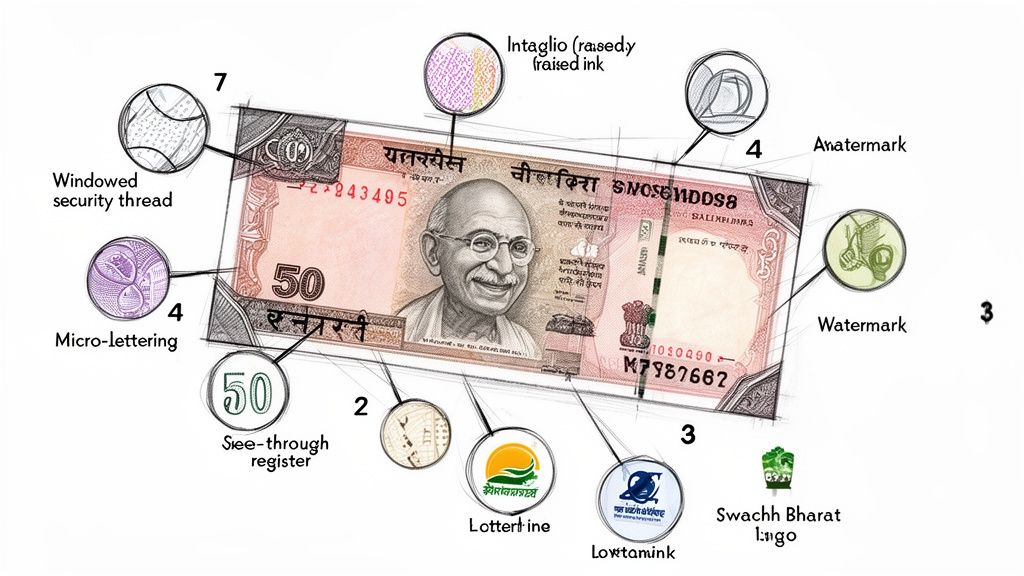
Start With the Feel
The very first and most intuitive check is to simply feel the note. A real banknote is printed on special paper made mostly from cotton, which gives it a distinct crispness that normal paper just doesn't have. More importantly, certain parts of the note are printed using a technique called intaglio printing, which leaves behind raised ink you can feel.
Gently run your finger over these areas:
- The portrait of Mahatma Gandhi
- The Ashoka Pillar emblem
- The large numeral 50 printed on the front
This tactile quality is a powerful first line of defence. It’s an expensive printing process that most counterfeiters can't mimic well, making it a reliable indicator of a genuine note.
Visual Checks You Can Do Anywhere
Beyond how the note feels, there are several visual tricks built right into the design. These elements are cleverly integrated and reveal themselves when you tilt the note or hold it up to a light source.
One of the most obvious is the windowed security thread. This is the greenish ribbon woven into the paper itself. On a genuine note, it looks like a series of broken dashes on the surface. But hold it up to the light, and it appears as a solid, unbroken line. Better yet, tilt the note and watch the thread’s colour shift from green to blue.
A genuine security thread isn't just printed on the surface; it's physically woven through the paper. This integration is a crucial detail that many forgeries fail to replicate, often settling for a simple printed or glued-on metallic strip.
Another clever feature is the see-through register. Look to the left of the watermark on the front, and you'll see half of the numeral '50'. Now flip the note over. You'll find the other half in the exact same spot. When you hold the note up to the light, these two halves align perfectly to form the complete number.
For a deeper dive into the world of banknote security, our guide on 7 essential banknote security features is a great resource.
Advanced Features for a Closer Look
If you take a moment for a closer inspection, you’ll find even more intricate details. The watermark of Mahatma Gandhi's portrait becomes visible when the note is held against the light, just to the right of his main image. You'll also see the electrotype watermark '50' alongside it.
Also, check for the latent image just below the Ashoka Pillar emblem. This is a bit of printing magic. Hold the note at eye level and tilt it slightly, and the numeral '50' will suddenly appear. It's created by the way the lines are engraved, making it visible only at a specific angle.
Finally, for the truly dedicated, there's the micro-lettering. Between the portrait of Mahatma Gandhi and the vertical band, you can find the letters 'RBI' and '50' printed in an incredibly small font. You'll likely need a magnifying glass to read it clearly, but its sharpness is a real testament to the quality of genuine currency printing.
Security Features of the Mahatma Gandhi New Series ₹50 Note
To make things simple, here’s a quick summary of the key security elements you'll find on the current fluorescent blue 50 rupee note. Use this as a checklist to authenticate your notes with confidence.
| Feature | Description | How to Check |
|---|---|---|
| Intaglio Printing | Raised ink used for key elements like the portrait, emblem, and numeral 50. | Run your finger over the print; it should feel slightly raised and textured. |
| Windowed Thread | A security thread that appears as broken dashes but becomes a solid line when held up to light. | Hold the note to a light source and tilt it to see the colour shift (green to blue). |
| See-Through Register | The numeral 50 is split between the front and back, aligning perfectly when held to light. | Hold the note up to a light source and check for perfect alignment. |
| Watermark | A subtle portrait of Mahatma Gandhi and the numeral '50' visible in the unprinted area. | Hold the note against a light source to see the images. |
| Latent Image | The numeral '50' hidden in a panel, visible only when the note is tilted at eye level. | Hold the note flat at eye level and tilt it to reveal the number. |
| Micro-Lettering | Extremely small text ('RBI', '50') printed on the note, often requiring a magnifying glass. | Use a magnifying glass to check for crisp, clear micro-text. |
By familiarising yourself with these features, you can quickly and easily distinguish a real note from a fake, protecting yourself and gaining a greater appreciation for the craftsmanship behind modern currency.
Determining Your Banknote's Market Value
So, why is one Indian 50 rupee note in your wallet worth exactly 50 rupees, while another that looks almost the same could sell for thousands at auction? The answer isn't just about age; it's a mix of factors that can turn everyday currency into a prized collector's piece.
A common myth is that old automatically means valuable. While that can be true, the real story is much more nuanced. Think of it like a jeweller appraising a diamond—tiny, almost invisible differences in quality can make a world of difference to the final price.
The Critical Role of Grading and Condition
The single most important factor in a banknote's value is its physical condition. We have a formal process for this called grading. It’s simple, really: a note that looks like it just rolled off the printing press is always going to be worth far more than one that's been folded, stained, or torn.
The grading scale goes from poor, heavily used conditions right up to a perfect, untouched state. The absolute pinnacle is Uncirculated (UNC). This is a note with zero signs of handling—no folds, no creases, crisp corners, and no blemishes. As you go down the scale to grades like 'About Uncirculated' (AU), 'Extremely Fine' (EF), and 'Very Good' (VG), the value drops with every new imperfection.
To put it in perspective:
- A common Mahatma Gandhi series 50 rupee note in a circulated 'Good' condition is probably only worth its face value.
- That exact same note in perfect UNC condition could be worth many times more to a serious collector.
Why the huge difference? Pristine, high-grade notes are incredibly rare. The moment a banknote enters circulation, it gets folded into a wallet, counted, and passed around. Finding one that has escaped this fate is what gets collectors excited.
Rarity: The Signature and Serial Number Factor
After you’ve figured out the condition, the next big driver of value is rarity. For the Indian 50 rupee note, this often comes down to two key things: the signature of the Reserve Bank of India (RBI) Governor and the note's unique serial number.
Some RBI Governors had very short terms in office, which means they signed a much smaller quantity of banknotes. A 50 rupee note with the signature of a governor who only served for a year or two is like a limited-edition print. Its scarcity alone bumps up the value. Many collectors try to build a set with a note from every governor, making those with rare signatures especially sought-after.
A banknote's signature is its historical fingerprint. It anchors the note to a specific period in India's economic history, and a rare signature can elevate an otherwise common note into a valuable artefact.
The serial number can also be a goldmine. Notes with "fancy" serial numbers are the ones to watch out for. Things like solid numbers (e.g., 666666), ascending or descending ladders (123456), or very low numbers (like 000001) are exceptionally rare and can command huge premiums from collectors.
Collector Demand: The Final Piece of the Puzzle
Finally, it all comes down to market demand. A note can be rare and in perfect condition, but at the end of the day, it's only worth what someone is willing to pay for it. Sometimes a particular series, a design, or a specific governor's signature just becomes popular, and demand can shoot up.
It’s this dance between condition, rarity, and demand that creates the true market value. A pristine, uncirculated Indian 50 rupee note with a rare signature and a fancy serial number is the collector's dream—the trifecta that can make it worth thousands of times its face value. For a deeper dive into this topic, check out our guide on how to determine the value of old paper money.
Identifying Rare Notes and Special Issues
Beyond the grade of a note, the real thrill for any collector of the Indian 50 rupee note is the hunt for special issues and rarities. This is where an ordinary banknote can become a genuine treasure. Think of it as a detective's game; all the clues you need are hiding in plain sight, right there on the note.
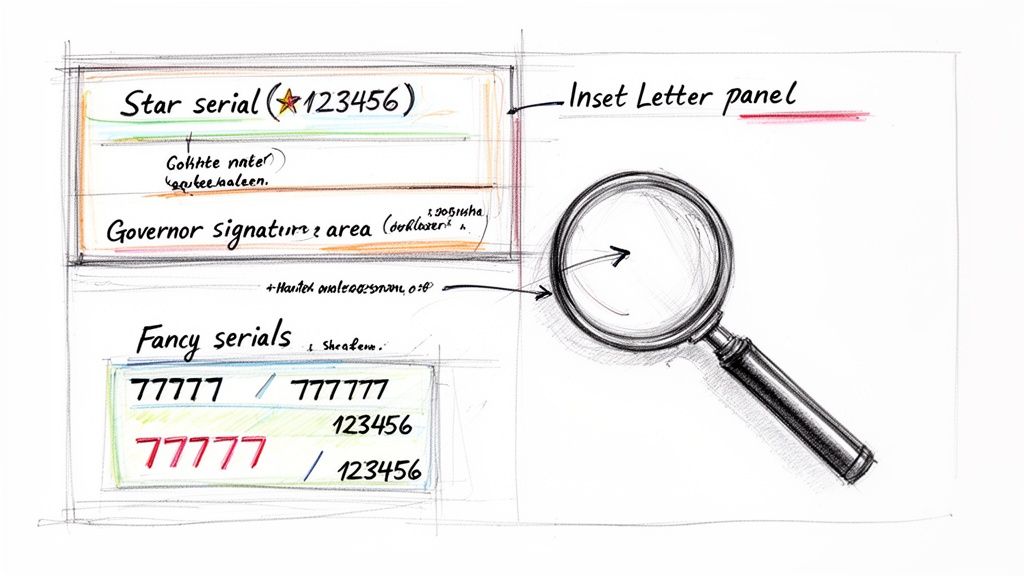
The trick is to look beyond the main design and zero in on the details that change from one print run to the next. Things like signatures, serial numbers, and tiny printed marks are where the magic happens. These features create pockets of scarcity that serious collectors are always looking for. A simple magnifying glass will quickly become your best friend in this pursuit.
The Governor’s Signature
Every single Indian banknote carries the signature of the serving Reserve Bank of India (RBI) Governor. This tiny detail is actually a massive clue to a note's potential rarity. Some governors had surprisingly short tenures, which means far fewer notes were ever printed with their names on them.
A note signed by a governor who held the post for five years will be common. But what about a governor who was only in office for a matter of weeks? For instance, Amitav Ghosh served for just 21 days. A note with his signature is exceptionally rare and highly prized by collectors. A common goal is to build a set with one note from each governor, making these short-term signatures the toughest ones to track down.
Understanding Insets and Serial Numbers
The serial number panel holds more secrets than you might think. Look closely at the background behind the six-digit number; you might spot a tiny letter printed there. This is called an inset, and it was introduced to identify which printing press produced that specific batch of notes.
For certain signature series, some inset letters are dramatically scarcer than others. Finding a note with a rare inset can make it worth significantly more than an identical note with a common inset or no inset at all.
Think of an inset as a banknote's postcode. It tells a part of its origin story, and for collectors, some "postcodes" are far more desirable and harder to find than others, directly impacting the note's market value.
The Allure of Star Notes
Have you ever come across an Indian 50 rupee note with a star symbol (★) tucked into its serial number? If so, you've found a "Star" note. These aren't printing errors; they are intentionally printed replacement notes. When a sheet of banknotes is found to have printing defects, the faulty notes are destroyed and replaced with these specially marked notes to keep the numbering sequence straight.
Because they only replace errors, Star notes are always printed in much smaller quantities than regular notes. This built-in scarcity makes them very collectable, and an uncirculated Star note is a fantastic find for any collection.
Hunting for Fancy Serial Numbers
The final piece of the rarity puzzle is the serial number itself. Collectors will often pay a huge premium for so-called "fancy" or "vanity" numbers simply because of their visual appeal and incredible rarity. Keep an eye out for these patterns:
- Solid Numbers: Every digit is the same (e.g., 555555).
- Ladder Numbers: The digits run in perfect sequence, up or down (e.g., 123456 or 654321).
- Low Numbers: The earliest numbers printed in a series (e.g., 000001).
- Radar Numbers: The number is a palindrome, reading the same forwards and backwards (e.g., 123321).
Finding a number like this on a 50 rupee note is like winning a small lottery. The probability is minuscule, which is precisely why they fetch such high prices in the numismatic community. As of the mid-2020s, with the Mahatma Gandhi New Series ₹50 note being part of a circulation valued at over INR 34.7 trillion, there's a massive pool for collectors to search through. Thanks to significant UK–India financial flows, these notes often pop up in currency exchanges abroad, giving sharp-eyed collectors even more opportunities. You can discover more insights about the Indian rupee's circulation on Wikipedia.
Building and Protecting Your Collection
Once you've got a handle on authentication and value, the real fun begins: building and looking after your collection. Here, we'll get into the practical side of things, offering some straightforward advice on how to find genuine Indian 50 rupee note specimens and keep them safe from harm.
A great collection starts with smart sourcing and proper care. Whether you're just starting out or adding to a well-established set, these tips will help you acquire and preserve your banknotes the right way.
Where to Find Authentic Notes
- Online Auctions: Big platforms like eBay are a good starting point, offering a huge selection with the safety net of buyer protection and seller ratings. Don't forget to check out specialised numismatic auction sites, too.
- Numismatic Dealers: This is often the safest route. Established dealers can provide certificates of authenticity and professional grading, giving you real peace of mind.
- Collector Forums: Joining a community of fellow notaphilists can open doors to private sales. You'll often find rare gems being traded between experienced collectors, sometimes at very fair prices.
- Charity and Bulk Auctions: Keep an eye out for these. Charities sometimes receive mixed collections as donations, letting you pick up multiple notes at a great price.
No matter where you're looking, always do your homework on the seller. Ask for high-resolution photos and don't be shy about checking their credentials before you commit to a purchase.
The Essentials of Handling and Storage
- Always wash and dry your hands before touching your banknotes. The natural oils on your skin can stain and damage the delicate paper over time.
- Use plastic or acid-free holders. This is non-negotiable if you want to prevent chemical damage, yellowing, and scuffs.
- Store one note per holder. Trying to cram too many into a binder is a surefire way to get bent corners and soft edges.
- Label everything! Note the series details and the RBI governor's signature on your storage pages. It makes finding what you're looking for so much easier.
A little bit of care in how you handle and store your notes goes a long way in maintaining their grade and making them more desirable to other collectors.
Best Practices for Preservation
- Store your collection somewhere cool and dark. Direct sunlight is the enemy of old paper, causing fading and making it brittle.
- Keep an eye on humidity. Aim for a stable level around 40–50% to stop mould from growing and to prevent the paper from warping.
- If you like to display your favourite Indian 50 rupee note rarities, rotate them regularly to limit how long any single note is exposed to light.
- Give your collection a check-up at least once a year. Look for any early signs of trouble like pests, environmental damage, or general deterioration.
Proper preservation isn't just about storage; it's about turning a piece of fragile paper into a lasting artefact that holds its value.
| Storage Option | Pros | Cons |
|---|---|---|
| Acid-Free Holders | Chemically safe, offers a crystal-clear view | Can get scratched if not handled carefully |
| PVC-Free Sleeves | Flexible and very durable | Can add a bit of bulk to your binders |
| Archival Boxes | Excellent protection from light and dust | Takes up more shelf space |
Staying on top of this ensures your collection of Indian 50 rupee note specimens stays in top-notch condition, whether you plan to display, sell, or just admire it.
Tips for Selling and Auctions
- Do your research. Check recent auction results for similar notes to get a realistic idea of what yours is worth.
- Presentation matters. Use high-quality scans or photos and write detailed descriptions, highlighting the series, signature, and condition.
- Pick the right platform. A specialised auction house is best for high-value notes, while reputable online marketplaces are great for more common issues.
- Don't forget the costs. Factor in any fees for grading services, commissions, and shipping so there are no nasty surprises.
- Network with other collectors. Sometimes the best buyer is a fellow enthusiast. Engage with collector communities to see if you can get a direct offer or arrange a trade.
A clear, honest, and professional approach will always lead to the most successful sales.
Frequently Asked Questions
Have a few questions about the Indian 50 rupee note? You're not alone. Here are some clear, straightforward answers to the questions we hear most often, covering everything from what drives value to where you can sell a rare find.
What Makes an Old 50 Rupee Note Valuable?
It’s a common misconception that age is the only thing that matters. In reality, the market value of an old Indian 50 rupee note comes down to a few key factors: its physical condition (the grade), how rare the RBI Governor's signature is, and any unusual features it might have.
A crisp, uncirculated note without a single fold or sign of wear will always be worth more than a heavily used one. Notes signed by a governor who had a very short tenure are especially scarce and highly prized by collectors. It's all about supply and demand.
Special features can dramatically increase a note's worth. A 'Star' in the serial number, marking it as a replacement note, or a simple printing error can turn an ordinary banknote into a serious collector's item. Rarity is what truly drives value beyond the number printed on the note.
How Can I Identify the New 50 Rupee Note?
Spotting the latest Indian 50 rupee note is easy once you know what to look for. As part of the Mahatma Gandhi New Series, its design is a complete departure from the older versions. The most obvious giveaway is its vibrant, fluorescent blue colour—a stark contrast to the old pink-violet notes.
Flip it over, and you'll see the Hampi with Chariot motif, a beautiful nod to India's rich cultural heritage. The new note is also physically smaller than its predecessors, measuring just 66 mm by 135 mm.
Where Is the Best Place to Sell a Rare Indian Note?
If you have a genuinely high-value or rare note, your best bet is a reputable numismatic auction house. They offer professional grading and give you direct access to a network of serious collectors who are prepared to pay top prices for the right pieces.
For notes that are less rare or fall into the mid-value category, online marketplaces like eBay can work well. The key to success there is taking excellent, high-resolution photos and writing a detailed, accurate description. You could also connect with specialised dealers or join online collector forums to sell directly to other enthusiasts.
Whether you're just starting your collection or hunting for that one elusive piece, Cavalier Coins Ltd offers a curated selection of world banknotes and coins. Explore our collection today at https://www.cavaliercoins.com.