

Finding a large 50p coin in a handful of change can stop a collector in their tracks. The familiar shape is there, but the coin feels heavier and broader than the modern pieces in circulation. If the reverse shows an invasion fleet moving towards Normandy, you may have found the 1994 Normandy Landings 50p, a coin that combines an important wartime anniversary with a major change in British decimal coinage.
The difficulty starts when an online listing calls every example a “D-Day 50p”. The 1994 circulation issue and the 2019 Brilliant Uncirculated reissue share a historical theme, but they aren't the same product, format or market category. Before assessing condition or value, identify which coin you have, establish whether it was made for circulation or collectors, and separate an ordinary example from a proof or presentation-pack issue.
The Historical Significance of the D-Day 50p
The 1994 coin commemorated the 50th anniversary of the Normandy Landings, the Allied invasion that began on 6 June 1944 as part of Operation Overlord. The Royal Mint describes D-Day as the largest amphibious military assault in history, giving the coin a subject that carries significance well beyond the usual appeal of a commemorative design. A collector holding one isn't merely handling an old decimal coin. They're holding a small public memorial to the operation that opened the Allied campaign in Western Europe.
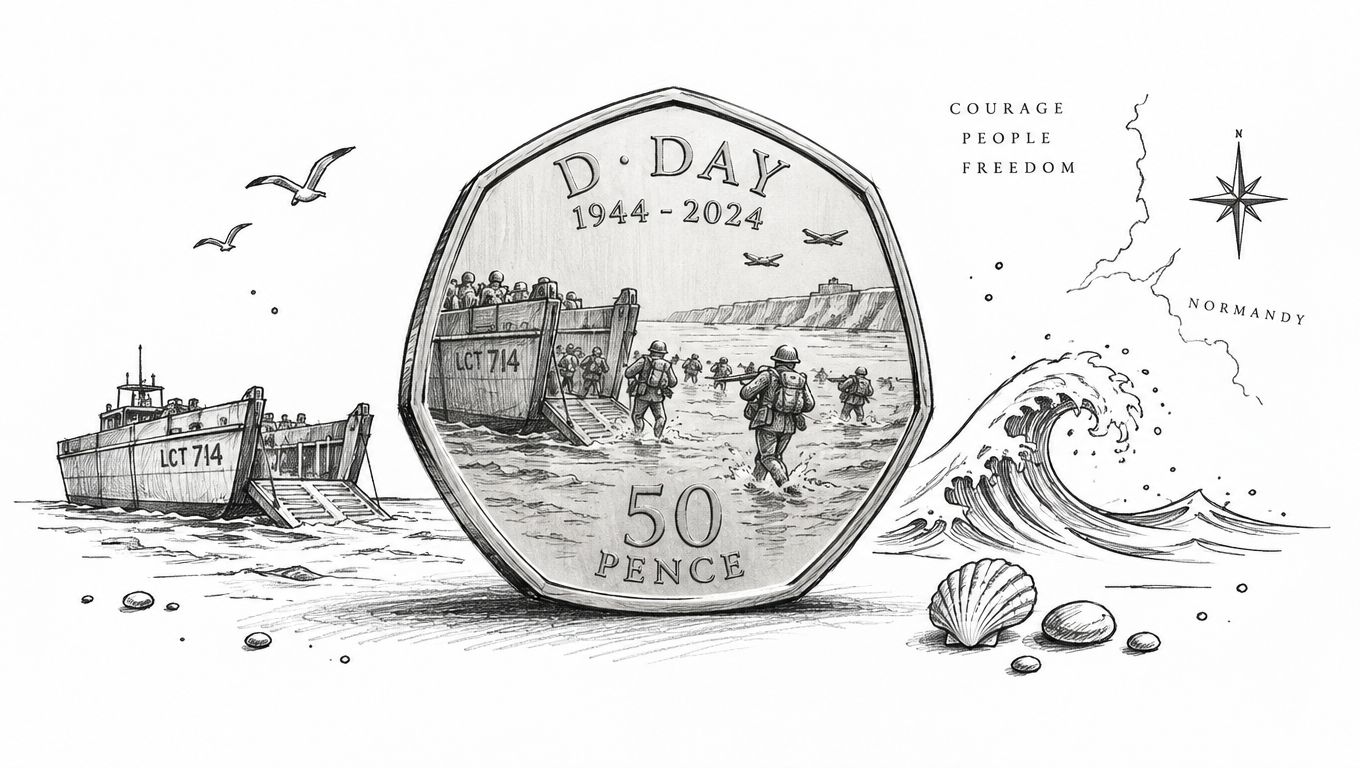
The reverse, designed by John Mills, shows the Allied invasion force advancing across the sea and sky towards Normandy. The denomination, 50 PENCE, is incorporated into the design, while the composition conveys movement, scale and the danger of the crossing. It's a more narrative reverse than many commemorative 50p designs, which helps explain why the coin attracts both decimal specialists and collectors focused on military history.
A circulating memorial
The 1994 issue matters because it was made as a circulation coin, not solely as a boxed collector product. That distinction gives it a different relationship with the public. Examples could be encountered in everyday transactions, handled without ceremony and later removed from ordinary use as the large 50p format disappeared.
The larger format was subsequently demonetised in 1998, so the coin is no longer found in ordinary change. The Royal Mint's account of the 50p series places the D-Day issue at an important point in that transition, since it was the final commemorative 50p produced in the original large format before the smaller version appeared.
Collector's perspective: The appeal isn't based on rarity alone. The coin combines a recognisable historical event, an expressive reverse and a physical format that no longer circulates.
That combination creates a durable collecting audience. A British-history collector may want the coin because it marks D-Day. A decimal specialist may want it because it represents the end of the large 50p era. A set builder may seek both the original circulation issue and the later collector reissue, but should record them as separate entries rather than treating them as interchangeable examples.
Design Details and the Large Format Transition
The first attribution test is physical. The 1994 Normandy Landings 50p measures 30 millimetres in diameter, making it visibly larger than the modern 50p. The Royal Mint introduced the smaller 50p design on 1 September 1997, and the D-Day issue stands as the final commemorative 50p made in the original large format. These details are confirmed in the Royal Mint's guide to 50p coin designs.
A seller may use “old 50p” loosely, but a serious attribution should begin with the date and diameter. A 1994 date paired with a 30 mm diameter points towards the large circulation issue, subject to checking the finish and provenance. A coin described as 1994 but measuring like a modern 50p deserves closer examination before any purchase decision.
Reading the reverse
John Mills' reverse is the principal visual identifier. It depicts the Allied invasion force moving towards Normandy across the sea and sky, with the landing operation presented as a coordinated advance rather than a single portrait or emblem. The imagery gives the design documentary force. Ships, aircraft and troops are brought together in a composition that communicates the scale of the undertaking.
The denomination is written as 50 PENCE, an important detail for anyone comparing photographs or checking a heavily worn example. On a genuine coin, the lettering, date and design should sit naturally within the broad flan. Blurring caused by wear is different from weak, uneven or suspiciously soft lettering that appears unrelated to normal circulation.
Reading the obverse
The obverse carries the portrait of Queen Elizabeth II by Raphael Maklouf, consistent with the reign and period in which the coin was issued. The obverse should be assessed alongside the reverse, not used as a substitute for measuring the coin. Date, diameter, design and surface quality form the useful attribution group.
The transition to the smaller format is more than a change in appearance. It divides the 50p series into collecting categories. Large-format pieces belong to the earlier decimal era and can show the handling associated with circulation. Modern-format pieces may look similar in photographs but belong to a later production system, with different dimensions and, in the case of the 2019 D-Day issue, a different distribution method.
1994 Mintage Figures and Collector Variants
The phrase “1994 Normandy Landings 50p” covers several related products. The main circulation issue had a published mintage of 6,705,520 pieces, or approximately 6.7 million coins, according to the Royal Mint's 50p mintage figures. That is a substantial production run compared with the very lowest-mintage modern 50p releases, so a normal circulated example shouldn't be described as exceptionally scarce just because it commemorates D-Day.
Mintage, however, isn't the only factor collectors use. The large format, the coin's removal from ordinary circulation and the strength of the subject all add collecting interest. The circulation issue sits alongside much smaller Brilliant Uncirculated, silver-proof and gold-proof versions. Those products can look similar in a listing photograph while representing very different levels of production and preservation.
| Format / Finish | Mintage Figure | Collector Category |
|---|---|---|
| Circulation issue | 6,705,520 | Base-metal commemorative circulation coin |
| Brilliant Uncirculated | Approximately 178,000 | Premium collector issue |
| Silver proof | 40,000 | Precious-metal proof issue |
| Gold proof | Approximately 2,000 | Precious-metal proof issue |
| Gold proof, Royal Mint limited issue | 1,877 | Separately recorded limited edition |
The figures for the BU, silver-proof and approximately 2,000 gold-proof examples come from specialist production records summarised in the verified mintage information, while the Royal Mint separately records the gold-proof edition as a limited issue of 1,877 coins. The distinction matters because “about 2,000 gold proofs” and “1,877 Royal Mint limited-issue gold proofs” shouldn't automatically be treated as competing descriptions of an identical product.
Why the category matters
A circulated base-metal coin and a proof coin have different buyer expectations. The circulation piece is judged for wear, rim knocks, scratches, colour and overall eye appeal. A proof is judged in relation to its original finish, packaging, certificate or other evidence of issue. A BU example occupies another position, with the emphasis on mint condition and the way it was distributed.
The most common costly mistake is to see the D-Day design and assume that the coin must belong to the rarest variant. A seller may use a low proof mintage in a listing for an ordinary circulated coin, or describe a worn example as BU. Check the product before considering its price.
Practical rule: Record the issue type first, then the condition. A condition grade can't correct a mistaken attribution.
For a collection record, note the 1994 date, 30 mm diameter, reverse designer, finish, packaging and any proof documentation. Those fields make it easier to compare like with like and prevent a standard circulation strike from being valued against a precious-metal issue.
The 2019 Reissue and Military Collection Context
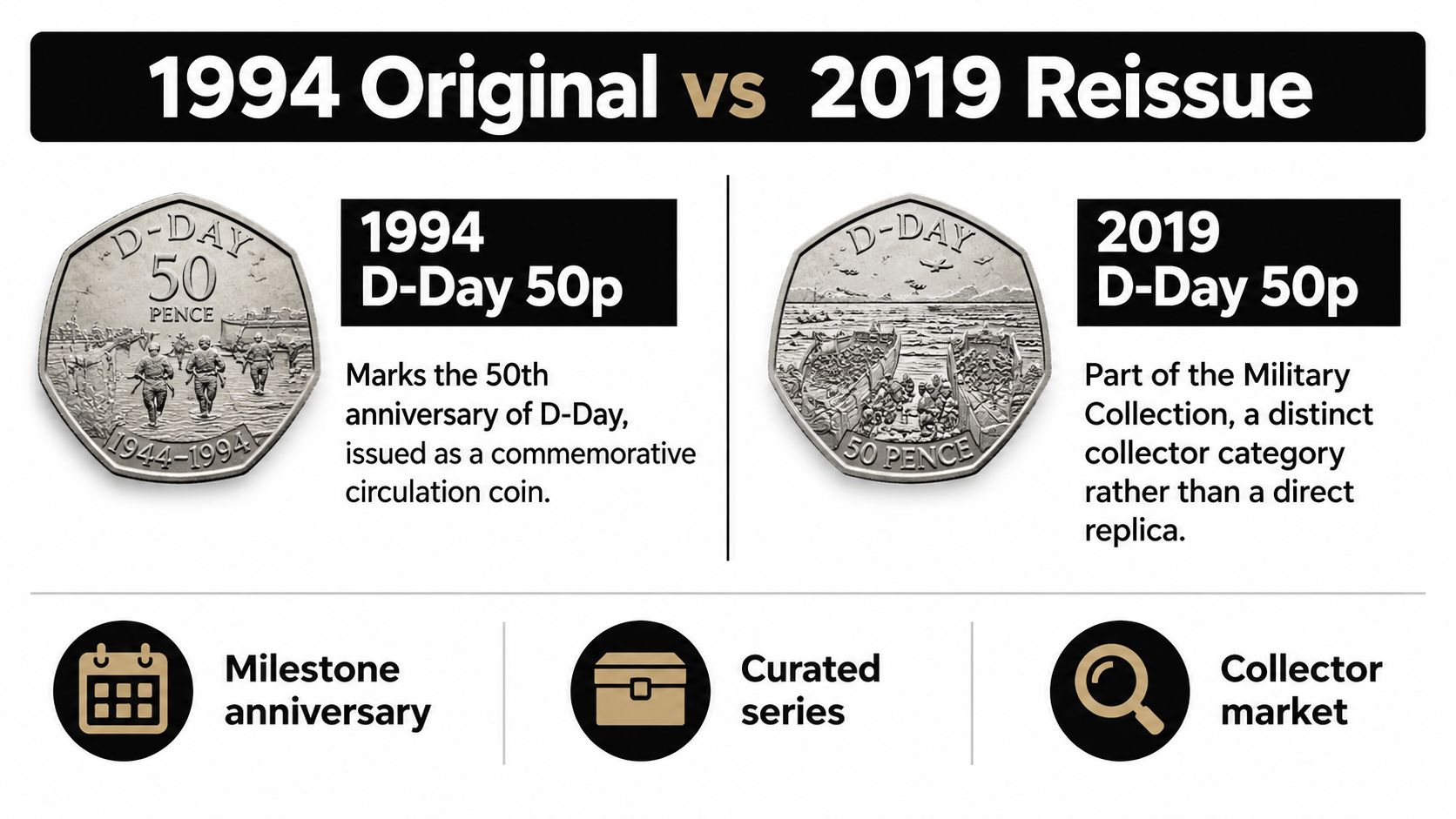
A collector comparing a worn 1994 D-Day 50p with a sealed 2019 example is handling two different products, even though both carry the John Mills design. Treat the 2019 D-Day 50p as a Brilliant Uncirculated commemorative issued for the 75th anniversary, rather than as a later circulation version of the 1994 coin. It was not released into general circulation. Specialist records list zero circulation pieces and approximately 32,402 BU examples, including 9,902 coins in Royal Mint presentation packs and 22,500 distributed through other official packaging, as recorded by Coin Hunter's 2019 D-Day Landings entry.
The distribution route affects both buying decisions and attribution. A loose 2019 coin can still be genuine BU, but a sealed presentation pack gives stronger evidence of the issue category and preserves the relationship between coin, packaging and original release. A coin showing handling marks is not automatically misidentified, although its condition, storage history and listing description deserve closer examination.
The specification separates the issues
The 2019 reissue follows the modern 50p specification, cupro-nickel, 8 grams and 27.3 millimetres in diameter, while the 1994 coin uses the earlier large 30 mm format. The British fifty pence overview provides context for these format differences and describes the later military commemorative group. Measurements remain more reliable than photographs, which can make unlike coins appear similar.
The reverse design connects the issues historically, but it does not make them interchangeable. The 1994 piece was a commemorative circulation coin for the 50th anniversary. The 2019 piece was a non-circulating BU product for the 75th anniversary, issued within a broader military collecting programme.
The linked overview describes reissued military designs covering D-Day, the Victoria Cross, the Battle of Britain and the Battle of Hastings. That context places the 2019 D-Day issue alongside related military commemoratives, rather than treating it as a replacement for the original circulation coin. For a wider view, see this guide to military coins of the UK.
Ask what you're collecting
The appropriate comparison depends on the collection's purpose:
- Historical event: The 1994 coin represents the original large-format anniversary issue. The 2019 coin records a later anniversary through a collector-only release.
- 50p development: The 1994 example belongs to the large-format era, while the 2019 piece uses the smaller modern format.
- Military collection: The 2019 coin fits naturally with the other reissued military designs, rather than serving as a direct substitute for the 1994 circulation coin.
- Packaging and condition: Presentation packs and sealed official packaging help identify the 2019 category and protect its original state.
Comparing an unboxed, circulated 1994 coin with a sealed 2019 BU pack produces a misleading market comparison. The shared theme does not erase the differences in production route, dimensions, finish and buyer appeal.
Authentication and Condition Assessment Strategies
Authentication begins with attribution, not a magnifying glass. Before inspecting tiny details, establish whether the date, size and stated issue agree. The basic comparison is clear: the 1994 issue is 30 mm, while the 2019 reissue is 27.3 mm, with the latter also specified as 8 grams and cupro-nickel in the modern format.
A practical inspection sequence
- Measure the diameter. Use digital callipers if available, or a ruler with a clear millimetre scale. A supposed 1994 coin that measures like the smaller modern piece needs a provenance check, and a supposed 2019 coin showing the large format has likely been misdescribed.
- Check the date and reverse. Confirm that the coin carries the relevant year and the John Mills D-Day design. Compare lettering, date placement and the general relationship between the design and rim rather than relying on a single small feature.
- Inspect the edge and rim. Large-format circulation pieces are vulnerable to knocks around the rim. A genuine circulated coin can have contact marks, but a sharp impact should be recorded separately from wear across the main design.
- Review the seller's description. Ask whether the coin is a circulation issue, BU, proof or presentation-pack product. If the listing uses “rare” without identifying the finish, packaging or issue category, treat the description as incomplete.
- Compare photographs carefully. Look for consistent lighting and images of both sides and the edge. A single heavily edited image can't establish condition or authenticity.
The coin authentication services guide offers useful context for collectors who need professional assessment. Specialist review becomes particularly sensible when a listing claims a proof or precious-metal variant, when the surface appears altered, or when the asking price reflects scarcity that the description hasn't demonstrated.
Condition without seller exaggeration
A circulated 1994 coin should be judged by what remains on the highest design points, the amount of friction across the fields, the sharpness of the lettering and the state of the rim. Dirt isn't automatically patina, and bright colour isn't proof of a superior grade. Cleaning can leave hairlines or an unnatural surface that reduces appeal even when the design looks crisp in a small photograph.
A BU 2019 coin should retain the look expected of an uncirculated collector strike. Handling marks, fingerprints, scratches or damaged packaging affect how confidently it can be presented as original BU stock. Don't confuse an attractive photograph with a documented finish.
Inspection habit: Photograph the coin beside a scale, record the diameter and save the original listing before you make an offer. Good records protect you when the description changes later.
Market Value Drivers and Investment Potential
There isn't one meaningful market value for the Normandy Landings 50p. The correct question is, which issue is being valued, in what condition, with what evidence of origin? A worn 1994 circulation strike, a carefully preserved large-format example, a 2019 BU coin in a presentation pack and a gold proof belong to different comparisons.
The 1994 circulation issue benefits from a strong historical theme and from its place in the changeover from the large 50p to the smaller format. Its removal from ordinary use in 1998 also gives collectors a clear reason to encounter it through dealers, collections and secondary-market listings rather than everyday change. That interest doesn't make every example rare. The substantial circulation mintage means condition and presentation still do important work.
The 2019 market operates differently. The coin wasn't released into general circulation, so its value is tied more closely to limited collector production, packaging, provenance and preservation. A sealed presentation pack can communicate issue history, while a loose example requires more careful description. The coin's historical link to D-Day supports demand, but packaging and condition determine whether one listing is comparable with another.
What helps and what doesn't
Helpful factors include:
- Correct attribution between 1994 and 2019.
- A clearly identified finish, especially for BU and proof products.
- Original presentation packaging where relevant.
- Clean photographs showing both sides, the edge and any damage.
- A realistic description of circulation wear.
- Provenance that supports the seller's issue classification.
Weak selling points include:
- Calling every D-Day 50p “rare”.
- Using the 2019 BU production figure to promote a 1994 circulation coin.
- Describing a large-format coin as a modern 2019 issue without measuring it.
- Treating a polished or cleaned coin as mint condition.
- Comparing a loose coin with a sealed pack without explaining the difference.
Collectors building a wider thematic set may find the guide to rare 50p coins useful as a comparison point, but rarity lists only help when the underlying products are correctly identified. For long-term collecting, the strongest strategy is usually disciplined attribution and sound storage rather than buying a poorly described coin because a headline promises exceptional returns.
Sourcing and Storing Your D-Day Collection
Buy the coin described, not the story attached to it. Established numismatic dealers and reputable auction houses can provide clearer attribution, photographs and packaging information than an anonymous marketplace listing. That doesn't make every dealer's description infallible, so retain the same habits: check the date, measure the format, confirm the finish and ask for evidence when the listing claims a scarce variant.
For an online purchase, request photographs of the obverse, reverse and edge. If the seller won't show the rim or avoids answering whether the piece is a circulation strike, BU or proof, the uncertainty should affect your decision. A low price doesn't compensate for a coin that can't be attributed confidently.
Storage for the large-format issue
The 1994 coin should be kept in an inert holder made for numismatic material. Avoid loose storage with other coins, where contact marks can accumulate, and don't place the piece in soft plastic that may react with the metal over time. Handle it by the edge with clean, dry hands, and avoid rubbing the surfaces to improve brightness.
A suitable storage routine is straightforward:
- Separate the pieces: Keep the large-format coin away from heavier or sharper objects.
- Protect the rim: Use a holder that prevents the edge from contacting the case.
- Control handling: Hold the coin by its edge and return it to its holder after inspection.
- Keep records: Note the issue type, condition, source and any packaging.
- Avoid cleaning: Leave attractive original surfaces alone unless a qualified professional advises otherwise.
The 2019 BU issue deserves a different approach. Keep a presentation-pack example in its original Royal Mint packaging, since the pack helps establish how the coin was distributed and protects the intended collector presentation. Don't remove a sealed item merely to compare it with a loose 1994 coin. Photograph the packaging and store it upright or flat in a stable, dry environment where it won't be crushed or exposed to damp.
Selling becomes easier when the collection record is complete. State whether the coin is 1994 or 2019, give the correct diameter, identify the finish, disclose wear and show the packaging. A buyer can then compare your listing with similar objects instead of guessing what “D-Day 50p” means.
Cavalier Coins Ltd offers collectors a changing selection of rare and unusual coins and banknotes, including themed UK pieces and limited-availability items through fixed-price listings and weekly eBay auctions. Visit Cavalier Coins Ltd to source accurately described additions to a Normandy Landings 50p collection, discuss bulk purchases or explore options for monetising coins you no longer need.