
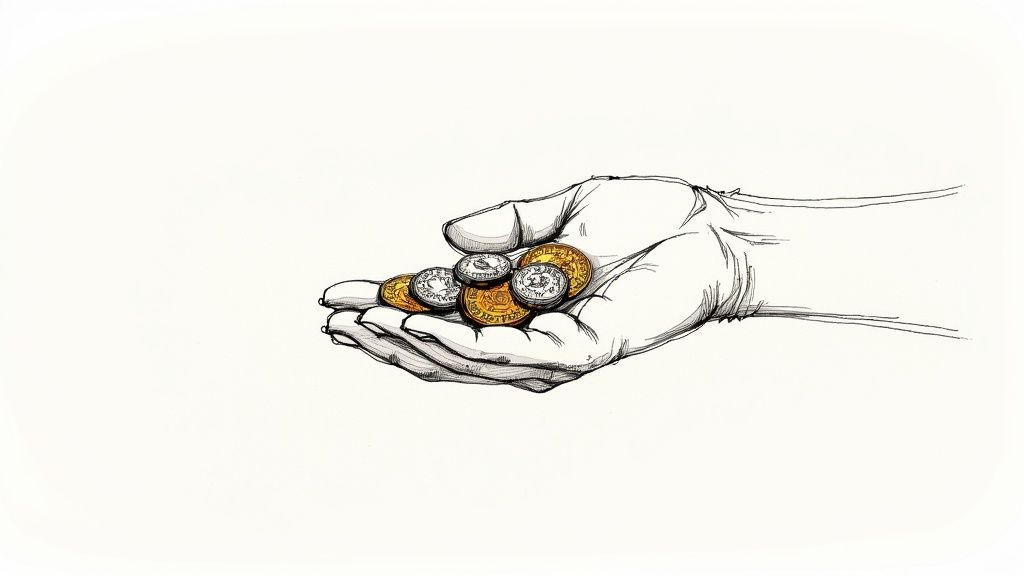
Old English coins are so much more than bits of old metal; they're tiny, touchable pieces of history. When you hold one, you're creating a direct link to the monarchs, merchants, and ordinary folk who made and spent it centuries ago.
These remarkable artefacts tell incredible stories of power, faith, and daily life, from the earliest Anglo-Saxon silver sceattas to the magnificent gold of the Tudor dynasty.
Your Journey into Old English Coinage
Welcome to the captivating world of old English coins. Think of this guide as your map, designed to turn you from a curious beginner into a knowledgeable enthusiast. We're going to peel back the layers and show you how each coin is a miniature historical document.
Together, we'll explore how these metallic objects helped forge kingdoms, broadcast royal power, and greased the wheels of commerce for people hundreds of years ago. It’s a journey that wonderfully combines history, art, and the simple thrill of discovery.
The story of English coinage is a long and winding one, stretching back over a millennium. It doesn’t start with grand gold pieces, but with humble silver pennies that helped knit together a patchwork of Anglo-Saxon kingdoms into the nation we'd eventually call England. Those early coins set a standard that would echo across Europe for centuries.
As we travel through time, you'll see this story unfold:
- The Anglo-Saxon Era: Witness the birth of the silver penny, the true economic workhorse that underpinned medieval society for generations.
- The Norman Conquest: See how coinage instantly reflected a dramatic and brutal shift in power and governance after 1066.
- The Tudor Dynasty: Discover the introduction of spectacular gold coins like the Sovereign, designed to project England's growing wealth and prestige onto the world stage.
The artistic progression from crude, early hammered coins to the more refined, machine-made milled pieces is plain to see. Each step forward reflects the technological and cultural shifts of its time, and understanding this evolution is the key to appreciating the story behind every coin you hold.
More Than Just Money
It's vital to see these coins not just as old money, but as potent symbols of identity and authority. For a population that was largely illiterate, the portrait of the king or queen on a coin was often the only image they would ever see of their ruler.
It was a tangible piece of the state that they could hold in their own hand. To dig deeper into this, have a look at this brief history of British coins which provides more context on their cultural significance.
My hope is that this guide ignites your curiosity, turning a simple hobby into a profound historical exploration. Let's get started.
How the Silver Penny Forged a Kingdom
To really get your head around old English coins, you have to start with the silver penny. This was much more than just a piece of currency; for almost 500 years, it was the very engine of medieval England's economy. And its story begins not in London, but in the mighty Anglo-Saxon kingdom of Mercia, where a forward-thinking ruler laid the groundwork for a monetary system that would last for centuries.
It was King Offa of Mercia who introduced his broad, thin silver penny back in the late 8th century. He created a coin that people could trust, one that was reliable in both its weight and its silver content. This standardisation was a complete game-changer. It built confidence in the money, allowing trade to thrive not just within Mercia but across all the fractured Anglo-Saxon kingdoms.
The Tower Pound: A Standard of Value
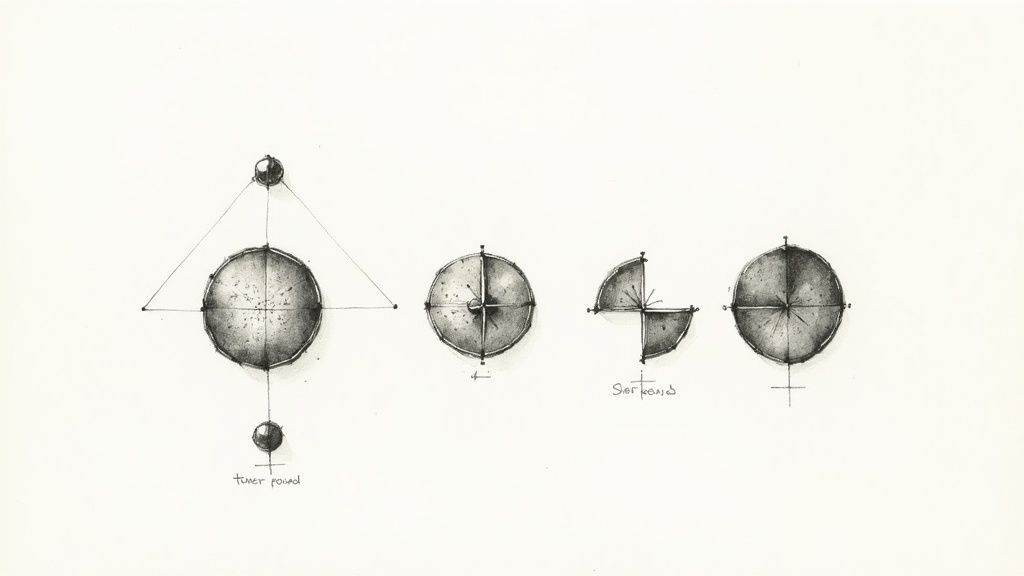
Offa's greatest legacy was tying his new penny to a fixed unit of weight. You can think of it like a modern standard of measurement, like a kilogram or a litre. For medieval England, this core unit was the tower pound, a standard of weight used at the Royal Mint, which at the time was housed in the Tower of London.
The system was beautifully simple. A tower pound of silver was divided into precisely 240 pennies. This direct link between a coin's value and the actual silver it contained gave the economy a certainty it had been sorely lacking. Offa fixed his penny's weight at 22½ troy grains—roughly 1.46 grams—making it the cornerstone of Old English coinage. This structure, which took cues from the Carolingian system, established the framework of 12 pence to a shilling and 20 shillings to a pound that would define British money for centuries.
This reliability was so powerful that the penny long outlasted Mercia's reign. When the Normans stormed England in 1066, they didn't scrap the currency. Far from it. They saw how well it worked and adopted it, continuing to mint silver pennies to the same established standard. This was a clever move that helped to unify the kingdom's economy under its new rulers.
The silver penny was more than money; it was a tool of unification. Its consistent weight and widespread acceptance helped dissolve regional economic barriers, binding a conquered nation together through shared commerce.
Daily Life and Small Change
Back then, a single penny held serious buying power – it could get you several loaves of bread or even a chicken. But what about smaller purchases? For centuries, there were no official smaller coins. So, how did ordinary folk buy something worth less than a whole penny?
The solution was surprisingly direct: they just cut the coins up.
- Halfpennies: To create a halfpenny (ha'penny), a penny was carefully sliced in half. The cross on the reverse design often served as a handy guide.
- Farthings: For even smaller transactions, the penny was cut into four equal quarters, creating "fourthings," which we now know as farthings.
This common practice of making "cut coinage" really shows you just how valuable even a fraction of a silver penny was to the average person. It’s also why finding a perfectly whole, well-struck hammered penny from this period is such a treat for collectors. So many of them were clipped, cut, or simply worn smooth through centuries of hard use.
The penny's design changed over time, with one of the most famous updates being the "long cross" design. This cross extended right to the coin's edge, a clever feature designed specifically to make it obvious if a cheat had tried to clip a bit of silver off the side. For those keen on the details, a closer look into old British penny values provides a complete reference guide for today’s collectors.
From its birth under Offa to its key role in the bustling markets of Norman England, the silver penny wasn't just part of the economy—it was the very foundation on which the kingdom’s commercial life was built, one transaction at a time.
The Arrival of Gold and Tudor Prestige
For centuries, the English economy ticked along to the reliable beat of the silver penny. It was the workhorse of daily commerce – practical, trusted, and understood by all. But as England’s influence grew, silver alone wasn't enough to broadcast the monarchy's rising power. A shift was needed towards a metal that screamed wealth, ambition, and international clout: gold.
This move from functional silver to statement-making gold wasn't just a change in the Royal Mint's production line; it was a powerful piece of political theatre. The first gold coins marked a new era where the currency in your pocket was a tool of royal propaganda, designed to dazzle rivals and command respect.
A Golden Experiment: The First Penny of Gold
Long before the Tudors, the first major leap into gold coinage was a bold but ultimately doomed experiment. In 1257, King Henry III introduced a stunning gold penny worth 20 silver pence. It was a landmark moment and hailed as Britain’s first proper gold coin, but it was met with resistance from merchants who found it impractical for everyday trade.
Production was tiny, and the coin was quickly withdrawn. As a result, only a handful exist today, making it one of the most legendary rarities in British numismatics, with most examples locked away in museums.
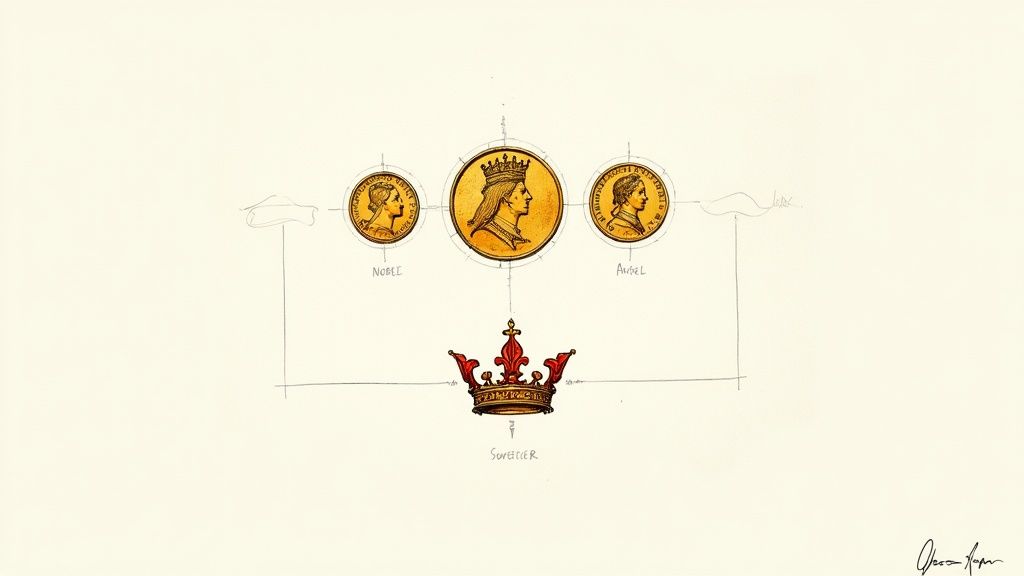
It took almost another century for gold to stick. King Edward III’s magnificent Gold Noble, introduced in 1344, was a different story entirely. This large, impressive coin, showing the king on a ship, was built for international trade and quickly became one of Europe’s most respected currencies. England had arrived on the world stage.
Tudor Gold: Propaganda in Your Pocket
The Tudor dynasty truly mastered the art of using coins as a political statement. When Henry VII seized the throne, he introduced a spectacular new gold coin that would become the ultimate symbol of royal might: the Sovereign.
First minted in 1489, the Sovereign was the largest and heaviest English coin ever made at the time. Its design was pure political messaging:
- The Obverse: Showcased King Henry VII enthroned in full coronation gear, holding his orb and sceptre. The image left no one in any doubt about who was in charge.
- The Reverse: Featured the iconic Tudor Rose, the symbol of the union between the houses of Lancaster and York. It was a clear declaration that the bloody Wars of the Roses were over.
The Tudor Sovereign was more than just money; it was a daily proclamation of power and stability. Every transaction with a Sovereign reinforced the legitimacy and grandeur of the Tudor monarchy, turning a simple coin into a piece of portable propaganda.
Another famous gold coin of the era was the Angel. First introduced by Edward IV, it became incredibly popular under the Tudors. Its design, featuring the Archangel Michael slaying a dragon, was thought to bring good luck and even possess healing powers. Monarchs would present these coins during a ceremony known as the "royal touch" to "cure" the sick, tying the crown directly to divine authority.
These old English coins, from the Noble to the Sovereign, are some of the most beautiful and historically significant pieces a collector can find. Their value isn't just in the gold content but in the powerful stories they tell of ambition, art, and the forging of a nation. If you're interested in how this legacy continues, our guide to sovereign coin values offers a deeper look.
Right, so you're holding a piece of history in your hand. That's the easy part. The real magic is learning to read its story. Identifying old English coins can feel like a tall order at first, with their curious lettering and crude portraits, but it's a skill anyone can pick up. You just have to think like a historical detective. By looking at a few key features, you'll start to unlock the secrets of who made your coin, where it came from, and when.
First things first, you need to know about the two ways these coins were made. For hundreds of years, every single coin was hand-hammered. Imagine a craftsman placing a metal blank between two engraved dies, then striking the top one with a hammer. That one forceful act created the coin. This method is why early coinage has such character – the charmingly irregular shapes, off-centre designs, and varied strike quality are all part of the story.
The alternative is milled coinage, which came into its own in the 17th century after some earlier trial runs. This process used machinery to churn out perfectly round, uniform coins. For this guide, though, we’re diving into the hammered era, where every coin is a one-of-a-kind, handmade artefact.
Decoding the Monarch's Portrait
The most glaring clue is usually on the obverse (the "heads" side): the monarch's portrait. Even though the earliest depictions can be almost comically stylised, they are your number one signpost to a coin's age. The style of these portraits changed dramatically over the centuries.
For instance, the portraits of the early Anglo-Saxon kings are often incredibly basic, sometimes looking like little more than a stick-figure bust. Fast forward to the Norman kings like William the Conqueror, and the portraits become more defined, often showing a monarch facing forward and holding a sceptre. Later still, during the Plantagenet era, you start to see more sophisticated side-profile portraits emerge.
A coin's portrait is its royal signature. For most people, it was the only image of their king or queen they would ever see, making it a powerful symbol of authority and a vital tool for dating the coin.
Reading the Inscriptions and Legends
The text circling the portrait is known as the legend. It’s almost always in Latin and tells you who the ruling monarch was. Getting the hang of these inscriptions can be a bit of a challenge thanks to archaic letterforms and abbreviations, but it's incredibly satisfying when it clicks.
Here are a few common things to look for in a legend:
- Monarch's Name: Keep an eye out for names like HENRICUS (Henry), EDWARDUS (Edward), or ELIZABETH.
-
Royal Title: Phrases like
REX ANGL(King of England) orD G ANG FR ET HIB REX(By the Grace of God, King of England, France, and Ireland) tell you a lot about the monarch's power and claims. - Roman Numerals: You'll often see Roman numerals (e.g., III, VIII) following the name, letting you know which Henry or Edward you're looking at.
Learning to read the legends is a bit like learning a new language. You'll begin by recognising a few key phrases and, before you know it, you'll be confidently identifying rulers and their specific titles.
Finding the Mintmark and Moneyer
Flip the coin over. The reverse holds the clues about where your coin was born. For much of the hammered period, the design was built around a cross, which had a practical purpose: it served as a handy guide for cutting pennies into halfpennies and farthings. But if you look closely, there's more information hiding in plain sight.
The legend on the reverse often names two critical people or places: the moneyer (the individual responsible for the coin's quality) and the mint town where it was struck. A coin might read WILLEM ON LUND, for example, which simply translates to "William in London." This tells you the moneyer was a fellow named William, and he worked at the London mint.
This system gives us a fascinating window into the medieval economy. While the major mints were in big centres like London, Canterbury, and York, dozens of smaller, regional mints were also operating at various times. The weight and production of the silver penny were pillars of Old English monetary stability. This whole tradition started with Offa's 8th-century standard of 22½ grains per penny, which works out to 240 pennies to the tower pound—a standard quite different from the later troy pound. Hand-hammered dies were the only way to do it until Elizabeth I introduced milled coins, though the old ways died hard. You can discover more insights into the history of UK coins and their production methods on Physical Gold.
By putting these three clues together—the portrait, the legend, and the mint information—you can piece together a complete identity for your coin. You'll be able to work out which king or queen issued it, roughly when it was made, and where in England it began its long journey through time.
Grading Condition and Spotting Fakes
For any collector, getting a handle on the value and authenticity of old English coins are two of the most vital skills you can develop. These two factors—condition and genuineness—are what separate a prized historical artefact from a worthless piece of metal. Understanding them not only helps you appreciate a coin’s true story but also protects you from making expensive mistakes on your collecting journey.
Think of a coin's condition, or grade, as its report card. It’s a snapshot of how much wear and tear the coin has picked up over hundreds of years. The grading scale for hand-hammered coins is a bit different from modern coinage, as it focuses more on the clarity of the design that’s left.
A coin's market value boils down to a mix of its rarity, historical significance, and, most importantly, its condition. A common silver penny in poor shape might not be worth much at all, but find that same coin with a sharp, clear strike, and it could be exceptionally valuable.
Understanding Hammered Coin Grades
Grading isn't an exact science, especially with coins made by hand, but it does follow a generally accepted spectrum. The main goal is to describe how much of the original detail, struck by a hammer all those years ago, is still visible.
Here’s a simplified breakdown of the common grades you'll encounter:
- Fine (F): The main design elements are there—you can make out the monarch's portrait and the cross on the reverse. However, much of the finer detail and most of the legend will be worn smooth.
- Very Fine (VF): This is a big step up. The portrait is much clearer, and you should be able to read at least half of the legend. The coin definitely shows it's been in circulation, but it still holds a good deal of its original character.
- Extremely Fine (EF): Now we're talking. The details are sharp and clear, with only the slightest hint of wear on the highest points of the design. Nearly all the legend is legible, giving the coin a really pleasing look.
- Uncirculated (UNC): The holy grail. This is a coin that looks as though it just left the mint. It shows no signs of wear and still has its original lustre—a true rarity for any piece of old English coinage.
This flowchart breaks down the key things to look for when you're first trying to figure out what you've got.
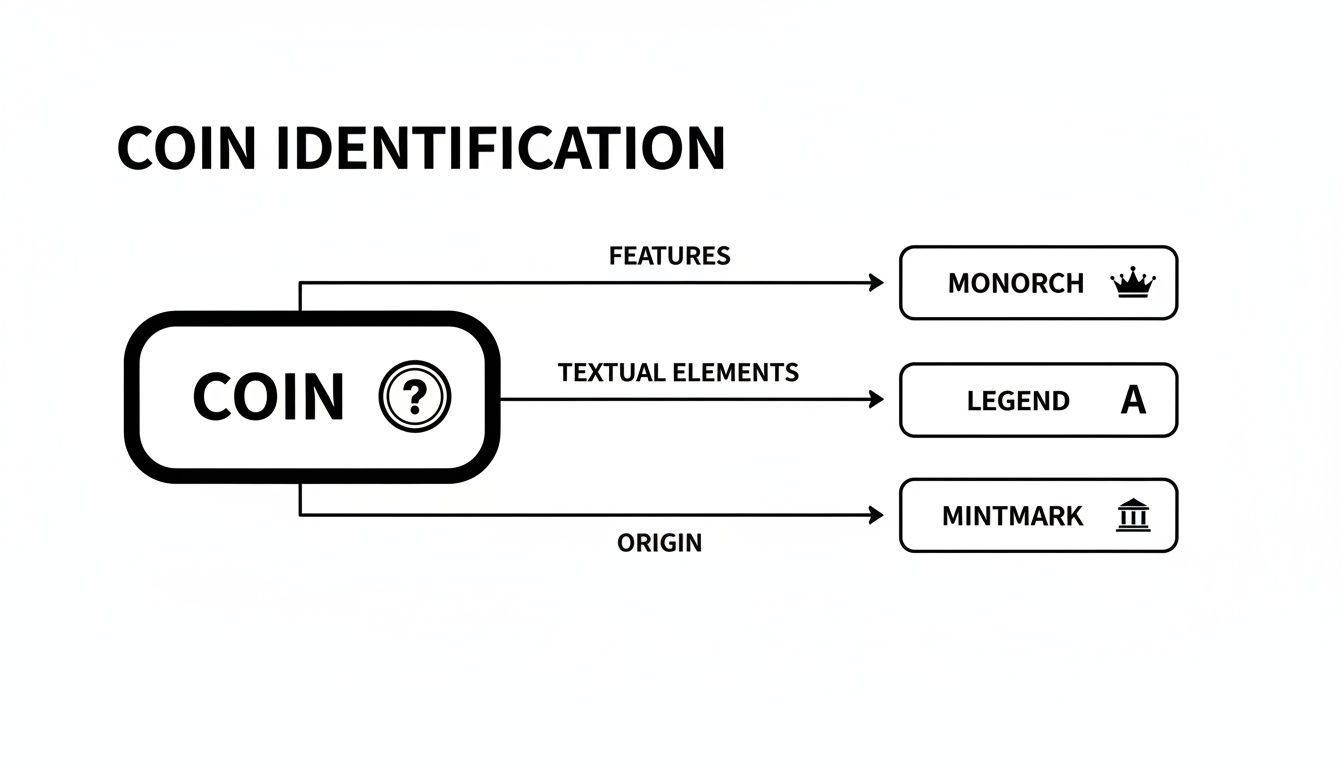
As this guide shows, identification starts with the monarch, legend, and mintmark—all of which become much easier to read on higher-grade coins.
How to Spot Common Fakes
Unfortunately, wherever there's value, forgeries are sure to follow. Learning to spot fakes is absolutely crucial. While some modern forgeries can be incredibly sophisticated, many fakes—both old and new—share common red flags that you can learn to recognise.
Authenticity is the bedrock of any collection. A fake, no matter how convincing, has no numismatic value. Developing a keen eye for detail is your best defence against deception.
Here are the key things to look out for when you're examining a potential purchase:
- Mushy or Soft Details: Real hammered coins were struck with immense force, creating sharp, well-defined details. Many fakes are cast in moulds, which leaves them with a softer, almost 'soapy' look where the lettering is indistinct and the portraits are fuzzy.
- Casting Seams: A cast fake is often made by joining two moulds together. Look very, very closely at the edge of the coin. If you see a thin line or seam running around its circumference, that’s a dead giveaway. A genuine struck coin will never have one.
- Incorrect Weight and Size: Every type of coin was minted to a specific weight standard. It’s worth investing in a small digital scale and callipers. If a coin is significantly lighter or heavier than it should be for its type, it's almost certainly a fake.
- Wrong Style or Lettering: Forgers sometimes slip up. They might use a style of portrait, crown, or lettering that is completely wrong for the period. Comparing the coin in your hand to verified examples in reference books or online databases is your best tool for catching these errors.
How to Build Your First Collection
So, you’re ready to dive into the world of old English coins. It’s an incredibly exciting journey, but looking at centuries of history all at once can feel a bit much. The real secret to getting started, and sticking with it, is to find a focus.
Rather than just buying coins at random, it’s far more rewarding to have a clear strategy. This simple shift in mindset turns a pile of metal into a curated story—your story. A focused collection isn't just more satisfying to build; it often becomes more valuable in the long run, too.
Choosing Your Collecting Path
There’s no "right" way to collect coins. The best path is always the one that genuinely fascinates you. Think of it like a detective quest; when you have a specific goal, the hunt for the next piece of the puzzle becomes a thrill.
Not sure where to start? Here are a few popular approaches:
- Focus on a Monarch: Pick a king or queen whose story grabs you. Maybe it’s the long and influential reign of Edward I, or the powerful era of Elizabeth I. Your mission would be to find different denominations, types, or mint marks from their time on the throne.
- Create a Type Set: This is a fantastic way to see history unfold. The goal is to get one good example of each major coin type from a specific period. For instance, you could build a silver penny "type set" to watch how the cross on the reverse evolved over several reigns.
- Specialise in a Period: If a particular slice of history calls to you, lean into it. You could focus on the chaotic Wars of the Roses or the artistically brilliant Tudor dynasty. This lets you explore the coinage of multiple rulers within a rich historical backdrop.
Think of your first collection as your own personal museum. Choose a theme that tells a story you want to uncover. Whether it’s the saga of a single ruler or the economic shifts of an entire century, that personal connection is what will make this a lifelong passion.
Where to Safely Acquire Coins
Once you’ve got a plan, the next step is finding coins from sources you can trust. The market for old English coins is a place where you need to keep your wits about you. Bargains are out there, but authenticity and fair pricing should always come first.
- Reputable Dealers: This is the best place to start. Established coin dealers offer their expertise, guarantee that what you're buying is genuine, and can often help you track down specific coins for your collection.
- Auctions: Auctions, both online and in person, are where you’ll find some of the rarest and highest-quality pieces. It's an exciting environment, but remember to factor in the buyer's premium and set a hard budget for yourself before the bidding starts.
- Online Marketplaces: Sites like eBay have a massive selection, but you have to be extra careful. Always buy from sellers with a long, consistent track record of positive feedback for coins. Scrutinise every photo and read the full description before even thinking about placing a bid.
And finally, the last piece of the puzzle is proper storage. Always handle your coins by their edges to protect the surfaces from the oils on your skin. Keep them in acid-free holders or albums to make sure they stay in great condition for generations to enjoy.
A Few Common Questions About Old English Coins
Jumping into the world of Old English coins is exciting, but it naturally brings up a lot of questions. Let's tackle some of the most common queries that pop up for new collectors, so you can build your knowledge and collect with more confidence.
What Is the Oldest English Coin I Can Realistically Collect?
For most people starting out, the most attainable ancient English coins are the silver pennies from the late Anglo-Saxon era, particularly from the 10th and 11th centuries. It’s often a surprise to new collectors that coins from kings like Aethelred II (978-1016) are actually quite available.
Even older coins like sceattas exist, but these pennies give you a direct, physical link to a time over 1,000 years ago without being impossibly rare or expensive. Getting your hands on one is a brilliant first step for any collection.
How Do I Know If My Old Coin Is Genuine?
Learning to spot a fake is a skill that comes with experience, but there are definitely a few key signs a beginner can look for. Genuine hammered coins were struck with immense force, which gives them sharp, well-defined details. Fakes, on the other hand, are often cast from a mould, and this process leaves clues.
Keep an eye out for these common red flags:
- A soft or 'mushy' look: Cast fakes just don't have the crisp, sharp details of a genuinely struck coin.
- A casting seam: Check the coin's edge very carefully for a faint line. This is a dead giveaway that it came from a mould.
- Incorrect weight: Get a good reference guide and compare your coin’s weight to verified examples. If it's significantly off, that's a major warning sign.
When you have a serious doubt, the best thing to do is always get an opinion from a reputable dealer or a professional third-party grading service. Their expertise is your best defence against counterfeits.
Are Old English Coins a Good Investment?
It’s always wisest to approach this as a fascinating hobby first, and an investment second. While the market for top-quality, rare Old English coins has been strong over the years, values can and do go up and down. For most collectors, the real payoff is the sheer enjoyment and historical connection.
That said, if investment is a key driver for you, the strategy should be to focus on acquiring high-grade examples of important, rare coins. And always, always prioritise buying from trusted sources. This ensures you're getting an authentic coin at a fair market price.
What's the Difference Between Hammered and Milled Coinage?
These terms simply describe the two main ways coins have been made throughout history.
'Hammered' coinage is the ancient, manual technique. A blank piece of metal was sandwiched between two dies, and then a moneyer would strike the top die with a heavy hammer. This hands-on process is why hammered coins are so often irregular in shape and have off-centre designs.
'Milled' coinage is the machine-driven process that began to take over in England during the 16th and 17th centuries. This new technology produced perfectly round coins with even, consistent strikes and often decorated edges—a huge leap forward in minting.
At Cavalier Coins Ltd, we are passionate about helping both new and experienced collectors find exceptional pieces of history. Explore our curated selection of old English coins and world banknotes to discover the perfect addition to your collection. Visit our online store to start your numismatic journey today.