
For over thirty years, the familiar round pound coin was a cornerstone of British currency. First minted in 1983 to take over from the short-lived £1 banknote, these coins tell a rich story of UK heritage through their ever-changing designs, right up until they were withdrawn in 2017.
The Story Behind the Original Round Pound
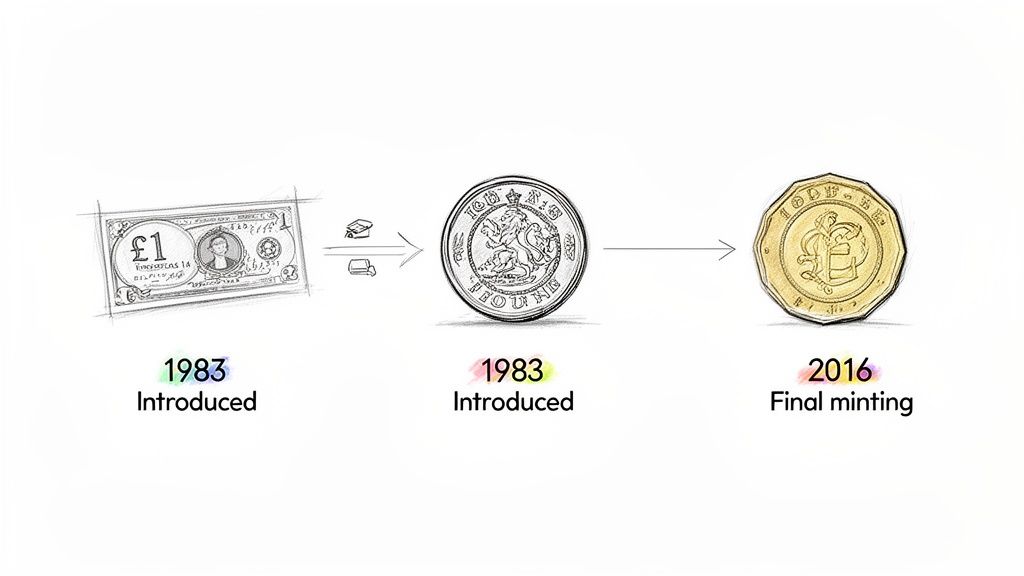
The journey of the round £1 coin started as a simple, practical fix to an everyday annoyance. Back in the early 1980s, the green £1 banknote had a terrible reputation for durability, often lasting just nine months before it was too worn out to use. The Royal Mint needed something tougher that could handle the demands of daily circulation.
When the original round £1 coin arrived in 1983, it marked a major shift in our currency. To make sure the changeover went smoothly, The Royal Mint went into overdrive, producing an incredible 985,000,000 coins in the first year alone. This huge initial run ensured there were plenty of coins to go around as the old banknote was gradually phased out, a process that was finalised when it was officially withdrawn on 11th March 1988.
But this new coin was more than just a replacement; it became a miniature canvas for national pride. Across its 34-year lifespan, the reverse designs were updated almost every year, showcasing the unique symbols and heritage of the United Kingdom's constituent nations: England, Scotland, Wales, and Northern Ireland.
To give you a quick snapshot of the coin that defined an era, here are its key specifications.
Quick Guide to Old Pound Coin Specifications
Here's a quick rundown of the technical details for the standard round pound coin. This table is a handy reference for quickly identifying these classic pieces.
| Attribute | Specification |
|---|---|
| Years of Issue | 1983–2016 |
| Demonetised | 15th October 2017 |
| Diameter | 22.50 mm |
| Weight | 9.50 grams |
| Thickness | 3.15 mm |
| Composition | Nickel-brass (70% copper, 24.5% zinc, 5.5% nickel) |
| Edge | Milled with incuse lettering |
| Obverse Design | Portrait of Queen Elizabeth II (three versions) |
| Reverse Designs | 24 standard designs, plus various commemorative issues |
This basic information is the foundation for any collector looking to dive deeper into the world of the round pound.
Why It Became an Icon
The round pound quickly wove itself into the fabric of daily life. Its reassuring weight and distinct golden colour made it instantly recognisable in any handful of change. For many, it felt like a more permanent and dependable form of money than the flimsy note it replaced.
This long history has cemented its place in Britain's monetary story. To see where it fits in the bigger picture, you can explore a brief history of British coins and understand the broader context of these changes.
The retirement of the round pound in 2017 didn't just mark the end of an era; it sparked a nationwide treasure hunt. As people began tipping out their change jars, a whole new appreciation for the different designs and their relative rarity started to emerge.
From Pocket Change to Collectable
What was once just ordinary cash is now a piece of history. The moment old pound coins were demonetised, they transformed from everyday money into collectable items. This sudden shift created a wave of interest, drawing in everyone from seasoned numismatists to casual collectors hoping to complete a set.
There are a few key reasons for its enduring appeal:
- Nostalgia: The coin is a time capsule for anyone who used it between 1983 and 2017.
- Variety: With dozens of different reverse designs, it offers a rich and achievable collecting goal.
- Accessibility: Plenty of people still have old pound coins tucked away in savings jars, drawers, and old coat pockets.
Getting to know this coin's story is the first step in appreciating its real value. It's more than just a piece of metal; it’s a tangible link to over three decades of British economic and cultural life.
Decoding the Designs on Old Pound Coins
Old pound coins are more than just currency; they're miniature canvases telling the story of the United Kingdom. From 1983 until the last "round pound" was struck in 2016, the reverse (the ‘tails’ side) changed almost every year. This created a rich tapestry of designs celebrating the heritage of the four home nations.
Think of each coin series as a chapter in a book. Every chapter follows a distinct theme, but they all contribute to the overarching story of British identity. Learning to spot these designs is the first step in turning a simple handful of change into a historical map of the UK.
The Inaugural Royal Arms Series
The journey began with the very first £1 coin, issued in 1983. It set the stage with a powerful and unifying symbol: the Royal Arms of the United Kingdom. This grand design represents the sovereignty of the monarch and, by extension, the entire nation. It features a quartered shield held up by the English lion and the Scottish unicorn.
This design was so foundational it became a recurring theme, appearing again in 1993, 1998, 2003, and 2008. A slightly different version, the Shield of the Royal Arms, was introduced in 2008 and was the final design used on the round pound until its last issue in 2015. This consistency makes the Royal Arms one of the most familiar faces for any collector of old pound coins.
The Floral Emblems of the Home Nations
Starting in 1984, The Royal Mint kicked off a five-year cycle celebrating the unique floral emblems of each constituent country. This series brought a welcome touch of nature and regional pride to the nation's pockets, making the coins feel more personal and representative.
The theme was so popular that it was repeated with different designs later on, proving the enduring appeal of these national symbols.
- Scotland (1984 & 1989): The Thistle, a prickly but beautiful plant that has been Scotland's national emblem for centuries.
- Wales (1985 & 1990): The Leek, a symbol tied to Saint David, the patron saint of Wales, representing deep-rooted Welsh heritage.
- Northern Ireland (1986 & 1991): The Flax Plant, which was vital to the historic linen industry, was chosen for its economic importance.
- England (1987 & 1992): The Oak Tree, a classic symbol of strength and endurance, represents England, with a Royal Diadem nestled in its branches.
These intricate designs were the work of Leslie Durbin, a renowned silversmith. His artistry brought a new level of detail to UK coins, making them particularly enjoyable pieces for collectors to study up close.
The Heraldic Beasts and Symbols
After the floral series, The Royal Mint launched a new cycle in 1994 that dived into the world of heraldry. These designs explored the centuries-old symbols associated with each nation, pulling from historic coats of arms and royal standards. Each coin felt like a piece of ancient history you could hold in your hand.
- Scotland (1994): The Lion Rampant, a fierce lion standing on its hind legs, lifted straight from the Royal Banner of Scotland.
- Wales (1995): The Welsh Dragon, or Y Ddraig Goch, a powerful and iconic symbol of Welsh identity and folklore.
- Northern Ireland (1996): The Celtic Cross and Broighter Collar, a design combining ancient Christian symbolism with exquisite Iron Age art.
- England (1997): The Three Lions, more accurately called 'three lions passant guardant', a classic English royal emblem that dates all the way back to Richard the Lionheart.
These designs are often praised for their bold, striking appearance. While they don't feature specific mint marks, understanding how these small but significant details can impact a coin's identity is a key skill for any collector. You can learn more about how to identify them by checking out our guide on what mint marks are on coins and why they matter.
The Bridges Series and Beyond
The final major series, launched in 2004, shifted focus from nature and heraldry to engineering and connection. The Bridges series celebrated iconic structures from each of the four home nations, brilliantly symbolising the links between them.
This series included:
- Scotland (2004): The Forth Rail Bridge, a true marvel of Victorian engineering.
- Wales (2005): The Menai Suspension Bridge, which connects the island of Anglesey to the mainland.
- Northern Ireland (2006): The Egyptian Arch Railway Bridge in Newry.
- England (2007): The Gateshead Millennium Bridge, a modern tilting bridge and an icon of the North East.
By getting to know these distinct series—the Royal Arms, the flora, the heraldic symbols, and the bridges—you can quickly identify and sort any old pound coins you come across, building a much deeper appreciation for their rich and varied designs.
How to Spot Rare and Valuable Old Pound Coins
Right, you’ve got the hang of telling the different series apart. Now the real fun begins—the treasure hunt. The secret to finding the most valuable old pound coins isn’t just about the cool design on the back. It comes down to one simple thing: how many were ever made. This is what separates everyday pocket change from a genuine collector's prize.
In the world of coin collecting, rarity is king. And for the round pound, rarity is almost always dictated by its mintage figure. This is just the official number of coins for a specific design and year that The Royal Mint pumped out into circulation. A low mintage figure means fewer coins are floating around, making them much harder to find and, you guessed it, a lot more desirable.
Why Mintage is the Key to Value
Think of it like a limited-edition print from an artist. They might release a standard poster with thousands of copies, which is nice but not particularly valuable. But a special, signed run of only 50 prints? That’s going to be worth a whole lot more. Old pound coins follow the exact same logic. A coin with a mintage in the tens of millions is common as muck, but one with a mintage under a million is something special.
The Royal Mint didn't just churn out the same number of coins each year; production levels went up and down depending on what the economy needed. This created a few accidental rarities along the way. Some years saw absolutely massive production runs, while others were surprisingly small, giving us the low-mintage gems that collectors are always hunting for.
The chart below gives you a quick visual breakdown of the three major design themes that defined the coin's 34-year history: the Floral Emblems, the Royal Arms, and the Bridges series.
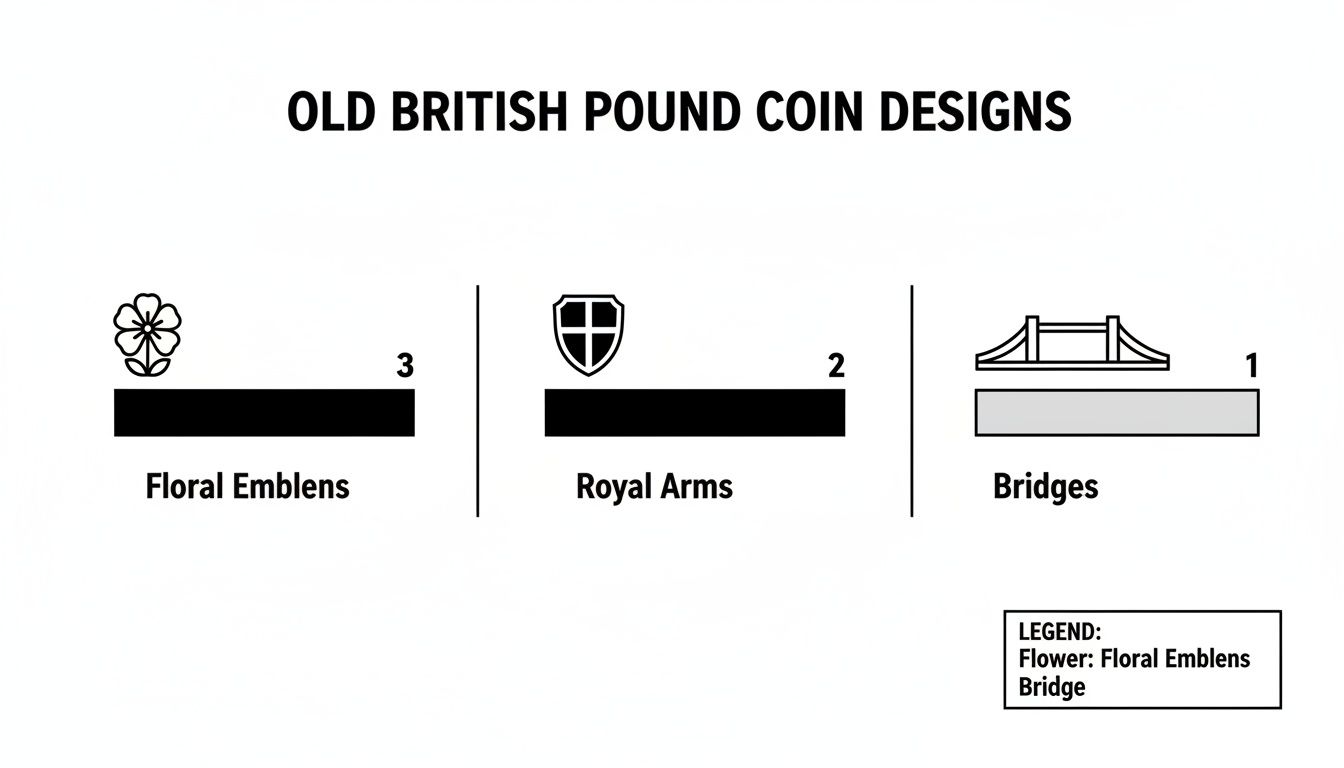
Getting familiar with these themes is the first step. Once you can categorise your coins, you're ready to start digging into the numbers to see if you have a winner.
The Rarest Old Pound Coins Ranked by Mintage
Some pound coins are famously difficult to track down, purely because so few were ever minted. If you stumble across one of these in an old change jar or down the back of the sofa, you’ve hit the jackpot. These are the coins that consistently sell for well above their face value.
To help you spot the true rarities, here’s a table of the round pounds with the lowest mintage figures. These are the ones to really keep an eye out for.
| Year and Design | Mintage Figure | Estimated Value Range |
|---|---|---|
| 2011 Edinburgh City | 935,000 | £10 - £15 |
| 2011 Cardiff City | 1,615,000 | £8 - £12 |
| 2010 Belfast City | 2,185,000 | £5 - £8 |
| 2010 London City | 2,635,000 | £5 - £8 |
| 2008 Royal Arms Shield | 3,910,000 | £4 - £6 |
As you can see, the 2011 Edinburgh City £1 is the undisputed champion of rarity, being the only round pound with a mintage figure under one million. Finding one in good condition is a fantastic achievement for any collector.
While the table highlights the top contenders, a few other notable coins are worth a mention:
- 1988 Crowned Shield: This one catches a lot of people by surprise. The Royal Arms shield design is very common, but the 1988 version had a comparatively low mintage of just over 7 million. It’s much scarcer than its counterparts from other years.
Of course, mintage isn't everything. A coin's condition is just as crucial. A shiny, uncirculated Cardiff City £1 will always be worth significantly more than one that’s been rattling around in pockets and purses for a decade.
And sometimes, value doesn't come from low production numbers but from a simple mistake at the mint. These "error coins" can be incredibly rare and sought-after. If you're interested in learning more about these fascinating flukes, check out our guide to discover valuable error coins and their hidden treasures.
By paying close attention to mintage figures, you start to move beyond just collecting pretty designs and begin to think like a true numismatist. You learn to spot the statistical outliers—the coins that are the hidden gems of UK pocket change. That knowledge is your best tool for sorting through any pile of coins and confidently picking out the ones that are truly worth something.
A Practical Guide to Grading Your Coins
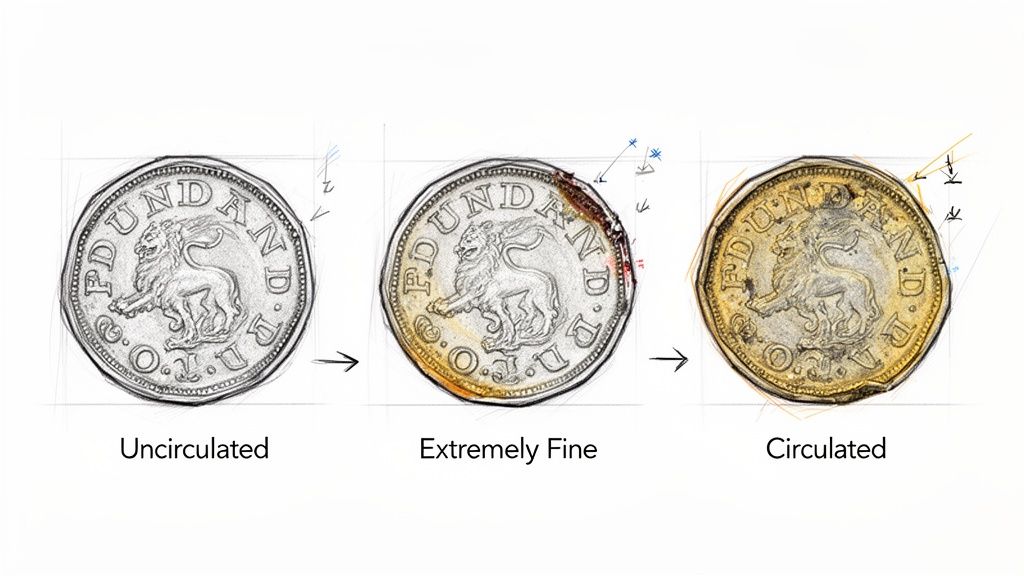
Beyond the mintage numbers, the single biggest factor driving the value of an old pound coin is its physical condition. In the world of coin collecting, we call this its grade. You could have two identical coins, from the very same year, but they could have wildly different values based entirely on how much life they’ve seen.
I like to use the classic car analogy. Imagine a vintage motor with only a few miles on the clock, flawless paintwork, and a perfect interior. It will always be worth more than the same model that’s been a daily runabout for a decade, covered in dings and scratches. Coins are exactly the same. The closer a coin is to the day it left the mint, the more a collector is willing to pay.
Learning to judge a coin's condition is a fundamental skill for any collector. It helps you value what you have, spot a bargain when you're buying, and understand why some coins fetch a premium while others are just worth their face value.
Understanding the Key Grading Tiers
Coin grading can seem a bit intimidating at first, full of jargon. But for old round pounds, you can boil it down to a few key categories. Each one is just a label for a different level of wear, from absolutely perfect to heavily used.
These are the main grades you’ll come across, explained in simple terms:
- Uncirculated (UNC): This is a coin in perfect, mint condition. It has never been jangling around in someone’s pocket and shows no wear, scratches, or marks. It will have its original mint lustre—that unique, almost cartwheeling shine that brand-new coins have.
- Extremely Fine (EF): A coin in this grade has only seen a tiny bit of circulation. All the main design details are crisp and clear. You might spot a few minuscule scratches or a slight dulling of the shine if you look closely, usually on the highest points of the design.
- Very Fine (VF): This coin has definitely been in circulation but has been well looked after. The design is still clear, but you can see obvious, moderate wear on the high points, like the Queen’s hair or the most intricate parts of the thistle or lion on the back.
- Fine (F): At this point, the coin is showing significant wear from its time in circulation. A lot of the finer details have worn smooth, but the main features of the design are still easy to make out.
Any coin more worn than ‘Fine’ falls into lower grades like ‘Good’ or ‘Poor’. These typically hold little to no value beyond their face value, unless you've stumbled upon an exceptionally rare variety.
How to Visually Assess Your Coins
Grading is a hands-on skill, so the best way to learn is to just get looking. Grab one of your old pound coins and a magnifying glass (the one on your phone is fine to start with) and let’s walk through it.
- Check the Lustre: Hold the coin under a bright light and tilt it side to side. See a bright, rolling shine? That’s the mint lustre. A true UNC coin will have it across its entire surface, whereas a circulated coin will look much flatter and duller.
- Examine High Points: The first place a coin shows wear is on the highest points of its design. On the Queen's head side (the obverse), look closely at the strands of her hair, the details on her crown, and her cheekbone. On the reverse, check the most raised parts, like the very top of a thistle or the lion's mane on the Royal Arms.
- Look for Scratches and Dings: Scan the flat, open surfaces of the coin—we call these the fields. Are they clean and smooth, or are they covered in little nicks, scuffs, and bag marks from knocking against other coins?
By comparing several coins of the same design, you’ll quickly start to spot the differences. The fastest way to train your eye is to place a shiny, new-looking coin right next to a dull, worn one. That side-by-side comparison makes the tell-tale signs of wear jump out. Mastering this skill is what elevates you from someone who just has a jar of coins into a true collector.
How to Sell Your Old Pound Coins
Right, so you've sorted through your coins, figured out what you've got, and have a good sense of their condition and value. What's next? Turning them into actual cash, of course.
The best way to sell your old pounds really depends on what you're holding. A single, rare coin needs a completely different approach to a hefty bag of mixed, common ones. Think of it like this: you wouldn't take a delicate antique to a car boot sale, and you wouldn't try to sell kilograms of scrap metal at a high-end auction house. Let's look at the main options so you can choose the right tool for the job.
Selling Individual Coins or Small Sets
If you've stumbled upon a few special coins—perhaps a rare date or a couple in brilliant condition—selling them one by one is almost always the way to go. This approach lets you showcase what makes each coin special, attracting the attention of dedicated collectors who are often willing to pay a premium.
Online marketplaces are the first port of call for most people, simply because they connect you with a huge audience of potential buyers, from casual hobbyists to serious numismatists.
- Online Marketplaces (e.g., eBay): This is the biggest stage for selling coins to a global audience. Your success here really comes down to creating a listing that stands out. You'll need high-quality, clear photos of both sides of the coin and an honest, detailed description. Make sure you include the year, design, and condition, and don't be afraid to point out any visible flaws—honesty builds trust.
- Specialist Coin Dealers: A reputable coin dealer offers an expert appraisal and a quick, hassle-free sale. You might get a little less than you would in a private sale (they have to make a profit, after all), but you get the benefit of their expertise, a guaranteed sale, and money in your hand straight away.
- Auction Houses: If you have something truly exceptional, like a very rare error coin or a high-value proof set, a specialist coin auction is your best bet. They have a built-in network of serious collectors ready to bid, which can drive the final price up significantly. This is generally reserved for the top-tier stuff.
Tips for a Successful Online Listing
Just snapping a quick picture on your phone and writing "old pound coin" won't get you very far. To get the best price, you need to build confidence with potential buyers. A professional, trustworthy listing can make all the difference.
Remember, a buyer can't hold the coin in their hand, so your photos and description must do all the work. Clarity and honesty are your most powerful tools for building confidence and securing a good price.
Here’s a quick checklist to get it right:
- Take Crystal-Clear Photos: Use good, natural light and a plain background. Get a sharp shot of the Queen's head (obverse), the design on the back (reverse), and the edge inscription.
- Write an Accurate Description: Include the year and design (e.g., "2011 Cardiff City"). Give an honest opinion on its condition (e.g., "Extremely Fine with minor marks from circulation").
- Set a Fair Price: Do your homework. Look up what similar coins have actually sold for recently on that platform. This gives you a realistic benchmark for its current market value.
- Factor in Fees: Don't forget about selling fees, payment processing charges, and what postage will cost. Price your coin so that you still make a decent profit after all the costs are covered.
Selling Old Pound Coins in Bulk
What if you're not dealing with a few choice collectibles, but a big jar full of coins from a clear-out or a charity collection tin? Selling them individually would be a nightmare and just not worth the time. This is where selling in bulk is the only sensible option.
With most banks and post offices no longer accepting the old round pounds, many people are left wondering what to do with them. Luckily, there are specialist services that handle this exact problem. Companies like Cavalier Coins buy bulk collections of old pound coins, saving you the monumental task of sorting, grading, and listing hundreds of items. This is an absolute godsend for charities that receive old currency donations.
The process is usually dead simple: you send them your coins, they verify and weigh them, and then they make you a single payment. It’s a fast and practical way to turn a large volume of non-legal tender coins into cash without all the fuss.
Protecting Your Collection for the Future
Once you’ve got your hands on some interesting old pound coins and figured out what they are, the next crucial step is making sure they stay in great shape. A collection is only as good as its condition, and how you look after your coins directly impacts their value down the line.
The golden rule for handling any collectable coin is simple: less is more. Every time you pick one up, you risk leaving fingerprints behind. The natural oils on your skin can, over time, permanently etch the metal’s surface, causing irreversible damage.
When you absolutely have to handle a coin, always hold it by its edges, pinched between your thumb and forefinger. Never let it rest in your palm or touch the front (obverse) or back (reverse) faces. For your best finds, a pair of soft cotton gloves is a wise investment for an extra layer of protection.
The Dos and Don'ts of Cleaning
You might feel the urge to polish up an old, tarnished coin to make it look brand new, but that's a temptation you have to fight. Cleaning a coin, especially with abrasive chemicals or polishes, will almost certainly destroy its value to a collector. What numismatists truly prize is the coin's original surface, including the natural toning, or patina, that develops over many years.
Abrasive cleaning strips away this original surface, leaving behind tiny, unnatural scratches that are immediately obvious to a trained eye. An improperly cleaned rare coin can be worth less than a dirty, untouched one.
Instead of cleaning, think preservation. If a coin is covered in loose dirt or grime, the most you should ever do is give it a gentle rinse in distilled water and carefully pat it dry with a soft, lint-free cloth. For anything more serious, it’s best left to a professional conservator.
Choosing the Right Storage Solution
Good storage is your number one defence against the elements. The biggest threats to your collection are moisture, prolonged exposure to the air, and physical damage from being knocked around. Luckily, there are plenty of affordable and effective ways to keep them safe.
For more in-depth advice, exploring some proven tips for storing collectibles can provide a wealth of useful information.
- 2x2 Cardboard Flips: These are a fantastic and inexpensive starting point. They're simple cardboard holders with a clear Mylar window. You pop the coin inside, fold it over, and staple it shut. Best of all, they give you space to write notes and details on the cardboard.
- Coin Albums: If you want a more organised and visually pleasing display, coin albums are an excellent choice. These folders have designated slots for specific coins, making them perfect if you're trying to complete a full set of the old round pounds.
- Plastic Capsules: For your real treasures and most valuable coins, hard plastic capsules offer the ultimate protection. These airtight holders encase the coin completely, shielding it from both physical knocks and the atmosphere itself.
By adopting these simple handling and storage habits, you’re not just protecting metal discs; you're safeguarding small pieces of British history. This ensures that their condition, and their value, will be maintained for many years to come.
Your Old Pound Coin Questions Answered
Even after getting to grips with the basics, a few specific questions always seem to pop up when sorting through old pound coins. This section tackles the most common queries head-on, giving you clear, straightforward answers to help you handle your collection with confidence.
Are Old Round Pound Coins Still Legal Tender?
No, the round £1 coin is no longer legal tender. Its official last day was 15th October 2017. This means shops and businesses are no longer required to accept it as payment. While they can't be spent in your local shop, they certainly haven't lost all their value, especially to collectors.
So, What Can I Do with My Old £1 Coins?
You have a few good options beyond letting them gather dust in a jar. Even though you can't spend them, many high-street banks will still let you deposit them directly into your account. It's always a good idea to phone ahead and check their specific policy first, as it can vary from branch to branch.
One common mistake is taking them to the Post Office. The Post Office will not exchange old pound coins. They're set up for everyday banking and postage, not for handling obsolete currency, which catches a lot of people out.
If you've got a large quantity, selling them in bulk to specialist services can be a great route. Many charities also gladly accept old pound coins as donations, turning your forgotten change into valuable funds for a good cause.
Can I Exchange Old Irish Pounds?
This is a frequent point of confusion, but the answer is a firm no. The old UK round pound is completely different from the old Irish pound, also known as the "punt." If you're holding Irish currency, you'll need to contact the Central Bank of Ireland, which continues to exchange old Irish banknotes and coins for euros. UK banks won't handle them.
What Is the Rarest Old Pound Coin?
The undisputed champion of rarity for the standard circulating round pounds is the 2011 Edinburgh City £1. With a mintage of just 935,000, it's the only one of its kind to dip below the one million mark. Its scarcity makes it the crown jewel for collectors trying to complete a full set.
Other notable rarities from the same capital cities series include the 2011 Cardiff City and the 2010 Belfast City coins, both of which are also highly sought-after.
Whether you're looking to value a rare find, sell a bulk collection, or simply learn more about your pocket change, Cavalier Coins Ltd is your trusted partner. Explore our extensive collection and expert resources to take the next step in your numismatic journey. Visit us at https://www.cavaliercoins.com.