
Back in 2011, The Royal Mint did something pretty special. They released a set of 29 unique 50p coins to celebrate the upcoming London 2012 Olympic and Paralympic Games. What happened next was totally unexpected – it kicked off a massive collecting craze, turning the nation's pocket change into a massive treasure hunt.
What's the Story Behind the London 2012 Olympic 50ps?
As the UK geared up for the London 2012 Olympics, you could feel the excitement everywhere. The Royal Mint decided to capture that buzz by launching one of the boldest coin collections in British history, a series designed to celebrate every sport in the Games. But this wasn't just another stuffy commemorative set; it was a full-blown cultural event.
The whole point of the Olympic 50p coins was for them to be found, collected, and talked about. In a brilliant move, The Royal Mint ran a nationwide competition, letting anyone from the public submit their own designs. It was a first, and it meant that everyday artists, designers, and even kids had a shot at seeing their art on a real UK coin. The outcome was this wonderfully diverse set of 29 coins, each one telling the story of a different Olympic or Paralympic sport.
This open-door approach really grabbed the public’s attention. Suddenly, getting your change back wasn't just a transaction anymore – it was a moment of discovery. People started checking their coins obsessively, hoping to spot a new design to add to their growing collections.
Kicking Off a Nationwide Treasure Hunt
The release of these coins was an instant hit. It was more than a nod to the sporting world; it was an open invitation for everyone to get involved in the Olympic spirit. That accessibility was the secret to its huge success.
The London 2012 Olympic 50p series didn't just create collectors; it created a phenomenon. By putting 29 publicly designed coins into circulation, The Royal Mint turned millions of us into amateur coin hunters overnight. That legacy is still fuelling the hobby today.
The variety of designs and their different production numbers only added to the fun. In 2011, The Royal Mint produced a staggering 29 distinct designs. Each one showcased a sport, from the Aquatics coin with its iconic swimmer silhouette (2,179,000 minted) to Archery (3,345,500 minted). At the other end of the scale was the now-famous Football 50p, with a mintage of just 1,125,500. You can dig deeper into all the mintage figures over at FiftyPence.co.uk.
Because the mintages varied so much, some coins were naturally much harder to find than others, which really dialled up the "treasure hunt" feel. This series remains a true cornerstone of modern collecting and is the perfect starting point for anyone who's ever wondered if there’s a bit of history—and value—hiding in their spare change.
How Mintage Figures Determine a Coin's Rarity
What makes one Olympic 50p coin worth just a couple of quid while another can fetch over £10? The answer, in a word, is mintage. In the world of coin collecting, mintage is simply the total number of coins of a specific design that were ever produced. It's the single most important factor that dictates a coin's rarity and, ultimately, its value.
Think of it this way: a common, high-mintage coin is like a pigeon in Trafalgar Square—you see them everywhere. A low-mintage coin, however, is more like spotting a rare kingfisher on the canal. It’s a genuinely exciting and valuable find. The lower the mintage figure, the scarcer the coin, making it much harder to come by and far more desirable for collectors trying to complete their sets.
This simple principle of supply and demand is what makes the Olympic 50p collection so much fun. The Royal Mint didn't just churn out the same number for all 29 designs. Instead, the mintage figures vary wildly, creating a natural pecking order of rarity that fuels the great British treasure hunt for collectors. Any coin with a mintage in the millions is going to be relatively common, but one with a figure closer to one million is instantly considered scarce.
Understanding the Rarity Tiers
Because the production numbers are all over the place, the 29 coins can be neatly grouped into different rarity tiers. Getting your head around these tiers helps you instantly size up the importance of a coin you find in your change. For example, a design like Archery, with over 3.3 million coins minted, sits comfortably in the "common" category. You're pretty likely to stumble across one sooner or later.
But then you have the Football 50p, famous for its offside rule explanation. It had a mintage of just 1,125,500. This incredibly low number puts it right at the top in the "rare" tier, making it the undisputed champion of the series and the one coin every collector dreams of finding. In between these two extremes, you'll find the rest of the designs, each with its own unique story told by its mintage figure.
This chart really brings home the huge difference in production numbers between a common, mid-range, and the rarest Olympic 50p.
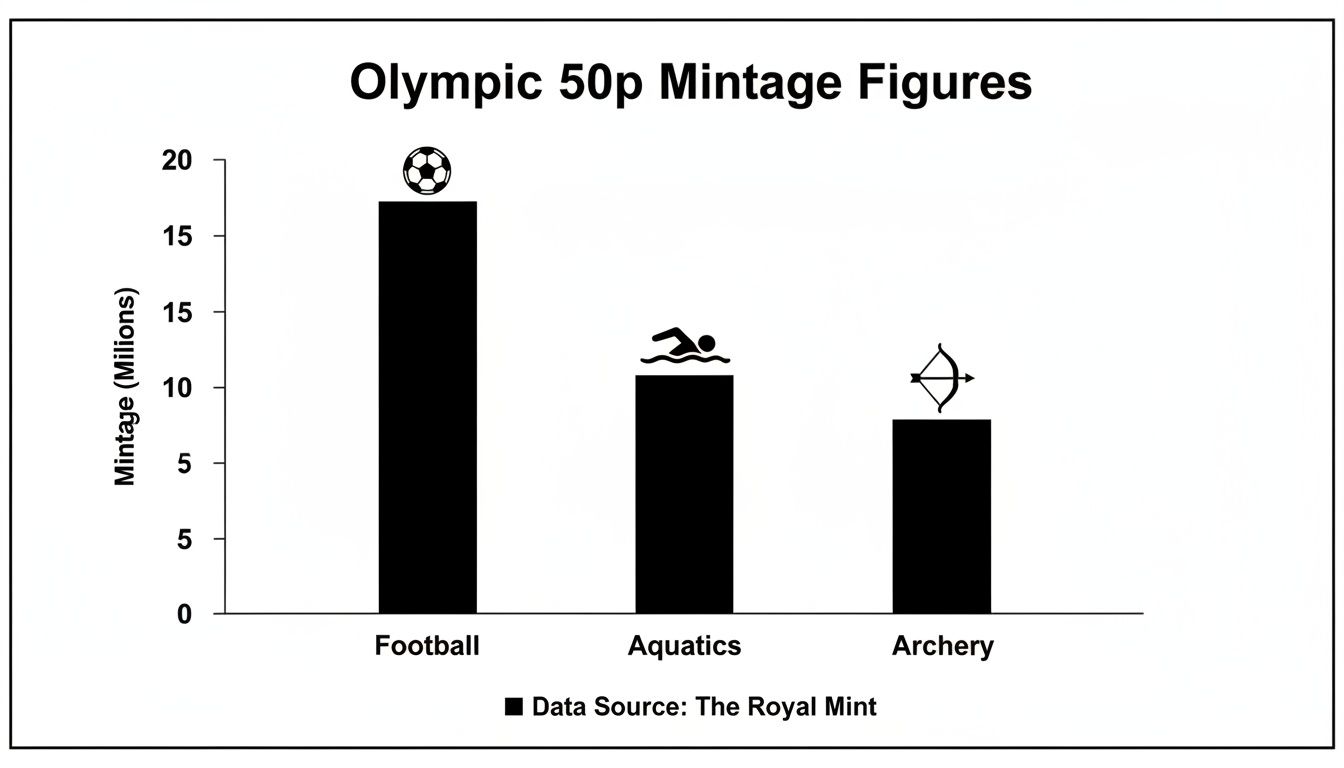
As you can see, the Football coin's mintage is less than half that of the Aquatics design and barely a third of the Archery coin. No wonder it’s so sought-after!
Complete Mintage Figures for All 29 Olympic 50p Coins
To really understand where your collection stands, it helps to see all the numbers laid out side-by-side. I've put together a full table listing every one of the 29 Olympic 50p coins, sorted from the rarest (lowest mintage) to the most common (highest mintage).
It's the ultimate cheat sheet for any collector, new or experienced, wanting to quickly check where their coins fall on the rarity spectrum.
Olympic 50p Mintage Figures and Rarity Tiers
| Sport | Mintage Figure | Rarity Tier |
|---|---|---|
| Football | 1,125,500 | Very Rare |
| Wrestling | 1,129,500 | Very Rare |
| Judo | 1,161,500 | Very Rare |
| Triathlon | 1,163,500 | Very Rare |
| Tennis | 1,454,000 | Rare |
| Goalball | 1,615,500 | Rare |
| Pentathlon | 1,689,500 | Scarce |
| Shooting | 1,690,500 | Scarce |
| Table Tennis | 1,737,500 | Scarce |
| Fencing | 1,770,000 | Scarce |
| Taekwondo | 1,821,500 | Scarce |
| Handball | 1,833,500 | Scarce |
| Weightlifting | 1,870,500 | Scarce |
| Volleyball | 2,000,500 | Uncommon |
| Canoeing | 2,021,000 | Uncommon |
| Cycling | 2,090,500 | Uncommon |
| Hockey | 2,107,000 | Uncommon |
| Boxing | 2,148,500 | Uncommon |
| Aquatics | 2,179,000 | Common |
| Athletics | 2,224,000 | Common |
| Sailing | 2,238,000 | Common |
| Gymnastics | 2,284,000 | Common |
| Basketball | 2,300,500 | Common |
| Rowing | 2,475,500 | Common |
| Equestrian | 2,624,500 | Common |
| Badminton | 2,746,000 | Common |
| Boccia | 2,865,500 | Common |
| Archery | 3,345,500 | Very Common |
| Wheelchair Rugby | 3,467,500 | Very Common |
Keep this table handy. Whether you’re sorting through a jar of change or considering buying a specific coin, these numbers are your guide to separating the everyday fifty pences from the true collector's treasures.
Determining the Market Value of Your Coins
So, you've found an Olympic 50p, checked the mintage table, and realised you might have one of the rarer ones. Fantastic. But the big question is, what's it actually worth? The internet is awash with crazy headlines about fifty pence pieces selling for hundreds, but the reality is usually a lot more down-to-earth. A coin’s true market value boils down to one simple, crucial factor: its condition.
The journey a coin takes from the moment it leaves the mint defines its worth. Was it tucked away immediately in a protective case, or did it spend a decade rattling around in pockets, cash registers, and piggy banks? That history is everything. There are three main condition categories that every collector needs to get to grips with, as they create a huge gap in value.
Circulated Coins: The Everyday Finds
This is the state you’ll most often find them in. A circulated coin is exactly what it sounds like – it's been used as money. It's been passed from hand to hand, picking up scratches, dings, and a general dullness along the way. The sharp, intricate details of the design have likely been softened and worn down from clinking against other coins.
Take the Triathlon 50p, for example. It's one of the rarer designs with a mintage of just over 1.1 million. A circulated version you find in your change might sell on eBay for around £8 to £12. While that’s a brilliant return for a 50p, it’s a world away from the prices you see for pristine examples. The value here comes from its rarity, but that value is capped by the visible wear and tear.
Brilliant Uncirculated Coins: The Collector's Choice
A Brilliant Uncirculated (BU) coin is a different beast entirely. These coins were never meant for your pocket. The Royal Mint sold them directly to collectors, often in special presentation packs or folders. They're struck to a much higher standard than circulating coins, giving them a sharp, clean finish and a brilliant lustre.
Because they’ve been protected from day one, BU coins are free from the scratches, fingerprints, and wear that plague circulated coins. A Brilliant Uncirculated version of that same Triathlon 50p could easily fetch £15 to £25, sometimes more. The higher price tag reflects its perfect preservation, making it far more desirable for serious collectors who want their coins in flawless condition.
A coin's condition is its story. A circulated coin tells a tale of its journey through the economy, while a Brilliant Uncirculated coin tells a story of preservation. The market pays a premium for the second story.
Professionally Graded Coins: The Top Tier
At the very peak of the value pyramid are professionally graded coins. These are coins that have been sent to an independent grading service, where experts scrutinise their condition under magnification. The coin is then sealed in a tamper-proof plastic holder—known as a "slab"—with a label that gives it a precise numerical grade.
This process takes all the guesswork out of it. A graded coin offers a guaranteed level of quality, giving buyers complete confidence. A top-grade, slabbed version of a rare Olympic 50p, like the Football design, can command significantly higher prices at auction simply because its quality has been certified. While most Olympic 50p collectors won't need to go this far, it's the gold standard for high-value coins. For a deeper dive into this, our guide on expert coin collection valuation tips for UK coins provides a lot more detail.
How to Find Realistic Values
So, how do you find a realistic price for your own coins? The best tool at your disposal is checking recently sold listings on marketplaces like eBay. It's crucial to ignore the ambitious asking prices; what matters is what people have actually paid.
Here’s a quick and practical way to do it:
- Head over to eBay and search for the specific Olympic 50p you have (e.g., "Olympic Football 50p").
- On the left-hand side, scroll down and filter the results to show "Sold Items."
- Analyse the prices, paying close attention to the coin's condition described in the listings that have sold.
This approach gives you a real-time snapshot of the current market. You’ll quickly see the clear price difference between a worn, circulated coin and a gleaming BU specimen from a pack. It's the best way to accurately value what you have and make smart decisions, whether you're buying or selling.
How to Grade and Authenticate Your Collection
So, you’ve pulled an interesting Olympic 50p from your change. The big question is, is it a hidden gem or just another well-travelled coin? Answering that really comes down to assessing its condition, a process we call grading. For any collector, understanding a coin's grade is crucial because it’s one of the biggest factors driving its market value.
Think of it like two identical classic cars. One has been driven every day, picking up its fair share of dings and scratches along the way. The other has been kept under a cover in a garage, looking as good as the day it was made. The garage-kept car will always be worth more, and it’s exactly the same story with your Olympic 50p coins. A coin that’s been jingling in pockets will show signs of its journey, while an uncirculated one looks as sharp as the day it left the mint.
Getting a handle on this helps you make much smarter decisions, whether you're buying a new piece, selling a spare, or just figuring out what you’ve already got.

A Simple Checklist for Coin Grading
You don't need to be a seasoned numismatist to get a good feel for your coin's condition. By checking for a few key visual clues, you can quickly sort a worn-down circulated coin from a top-quality uncirculated one.
Here’s what you should be looking for:
- Surface Lustre: Does the coin still have that original mint shine? An uncirculated coin will have a bright, almost frosty look to it, whereas a circulated coin often appears dull and flat.
- Design Sharpness: Get in close and look at the fine details of the athlete or equipment. On a high-grade coin, every line is crisp and distinct. On a worn one, the details will look soft, flattened, or even a bit blurry.
- Rim and Edges: The seven-sided edge should be sharp and clean. Coins that have been through the wars will often have rounded or nicked edges from years of being handled.
- Scratches and Nicks: Tilt the coin under a light and check the flat surfaces (the 'fields') for any obvious scratches, marks, or tiny dents. Even small imperfections can knock the grade and value down a peg.
A coin's grade really just tells its life story. A pristine, uncirculated coin has been tucked away safely since it was made, while a heavily circulated one carries the battle scars of its time in our economy. The fewer scars, the higher the value.
For collectors who want a final, official verdict, professional grading services offer expert analysis. If you're wondering if that's the right move for your best coins, you can learn more about how to get coins graded and see what the process involves.
How to Spot a Fake Olympic 50p
While fake Olympic 50ps aren't a massive problem, it always pays to be careful, especially if you’re buying one of the rarer designs online. Counterfeits nearly always fall short of the precision and quality of a genuine coin from The Royal Mint. Knowing what to look for can save you from a costly mistake.
Keep a close eye on these three areas to check if your coin is the real deal:
- Weight and Dimensions: A genuine 50p coin weighs exactly 8.00 grams and measures 27.30mm in diameter. Fakes are often made from cheaper metals and will usually feel slightly too light or too heavy.
- Detail and Finish: Look for sharp, high-quality details. Fakes often have a soft, almost 'soapy' appearance, with blurry lettering or poorly defined lines in the design. The Queen's portrait is a common giveaway—it often looks much less detailed on a counterfeit.
- Edge Quality: The seven-sided edge should feel sharp and even. Many fakes have poorly defined or irregular edges that just don't feel right compared to a genuine 50p.
Smart Strategies for Buying and Selling Your Coins
Navigating the market for Olympic 50p coins can be just as exciting as finding them in your change. Whether you're hunting for that one last design to complete your set or looking to turn your collection into cash, having a smart strategy is key. The right approach really depends on your goals, how quickly you want to move, and the condition of your coins.
For buyers, the journey often kicks off online. Marketplaces like eBay can feel like a treasure trove, letting you cherry-pick the exact coins you need. But it’s a space where you need to have your wits about you. Always stick to sellers with a long history of positive feedback and scrutinise the photos carefully—you have to be the judge of the coin's condition.
Reputable coin dealers, both online and in-person, offer another brilliant route. You might pay a little more, but what you’re really paying for is expertise and a guarantee of authenticity. This is often the safest path when you're looking to buy higher-value Brilliant Uncirculated (BU) coins.
Where to Buy Your Olympic 50p Coins
Finding the right place to buy can make all the difference. Each platform has its own perks, whether you’re prioritising the best price, sheer convenience, or guaranteed quality.
- Online Marketplaces (eBay): Perfect for finding a huge variety of circulated coins at competitive prices. The trick is to check a seller’s reputation and compare sold listings to make sure you aren't overpaying.
- Specialist Coin Dealers: This is your best bet for guaranteed authentic, high-grade coins. Dealers offer expert knowledge and are ideal for sourcing pristine BU examples or even professionally graded coins.
- Coin Fairs and Collector Groups: A fantastic way to see the coins in person before you buy. These events are also a great chance to chat with other collectors and learn directly from people who have been in the hobby for years.
Selling Your Collection The Right Way
When it's time to sell, you have a big choice to make: sell your coins one by one, or as a complete collection?
Selling them individually on a platform like eBay can often maximise your total return, especially if you have a few of the rarer designs in good condition. Be warned, though: it’s a time-consuming process. You'll be photographing, listing, and posting each coin separately.
On the other hand, selling your entire 29-coin set to a specialist dealer is fast, simple, and hassle-free. You’ll get a single lump-sum payment that's fair, though it might be slightly less than you'd make selling them individually. This is a great option if you value your time and want a quick sale over squeezing every last pound out of the collection.
The buzz around these coins has only grown with time. By March 2013, the total number of 50p coins in circulation hit 920 million, but the Olympic series was already becoming hard to find. That scarcity is precisely why they command a premium today. You can read more about the mintage figures that make these coins rare.
If you’ve got a lot of swaps or a bulk collection, approaching a dealer like Cavalier Coins Ltd directly can be a very smart move. Bulk sales are attractive to dealers who supply other collectors or sell at fairs, and they can often offer competitive prices for larger quantities. It could save you an enormous amount of effort. Ultimately, the best strategy is the one that balances the profit you want with the time and effort you're willing to put in.
Properly Storing and Displaying Your Collection
Once you’ve put the time and effort into building your Olympic 50p collection, the next job is to protect your investment. Proper storage isn’t just about being tidy; it’s about preserving the condition—and the value—of every single coin for years to come.
How you look after your coins can be the difference between a sharp, gleaming finish and irreversible damage. A coin’s worst enemies are the environment and clumsy handling. The oils from a single fingerprint, for instance, can permanently etch into the metal’s surface over time, leaving a mark that can’t be removed.
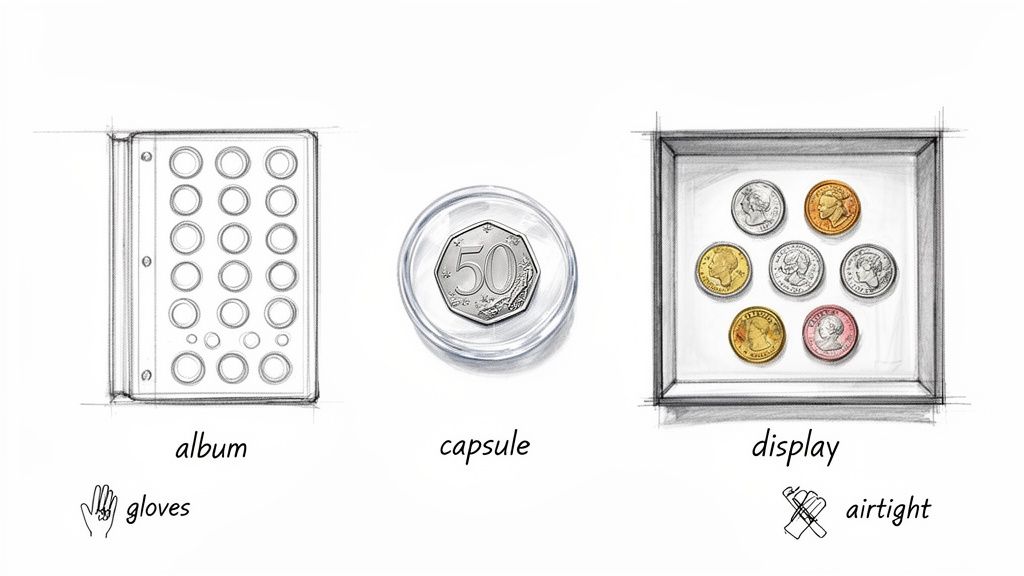
It’s the same story with scratches. Coins clinking against each other in a bag or a jar can quickly downgrade their condition and slash their value. Your goal is simple: create a stable, protected home for your collection that shields it from these everyday hazards.
Choosing The Right Storage Solution
The best way to store your coins really depends on what you have. A circulated set you’ve pulled from your change has very different needs to a pristine, untouched Brilliant Uncirculated collection.
Here are a few of the most popular options for keeping those Olympic 50ps safe:
- 2x2 Cardboard Flips: These are cheap, cheerful, and perfect for beginners. You just place the coin in the middle of the little cardboard holder, fold it over, and staple it shut.
- Coin Albums: You can find albums made specifically for the 29-coin Olympic set, with pre-cut slots for each design. They’re a fantastic way to display your whole collection at a glance while keeping every coin safely separated.
- Airtight Capsules: For your real treasures—like that low-mintage Football 50p in perfect condition—an individual plastic capsule is the gold standard. They create an airtight seal to lock out moisture and stop anything from touching the coin’s surface.
Protecting a coin is about freezing it in time. The best storage solutions create a barrier against the elements—air, moisture, and physical impact—that degrade a coin’s condition and diminish its historical and monetary value.
If you want to dig deeper into the pros and cons of each method, there are some great guides on the https://www.cavaliercoins.com/blogs/news/best-way-to-store-coins that can help you decide.
Creative Ways To Display Your Collection
Once your coins are tucked away safely, you can start thinking about showing them off. A beautifully presented collection isn’t just a hobby; it’s a brilliant conversation starter.
A custom frame with slots for all 29 of the Olympic 50p designs makes for a stunning piece of wall art. Another great idea is a glass-topped display case, which lets you show off your coins on a shelf or table while keeping them free from dust.
And don't just think about physical displays. Whether you're cataloguing your collection or getting ready to sell, good photos are a must. Learning how to take better product photos will make the intricate details pop, helping your online listings stand out or simply giving you a gorgeous digital archive of your prized possessions.
Your Olympic 50p Questions Answered
Even after diving into the details of mintage figures and coin condition, a few questions often pop up for collectors new and old. Getting simple, straight answers is the best way to build your confidence and really get to grips with the series. This section clears up some of the most common queries.
Think of this as your go-to guide for those last few bits of info, from spotting the top prize to figuring out if you can still find one in your change.
Which Olympic 50p Coin Is the Rarest?
The undisputed champion of rarity in the London 2012 series is the Football 50p. It's famous for its clever design explaining the offside rule and has the lowest mintage of the entire 29-coin set, with just 1,125,500 ever entering circulation.
That scarcity alone makes it a top target for collectors. But there’s a little more to the story – the coin had a last-minute redesign, which adds another layer of intrigue. It’s for these reasons that the Football 50p remains the single most sought-after coin in the collection.
How Much Is a Complete Set of Olympic 50p Coins Worth?
Putting together a full 29-coin set is a real achievement, and its value really boils down to the condition of the coins inside.
Here’s a realistic idea of what to expect:
- Circulated Set: A complete collection built from coins found in pocket change, showing the usual signs of a life in circulation, will typically sell for £80 to £100.
- Brilliant Uncirculated (BU) Set: If you have a pristine set, likely sourced from official Royal Mint packs, it could be worth several hundred pounds. That flawless, untouched condition is what serious collectors are prepared to pay a premium for.
Can You Still Find Olympic 50p Coins in Circulation?
Yes, you can – but it’s getting tougher all the time. While all 29 designs are still legal tender, it's thought that collectors have already snapped up around 75% of them over the last decade.
Every year, fewer and fewer are discovered in cash registers and piggy banks. This growing scarcity is exactly why finding one in your change today feels like such a win. It's a proper modern-day treasure hunt, and the treasure is only getting harder to find.
The thrill of the hunt for Olympic 50p coins is directly linked to their disappearing act from our change. The simple fact that they are no longer a common sight fuels the passion for collecting them.
How Can I Spot a Fake Olympic 50p?
Thankfully, fakes aren’t a huge problem for this series. But it always pays to be careful, especially when buying the rarer coins like the Football 50p online. A genuine coin from The Royal Mint has a quality and finish that fakes just can't match.
To make sure a coin is the real deal, check these key details. A genuine Olympic 50p should have:
- Precise Weight and Size: It has to weigh exactly 8.00g and have a diameter of 27.30mm.
- Sharp Design Details: The lines on the design should be crisp and clean, and the lettering should be sharp.
- Clean Edges: The seven-sided shape should have distinct, well-defined edges, not soft or rounded ones.
If you’re ever in doubt, the best advice is to buy from reputable dealers or sellers with a long history of positive feedback. It’s the simplest way to guarantee you’re adding a genuine piece of Olympic history to your collection.
At Cavalier Coins Ltd, we provide a trusted marketplace for both buying and selling rare and collectible coins. Whether you're hunting for that final Olympic 50p to complete your set or looking to sell a collection, we offer expert service and a passion for numismatics. Explore our curated selections and weekly auctions at https://www.cavaliercoins.com.