
Let's get straight to it: the value of a 1948 one shilling is, for the most part, quite modest. You're typically looking at a value ranging from a few pence to a couple of pounds for a coin in average, circulated condition.
The main reasons? They were minted in huge numbers right after the war, and they contain no silver. That said, if you've stumbled upon an exceptional uncirculated example or a rare error coin, the story can be very different.
What Is Your 1948 One Shilling Worth Today
If you've found a 1948 shilling, you're holding a common but fascinating piece of British post-war history. It’s important to set realistic expectations right from the start. This isn't a rare coin by any stretch of the imagination.
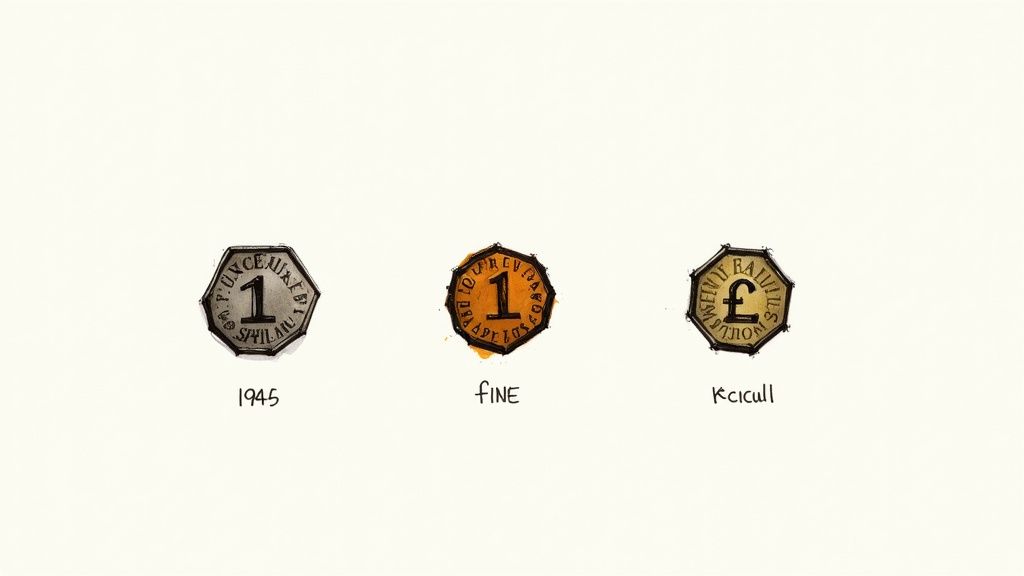
That year, The Royal Mint actually produced two distinct versions. One features an English reverse design (a crowned lion standing proudly) and the other has a Scottish reverse (a seated lion holding a sword and sceptre).
Despite the two different designs, neither is particularly scarcer than the other. The numbers tell the story: 45,577,000 coins with the English reverse and 45,352,000 coins with the Scottish reverse were struck. Because of this incredibly high mintage, a typical coin that has been through many hands will have a low value, often starting from just £0.05 for a heavily worn piece.
How Condition Affects Value
The single most critical factor that will determine your coin’s worth is its physical condition, or what we call its "grade."
Think of it this way: a worn, scratched shilling that has clearly been jangling around in pockets for decades is just a piece of history. But a pristine, uncirculated one that looks as fresh as the day it left the mint? That's a collector's item. Understanding this difference is the first real step in figuring out what you have.
The journey from a few pence to a significant sum is almost entirely dictated by preservation. A tiny scratch or minor wear can be the difference between a common coin and a collector's piece.
For a deeper dive into the nuances of grading, our guide on how to value coins is a great place to start. It explains these core principles in much more detail.
1948 One Shilling Quick Value Guide
To give you a clearer picture, I've put together a simple table breaking down how the 1948 one shilling value changes based on its condition. This should help you get a rough idea of where your coin sits on the scale.
| Coin Condition | Typical Value (GBP) | Key Characteristics |
|---|---|---|
| Well Worn | £0.05 - £0.50 | Major details are smoothed over; lettering may be faint. |
| Average Circulated | £0.50 - £2.00 | Clear details, but with visible signs of wear and light scratches. |
| Uncirculated (UNC) | £5.00 - £15.00+ | Sharp details, original mint lustre, and no signs of wear. |
As you can see, the jump in value from an average circulated coin to an uncirculated one is significant. This is why preservation is everything in the world of coin collecting
The Story Behind Your Post-War Shilling
Every coin you hold is a tiny time capsule, but the 1948 shilling tells a particularly powerful story of a nation picking up the pieces. To really get a feel for the one shilling 1948 value, you first have to understand the world it came from—a Britain just starting to emerge from the long shadow of the Second World War.
The country was on its knees financially, weighed down by enormous war debt to the United States. Repaying this debt meant finding vast quantities of precious metals, which led to a historic decision in 1947: for the first time in centuries, Great Britain would stop using silver in its everyday coins.
This wasn't a choice made lightly; it was a purely economic move. The silver from older coins was desperately needed to pay off international loans. In its place, The Royal Mint started churning out coins made from a much cheaper, hard-wearing alloy called cupro-nickel (a simple mix of copper and nickel). Your 1948 shilling is one of the very first of this new, silver-free generation.
A Portrait of a Post-War King
The face on the coin is, of course, King George VI, the monarch who had guided the nation through its darkest chapter. The portrait, designed by Humphrey Paget, is quite striking because he isn't wearing a crown. This was a deliberate choice to present a more stoic, relatable image of a king sharing in the national austerity.
Look closely at the inscription and you’ll spot "IND: IMP", which stands for Indiae Imperator, or Emperor of India. This is another fascinating quirk of history. By 1948, this title was already out of date after India gained its independence the year before. This makes these coins some of the last to carry a reminder of the British Empire before the legend was officially removed.
Holding a 1948 shilling is like holding a direct link to this moment of transition. It represents the end of silver money, the last echoes of the British Empire in India, and the very beginning of a modern, recovering Britain.
The Two Lions of the United Kingdom
Flip the coin over, and you’ll find one of two different designs, both powerful symbols of British identity. One version shows the English lion standing proudly on a Tudor crown, a timeless emblem of strength and royalty.
The other design features the Scottish lion, seated and armed with a sword and sceptre, a clear nod to Scotland's distinct heritage and role in the union. This dual-design approach was a clever way to acknowledge the unique cultures within Great Britain, making the 1948 shilling a fascinating piece for both its numismatic and national history.
English or Scottish? Telling the Two Lions Apart
At first glance, you might not even realise there are two different versions of the 1948 shilling. The front (the 'obverse') is identical on both, featuring the portrait of King George VI. The real giveaway is on the back.
The secret is to flip the coin over and look at the reverse. Here you'll find one of two distinct designs, each featuring a symbolic lion representing the nations of England and Scotland. Knowing which one you're looking at is the first step to understanding your coin's story, and it's a simple visual check that adds a nice layer of depth to collecting this piece of post-war history.
The English Lion Design
The English version sports a classic symbol of British royalty: a proud lion standing on top of a Tudor crown.
In the formal language of heraldry, this pose is called a Lion Passant Guardant. It basically means the lion is walking forward but turning its head to look straight at you. It’s a powerful, confident stance that has appeared on English crests and coins for centuries, a clear symbol of strength, courage, and sovereignty. The lion's tail usually has a distinctive flick to it, adding to the design's majestic feel.
The Scottish Lion Design
The Scottish shilling, on the other hand, shows a completely different scene deeply rooted in Scottish heritage. This lion isn't standing but is seated, facing to the left.
This pose is known as a Lion Sejant. He's not just sitting there, though; he's holding two key symbols of Scottish royalty—a sword in his right paw and a sceptre in his left. This image is a direct nod to the Royal Standard of Scotland, famously known as the Lion Rampant. You'll also spot two small shields flanking the lion, one showing St. Andrew's Cross and the other the iconic Scottish thistle.
A common question from new collectors is whether one version is rarer or holds a higher one shilling 1948 value. In almost all cases, the answer is no. With mintage figures of over 45 million for each design, both are considered extremely common.
This virtually identical production run means that for the average coin you'd find in circulation, there's no real value difference between the English and Scottish versions. If you see a big price jump, it’s almost certainly down to the coin's grade—its physical condition—rather than which lion is on the back.
The only time a price difference might appear is for the absolute best-of-the-best uncirculated examples. Top-tier collectors will pay a premium for even a slight edge in rarity, but for the vast majority of these shillings you'll come across, the two lions are equals in the eyes of the market.
How to Grade Your 1948 Shilling Like a Pro
What separates a 1948 shilling worth a few pence from one worth some serious money? It all boils down to one thing: its condition.
Coin grading might sound like a highly technical skill reserved for experts, but it's really just a way of measuring how much wear and tear a coin has seen since it was first struck. Think of it like a classic car's mileage – the lower the mileage and the better its condition, the more a collector is willing to pay.
For any collector, the holy grail is an Uncirculated (UNC) coin. This is a coin that looks like it just left the Royal Mint yesterday, with zero signs of wear and its original, frosty lustre still intact. On the flip side, you have coins graded as Fair or Good, where the design has been worn so smooth it’s almost unrecognisable. Most 1948 shillings you'll come across will be somewhere in the middle.
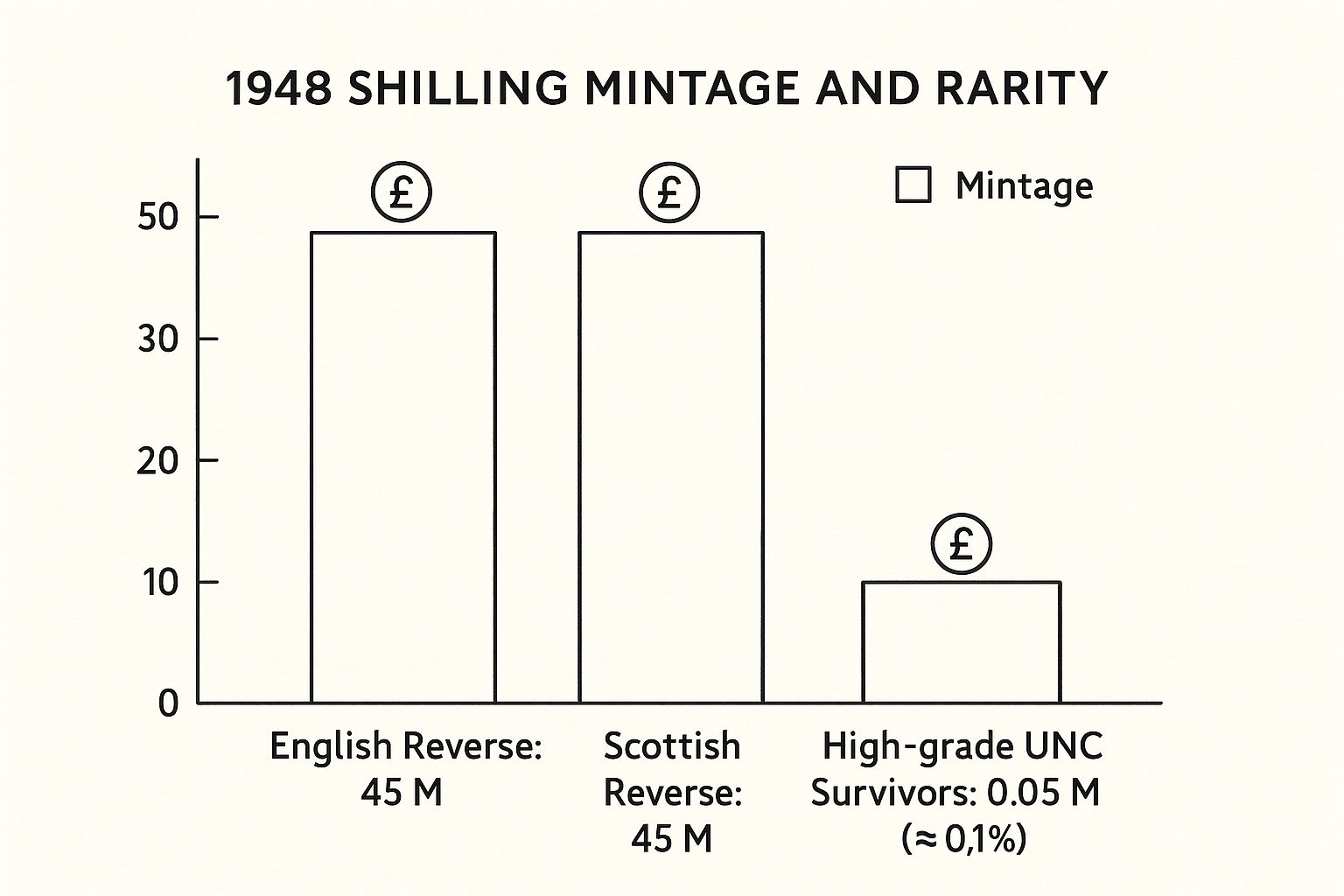
This chart drives the point home. While a staggering 90 million of these shillings were minted, precious few have survived in top-notch condition, which is exactly why the best examples are so sought-after.
What to Look For: The Key Wear Points
To get a real sense of your coin's grade, you need to know exactly where to look. Wear and tear isn't an even process; it always hits the highest points of the design first. For the 1948 shilling, two spots are absolutely critical.
First, turn your attention to the obverse (the 'heads' side) and King George VI's portrait. The first place to show wear is the detail in his hair and over his eyebrow. On a coin that’s been through many hands, these features will be flattened and smooth. A higher-grade example, however, will still show clear, individual strands of hair.
Next, flip the coin over to the reverse. Whether you've got the English or Scottish design, the lion is your focus. Specifically, you want to examine the lion's mane and its facial features. A well-preserved coin will have sharp, distinct lines making up the mane, whereas a heavily worn one will look soft and blurry.
Putting It All Together: A Visual Guide
Knowing what to look for is one thing, but seeing it is another. To help you pin down your coin's grade, here’s a quick-glance table breaking down the key wear indicators for both sides of the coin.
| Grade | Obverse (King George VI) | Reverse (Lion) |
|---|---|---|
| Good (G) - Fine (F) | Hair and eyebrow are completely flat and worn smooth. | Lion's face is a faint outline; the mane is a soft, undefined mass. |
| Very Fine (VF) | Some major hairlines are visible, but finer details are gone. | The main locks of the mane are clear, but smaller details are soft. |
| Extremely Fine (EF) | Most of the hair detail is sharp. Only the very highest points show light wear. | Nearly all details of the mane and face are sharp and distinct. |
| Uncirculated (UNC) | Every strand of hair is perfectly defined. No signs of friction or flatness. | The lion's mane, claws, and face are exceptionally sharp. The coin has its original mint lustre. |
Use this as your checklist. By carefully comparing your 1948 shilling against these descriptions, you can get a much more accurate idea of its condition.
The ability to spot these subtle differences in wear is what separates a casual finder from a knowledgeable collector. It’s the small details that create the big differences in value.
Grading definitely gets easier with practice. If you find yourself getting hooked and want to dive deeper, our guide to the European coin grading system explained covers the more detailed numerical scales used by professional services. By checking these key points, you can make a confident assessment of your coin's condition and, in turn, its true value.
Hunting for Rare and Valuable Minting Errors
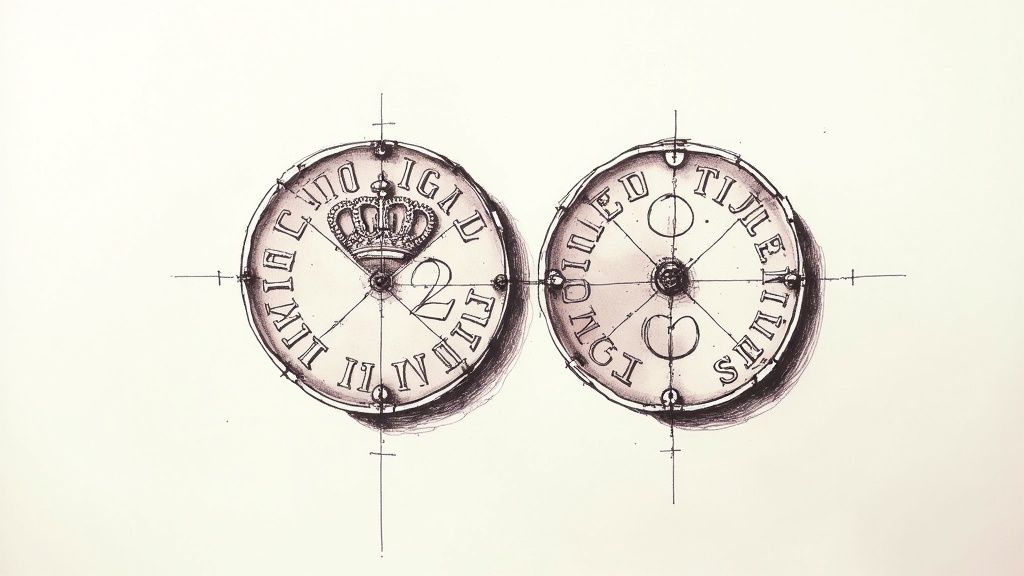
While most 1948 shillings you'll come across have a fairly modest value, this is where the real fun of collecting begins. For every million perfectly minted coins that left The Royal Mint, a tiny handful managed to slip through quality control with fascinating flaws. These aren't just damaged coins; they are genuine minting errors, and they can turn a common piece of pocket change into a rare and valuable treasure.
This is what gets a numismatist's pulse racing. It’s the reason we look closer at coins others might just toss in a jar. An error elevates a coin from a simple piece of metal into a one-of-a-kind artefact, capturing a fleeting moment of imperfection in the minting process.
The Famous Off-Centre Strike Error
One of the most exciting and sought-after errors on this coin is the off-centre strike. Think of it like a postage stamp printed so badly that the picture is hanging halfway off the paper. It’s the same basic idea for a coin: the planchet (the blank metal disc) wasn't sitting perfectly in place when the dies struck it with immense force.
This misalignment creates a design that’s shifted to one side, leaving a tell-tale crescent of blank, unstruck metal on the other. The more dramatic the error, the more valuable it becomes. A slight shift might only double the coin's value, but a major one can create a serious collector's piece.
The more dramatic the error, the more desirable it becomes. A coin that is 50% off-centre is far rarer and more visually striking than one that is just 5% off, and its value will reflect that difference exponentially.
For the 1948 shilling, a few exceptional examples of this error have reached incredible prices. Coins where the lion on the reverse is massively out of alignment are considered true rarities. Depending on their condition and the severity of the strike, some have sold for upwards of £40,000 at auction. This kind of find skyrockets the one shilling 1948 value from a few quid to a serious investment. You can see more about these jaw-dropping sales in this video about ultra-rare error coins.
What Should You Look For?
When you’re sifting through your shillings, keep a sharp eye out for these key signs of an off-centre strike:
- A Crescent-Shaped Blank: This is the dead giveaway – a part of the coin that is completely smooth and unstruck.
- Incomplete Design: You'll see part of the King's portrait or the lion being cut off at the edge, along with the lettering.
- No Reeding on One Side: The grooved edge of the coin, known as reeding, will likely be missing from the blank, unstruck portion.
Finding a genuine minting error is a bit like finding a needle in a haystack, but that’s what makes it so rewarding. If you're keen to learn more about the different types of flaws that can occur, you can discover valuable error coins and their hidden treasures in our detailed guide. Always give your coins a second look; you just never know what you might find.
Checking Current Market Prices and Trends
Price guides are a great starting point, but to get a true feel for the one shilling 1948 value, you have to see what people are actually paying for them today. The modern coin market, especially online, gives us a fantastic, real-time window into supply and demand, cutting right through the noise of those wildly optimistic listings you sometimes see.
By digging into the completed sales data from auction sites and dealer inventories, a very clear picture starts to form. The vast majority of sales for circulated 1948 shillings – whether they're the English or Scottish version – land within a pretty modest price bracket. These aren't rare coins by any stretch, and the market price reflects that.
What Real-World Data Shows
The best way to get a handle on what these coins are worth is to follow the money. Forget the listings asking for hundreds of pounds for a standard, circulated coin; the real story is in what buyers have genuinely paid.
Online marketplaces are your best friend for this kind of research. A quick look at active and sold listings shows that most examples, even those described as ‘rare’, typically change hands for between £1 and £15. This makes perfect sense when you remember the coin's huge mintage and its cupro-nickel composition, which means it has no precious metal value to fall back on. You can see this for yourself by checking out the live and completed sales data from current 1948 shilling listings on eBay.
This hard data confirms that for a standard coin that’s been in circulation, the value is consistently low.
The key takeaway from the market data is consistency. The value of a circulated 1948 shilling has been stable and modest for years, simply because the supply massively outweighs collector demand.
This reality check is so important for setting your expectations. Unless you've stumbled upon a coin in pristine, uncirculated condition or one with a verifiable minting error, its market value will almost certainly be under £10. Knowing this empowers you to buy or sell confidently, armed with a proper understanding of what your coin is genuinely worth today – not what a hopeful seller wishes it was.
Got a Question?
When you're digging into the details of a specific coin, a few common questions always seem to pop up. Let's tackle the most frequent ones about the 1948 shilling so you can get the answers you need, straight and simple.
Think of this as your quick-reference guide to clear up any lingering uncertainties about the coin in your hand.
Is the 1948 Shilling Made of Silver?
This is the big one, and the answer is a clear and simple no. After 1946, the Royal Mint stopped using silver in its shillings. All shillings minted from 1947 onwards, including every single one from 1948, are made from cupro-nickel – a hardy blend of copper and nickel.
Why the change? Britain had staggering war debts to pay off, and switching to a more affordable metal was a necessary economic measure. This lack of precious metal is the main reason why the one shilling 1948 value for most circulated coins is quite modest.
Which Is Worth More: The English or Scottish Shilling?
For just about every 1948 shilling out there, neither design is worth more than the other. Both the English Lion and the Scottish Lion designs were churned out in massive numbers, with mintages for each hovering around the 45 million mark.
Since they're both incredibly common, their value is identical in most conditions. You might see a tiny price difference for a flawless, top-tier uncirculated coin, but those are exceptionally rare finds that only specialist collectors chase. For 99.9% of these coins, there’s no value difference at all.
The key thing to remember is that for the average collector, the picture on the back – English or Scottish – doesn't affect the price. It's the coin's condition that truly matters.
How Can I Clean My 1948 Shilling to Increase Its Value?
The short answer here is: don't do it. In the world of coin collecting, "cleaning" is almost always a code word for "damaging."
Using polishes, chemical dips, or even just rubbing a coin vigorously will leave behind fine scratches and strip away its original patina. That subtle toning that develops over decades is part of the coin's history, and collectors value it highly. Cleaning it off can obliterate its numismatic value, leaving you with nothing more than a shiny piece of metal. It's always best to leave your shilling as you found it.
Whether you're just starting your collection or hunting for that final piece to complete a set, Cavalier Coins Ltd offers a fantastic selection of world coins and banknotes. Come and explore the rare and historical treasures we have at https://www.cavaliercoins.com.