
Ever wonder if that handful of change rattling in your pocket could be worth more than a few quid? While most pound coins are worth, well, a pound, some rare designs, low-mintage issues, and even coins with funny mistakes can be worth a small fortune to collectors, fetching anywhere from £5 to over £100. It all boils down to two simple things: scarcity and demand.
Uncovering Hidden Treasures in Your Change
Most of us see a £1 coin and just think about what it can buy. But for the growing community of numismatists (that’s coin collectors to you and me), each one is a tiny piece of history with its own story to tell. This guide is your starting point for turning that loose change into something special, showing you how to spot the valuable coins that most people simply spend without a second thought.
Think of this as your personal treasure map. We’ll walk through the key things that can turn an ordinary bit of metal into a collector's dream. By the end, you'll be looking at your change jar in a completely new light.
What Makes a Pound Coin Valuable?
It’s not just one thing but a combination of factors that separates a rare find from your everyday currency. Getting a handle on these is the first step to becoming a savvy coin hunter.
Here's a quick look at the main drivers that can bump up a coin's value.
Quick Guide to Factors Affecting Pound Coin Value
| Factor | How It Boosts Value | What to Look For |
|---|---|---|
| Mintage Figures | The fewer coins made, the harder they are to find. Simple supply and demand means rarity equals value. | Check the date and design against official mintage numbers. Anything under 1 million is worth a second look. |
| Commemorative Designs | Special one-off designs for events or anniversaries are often produced in limited numbers, making them instantly collectible. | Designs that stand out from the standard Royal Arms, like the regional floral or city series. |
| Minting Errors | Mistakes during production create unique, accidental rarities. These imperfections are highly sought-after. | Off-centre strikes, mismatched metals (e.g., a 2014 coin with a 2015 date), or text anomalies. |
| Coin Condition | A shiny, well-preserved coin with sharp details is far more desirable than one that's been battered in circulation. | Look for coins with minimal scratches, clear lettering, and a crisp design. "Uncirculated" is the gold standard. |
Understanding these points is the key to it all. Once you know what to look for, your perspective shifts entirely. You're no longer just holding money; you're holding a potential piece of treasure.
You can learn more about how to find valuable pound coins in your change with our in-depth guide.
A Brief History of the Modern Pound
To get a real feel for modern pound coin values, you first have to understand where they came from. It's a story that’s less about just minting new metal and more about a complete overhaul of how Britain counted its cash—a change that has a direct impact on which coins are rare and sought-after today.
For centuries, Britain ran on a wonderfully complicated pre-decimal system. This wasn't as simple as 100 pence making up a pound. The old way was a mishmash of pounds, shillings, and pence, a system with roots stretching deep into the nation's history.
Before 1971, the maths was something else. One pound was equal to 20 shillings, and every shilling was worth 12 pence. That meant a single pound contained a whopping 240 pence! You can imagine how tricky everyday calculations were, a real headache in an increasingly modern, computerised world.
The Great Change: Decimalisation
Moving away from this ancient system was a massive national project. The big switch, officially happening on 15 February 1971, a day forever known as 'Decimal Day', simplified everything. From that day on, one pound was worth 100 new pence. Simple.
But you don't change a country's money overnight. To get the public used to the idea, new decimal coins like the 5p and 10p were introduced as early as 1968. They circulated right alongside their old equivalents, the shilling and the florin, which helped ease the transition. This crossover period is a goldmine for collectors, as it created some real numismatic oddities.
The shift to decimalisation was more than a monetary change; it was a cultural one. It streamlined commerce, simplified accounting, and aligned Britain's currency with many other nations, marking a pivotal moment in the country's post-war modernisation.
The Birth of the £1 Coin
Even after decimalisation, the pound itself was still a paper banknote. By the early 1980s, though, the trusty old £1 note was showing its age. With an average lifespan of just nine months, it was becoming far too costly to keep printing replacements. A tougher, more durable solution was needed.
The Royal Mint delivered that solution on 21 April 1983, with the launch of the very first round £1 coin. This chunky new coin, with the Royal Arms on its reverse, was built to last for 40 years or more, offering a much more cost-effective and robust alternative to the flimsy paper note.
This bit of history is absolutely vital for any collector. The coins from these key moments tell a story of huge change, and their designs, mintage figures, and even errors reflect Britain's journey. Knowing this history is the first step in spotting the genuinely special pieces that command high pound coin values. For a deeper dive, take a look at our guide on the brief history of British coins.
So, what separates a common pound coin from a genuine collectible?
Beyond its age or the story it tells, a pound coin's real value hinges on three core elements that every collector quickly learns to look for: scarcity, condition, and errors.
To really get to grips with what makes a coin worth more than its face value, you need to understand the idea of fair market value. It's simply the price a collector is willing to pay for a coin, and in our world, that price is almost always decided by those three key factors.
Think of them as the three legs of a stool. If one is weak, the value gets shaky. But when all three are strong, you might just be holding something truly special.
Scarcity: The Golden Rule of Collecting
The most straightforward factor is scarcity. Just like a limited-edition art print, a coin with a low production run is instantly more desirable. The number of coins produced for a specific design is called its mintage figure.
When The Royal Mint produces fewer coins of one design, there just aren't enough to go around for every collector who wants one. It’s the classic rule of supply and demand, and it’s the absolute bedrock of coin collecting.
A coin with a mintage of under 1 million is often a good sign you’ve found something interesting. Get into the low hundreds of thousands, and you could be looking at a significant premium. This simple fact is why a 2011 Edinburgh City £1 coin is sought after, while a common 2016 Royal Arms design is just pocket change.
Condition Is King
Next up is the coin's physical state, or its condition. It’s just common sense, really. Imagine finding two identical vintage cars. One is battered and rusty, the other is in showroom condition. The pristine one will always be worth dramatically more. It's exactly the same with pound coins.
A coin that's been rattling around in pockets, tills, and piggy banks for years will inevitably pick up scratches and dings, and the fine details of the design will wear down. On the other hand, an 'uncirculated' coin—one that has never seen the inside of a shop till—retains its original shine and crisp design features.
Coin grading is the formal process of evaluating a coin's condition on a standardised scale. A higher grade directly translates to a higher market value, often turning a £10 coin into a £50+ collectible.
The difference in value can be staggering. A common coin in poor condition is just worth £1. But that very same coin in perfect, uncirculated condition? It could fetch ten times that amount from a serious collector. If you want to dive deeper, you can check out our expert guide to UK coin grading and see just how much of an impact it has.
Errors: The Excitement of Imperfection
Finally, we have the thrilling world of minting errors. These are mistakes made during the production process at The Royal Mint. While their quality control is incredibly high, tiny imperfections do occasionally slip through, creating unique and often highly prized rarities.
These aren't just damaged coins; they are genuine production flaws that happened right at the source. The most common types collectors hunt for include:
- Mules: A coin struck with mismatched dies. For example, the 'obverse' (heads) of one coin design and the 'reverse' (tails) of another.
- Mis-strikes: This happens when a coin is struck off-centre, leaving a distinctive crescent-shaped blank area on one side.
- Die Cracks: A tiny crack in the die used to stamp the coin leaves a raised, jagged line on the coin's surface.
Finding an error transforms a standard piece of currency into an accidental treasure. These imperfections create one-of-a-kind pieces that collectors are always eager to track down.
The Most Sought-After UK Pound Coins
This is the checklist every budding coin hunter needs. While millions of pound coins have passed through our hands over the years, a select few are genuine rarities worth far more than their face value. These are the coins that collectors dream of finding, primarily set apart by their incredibly low mintage numbers—that's the total number of coins The Royal Mint produced.
Before we dive into the specifics, it helps to understand the sheer scale of coin production. For instance, The Royal Mint estimated that by March 2016, around 1.67 billion old 'round pound' coins were in circulation. That huge figure really puts into perspective just how scarce a coin with a mintage under one million truly is, making such a find incredibly exciting.
This quick visual breaks down the three main factors that give a pound coin its value: scarcity, condition, and any errors made during minting.
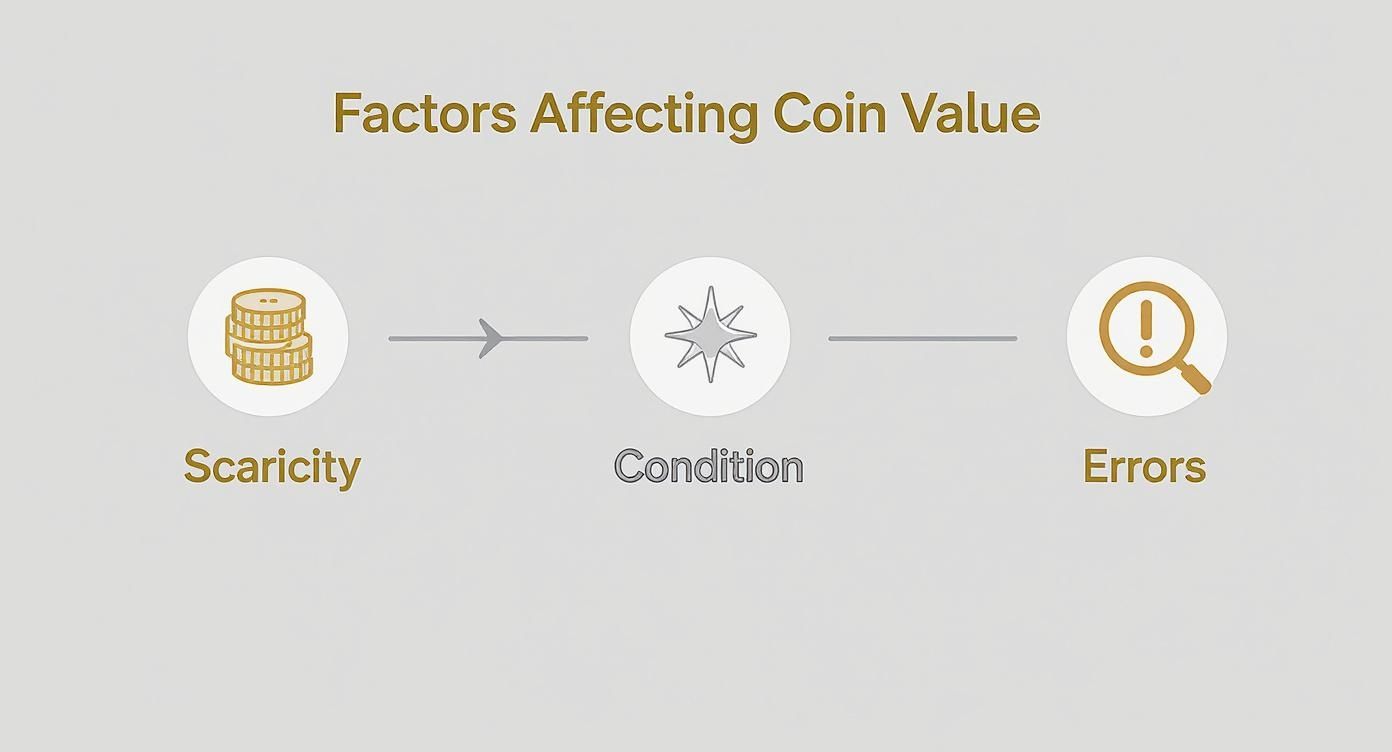
As you can see, a coin's rarity is the biggest driver of its value. But its physical condition and any unusual minting mistakes can also send its market price soaring.
The Legendary Capital Cities Series
Among the most famous rare 'round pounds' are those from the Capital Cities series. These coins celebrated the four capitals of the United Kingdom with unique designs, but two of them were produced in such small numbers that they became legends among collectors.
- 2011 Edinburgh City: With a mintage of just 935,000, this is the rarest UK £1 coin to have ever entered general circulation. Its reverse features the city's coat of arms.
- 2011 Cardiff City: Close behind its Scottish counterpart, the Cardiff coin had a mintage of only 1,615,000. It features the coat of arms of Cardiff.
Because they are so scarce, finding either of these in your change is a major event for any collector. Their low numbers mean they are in constant demand, which keeps their values consistently high.
The Capital Cities series perfectly illustrates the principle of scarcity. While the London and Belfast coins from the same series are common, the extremely low mintage of the Edinburgh and Cardiff designs turned them into modern classics almost overnight.
Other Notable Round Pound Rarities
Beyond the famous Capital Cities, several other round pounds are highly prized for their low production runs. Keep a sharp eye out for these specific designs as you sift through your change, as each one carries a significant premium over its face value.
The 2008 Royal Arms is a key one to watch for. While the Royal Arms design itself is common, the 2008 version is the third-rarest, with a mintage of only 3,910,000. Similarly, the 2014 Thistle & Bluebell and 2014 Flax & Shamrock coins, representing Scotland and Northern Ireland respectively, are also uncommon finds.
To make things easier, here's a quick-reference table of the top five rarest round pounds to help you spot these valuable keepers in the wild.
Top 5 Rarest 'Round Pound' Coins by Mintage
Here's a breakdown of the most sought-after old pound coins, ranked by how few were made. These are the ones to look for if you want to find a hidden gem.
| Rank | Coin Design and Year | Mintage Figure | Estimated Value Range |
|---|---|---|---|
| 1 | 2011 Edinburgh City | 935,000 | £10 - £20 |
| 2 | 2011 Cardiff City | 1,615,000 | £8 - £15 |
| 3 | 2008 Royal Arms | 3,910,000 | £5 - £10 |
| 4 | 2014 Thistle & Bluebell | 5,185,000 | £3 - £7 |
| 5 | 2014 Flax & Shamrock | 5,780,000 | £3 - £6 |
So next time you're handed some change, take a closer look. You just might have one of these rare treasures sitting in your pocket
Right, so you've found a coin that looks a bit special. That initial thrill of discovery is fantastic, but what you do next can make all the difference between a nice story and a nice payday. The first rule is surprisingly simple: handle it with care.
Always, and I mean always, hold a potentially collectible coin by its edges. The oils and dirt on your fingers can leave prints that, over time, can cause permanent damage to the coin's surface. Don't let your rare find jingle about in your pocket with its common cousins, either. The best thing you can do is pop it into an acid-free plastic flip or a proper coin capsule straight away. This little step is crucial for preventing scratches and preserving its condition, which is a massive factor in its final value.
Getting an Accurate Valuation
Once your coin is tucked away safely, the real detective work begins. You need to figure out what it's actually worth. Guessing is a rookie error that can cost you dearly, so taking your time to get a proper assessment is a must.
Here are a few trusted ways to get a handle on your pound coin's value:
- Talk to a Reputable Dealer: A professional numismatist (that's a coin expert, to you and me) can give you an appraisal on the spot. They live and breathe coins, so they can accurately grade its condition and know exactly what the market is doing right now.
- Check Recent Sales Data: Websites like eBay are a goldmine for real-world prices. The key is to use the 'Sold Items' filter. This shows you what people have actually paid for similar coins in a similar state, not just the optimistic prices sellers are asking for.
- Tap into Online Communities: There are some brilliant numismatic forums and social media groups out there, packed with seasoned collectors who are often more than happy to share their wisdom. Post a few clear, well-lit photos, and you'll likely get some great feedback on its grade and potential value.
A golden rule that can't be stressed enough: never, ever clean a rare coin. It’s so tempting to try and make it look shiny and new, but you'll be doing more harm than good. Cleaning strips away the natural patina that collectors look for and leaves behind tiny, value-destroying scratches. An original, untouched coin is always the most desirable.
Choosing How to Sell
With a solid valuation in mind, you can start thinking about the best way to sell. There’s no single right answer here; it all depends on the coin's value, how quickly you need the cash, and how much legwork you're willing to put in.
These are the three main routes most people take:
- Online Marketplaces: Platforms like eBay throw your coin in front of a huge global audience. You'll have to handle the listing, take good photos, and sort out the shipping yourself, but it's a great way to achieve a fair market price (just remember to factor in the seller fees).
- Specialist Coin Auctions: If you're sitting on something truly rare and valuable, a dedicated auction house is your best bet. They take care of all the marketing and verification, attracting serious buyers ready to pay top-whack. The catch? They take a hefty commission for their services.
- Direct to a Dealer: This is by far the quickest and easiest option. A dealer will likely offer you a price a bit below its full retail value—they have to make a profit, after all—but it's a fast, no-fuss way to turn your coin into cash.
Common Questions About Pound Coin Values
As you dive deeper into the world of coin collecting, you're bound to have questions. It’s only natural. This section is your go-to guide, designed to clear up some of the most common uncertainties and help you sidestep a few classic beginner mistakes.
Getting these fundamentals right is the key to building your confidence and sharpening your coin-hunting instincts. Let's tackle some of the most frequently asked questions about pound coin values head-on.
Should I Clean My Old Coins to Make Them Look Better?
This is easily the most common question we hear, and the answer is a firm, unwavering no. It might feel completely counterintuitive, but cleaning a coin, especially with abrasive polishes or harsh chemicals, can absolutely destroy its value.
Serious collectors prize a coin's natural patina—that’s the thin layer of toning that develops on its surface over many years. This patina is like a fingerprint, telling the story of the coin's history and proving its authenticity. When you scrub a coin clean, you strip this history away and leave behind a network of tiny, unnatural scratches, instantly making it far less desirable.
An untouched, original coin with its natural patina will almost always be more valuable than the same coin polished to a brilliant shine. The best advice? Leave your coins as you find them. Their history is part of their appeal and their worth.
How Can I Spot a Fake Pound Coin?
The new 12-sided £1 coin, introduced in 2017, is celebrated as the most secure coin in the world, which makes counterfeits incredibly rare. The old round pounds, however, were a different story. They were notoriously easy to fake, with an estimated 1 in 30 in circulation being counterfeit at their peak.
When you're checking an old round pound, keep an eye out for these tell-tale signs:
- Poor Quality: Fakes often look a bit "off." The design can appear soft, blurry, or indistinct. The Queen's portrait might look flat, and the lettering can seem uneven or poorly defined.
- Incorrect Edge Inscription: Take a close look at the milled edges. The lettering on fakes is often poorly formed, uses the wrong font, or might even be missing entirely.
- Mismatched Dates: This is a classic counterfeiter's mistake. Check that the date on the obverse (the Queen's head side) matches the date on the reverse (the design side).
- Wrong Metal Colour: Fake coins often have a strange, brassy look. They can be overly shiny or have an oddly dull appearance when compared to a genuine coin.
Are Any of the New 12-Sided Pound Coins Valuable?
While most of the new bimetallic £1 coins are just worth their face value, there are a few exceptions that collectors are keeping their eyes on. It's still early days, so they haven't reached the legendary status of some round pounds, but certain varieties definitely command a small premium.
The most well-known are the 2017 "die error" coins. This happened when the new design was struck using one of the old round pound's dies, creating a coin where the date is only visible on the tiny micro-lettering. These can fetch a modest amount more than face value. And as with all coins, those from years with lower mintage figures will likely become more sought-after in the future, so it always pays to check your dates.
At Cavalier Coins Ltd, we are passionate about helping both new and experienced collectors find those special pieces to complete their collections. From rare banknotes to commemorative coin sets, our curated selection offers something for every enthusiast. Explore our collection and start your next numismatic adventure today.
Find your next treasure at https://www.cavaliercoins.com.