
Ever wondered if the change rattling around in your pocket is worth more than its face value? The short answer is yes. Certain pound coins worth money can fetch a surprising amount, and they're often hiding in plain sight. This guide is your treasure map, showing you exactly what to look for.
Unlocking The Value In Your Pocket Change
It’s easy to overlook our coins, but some designs, low production dates, and rare minting errors can turn a simple £1 coin into a real collector's item. Getting to grips with these key factors is the first step into a fascinating hobby that literally starts with the change you already have.
Once you learn why a coin minted one year might be worth ten times more than another, you can start sifting through your collection with a newfound expert eye.
The modern pound coin itself has a pretty interesting history. It was first introduced on 21 April 1983 to replace the flimsy £1 banknote, which typically fell apart after only nine months in circulation. To get things moving, The Royal Mint churned out a staggering 825,500,000 of the original round pounds.
The old banknote was officially taken out of circulation by 11 March 1988, cementing the durable metal version's place in our pockets, where it could last for up to 40 years. With UK coin circulation now sitting around 27 billion pieces, some of those early round pounds have become collector gold. You can find more great insights into the history of the pound coin on PhysicalGold.com.
What Makes a Pound Coin Valuable?
Several things contribute to a coin's collectability and, ultimately, its market value. It's rarely just one thing, but a combination of factors that creates a buzz among numismatists.
Here are the key features to watch for:
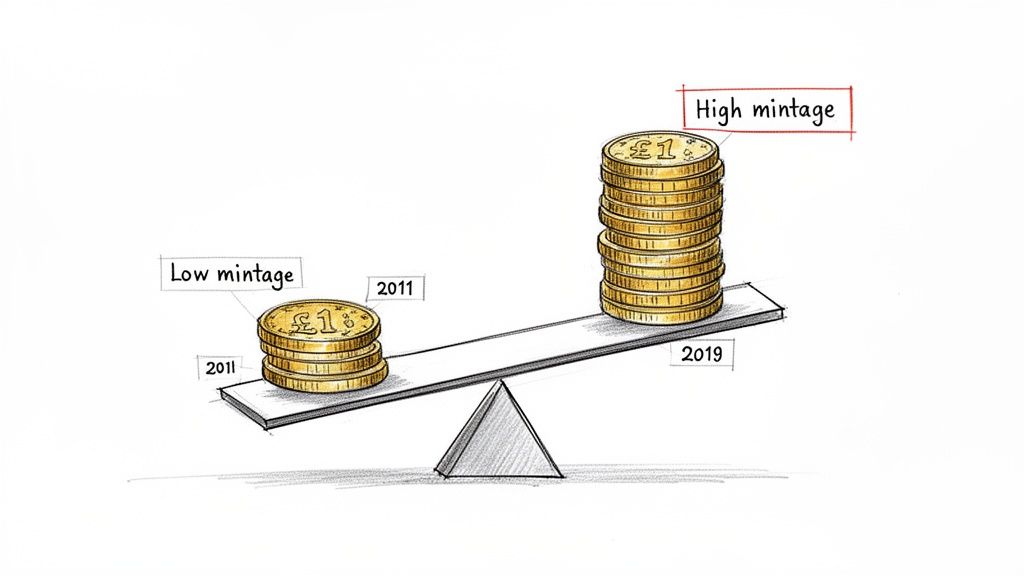
- Low Mintage Figures: This is the big one. The fewer coins of a specific design and year that were produced, the rarer and more sought-after they become. It’s simple supply and demand.
- Commemorative Designs: Coins celebrating the UK's capital cities, national floral emblems, or major historical events often carry a premium over the standard-issue designs.
- Minting Errors: Mistakes during the production process—like off-centre strikes or mismatched sides (known as 'mules')—create unique and often highly valuable oddities.
- Coin Condition: A coin in pristine, uncirculated condition will always command a much higher price than one that’s been knocking about in purses and tills for years.
Think of it like this: a low mintage figure creates the initial scarcity, a compelling design makes it desirable, and excellent condition preserves its maximum potential value. Finding a coin that ticks all three boxes is the holy grail for any serious collector.
Why Mintage Figures Dictate Rarity
When you're trying to figure out which pound coins are worth serious money, one thing matters more than anything else: the mintage figure.
Simply put, this number is how many coins of a particular design The Royal Mint produced in a specific year. It’s the classic rule of supply and demand, and it’s the absolute foundation of the coin collecting world.
A low production run instantly makes a coin scarce. If millions of collectors are hunting for a coin that only had a limited release, its value can't help but climb. On the flip side, a coin minted in the hundreds of millions is almost never going to be worth more than its face value, no matter how cool the design is. This is exactly why a 2011 Edinburgh City £1 is a fantastic find, while a standard 2019 Shield of the Royal Arms is just... a pound.
Understanding Scarcity and Value
Think about it like a limited-edition print from a famous artist. The fewer there are, the more they're worth to people who want one. The very same logic applies in numismatics. The Royal Mint publishes its official circulation data, and for a collector, that data is like a treasure map pointing straight to the scarcest dates and designs.
These figures show some pretty wild swings in production over the years. We saw a massive 825,500,000 of the first-ever £1 coins struck in 1983, but that number has plummeted recently. Compare that to the 2021 'Nations of the Crown' at just 21,760,000, the 2022 coin at a tiny 7,735,000, or the 2023 'Bees' design at 10,030,000. These drops are what create modern rarities.
It's also crucial to know that no circulation £1 coins were issued at all in 1998 or 1999. This creates a gap in collections that people are willing to pay a premium to fill, often with special collector's editions, pushing values up to £100 or more for verified alternatives. You can dig deeper into these numbers by checking out the detailed history of the one pound coin on Wikipedia.
This infographic really puts into perspective why the durable pound coin was brought in to replace the old paper banknote.
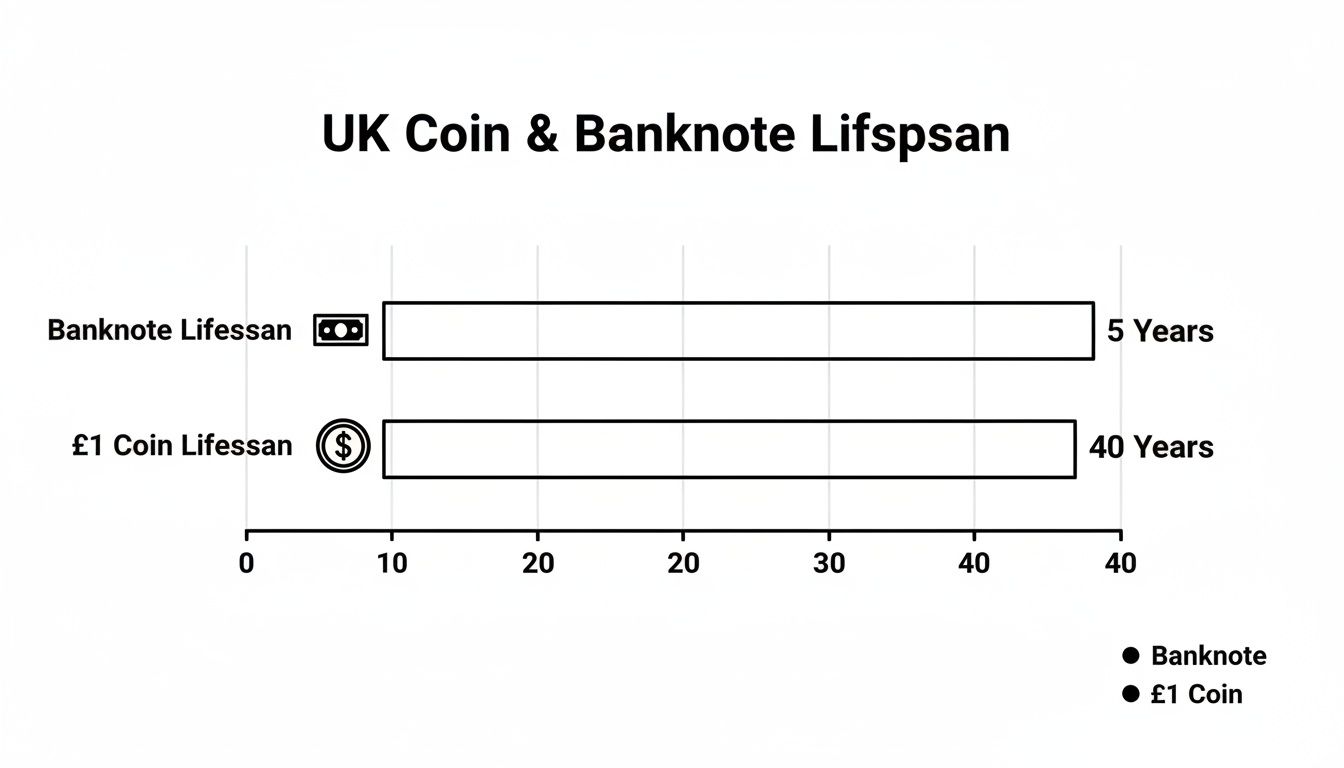
As the chart shows, the coin's 40-year projected lifespan made it a much more sensible long-term choice than the flimsy fiver.
Key Low Mintage Pound Coins to Find
Okay, so how do you put this into practice? You need to know exactly which coins to look for. Focusing on the ones with the lowest mintage numbers is the smartest and fastest way to find valuable pound coins hiding in your change.
Here are a few of the scarcest round pound designs that always command a premium:
- 2011 Edinburgh City: With a mintage of just 935,000, this is the holy grail of UK mainland round pounds. An absolute top find for any collector.
- 2011 Cardiff City: Not far behind its Scottish sibling, the Welsh capital coin had a tiny run of only 1,615,000.
- 2010 London City: Representing England's capital, this coin from the "Capital Cities" series had a mintage of 2,635,000, making it another key piece to hunt for.
- 2008 Royal Arms: The design itself is very common, which makes this one a bit of a wolf in sheep's clothing. The 2008 issue is surprisingly scarce, with only 3,910,000 released into circulation.
To put these numbers in perspective, remember that a staggering 443 million Royal Arms round pounds were minted back in 1983. That enormous difference is exactly what separates a true collectible from everyday currency. It’s why you should always, always check the date on every coin you get.
Spotting Valuable Designs And Minting Errors
It's not just about how many coins were made. Two other, far more exciting, factors can turn a regular pound coin into a collector's piece: its specific design and any mistakes made when it was minted. While a low mintage number creates scarcity, it's the compelling design or a unique error that gives a coin its story and real character.
Commemorative designs are a great place to start your hunt. These are the special coins The Royal Mint releases to celebrate everything from UK capital cities and floral emblems to major historical events. They often become sought-after because they capture a moment in time. Think of the much-loved "Capital Cities" series or the beautifully detailed "Floral Emblems" set—each design tells a piece of the British story, making them infinitely more interesting than the standard shield.
Uncovering Profitable Minting Errors
Now, this is where coin collecting gets really fun. Minting errors are the happy accidents of coin production. Modern quality control is so stringent that genuine errors are few and far between, which is exactly what makes them so valuable. It’s important to remember these aren't coins that got damaged in a till or down the back of a sofa; they are unique specimens that were flawed from the very moment they were struck.
Spotting these little imperfections requires a sharp eye. You're essentially looking for something that just feels off—a clear deviation from how the coin should look.
Here are a few of the classic minting errors to keep an eye out for:
- Off-Centre Strikes: The design isn't stamped squarely in the middle of the coin blank. This leaves a portion of the coin's surface completely smooth and unmarked.
- Mule Coins: This is a huge and highly prized error. It happens when a coin is struck with two dies that were never meant to be paired together—for instance, the 'heads' side from one coin design and the 'tails' from a completely different one.
- Rotation Errors: The alignment between the obverse (heads) and reverse (tails) is wrong. If you hold the coin upright and flip it over vertically, the design on the other side should also be perfectly upright. If it’s tilted at an angle, you've found a rotation error.
- Die Cracks and Cuds: A tiny crack in the die can leave a raised, squiggly line on the coin's surface. A "cud" is a more dramatic version where a piece of the die actually breaks away, leaving a raised, unstruck blob of metal on the coin's edge.
It's a common mistake for newcomers to think any odd-looking coin is a valuable error. Damage from circulation, like scratches and dents, actually reduces a coin's value. A true minting error is a factory mistake, not wear and tear from its life in circulation.
Differentiating Minor Flaws from Major Finds
You quickly learn that not all errors are created equal. A slightly off-centre strike might only add a small premium to the coin's value. In contrast, a dramatic "mule" coin could be worth a very significant sum. For example, the so-called 'fried egg' errors on bimetallic £1 or £2 coins, where the inner core is misaligned, are fairly common and might not add much value unless the shift is extreme.
Learning to spot these valuable imperfections takes practice. A brilliant way to start is by comparing any coin you're suspicious about against a known, perfect example. If you want to dive deeper, you can discover valuable error coins and their hidden treasures in our detailed guide. It's packed with more examples and photos to help you train your eye.
How To Grade Your Coins And Verify Authenticity
Finding a potentially valuable pound coin is a brilliant start, but its physical condition is what truly unlocks its market price. A coin that looks like it just left The Royal Mint will always be worth more than one that has spent years being bashed around in pockets and tills.
Getting to grips with coin grading is a fundamental skill for any serious collector. It’s simply a standardised way of describing a coin's condition, which helps everyone in the hobby speak the same language when it comes to value. While you can pay for professional grading, learning the basics yourself is surprisingly straightforward.
A Practical Guide to Coin Grades
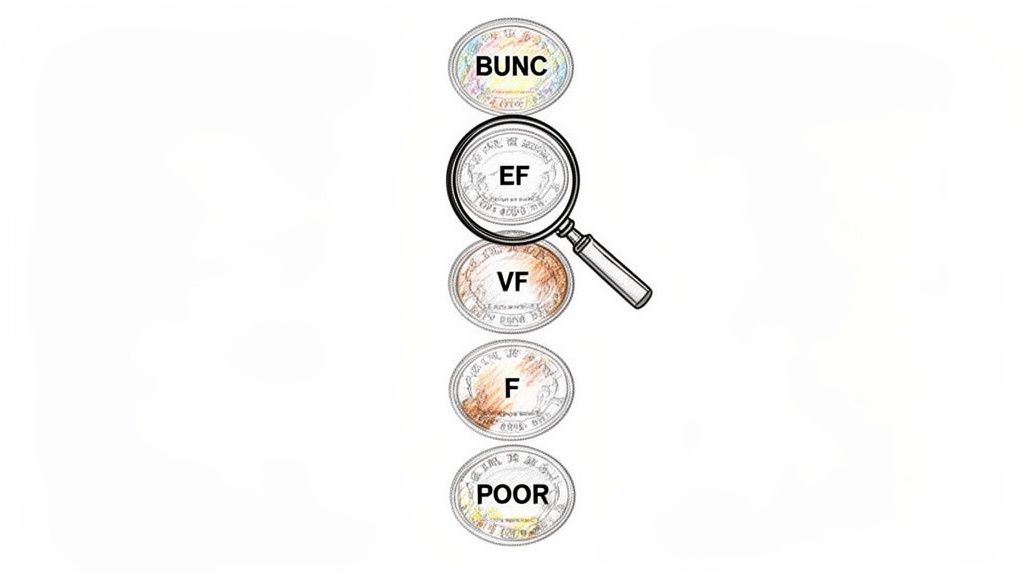
The grading scale runs from 'Poor' (barely identifiable) all the way up to 'Brilliant Uncirculated' or BUNC, which describes a perfect coin with its original mint lustre. A coin that has seen some use but still has most of its detail might be classed as 'Very Fine' (VF) or 'Extremely Fine' (EF).
Here’s a quick breakdown:
- Brilliant Uncirculated (BUNC): A flawless coin with absolutely no signs of wear. It looks brand new.
- Extremely Fine (EF): Shows only the slightest friction or wear on the highest points of the design.
- Very Fine (VF): Light wear is visible across the coin’s surface, but all the major details remain sharp and clear.
- Fine (F): The coin shows moderate wear, with some of the finer details starting to soften and merge.
- Poor (POOR): The date is often illegible, and the main design is mostly worn away. Not one you want to find!
For a deeper dive into the nuances of this process, you can learn more about how to get coins graded in our specialised guide.
Spotting a Counterfeit Pound Coin
Authenticity is just as important as condition, and this is especially true for the old round pounds. Before they were replaced by the much more secure bimetallic coin in 2017, the UK was absolutely flooded with fakes. This counterfeit problem became a stealthy epidemic, turning everyday transactions into a numismatic minefield.
It got so bad that by 2013, official estimates suggested that 3.04% of all £1 coins in circulation were counterfeit—that's roughly 1 in every 33. Some independent testing firms even put the figure closer to 6%. This crisis of confidence is ultimately what prompted the switch to a more secure design. You can discover more insights about these figures on fred.stlouisfed.org.
The sheer volume of fake round pounds means you must check every single one you find. Learning the tell-tale signs of a counterfeit is a non-negotiable skill for protecting your collection's integrity and value.
So, how do you spot a dud? Generally, counterfeits just have a cheap, poorly defined look and feel compared to a genuine coin struck by The Royal Mint.
Common signs of a fake include:
- Mushy or indistinct details: The Queen's portrait or the reverse design might look soft and lack sharp definition.
- Incorrect edge inscription: The lettering around the edge might be poorly spaced, in the wrong font, or even missing entirely.
- Poor alignment: The orientation of the heads side (obverse) compared to the tails side (reverse) might be off-kilter.
- Wrong colour or lustre: Fakes often have a strange, overly brassy sheen or an unusually dull, leaden look. They just don't feel right in your hand.
Key Indicators Of A Counterfeit Round £1 Coin
To make it easier, here’s a quick checklist of what to look for when you're examining a pre-2017 pound coin.
| Feature To Check | What A Genuine Coin Looks Like | Common Counterfeit Flaws |
|---|---|---|
| Edge Inscription | Crisp, clear, and evenly spaced lettering. The font is consistent. | Missing, poorly formed, or unevenly spaced letters. The font may look wrong. |
| Overall Design Detail | Sharp and well-defined features on both the Queen's portrait and the reverse design. | "Mushy" or soft details. The design lacks the sharpness of a real coin. |
| Coin Alignment | The "heads" and "tails" sides should be perfectly aligned when you flip the coin over. | The two sides are misaligned, sometimes by a noticeable degree. |
| Colour and Lustre | A natural-looking nickel-brass alloy with a consistent finish. | Often has an odd, overly yellow or brassy shine, or a dull, leaden appearance. |
| Date and Lettering | The date and other text on the coin face are clear and uniform in style. | The numbers in the date might be unevenly spaced or in a slightly different font. |
Always trust your gut. If a coin feels off—too light, too slick, or just generally poor quality—it probably is. Taking a few seconds to check these features can save you from adding a worthless fake to your collection.
Effective Strategies For Selling Your Valuable Coins
You’ve done the hard work of identifying, grading, and authenticating your valuable pound coins. Now for the exciting part: turning that potential into actual cash. How and where you decide to sell can make a huge difference to the price you get, so it’s a decision worth thinking about.
Whether you've stumbled upon a couple of rare finds or you're a seasoned collector looking to offload some pieces, your selling strategy is key. The right path really comes down to your personal goals. Are you after a quick, no-fuss sale, or are you prepared to invest a bit more time to squeeze every last drop of value out of your coin? Each approach has its pros and cons.
Choosing Your Sales Platform
For many, the first port of call is an online marketplace like eBay. The sheer size of its audience is a massive plus, giving your coins incredible exposure. But there’s a catch. The platform is flooded with wildly optimistic prices and listings that can be downright misleading, which often confuses sellers and buyers who are new to the game.
A quick search for any popular coin will throw up listings with eye-watering price tags, but these are almost never what the coin actually sells for. To get a true sense of a coin's market value, you have to use eBay's "Sold Items" filter. This is the only way to see what people have genuinely paid, cutting through the noise from aspirational sellers.
A more direct option is to approach a specialist coin dealer. A reputable dealer can give you a quick valuation for your collection and make you a fair offer on the spot. Of course, their offer will be below the full retail value—they have a business to run, after all—but it’s a fast, secure, and wonderfully simple way to sell. This is often the best route if you have a large number of coins and can’t face the hassle of photographing, listing, and shipping each one yourself.
It all boils down to a trade-off: convenience versus profit. Selling coins one by one on eBay might earn you more per piece, but it demands a serious investment of your time and effort. Selling to a dealer is quick and painless but will likely mean a lower overall payout.
Perfecting Your Listing
If you do decide to sell online yourself, remember that presentation is everything. There are two things you absolutely cannot afford to skimp on if you want to attract serious buyers and secure the best price: top-notch photos and a detailed, honest description.
- Photography: Take clear, brightly lit photos of both the obverse and reverse of the coin. A plain, neutral background works best. Make sure you capture any unique characteristics or flaws—good lighting is essential for showing off the coin’s lustre and fine details.
- Description: Be as specific as you can. State the year, design, and condition (using the grading terms you've learned). If you have a known rare variety or an error coin, shout about it. Honesty is your best policy here; if there are scratches or marks, point them out.
When you're ready to sell your valuable pound coins, finding reputable buyers is paramount to ensure a fair transaction. For general guidance on identifying trustworthy dealers and avoiding common pitfalls, you might find insights in guides on choosing the best gold buyers. While focused on gold, the principles of vetting a buyer are universal. For a more tailored approach, check out our complete success guide on how to sell coins in the UK.
Common Questions from Fellow Collectors
As you get deeper into the fascinating world of coin collecting, you'll find certain questions come up time and time again. Let's tackle some of the most common queries that pop up when you're on the hunt for those elusive, valuable pound coins.
Should I Clean My Coins to Make Them Look Better?
I can't stress this enough: put the polish away. It’s probably the single biggest (and most heartbreaking) mistake a new collector can make.
Cleaning a coin, no matter how gently you think you're doing it, strips away its original lustre. It also creates a network of tiny, unnatural scratches across the surface. Collectors call this 'hairlining', and it absolutely tanks a coin's value. Serious numismatists want to see a coin in its original, untouched state—natural toning and all.
Why Do I See Coins for Thousands on eBay?
You've no doubt scrolled through eBay and seen a standard-issue 50p or £1 coin listed for a mind-boggling price. These listings are almost always smoke and mirrors. Some sellers are just chancing their arm, hoping an inexperienced buyer will bite. Others use it as a strange tactic to make their other, more reasonably overpriced coins look like a steal in comparison.
Here's the golden rule for finding a coin's real market value: always, always use the 'Sold Items' filter on eBay. This cuts through all the hopeful listings and shows you what people have actually paid. It’s the difference between wishful thinking and market reality.
How Can I Get an Exact Valuation?
Online guides and sold listings are great for getting a ballpark figure, but for a definitive valuation, you really need an expert eye. If you think you've found something special, here are your best bets:
- Talk to a reputable coin dealer: Most dealers will offer a valuation for free, with no obligation to sell. They live and breathe this stuff, so they can assess a coin’s condition and current market demand in minutes.
- Get a printed guide: Nothing beats having a physical catalogue on your bookshelf. Publications like the annual Coin Yearbook from Token Publishing are packed with detailed pricing based on recent auction results.
- Consider professional grading: For a truly rare or high-value coin, using a professional grading service is the way to go. They will authenticate and grade your coin, which cements its value and makes it much easier to sell at the top end of the market.
Are All Error Coins Valuable?
Not quite. The world of error coins has its own hierarchy. Minor flaws, like a slightly off-centre strike or a small die crack, are fairly common and might only add a few quid to the coin's value.
The big money is in the dramatic, unmissable errors. Think of 'mule' coins, where the Royal Mint accidentally used two different dies, or coins with a significant rotation error. When it comes to errors, it's the rarity and the visual 'wow' factor that really gets collectors excited and drives the price up.
Here at Cavalier Coins Ltd, we're passionate about numismatics. Whether you're trying to value a coin you just found, looking to sell a collection, or searching for that one special piece to complete a set, we're here to help. Feel free to explore our collection today at https://www.cavaliercoins.com.