
A collector once opened a presentation case expecting a silver coin and found a large, bright cupro-nickel piece instead. That surprise is common with the Queen Mother 90th birthday coin, because the 1990 issue exists in more than one metal and its £5 denomination was new to the modern UK commemorative market.
The Story Behind the 1990 Queen Mother £5 Coin
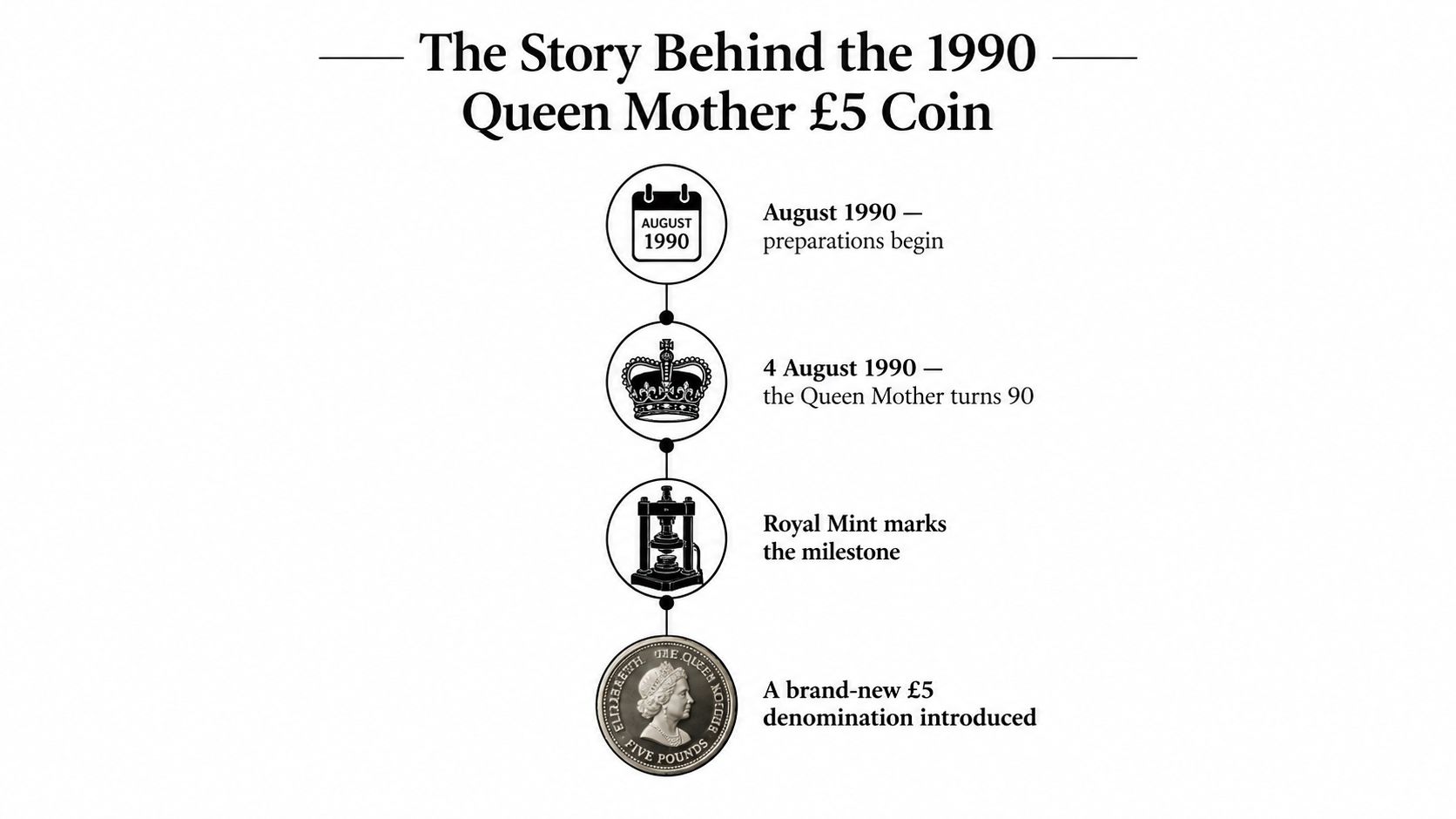
A royal birthday gave British collectors more than a keepsake. In August 1990, the Royal Mint marked Queen Elizabeth The Queen Mother's 90th birthday with a coin that introduced the £5 face value to the modern UK commemorative crown format. It replaced the older denomination associated with the traditional crown and established a new reference point for later commemorative issues.
The birthday fell on 4 August 1990, linking a family celebration with an important change in how the crown was valued. Earlier commemorative crowns carried the older crown denomination. This issue kept the familiar broad, substantial format but presented it as a five-pound coin. The Royal Mint describes it as the first UK commemorative five-pound crown, following the retariffing of crown denominations from 25p to £5 in August 1990. (Royal Mint five-pound coin designs)
That history affects how you should approach the coin as a buyer. A presentation case, bright surface, or royal subject does not by itself identify a silver proof. Check the exact version before paying a premium, since the standard cupro-nickel issue can surprise collectors who associate a large £5 commemorative with silver.
Leslie Durbin designed the reverse, showing the Queen Mother in a crowned and draped portrait with the formal character expected of a major royal birthday issue. The obverse shows Queen Elizabeth II in Raphael Maklouf's third official coinage portrait, used during this period.
Collector's perspective: The coin honours the Queen Mother while also marking the beginning of the modern UK £5 commemorative tradition.
That dual role gives it wider appeal. A royal collector may focus on the portrait and occasion, while a denomination collector may want the first modern UK commemorative £5 crown. It also provides a useful comparison with earlier crowns and later Royal Mint issues. For context on another Queen Mother issue, see this guide to the Queen Mother coin from 1980.
Technical Specifications and Metal Variants
A collector's first task is to identify the format, not judge the coin by its shine. The 1990 Queen Mother 90th birthday £5 was issued in different metals and finishes. As the UK's first commemorative £5, it is often encountered in its standard cupro-nickel form, which can surprise buyers expecting every large royal £5 to be a silver proof.
The ordinary issue is cupro-nickel, an alloy of copper and nickel. The Royal Mint gives the composition as 75% copper and 25% nickel, with a diameter of 38.61 millimetres and a weight of 28.28 grams (Royal Mint five-pound coin designs). Those specifications help separate the common base-metal version from precious-metal alternatives.
The standard silver proof is .925 sterling silver, with the same reported weight of 28.28 grams and diameter of 38.61 millimetres, as described in the London Coin Company silver proof description. Its polished fields and sharper design contrast distinguish proof production from the ordinary cupro-nickel finish.
A gold proof was also issued, but the verified information available here does not establish its precise weight, diameter or fineness. Treat catalogue descriptions carefully. A photograph cannot prove a gold specification.
| Version | Metal | Weight | Diameter | Finish |
|---|---|---|---|---|
| Cupro-nickel Brilliant Uncirculated | 75% copper, 25% nickel | 28.28 g | 38.61 mm | Brilliant Uncirculated |
| Sterling silver proof | .925 sterling silver | 28.28 g | 38.61 mm | Proof |
| Gold proof | Gold | Not established in the verified data | Not established in the verified data | Proof |
The cupro-nickel version is the one collectors most often encounter. Under indoor lighting, it can look silver-coloured, especially in an original pack. Colour is a weak test, much like judging a book by its cover. A scale and callipers provide more useful evidence, while the base-metal composition means it should not be valued as a silver bullion coin.
The obverse carries Queen Elizabeth II's third official coinage portrait, and Leslie Durbin's reverse identifies the commemorative subject. If a listing gives a metal, weight or finish that does not match the stated version, pause before buying.
Mintage Figures and Why They Matter
Mintage gives a coin's production context, not a guaranteed price. A piece can have a substantial issue total and still attract buyers when it survives in excellent condition with its original presentation. Condition, packaging, demand and availability all shape the market.
The reported silver proof issue was 56,102 worldwide, while one original Brilliant Uncirculated presentation run was 45,250. These figures help explain why the ordinary 1990 Queen Mother £5 coin should not automatically be treated as a rare treasure.
| Version | Reported mintage | Collector implication |
|---|---|---|
| Cupro-nickel Brilliant Uncirculated | 45,250 in one original presentation run | A substantial issue, rather than an ultra-low-mintage rarity |
| Sterling silver proof | 56,102 worldwide | A sizeable proof issue where finish and completeness still matter |
| Gold proof | Not established in the verified data | Do not assume scarcity without reliable issue records |
The cupro-nickel version often causes confusion. Its bright surface can look silver-coloured in an original pack, but appearance alone cannot confirm the metal. It was the United Kingdom's first £5 commemorative, yet that historical role does not make every example scarce. For a buyer used to silver proof coins, the standard base-metal version may look more valuable than its composition suggests.
A silver proof can still be appealing because of its precious metal, sharper finish, royal subject and presentation. Its mintage, however, makes an exceptional premium harder to justify for an average example.
Packaging changes the practical supply. Coins may have been removed from cases, stored badly or handled without care. Clean examples with complete original presentation can therefore be less common than the production total suggests, without making every boxed coin rare.
A sensible rule: Confirm the version, metal and completeness before paying a scarcity premium.
For broader context, 50p coin mintage figures show why production totals need to be read alongside condition, demand and surviving presentation.
Identifying Marks and Authentication Tips
A genuine 1990 Queen Mother 90th birthday coin should read as one coherent object. Begin with the date, portrait, commemorative reverse and overall strike, then test its physical specifications. This sequence helps separate a plausible coin from an attractive replica.
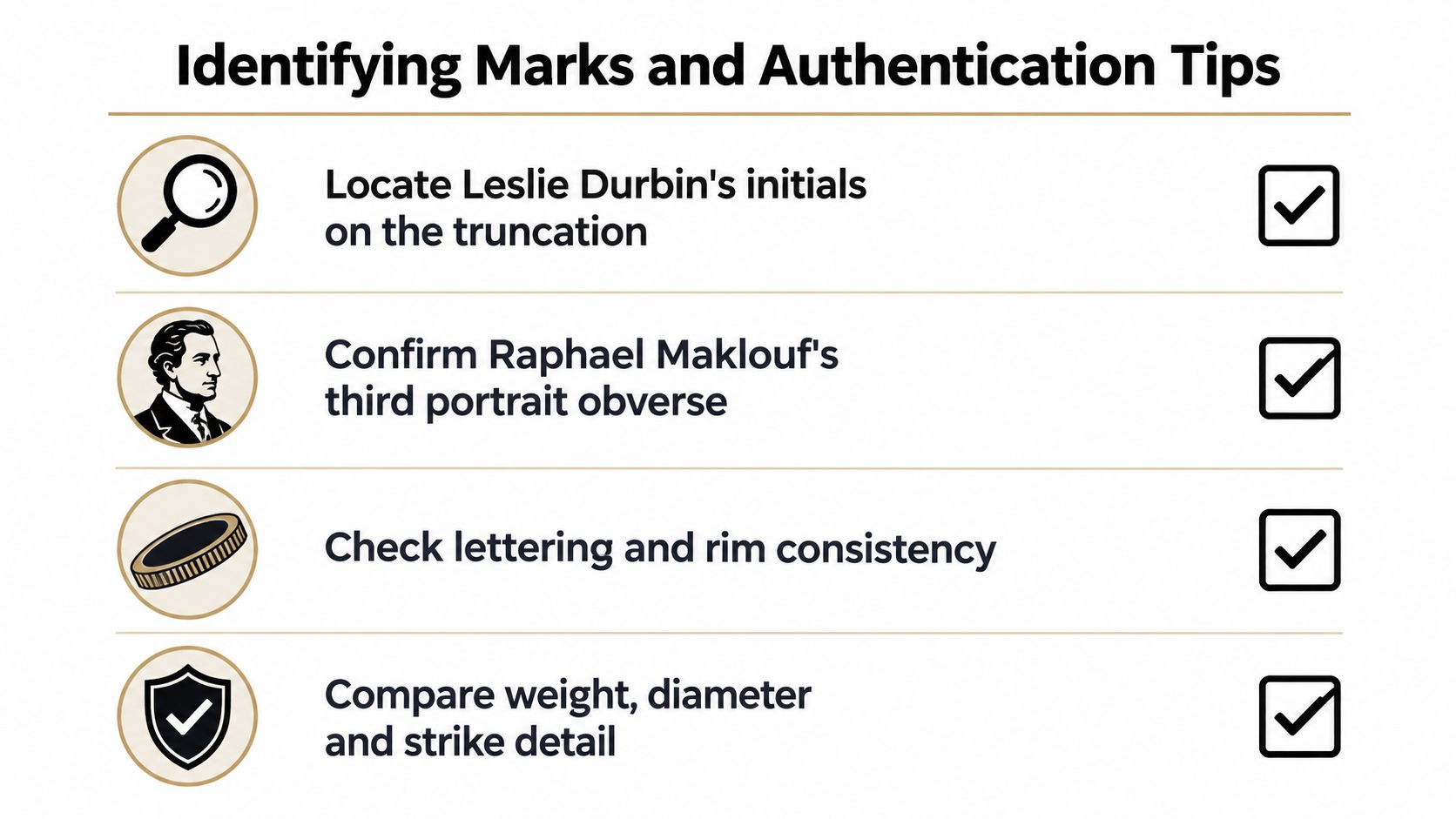
On the reverse, find Leslie Durbin's initials on the truncation and examine them with a loupe. They should sit naturally within the design, with even lettering and relief that matches the surrounding detail. Crude marks, irregular placement or lettering that appears added later deserve caution. On the obverse, confirm Queen Elizabeth II's third portrait by Raphael Maklouf. The portrait and diadem should align cleanly, without awkward distortion.
The edge can provide another useful check, although the available verified information does not establish a precise edge legend. Ask for a sharp edge photograph and inspect the coin directly where possible. An unclear listing image or a seller's description cannot confirm authenticity.
A practical home inspection
Use the same routine for every candidate:
- Inspect the portraits: Check the date, obverse portrait and reverse design under clear, neutral light.
- Measure the diameter: Compare the coin with the standard specification recorded earlier. A measurement that is noticeably outside the expected specification needs an explanation.
- Weigh the piece: Compare its weight with the published standard. Silver and cupro-nickel examples share the reported standard weight, so weight supports identification but cannot establish the metal by itself.
- Examine the rim: Look for a continuous, even rim. Avoid pieces with seams, filed edges or distorted lettering.
- Check the packaging: Cases, capsules and certificates can support provenance, but they do not replace examination of the coin.
Cupro-nickel and silver do not respond to an ordinary magnet, yet a negative result proves very little. Copper-plated replicas, altered dates and poorly made casts may pass this basic test. If the coin appears unusually valuable, request an assessment from a recognised third-party service such as PCGS or NGC. Beginners can also use this guide to mint marks on coins to become more familiar with small diagnostic features.
Grading, Market Value, and Varieties
The 1990 Queen Mother £5 is best understood as an accessible commemorative rather than an automatic rare-date investment. Condition and format create the main divisions: an handled cupro-nickel example, a clean Brilliant Uncirculated piece, a silver proof and a gold proof appeal to different buyers.
A circulated coin may show hairlines, contact marks and dulling across the high points. A Brilliant Uncirculated coin should retain sharper detail and stronger original surfaces, though it can still have marks from storage or contact with packaging. A proof should display the deliberate contrast between polished fields and frosted design elements, but a proof designation doesn't remove the need to inspect the surface.
There isn't enough verified market data here to give responsible GBP price bands. Dealer asking prices, auction results and private sales can differ, and a precise figure without a current, reliable result would create false confidence.
| Version | Grade tier | Typical price |
|---|---|---|
| Cupro-nickel | Circulated | Varies with appearance, completeness and buyer demand |
| Cupro-nickel | Brilliant Uncirculated | Usually depends on original packaging and surface quality |
| Sterling silver | Proof | Influenced by finish, case, certificate and eye appeal |
| Gold | Proof | Requires reliable identification and current specialist valuation |
What buyers should judge
A coin's grade is only one part of its market position. A silver proof with attractive surfaces and complete Royal Mint presentation may be more appealing than a technically higher-graded example with unattractive toning or damaged packaging. A raw coin can also be cheaper to buy, but the buyer accepts more uncertainty about grade and authenticity.
Slabbed examples from PCGS or NGC may be easier for distant buyers to compare because the coin has passed through a third-party grading process. That doesn't make the grade infallible, and the holder can't repair hairlines, spots or poor eye appeal. Certification makes most sense when the coin's value and condition justify the cost.
Market reality: A proof finish, precious metal and attractive presentation can create a premium, but none of them guarantees a dramatic return.
The issue's strongest role is as a collectable with broad entry points. Beginners can start with the standard format, while specialists can pursue a well-preserved silver proof or investigate the gold variant through a reputable numismatic source.
Buying and Selling With Confidence
A good listing gives you enough evidence to identify the coin before money changes hands. A single photograph of the obverse in a plastic holder isn't enough, especially when the seller uses the word “silver” without showing the coin's documentation or specifications.
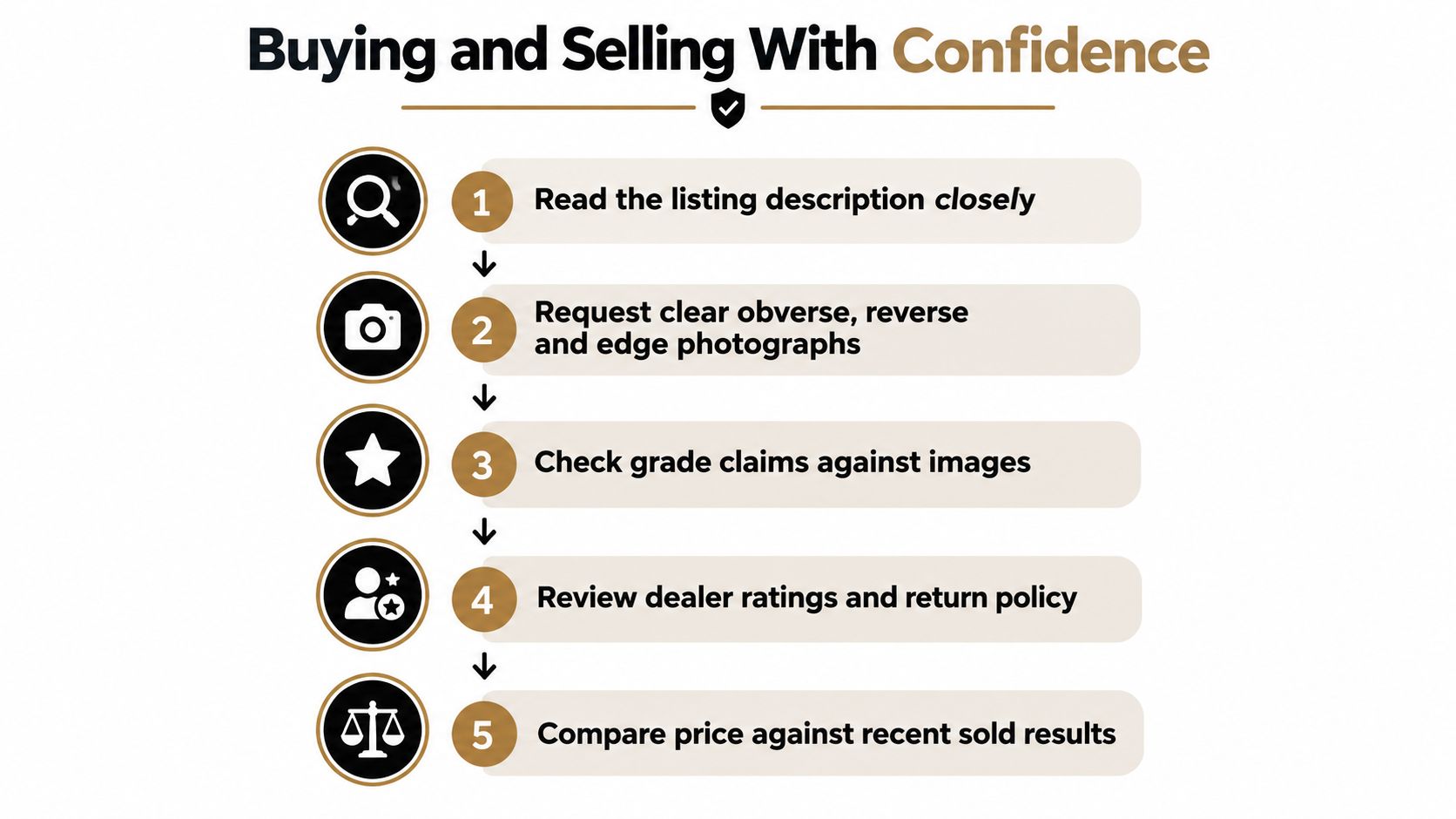
Ask for four views: a focused obverse, a focused reverse, the edge and the complete packaging. The photographs should be large enough to show hairlines, spots, rim knocks and any marks around the lettering. If the coin is sealed, ask whether the seller can show the case, outer sleeve and certificate without opening it.
Questions to ask before purchase
- What version is it? Ask whether the piece is cupro-nickel, sterling silver or gold, and request the evidence supporting that description.
- Is it certified? Record the PCGS or NGC certification number where applicable, then compare the holder details with the photographs.
- What is included? Confirm whether the original case, capsule, certificate and outer packaging are present.
- Can you return it? Read the dealer's or marketplace seller's return terms before paying.
- How is the price supported? Compare the offer with recent sold results, not just ambitious unsold listings.
Red flags include a mismatched date style, unusually artificial toning on an alleged proof, a missing certificate where the listing relies heavily on one, or a price that seems disconnected from the stated metal and condition. A low price isn't automatically a bargain. It may reflect damage, an incomplete set, an incorrect description or a counterfeit.
When selling, choose the route that matches the coin. A standard raw example may suit a fixed-price listing, while a certified or precious-metal piece may benefit from a specialist dealer or timed auction. Keep photographs honest and describe imperfections directly. Provenance helps, but it should support the coin's measurable features rather than replace them.
Storage, Care, and Final Collector Takeaways
Storage protects the features that buyers pay for. Handle cupro-nickel Brilliant Uncirculated and circulated coins by their edges, preferably with clean cotton gloves, and keep them in non-PVC flips or suitable album slots. Rubber bands, loose contact with paper and unstable plastic can leave marks or encourage surface problems.
Silver proof coins deserve greater protection from air, moisture and contamination. An airtight capsule can reduce exposure, while silica gel in the surrounding storage area helps manage moisture. Don't place silica gel directly against the coin or capsule, and don't open the original presentation unnecessarily if the packaging is clean and secure.
Gold proofs should have individual, secure storage and appropriate insurance where their value warrants it. Keep records of the version, packaging, purchase details and any certification. Those notes make future insurance, resale or estate administration much easier.
Avoid cleaning
Never polish the coin to make it brighter. Abrasive cleaning leaves hairlines, while chemical treatment can alter the original surface and reduce collector appeal. Even a silver proof that has developed attractive or unattractive toning is better assessed in its present state than damaged in an attempt to restore a factory appearance.
Care rule: A coin's original surface is an asset. Cleaning can remove the very evidence that supports a strong grade.
The Queen Mother 90th birthday coin remains interesting because it joins three collecting themes in one issue. It commemorates a major royal birthday, establishes the modern UK £5 format and offers a choice between ordinary cupro-nickel, sterling silver proof and gold proof production. Its relatively substantial reported production means buyers should remain realistic, but it also makes the issue approachable for new collectors.
Hold a coin when its history, condition and presentation fit the collection you want to build. Trade it when the format is misidentified, the packaging is incomplete or another collector values the piece more strongly. If you own an unusually clean high-grade example, consider professional certification from PCGS or NGC after comparing the likely benefit with the cost.
Cavalier Coins Ltd offers fixed-price collectible coins and banknotes, together with weekly eBay auctions that can include commemorative and vintage issues. Visit Cavalier Coins Ltd to compare available pieces, explore related UK material or discuss larger purchases with its team.