
Ever found a shiny £2 coin in your change and wondered if it might be worth more than a couple of quid? The truth is, many are. But what separates a regular two-pound piece from a rare 2 pound coin isn't always age. It often comes down to a combination of low mintage numbers, a special commemorative design, or a unique minting error.
What Makes a 2 Pound Coin a Collector's Item
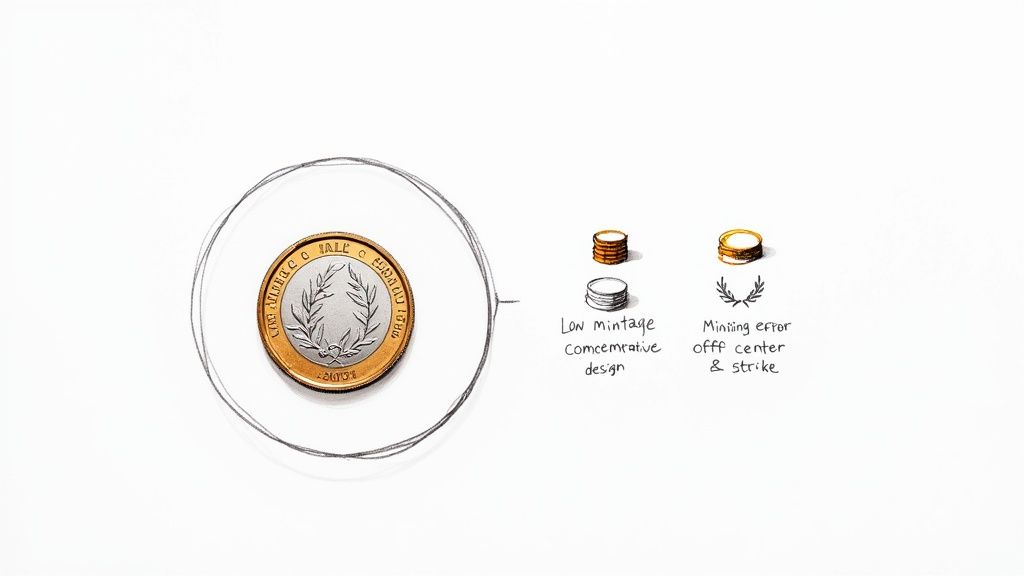
Spotting a valuable £2 coin feels a bit like a modern-day treasure hunt. Many people assume older automatically means more valuable, but the real drivers are scarcity and demand. Three key things work together to turn a simple piece of currency into something a collector would eagerly snap up. Getting to grips with these is the first step for any budding numismatist.
To make it easier to understand, we've put together a quick reference table.
Key Factors That Determine £2 Coin Value
| Rarity Factor | What It Means for Collectors | Classic Example |
|---|---|---|
| Low Mintage | The Royal Mint produced very few of this design, making it naturally hard to find in circulation. | 2002 Commonwealth Games (Northern Ireland) |
| Commemorative Design | A limited-edition coin released to mark a specific event, making it desirable for its story. | 2015 First World War (Navy) £2 |
| Minting Error | A mistake made during production, creating a unique and often highly sought-after variety. | 1999 Rugby World Cup (Inverted '£2') |
Each of these factors can make a coin special, but when you find a coin with more than one, its value can really take off. Let's dig into what each of these means in a bit more detail.
The Importance of Mintage Figures
The single biggest factor in any coin’s rarity is its mintage figure. This is simply the total number of coins with that specific design that were produced and released for us to use. A low mintage figure means fewer coins are out there, which directly translates to higher scarcity.
Take the 2015 Britannia £2 coin, for example. It became an unexpected collector's item because of its surprisingly low mintage of just 650,000. To put that in perspective, the Royal Mint churned out over 6 million Britannia coins in 2021 and another 4 million in 2022. That huge difference shows how a standard-issue coin can become a rare 2 pound coin just because so few were made.
Commemorative Designs and Special Issues
Many of the £2 coins you'll find are minted to celebrate major historical events, national achievements, or cultural milestones. These commemorative designs are almost always produced for a limited time, which naturally restricts their supply from the get-go.
These special editions often feature unique artwork that makes them stand out from the standard "Technology" design, making them far more appealing to collectors. The story behind them adds another layer of desirability. This group includes some of the most famous rare coins, like the 2002 Commonwealth Games series.
A coin is more than just money; it's a small piece of history you can hold in your hand. The story behind a commemorative coin is often as valuable to a collector as the metal it's struck on.
The Role of Minting Errors
Every now and then, things go wrong during the minting process. These little imperfections, known as minting errors, can create exceptionally rare and valuable varieties. It's crucial to remember that an error isn't just damage; it's a flaw that happened at the Royal Mint itself.
Common errors to keep an eye out for include:
- Mule Coins: This happens when a coin is struck with mismatched obverse (heads) and reverse (tails) dies.
- Off-Centre Strikes: The design isn't perfectly centred on the coin blank.
- Rotation Errors: The alignment between the heads and tails side is incorrect.
These mistakes are usually caught by quality control, so the few that slip through are incredibly scarce. While some coins become rare by accident, others are made to a much higher standard from the very beginning. To appreciate the difference in quality, you might be interested in our guide on what a proof coin is and why they are so special.
The Story Behind the Modern £2 Coin
To really get a feel for what makes a rare £2 coin, you have to know where it came from. The two-pound coin we use today wasn't always a staple of our everyday change. Its story starts long before the familiar two-toned, or bi-metallic, version began jingling in our pockets.
It all kicked off back in 1986 with the first commemorative £2 coins. These early versions were single-metal pieces, struck from nickel-brass, and felt more like special medals than actual currency. They were designed to celebrate major national events but were never meant for general circulation, which explains why you don't find them mixed in with their modern cousins.
The Uni-Metallic Commemorative Era
Between 1986 and 1996, The Royal Mint issued a whole series of these single-metal £2 coins. Each one tells a story, marking a moment in British history and celebrating our achievements.
These included coins for:
- The 1986 Commonwealth Games held in Scotland.
- The tercentenary of the Claim of Right in 1989.
- The 1995 anniversary marking the end of the Second World War.
While these coins are fascinating pieces of history, most were minted in huge numbers. This means that, unless you have a special proof version, they aren't typically worth a fortune. Their real job was to pave the way for a more permanent, functional two-pound coin.
This image from Wikipedia shows several of the bi-metallic £2 coins that have entered circulation over the years.
The sheer variety in designs really highlights how the coin became a canvas for commemorating British history and culture right from its introduction.
A New Chapter: The Bi-Metallic Coin
The real game-changer landed in 1997 with the bi-metallic £2 coin, although it didn't officially hit our pockets until 15 June 1998. This new design by Bruce Rushin was a huge leap forward, becoming the first bi-metallic circulating coin in Britain since the 17th century.
It came about after a review of UK coinage highlighted the need for a denomination that bridged the gap between the £1 coin and the £5 note. It was a massive success. By March 2014, there were roughly 417 million £2 coins circulating in the UK. You can dig into more of the history and circulation figures on Wikipedia.
The new £2 coin wasn't just another piece of currency; it was a small marvel of engineering. Its reverse design, featuring four concentric circles, cleverly tells the story of technological progress from the Iron Age right through to the digital era.
The design was deeply symbolic. The inner circle represents the Iron Age, the next depicts the Industrial Revolution, the third signifies the silicon chip, and the outer ring symbolises the internet. It was a powerful statement about progress as Britain headed towards a new millennium.
This shift from non-circulating commemoratives to a widely used bi-metallic coin is what every collector needs to understand. It created two completely different categories of £2 coins and set the stage for the modern hunt for rare editions. Getting your head around this evolution is the first step to spotting the truly special finds in your change.
Your Guide to the Most Valuable 2 Pound Coins
Right, this is the part everyone gets excited about—the treasure map. While loads of commemorative £2 coins are floating around, only a handful are genuinely scarce. These are the ones that turn your loose change into a serious find.
Knowing what to look for is the name of the game. It’s not just about the design; it's about the story behind the coin, whether that’s a tiny mintage or a famous mistake. These are the coins every collector dreams of finding in their pocket.
Before we dive in, it helps to understand how the £2 coin has evolved. It started as a single-metal commemorative piece before becoming the bi-metallic coin we all recognise today.
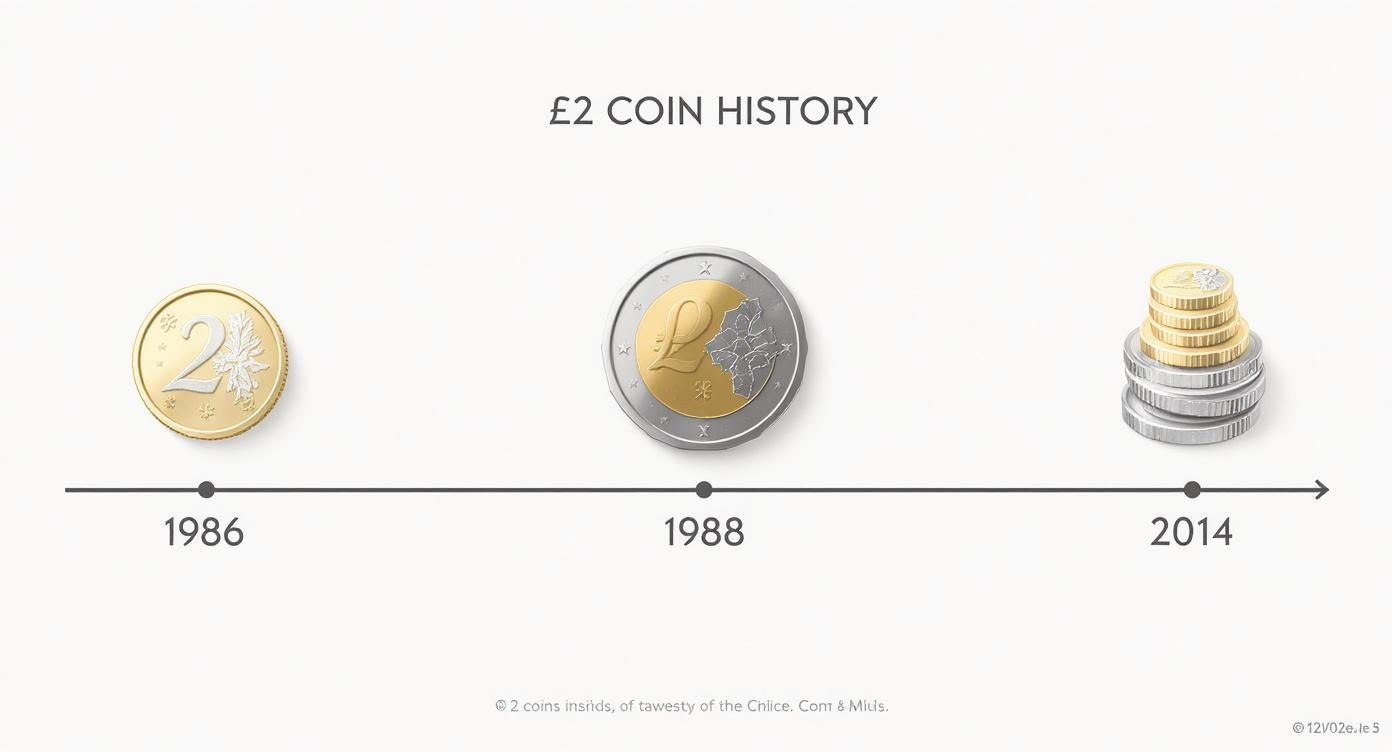
The timeline really highlights that pivotal shift in 1998, which kicked off a new era for circulating commemorative coins and shaped the collecting world as we know it.
Now, let's get into the specifics. Below are some of the most sought-after £2 coins you might actually find in your change. We'll look at why they’re so special, from their low mintage numbers to the unique features that set them apart.
Top 5 Rare £2 Coins to Find in Circulation
| Coin Name and Year | Mintage Figure | Key Identifying Feature | Estimated Value Range |
|---|---|---|---|
| Commonwealth Games (Northern Ireland), 2002 | 485,500 | The small flag of Northern Ireland on the reverse. The rarest of the four-coin set. | £30 - £50 |
| Commonwealth Games (Wales), 2002 | 588,500 | The flag of Wales on the reverse. The second rarest in the Commonwealth Games series. | £15 - £25 |
| Britannia, 2015 | 650,000 | Standard Britannia design, but check the 2015 date. Known for a "mule" error. | £15 - £30 |
| Commonwealth Games (England), 2002 | 650,500 | The flag of England on the reverse. The most common of the four, but still very collectible. | £10 - £18 |
| Commonwealth Games (Scotland), 2002 | 771,750 | The flag of Scotland on the reverse. Slightly more common than the others but still a key find. | £8 - £15 |
These coins are the holy grail for many collectors. Finding any one of them is a fantastic achievement, but discovering the full Commonwealth set, especially the Northern Ireland coin, is a real numismatic victory.
The Commonwealth Games Quartet
The 2002 Commonwealth Games £2 coins are legendary in collecting circles, and for good reason. The Royal Mint issued four distinct versions to represent the home nations: England, Scotland, Wales, and Northern Ireland. The designs look almost identical at a glance, but that tiny flag on each coin is everything.
The mintage figures tell the whole story:
- England: The most common of the set, with 650,500 minted.
- Wales: A bit scarcer, with a mintage of 588,500.
- Scotland: This one's harder to track down, with 771,750 released.
- Northern Ireland: The undisputed champion. With a tiny mintage of just 485,500, this is the rarest circulating £2 coin out there.
Finding any of these is a win, but pulling the Northern Ireland coin from your change is like striking gold. It remains the top prize for any serious rare 2 pound coin collector.
The Modern Marvel: 2015 Britannia
You don't always have to dig through old coin jars to find a rarity. The 2015 Britannia £2 coin is a perfect example of a modern scarcity that caught everyone off guard. For years, the Britannia design was just a standard, high-mintage issue that nobody paid much attention to.
Then, in 2015, something changed. The Royal Mint only struck 650,000 of them. This was a minuscule number compared to the millions produced in other years, instantly making it a key date. Of course, most people just spent them, meaning well-preserved examples are now even harder to come by.
The 2015 Britannia teaches us a crucial lesson: always, always check the date. What looks like a common coin one year can be an absolute treasure the next.
Famous and Valuable Error Coins
Beyond low mintages, some of the most exciting finds are coins that went wrong during production. These minting errors create unique, and often valuable, varieties simply because they were never meant to exist.
A classic example is the 2011 Charles Dickens £2 coin. A small number slipped through quality control with the ring of dots missing around the Queen's head on the obverse. It sounds like a tiny detail, but in the coin world, it’s a massive flaw that makes it incredibly desirable.
Another one to watch for is the 1999 Rugby World Cup coin. Some of these were minted with an inverted "£2" on the reverse—it’s completely upside down. It’s a subtle error that sets it apart from millions of correct versions, creating a classic rare 2 pound coin. A magnifying glass can be your best friend when hunting for these tiny, valuable imperfections in your change.
How to Properly Identify and Grade Your Coins
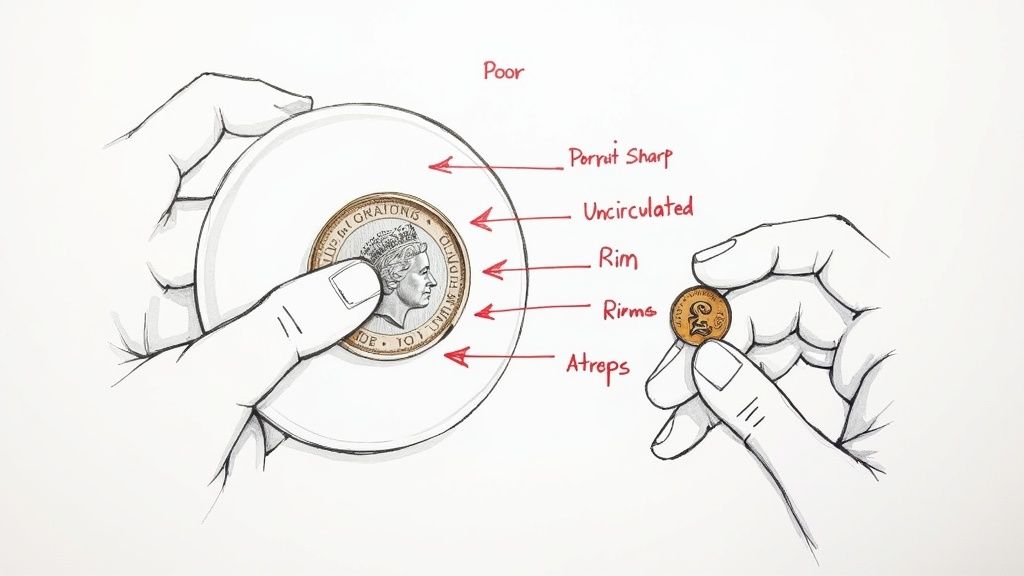
So, you think you’ve stumbled upon a £2 coin with a low mintage or a sought-after design? That’s a brilliant start, but it’s only telling you half the story. The coin's physical condition, what we call its grade, is a massive factor in figuring out its final value. A flawless, untouched version of a rare £2 coin will always be worth a great deal more than one that's been clinking around in change for years.
Think of it like buying a classic car. A model with low mileage and immaculate paintwork will fetch a much higher price than the exact same car with dings, scrapes, and a tired interior. Coin grading is built on a similar idea; it’s a standardised language for describing a coin's level of wear and tear.
Getting to grips with the basics of grading gives you the power to properly assess your own finds and spot a bargain when you’re looking to buy. It’s what separates simply having a potentially rare coin from truly understanding what it's worth to other collectors.
Understanding the Key Grading Terms
In the world of coin collecting, we use a specific set of terms to describe a coin's condition, from perfect to barely recognisable. While the official systems can get incredibly detailed, you only need to know a few key grades to get going.
Here’s a quick rundown of the most common grades you'll come across:
- Uncirculated (UNC): This is the pinnacle. A perfect coin with zero signs of wear, looking as fresh and shiny as the day it left the Royal Mint. It has its full lustre and all the details are razor-sharp.
- Extremely Fine (EF): A coin with just a whisper of wear, and only on the very highest points of the design. You can still see most of the original mint lustre, and all the main details are crisp.
- Very Fine (VF): Here, the coin shows some light but noticeable wear on its highest points. The overall design is still clear, but you'll notice some of the finer details have begun to soften.
- Fine (F): This grade indicates moderate wear across the whole coin. The main design is still visible, but those finer details are long gone, and the coin has lost that original fresh-from-the-mint shine.
If you’re keen to dive deeper, our comprehensive coin grading guide is perfect for beginners and experts breaks things down even further with more detailed explanations and helpful pictures.
A Practical Guide to Grading Your Coins
Now you know the lingo, how do you put it into practice? You don't need any fancy or expensive gear to start; a simple magnifying glass and a good lamp are your most trusted tools. Here’s a straightforward, step-by-step way to look at your own £2 coins.
1. Handle With Care: First and most importantly, never touch the face of the coin with your bare fingers. The natural oils on your skin can cause permanent damage over time. Always, always hold the coin by its edges between your thumb and forefinger.
2. Examine the High Points: The highest points of the design are always the first places to show wear. On any £2 coin, these are the critical areas you need to inspect up close.
Grab your magnifying glass and take a close look at the Queen's portrait. Pay attention to her hair, the intricate details of the crown, and her cheek. On a high-grade coin, these areas will be sharp and well-defined. On a lower-grade coin, they will look flattened and worn down.
3. Check the Field and Lustre: The flat, background part of the coin is called the field. Scan it for tiny scratches, bag marks (small dings from bumping against other coins), or any other blemishes. An Uncirculated coin will have a clean field and a bright, "cartwheeling" lustre that seems to spin as you tilt it in the light.
4. Inspect the Rim and Edge: Don't forget the third side of the coin! Check the edge for any nicks, dents, or damage. The edge inscription on a £2 coin should be clear and easy to read. Any serious damage here can really knock down the coin's overall grade and, ultimately, its value.
By following these simple steps, you can start to confidently assign a basic grade to your finds and get a much better feel for the potential of your rare 2 pound coin collection.
Getting to Grips with the Pre-1997 Commemorative Coins
Before the two-tone £2 coin we know today started jingling in our pockets, The Royal Mint produced a very different kind of two-pound piece. These earlier, single-metal coins, issued between 1986 and 1996, often trip up new collectors. They certainly look the part – old, chunky, and substantial – so it’s easy to think you’ve stumbled upon a real treasure.
These uni-metallic coins were all struck from nickel-brass and were released to mark major national events. It’s best to think of them not as everyday cash, but as special souvenirs. Because they were never really meant for wide circulation, pulling one from your change is a bit unusual, but that on its own doesn't make it a valuable rare 2 pound coin.
The simple truth is, most of the standard nickel-brass versions were churned out in massive numbers, often running into the millions. This means that despite their age and interesting history, they’re usually only worth a smidge more than their face value to a collector.
The Tale of Two Versions
The real secret to finding value in this era of £2 coins comes down to one crucial detail: the huge difference between the common circulation coins and their much, much scarcer precious metal cousins. For every commemorative design, The Royal Mint also struck a very small number of coins in silver and, in some cases, gold.
These special editions were aimed squarely at serious collectors from day one. So, how can you spot the difference?
- Standard Nickel-Brass: These have a distinct yellowish, brassy look. They are by far the most common type you'll encounter.
- Silver Proof: These have a brilliant, bright white shine that’s impossible to miss. They were typically sold in protective plastic capsules and fancy presentation boxes.
- Piedfort Silver Proof: These are the heavyweights. They are double the thickness and weight of the standard silver proofs, giving them an incredibly chunky and satisfying feel in the hand.
It’s this built-in scarcity that turns a silver or gold version into a genuine prize. While millions of the standard coins are out there, the precious metal proofs were made in tiny batches, creating true rarity.
The key takeaway for any pre-1997 £2 coin is to look past the date. Age isn't the deciding factor here; it's all about the metal it's made from and, most importantly, how few were produced.
Understanding Mintage and Rarity
The production numbers from this period tell the whole story. Between 1986 and 1996, The Royal Mint issued seven different commemorative £2 designs. Most of them had mintage figures in the millions; the 1986 Commonwealth Games £2, for instance, had over 8.2 million coins minted. Some, however, were less common even in their standard form. The 1989 Claim of Right £2 had a much lower mintage of just 381,400.
But when you turn to the collector editions, the numbers fall off a cliff. The proof versions of that same 1989 coin, including the silver proofs, were limited to as few as 10,000. The even rarer piedfort silver proof had a tiny mintage of only 7,634. You can dig deeper into the history and mintage figures of these older coins over at the Britannia Coin Company. This is the kind of dramatic drop-off that separates a common keepsake from a truly valuable collectible.
Tips for Buying and Selling Rare Coins Safely
Dipping your toe into the market to buy your first rare £2 coin, or perhaps sell one you've just found, is a genuinely exciting moment. But it's a field where a bit of know-how goes a very long way. It protects you from the usual traps, helps you get a fair price, and ensures you're buying the real deal.
When it comes to the transaction itself, you're looking at two main routes: online marketplaces and specialist dealers. Each comes with its own pros and cons, and it’s worth weighing them up before you jump in.
Where to Buy and Sell Your Coins
Picking the right place to trade is your first big decision. It often comes down to how experienced you are, the coin's value, and frankly, how much legwork you're prepared to do.
These are your most common options:
- Online Marketplaces (like eBay): These sites give you access to a huge number of buyers and sellers, which is great. You might even snag a bargain. But, and it's a big but, you have to be incredibly careful. The sheer volume means fakes and ridiculously overpriced common coins are everywhere.
- Specialist Coin Dealers: A reputable dealer, whether they have a physical shop or are online, brings expertise and a guarantee of authenticity to the table. You might pay a little more when buying, or get a slightly lower offer when selling (they have overheads, after all), but what you're really paying for is peace of mind.
- Auctions: If you're dealing with something exceptionally rare or valuable, a specialist coin auction is often the best way to go. They market the coin to serious collectors who are prepared to pay top prices, but be aware they do charge hefty fees.
For most collectors, a trusted dealer strikes the perfect balance between safety and getting a fair market price. It takes the guesswork out of the equation and dramatically cuts the risk of being stung with a counterfeit.
How to Spot Fakes and Avoid Scams
Sadly, wherever there are valuable collectibles, fakes will follow. Counterfeiters often focus on well-known rare issues, like the Commonwealth Games £2 coins. Learning to spot the red flags is your single best defence.
A genuine rare coin tells its story through its precise weight, the specific metal it’s made from, and the sharpness of its design. A fake almost always gets one of these crucial details wrong, giving the game away.
When you're looking at a potential purchase, keep an eye out for these tell-tale signs:
- Poor Design Quality: Fakes often look a bit 'soft' or blurry. The details just aren't as crisp as they should be. Always compare the coin you're looking at with a high-resolution photo of a known genuine one.
- Incorrect Weight and Size: Every coin is struck to incredibly precise specifications. A cheap set of digital scales is one of the best tools you can own. If a coin's weight is off by more than a tiny fraction, it's a massive red flag.
- Edge Inscription Errors: The lettering around the edge of a £2 coin should be clean, clear, and evenly spaced. Fakes often have sloppy, hard-to-read, or sometimes just plain nonsensical inscriptions.
- Suspiciously Low Prices: This one is simple. If a deal on a rare 2 pound coin looks far too good to be true, it is. Scammers prey on newcomers hoping to find a bargain they can't resist.
Getting a Fair Price for Your Coin
Whether you're on the buying or selling side of the table, making sure the price is right is crucial. For sellers, that means getting your coin properly valued. Online price guides are a decent starting point, but a professional valuation will take into account the coin's specific grade and the current market demand.
This expert assessment gives you the confidence that you're asking for what the coin is truly worth. To get a better feel for how this works, our detailed guide on how to sell a rare coin breaks down the practical steps.
Common Questions About Rare £2 Coins
Even when you've got the basics down, a few questions always seem to pop up in the coin collecting community. Let's tackle some of the most common ones head-on to clear up any lingering confusion about finding a rare two pound coin.
Think of this as a quick-fire round to sharpen your knowledge, whether you're just starting out or have been collecting for years.
What Is the Rarest Circulating £2 Pound Coin?
The one everyone is looking for is the 2002 Commonwealth Games Northern Ireland £2 coin. It's the undisputed king of circulating £2 coins, with a tiny mintage of just 485,500.
Because so few were made, stumbling across one in your change is incredibly unlikely. This rarity is exactly why it sits at the very top of most collectors' wish lists.
Are Older Coins Always More Valuable?
That's a common myth, but the short answer is a firm "no". A coin's value is almost always driven by its rarity, not its age. The mintage figure is far more important than the date stamped on it.
Take the 1997 bi-metallic £2 coin. It was one of the first, but with over 13 million minted, it's only worth its face value. Now, compare that to the 2015 Britannia £2 coin. Despite being much newer, its low mintage of only 650,000 makes it a highly sought-after piece.
Should I Clean My Coins to Improve Their Appearance?
Whatever you do, don't. Cleaning a coin is probably the single biggest mistake a new collector can make. Using polishes, harsh cloths, or any kind of abrasive will create tiny, irreversible scratches on the coin's surface.
You also strip away the natural patina – that subtle toning a coin develops over time – which is something experienced collectors actually look for and value. A cleaned coin is almost always worth significantly less than an untouched one.
How Can I Get an Accurate Valuation?
Online guides and checking sold listings on eBay are great for a ballpark figure, but for a truly accurate valuation, you really need to speak to a professional. A reputable coin dealer has the experience to do three critical things:
- Authenticate the Coin: First and foremost, they can tell you if it's genuine or a fake.
- Grade its Condition: They will professionally assess its level of wear and tear, which massively affects the price.
- Provide Market Value: Based on its condition and current collector demand, they can give you an accurate market price.
Getting that professional insight is the only way to be sure of what your rare two pound coin is really worth.
For expert advice and a trusted place to build your collection, Cavalier Coins Ltd offers a wide selection of rare and collectible coins from the UK and around the world. Visit https://www.cavaliercoins.com to explore our inventory or get in touch for a professional valuation.