
Embark on a numismatic journey into the world of Britain's most coveted coins. Beyond mere currency, these metallic artefacts are windows into pivotal moments in history, from royal abdications to wartime economies. This guide is designed for both the discerning collector and the curious beginner, offering a deep dive into the stories, specifications, and current market values of some of the United Kingdom's most exceptionally rare coinage. Understanding the factors that determine rare British coin values is the first step towards building a significant collection or identifying a hidden gem.
Whether you're looking to start a serious collection, understand the potential of a family inheritance, or simply appreciate the artistry and rarity of these pieces, we will provide the expert insights needed. Navigating the numismatic market requires more than just a price guide; it demands an appreciation for the 'why' behind a coin's worth. This involves examining minuscule mintage figures, understanding unique historical contexts, and spotting the subtle characteristics that separate a common piece of shrapnel from a national treasure.
In the following sections, we will explore six legendary coins that define the pinnacle of British numismatics. We'll detail everything from the fabled 1933 George V Penny, a coin of almost mythical status, to the politically charged Edward VIII pattern coins that were never meant to exist. Prepare to uncover the specific details that make these coins so valuable in today's market, providing you with the knowledge to recognise true rarity.
1. 1933 George V Penny
The 1933 George V penny is arguably the most famous and sought-after coin in modern British numismatics. Often described as the "holy grail" for collectors, its legend stems from its extreme rarity and the unique circumstances surrounding its creation. This coin’s value is not just monetary; it represents a fascinating piece of Royal Mint history.
The story begins in the early 1930s when the Royal Mint determined there was no commercial need for new pennies. The economy had an abundance of them in circulation, so no pennies were officially struck for public use that year. However, a small number were produced as "pattern" pieces, not for circulation, but to fulfil a tradition of placing a complete set of the year's coins under the foundation stones of new, important buildings.
Rarity and Provenance
Only seven 1933 pennies are confirmed to exist, making it one of the rarest British coins of the 20th century. Of these seven, three were placed under foundation stones, one was kept by the Royal Mint Museum, and another by the British Museum. The remaining specimens found their way into private collections, creating a mythos that has captivated collectors for decades.
This infographic summarises the core data points that underscore the coin's exclusivity.
The data clearly illustrates that with only seven known examples and none intended for circulation, the chances of discovering another are virtually zero, cementing its status as a pinnacle of rare British coin values.
Market Value and Acquisition Strategy
Due to its legendary status, acquiring a 1933 penny is a monumental undertaking. The market value reflects this extreme rarity. One of the privately owned examples sold at a Heritage Auctions sale in 2016 for approximately £200,000. Subsequent private sales and market analysis suggest its value has since climbed, with estimates now often exceeding £300,000.
For those in a position to pursue such a piece, a rigorous acquisition strategy is non-negotiable.
Key Takeaway: The 1933 George V penny's value is driven by its incredibly low mintage numbers and historical significance. It was never a circulation coin, but a ceremonial pattern piece, making every known example a direct link to a specific moment in British history.
Given its high value and the existence of sophisticated forgeries, any potential purchase demands the highest level of scrutiny.
- Expert Authentication: Never consider a purchase without comprehensive verification from at least two independent, world-renowned numismatic experts or grading services like PCGS or NGC.
- Reputable Channels: Only engage with top-tier auction houses such as Spink & Son or major international numismatic dealers with a documented history of handling coins of this calibre.
- Provenance Documentation: Insist on a complete and unbroken chain of ownership (provenance). This documentation is as valuable as the coin itself, confirming its authenticity and historical journey.
- Security and Insurance: Upon acquisition, the coin requires professional-grade security, such as a high-security vault, and a specialised insurance policy that covers its full market value.
The 1933 penny is more than just currency; it is a numismatic icon. For an even deeper dive into its fascinating history, you can learn more about the elusive rarity of the 1933 George V penny. Its story is a perfect example of how a coin becomes a legend, making it an essential entry in any discussion of rare British coin values.
2. 1954 Elizabeth II Halfcrown
The 1954 Elizabeth II halfcrown is a modern rarity that holds the distinction of being the most elusive regular-issue circulation coin from the Queen's entire reign. Its scarcity rivals that of much older coins, making it a key target for serious collectors of decimal and pre-decimal British currency. The coin’s value is underpinned by a simple fact: no halfcrowns were officially issued for general circulation in 1954.
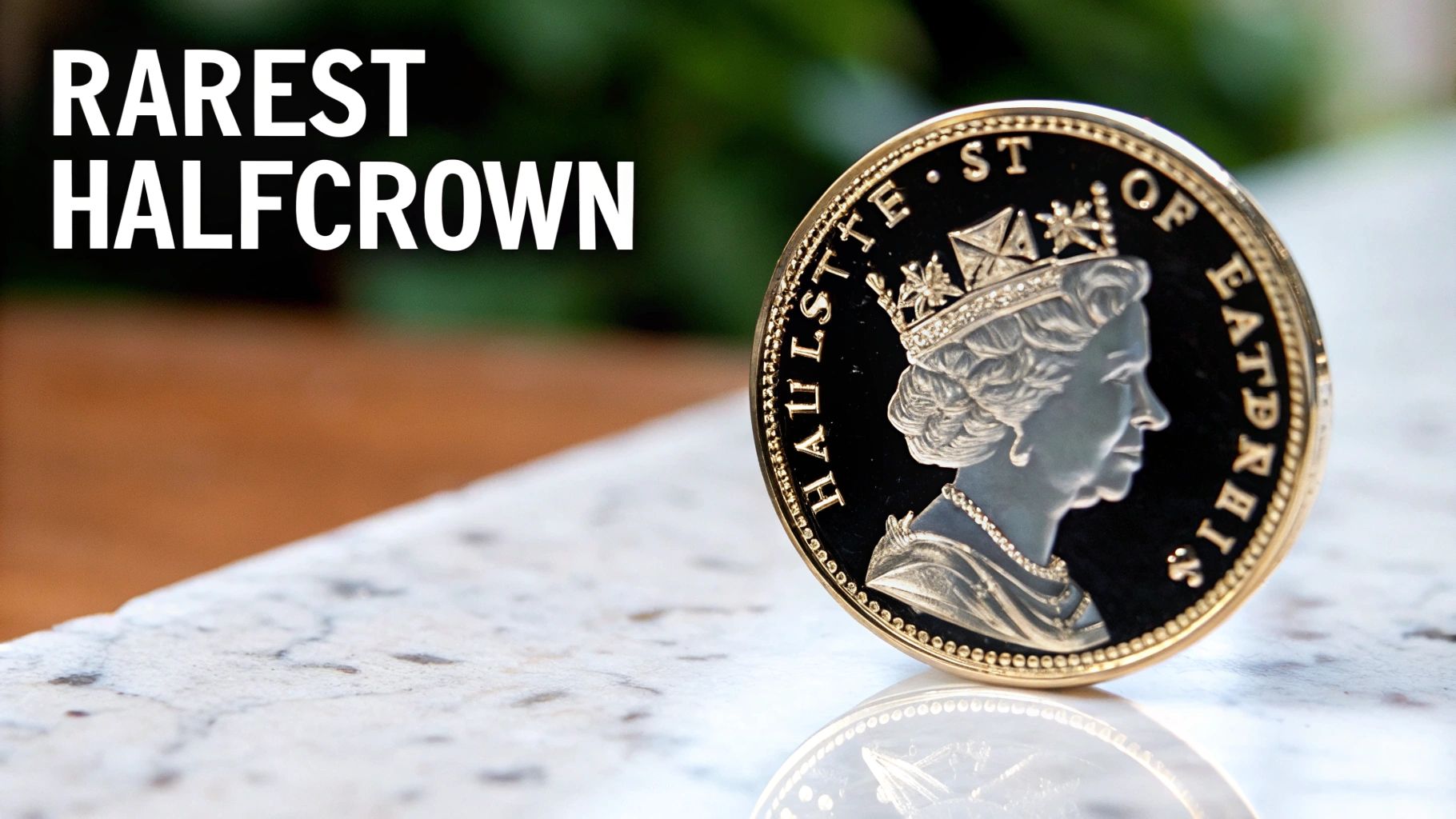
The Royal Mint’s decision not to strike halfcrowns for public use that year means any surviving examples are exceptionally rare. It is believed that a very small number were minted, likely as trial pieces or to be included in VIP presentation sets. These few coins escaped the mint and entered the collecting world, creating one of the most significant challenges for those aiming to complete a date run of Elizabeth II coinage.
Rarity and Provenance
The exact mintage figure for the 1954 halfcrown is unknown, but numismatic experts agree the number is incredibly small, possibly numbering in the low single digits. Unlike the 1933 penny, which was a ceremonial pattern piece, the 1954 halfcrown was intended as a standard circulation design, making its non-issuance a fascinating anomaly. Most known examples are of 'Proof' quality, suggesting they originated from specially prepared sets.
Any specimen that surfaces is subject to intense scrutiny, with its provenance being a critical factor in establishing authenticity and value. The lack of official records means each coin's history is pieced together through auction catalogues and dealer records, making documented ownership crucial for any serious collector considering an acquisition.
Market Value and Acquisition Strategy
The extreme rarity of the 1954 halfcrown ensures its position among the most valuable modern British coins. Its market value has seen a significant appreciation over the years, with high-grade examples commanding substantial prices at auction. A specimen graded as AU (About Uncirculated) sold for £35,000 in a 2017 auction. Even examples in lower grades, such as VF (Very Fine), consistently achieve between £15,000 and £20,000, while premium Proof versions can fetch even higher sums.
Pursuing this coin requires a meticulous and informed strategy, as the financial commitment is significant.
Key Takeaway: The 1954 halfcrown’s value stems from its status as an unissued circulation coin. Its near-mythical rarity makes it the ultimate prize for collectors of Queen Elizabeth II's coinage, with every known example being a celebrated numismatic treasure.
Given its high value, potential buyers must exercise extreme caution to avoid forgeries and ensure they are acquiring a genuine piece.
- Professional Grading: Due to its rarity, authentication by a leading grading service like PCGS or NGC is essential. A professional grade not only verifies its authenticity but also provides an objective assessment of its condition, which is critical for valuation.
- Focus on Grade: Whenever possible, prioritise higher-grade examples. The difference in value and long-term investment potential between a VF and an AU or Proof specimen is considerable.
- Auction Record Research: Thoroughly research past auction results from reputable houses like Spink or Baldwin's. This provides a clear benchmark for current market values and helps in making an informed offer.
- Provenance Verification: Insist on clear and detailed provenance. A documented history of ownership adds a layer of security and can significantly enhance the coin's desirability and future value.
The 1954 halfcrown is a modern classic in the world of rare British coin values. For a more comprehensive look at this specific denomination, you can explore half crown coin values in this 2025 guide. Its story is a testament to how minting anomalies can create legends in the numismatic community.
3. 1952 VIP Proof Set Crown
The 1952 VIP Proof Set Crown occupies a unique and revered space in British numismatics. It was struck during a poignant transitional year, following the death of King George VI in February 1952 and preceding the coronation of Queen Elizabeth II. This coin represents the pinnacle of Royal Mint craftsmanship from a period of great historical significance, created not for circulation but as an exclusive presentation piece.
The story of this crown is one of extreme exclusivity. With King George VI's passing, plans for a 1952 coinage were halted. However, a tiny number of proof sets, including this cupro-nickel crown, were produced for very important persons (VIPs) and key national institutions. These were never intended for the public, making them exceptionally rare from the moment they were minted. Their purpose was purely archival and ceremonial.
Rarity and Provenance
The exact mintage of the 1952 VIP Proof Crown is unknown, but numismatic experts agree that the number is incredibly small, likely just a handful of complete sets. This extreme scarcity makes it a ghost coin for most collectors, with only a few examples known to exist in private hands. The majority are held within institutional collections like that of the Royal Mint Museum.
Each coin was struck to the highest proof standard, featuring deeply mirrored fields and sharp, frosted devices. This superior quality of strike is a key identifier and a major contributor to its high valuation. Any example that surfaces in the market is a significant event for the numismatic community.
Market Value and Acquisition Strategy
The 1952 VIP Proof Crown is a high-value piece whose market price is dictated by its rarity and historical context. It is one of the most desirable items for collectors specialising in modern British proofs. A top-grade example sold at auction in 2020 for £8,500, and it is not uncommon to see high-grade specimens listed by specialist dealers for between £6,000 and £10,000, depending on condition and provenance.
Pursuing such a coin requires a dedicated and informed acquisition strategy, as opportunities are few and far between.
Key Takeaway: The 1952 VIP Proof Crown's value is rooted in its status as a non-circulating presentation piece from a pivotal year in royal history. Its microscopic mintage and exceptional proof quality make it a cornerstone of any serious collection of rare British coin values.
Given the coin's value and the importance of its proof finish, meticulous scrutiny is essential before any acquisition.
- Verify Proof Status: The distinction between a currency strike and a true proof is critical. Authentication by a grading service like PCGS or NGC, or examination by a trusted numismatic expert, is vital to confirm its proof characteristics and grade.
- Focus on Condition: The value of a proof coin is heavily dependent on its preservation. Only consider examples with flawless, mirror-like fields and no signs of handling, often designated as FDC (Fleur de Coin).
- Document Provenance: Any ownership history associated with a VIP presentation piece significantly enhances its value and appeal. Insist on any available documentation that can trace its journey from the Royal Mint.
- Proper Storage: To preserve its delicate surfaces, the coin must be stored in an inert, airtight capsule in a stable, climate-controlled environment.
This coin is a testament to the Royal Mint's artistry during a time of national transition. For collectors wishing to understand the specifics of what makes these pieces so special, you can learn more about what proof coins are and why they are so prized. Its rarity and beauty secure its place as a truly exceptional British numismatic treasure.
4. 1937 Edward VIII Pattern Coins
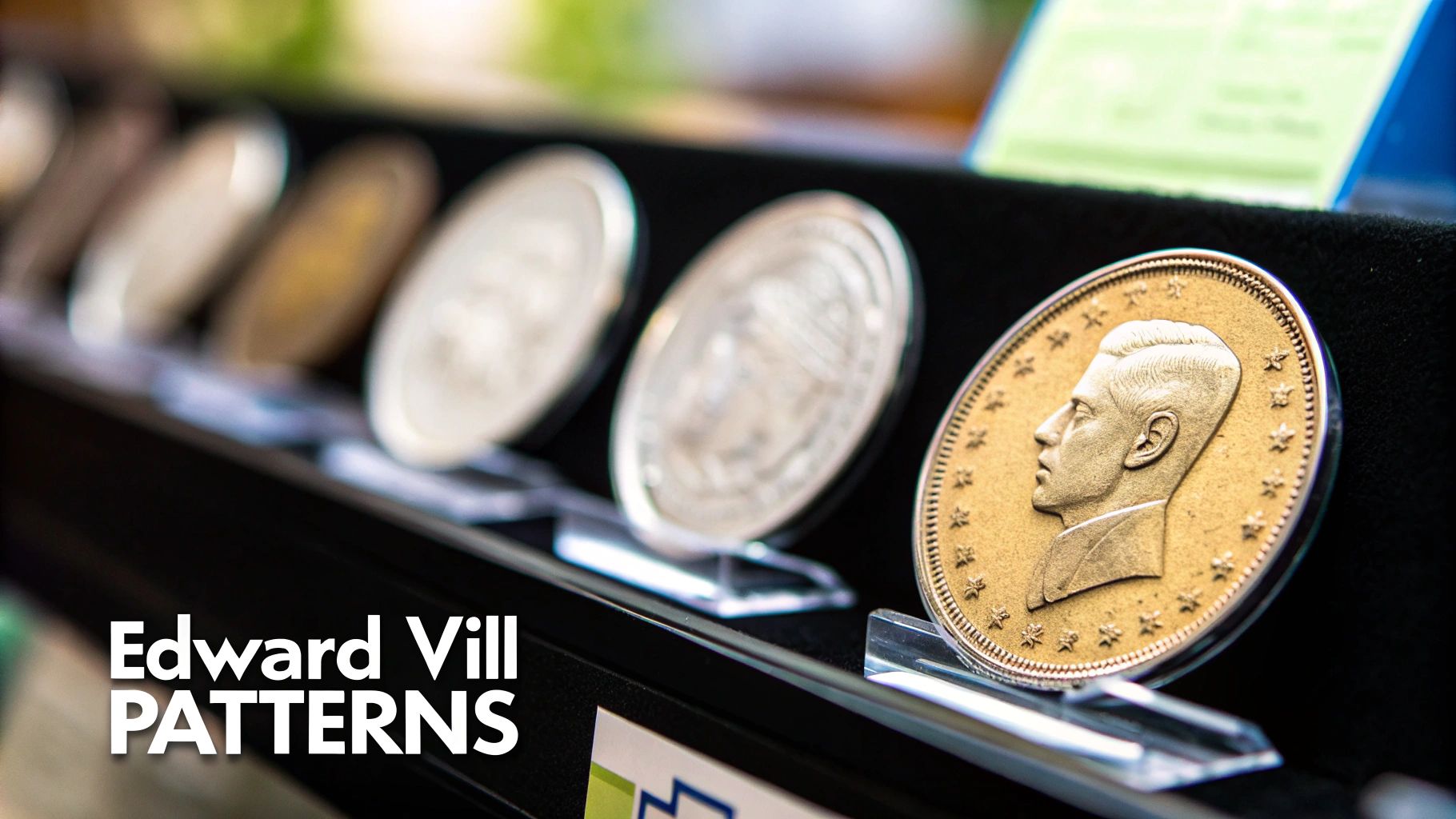
The 1937 Edward VIII pattern coins represent a fascinating "what if" scenario in British numismatic history. Produced in anticipation of a new reign that never fully materialised, these coins were never issued for circulation due to King Edward VIII's abdication in December 1936 after just 325 days on the throne. These patterns are the only tangible numismatic legacy of his brief, tumultuous rule, making them exceptionally desirable to collectors.
The story of these coins is intrinsically linked to the constitutional crisis that gripped the nation. While the Royal Mint prepared for the new coinage, Edward’s decision to abdicate to marry Wallis Simpson halted all production. As a result, only a tiny number of trial or "pattern" pieces were struck to finalise the designs, which famously broke with tradition by having the King’s portrait face the same direction (left) as his predecessor, George V.
Rarity and Provenance
An extremely small number of Edward VIII pattern sets were produced and subsequently gifted to Royal Mint officials and select dignitaries. Because they were never intended for the public, their survival rate is incredibly low, and each piece carries immense historical weight. The patterns span various denominations, from the farthing to the sovereign and even a proposed 12-sided threepence.
The rarity varies by denomination, but even the more "common" patterns are incredibly scarce. Many of the known examples originate from a very small number of original sets that have since been broken up and sold individually, meaning their provenance can often be traced back to a specific high-profile source. This documented history adds significantly to their allure and value.
Market Value and Acquisition Strategy
The market for Edward VIII patterns is robust, driven by their unique story and extreme rarity. Values are consistently high and depend heavily on the denomination, metal, and condition of the coin. For instance, a rare 1937 pattern threepence in nickel-brass was auctioned by Spink in 2014 for £15,000, while bronze penny patterns have achieved prices upwards of £20,000 in private sales. The larger denominations, like the crown, can command values well over £50,000.
Acquiring one of these pieces requires a targeted and cautious approach, as their high value makes them a target for forgers.
Key Takeaway: Edward VIII pattern coins offer a unique connection to a pivotal moment in British royal history. Their value is derived not from mintage for circulation, but from their status as unissued historical artefacts from a reign that ended before it truly began.
For collectors serious about adding one of these pieces to their collection, the following steps are crucial for a secure acquisition.
- Prioritise Provenance: Focus on specimens with a clear and documented history, ideally tracing back to the Royal Mint or an original presentation set. This is a critical element in confirming authenticity.
- Seek Expert Verification: Given the existence of high-quality counterfeits, authentication by leading numismatic grading services like PCGS or NGC, or consultation with specialists at major auction houses, is essential.
- Consider Smaller Denominations: For those looking for a more accessible entry point, pattern farthings or halfpennies can sometimes be acquired at a lower price point than the more coveted pennies or sovereigns.
- Engage Reputable Dealers: Work exclusively with dealers and auctioneers like Spink & Son who specialise in high-value British coins and have a proven track record with Edward VIII patterns.
The pursuit of an Edward VIII pattern coin is a quest for a piece of history frozen in time. Their story is a powerful reminder of how political events shape numismatics, solidifying their place as a cornerstone of any serious discussion about rare British coin values.
5. 1917 George V Sovereign (London Mint)
The 1917 London Mint George V Sovereign is a key date coin highly prized by collectors of British gold. Struck during the height of the First World War, its significance lies in its historical context and exceptionally low mintage for a London sovereign. This coin’s value is a fascinating intersection of bullion content, historical circumstance, and numismatic rarity.
The story of this coin is tied directly to the economic pressures of WWI. By 1917, Great Britain was funnelling immense resources into the war effort. Gold was a critical strategic asset, primarily used to settle international debts, particularly with the United States for war supplies. Consequently, the production of gold sovereigns for general circulation had ceased, and most were being held in Treasury and bank vaults or melted down. The London Mint only struck sovereigns this year for specific foreign exchange purposes.
Rarity and Provenance
With a mintage of just 1,014,714, the 1917 London Sovereign is the lowest mintage sovereign produced at the London Mint in the entire 20th century. While this figure is higher than some of the famous colonial mint sovereigns, it is exceptionally low for the main Royal Mint facility. The vast majority of these coins were never intended for circulation within Britain and were shipped overseas, with many later being melted.
This scarcity means that surviving examples, particularly those in high-grade condition, are difficult to locate. Most examples encountered today show signs of handling from their time in bank bags or transit, making pristine, uncirculated specimens genuinely rare and a highlight in any discussion of rare British coin values.
Market Value and Acquisition Strategy
The 1917 London Sovereign commands a significant premium over its bullion value, a premium that increases sharply with the coin's condition. While common date sovereigns trade close to the spot price of gold, this key date coin is a true numismatic piece. Examples in Extremely Fine (EF) condition often sell for between £800 and £1,200, while Almost Uncirculated (AU) specimens can command £1,500 or more.
For collectors seeking to add this important coin to their portfolio, a focused acquisition strategy is essential to ensure both authenticity and value.
Key Takeaway: The 1917 London Sovereign’s value is driven by its status as the lowest mintage 20th-century sovereign from the London Mint, a direct result of gold conservation during World War I. Its value is a blend of its gold content and significant numismatic premium.
Given the premium prices and the existence of counterfeit coins, due diligence is critical before any purchase.
- Verify Date Authenticity: Carefully inspect the "17" date for any signs of tooling or alteration, as forgers have been known to alter more common dates like the 1927 sovereign.
- Focus on Originality: Seek out examples with original, uncleaned surfaces. Harshly cleaned or polished coins will have a significantly lower market value, so prioritise coins that retain their natural mint lustre.
- Consider Professional Grading: For higher-grade examples (AU or better), having the coin certified by a reputable grading service like PCGS or NGC can confirm its authenticity and grade, justifying the higher price point and making it more liquid in the market.
- Track Gold Prices: While a numismatic coin, its base value is still tied to gold. Monitoring the spot price of gold can help you identify opportune moments to buy, potentially saving you money on the bullion component of its price.
6. 1946 George VI Threepence (Brass)
The 1946 George VI brass threepence is a classic example of a "transitional" rarity, a coin whose value stems from a subtle but crucial change in its metallic composition. While millions of threepences were minted in 1946, a tiny fraction were struck in brass, making them exceptionally scarce compared to the common nickel-brass versions produced for circulation that year. This makes it a fascinating target for specialist collectors.
The story of this coin is rooted in the post-war period. After World War II, the Royal Mint transitioned its threepence coinage from brass (79% copper, 20% zinc, 1% nickel) to nickel-brass (79% copper, 20% zinc, 1% nickel). However, it is believed a very small number of brass planchets (blank coin discs) from earlier years were mistakenly used in 1946, creating this significant rarity. Identifying this coin is key to understanding its place among rare British coin values.
Rarity and Provenance
The extreme scarcity of the 1946 brass threepence cannot be overstated. With no official mintage figures recorded for the brass variant, its existence is confirmed only by the handful of examples that have surfaced in the market. Its rarity is often highlighted by its absence from many major collections of George VI coinage, and it is a piece that even seasoned dealers handle infrequently.
Authentication relies heavily on metallurgical analysis, as the visual difference between brass and nickel-brass is subtle, especially on worn examples. The brass variety tends to have a slightly warmer, more golden hue compared to the paler, yellower tone of the nickel-brass coins. Weight and specific gravity tests are often required for definitive confirmation, making professional grading essential.
Market Value and Acquisition Strategy
The market for the 1946 brass threepence is highly specialised, with values driven by dedicated George VI and error coin collectors. An example in Very Fine (VF) condition can achieve between £1,200 and £1,800. Higher-grade specimens in Extremely Fine (EF) condition are considerably rarer and can command prices well over £2,500, with auction records showing consistent appreciation.
Given its subtle nature, a meticulous acquisition strategy is required to avoid purchasing a common nickel-brass coin by mistake.
Key Takeaway: The 1946 brass threepence's value comes from a production anomaly during a period of metallurgical change. Its rarity is not due to a low mintage of the date itself, but a very low, accidental mintage of a specific metallic composition.
Pursuing this coin requires diligence and access to specialist knowledge, as misidentification is a significant risk.
- Compositional Verification: The primary step is confirming the coin is brass, not nickel-brass. This may require an X-ray fluorescence (XRF) analysis from a reputable grading service or dealer.
- Focus on High Grades: Due to the subtlety of the coin's colour, wear can obscure its key identifying feature. Prioritise examples with minimal wear and strong lustre, as this makes identification easier and preserves value.
- Specialist Dealers: Engage with dealers who specialise in 20th-century British error coins. They are more likely to have authenticated stock and the expertise to verify a potential purchase.
- Collector Community Intelligence: Join forums and numismatic societies like the British Numismatic Society. Fellow collectors often share information about recent sales and discoveries, providing invaluable market intelligence.
The 1946 brass threepence is a subtle yet highly rewarding coin for the discerning collector. Its story is a perfect illustration of how a minor production change can create a major numismatic rarity.
Rare British Coin Values Comparison
| Item | Implementation Complexity 🔄 | Resource Requirements ⚡ | Expected Outcomes 📊 | Ideal Use Cases 💡 | Key Advantages ⭐ |
|---|---|---|---|---|---|
| 1933 George V Penny | Very high - expert authentication needed | Very high - requires professional security & insurance | Exceptional rarity and high value (£200,000+) | Ultra-rare collector acquisitions, museum displays | Highest value British penny, unmatched rarity |
| 1954 Elizabeth II Halfcrown | High - must verify authenticity | Moderate - expert grading recommended | Strong demand, value £15,000-£40,000 | Serious collectors seeking rarities within circulation | Rarest Elizabeth II circulating coin |
| 1952 VIP Proof Set Crown | Moderate - proof verification | Moderate - specialized storage required | Limited quantities, value £5,000-£12,000 | Proof coin collectors, historical significance focus | Exceptional quality and historical importance |
| 1937 Edward VIII Pattern Coins | Very high - complex authentication | High - insurance and provenance crucial | Highly variable (£10,000 to £75,000+) with rarity | Historical pattern collectors, museums | Unique historical narrative, very rare |
| 1917 George V Sovereign | Moderate - requires date verification | Low to moderate - liquid market availability | Stable market with value £600-£2,000 | Gold coin collectors, WWI era enthusiasts | Intrinsic gold value, manageable premium |
| 1946 George VI Threepence | Moderate - composition identification required | Low - affordable for entry-level collectors | Steady appreciation, valued £800-£3,000 | Entry to rare British coins, George VI collectors | Distinctive brass composition, clear identification |
From Pocket Change to Priceless Artefact: Your Next Steps in Coin Collecting
Our journey through the echelons of British numismatics has revealed a captivating world where history, artistry, and rarity converge. We have seen how a simple penny, like the legendary 1933 George V, can become a near-mythical object of desire, and how political turmoil, exemplified by the 1937 Edward VIII patterns, can create incredible numismatic value. Each coin, from the surprisingly scarce 1954 Halfcrown to the exclusive 1952 VIP Proof Crown, tells a story that extends far beyond its metallic composition.
Understanding rare British coin values is not merely about memorising auction prices; it is about grasping the delicate interplay of factors that bestow a coin with its extraordinary worth. The examples in this article, such as the wartime rarity of the 1917 London Mint Sovereign or the subtle anomaly of the 1946 Brass Threepence, underscore a crucial lesson: value is found in the details.
Core Principles for the Discerning Collector
As you move forward in your collecting journey, whether you are a seasoned numismatist or just starting out, there are several foundational principles to internalise. These pillars will not only protect your investments but also deepen your appreciation for the hobby.
-
Authentication is Paramount: The market for rare coins is, unfortunately, not immune to forgeries. The difference between a genuine 1933 Penny and a clever fake is hundreds of thousands of pounds. Always seek professional grading and authentication from reputable services like the Numismatic Guaranty Company (NGC) or the Professional Coin Grading Service (PCGS). This is the single most important step in securing your collection's value.
-
Condition Dictates Value: As we have consistently highlighted, a coin's grade has a monumental impact on its price. A coin in Uncirculated (UNC) or Proof condition can be worth exponentially more than the same coin in Very Fine (VF) condition. Learning the nuances of coin grading, from hairlines and lustre to toning and strike quality, is an indispensable skill.
-
Provenance Adds a Premium: The history of a coin's ownership, its provenance, can significantly enhance its desirability and value. A documented lineage tracing back to a famous collection, like the coins from the renowned Norweb Collection, adds a layer of prestige and confidence that serious collectors will pay a premium for. Always preserve certificates, auction catalogues, and any documentation related to your acquisitions.
Actionable Strategies for Building Your Collection
With these principles in mind, the path to building a significant collection becomes clearer. It requires a proactive and educated approach.
-
Specialise and Educate: Rather than collecting sporadically, consider focusing on a specific monarch, denomination, or historical period. This allows you to become a true expert in a niche area, making you better equipped to spot undervalued opportunities and recognise genuine rarities. Immerse yourself in numismatic literature, from classic reference books like Spink’s Coins of England & the United Kingdom to modern auction archives.
-
Build Relationships with Trusted Dealers: A reputable dealer is your most valuable ally. They provide access to high-quality, authenticated coins and offer expert guidance tailored to your collecting goals. They can alert you to new acquisitions before they reach the open market and help you navigate the complexities of auctions.
-
Think Long-Term: Collecting rare British coins should be viewed as a long-term passion, not a get-rich-quick scheme. The market for the finest pieces has historically shown remarkable resilience and appreciation, but it is a patient pursuit. The true reward lies in the curation of a collection that reflects your knowledge, passion, and appreciation for centuries of British history encapsulated in metal.
The allure of uncovering a hidden gem, whether in an old tin or at a local auction, is what fuels the passion of every collector. By arming yourself with knowledge, prioritising authenticity, and engaging with experts, you transform from a mere accumulator of objects into a custodian of history. The journey from pocket change to priceless artefact is a marathon, not a sprint, but it is one of the most rewarding pursuits imaginable.
Ready to take the next step in your numismatic journey or need expert advice on rare British coin values? At Cavalier Coins Ltd, we provide professional valuations, source world-class rarities, and offer personalised guidance to collectors of all levels. Explore our curated collection and discover how our expertise can help you build a collection of distinction at Cavalier Coins Ltd.