
The value of a 1937 threepence hinges entirely on which version you're holding. It was a strange and wonderful year for pocket change, as the Royal Mint issued two completely different threepence coins at the same time: the old-school, small silver coin and a brand-new, chunky 12-sided brass one.
Depending on which you have, its worth could be anything from the scrap value of its silver to a handsome sum for a top-condition brass piece.
Unlocking the Value of Your 1937 Threepence
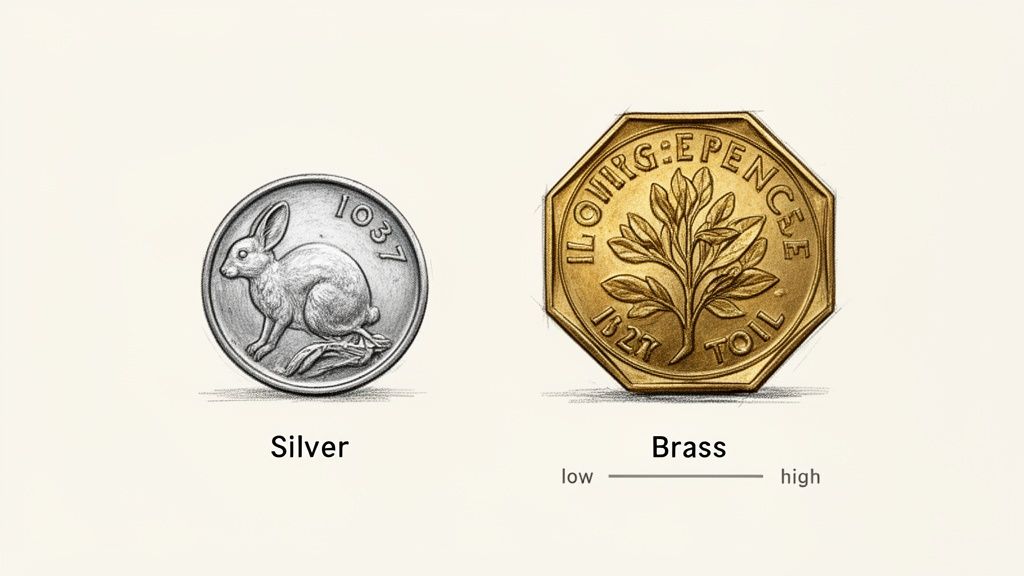
For coin collectors, 1937 is a really interesting year. It was a moment of transition, a crossroads for British currency where two threepence coins were circulating side-by-side. This unique situation is what makes them so compelling and is the first clue to figuring out what your coin might be worth.
Before you can get to a value, you have to know which one you've got. The differences are pretty stark and go well beyond just their colour. It's a bit like telling apart two car models from the same year; one might be the everyday family saloon, while the other is a special edition with far more appeal to enthusiasts.
The Tale of Two Coins
The traditional silver threepence, often nicknamed a 'joey', had been jingling in pockets for centuries. By the 1930s, though, people found it a bit of a nuisance. It was tiny, fiddly, and all too easy to lose down the back of the sofa.
So, the Royal Mint came up with a bold solution: the 12-sided brass threepence. It was bigger, heavier, and you could tell what it was just by the feel of it. It was a design marvel that solved a real-world problem.
This dual-issue year gives us a clear starting point for valuation:
- The Silver Threepence: The small, round, silver-coloured coin. This one represents the end of an era.
- The Brass Threepence: The larger, heavier, golden-coloured coin with its unmistakable 12 sides. This was the future of small change.
To make identification a breeze, here’s a quick side-by-side look at the two coins.
1937 Threepence Quick Identification Guide
| Feature | Silver Threepence | Brass Threepence |
|---|---|---|
| Shape | Round | 12-Sided (Dodecagonal) |
| Metal | 50% Silver | Nickel-Brass |
| Colour | Silver | Yellow-Gold / Brass |
| Size | Small (16.2 mm) | Large (21.8 mm) |
| Weight | 1.4 grams | 6.8 grams |
| Edge | Plain | Plain |
This table shows just how different they were. You can usually tell them apart instantly by size and shape alone.
The 1937 silver threepence features the portrait of the newly crowned King George VI. It’s a lovely piece of history from the very start of his reign. While records show over 8.1 million were minted, their value today is almost entirely dependent on condition. A well-worn example might only be worth its 50% silver content, but a pristine, uncirculated one is a different story altogether. You can dig deeper into the specifications and market history for George VI silver coins to see where it fits in the bigger picture.
For collectors, 1937 isn't just a date on a coin. It's a snapshot of a changing Britain, a moment when modern, practical design began to elbow aside centuries of tradition in the nation's currency.
Ultimately, your journey to discovering your 1937 threepence's value starts with a simple question: is it the small, classic silver piece or the robust, modern brass one? Once you’ve answered that, you can dive into the finer points of grading, rarity, and market demand to find out what it’s really worth.
The Year Britain Had Two Different Threepence Coins
The year 1937 is a standout in the long story of British money, not just for a new king on the throne, but for a peculiar numismatic overlap. For one year only, two completely different threepence coins were minted and circulated at the same time. This wasn’t some Royal Mint blunder; it was a clever solution to a very common complaint, creating a unique moment in history that collectors find fascinating.
Think about the change jingling in people's pockets back in the 1930s. You’d find the classic silver threepence, a tiny coin that had been around for ages. It was affectionately known as a 'joey', but its miniscule size—just over 16mm—made it a real pain. It was so small and light that it would vanish through the tiniest hole in a pocket, causing endless frustration.
A Problem That Needed a Modern Solution
For shoppers and shopkeepers alike, the tiny silver coin was more of a nuisance than a convenience. People wanted something different, something a bit more substantial that you could actually feel in your hand. The Royal Mint's answer wasn't just a minor adjustment; they went back to the drawing board entirely.
Their solution was a coin you simply couldn't miss: a chunky, 12-sided piece struck from nickel-brass. This new coin was a total game-changer. It was bigger, heavier, and its unique shape meant you could pick it out from other coins by feel alone. It was currency designed for the modern world, solving a real-world problem with smart design.
The dual circulation of the tiny silver 'joey' and the robust new brass 'threepenny bit' in 1937 represents a clear turning point in British coinage. It was a tangible shift from centuries of tradition towards functional, user-centric design that would define currency for decades to come.
The Birth of an Iconic Design
The 1937 brass threepence wasn’t just a one-off; it introduced a design that would become a staple of British change for nearly thirty years. This new coin was a massive hit with the public, solving the unpopularity of both the fiddly silver threepence and the cumbersome old penny. It also holds the distinction of being Britain's first-ever twelve-sided coin, an innovation so successful it directly inspired the modern £1 coin launched in 2017. The coin's reverse features a beautiful depiction of the three-headed Thrift plant, a design by Frances Madge Kitchener that graced every brass threepence until 1967. You can find more insights about this coin's influential design at Coincraft.com.
This switch from silver to brass was more than just a change of metal—it was a significant moment in the evolution of everyday money. If you're curious about the bigger picture, you might enjoy our article covering a brief history of British coins.
In the end, the public voted with their pockets. The new brass threepence was an immediate success. Its practical design meant it quickly became the go-to coin, while the little silver joey began its slow fade into history. This story of innovation is key to understanding the threepence 1937 coin value and why both versions from this pivotal year are still so sought-after by collectors.
How to Grade Your 1937 Threepence Like an Expert
Figuring out the condition, or grade, of your 1937 threepence is the single most important factor in determining what it's really worth. A coin's grade is just a standardised way of describing the amount of wear it has picked up over the years, with a scale that runs from heavily circulated to absolutely perfect. The difference between a slightly worn coin and a pristine one can mean a jump in value from a few pounds to a very serious figure.
I often tell new collectors to think of it like assessing a piece of antique furniture. A chair that’s seen daily use for decades will have scratches, dents, and faded varnish, all of which lower its appeal and price. An identical chair, however, that was tucked away in an attic and looks brand new will be far more desirable. Coin grading follows the same logic—it’s all about how well the coin’s original details have been preserved.
When it comes to the threepence 1937 coin value, we need to inspect specific high points on both the silver and brass versions. These are the parts of the design that stick out the most, and as a result, they're the first to show wear when a coin is jangling around in pockets and purses.
Key Wear Points on the Silver Threepence
The little silver threepence has a bare-headed portrait of King George VI on the obverse (the 'heads' side). This side tells the clearest story of its life in circulation.
To grade this coin properly, you’ll want to focus on these specific areas:
- The King's Hair: On a high-grade example, you should be able to see the individual strands of hair above the ear and on top of his head. As the coin wears, these fine details start to look flat and eventually merge together.
- The Eyebrow and Ear: The King's eyebrow and the upper curve of his ear are high points. On a worn coin, these features lose their definition and start to appear smooth.
- The Legend Lettering: The letters in the inscription 'GEORGIVS VI D: G: BR: OMN: REX' should be sharp and clear. Wear tends to soften the letters, especially at their very tops.
Key Wear Points on the Brass Threepence
The iconic 12-sided brass threepence has a completely different set of checkpoints. Most of the action is on the reverse ('tails' side), which features the famous thrift plant design.
Look closely at these elements:
- The Thrift Plant Flowers: The three flower heads are the most obvious feature. An uncirculated coin will show a clear texture and separation between the tiny individual florets. On a circulated coin, these details blend into smooth, rounded domes.
- The Leaves: At the base of the plant, the pointed leaves should be nice and sharp. Wear will quickly round off the tips, making them look blunt.
- The Date and Denomination: Check how crisp the numbers in '1937' and the letters in 'THREE PENCE' are. These can become flattened from handling over time.
A coin's grade is its biography. Every scratch, rub, and loss of detail tells the story of its time in circulation. An 'Uncirculated' coin is a story that was never told, preserved exactly as it was on the day it was made, which is why collectors prize it so highly.
This chart really brings home the difference between the two 1937 threepence coins, highlighting just how different their production runs were.
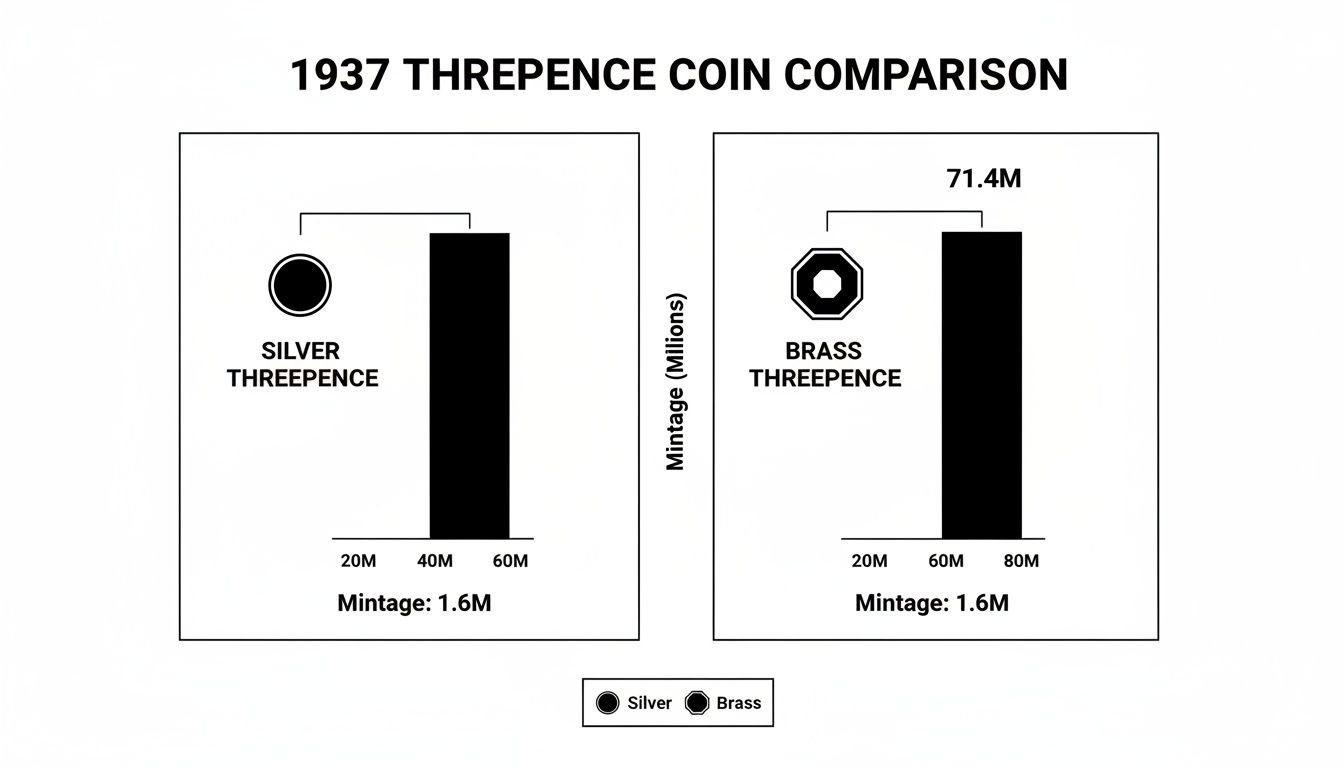
As you can see, the huge difference in mintage is a massive clue as to why their rarity and value profiles are worlds apart.
Understanding the Official Grading Scale
Numismatists use a specific scale to define a coin's condition. While the professional world can get incredibly detailed, the main grades you’ll come across are actually quite straightforward. Getting to grips with them is essential for assessing the threepence 1937 coin value.
- Poor/Fair: The coin is extremely worn down, with just the basic outline of the design left. The date and lettering might be partly or even completely worn away.
- Good (G): Heavily worn, but you can still make out the main design and the date. Most of the finer details, like the King’s hair or the plant’s florets, will be completely smooth.
- Very Good (VG): There's still significant wear, but you can see more detail than on a 'Good' grade coin. You might be able to spot faint outlines of the hair or leaves.
- Fine (F): The coin shows moderate wear on the highest points, but the main details are clear. Roughly half of the original design detail is still there.
- Very Fine (VF): You'll see light wear across the coin, mostly on the high points. The vast majority of the details are still sharp and clear.
- Extremely Fine (EF): This coin has only the slightest traces of wear, often just visible on the very highest points of the design. It will still have a lot of its original mint lustre.
- Uncirculated (UNC): This is a perfect coin with zero signs of wear. It looks just as it did the day it left the Royal Mint, with full lustre and razor-sharp details.
If you’re keen to really master the art of coin assessment, our complete UK coin grading expert guide dives even deeper with more examples and professional tips. By carefully checking these key areas, you can get a very accurate idea of your coin's grade and, in turn, its true place in the market.
The Ghost Coin: Understanding the Ultra-Rare Edward VIII Pattern
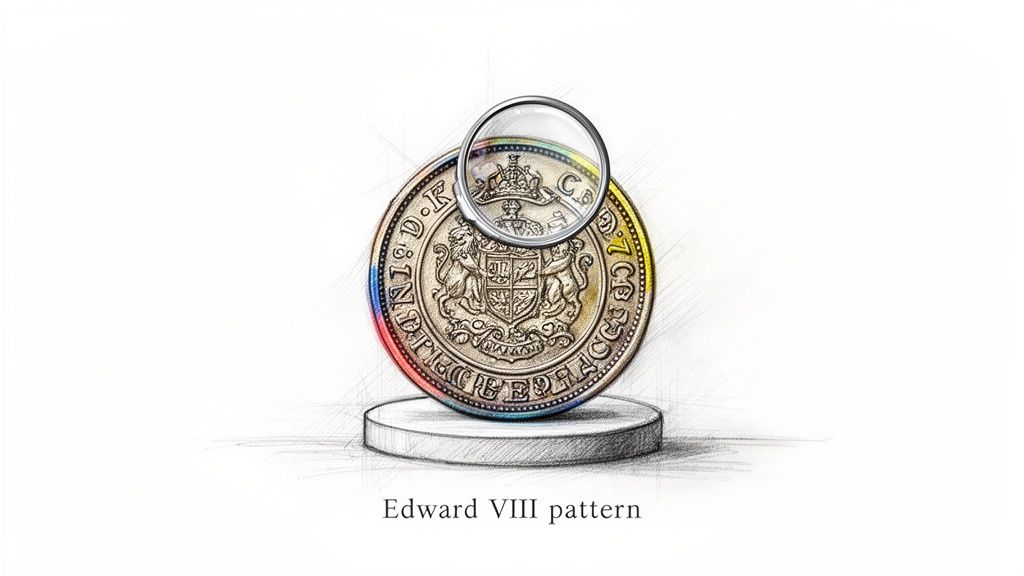
While the silver and brass threepences of 1937 offer a fantastic window into a year of royal transition, there’s a near-mythical third coin from this era. This is the Edward VIII pattern threepence—a true holy grail for numismatists and the ultimate prize related to the threepence 1937 coin value.
Every collector dreams of the ultimate barn find. In the world of British coins, this is it. But what exactly is a 'pattern' coin? Think of it as a prototype. It’s a test piece the Royal Mint creates to finalise a new design before committing to a full production run.
Pattern coins are never meant for public pockets. They're experimental pieces used to trial everything from the metal composition to the visual appeal of the new monarch’s portrait. Normally, these patterns are the blueprint for millions of coins entering circulation, but the story of Edward VIII was anything but normal.
How an Abdication Created a Legend
King Edward VIII’s reign was one of the shortest in British history, lasting less than a year. His shocking decision to abdicate the throne in December 1936 to marry Wallis Simpson sent tremors through the nation and had a direct, dramatic impact on its coinage.
The Royal Mint had already been hard at work preparing coins bearing his effigy. When he abdicated, all production slammed to a halt, and the vast majority of these unissued coins were ordered to be melted down. This single historical event transformed the Edward VIII pattern coins from routine prototypes into objects of extreme rarity and fascination.
A tiny handful of these pattern pieces survived, escaping the furnace to become legendary artefacts. Their value lies not just in their scarcity, but in the dramatic royal story they represent. They are tangible links to a constitutional crisis and a king who was never officially featured on circulating currency.
The Edward VIII pattern threepence is more than just a coin; it's a historical document cast in brass. Its immense value comes from the unique intersection of a radical new coin design and an unprecedented royal abdication, freezing a "what if" moment in numismatic history.
What Makes This Pattern So Special?
This coin was designed to be the new 12-sided brass threepence. Visually, it shares its innovative shape and thrift plant reverse with the George VI version that followed it into circulation. The key difference, of course, is the obverse, which features a portrait of Edward VIII.
The extreme rarity of this pattern is reflected in its staggering market value. The Pattern Threepence 1937, struck from brass with a plain edge, was never meant for public hands. Its status as a historical treasure is confirmed by auction results; one example fetched an incredible £144,000 in January 2023, showcasing its elite collector appeal. You can explore more about this remarkable coin's auction history online.
While your chances of finding one are virtually zero, its story is essential for understanding the absolute peak of the market. It provides crucial context for the value of all 1937 threepence coins and highlights the profound difference between everyday money and a priceless piece of history.
Mintage, Rarity, and What Drives the Market Price
Ever wondered why a coin's condition is so important? It often boils down to simple supply and demand, which all starts with the original mintage figures. How many coins the Royal Mint churned out in 1937 directly affects how rare each type is today, setting the foundation for its market value. This is where the story of the two 1937 threepence coins takes a sharp turn.
Think of it like an artist's limited-edition print. A run of only 100 copies will always be more desirable than a poster printed in the millions. It's the exact same principle with coins. The threepence 1937 coin value is fundamentally tied to how many were struck in the first place.
A Tale of Two Production Runs
The production numbers for the silver and brass threepence in 1937 couldn't be more different, painting a very clear picture of rarity.
- Silver Threepence: The Royal Mint struck around 8.1 million of these traditional little coins. That might sound like a lot, but for the time, it was a fairly modest figure. Crucially, many were later withdrawn from circulation and melted down for their silver content.
- Brass Threepence: By contrast, the new 12-sided brass coin was a massive hit. To keep up with public demand, the mint produced a colossal 45.4 million—more than five times the number of its silver cousin.
This huge gap in mintage is the main reason a high-grade silver 1937 threepence is often much tougher to find and commands a higher price than a brass one in similar shape. There are simply fewer of them left for collectors to chase.
How Mintage Translates to Market Value
So, how do these production figures affect what a collector might actually pay? The market price for a threepence 1937 coin is always shifting, pushed and pulled by its grade, rarity, and the latest collector trends.
For the silver threepence, its 50% silver content gives it a "melt value" floor. This means that even in terrible condition, it will always be worth at least the value of the silver it's made from. As its condition improves, however, its numismatic (collector) value quickly leaves its metal value in the dust. A pristine, uncirculated example can be worth many times more than a heavily worn one.
The brass threepence is a different story. It has no real intrinsic metal value. Its worth is driven purely by collector demand. Because so many were minted, circulated examples from 1937 are incredibly common and usually very affordable, making them a perfect starting point for new collectors. But finding one that looks like it just left the mint, with all its original lustre, is a genuine challenge. These top-tier coins fetch surprisingly strong prices.
The market for 1937 threepence coins is a perfect lesson in a key numismatic principle: rarity is relative. Millions of both were made, but it's the 'survival rate' of high-grade examples that truly drives value today. That's what makes the hunt so exciting.
What Else Affects the Price?
A coin's value isn't static. A few outside forces can make the prices for a 1937 threepence go up or down, and knowing what they are can help you time your buying or selling.
The spot price of silver is a big one. When silver prices climb, the melt value of the silver threepence goes up with it, raising the baseline price for all grades. Collector demand is just as important. If a new wave of interest in pre-decimal British coins sweeps the community, the added competition can drive prices up across the board.
Finally, keep an eye on auction results. A record-breaking sale for a top-grade 1937 threepence can change how the market perceives the value of all similar coins. Staying on top of these trends is the key to getting an accurate read on the current threepence 1937 coin value.
How to Get the Best Price for Your Coin
So, you’ve identified and graded your 1937 threepence. The next big question is how to turn that knowledge into the best possible price. It’s not just about knowing what the coin is worth; it’s about a smart sales strategy, great presentation, and picking the right place to sell.
Think of it like selling a vintage watch. You wouldn't take a rare Rolex to a car boot sale, and you wouldn't list a common, well-worn Timex at a high-end auction house. The same logic applies here. The best sales route depends entirely on the rarity and condition of your particular threepence.
Choosing Your Sales Channel
Where you choose to sell your coin can make a huge difference to the final price you get. Every option has its own pros and cons, and they each suit different types of coins and sellers.
Here’s a quick rundown of your main options:
- Online Marketplaces (e.g., eBay): These platforms offer access to a massive, global audience of collectors. They’re fantastic for common to mid-grade coins, but just be ready for the seller fees and the responsibility of managing the listing, packing, and postage yourself.
- Specialist Coin Dealers: A reputable dealer provides expertise and a quick, hassle-free sale. While they will pay less than the retail value to cover their overheads, it's often the fastest and simplest way to sell, especially if you have a whole collection.
- Coin Fairs and Shows: These events are brilliant for meeting motivated buyers in person. You get to negotiate face-to-face and can walk away with immediate payment, but they do require you to travel.
- Major Auction Houses: If you’re lucky enough to have an exceptionally rare or high-grade coin (like a flawless uncirculated 1937 silver threepence), a major auction house is your best bet. They connect you with serious collectors ready to pay top prices, though their commission fees are something to keep in mind.
Preparing Your Coin for a Successful Sale
Once you've picked a channel, it’s time to focus on presentation. How you present your coin is absolutely vital for attracting buyers and justifying your asking price. A bit of extra effort at this stage can really pay off.
First things first: take high-quality photographs. Use a plain, neutral background and good, natural light to capture all the coin's details accurately. Get clear shots of both the front (obverse) and back (reverse), and if you can, an angled shot to show off the coin's lustre and edge. Try to avoid using a flash, as it creates glare and can wash out important details.
Next, write a description that is both honest and accurate. Use the grading knowledge you've picked up to describe its condition fairly. Point out key details like "sharp lettering" or "light wear on high points." Being transparent builds trust with potential buyers. For a much deeper dive into the selling process, our complete guide on how to sell coins in the UK offers more detailed advice.
Your coin's listing is its shop window. Clear photos and a detailed, honest description act as your expert salesperson, convincing a potential buyer that your coin is a worthwhile addition to their collection.
By combining an accurate valuation with the right sales platform and a stellar presentation, you give yourself the best possible chance of getting a fantastic price for your 1937 threepence.
Common Questions About the 1937 Threepence
When you're digging into the world of the 1937 threepence, a few questions always seem to pop up, especially if you're just starting out. Let's tackle the most common ones to give you a clearer picture and help you collect with more confidence.
Which 1937 Threepence Is More Valuable?
In a direct, like-for-like comparison, the silver 1937 threepence is almost always more valuable than its brass cousin. It really boils down to two simple reasons: mintage numbers and the metal in the coin itself.
The Royal Mint struck over 45 million of the new brass threepences, but only about 8.1 million of the traditional silver ones. That initial scarcity, plus the fact that countless silver coins were melted down over the years, makes finding a top-quality silver example a real challenge today. The brass coin's value is purely what a collector will pay for it, but the silver one always has a floor price based on its silver content.
Is the 1937 Threepence Made of Real Silver?
Yes, but it’s not pure silver. The little round 1937 threepence is a 50% silver alloy, which was standard for British "silver" coinage at the time. This silver content gives it an intrinsic "melt value," meaning it's always worth at least the market price of the silver it contains, even in poor condition.
Remember: Only the small, round coin from 1937 contains silver. The larger, 12-sided brass coin has no precious metal content, and its value is determined solely by its condition and appeal to collectors.
How Do I Know If I Have a Rare Version?
For the standard coins you'll find in collections, rarity is all about condition. Millions were made, but nearly all of them went straight into pockets and purses, seeing heavy use. Finding any 1937 threepence—brass or silver—in Extremely Fine (EF) or Uncirculated (UNC) condition is genuinely rare and valuable. The vast majority you'll come across will be very worn.
Of course, the ultimate prize is the Edward VIII pattern threepence. This was a prototype that never saw public release. Finding one is the numismatic equivalent of winning the lottery, but it's the legendary "ghost coin" of the era. If you think you have something that looks unusual, getting it professionally authenticated is the only way to be sure.
Where Should I Sell My 1937 Threepence?
The right place to sell really depends on what you have. For common, circulated coins worth a few pounds, online marketplaces like eBay can work perfectly well. But if you have a high-grade, valuable example, you’ll likely get a better and more straightforward return by selling directly to a specialist dealer.
When you’re ready to sell, getting in touch with reputable numismatic coin dealers is the best next step. They have the expertise to grade your coin accurately and make a fair offer based on what the market is doing right now.
At Cavalier Coins Ltd, we are passionate about helping collectors at every stage of their journey. Whether you are looking to value a single coin or build an entire collection, our extensive selection and expert knowledge provide the resources you need. Explore our curated coins and banknotes today at https://www.cavaliercoins.com.