
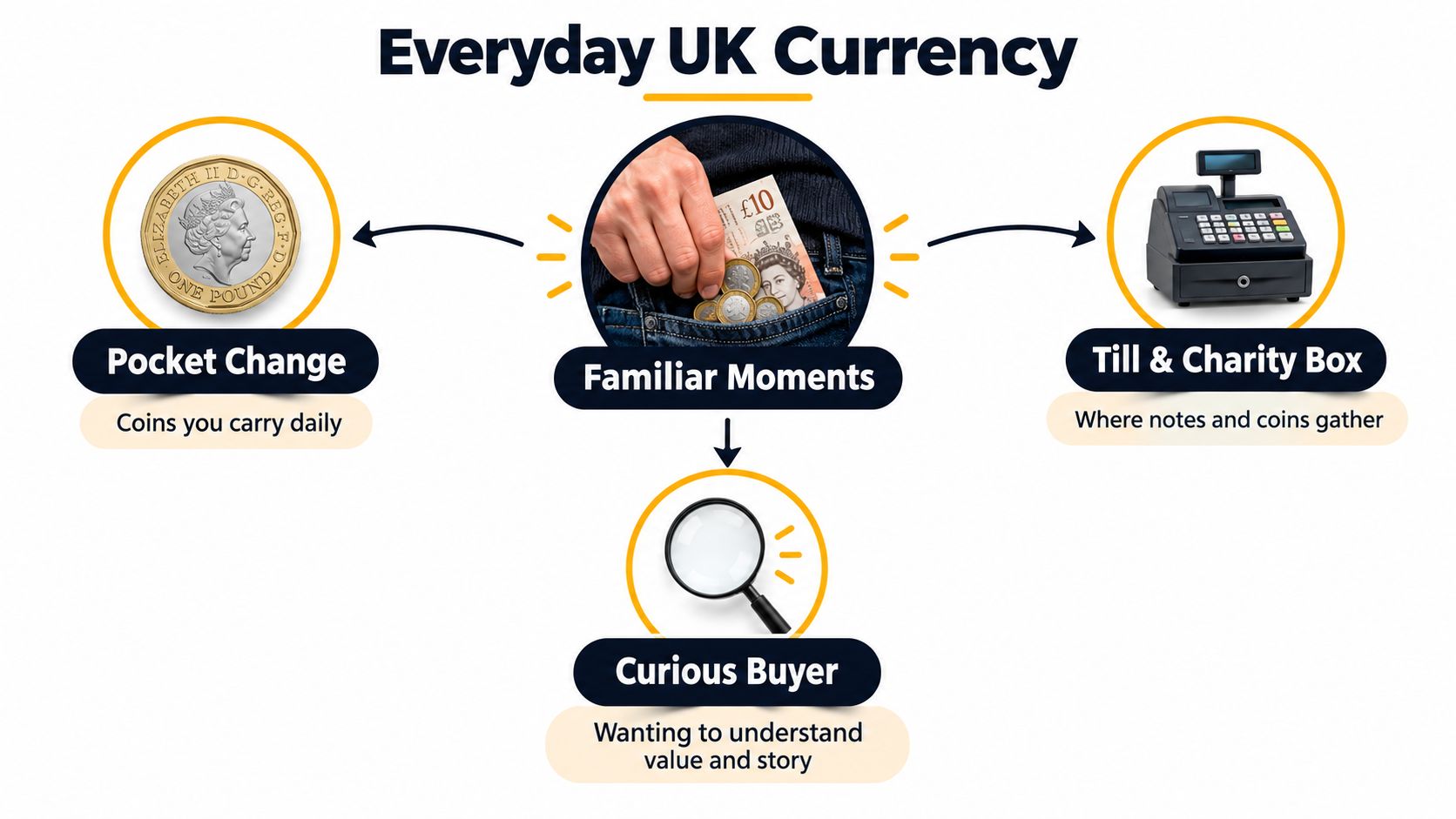
You're emptying a coat pocket, counting a till, or opening a charity donation box, and something looks unfamiliar. A coin feels heavier than expected. A note has an older portrait, a different colour, or a texture you don't recognise. At that moment, ordinary money raises a collector's question. Is this spendable cash, or is it worth keeping, recording, and checking more carefully?
Start With Everyday UK Currency
Most collections of UK coins and notes begin with that pause before spending. You might find an unusual date in your change, inherit a small envelope of paper notes, or sort donated currency for a charity shop. The temptation is to search for a price immediately. Resist it. A price means little until you know exactly what you're holding.
Think of every piece as carrying three linked forms of value. Face value is the amount printed or struck on it. Legal-tender status is its formal standing when offered in payment of a debt, which isn't quite the same as whether a shop will accept it. Collector value is separate again, and it depends on identity, condition, scarcity, demand, and evidence from comparable sales.
Three Questions to Ask About Any UK Coin or Note
| Question | What it means | Why it matters |
|---|---|---|
| What is it? | Denomination, date, issuer, material, and variety | Prevents confusion with similar issues |
| What condition is it in? | Wear, folds, scratches, damage, or alteration | Condition can change collector interest sharply |
| What evidence supports its value? | Catalogue identity, scarcity, and comparable sales | Separates informed pricing from guesswork |
A common coin in poor condition may be worth only its face value, while an ordinary looking note with a sought after signature, serial pattern, or variety may deserve specialist attention. The reverse also happens. A dramatic story attached to a newly released coin doesn't prove rarity.
Your first job is observation, not valuation. Note where the piece came from, photograph both sides, and keep it separate from loose cash until you've identified it. That small discipline protects beginners from spending something interesting by accident and protects experienced collectors from paying for a story they haven't verified.
Understand Modern Coins and Banknotes
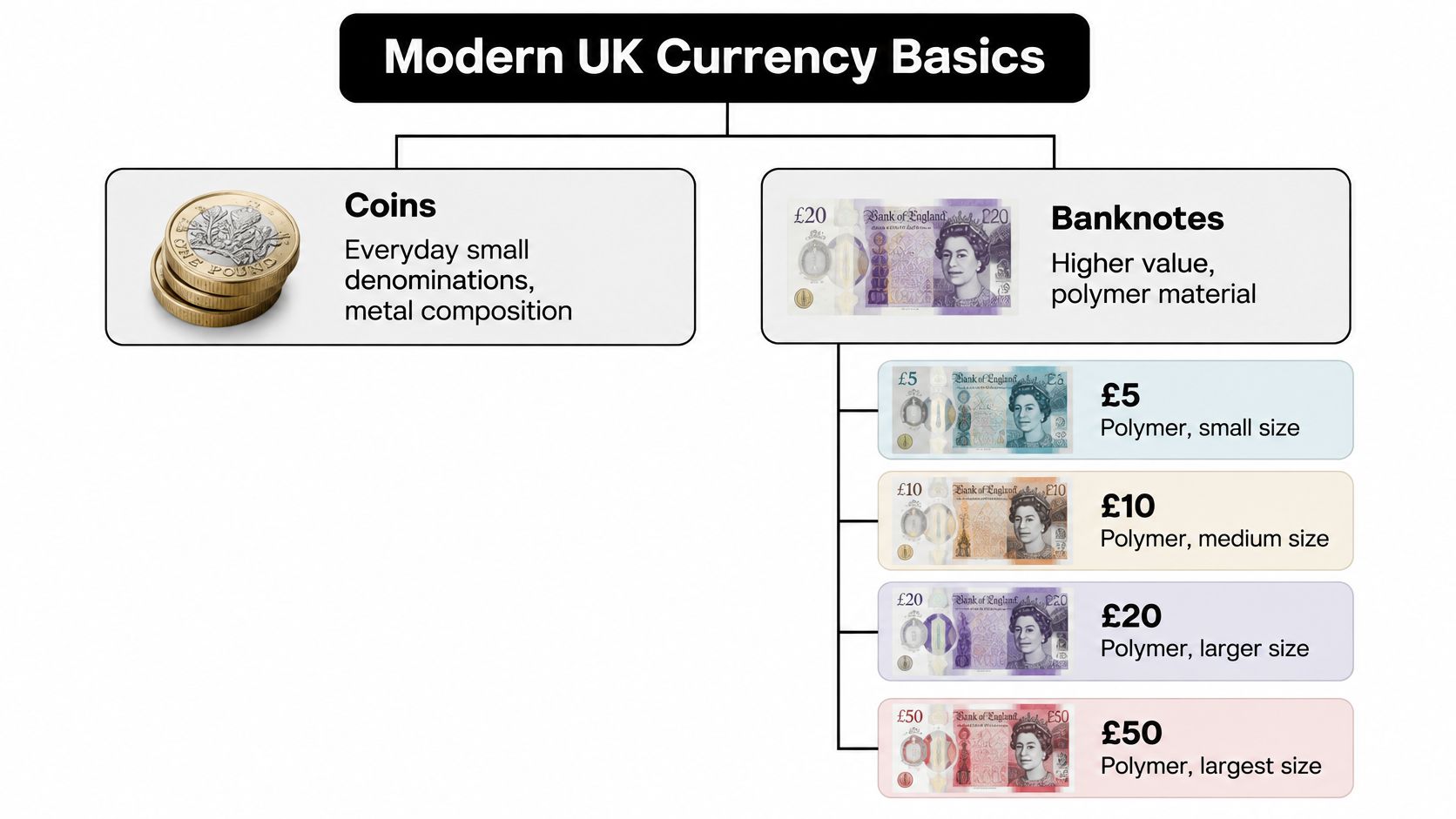
Start with the physical basics. Coins are struck metal pieces used mainly for smaller denominations, while banknotes carry higher values in a lighter format. That difference shapes how each is identified. A coin invites checks of diameter, weight, edge, metal, portrait, and inscriptions. A note invites checks of size, denomination, serial number, signatures, design, and substrate, meaning the material it's printed on.
Modern Bank of England notes have changed in feel as well as appearance. Polymer replaced paper for current issues, so a note that feels smooth and flexible isn't automatically suspicious. It's likely to be a modern production choice designed for durability and security. Paper notes you find in old wallets or donation boxes belong to an earlier phase and need to be identified by series and denomination before anyone discusses value.
Modern UK Cash at a Glance
| Item | Material or format | First identification question |
|---|---|---|
| Circulating coins | Struck metal in several alloys | Do weight, diameter, and edge match the denomination? |
| Polymer banknotes | Thin, flexible plastic substrate | Are the window, portrait, and foil consistent? |
| Older paper banknotes | Paper substrate from earlier series | Which series, signature, and serial range is it? |
| Presentation products | Packaged coins or sets sold to collectors | Was it made for circulation or for direct sale? |
Cash remains a substantial part of British life even alongside digital payments. Bank of England figures show notes in circulation rising from 3,071 million in 2014 to 3,799 million in 2019, with growth across the £5, £10, £20, and £50 denominations during that period, according to Bank of England banknote circulation statistics. Those totals include notes held and stored as well as notes passing through tills, so they don't tell you how often you'll meet a particular design in daily change.
Denomination alone never settles collector value. A worn modern £20 note is normally just £20. A crisp early serial number, an error, or a scarce variety is a different collecting proposition. Apply the same lens to coins. First establish what the piece is, then grade its condition, then ask whether collectors actively seek it.
Collector's lens: Identity comes before condition, condition comes before price, and price comes last.
That order sounds simple, but it prevents the most common beginner error, which is treating anything unfamiliar as rare. Unfamiliar to you and scarce to the market are not the same thing.
Trace the History of UK Notes and Coins
UK currency carries its history in visible layers. Changes in denomination, portrait, material, and issuing authority usually happened for practical reasons, including war finance, forgery, inflation, technology, and the way people used cash. When you understand the reason for a change, an old piece becomes evidence of its period rather than a puzzle with a price tag attached.
The Bank of England has issued banknotes since 1695, initially with circulation concentrated in London before provincial branches were established from 1826 to widen distribution, as recorded in the Bank of England historical account of its notes. The Bank Charter Act 1844 then created the legal foundation for the Bank's effective monopoly of note issue in England and Wales by restricting other banks. For collectors, that legal shift matters because it helps explain why earlier provincial and private issues sit in a different category from later centralised Bank of England notes.
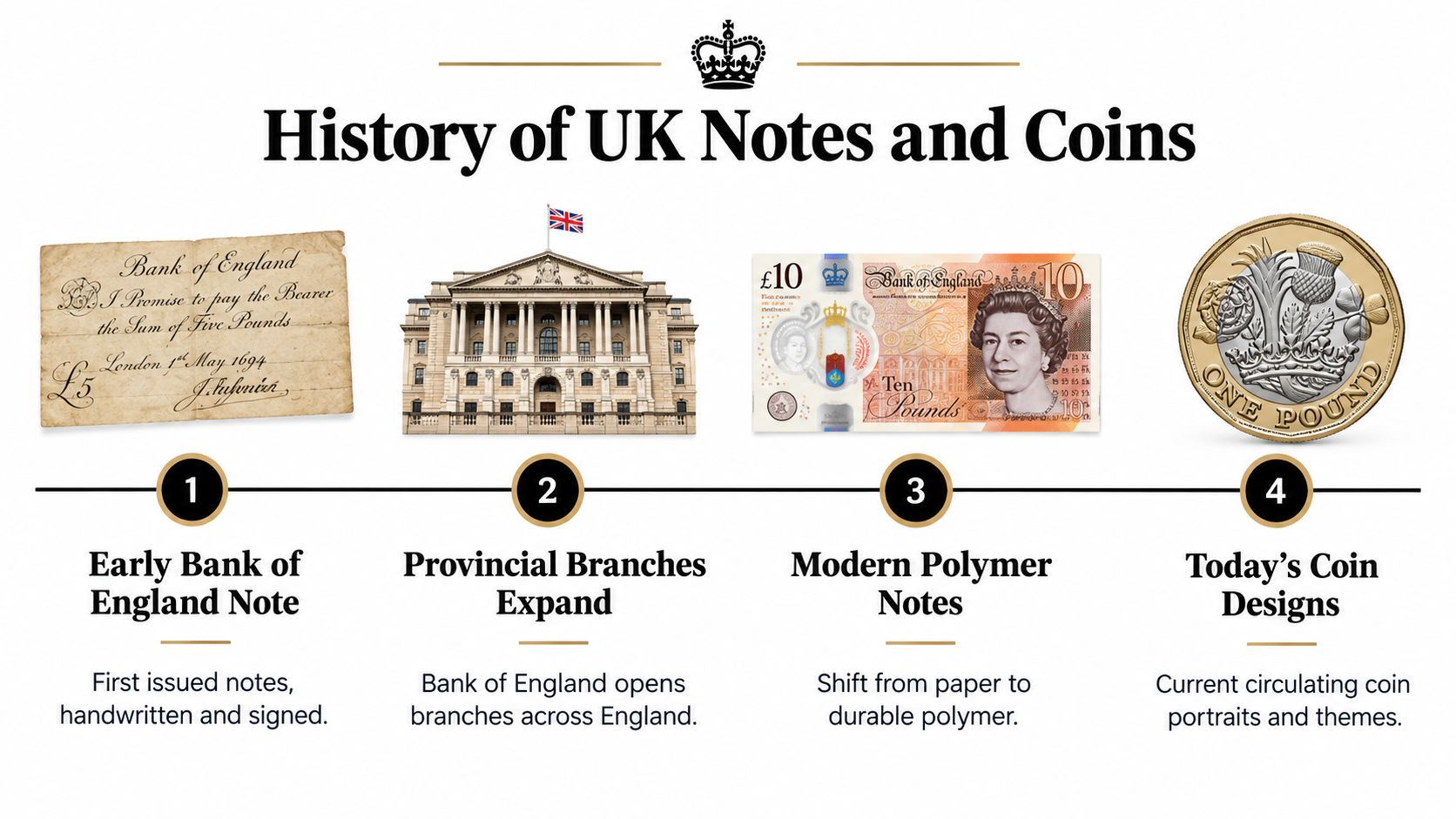
Denominations also moved with economic pressure. Lower value £1 and £2 notes were permitted from 1797 during the French and Napoleonic Wars and withdrawn in 1821 when cash payments resumed, partly after forgery increased. Higher denominations were discontinued in 1943, while the £10 returned in modern form in February 1964. If you'd like a broader coin focused timeline to sit alongside this note history, a brief history of British coins provides useful background reading.
Historical Milestones and Collecting Significance
| Milestone | Historical change | Collector implication |
|---|---|---|
| Early Bank of England issue | Note circulation centred on London | Provenance and place of issue need careful recording |
| Provincial expansion | Branches widened distribution beyond the capital | Regional context can affect cataloguing |
| Legal centralisation in 1844 | Other banks were restricted in England and Wales | Earlier private issues form a distinct collecting field |
| Wartime denomination changes | Low and high values appeared or disappeared under pressure | Date and denomination must be read in period context |
| Paper to polymer transition | Production material changed for modern notes | Substrate becomes part of identification and grading |
By July 1978, about 1,880 million Bank of England notes with a combined face value of £8.7 billion were in circulation, and £1 notes had fallen from 43% of circulation value in 1963 to 10% by 1978 while £10 and £20 notes together reached 39%. Those shifts show why denomination patterns can date a cash based collection. A group dominated by one value may reflect everyday spending in a particular era, not deliberate collecting.
History also disciplines valuation. An old note isn't valuable just because it's old, and a modern coin isn't uninteresting just because it's recent. Survival, condition, demand, and the story documented in catalogues all interact. Your task is to place the object accurately first.
Examine Designs and Security Features
Authentication works best as a combined exercise. Don't rely on one dramatic feature, one measurement, or a general impression that a piece looks right. Coins and notes fail in different ways, so your checks should suit the object in front of you.
Modern Bank of England £5, £10, and £20 notes use polymer, described as cleaner, safer, and stronger than paper, with a large transparent window, a sharply defined royal portrait, denomination text, and a finely detailed metallic image, according to the Bank of England polymer guidance for businesses. The metallic foil is gold on the front and silver on the reverse. Tilt the note slowly under good light and check whether the foil colour, placement, window clarity, and fine detail behave consistently together.
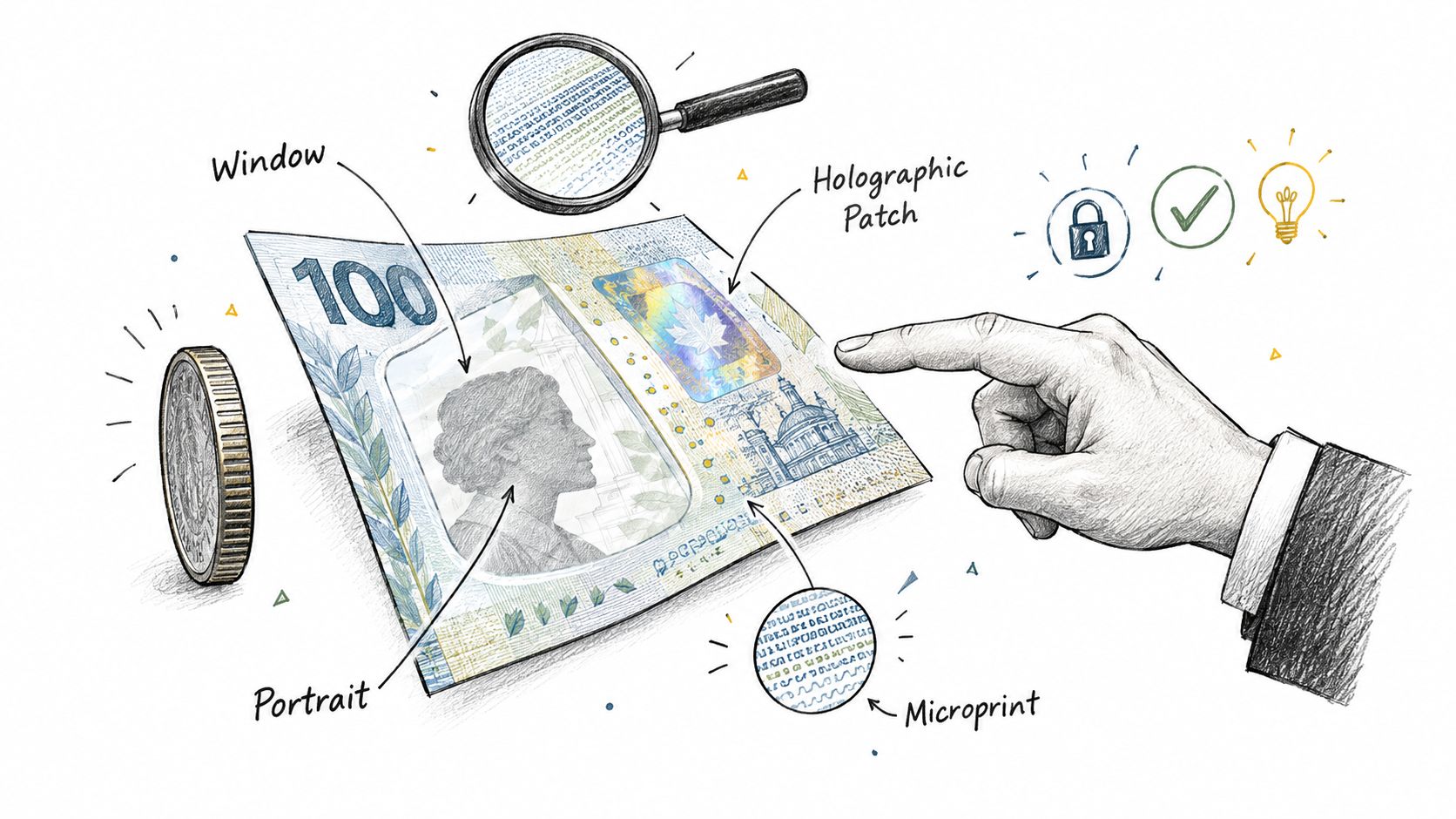
A cloudy window or scratched foil doesn't automatically mean a note is counterfeit. Polymer can show folds, creases, scratches, ink transfer, delamination, or damage around the transparent aperture. Those faults may reduce collectability while the note remains spendable. Keep three judgements separate. Is it genuine? Is it spendable? Is it collectible in this condition?
Inspection Checklist for Modern UK Cash
| Object | Check | Reason for check |
|---|---|---|
| Polymer note | Transparent window and portrait definition | Confirms a core security area hasn't been damaged or imitated poorly |
| Polymer note | Foil colour on both sides | Tests consistency under changing light |
| Paper note | Serial number, signature, and series details | Supports precise cataloguing |
| Coin | Weight and diameter | Detects wear, clipping, wrong planchet, or imitation |
| Coin | Edge, inscriptions, and metal appearance | Cross checks identity beyond the main design |
For coins, measurements protect you from judging by colour alone. Toning and patina can mislead, and a polished coin can look brighter while being less desirable. Use accurate scales and callipers where possible, compare the results with a reliable reference for that exact denomination and date, and record what you measured rather than writing a vague note such as seems light.
Follow a calm inspection sequence. Photograph both sides before handling further. Record denomination, date or serial number, substrate or metal, measurements, and visible damage. Isolate anything suspicious in a plain envelope or holder. Don't clean it, bend it to test flexibility, rub the surface, or try to improve it.
A genuine looking design is only the starting point. Security features and physical measurements need to agree with each other.
If they don't agree, stop short of a confident diagnosis. A specialist can compare your piece with known genuine examples and reference material. That restraint is part of good authentication, especially when money may change hands.
Assess Scarcity and Market Value
Scarcity is where careful beginners most often get misled. Mintage means how many pieces were produced. Circulation availability means how readily you can find one in change. Collector scarcity means how difficult it is to obtain an example in the condition and variety collectors want. Those three ideas overlap, but they're not interchangeable.
King Charles III coins provide a useful worked example. The Royal Mint reported about 24.7 billion coins in circulation, with King Charles III coins representing only around 0.004% of that total in the cited release, and announced 30.855 million £1 coins comprising 23.29 million final Queen Elizabeth II coins and 7.565 million King Charles III coins, including only 170,000 dated 2025 pieces, according to the Royal Mint announcement on the £1 coin handover. That tells you the new portrait is still a small part of everyday change.
It doesn't, by itself, prove a high market value. A coin can be uncommon in your pocket because it's newly released and still entering circulation through banks and cash centres. It can also be widely saved by the public precisely because people think it's special, which may leave plenty of uncirculated examples available later. Think of a limited print run that was bought mainly by collectors. Production may be modest, yet supply in the collector market can be plentiful.
From Finding to Valuation
| Evidence level | Question to answer | Decision |
|---|---|---|
| Identity | What denomination, date, and variety is it? | Catalogue it or set it aside for help |
| Distribution | Was it issued for circulation or sold in packaging? | Judge availability in the right context |
| Condition | How much wear or damage is present? | Compare only with similar grades |
| Demand | Do collectors actively seek this piece? | Look beyond novelty and headlines |
| Market evidence | What have comparable examples actually sold for? | Price from completed sales, not asking prices alone |
Record where you found a coin, whether it came from change, a roll, a set, or a donation, and whether it shows circulation wear. That context helps a dealer or auctioneer understand what you have. For notes, serial number, series, signature, and condition perform the same job. If you're assessing older paper material, background on how old paper money is valued can help you frame better questions before you seek a formal opinion.
Use asking prices cautiously. An optimistic listing isn't evidence that anyone paid that amount. Completed auction results for the same variety in a similar grade carry more weight, and even then you should allow for fees, presentation, and the strength of bidding on the day. No single percentage or mintage figure can replace that chain of evidence.
Preserve Coins and Notes Properly
Preservation means preventing further harm. It isn't restoration, and it certainly isn't making an old piece look new. Cleaning a coin, polishing a note's foil area, ironing a fold, or laminating a banknote can destroy the very evidence and surface quality collectors value.
Handle coins by their edges where possible, and hold notes with clean, dry hands over a soft surface. Skin oils, grit, moisture, and friction leave marks that can't be undone safely. Keep potentially interesting pieces separate from loose change at once. A coin rattling against keys for one afternoon can pick up scratches that change its grade.
Preservation Actions by Condition Risk
| Risk | Safe response | Avoid |
|---|---|---|
| Loose contact damage | Place each piece in its own inert holder or sleeve | Throwing finds into a shared jar or drawer |
| Folded or creased note | Store flat in a suitable sleeve without forcing it | Ironing, flattening under heavy pressure, or laminating |
| Dirty or toned coin | Leave the surface alone and seek advice if valuable | Polishing, dipping, rubbing, or using household cleaners |
| Cloudy polymer window | Record the fault and isolate the note | Scraping, heating, or applying solvents |
| Uncertain identity | Label with what you know and your source | Guessing a date, variety, or attribution on the holder |
Build a simple intake routine you can repeat at home or in a charity sorting room. Assign each item a temporary number. Photograph front and back. Record denomination, date, serial number where present, material, measurements, and condition notes. For polymer notes, add window clarity and foil colour and placement. Store the item flat or upright as appropriate, away from damp, heat, and direct light.
For coins, control your conclusions about wear. Dirt, mounts, polishing, and inaccurate scales can distort a weight reading, so repeat measurements before deciding that a piece is underweight or altered. Colour and patina should support, not replace, diameter, weight, edge, and composition checks. If you'd like more detail on note storage choices, guidance on how to store a paper money collection is a practical next read.
Preservation rule: If an action can't be reversed, don't do it to a piece you haven't identified and valued.
That rule covers well meaning helpers too. Volunteers sorting donations should know not to tape torn notes, staple groups together, write prices on holders containing the item, or wash coins to make them presentable. Plain separation and honest labelling protect value better than enthusiasm.
Buy and Sell With Clear Judgement
Commercial decisions improve when you keep face value, legal-tender status, and collector value in separate columns. Legal tender has a narrow legal meaning, and it doesn't guarantee that a shop must accept a piece or that a collector will pay a premium. A spendable coin can be common. A withdrawn note can still interest collectors. Neither fact contradicts the other.
The Coinage Act 1971 shows why precise language matters. Under the Coinage Act 1971 provisions on legal tender and coin standards, gold coins are legal tender for any amount unless their weight falls below the legally specified least current weight, while ordinary circulating coins have limits including £10 for cupro nickel or silver coins above 10 pence, £5 for those of 10 pence or less, and 20 pence for bronze coins. The Act also lists standard weights of 39.94028 g for the five pound gold piece and 15.97611 g for the two pound gold piece, with 916.66 fineness. For a buyer, that turns weighing from a curiosity into a screening step. A shortfall may indicate wear or alteration, though you still need accurate equipment and a clean, unmounted piece before drawing conclusions.
Evidence Record for Buying or Selling
| Field | Record | Reason |
|---|---|---|
| Identity | Denomination, date, variety, serial number, and catalogue reference where known | Prevents disputes about what was offered |
| Condition | Wear, folds, scratches, cleaning, mounts, and repairs | Allows fair comparison with similar pieces |
| Evidence | Measurements, photographs, provenance, and comparable sales | Supports authentication and pricing |
| Price basis | Face value, metal consideration where relevant, and collector premium | Shows how the asking price was reached |
Charities and bulk holders need controlled intake before they need pricing. Separate ordinary spendable cash from older, foreign, damaged, packaged, or unusual material. Count and record donations in batches, keep potentially collectible items unsorted by value until they've been identified, and don't promise donors a figure you can't evidence. A reputable bulk buyer should explain how material is assessed and what happens to items that turn out to be ordinary.
Collectors buying individual pieces should ask for clear photographs of both sides and the edge of a coin, plus measurements where authenticity depends on them. For notes, ask about folds, pinholes, annotations, thinning, window damage, and whether the note has been pressed or cleaned. Transparent descriptions reduce returns and help you compare like with like.
Resellers should write listings from evidence, not adjectives. Rare, investment grade, and must have are claims, not descriptions. State the variety, grade, disclose faults, and explain your price basis. Cavalier Coins Ltd is one example of a retailer offering fixed price UK coins and notes, auctions, and bulk purchase services for larger holdings, and comparing that route with local dealers or auction houses can help you judge fees, speed, and likely audience.
Cash also has a social role that affects how donated and hoarded material reaches the market. Bank of England research discussed in 2026 found 14% of people choose cash as their first choice payment method and one quarter of UK adults could not go more than a week without using it, while cash in circulation reached £91.5 billion at the end of February 2026, according to the Bank of England fireside chat on the future of cash. Treat that 2026 discussion as a policy snapshot, not a valuation tool. It does, however, explain why jars, tins, and donation boxes still produce large mixed holdings that need patient sorting.
Build a Responsible Collecting Habit
The assumption to challenge is simple. Rare doesn't automatically mean valuable, and common doesn't automatically mean worthless. A scarce variety with few interested buyers may realise less than a popular coin in exceptional condition. Demand, grade, eye appeal, and evidence decide how scarcity translates into money.
Build your habit around a repeatable path. Identify the piece. Place it in its historical and issuing context. Inspect security features or physical measurements. Assess scarcity without confusing mintage, circulation availability, and collector demand. Preserve it without irreversible intervention. Only then decide whether to keep, spend, donate, sell, or seek authentication.
Next Steps by Collecting Goal
| Reader goal | Next action | Avoid |
|---|---|---|
| Checking everyday change | Keep a short log of dates, denominations, and where finds came from | Assuming every new portrait is a high value rarity |
| Building a focused collection | Choose a theme and buy the best condition you can justify | Buying unrelated bargains with no reference plan |
| Handling charity donations | Separate spendable cash from older or unusual material at intake | Cleaning, taping, stapling, or pricing before identification |
| Preparing to sell | Photograph, measure, disclose faults, and find comparable sales | Copying the highest asking price you can find |
| Assessing a possible high value piece | Obtain specialist authentication before agreeing a price | Relying on a single feature or measurement |
A few distinctions answer most beginner questions. Circulating pieces were issued for everyday use, while many commemorative products were sold directly to collectors in packaging, so their survival patterns differ. An old paper note that shops no longer accept may still have face value through the issuing bank's exchange arrangements or collector value above face, but you must identify the exact series before choosing a route. Professional authentication matters most when a significant claim depends on a variety, error, metal, or condition detail you can't verify with your own references.
Your next step doesn't need to be a purchase. Record what you already own. Check one piece properly, with photographs and measurements, and write down what remains uncertain. That honest gap tells you whether you need a catalogue, a second opinion, or a specialist. Careful collectors aren't people who never make mistakes. They're people who leave enough evidence to catch a mistake before money changes hands.
If you're ready to turn careful identification into your next purchase, sale, or charity fundraising decision, Cavalier Coins Ltd offers UK coins and notes through fixed price listings and auctions, alongside bulk buying services for larger collections and donated currency. Visit the site to browse current stock, compare pieces with your own evidence record, or contact the team before you buy or sell.