
Diving into UK coins is about more than just collecting; it's like holding a piece of history in your hand. What might start with an unusual coin found in your change can quickly become a fascinating journey through Britain's past, with each piece telling its own unique story.
Your Adventure in Coin Collecting Starts Here
Welcome to the rich world of UK numismatics. This guide is here to cut through the jargon and make collecting an enjoyable pursuit for anyone, whether you're just starting out or have been at it for years. We’ll cover everything from ancient hammered silver to the modern commemorative coins that mark our national milestones.
Think of every coin as a tiny historical document. A Roman denarius tells a story of occupation and empire, while a Victorian penny speaks of industrial might and global reach. Holding one connects you directly to the people who minted it, spent it, and saved it hundreds of years ago.
Finding Your Starting Point
The best thing about starting a UK coins collection is how simple it is. Many of the most dedicated collectors I know began by simply putting aside coins that looked different or felt special. Maybe it was a unique 50p design or an old, unfamiliar shilling discovered in a grandparent’s attic. That initial spark of curiosity is all it takes.
This guide will serve as your map, helping you get your bearings before you take your first step. We’ll be looking at:
- A Bit of History: Getting to grips with the major eras of British coinage, from the old pounds, shillings, and pence to the massive shift of decimalisation in 1971.
- Spotting a Gem: Learning what makes a coin valuable, from low mintage numbers and minting errors to its historical importance.
- Building Your Collection: Practical advice on how to pick a theme, find new pieces, and keep your collection organised.
- Looking After Your Coins: Understanding the basics of coin grading and learning how to properly store and preserve your collection for the future.
At its heart, coin collecting is about storytelling. Each piece you add is a new chapter in a narrative that spans monarchies, wars, and huge societal changes. Your collection becomes a personal museum, curated entirely by you.
As you get more into it, you'll discover specific areas that grab your attention. You might decide to focus on the coins of a single monarch, hunt for every commemorative £2 coin, or even delve into the intricate world of medieval hammered currency. The path you take is completely up to you.
Here at Cavalier Coins, we’re ready to be your partner on this adventure. We offer the expertise, resources, and a varied stock to help you start and grow a collection you’ll be proud of for years to come. Let's get started.
Discovering the History Behind UK Coins
To really get the most out of collecting UK coins, you need to understand the incredible stories they hold. Each one is a tiny artefact, a direct link to the economic and political shifts that shaped Britain over the centuries. When you look beyond a simple timeline, you start to see how these metal discs reflect the nation's journey through triumph and turmoil.
The story really gets going with the Saxon kings and their hammered silver coins. For hundreds of years, this was how it was done: every single coin struck by hand. This gave each one a unique, often off-centre, character that collectors now treasure. This method defined English money right through the medieval period and into the early modern era.
But hand-crafting coins was slow, and the quality was all over the place. This left the currency wide open to problems like clipping (shaving bits off the edges) and counterfeiting. As Britain's influence on the world stage grew, it was clear that a more uniform and secure coinage was desperately needed.
The Great Recoinage Reshapes a Nation
A huge change came with the Great Recoinage of 1816. This wasn't just a simple currency update; it was a critical fix for the financial mess left by the Napoleonic Wars. The country's silver coinage was in a terrible state, worn thin and unreliable after years of conflict.
To solve the crisis, the Royal Mint brought in the latest technology. The Great Recoinage was a landmark moment in British coin history, driven by the huge financial strain of the Napoleonic Wars (1803-1815). Using steam-powered machinery pioneered by Birmingham industrialist Matthew Boulton, the Mint could suddenly produce coins on an unbelievable scale. In the six years after 1816, they struck nearly 40 million shillings, 17 million half-crowns, and 1.3 million crowns.
This industrial leap forward meant coins were now perfectly round, with intricate designs and milled edges that stopped clippers in their tracks. It stabilised the economy and gave us one of the world's most famous coins: the modern Gold Sovereign. This event truly marks the birth of British coinage as we know it today.
The timeline below helps to visualise the journey through these major periods.
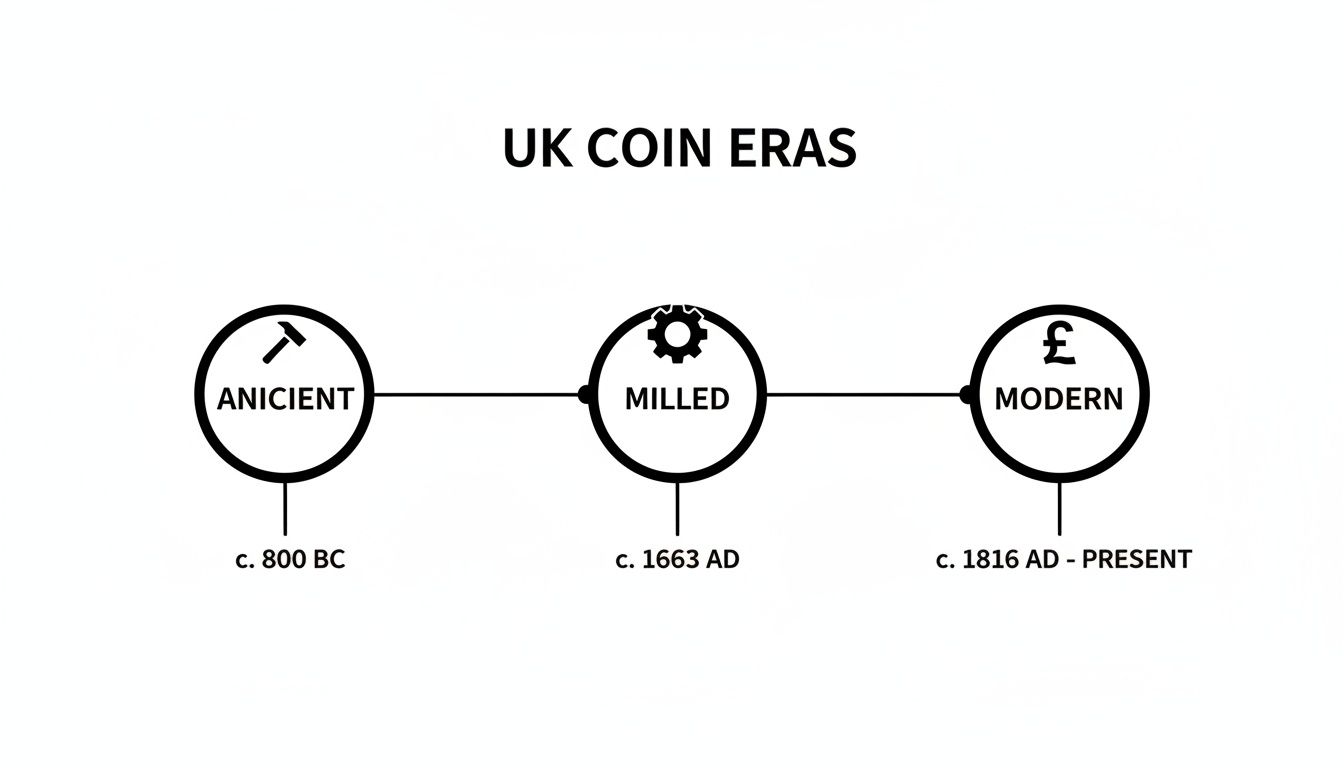 You can clearly see how technology, from simple hammers to powerful steam presses, completely changed how our money looked and was made.
The Decimal Day Revolution
The next big shake-up happened just over 150 years later. On 15 February 1971, Britain went through another complete currency overhaul known as "Decimal Day." The old, complicated system of pounds, shillings, and pence (£sd) was officially retired. In its place came the simple decimal system we use today, with 100 pennies to the pound.
This was a massive shift, both culturally and practically. It drew a clean line in the sand for British money, instantly making all pre-1971 coins obsolete for everyday shopping but fascinating for collectors.
For numismatists, decimalisation created two distinct and exciting fields. Pre-decimal coins represent a romantic link to a bygone era, while decimal coins offer a modern and accessible area for collecting, filled with commemorative designs and low-mintage rarities.
Understanding this history transforms a pile of coins into a tangible story. Knowing why a coin was minted, how it was made, and the world it circulated in adds incredible depth to your collection. It’s the key to understanding why some coins are common and others are incredibly rare, turning every piece into a clue to the past. For a deeper dive, you might enjoy our article on the brief history of British coins.
Identifying Rare and Valuable British Coins
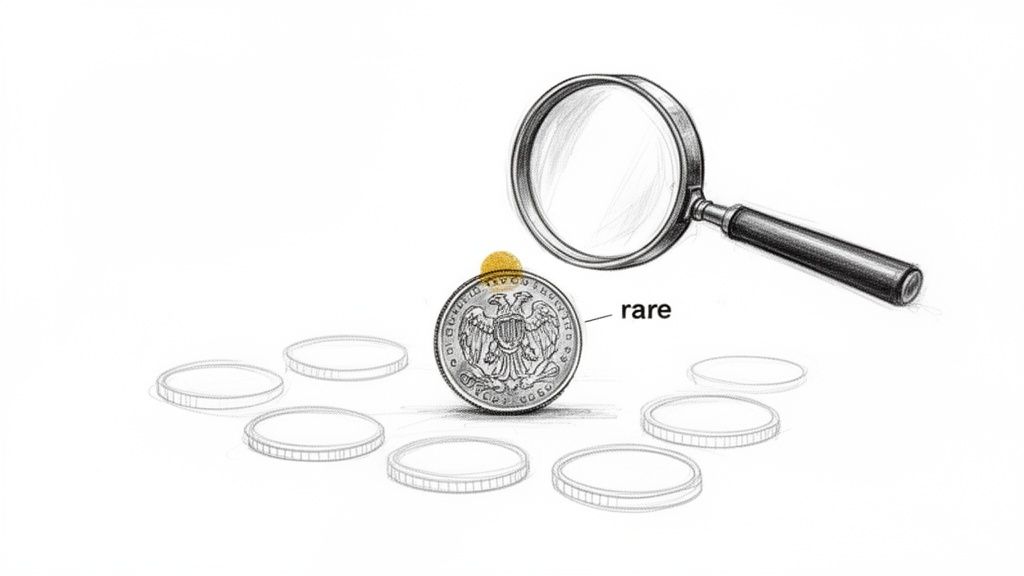
This is where the real treasure hunt begins. While every coin tells a story, a special few hold a monetary value that dwarfs what's stamped on their face. The secret is learning to see what turns a simple piece of metal into a collector's prize.
It’s a common myth that age is everything. Sure, ancient coins can be incredibly precious, but the true driver of value is always rarity. And rarity isn’t just one thing—it’s more like a perfect storm of scarcity and desire coming together.
The three forces that create a truly valuable coin are low mintage, a low survival rate, and high collector demand. When all three line up, even a modern coin can become something extraordinary.
Understanding Mintage Figures
The most straightforward piece of the puzzle is the mintage—that's simply the total number of a specific coin the mint produced in a given year. The lower this number, the rarer the coin is right out of the gate. A coin minted in the millions will almost always be less valuable than one with a run of just a few thousand.
Take the 2009 Kew Gardens 50p. Its mintage was just 210,000, making it the rarest 50p ever put into circulation. That tiny number is exactly why it commands prices of over £150 among collectors today.
A low mintage figure is the starting point for rarity. It establishes an absolute ceiling on how many examples can possibly exist, setting the stage for a coin's future collectability.
This rule holds true for any era. Whether you're looking at a Victorian shilling or a modern £2 piece, the production number is the very first thing you should check.
Survival Rate and Historical Context
Mintage only tells part of the story. The survival rate is just as critical. How many of those original coins are still around today in decent condition? History often has a big say in this.
Wars, economic meltdowns, and government recalls can completely decimate a coin's population. Think about the 1917 London Mint Sovereign. A huge number of these beautiful gold coins were melted down to help pay for the First World War, dramatically slashing the number available for future collectors. That historical context makes the survivors incredibly scarce and valuable.
Likewise, many older silver coins were recalled and melted down over the centuries when the value of the silver itself became higher than the coin's face value. A coin might have started with a high mintage, but if most of its siblings were destroyed, it becomes a rarity by attrition.
The Power of Collector Demand
The final, crucial piece of the puzzle is demand. A coin can have a tiny mintage and a terrible survival rate, but if nobody actually wants it, its value will stay flat. Collector interest is the engine that drives prices skyward.
What fuels this demand?
- Historical Significance: Coins tied to major events or famous monarchs always attract more attention.
- Design Appeal: Sometimes a coin is just beautiful or unusual, making it highly sought-after.
- Minting Errors: Mistakes made during production—like a coin struck on the wrong metal disc or with a wonky die—create unique varieties that are hugely prized.
- Completing a Set: If a coin is the "key date" needed to finish a popular series, collectors will pay a premium to fill that gap in their album.
Perhaps the ultimate example is the 1933 George V Penny. Only seven were ever made, and none were meant for circulation. With plenty of pennies already in use, they were only created to be placed in the foundations of new buildings as a tradition. This fascinating backstory, combined with its extreme rarity, has seen one sell for £86,400 at auction.
By learning to look beyond just the date, you start to see the powerful forces at play. For a closer look at some specific examples, check out our list of 7 rare UK coins every collector should know.
How to Build and Organise Your Collection
Starting a UK coin collection can feel like standing at the foot of a mountain. With so many centuries of history and countless designs, it’s easy to wonder where on earth to begin. The secret isn't to try and collect everything at once. A much more rewarding—and sane—approach is to focus.
Think of yourself as a museum curator, not a hoarder. Instead of grabbing every coin you see, you’re building a specific, themed exhibit. You might decide to focus on a particular monarch, a single denomination, or even a theme that fascinates you. This focus gives your collection a real identity and makes the hunt for the next piece incredibly exciting.
Choosing Your Collecting Niche
This is the most important part of the journey: picking a niche you’re genuinely interested in. Your passion is what will keep you going. There are no right or wrong answers here, but if you need some inspiration, here are a few popular starting points:
- By Monarch: You could set yourself the challenge of collecting one of every coin type issued during Queen Victoria's long reign, or maybe take on the shorter, more manageable reign of a monarch like Edward VII.
- By Denomination: The "Great British Coin Hunt" for commemorative 50p and £2 coins is a hugely popular and accessible way to get started. Hunting for every design, from the Olympics to Paddington Bear, can become quite addictive!
- By Theme: Are you fascinated by military history? You could build a collection around coins marking famous battles and anniversaries. Or perhaps you're a nature lover who wants to gather every coin featuring British wildlife.
Choosing a focus is what turns a random pile of coins into a meaningful UK coins collection. It gives you a roadmap, helping you see which coins you need next and letting you celebrate each new addition as a genuine step towards your goal.
Acquiring Your First Coins
Once you've got a goal in mind, the fun can really start: finding the coins. The brilliant thing about this hobby is how accessible it is. You don't need a huge budget to get going; in fact, your journey can begin with the change you get from your morning coffee.
With around 27 billion UK coins in active circulation, the real thrill is sifting through the common to find something scarce. This huge number, a result of The Royal Mint's ongoing production to meet public demand, means that low-mintage treasures are always out there, just waiting to be discovered.
Beyond checking your own change, other great sources include:
- Reputable Dealers: Specialists like us at Cavalier Coins offer authenticated coins and expert advice you can trust.
- Coin Fairs: These events are fantastic for browsing a wide variety of coins and chatting with other collectors.
- Online Marketplaces: Sites like eBay can be a treasure trove, but a word of caution: always buy from sellers with a long history of strong, positive feedback.
Essential Tools and Organisation
As your collection grows, keeping it organised becomes crucial. It’s not just about being tidy; proper organisation protects your coins from damage and lets you appreciate how far you've come. It also makes it easy to see which pieces you're still missing at a glance.
You'll need a few basic tools to do the job properly:
- A Magnifying Glass: A good quality jeweller's loupe (with 5x to 10x magnification) is essential for examining fine details, checking for wear, and spotting those exciting little errors.
- Safe Storage: Whatever you do, never store coins in PVC holders—they can release chemicals that cause damage over time. Always opt for acid-free coin flips, albums with pockets, or purpose-built coin trays.
- A Reference Guide: A reliable book (Spink's 'Coins of England' is a classic) or a trusted website for your chosen niche is invaluable for identifying and understanding your finds.
Cataloguing is the final, crucial step in building a serious collection. It's the process of creating a detailed inventory, turning a box of coins into a structured and valuable asset.
A simple spreadsheet or a dedicated notebook is all you need to start. For each coin, jot down key details like the year, denomination, monarch, and its condition (or grade). This organised record isn't just for insurance; it’s a tangible account of your hard work and passion. As you progress, you'll find our guide on how to properly catalogue coins extremely helpful.
Understanding Coin Grading and Valuation
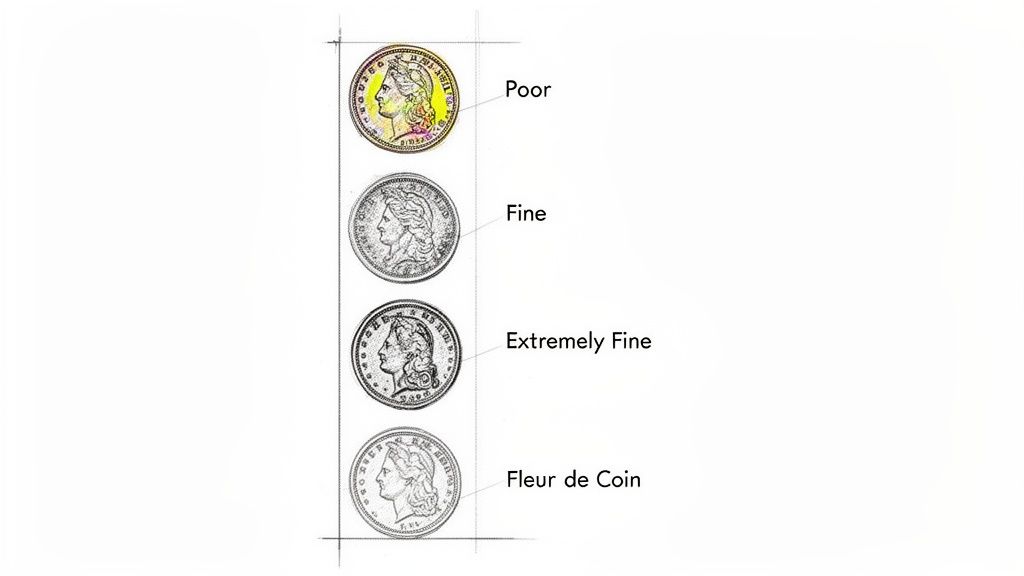 When it comes to a coin's value, one factor stands above all others: its physical condition, or grade.
Imagine you have two Victorian pennies, both struck in the same year. One has been worn smooth by a century of changing hands, while the other looks as fresh as the day it left the Royal Mint. The difference in their value won't be a few pounds—it could be hundreds, or even thousands.
This concept is the bedrock of any serious UK coins collection. Grading gives us a common language to describe a coin’s state of preservation. It allows collectors to know exactly what they’re buying and to understand the true worth of what they own, preventing costly mistakes along the way.
The UK Coin Grading Scale Explained
The British grading system isn't based on numbers, but on descriptive terms that classify a coin’s condition, from heavily worn to absolute perfection. Getting a feel for these grades is absolutely crucial. While the differences can seem subtle at first, they have a massive impact on a coin's price tag.
Here are the main grades you’ll come across, from the lowest quality to the highest:
- Poor (P): The coin is extremely worn down. The date might be barely readable, and most of the design is flattened or gone completely.
- Fair (F): Still very worn, but you can make out the main design outline and the date. All the major details are lost.
- Good (G): You can see significant wear across the whole coin, but the key features and lettering are clear.
- Very Good (VG): The coin shows quite a bit of wear, especially on the highest points of the design, but it’s still a clear and identifiable piece.
- Fine (F): There's moderate wear on the high points, but a lot of the finer details are still present and reasonably sharp.
- Very Fine (VF): This coin has only seen light circulation. There's minor wear on the very highest points, but the overall design is sharp.
- Extremely Fine (EF): You'll only spot very light wear on the absolute highest points, often needing a magnifying glass to see it. The coin still has most of its original mint shine, or lustre.
- Uncirculated (UNC): A coin that shows no signs of wear at all. It may have small scuffs or ‘bag marks’ from being knocked against other coins during production, but it has never been used as money.
- Fleur de Coin (FDC): This is the peak of coin condition, translating from French as "flower of the die." It describes a perfect, uncirculated coin with no visible marks or flaws—exactly as it looked the moment it was struck.
Think of grading like comparing a blurry photograph to a high-definition one. A ‘Fine’ coin is a clear enough picture, but an ‘Extremely Fine’ coin is so sharp you can see every tiny detail. A ‘Fleur de Coin’ is a flawless original print. That massive difference in quality commands a huge premium.
How Grade Drastically Affects Value
The financial jump between grades can be staggering. A common coin in a low grade might only be worth its face value or a few quid. That exact same coin in Uncirculated condition could be a prized and valuable item. Why? Because high-grade examples are incredibly rare. Most coins went straight into circulation and got worn down over time.
To see just how much grade matters, look at this example for a single coin type, the Victorian Penny.
Impact of Grading on Coin Value (Example Victoria Penny)
| Coin Grade | Description of Condition | Estimated Value Range |
|---|---|---|
| Good (G) | Heavy wear but date is clear | £1 - £5 |
| Fine (F) | Moderate wear, some details visible | £10 - £25 |
| Extremely Fine (EF) | Very light wear, sharp details | £100 - £250 |
| Uncirculated (UNC) | No wear, original mint lustre | £400+ |
As you can see, the value multiplies with each step up in condition. Mastering the basics of grading empowers you to make smarter collecting decisions, ensuring you buy and sell with confidence and truly understand the potential locked within your collection.
Your Partner in the World of Coin Collecting
Diving into the world of numismatics is an incredible journey, but it can be as challenging as it is rewarding. Whether you’re just starting out or you’re a seasoned collector hunting for that one elusive piece, having a trusted partner makes all the difference. At Cavalier Coins, we’re here to support every aspect of building a meaningful UK coins collection.
For anyone taking their first steps, the sheer volume of options can feel a bit overwhelming. We help simplify things by offering a diverse selection of accessible entry points. You could begin with a themed set of vintage UK pennies or even explore our range of world coins to broaden your horizons from day one.
Services for Every Collector
As your passion and knowledge grow, so will your needs. We cater to the entire collecting community, ensuring you have the right resources at every stage of your journey. Our services are designed to help you build, grow, and even get the best value from your collection with confidence.
We know that experienced numismatists are often on the hunt for rarity and exceptional quality. That’s why we host weekly eBay auctions, presenting a carefully curated selection of high-grade and sought-after pieces. These auctions offer a transparent and exciting way to acquire fantastic items for your collection.
Beyond individual collectors, we also work with the wider community:
- Bulk Buyers and Resellers: We provide specialised inventory and favourable pricing for those looking to purchase in larger quantities.
- Charitable Organisations: We partner with charities to help them raise vital funds from donated coin and banknote collections, turning generosity into real support.
More Than Just a Shop
We see ourselves as more than just a place to buy coins; we’re an active part of the numismatic community. It’s this community focus, combined with our deep expertise and commitment to great service, that makes us a reliable partner for your collecting journey.
A great collection is built on passion, knowledge, and trust. Our role is to provide the latter two, so you can focus on the pure joy of collecting. We’re dedicated to helping you build a UK coins collection you can be truly proud of.
From finding the very first coin for a new album to sourcing a high-value rarity for a specialist, our goal is to support your passion. Let Cavalier Coins be your guide as you explore the rich history held within every single piece.
Frequently Asked Questions About Coin Collecting
As you get further into the fascinating world of UK coin collecting, you’re bound to have questions. It’s only natural. Here, we’ve put together some straightforward answers to the queries we hear most often from collectors just starting out.
What Is the Best Way to Clean Old UK Coins?
The golden rule, and I can't stress this enough, is simple: do not clean your coins. It’s the single biggest mistake a new collector can make. Cleaning strips away the natural patina—the subtle toning that develops over decades or even centuries—which is a huge part of a coin's character and is highly valued by other collectors.
Worse still, any rubbing, even with a soft cloth, creates tiny, microscopic scratches that permanently damage the coin’s surface. This can absolutely destroy its value.
If a coin has some loose dust or dirt on it, the most you should ever consider is a quick, gentle rinse in distilled water. After that, let it air dry on a soft towel without any rubbing. For anything more stubborn, it's far, far better to consult a professional conservator than to risk ruining a potentially valuable piece of history.
How Can I Find the Mintage Figure for a Coin?
Knowing how many of a particular coin were struck is the first step in figuring out how rare it is. The source you need depends on the age of the coin.
- Modern Decimal Coins: For coins minted since decimalisation in 1971, your best bet is The Royal Mint’s official website. They publish detailed annual mintage data, making it the definitive source.
- Older Pre-Decimal Coins: For historical coins, you'll need to turn to the bibles of the hobby. Essential reference books like Spink's 'Coins of England & the United Kingdom' are the go-to resources. These guides are packed with the production numbers you need to get a feel for a coin's scarcity.
Understanding a coin's mintage is the first step in valuation. A low number doesn't guarantee high value, but it's the foundational piece of the rarity puzzle.
Is It Better to Collect Pre-Decimal or Decimal Coins?
Honestly, this comes down entirely to what you find interesting. There's no right or wrong answer; it's all about personal passion.
Pre-decimal coins offer an incredible journey through British history, connecting you directly to the eras of monarchs like Queen Victoria or George III. Holding a penny from 1890, you can't help but wonder whose hands it passed through.
On the other hand, modern decimal coins, especially the commemorative 50p and £2 pieces, are an exciting and very accessible way to get into the hobby. The thrill of the hunt for a Kew Gardens 50p is what gets many people hooked! Many collectors enjoy a bit of both. A great way to start is to pick one series that fascinates you and try to complete it, whether that’s Victorian pennies or the full set of Olympic 50p coins.
What Are the Most Important Tools for a New Collector?
You really don't need a lot of expensive kit to get going. A few key items will make a world of difference in how you view, identify, and protect your growing collection.
A good quality magnifying glass is non-negotiable. A 5x-10x jeweller's loupe is perfect for spotting the tiny details, mint marks, and wear that determine a coin's grade and authenticity.
Safe storage is also absolutely crucial. You need to protect your finds from fingerprints and environmental damage. Invest in some acid-free coin flips, capsules, or proper albums. Finally, a reliable reference book or website for your chosen niche will prove invaluable for identifying what you’ve found.
At Cavalier Coins Ltd, we provide the resources and expertise to help you build your collection with confidence. Explore our extensive selection of world coins, vintage sets, and rare pieces today. Visit us at https://www.cavaliercoins.com.