
If you've ever stumbled across a two shilling coin, or florin, you might be wondering if you've found a hidden treasure. The truth is, its value can swing wildly from just a few pounds to potentially several hundred for the rarest, best-preserved examples. The final price all comes down to its condition, the year it was minted, and its silver content. Getting to grips with these details is the first step in figuring out what your coin is really worth.
Your Quick Guide to Florin Coin Values
Before we dive deep into the fascinating history and the nitty-gritty of what makes a florin valuable, it's good to have a rough idea of what you might be looking at. Think of this as a starting point for your appraisal.
The journey from a worn piece of everyday change to a sought-after collectible is almost entirely about preservation. A coin that has passed through countless hands will naturally show its age, with the fine details on the monarch's portrait and the national emblems becoming soft and worn down.
On the other hand, a coin that was tucked away soon after it was made will still have its sharp, crisp features and that original shine, or lustre. These 'uncirculated' examples are what collectors get really excited about because they look just as they did the day they left the mint. The difference in value between a battered coin and a pristine one can be absolutely huge.
Understanding the Price Spectrum
For example, most florins minted after 1947 contain no silver and usually aren't worth a great deal unless they're in exceptional condition. A common 1951 florin that’s seen a bit of life might only sell for £1 to £2. But, find one in 'proof' or an incredibly fine condition, and the price can jump significantly due to its rarity and collector demand. For more in-depth pricing, you can always check out specialised numismatic sites.
The image below gives you a great visual on how the British florin changed over the years, showcasing the different designs across various reigns.
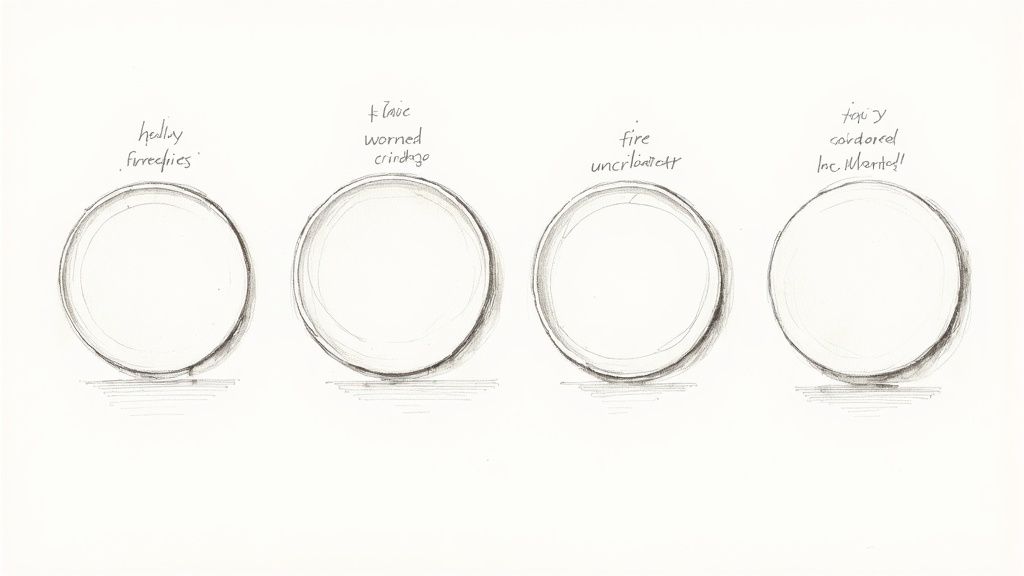
This fantastic timeline really shows the coin's evolution, from the early Victorian "Godless" florin right through to the last ones issued under Queen Elizabeth II.
Key Takeaway: Condition is king. It's the single most important factor in determining the value of a two shilling coin. A common date in superb condition will almost always be worth more than a rarer date in poor condition.
Estimated Florin Values by Condition
To give you a quick reference, the table below outlines some general price ranges you can expect based on a coin's physical state. Keep in mind these are just averages for common florins.
| Condition | Estimated Value (GBP) |
|---|---|
| Heavily Circulated (Poor to Fair) | £1 – £5 |
| Moderately Circulated (Good to VF) | £5 – £20 |
| Lightly Circulated (EF to AU) | £20 – £75 |
| Uncirculated or Proof (UNC/MS) | £75 – £300+ |
As you can see, the better the condition, the more a collector is willing to pay. A coin in pristine, uncirculated condition is a true snapshot of history, preserved just as it was intended.
To help you get a better feel for these grades, here's a simple breakdown:
- Heavily Circulated (Poor to Fair): These coins have seen a lot of action. They show significant wear, and the key details are smoothed over. Their value is mostly historical, and they typically fetch just a few pounds.
- Moderately Circulated (Good to Very Fine): You can still make out the details, but there are clear signs of use. This is how you'll find most florins, and they carry a modest collector value.
- Uncirculated or Proof (Extremely Fine to Mint State): These are the cream of the crop. They look brand new, with sharp details and the original mint lustre. Their value can be substantial, especially for key dates or those with a high silver content.
The Story Behind the Two Shillings Coin
Every coin tucked away in a dusty drawer has a story to tell, and the two shillings piece – more affectionately known as the florin – is no exception. Its tale begins in Victorian Britain, not just as another piece of currency, but as a bold experiment that was well ahead of its time.
The florin was first introduced in 1849 as one of the UK’s earliest steps towards decimalisation. Valued at one-tenth of a pound sterling, it was designed to make calculations simpler in an increasingly industrialised and globalised world. This forward-thinking coin marked a truly significant moment in the long and complex history of British currency.
For nearly a century, these coins were struck from 92.5% silver, giving them a pleasing weight and an intrinsic value tied directly to the precious metal they contained. This silver content is a critical detail for collectors today, as it’s what separates the earlier issues from their later, more common counterparts.
A Post-War Change in Composition
The aftermath of the Second World War brought immense economic challenges, and one of the biggest was the soaring price of silver. To get costs under control, the Royal Mint made a decisive change. After 1947, the composition of the florin was completely overhauled.
The new florins were minted from a copper-nickel alloy, often called cupro-nickel. While they looked almost identical and served the same purpose in day-to-day transactions, they no longer contained any precious metal. This change is the key dividing line for any valuation; pre-1947 coins will always have a foundational value based purely on their silver content.
The screenshot below shows just how much the florin evolved through the reigns of different monarchs.
As you can see, the coin’s design changed significantly over its lifetime. It beautifully reflects the artistic styles and national symbols of each era, from the intricate Gothic Revival style of the Victorian period to the more modern, streamlined portraits of Queen Elizabeth II.
A Decimalisation Pioneer: The florin was introduced in 1849 as an early experiment in decimal currency, representing one-tenth of a pound. Initially containing 92.5% silver, this was reduced to 50% in 1920, and then eliminated entirely in favour of cupro-nickel in 1947 due to rising silver prices. It remained in circulation until being officially demonetised in 1993.
The Famous Godless Florin
One of the most fascinating chapters in the florin’s long history is the story of its very first issue in 1849. This particular coin caused an immediate public stir because the titles of Queen Victoria omitted the traditional Latin phrases "Dei Gratia" (By the Grace of God) and "Fidei Defensor" (Defender of the Faith).
This glaring omission led to a national outcry, quickly earning the coin its infamous nickname: the "Godless Florin." The design was promptly corrected, which makes the original 1849 issue a rare and highly sought-after collectible today. It’s a fantastic example of how even the smallest details can dramatically increase a coin’s value and appeal. Understanding these unique stories is what turns a simple piece of metal into a treasured historical artefact.
What Determines a Florin's True Worth
Ever wondered why one two shilling coin might fetch just a couple of pounds, while another that looks almost identical sells for hundreds? The answer goes far beyond its simple face value. Figuring out the real market value of a florin is a bit like being a detective; you have to piece together clues from its past to understand its desirability today.
It's not just about age or silver content, though those are certainly important pieces of the puzzle. The true value of two shillings is a cocktail of its physical state, the specific year it was minted, its overall rarity, and even its historical context. All these elements work together, transforming what was once simple currency into a sought-after historical artefact.
A coin's journey through time is etched right onto its surface. Think of it like a classic car. One that’s been tucked away in a garage and perfectly maintained will always command a higher price than a similar model that’s been a daily driver for decades. That same principle applies directly to coins, where preservation is everything.
The Core Factors of Valuation
Appraisers and seasoned collectors look at several key areas to build a complete picture of a florin's worth. These are the fundamental pillars that support a coin's price in the collector's market.
- Condition (Grading): This is without a doubt the most critical factor. A coin’s grade reflects its level of wear, from a heavily circulated piece with smoothed-down details to a pristine, uncirculated specimen that still boasts its sharp features and original mint lustre.
- Year and Mint Mark: Certain years had much lower mintage numbers, making those coins inherently scarcer from the get-go. On top of that, some coins have small mint marks showing where they were produced, which can also add a layer of rarity.
- Rarity: This goes beyond just the initial mintage figures. It also considers how many coins from a particular year are estimated to have survived, especially in good condition. A coin might have been common in its day, but if most were later melted down or simply lost, it becomes a rare find today.
- Historical Significance: Does the coin have a unique story to tell? The famous 1849 "Godless Florin," for instance, is highly valued not just for its scarcity, but because of its controversial design and very short production run.
This infographic does a great job of summarising the florin's major compositional changes over its lifespan.
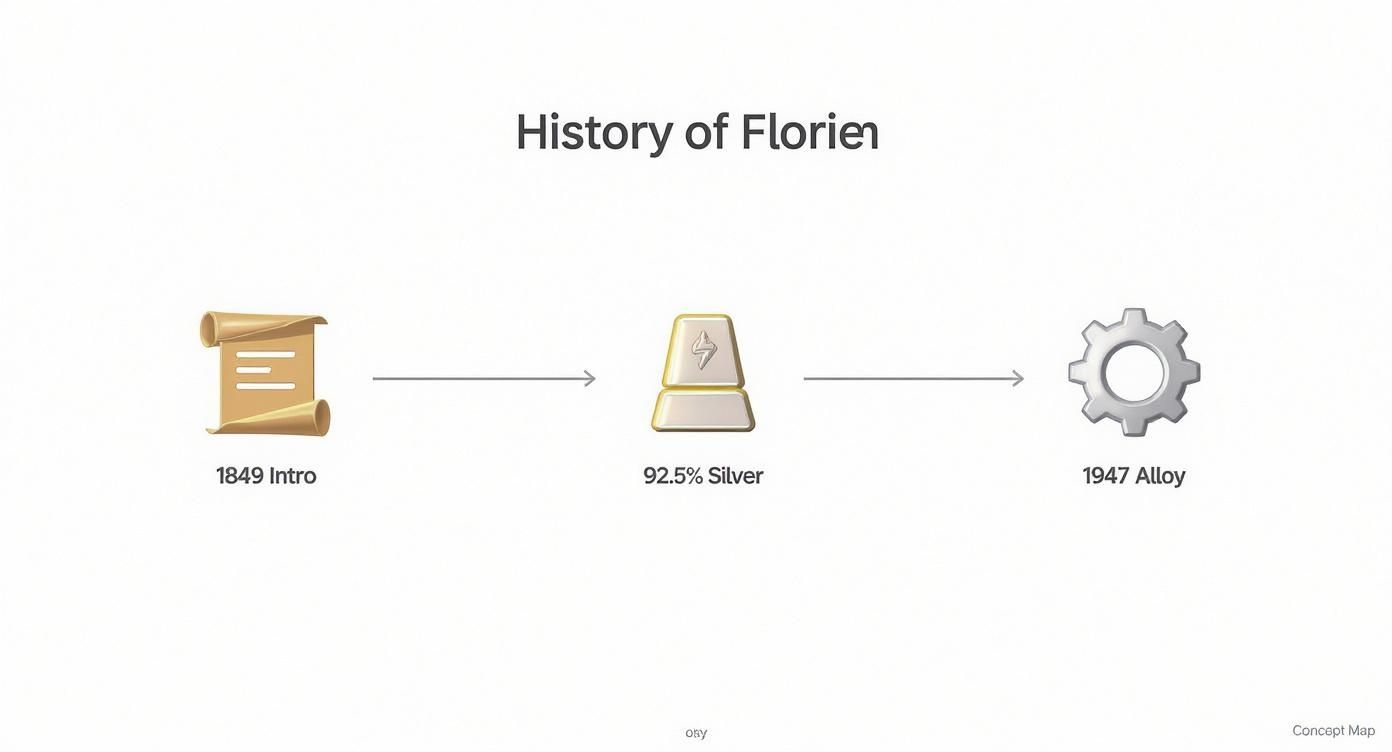
You can clearly see the transition from high-purity silver to a base metal alloy, which is a key dividing line for any valuation.
Expert Insight: A coin’s value is a blend of its physical attributes and its story. A rare date in poor condition might be less valuable than a common date in perfect condition. It’s the balance of rarity and preservation that truly excites collectors.
Getting to grips with these individual components is the first step, but the real skill is in understanding how they interact. For a deeper dive into the principles of coin assessment, you might find our detailed guide on how to value coins helpful, as it breaks down the process even further. Each factor contributes to the final equation, helping you see your florin not just as money, but as a piece of history with a quantifiable legacy.
What Are Florins Actually Selling For Today?
It's one thing to talk about catalogue prices, but what are two shilling coins really selling for in today's market? To get a proper feel for their worth, you have to look past the guidebooks and see where the buying and selling actually happens. The market is a living, breathing thing, shaped by what collectors are chasing, recent auction results, and simple supply and demand.
Online marketplaces like eBay are a fantastic place to get your finger on the pulse, especially for the more common-date florins. You can see hundreds of live listings, which gives you a brilliant, real-time picture of what people are prepared to pay for coins in different states of preservation. It’s the best way to track price trends and see the value gap between a worn, heavily circulated coin and a gleaming, uncirculated example.
When it comes to the rarer or more significant pieces, however, the real action happens at specialised coin auctions and with established dealers.
Where to Find Solid Pricing Information
Pinning down reliable prices means knowing where to look. Different places cater to different types of coins, and understanding that is the key to building an accurate picture of the market.
- Online Marketplaces (like eBay): Your go-to for common-date florins in both circulated and uncirculated conditions. Prices can jump around a bit, but they give a great snapshot of immediate collector demand.
- Auction Houses (like Spink & Son): This is where you’ll find the rare, high-grade, and key-date florins. Their finalised sale prices are public record, serving as a rock-solid benchmark for top-tier coins.
- Dealer Price Lists: Reputable coin dealers often publish price lists based on what they have in stock. These are typically retail prices, but they offer a stable, professional take on a coin's value.
This varied landscape shows that the value of two shillings isn't one single figure but a whole spectrum. A run-of-the-mill 1950s florin might change hands for a few pounds on eBay, while a rare Victorian "Gothic" florin in pristine condition could command hundreds, or even thousands, at a major auction.
A Pro Tip: Remember that online listings show asking prices, not what the coin actually sold for. To get a true sense of value, always filter your search to see the "sold" or "completed" listings. That's where you see what real buyers have paid.
Ultimately, keeping an eye on these different sources gives you a practical, real-world understanding of what a florin is worth. By watching the trends, you start to see how rarity, condition, and even current collecting fads all come together to create the final price—helping you make much smarter decisions when buying or selling for your own collection.
How to Properly Appraise Your Florin Coin
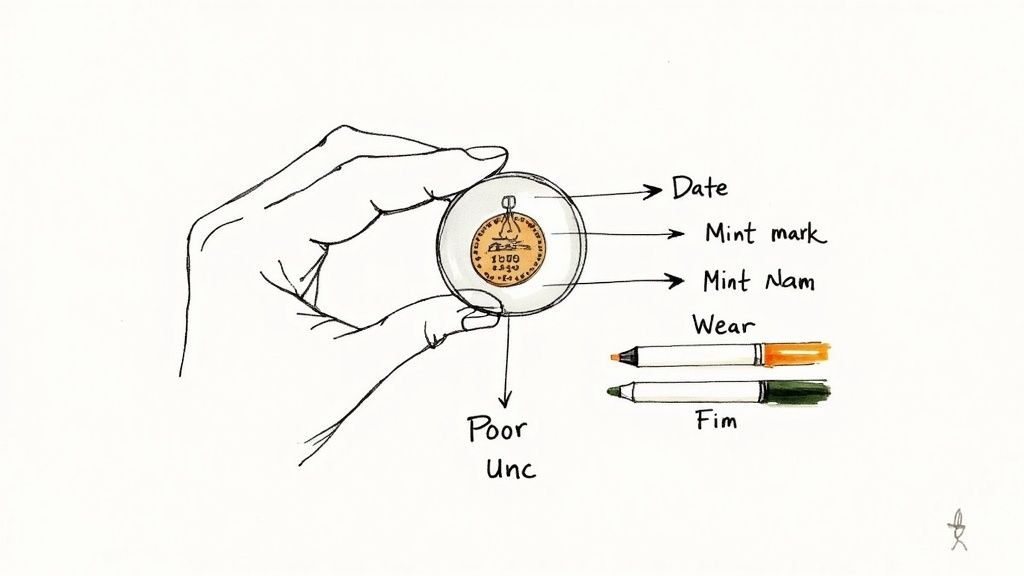
Ready to put your own two shilling coin under the microscope? Figuring out what a florin is worth is more than just looking up its date in a book. It’s a bit like being a detective, piecing together clues left by history. With a decent light and a magnifying glass, you can start to uncover the story your coin has to tell.
First things first, let’s do a good visual check. Always hold the coin by its edges – the oils on your fingers can cause damage over time. Take a close look at the monarch's portrait. Are the tiny details in the hair and crown still crisp? Flip it over and examine the shields or the rose. These high points are always the first to show wear and tear.
Next, try tilting the coin under your light. A coin that has never been in circulation will often have something called cartwheel lustre. It’s a unique satiny sheen that seems to spin as you move it. If you see that original mint lustre, it’s a massive clue you're holding a high-grade coin, and that significantly bumps up its value.
Examining for Wear and Authenticity
When we talk about condition, or grade, we're really talking about the coin's life story told through wear patterns. Think of it as reading a map of its journey from the mint to your hand.
- Look for Scratches and Dings: Are there any obvious marks on the surface? Any knocks to the rim? Deep scratches or bad rim damage can really pull a coin’s grade down.
- Check the Field: The field is the flat, blank background of the coin. On a top-notch coin, this area will be smooth and clean, without any distracting marks.
- Identify Signs of Cleaning: This is a big one. Be suspicious of any coin that looks a bit too shiny or has very fine, parallel scratches across its surface. Someone might have tried to clean it, and harsh cleaning strips away the natural protective layer (patina), killing its collectible value.
Authenticity is also key. Forgeries of florins aren't as common as with super-rare coins, but it always pays to be careful. Check your coin's weight and size against the official specs from a reliable source. A genuine florin will have sharp, well-struck lettering and design details.
Key Insight: A coin's grade is its biography. Every little imperfection and sign of wear tells you where it's been. While you can learn the basics yourself, professional grading services offer a definitive, unbiased assessment.
Taking the Next Step to a Formal Grade
While doing your own appraisal is a fantastic starting point, a professional grade from a third-party service gives you an impartial, standardised verdict. This is especially important for more valuable coins because it takes all the guesswork out of the equation and gives potential buyers complete confidence.
If you think you have something special, learning how to get coins graded professionally is the logical next step on your collecting journey.
By taking the time to carefully examine these details, you'll get a much clearer picture of your florin’s condition and authenticity. This hands-on approach not only helps you estimate the value of two shillings more accurately but also deepens your connection to a real piece of history.
Spotlighting Rare and Valuable Florin Coins
While most florins you come across will have a modest value, some are genuine collector's items that can command impressive prices. These are the coins with a story to tell—perhaps they had an exceptionally low mintage, feature a famous design error, or are tied to a significant moment in history. Knowing what to look for is the key to spotting these hidden gems.
A perfect example is the infamous 1849 'Godless' Florin. Its design caused a public scandal by omitting the traditional "Dei Gratia" (By the Grace of God) from Queen Victoria’s titles. The coin was quickly withdrawn and corrected, but not before a small number entered circulation. That rarity, combined with its controversial backstory, makes it a true prize for any serious numismatist.
Another one to watch for is the 1951 Proof Florin. The standard coins from 1951 are quite common, but the proof versions are another story entirely. These were specially struck for collectors with a stunning, mirror-like finish. With only 20,000 ever minted, finding one in pristine condition is a real challenge, and its value reflects that scarcity.
Key Dates and Error Coins to Watch For
Beyond the big names, certain dates and minting errors can turn an otherwise ordinary coin into a valuable find. It pays to keep an eye out for these specific issues:
- Low-Mintage Years: Production numbers weren't always consistent. Coins from years like 1925 or 1932 had lower mintages, making them naturally scarcer and more sought-after by collectors trying to complete a set.
- 'Gothic' Florins (1847-1887): Valued for their beautiful, intricate design and high silver content, these Victorian-era coins are consistently popular and hold their value well.
- Error Coins: Always check for mistakes! Things like misaligned strikes or visible die cracks are unique imperfections that can significantly boost a coin's appeal and price tag.
Even a more modern coin can be surprisingly valuable. Take the 1966 Florin. Around 64 million were minted, which sounds like a lot. However, finding one in perfect, uncirculated condition is much harder than you'd think. As one of the last florins struck before decimalisation, these pristine examples are tangible symbols of a major shift in British currency and can fetch prices well above their face value. You can find out more about this coin’s unique place in history on YouTube.
Collector's Insight: Remember that rarity isn't just about low mintage numbers. It’s also about survival. A coin that was common in its day but has very few high-grade examples left can be just as valuable as an officially rare issue.
Your Top Florin Questions, Answered
As you dive into the world of florins, you’ll find certain questions pop up again and again, whether you're just starting out or have been collecting for years. Let's tackle some of the most common queries to clear up any confusion and get you collecting with confidence.
Are All Florins Made of Silver?
This is a big one, and the answer is a definite no. It's one of the most important things to know, as it directly impacts a coin's value.
The composition changed over time:
- Florins minted up to and including 1919 are made from 92.5% silver, which is proper Sterling silver.
- From 1920 to 1946, the silver content was slashed to 50%.
- Any florin dated 1947 or later contains no silver at all; they are made from a copper-nickel alloy.
This means older coins have a built-in "melt value" from their silver content. It gives them a price floor that modern, non-silver florins simply don't have.
How Much Is a Florin Worth in Today's Money?
That's a bit like asking how long is a piece of string! Comparing purchasing power across centuries is tricky, but we can get a rough idea. Back in the late 19th century, two shillings was a significant amount of money – often a full day's wages for a skilled tradesman.
For a bit of perspective, think of it this way: a skilled worker in the 1800s might have earned about two shillings for a hard day's labour. While it’s not a direct conversion, it really shows that its historical buying power was much greater than its simple face value suggests today.
Can I Still Use a Florin Coin in a Shop?
Not a chance! The florin officially bowed out in 1993 when it was demonetised and removed from circulation. It holds no legal tender status anymore, so you can't use it to buy a pint of milk. Today, its value is purely numismatic, meaning it’s worth whatever a fellow collector is willing to pay for it.
What Is the Most Valuable Florin?
While value depends heavily on condition, the coin that gets most collectors excited is the 1849 'Godless' Florin. Its story is fantastic. The design controversially left off the traditional "Dei Gratia" (By the Grace of God) inscription, causing an uproar that led to its swift withdrawal.
This combination of a great backstory and genuine rarity makes it a prize for any collection. A good example can fetch thousands of pounds at auction.
At Cavalier Coins Ltd, we live and breathe numismatics and love helping collectors find those unique, historical pieces that tell a story. Why not explore our huge selection of world coins and banknotes today?
Find your next numismatic treasure at https://www.cavaliercoins.com.