

You've opened an inherited coin box, found a promising date and searched online. One listing suggests a modest collector's item; another makes the apparently identical coin look like a life-changing discovery. Before you tell the family what it's worth, accept a dealer's offer or update your insurance, establish whether those listings describe what you own.
To value rare coins properly, build a chain of evidence. A defensible appraisal connects the physical object to its identity, authenticity, condition, ownership history and relevant sales, then states what the resulting figure means.
Why Rare Coin Values Need Careful Evidence
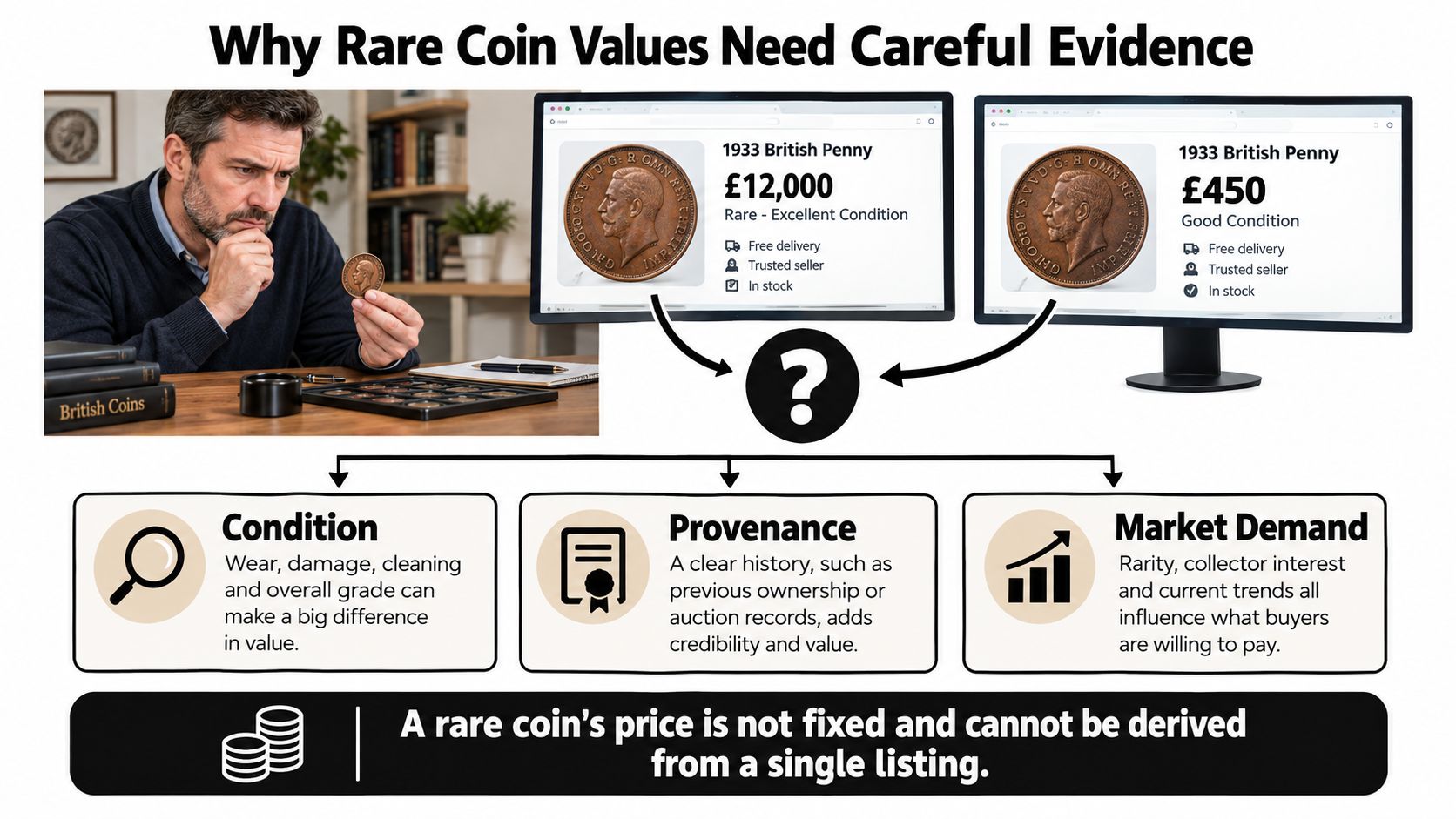
Consider a collector comparing listings for coins bearing the same date. The photographs look similar, but the expensive example has documented provenance and a specialist description; the cheaper listing offers little beyond a photograph and an ambitious title. Neither asking price establishes the value of the collector's own coin.
The sensible response isn't to choose the higher figure, split the difference or assume the seller with the longest description must be right. Treat each listing as a claim to investigate. You need to know whether the coins share the same variety, production format and preservation before their prices become useful.
Decide which value you need
A valuation without a stated purpose invites misunderstanding. A collector arranging cover and an executor preparing an estate account may need different answers, even when they're discussing the same object.
| Value basis | What you're trying to establish |
|---|---|
| Face value | The denomination represented on the coin |
| Bullion value | The value attributable to its precious-metal content |
| Catalogue value | A reference figure whose assumptions need checking |
| Insurance replacement value | An appropriate replacement figure under the policy's requirements |
| Open-market value | A supported opinion of what the coin could achieve under the stated sale conditions |
| Net sale proceeds | What the owner retains after the relevant selling costs |
These aren't interchangeable labels. Don't use an insurance schedule as evidence of what a dealer should pay, or treat a catalogue entry as a binding offer.
Replace a price lookup with an evidence chain
Use a consistent sequence: identify the coin, investigate authenticity, assess preservation, establish relevant scarcity, examine matched sales and record the valuation assumptions. Only then should you calculate the likely selling outcome.
Practical rule: A useful valuation explains why a figure is reasonable and what evidence could change it.
My recommendation is to seek a reasoned range, not an impressively precise guess. Where the evidence is weak, identify the missing information rather than hiding uncertainty inside a confident number.
That approach also makes disagreement productive. If a dealer and an auction specialist reach different opinions, you can compare their assumptions about condition, comparable lots and sale conditions instead of arguing over unsupported totals.
Identify the Coin Before Judging Its Value
Start with the object, not the search result. Record what you can observe before adopting a seller's identification or a family label.
The identification framework should include denomination, date, mint mark, metal, weight, diameter, edge, die axis, provenance and accompanying documents, consistent with the documented approach described in The Royal Mint's authentication and valuation terms. Its valuation is an estimate under stated auction assumptions, not a fixed market value, and authentication depends on expert examination and available technical resources.
Create a reliable physical record
Work on a clear surface with the coin and its existing packaging kept together. Give the item a reference that also appears on its photographs and notes, so an appraiser can connect the evidence without guessing.
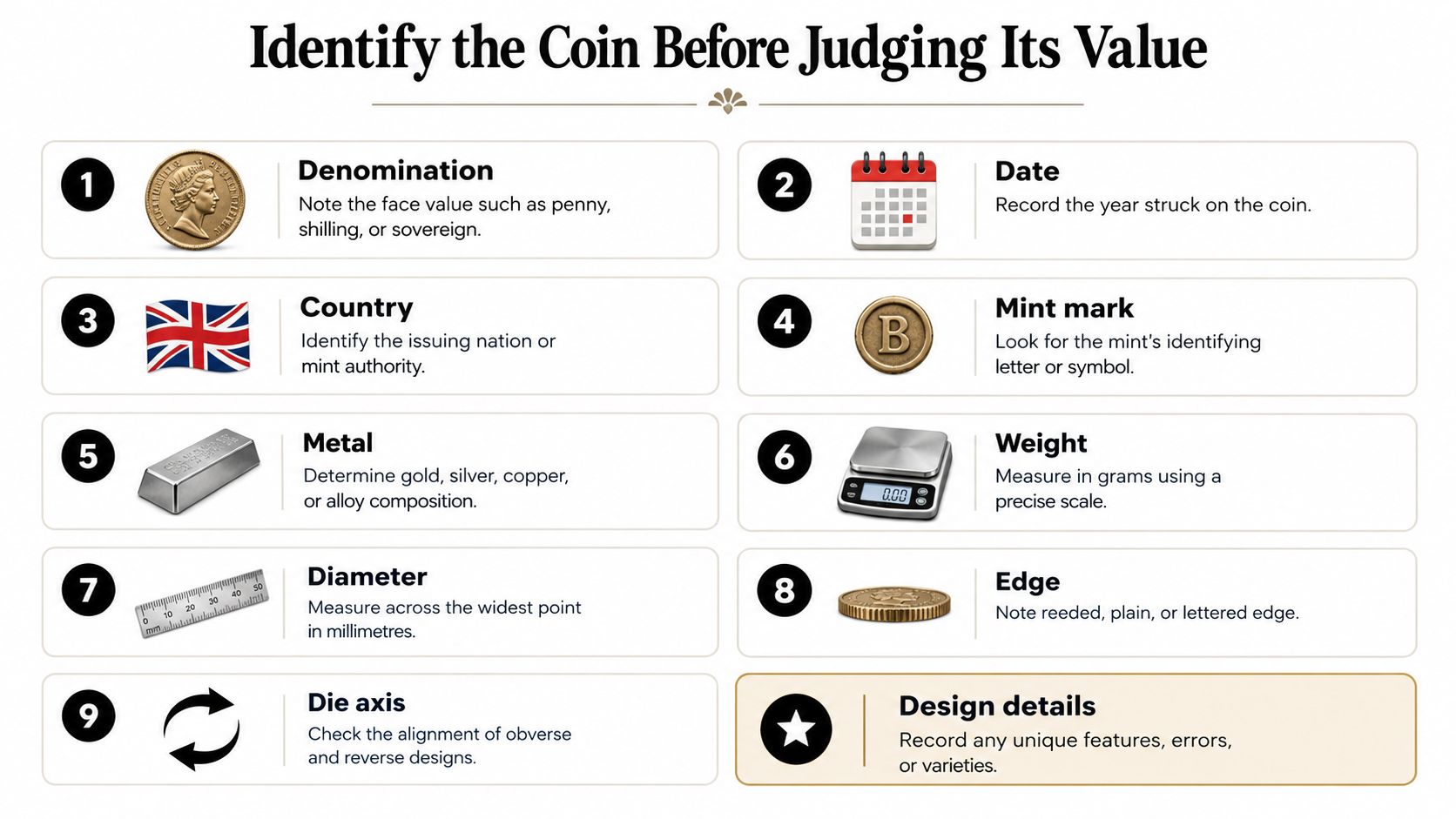
Photograph both faces and the edge under neutral lighting. Keep the original images, avoid filters and take additional close-ups of unclear lettering, mint marks or unusual details rather than relying on digital sharpening.
Use a suitable scale and measuring tool, recording the units and any uncertainty. Don't squeeze the coin with callipers or remove it from a sealed holder merely to complete a worksheet; ask the reviewing specialist how to handle measurements that aren't safely accessible.
- Read the inscriptions: Transcribe visible wording and mark uncertain characters rather than completing them from memory.
- Describe the design: Note portraits, shields, symbols and anything that differs from the reference image.
- Record the edge: Describe whether it appears plain, reeded or lettered, including visible interruptions.
- Check alignment: Record the relationship between the obverse and reverse designs, known as the die axis, without assuming an unusual alignment proves an error.
- Keep the context: Photograph envelopes, labels, presentation boxes and certificates alongside the item record.
Test the identification rather than forcing a match
Suppose an inherited envelope names a desirable issue, and the coin's date appears to agree. That's a starting point, not a conclusion: the denomination, mint mark or edge may identify a different object.
Compare the observations with a specialist reference for the proposed issue. If the measurements or design disagree, retain the discrepancy in your notes and suspend the identification until someone can explain it.
Don't label an uncertain metal composition as confirmed gold or silver because of colour alone. Equally, don't turn an unfamiliar feature into a mint-error claim because you can't find an immediate match.
A compact observation sheet should let another appraiser reproduce your screening:
| Record field | What to preserve |
|---|---|
| Identity | Country, denomination, visible date, inscriptions and proposed variety |
| Physical observations | Weight, diameter, edge, alignment and measurement limitations |
| Images | Unedited face, edge and detail photographs |
| Associated material | Packaging, certificates, labels and purchase records |
| Unresolved questions | Illegible details, mismatches and unverified descriptions |
Keep observed facts separate from conclusions. “Letter visible beneath the design” is an observation; “rare mint variety” is a conclusion requiring support.
Authenticate and Grade the Coin Safely
Authenticity and condition answer different questions. An authentic coin can be badly damaged, and an attractive object can still require substantial investigation before anyone should sell it as genuine.
Treat certification as another evidence layer, not permission to stop examining the object. A holder, label or certificate needs to correspond with both the issuing service's record and the coin's physical diagnostics.
What each validation layer can establish
| Check | What it establishes | What it does not establish | When to use it |
|---|---|---|---|
| Initial visual examination | Observable design and surface characteristics | Conclusive authenticity from photographs alone | Early screening |
| Specialist authentication | An expert opinion based on examination and available testing | A guaranteed selling price | Suspected rarities or conflicting diagnostics |
| Condition assessment | An opinion on wear, strike and preservation | Authenticity merely because the coin looks convincing | Before selecting price comparisons |
| Independent certification | The service's recorded identification and grading opinion | An automatic match with every similarly labelled auction lot | Where the potential value justifies the cost |
| Certificate or holder verification | Whether the supplied details agree with the issuer's records | Proof that no further physical examination is needed | Whenever relying on certification |
Ask a specialist to explain the basis of the conclusion. “Looks right” isn't enough when weight, edge characteristics or the ownership account raise unresolved questions.
For help deciding what to request, use this guide to coin authentication services. Establish the examination scope, costs and limitations before submitting the coin.
Preserve the evidence on the surfaces
Don't clean, polish, mount or chemically test a suspected rarity before expert review. Surface alteration can remove original mint lustre and reduce collector desirability; it can also leave the next examiner assessing your intervention rather than the coin as found.
Resist the urge to make an inherited piece look presentable. If you've already treated it, record exactly what you used and tell the appraiser rather than describing it as untouched.
A bright coin isn't necessarily a well-preserved coin. Ask the grader to explain the surfaces, not merely admire the shine.
Recognised grading terminology helps specialists communicate preservation and production characteristics. It doesn't make prices linear: a numerical step isn't a standard monetary increment, and proof status shouldn't be inferred from an attractive appearance.
Keep exceptional results in their proper category
In the London sale reported by NGC, an 1826 five-sovereign proof graded PF 63 realised £144,000, an 1825 sovereign graded PF 62 realised £57,600, and a 1729 East India Company five guineas graded MS 63 realised £108,000, according to NGC's account of the Sovereign Rarities auction. These are benchmarks for specific exceptional objects, not a price scale for miscellaneous British gold.
For a mixed collection, separate ordinary circulation and bullion material from identifiable scarce varieties and possible exceptional pieces. Refer the last group for specialist review before assigning a collection-wide figure.
Referral is particularly important when the measured weight, edge, design or provenance conflicts with the proposed identification. If you can't resolve the contradiction, don't promote the coin to a valuable variety on optimism alone.
Research Rarity and Comparable Auction Results
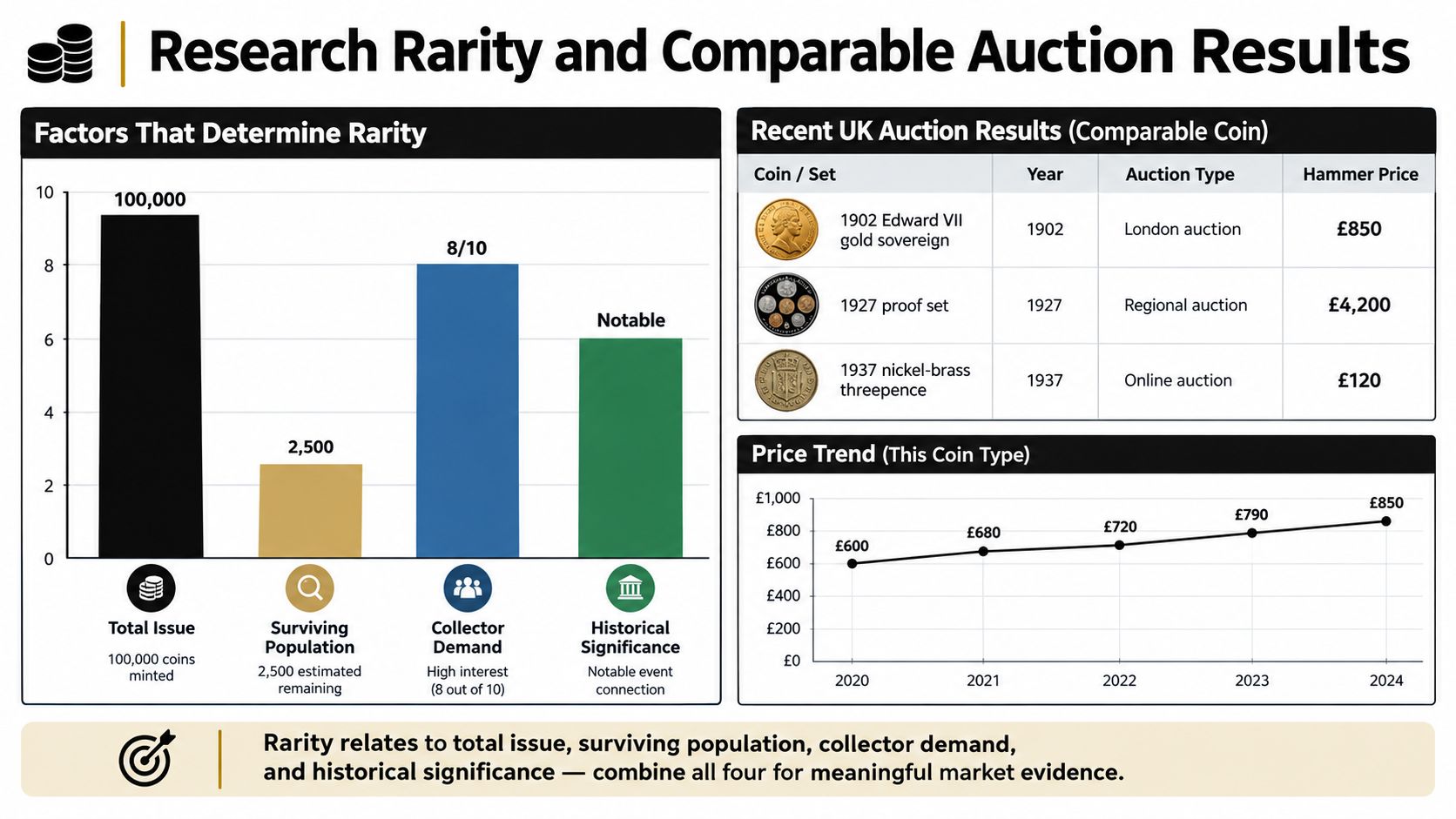
Low mintage is a research clue, not a valuation. Your question is whether buyers pay a premium for the particular issue in the condition and format you own.
The Royal Mint describes the 2025 UK 5p as having a mintage of 19 million, the lowest of its type, while reporting more than 9 million 2025-dated £1 coins in circulation in its coin-of-the-year discussion. Those production figures don't, by themselves, establish a collectible premium.
Define what makes the coin scarce
Separate the original issue from the population available to collectors. Then ask whether scarcity concerns the date, variety, production format, preservation or documented ownership history.
Where you can't support a surviving-population estimate, don't invent one. Describe the available evidence and its limits instead.
- Issue rarity: Investigate the exact date and variety rather than the denomination generally.
- Condition rarity: Check whether the relevant scarcity concerns exceptional preservation rather than all examples.
- Format rarity: Distinguish circulation coins from proofs, patterns and trial pieces.
- Collector demand: Look for completed transactions, not repeated claims that an item is desirable.
- Historical significance: Explain the connection using documented information rather than an appealing story.
Use the following visual as a process illustration, not as evidence for an appraisal. Verify any numerical labels or example results independently before relying on them.
Learn the right lesson from a famous rarity
The 1937 Edward VIII gold sovereign sold privately for £40,000 in 1984, achieved £516,000 at auction in 2014 and reached £1,000,000 in 2020, making the last result 25 times the private-sale price, as recorded in The Royal Mint's account of historic coin collecting. That account connects its desirability with Edward VIII's brief reign and the fact that the issue never entered ordinary circulation.
The useful lesson is that buyers can place extraordinary importance on rarity, historical context and provenance. It isn't evidence that ordinary sovereigns should follow the same price trajectory.
A modern trial piece also needs its own category. Don't compare it with a circulating coin merely because the design and denomination resemble each other; the connection to the minting process and restricted availability are material differences.
Build a comparable-sales file
Start with the closest matches, not the highest results. Check the date, variety, metal, production format, grade, surface description, provenance, sale date and venue before admitting a result to your valuation file.
Keep the auction description and photographs with the result. If a listing disappears later, your reasoning should still be understandable from the evidence you retained.
| Comparable question | Decision |
|---|---|
| Is the identity genuinely matched? | Exclude different varieties unless the difference is explicitly relevant |
| Is the preservation comparable? | Explain wear, cleaning or surface differences |
| Is the production format the same? | Keep proofs and trials distinct from ordinary issues |
| Is the transaction completed? | Separate realised results from asking prices |
| Is the price basis clear? | Establish whether the published amount includes buyer's premium |
The practical discipline in using comparable sales data is knowing when to reject a superficially attractive match. A prestigious result for a different object is less useful than a modest, well-documented sale of the correct variety.
Don't turn published headline results into an expected outcome for an entire collection. Selective reporting tells you what particular bidders paid for particular lots, not how frequently an inherited box contains a rarity.
Finally, distinguish the metal component from the numismatic premium. A comparison that only tracks precious-metal content won't explain the collector price of an exceptional piece, while a celebrated rarity won't establish the premium on common bullion material.
Estimate a Defensible Market Value
A defensible range needs a written explanation of its boundaries. State what supports the lower end, what would justify the upper end and which unresolved issue could materially alter the conclusion.
Don't average a group of auction results because they're easy to collect. Give the closest matches the greatest weight, and explain why you've discounted older, differently preserved or less clearly described examples.
Explain the judgement behind the range
Prepare a short valuation note that identifies the subject coin, purpose, effective date and principal comparisons. Record assumptions explicitly, particularly where the coin hasn't been examined in hand or where a proposed variety remains unconfirmed.
Use conditional language precisely. “Subject to authentication” identifies a major outstanding dependency; it shouldn't be buried beneath an unconditional headline figure.
Valuation discipline: More decimal places don't make an unsupported opinion more accurate.
Auction estimates also need context. In The Royal Mint's reported trial-piece sale, a Brilliant Uncirculated 2022 Harry Potter 50p trial estimated at £200 realised £1,302.08; a 2022 Tutankhamun centenary £5 trial estimated at £200 realised £1,354.15; and a 2023 Coronation silver trial estimated at £200 realised £1,750, according to The Royal Mint's trial-piece auction results.
These were distinct lots, not interchangeable evidence. The results demonstrate why an estimate is a pre-sale opinion rather than a promised outcome; they don't justify applying an uplift to another coin.
Separate the buyer's price from the seller's receipt
Establish the basis of every reported result before comparing amounts. A premium-inclusive total and a hammer price describe different stages of the transaction.
Then obtain the proposed selling terms in writing. Ask the auctioneer or intermediary to identify which deductions apply to you and which costs fall on the buyer.
| Cost or adjustment | What to establish |
|---|---|
| Buyer's premium | Whether it is already included in the comparable result |
| Seller's commission | The contractual deduction from your sale |
| VAT where applicable | Which charges attract it under the stated terms |
| Shipping and insurance | Who pays and who bears transit risk |
| Currency conversion | The conversion basis and associated charges |
| Payment costs | Any applicable transaction or settlement charges |
| Other agreed charges | Certification, photography, withdrawal or unsold-lot costs |
Keep gross market value and expected net proceeds on separate lines. Subtract only applicable seller-side deductions from the correctly defined seller receipt; don't deduct a buyer's premium twice or treat it automatically as your own expense.
For a collector deciding whether to sell, the net figure is usually the decision-making number. For a dealer considering stock, the purchase decision also needs an explicit allowance for unresolved attribution, holding costs and selling risk rather than an assumption that the next sale will match the highest comparable.
Finish with a sensitivity note. Explain what would happen to the opinion if the attribution changes, an apparent surface problem is confirmed or the strongest comparable proves unsuitable.
Document Provenance and Purpose-Specific Values
A valuation should travel with its evidence. Preserve purchase invoices, auction descriptions, grading records, certificates, correspondence, photographs and ownership-transfer documents in a file connected to the item reference.
Keep family recitations, but label them clearly. "Reported by the previous owner" is different from "supported by a dated invoice", and the distinction matters when an executor or buyer asks how the history was established.
Separate ownership evidence from ownership stories
Build a chronological record of documented transfers and mark gaps instead of filling them with assumptions. Preserve original wording when transcribing an old label, including uncertainty about handwriting or identity.
For material-value items, record who held the coin during examination, transport and storage. Ask specialists to identify it on receipts so the chain of custody relates to the actual object rather than a generic description.
Your portable worksheet should contain:
- Object record: Identification, photographs, measurements and unresolved diagnostics.
- Expert evidence: Authentication opinions, grading records and examination limitations.
- Ownership history: Supporting documents, reported accounts and unexplained gaps.
- Market reasoning: Selected comparables and the reasons for including them.
- Valuation instruction: Purpose, effective date, assumptions and named recipient.
- Conclusion: The supported figure or range and any conditions attached.
Match the report to the decision
An executor needs an estate-focused opinion at the relevant valuation date. A collector arranging insurance needs a figure and description that meet the insurer's requirements, while a charity needs an accountable record connecting donated items with their eventual disposal.
| Purpose | Evidence to prioritise |
|---|---|
| Estate or probate | Relevant date, individual identification and support for the valuation basis |
| Insurance | Replacement basis, detailed description and policy requirements |
| Charity donation or disposal | Donation inventory, assessment record, sale authority and proceeds |
| Proposed sale | Current comparisons, proposed route, contractual costs and likely receipt |
The inherited-coin guidance published by My Coinage cites a £1,500 threshold in discussing collections requiring individual valuation and warns that tax treatment depends on the coin's type and legal status; consult its guide to selling inherited coins in the UK as an introduction, not a substitute for current professional advice.
Don't treat that threshold as permission to skip proper identification. A lump-sum description may conceal a scarce variety or leave beneficiaries unable to understand how an executor reached the estate figure.
Ask the solicitor, tax adviser or insurer to confirm the required basis before commissioning the report. Avoid blanket claims that gold, commemoratives or legal-tender coins are universally tax-free.
For a charity, retain the authorisation to sell alongside the assessment and settlement record. For a family estate, give beneficiaries a clear explanation of the basis used rather than circulating unrelated retail listings as competing valuations.
Prepare to Sell or Consign with Confidence
Choose a selling route by comparing the written terms and likely outcome, not the most flattering verbal estimate. A direct dealer offer, specialist auction and consignment arrangement should each be evaluated on their own conditions.
Ask who sets the price, whether a sale is guaranteed, which charges apply, when payment becomes due and who carries the risk while the coin is away from you. If the answer isn't clear, don't hand over the item until it is.
Match the route to the material
| Route | Questions to resolve |
|---|---|
| Direct dealer sale | Is the offer firm, what is included, and when will payment be made? |
| Specialist auction | What are the reserve, seller charges, unsold terms and settlement conditions? |
| Consignment | Who controls the asking price, how long is the agreement, and what happens if it doesn't sell? |
A collector selling an exceptional coin should ask prospective specialists how they would catalogue it and support the attribution. A reseller should separate stock with unresolved high-value potential before agreeing a routine bulk price.
For a charity sorting donated currency, maintain an inventory and isolate suspected rarities for review. Don't let pressure to clear storage replace an accountable disposal decision.
Send an appraisal packet rather than an unsupported claim
Provide the identification sheet, photographs, physical observations, provenance documents, certification details and selected comparisons. State whether you want an offer, an auction estimate or a purpose-specific valuation, because those instructions are different.
Use the practical guidance on how to sell rare coins in the UK to prepare questions before agreeing terms. Keep the original evidence file even after the transaction is complete.
Before committing, check that:
- Identity is settled: Material attribution questions have been resolved or disclosed.
- Terms are written: Charges, risk, reserve and settlement arrangements are understood.
- Evidence is retained: Copies remain with you when the coin leaves your custody.
- Handling is agreed: Nobody will clean or alter the coin without explicit authority.
- The decision is proportionate: Significant financial or legal consequences justify an independent second opinion.
Your objective isn't to secure the highest unsupported valuation. It's to make a decision you can explain, supported by evidence that another competent person can follow.
Cavalier Coins Ltd offers collector coins and banknotes, auction listings and bulk purchasing of donated coin collections from charities. Visit the store to explore available material or contact the team about a bulk collection, bringing your inventory and photographs so the discussion starts with identifiable evidence rather than an unsupported headline price.