
You've found a biscuit tin full of old pennies, shillings and half crowns in a loft clearance. The dates look impressive, one coin has a dark silver colour, and an online listing appears to show the same type for a surprisingly high price. The natural question is, “What are my old coins worth?”
The honest answer depends on the exact coin, its authenticity, its grade and what comparable examples have sold for. Age alone isn't a price guide. The Royal Mint notes that around 27 billion coins are currently in circulation across the UK through its UK coin mintage guidance, so a worn old coin may still be common, while a scarce variety or unusually well-preserved survivor can attract serious collector demand.
This is a practical method for valuing old coins in the UK without relying on hopeful asking prices. Identify each piece, check whether it's genuine, assess condition using a recognised scale, research its historical context, then compare it with realised prices for the same coin and grade.
Introduction to Valuing Old Coins in the UK
The first mistake is sorting coins by age. A Victorian penny may be interesting but widely available, while a later issue with a scarce date, variety or error can be much more desirable. Collectors pay for availability, condition, demand and significance, not for the number printed on the date.
The Royal Mint's own guidance reinforces this point. It uses the British grading scale when verifying condition and value, because two coins with the same date and design can sell very differently when one is heavily worn and the other retains sharp detail in its collector resources. A catalogue photograph may show a superb example, but your coin might sit several grades below it.
The kitchen-table starting point
Empty the tin onto a clean, soft surface. Don't polish anything, rub away dirt or stack valuable-looking coins loosely together. Separate obvious categories first, such as pre-decimal British coins, decimal coins, foreign pieces, tokens and medals.
For every potentially interesting coin, record:
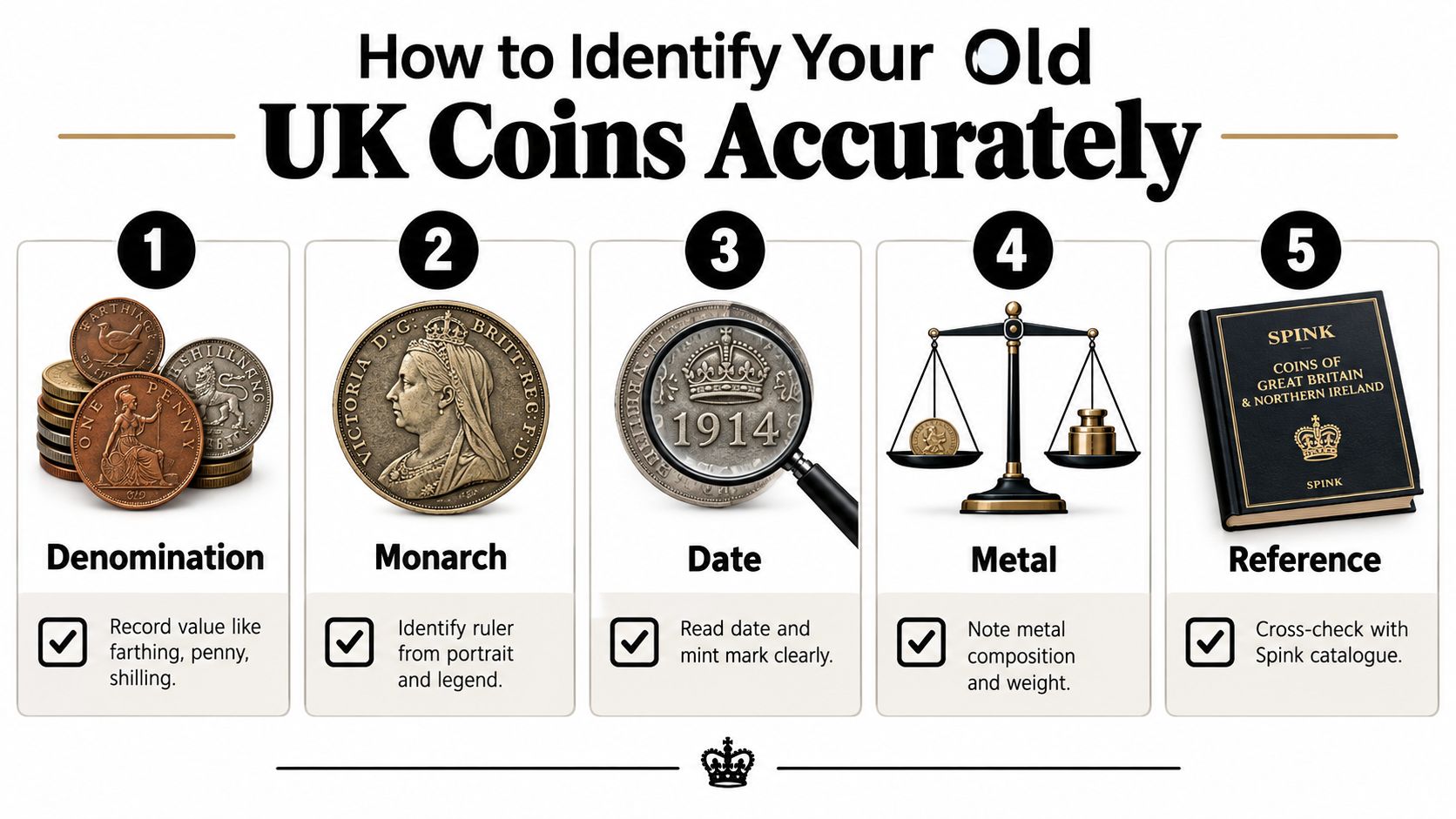
- Denomination: Farthing, penny, threepence, sixpence, shilling, florin, half crown, crown or sovereign.
- Monarch: Read the portrait and surrounding legend rather than relying on a family member's recollection.
- Date and variety: Small design differences, mint marks and lettering details can matter.
- Condition: Describe wear before looking at prices.
- Provenance: Keep notes about where the coin came from, especially if it was inherited with paperwork or an old collection ticket.
That record stops the most expensive form of guesswork, comparing a vaguely similar coin against the wrong market evidence. A reliable valuation is a chain of evidence, not a single search result.
Practical rule: Never set a selling price until you can describe the coin precisely enough for another collector to locate the same issue.
The Royal Mint's collector services list a formal valuation from as little as £20, which demonstrates that professional assessment is an established service rather than an unnecessary ritual in its collector guidance. For a mixed tin of ordinary pieces, research may be sufficient. For an unusual, valuable or potentially rare coin, a specialist opinion can prevent a costly misidentification.
How to Identify Your Old UK Coins Accurately
Valuation starts with identity. A price search for “old British penny” is too broad to be useful because pennies span different monarchs, metals, designs, dates and varieties. Write down what you can see before you search for a price.
Build a proper coin record
Begin with the denomination. The reverse usually provides the strongest clue, although worn details may require comparison with a specialist reference. Next, identify the monarch from the portrait and legend. Pay attention to the lettering, because similar denominations can appear across several reigns.
Read the date under magnification and photograph both sides in good, indirect light. Include the edge in a separate photograph if it carries lettering, milling or a distinctive pattern. A phone camera is adequate for an initial record, provided the coin is sharply focused and the image shows the full surface without glare.
Use a digital scale and callipers where appropriate, then compare the results with a trusted catalogue reference. The beginner's guide to identifying old coins is useful for organising this first pass, but don't treat a visual resemblance as proof of an exact variety.
The date also determines which valuation route applies. The Royal Mint states that its Authentication and Valuation service is available only for British coins made before 1971 in its coin valuation FAQs. Separate pre-decimal coins from later decimal material before using price references or submitting an enquiry.
Authenticate before comparing prices
A fake can look convincing in a photograph, especially when the design is worn. Check the weight, diameter, edge and surface, and use a magnet only as a preliminary indication, not as a complete authentication test. Current UK-focused guidance recommends checking these features before assigning value and says a coin more than 5% away from its published weight is likely counterfeit or struck on the wrong planchet in its coin value checker guidance.
That warning matters most for crowns, sovereigns, proofs and other pieces that attract counterfeiters. Don't clean a suspect coin to improve its appearance. Cleaning can remove original surfaces and leave an expert with less evidence to assess.
Grading Condition the British Way and Why It Changes Value
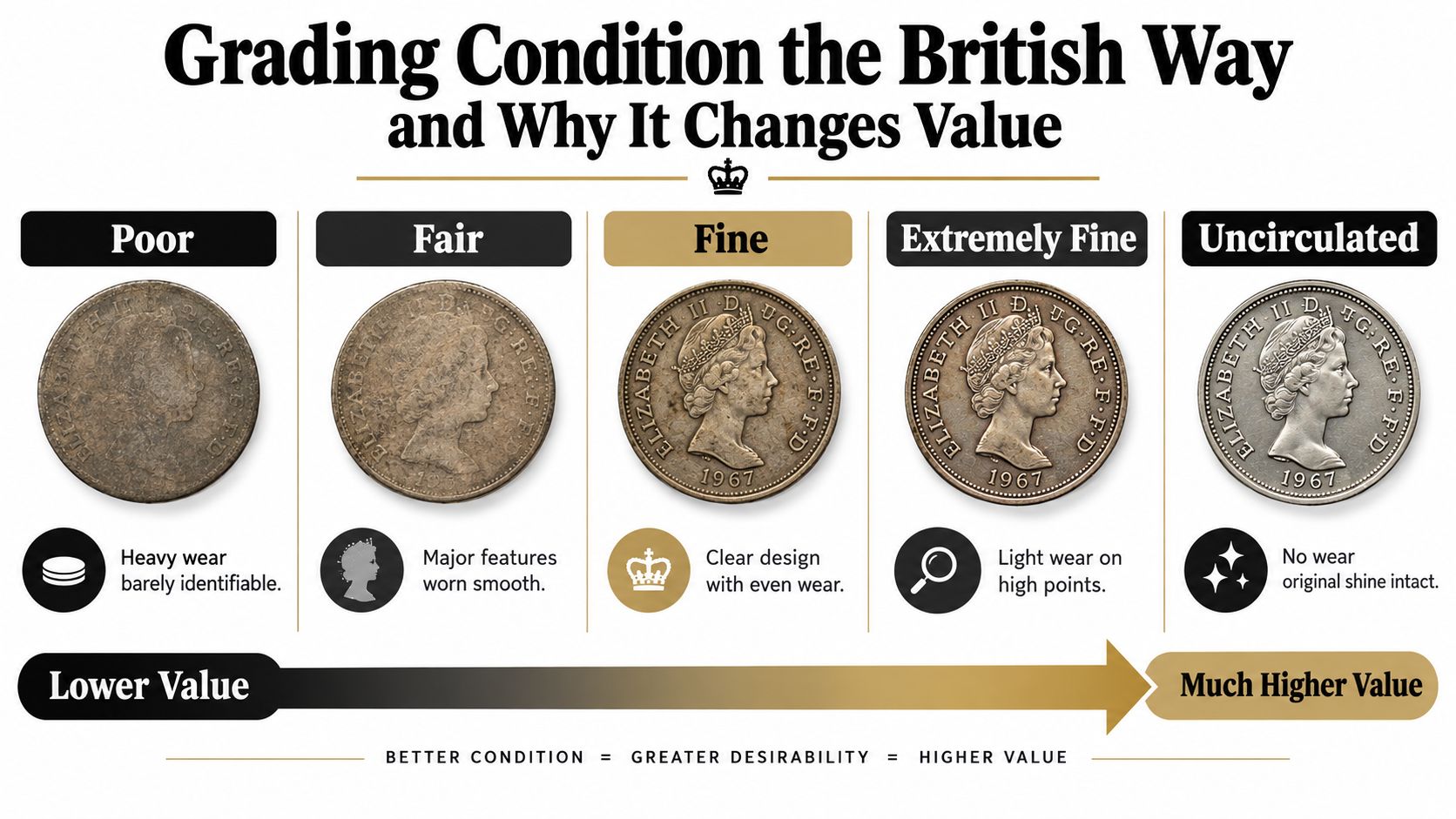
Condition is where many otherwise careful valuations fail. British dealers generally use descriptive terms such as Poor, Fair, Fine, Very Fine, Extremely Fine and Uncirculated. The grade describes the amount of wear and the remaining detail, not whether the coin looks attractive to its owner.
Read wear rather than age
Inspect the highest points of the portrait and reverse design under magnification. Look for flattened hair, missing beads, softened lettering, hairlines, scratches, rim knocks and loss of lustre. A dark tone isn't automatically damage, and bright shine isn't automatically originality. Some coins have been cleaned, dipped or polished, and that surface alteration can reduce collector appeal.
A useful working description might read, “Very Fine, moderate even wear, clear legends, small rim mark at the lower reverse.” That is more valuable than writing “good condition”, because another buyer can understand what you mean.
The British Numismatic Trade Association explains that condition can alter value by multiples. Its guidance indicates that a Fine coin may be worth only one quarter to one half of the price of the same coin in Very Fine, while mint-state examples can exceed Extremely Fine examples substantially in its introduction to collecting. Overgrading therefore creates a distorted price comparison from the start.
The costly error is calling a Fine coin Very Fine. If the benchmark says the difference can be two to four times, an optimistic grade can make the entire valuation misleading.
Decide whether third-party grading makes sense
Third-party grading can help when the coin is valuable, disputed or difficult to grade consistently. The coin is assessed, encapsulated and assigned a grade, often using a Sheldon 1–70 scale alongside a description that collectors can compare internationally.
It isn't automatically worthwhile. UK collector guidance places grading fees around £25–50 per coin and notes that coins with an ungraded value under £200 often don't justify the cost; the same material cites a typical 15–35% uplift in realised price for slabbed coins through the British grading discussion. Compare the possible premium with the fee, postage, insurance and the risk that the professional grade is lower than your estimate.
For a modest coin, clear photographs and a restrained British grade are usually enough for a dealer or auctioneer to form an opinion. For a rare modern error or a high-grade key date, certification may make the coin easier to sell because it gives buyers confidence in authenticity and condition.
Researching Mintage Provenance and Historical Context
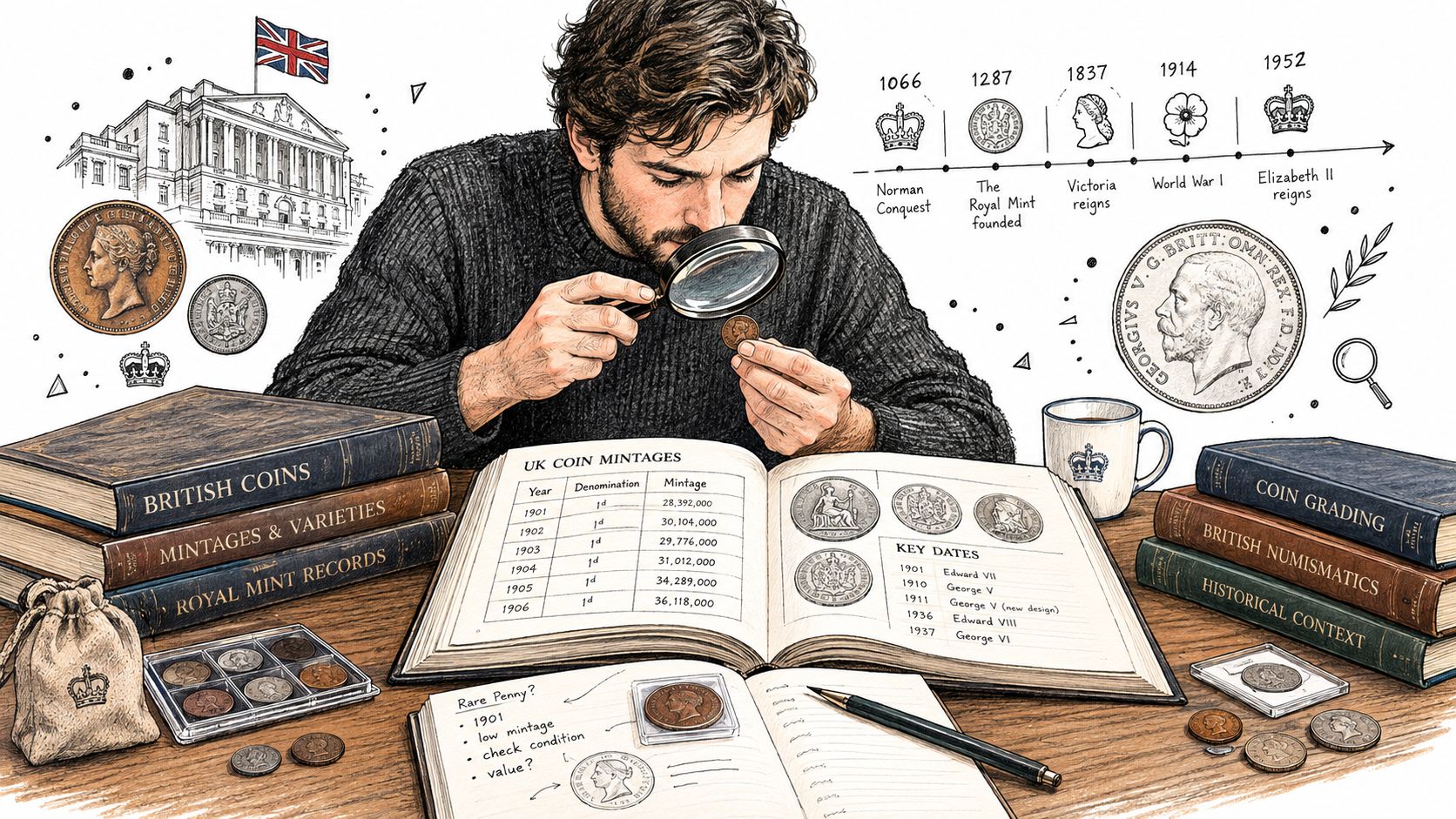
Research should answer a narrower question than “Is this old?” Ask instead, “Why might this exact issue be scarce or desirable?” Start with official mintage information, then investigate varieties, historical use, metal standards and the number of high-grade survivors that collectors can find.
The Royal Mint's UK coin mintage resource places current circulation at around 27 billion coins in its published collector information. That scale explains why broad age-based claims are unreliable. A coin may have been made long ago and still be common in worn condition, while a low-mintage issue can be difficult to locate in attractive grade.
Put the coin in the right monetary period
Pre-decimal coins must be understood in their original system. Britain's monetary history includes substantial changes in denominations and purchasing power. The historic value table for British coins records the penny increasing to 100d, or 41.67p, in 1464, and another coin rising to 15d, or 75p, in 1553 through its historical coin value data.
Decimalisation in 1971 is the key modern dividing line as documented in the same historical reference. Don't translate an obsolete denomination into a modern figure and assume that creates its collector value. The coin's issue, rarity, grade and market demand still do the pricing work.
Separate genuine rarity from an interesting backstory
Historical context helps you form a shortlist, not a final price. Look for:
- Low mintage or limited availability: Use the Royal Mint's figures as a starting point, then check whether examples regularly appear in auctions.
- Obsolete denominations: Half crowns, florins and other pre-decimal pieces can interest collectors because they belong to a retired monetary system.
- Varieties and errors: Compare lettering, portrait details, mint marks and suspected striking faults against a specialist reference.
- Provenance: Old envelopes, collection tickets or documented ownership may support authenticity, but provenance doesn't replace examination.
- Metal and standard: Treat silver or gold content as one factor only. A coin can be worth more, or less, than its metal value depending on collector demand and condition.
Don't confuse catalogue rarity with saleability. A coin may be described as scarce yet attract little competition in a particular grade. That's why the next step must be realised-price research for the exact match.
Checking Realised Prices and Choosing Where to Value and Sell
An asking price is a seller's ambition. A realised price records what a buyer paid. For valuing old coins in the UK, realised auction results are the strongest practical evidence, provided the sold coin matches yours in denomination, date, variety, authenticity and grade.
Start with eBay sold listings rather than live listings, and discard results with vague descriptions or poor photographs. Auction archives and specialist dealers' completed sales can add context. Fixed-price dealer listings help show how professionals position stock, but they're not proof that the price has been achieved.
Match the evidence precisely
Create a small comparison file for each important coin. Record the sale date, venue, hammer or final price where available, buyer's premium if stated, grade, certification, surface notes and photographs. Exclude a brilliant Uncirculated example when your coin is Fine, even if the date and design are identical.
Market evidence also needs judgement. One unusually high result may reflect a bidding contest, an exceptional surface or a variety that wasn't obvious in the title. Several comparable results give you a more defensible range, while a catalogue estimate should be treated as guidance rather than a guaranteed outcome.
| Value Tier | Best Price Evidence | Recommended Venue |
|---|---|---|
| Common or lower-value group | Sold listings for the same type and condition | Bulk dealer sale, local auction or grouped online listing |
| Clearly collectible coin | Multiple realised results for the exact issue and grade | Specialist auction or established coin dealer |
| Rare, certified or high-value piece | Specialist auction records, authenticated comparisons and certified examples | Specialist auction or professional dealer appraisal |
Venue choice changes the net amount you receive. A private sale may offer control and direct contact but requires accurate descriptions and buyer confidence. A weekly auction can expose a coin to collectors, while a dealer offer provides speed and certainty but reflects the dealer's need to cover handling, stock risk and resale costs.
Compare net proceeds, not the headline price. Fees, postage, insurance, photography, returns and time can turn a higher gross result into a weaker outcome.
For practical selling routes, the guide to where to sell old coins sets out alternatives including dealers, auctions and online channels. High-risk or potentially valuable coins should be authenticated before you advertise them. Certification can make the buyer's decision easier, but it only pays when the expected market benefit outweighs the grading and selling costs.
The UK collecting market is still substantial, with an estimated value of USD 480 million in 2025 and a projected 3.0% compound annual growth rate through 2032, according to the cited market guide from MyCoinage. That projection doesn't value an individual coin, but it supports a practical conclusion: buyers increasingly need precise descriptions and credible evidence, not generic claims about old coins being valuable.
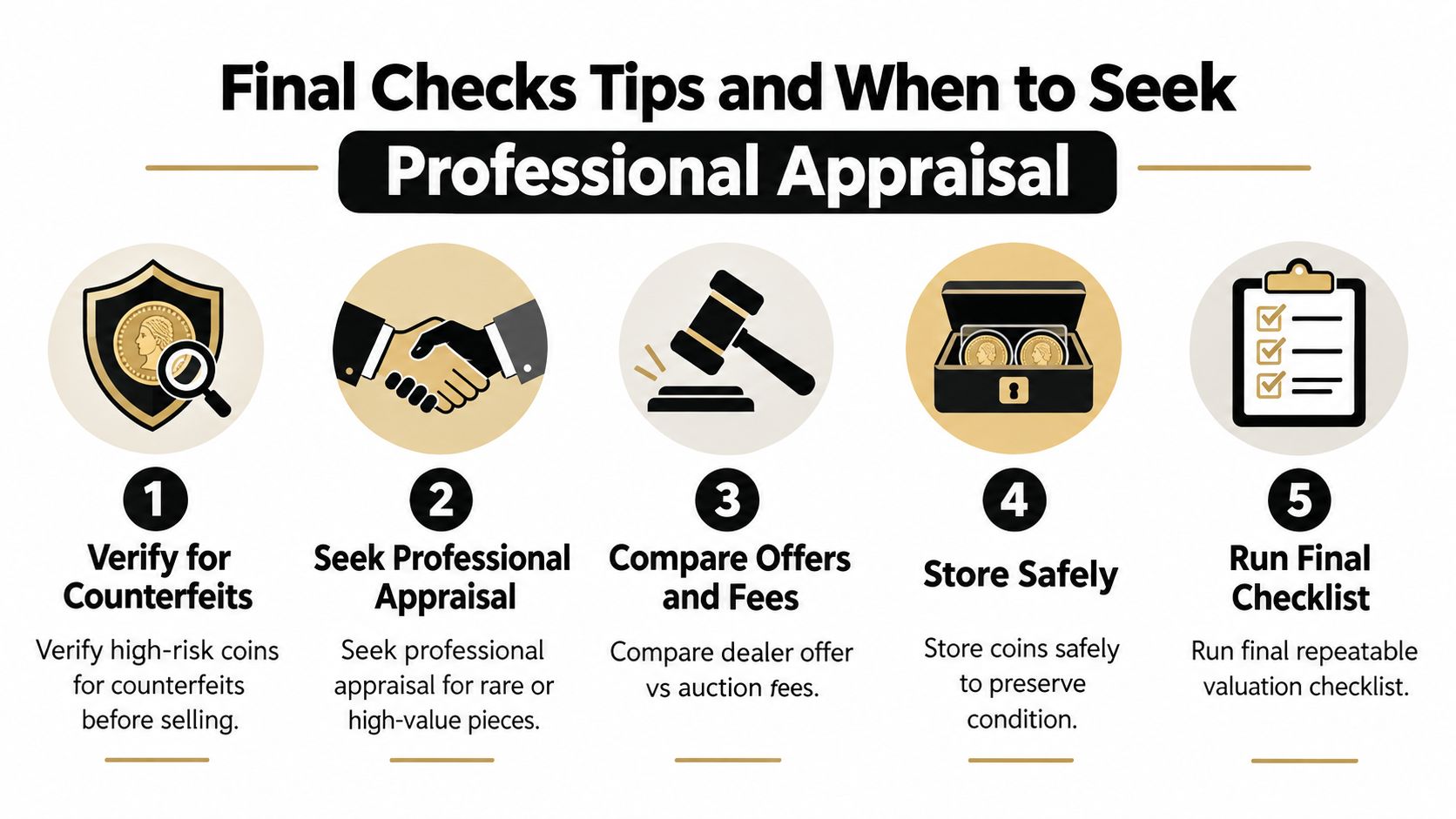
Final Checks Tips and When to Seek Professional Appraisal
Before selling or insuring a collection, run the process again with fresh eyes. Confirm the date, denomination, monarch, variety and pre-decimal status. Check the surface, record an honest grade, compare exact realised results and keep photographs with your notes.
Use a higher standard for valuable pieces
Sovereigns, crowns, proofs, error coins and pieces with precious-metal possibilities deserve authentication before a price is assigned. Check weight, diameter and edge details without altering the coin. The UK-focused authentication guidance says that an item more than 5% away from its published weight may be counterfeit or struck on the wrong planchet in its coin value checker workflow.
Pay for professional appraisal when the coin is rare, the grade is disputed, the collection is large or the consequences of a wrong valuation matter. The Royal Mint lists valuation services from as little as £20 in its collector services information, while third-party grading has separate fees and is more appropriate for pieces whose value can absorb that cost.
Storage is part of valuation. Handle coins by the edge, keep them in suitable holders and avoid abrasive cleaning. A polished coin may look brighter but can lose the original surface collectors want to see.
For a mixed collection or charity donation, a specialist buyer can sort, identify and value groups more efficiently than an owner working through every common coin individually. Cavalier Coins Ltd also handles fixed-price stock, weekly eBay auctions, bulk purchases and donated coin and banknote collections, so the right route depends on whether you prioritise speed, exposure to collectors or administrative simplicity.
Use this final checklist:
- Identity: Denomination, monarch, date, mint mark and variety recorded.
- Authenticity: Weight, diameter, edge and surfaces reviewed.
- Condition: British descriptive grade assigned conservatively.
- Evidence: Exact realised prices collected, not just live asking prices.
- Outcome: Sale, insurance or further appraisal chosen according to the coin's risk and value.
If you've inherited a mixed collection, charity donation or unusual British coin, Cavalier Coins Ltd can help sort, identify and value the material, with options including direct bulk purchases and weekly auctions. Visit the site with your photographs and notes ready, and ask which route best fits the coins you hold.