

A modern UK 2p coin weighs 7.12 grams, with a statutory standard of 7.128 grams, and has a diameter of 25.9 millimetres. That small figure changes dramatically if someone means Britain's pre-decimal 1797 twopence, which weighed roughly 56.7 grams.
The question sounds simple, but “2p” can refer to coins from completely different monetary systems. Often, this means the familiar decimal coin introduced when Britain changed to decimal currency. Collectors may instead be discussing the enormous copper “cartwheel” twopence from the eighteenth century.
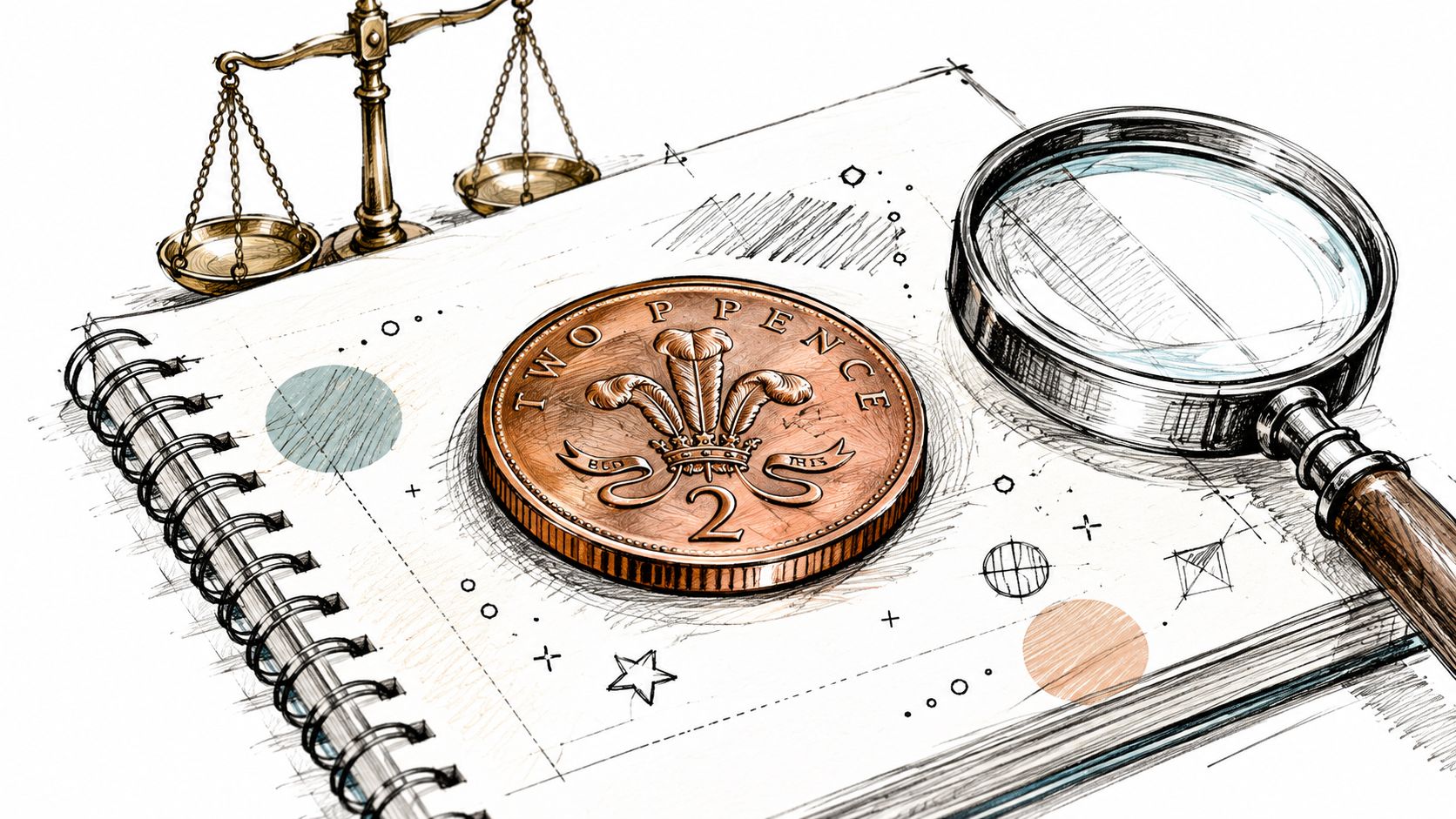
The modern coin's catalogue weight, legal specification, size, metal and condition all help explain what you're holding. A weighing scale can also help identify an unusual piece, but a small difference from the published figure doesn't automatically prove a rare error. Wear, dirt and manufacturing tolerances matter.
The Short Answer for a Modern UK 2p
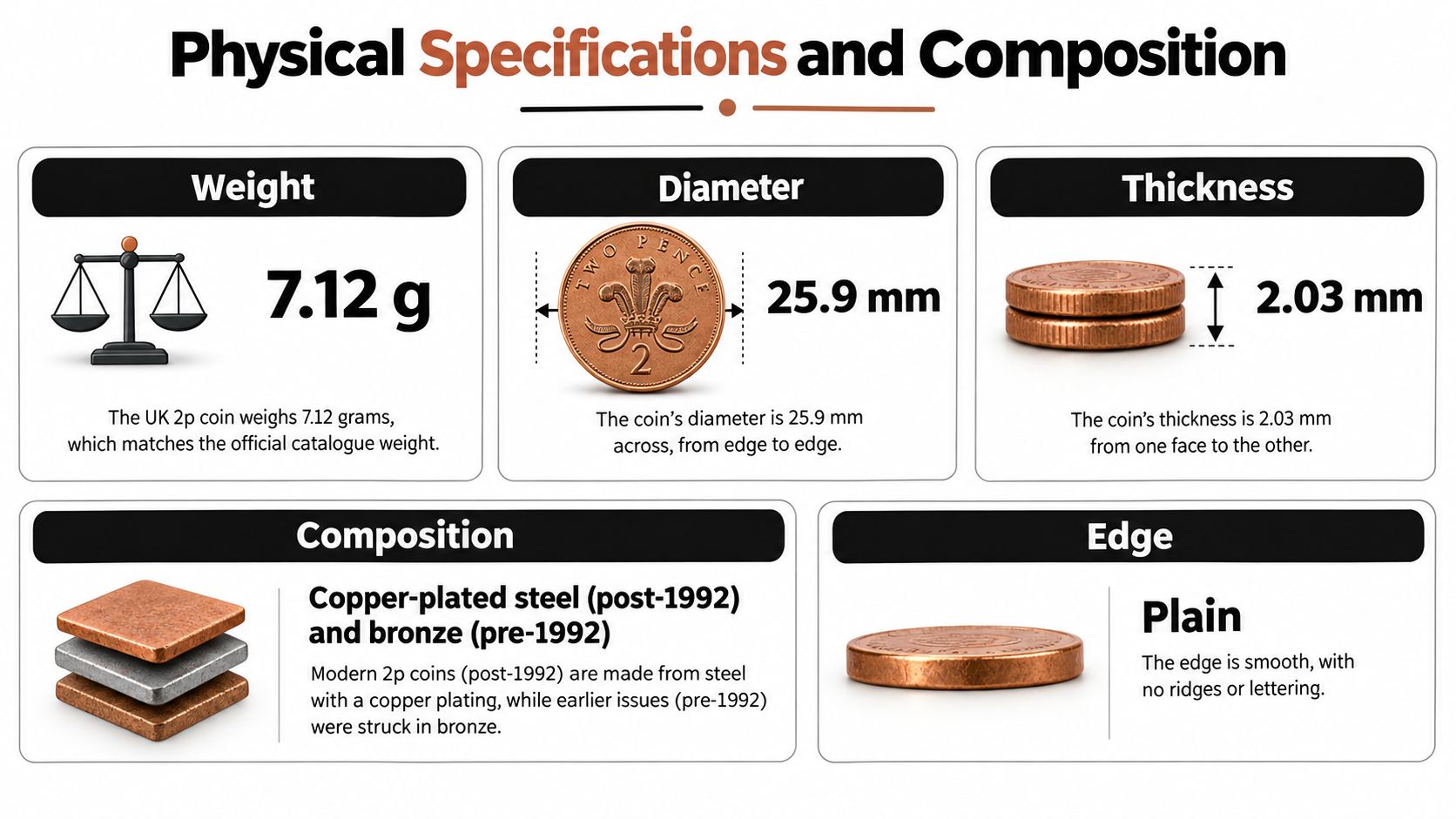
The standard answer is approximately 7.12 grams for a modern UK 2p. The Royal Mint's two pence specifications also give the coin a 25.9 millimetre diameter, measured across its widest point.
The more precise legal figure is 7.128 grams. That value appears in the statutory specification recorded by the Coinage Act 1971, while the Royal Mint commonly rounds the practical catalogue figure to 7.12 grams. Both figures describe the same ordinary decimal 2p, not two different versions.
For a physical comparison, seven grams is a light object, roughly comparable to the weight of two teaspoons of sugar. You won't feel a dramatic difference when you move one coin from your palm to a table, but a group of coins becomes easier to judge on a kitchen or jewellery scale.
Why both weight figures are useful
The rounded 7.12g figure is convenient for quick identification and catalogue searches. The statutory 7.128g standard is more precise, which matters when a collector compares a coin with technical records or investigates a suspected error.
A circulated coin may weigh slightly more or less than the catalogue figure because it has picked up dirt, suffered wear or developed corrosion. A reading that isn't exactly 7.12g therefore needs context rather than instant excitement.
The rest of the identification process involves more than a scale. The coin's diameter, composition and design should agree with its stated type. Its date also tells you whether you're looking at a modern decimal 2p or a much older British twopence.
Practical rule: Treat the published weight as a baseline, not a magic pass-or-fail number.
That distinction protects beginners from two common mistakes. A normal circulated coin isn't automatically rare because it differs slightly from 7.12g, and an unusual weight alone isn't enough to authenticate a valuable error. Examine the whole coin before drawing a conclusion.
Physical Specifications and Composition
A modern UK 2p measures 25.9 millimetres across, giving it a broader appearance than a 1p while remaining small enough for everyday change. The measurement is listed in the Royal Mint's published design specifications. Diameter helps confirm the coin's type, just as weight does.
Modern 2p coins are made from bronze, an alloy based mainly on copper with tin and zinc. That mixture affects the coin's colour, density and feel. Handling, dirt and corrosion can alter the surface, so appearance alone is an unreliable guide.
Comparing the 2p with a 1p
A modern UK 1p weighs 3.56 grams, while a 2p is commonly listed at approximately 7.12 grams. In everyday terms, one 2p should feel about as heavy as two modern 1p coins together. It is a useful mental check, although it cannot replace a scale.
The two published weight figures can also cause confusion. The commonly cited 7.12g rounds the statutory 7.128g standard. A scale showing two decimal places may display a different rounded result from one showing three, and a circulated coin can vary slightly through wear, dirt or corrosion.
For a quick identification, the rounded figure is usually sufficient. A collector examining a possible variety or error should record the precise reading, the scale used and the coin's condition before comparing the result with technical records.
A broader guide to UK coin weights and specifications places the 2p alongside other British denominations. The key principle is to assess several features together: weight, diameter, metal and design. Those details should agree with one another before you identify the coin confidently. A 2p that feels wrong beside two 1p coins deserves closer examination, but one unusual reading does not prove a rare error.
A Different 2p From a Different Era
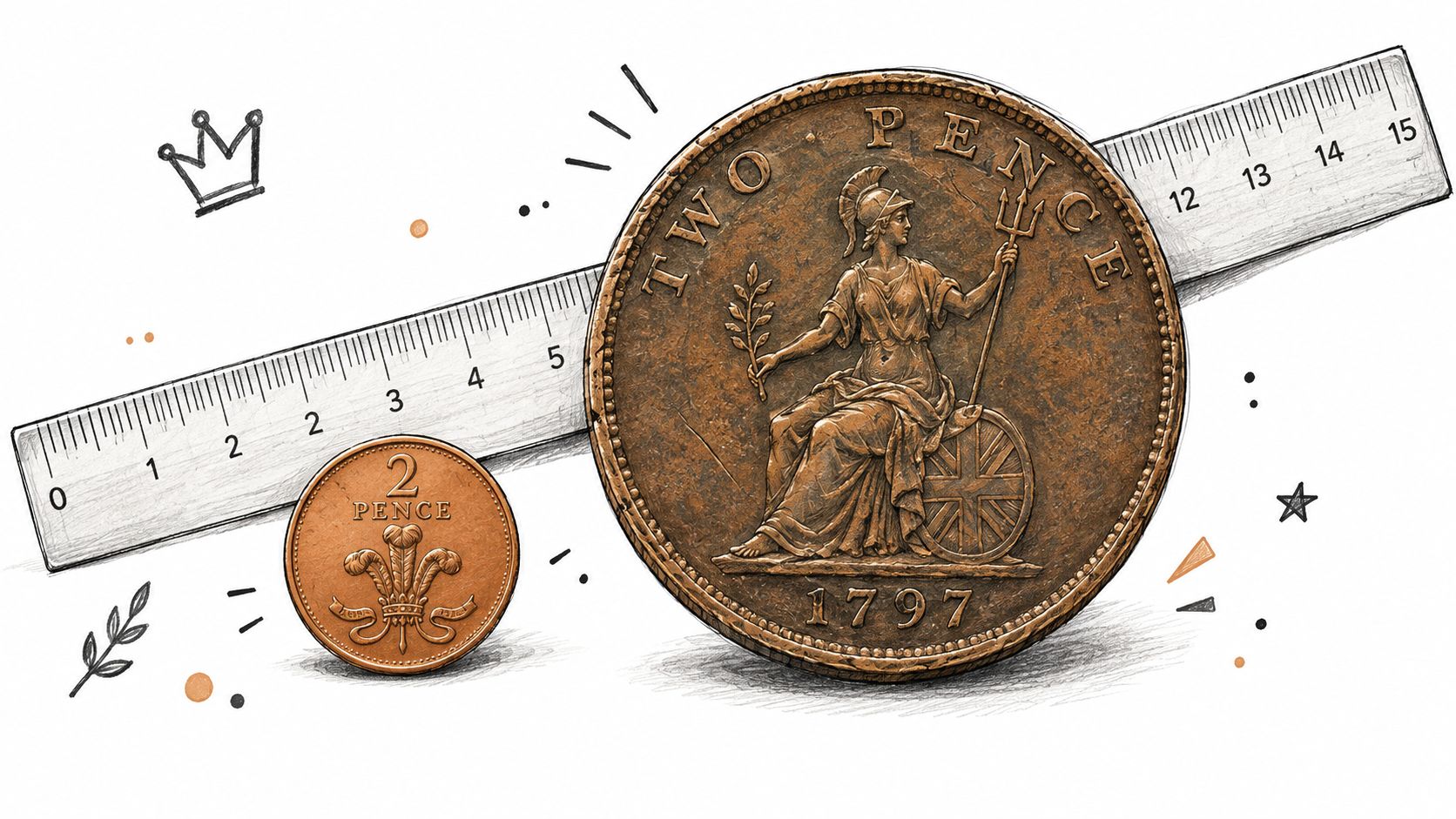
The phrase “2p” becomes misleading when it's applied to Britain's pre-decimal coins. Before decimalisation, Britain issued a 1797 twopence that was vastly larger and heavier than today's pocket change. Collectors often call it the cartwheel twopence because its size and broad design make it resemble a wheel.
The Royal Mint Museum's account of the historic penny records that the 1797 twopence was legally specified at two avoirdupois ounces, or approximately 56.7 grams. It measured about 40.6 millimetres across, compared with the modern decimal 2p's 25.9 millimetres.
Why the cartwheel was so heavy
The weight was deliberate. Authorities intended the value of the copper and the cost of producing the coin to correspond as closely as possible with its face value. The result was a substantial coin that feels more like a small metal object than the light change people associate with “2p”.
Approximately 720,000 of these 1797 twopences were issued, and all carried the date 1797, according to the Royal Mint Museum. They circulated alongside later, lighter copper pennies until 1860, when Britain replaced the large copper pieces with smaller bronze coins.
That history creates an important identification question. If a listing describes an item as a “British 2p”, check the date, diameter and monetary era before comparing its weight with a modern coin. A 1797 piece weighing around 56.7 grams isn't an overweight decimal 2p. It's a different denomination from a different system.
Collectors exploring related historical issues may also encounter specialist references such as this guide to the Bailiwick of Jersey 2p. Regional and historical coinage often uses familiar denomination names while differing in design, period and specifications.
How to Verify a 2p at Home
You don't need a laboratory to perform a useful first check. A digital jewellery scale, a ruler or callipers, a magnet and a good light can reveal whether a coin broadly matches its expected type.
Start by cleaning the measuring area, not the coin. Scrubbing or polishing a collectible can damage its surface and reduce its appeal. Place the coin flat on the scale, record the reading, then inspect its diameter and design without altering the metal.
A simple checking sequence
- Weigh the coin. Use a scale that can display grams and record the result rather than relying on how heavy the coin feels.
- Measure the diameter. Use callipers if available, checking against the expected 25.9 millimetres for a modern 2p.
- Inspect the edge and surface. Look for a clean, consistent rim and details that appear struck rather than soft or poured.
- Check the date and design. Confirm that the portrait, reverse design and date belong together.
- Use a magnet carefully. The result can help distinguish different material types, but it must be interpreted alongside the coin's date and composition.
At-home verification checks
| Test | Tool needed | Expected result | Red flag |
|---|---|---|---|
| Weight | Digital jewellery scale | Close to the published modern 2p specification | A major mismatch that remains after retesting |
| Diameter | Callipers or a precise ruler | 25.9 millimetres for a modern 2p | Clearly incorrect size |
| Surface | Bright lamp and magnifying glass | Sharp, coherent design details | Porous, unusually soft or mould-like surfaces |
| Date and design | Magnifying glass | Details consistent with the coin type | Mismatched or altered-looking features |
| Magnet response | Small magnet | Interpreted with the coin's material and period | A result inconsistent with the expected composition |
A magnet test isn't a complete authenticity test. Bronze and steel behave differently, and British 2p composition has changed across the series, so don't reject a coin solely because it does or doesn't attract a magnet.
For more advanced warning signs, compare your observations with these methods for detecting counterfeit coins. If the weight, dimensions and design all look inconsistent, keep the coin separate and ask a reputable dealer or experienced numismatist for an opinion.
Collector Value, Errors, and Key Dates
A 2p's weight is only one part of its collector appeal. Condition, date, design details, provenance and confirmed minting errors usually need to be considered together. An ordinary, worn coin may be worth little beyond its denomination, while a well-preserved or unusual example can attract greater interest.
Condition runs from heavily circulated pieces through Fine examples to Uncirculated coins. Scratches, rim knocks, colour changes and missing detail all influence an assessment. A scale records mass, but it cannot show whether the portrait remains sharp, the fields are attractive or the coin has been cleaned.
Dates and documented errors
The modern decimal 2p was first issued on 15 February 1971, when Britain introduced decimal currency. That date matters to collectors assembling a complete run, although an early issue does not automatically carry a premium.
Collectors also examine documented design and striking errors. The frequently discussed 1983 “New Pence” 2p is sought after because its reverse legend reads “New Pence” instead of the “Two Pence” wording used from 1982 onwards, as documented in specialist reference. Check the lettering against clear photographs and a recognised reference. Online listings sometimes use “error” as a sales label without showing evidence of a genuine minting mistake.
A weight difference is evidence to investigate, not proof of rarity.
The figures 7.12g and 7.128g describe the same modern standard at different levels of rounding. The shorter figure is a practical catalogue value, while the longer figure expresses the statutory standard. Neither figure, by itself, identifies a variety or error. Wear, residue and small manufacturing tolerances can also affect a reading.
Avoiding overvaluation
Before buying a supposedly rare 2p, request clear photographs of both faces, the edge, and the relevant date or lettering. Compare the claimed feature with a recognised reference, especially when the listing relies on a dramatic description rather than close-up evidence.
A sound attribution should state what differs, where it appears, and why damage, cleaning or wear do not explain it. For a coin with meaningful potential value, an experienced specialist's opinion provides stronger support than a kitchen-scale result alone.
Practical Tips for Buyers and Sellers
The useful weighing method depends on the task. A charity sorting donated change may need only a packing estimate. A collector should examine each coin, while a reseller must separate ordinary stock from pieces with a documented point of interest.
For bulk handling, start with the per-coin figure. One hundred ordinary modern 2p coins have a nominal combined weight of about 712 grams, or 0.712 kilograms, calculated from the 7.12 g figure, before allowing for dirt, wear, corrosion and manufacturing differences. This works as a rough packing guide, but a parcel scale cannot replace counting the coins.
Match the method to the task
- Charities: Set visibly unusual pieces aside before sending ordinary change for counting or sale. Use the bulk estimate for planning, not as the guaranteed final weight.
- Collectors: Photograph the date, reverse, edge and condition before buying. Ask whether the seller accepts returns if the description proves inaccurate.
- Resellers: Sort by date, condition and verified varieties. An old-looking coin does not automatically belong in a premium category.
- Bulk buyers: Request a clear description of the lot, including circulated coins, damaged pieces and items separated for possible errors.
A specialist retailer or established auction channel usually gives a buyer clearer recourse than an anonymous listing. Cavalier Coins Ltd sells coins and banknotes, runs weekly eBay auctions, buys bulk collections from charities and discusses direct pricing for larger orders. These services suit different purchasing needs, but inspect the individual listing and read its return terms before committing.
Selling with useful evidence
A seller builds confidence by recording the coin's date, visible condition and measured specifications accurately. If its weight differs from the normal figure, include the scale reading and describe the equipment used. Present the difference as a reason for further examination, not as proof of an error.
A useful listing explains what the buyer can see and what remains uncertain. Clear photographs of both faces, the edge and any unusual lettering let buyers compare the coin with recognised references without relying on a dramatic description.
Do not clean a potentially collectible coin to make it brighter. Cleaning can leave hairlines or an unnatural surface, and buyers generally prefer honest original condition to aggressive polishing. Keep the coin, photographs and measurement notes together so its description remains consistent through a sale.
What to Do With This Information
For the ordinary decimal coin, the answer to what does a 2p weigh is approximately 7.12 grams, with a statutory standard of 7.128 grams. Its 25.9 millimetre diameter and bronze composition give you two further checks when the coin is in your hand.
The historical comparison matters just as much. A 1797 cartwheel twopence weighed roughly 56.7 grams, so the date and monetary era must come before any serious comparison. A modern 2p and an old twopence share a denomination name, but they aren't interchangeable objects.
At home, weigh the coin, measure its diameter, inspect the design and consider the material response. A small difference from the catalogue figure may reflect circulation rather than rarity, while an apparent error deserves clear photographs and specialist review.
If you've found an unusual 2p, record its date and condition before handling it further. Then compare it with current specialist listings or auction results, keeping the distinction between an ordinary circulated coin and a documented variety firmly in mind.
Cavalier Coins Ltd offers world coins and banknotes, fixed-price listings, weekly eBay auctions and options for bulk purchases or collection sales. Visit Cavalier Coins Ltd to browse current pieces or submit a coin collection for consideration.