
A commemorative coin is a specially issued piece of currency designed to honour a specific event, person or anniversary, rather than support ordinary daily spending. In the UK, the modern tradition is generally traced to 1935, while the 50p has featured over 100 designs since its introduction in 1969.
You may have found an unusual 50p in your change, noticed a different design on a £2 coin, or inherited a larger £5 piece in a presentation case. The natural question follows: is it merely money with an attractive design, or is it a collectible with a value of its own?
The answer depends on more than the subject shown on the coin. A commemorative issue can be common or scarce, intended for circulation or made primarily for a display case, worth little more than face value or sought after by collectors. Understanding those distinctions will help you buy carefully, store properly and avoid treating every unusual coin as a hidden fortune.
Defining the Commemorative Coin
A commemorative coin is made to mark something specific. That might be a royal anniversary, a national event, a historical figure, a sporting occasion or a cultural milestone. The design gives the coin a message beyond its monetary denomination, turning an object used in commerce into a small record of public memory.
Standard circulating coinage has a different primary job. The Royal Mint produces ordinary denominations so people can use them in routine transactions, while a commemorative issue gives the design itself a reason to exist. Some commemoratives enter general circulation and can appear in your pocket. Others are struck in special finishes, placed in presentation packaging and sold directly to collectors.
The purpose behind the design
Finding a special 50p in your change doesn't automatically mean you've found a rare coin. It first tells you that the denomination has been used to carry a commemorative design. The next questions are more important:
- What does the design mark? Identify the event, person or anniversary shown.
- Was the coin made for circulation? A 50p or £2 may have been distributed through ordinary transactions, while a larger crown may have been intended mainly as a souvenir.
- Which version do you have? The same theme can appear as a circulating strike, a Brilliant Uncirculated piece, a proof coin or a precious-metal edition.
- How much demand exists? Collectors often care more about scarcity, condition and completeness than the emotional appeal of the subject.
This is why the phrase “commemorative coin” describes a purpose, not a guaranteed level of rarity. A coin can commemorate an important event and still be readily available. Equally, a modest-looking design can become desirable if relatively few examples were made or if collectors compete for it.
Practical rule: Treat the commemorative theme as the starting point of your research, not the conclusion about value.
The best way to understand a new acquisition is to separate its story, official status and market position. The story explains why the coin was issued. Its status tells you whether it belongs to circulating or non-circulating coinage. Its market position depends on the details collectors evaluate, including issue type, condition, availability and buyer demand.
That distinction protects beginners from two opposite mistakes. You shouldn't dismiss a coin because it looks modern and familiar, and you shouldn't assume that an attractive portrait or anniversary automatically creates rarity.
The Evolution of British Commemorative Coinage
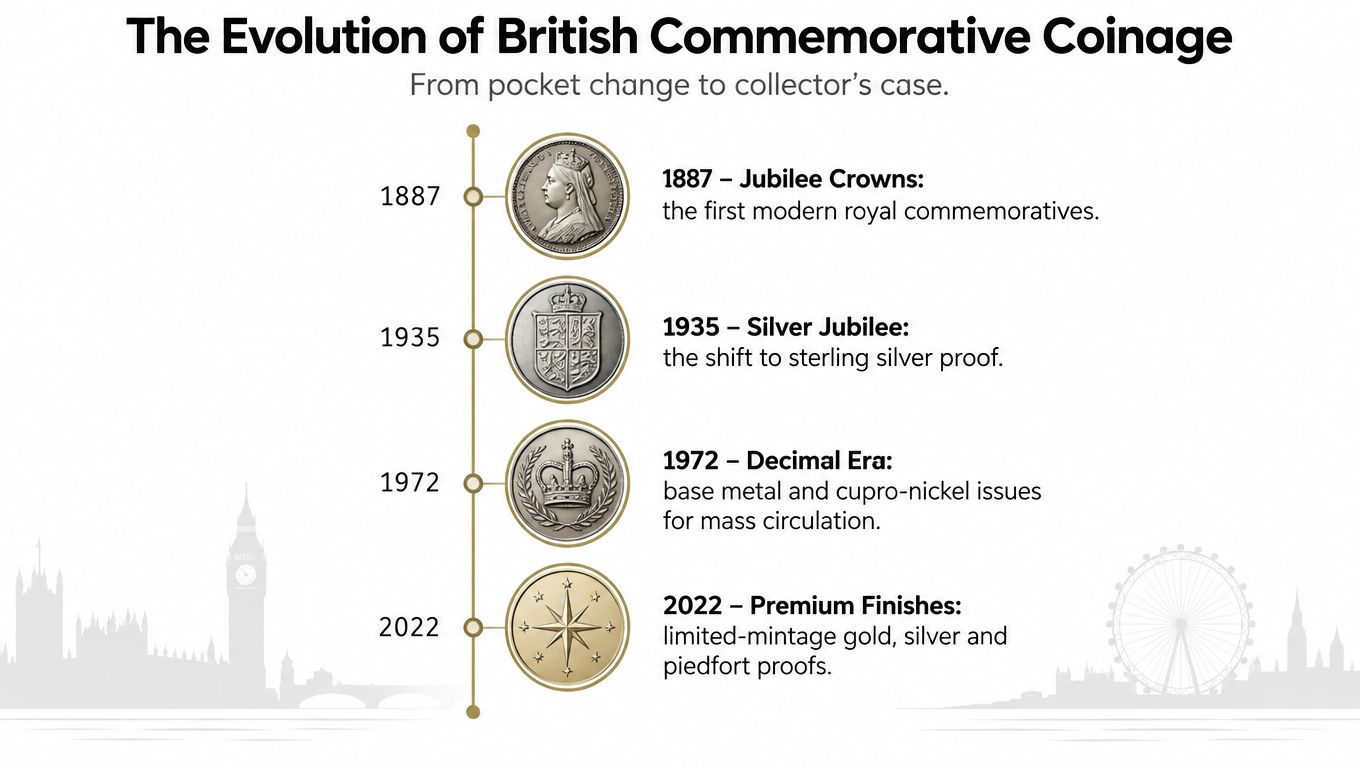
British commemorative coinage grew from occasional royal and national issues into a broad collecting field, including pieces that can appear in ordinary change. The modern tradition is generally traced to 1935, when the Royal Mint issued a crown for the Silver Jubilee of George V. Earlier special coins existed, but this issue established a lasting model: strike a coin specifically to mark an event, rather than produce it only for everyday circulation. The Royal Mint presents that Silver Jubilee crown as a template for later British commemoratives in its overview of British coins and collecting.
The change was more than a new design choice. It altered the relationship between a coin and the occasion it represented. A circulating coin normally passes from hand to hand as a payment tool. A commemorative crown could also become a souvenir, a keepsake and a physical reminder of a public event. The coin carried two kinds of meaning, much like a museum ticket that can also become a memento. For collectors, its date and design therefore matter before questions of price arise.
British commemoratives have developed as both historical souvenirs and accessible circulating objects, as explained in this brief history of British coins.
From royal occasions to national subjects
The next important step came with the first commemorative UK £2 coin, struck for the Commonwealth Games in Edinburgh. It was the first UK coin to commemorate a sporting event, broadening the subject matter beyond royal milestones and constitutional occasions. Sports, anniversaries and national achievements could now enter the visual language of British money. That expansion also gave collectors more ways to organise a collection, whether by event, denomination or design theme.
The denomination later became even more accessible. In 1997, the first bi-colour £2 coin was released, creating a recognisable format for modern commemorative designs. The Royal Mint records that more than 400 million £2 coins have entered circulation since that release, carrying 39 commemorative designs, as described in this history of the UK £2 coin. These figures help explain why commemorative coinage is not confined to specialist cabinets. It has become part of the country's circulating design history, although legal-tender status and practical acceptance are separate questions.
The 50p followed its own path. Introduced in 1969, it has featured many designs and is described by the Royal Mint as the UK's most collected coin. Its size, distinctive shape and frequent appearance in change made it an approachable entry point for new collectors. A child can begin by setting aside an unusual 50p, while an experienced numismatist may examine varieties, finishes, provenance and market availability. The same denomination can therefore serve as both a first discovery and a detailed study.
A market with different scales
Modern production spans a wide range. Some issues are made for broad public distribution, while others are sold as limited collector products in carefully presented formats. Even coins sharing one commemorative subject may differ by finish, packaging and distribution. The product name alone is not enough. A collector must identify the precise issue before judging its availability or likely demand.
For a first major acquisition, this history offers useful perspective. Age alone does not make a coin important, and a modern issue does not lose all interest because it reached a mass audience. The commemorative theme explains the story, while collectability depends on how that particular coin was produced, finished and distributed. Market value works like a scale with several weights, including condition, availability, completeness and buyer interest. A memorable event may attract attention, but those practical details determine whether attention becomes sustained demand.
Legal Tender Status and Everyday Spendability
“Legal tender” sounds like a guarantee that a shop must accept a coin. In practice, that assumption causes repeated confusion. A commemorative coin can have official legal status without functioning like the change you use for a routine purchase.
Modern commemorative crowns are authorised by Royal Proclamation under the Coinage Act 1971 and are legal tender, according to the Royal Mint's guidance on commemorative coins in circulation. That legal status recognises the coin as official money. It doesn't mean every retailer, bank or building society must accept a non-circulating commemorative issue across the counter.
Two categories that look similar
The practical distinction is between circulating commemoratives and non-circulating collector issues.
A special 50p or £2 may be released into the normal cash system. You can receive one in change, and a retailer may accept it in the same way as other coins of that denomination. Its design is commemorative, but its distribution gives it a genuine role in everyday transactions.
A £5 crown, £20 silver coin, £50 issue or £100 collector piece belongs to a different practical category when the mint produces it primarily as a souvenir or collector product. It may be legal tender, but it isn't intended for routine spending. Banks, building societies and shops aren't obliged to accept those non-circulating pieces, so a refusal at the till doesn't mean the coin is counterfeit or unofficial.
This is also why the phrase “face value” can mislead. The denomination tells you the coin's official monetary value, but a collector may buy it for its design, metal, finish, packaging or scarcity. Conversely, a non-circulating coin may have a denomination that doesn't reflect what a specialist buyer would pay for it.
A legal-tender label answers a legal question. It doesn't answer a retailer's acceptance policy or a collector's valuation question.
Before attempting to spend an unfamiliar coin, inspect its denomination and format. A small circulating piece found in change is very different from a heavy coin sealed in a presentation case. If you're uncertain, keep the item safe and identify it through the mint's specifications or a reputable dealer rather than testing it at several tills.
You can also read a specialist explanation of whether commemorative coins are legal tender for a practical discussion of the difference between official status and everyday acceptance. The key lesson is simple: legal tender doesn't equal guaranteed spendability.
Physical Specifications and Collector Finishes
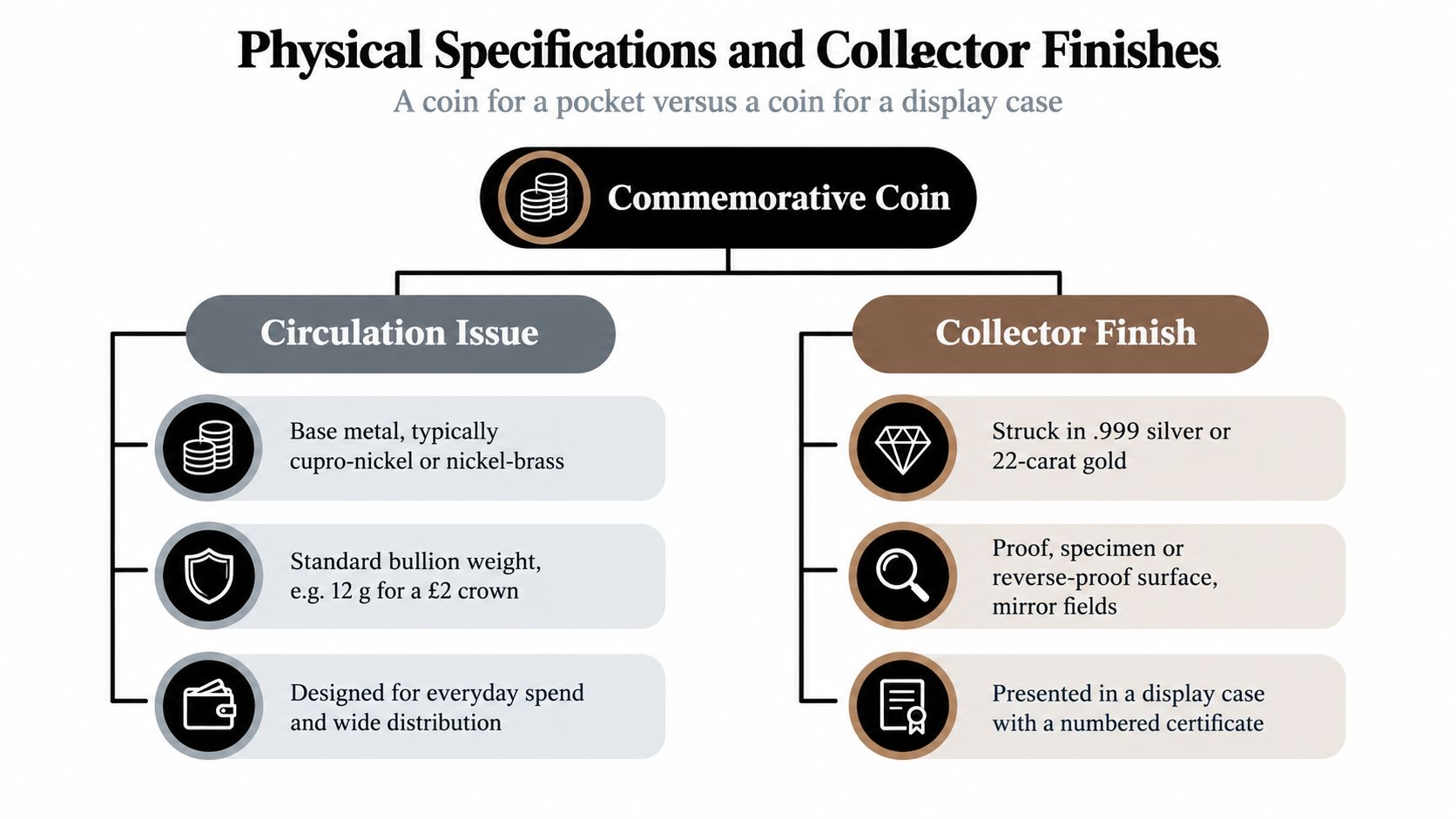
A commemorative coin's physical form often reveals how the mint expected people to use it. A piece designed to pass through pockets and tills needs durability and practical distribution. A collector issue can prioritise surface quality, presentation and visual detail instead.
The standard UK £5 crown format provides a useful reference point. The Royal Mint lists it at 38.61 mm in diameter, 28.28 g in weight and 2.89 mm in thickness, with a typical cupro-nickel composition of 75% copper and 25% nickel, as shown in its £5 coin designs and specifications. Those measurements help you identify the format, compare an item with its official description and notice when a supposed match deserves closer inspection.
Reading the finish
The metal alone doesn't tell the whole story. Mints can produce the same commemorative subject in several finishes, and those finishes affect both appearance and handling.
- Circulation strike: Made for distribution through the normal coin system, with a surface suited to practical use. Marks from handling are part of the risk attached to this format.
- Brilliant Uncirculated: Produced and handled to a higher standard than an ordinary circulation piece. Collectors look for clean fields, strong detail and careful presentation.
- Proof: Struck using a specially prepared process that creates sharper detail and contrasting surfaces, often including mirror-like fields. Proofs require careful handling because hairlines, fingerprints and edge knocks can affect their appearance.
- Precious-metal edition: A commemorative design may also be produced in a precious metal and sold as a premium collector product. Its desirability can involve the metal, finish, packaging and scarcity, not just the denomination.
A display coin isn't automatically valuable, and a circulating coin isn't automatically ordinary. The finish is one part of the identification process. You should record the denomination, date, design, metal, finish and packaging before comparing prices.
Why handling changes the result
A collector who grips a proof coin by its faces can leave marks that alter its visual quality. Use the edge where appropriate, keep the coin over a clean surface and return it to a capsule or presentation holder after inspection. Don't polish a coin to make it shine. Cleaning can remove the original surface and make the piece less attractive to experienced buyers.
For readers learning the terminology, this guide to UK proof coins and collector finishes offers useful context. The important habit is to classify first and handle second. Once you know whether you're looking at a circulation issue, BU piece or proof, you can research comparable examples without confusing different products.
Evaluating Rarity and True Market Value
The most common beginner's error is to treat commemorative as a synonym for valuable. It isn't. A commemorative theme explains why the coin exists, but the market usually responds more strongly to how many examples are available, what condition they are in and how actively collectors want them.
The Kew Gardens 50p demonstrates the difference. Its mintage was 210,000, and it can sell for over £100, while many other commemorative 50ps sell for only slightly above face value, according to Which?'s guide to rare 50p values. The contrast doesn't mean every low-mintage coin will command the same price. It shows that scarcity can matter more than the fame of the event shown on the reverse.
Compare the coin, not just the story
Use this table as a first sorting tool. It doesn't replace identification, but it helps you ask the right questions before you attach a price to an unusual piece.
| Feature | Circulating Commemoratives | Non-Circulating Collector Issues |
|---|---|---|
| Where you may find them | In change, cash drawers or ordinary collections | Mint packaging, dealer stock or a collector's cabinet |
| Primary purpose | Carry a commemorative design while serving as usable coinage | Mark an occasion as a souvenir or presentation object |
| Typical research focus | Mintage, distribution, condition and design varieties | Finish, metal, packaging, certificates, mintage and condition |
| Spending reality | May be accepted in ordinary transactions | Banks and retailers aren't obliged to accept them |
| Value risk | A familiar design may be widely available | A premium issue may still have limited resale demand |
| Best buying question | How scarce is this exact circulating issue? | What comparable examples have collectors actually sought? |
A dramatic subject can be common. A quiet design can be scarce. Even a low-mintage issue may disappoint if it has damaged surfaces, missing packaging or weak buyer interest. For that reason, don't use an asking price as proof of value. Sellers can list coins at any figure, but a realistic assessment needs comparable examples and a clear description of the exact format.
A disciplined valuation check
Start with the coin's identity. Confirm the denomination, date, design, edge, metal and finish. Then check whether the item is loose, encapsulated, boxed or accompanied by its original documentation. These details can separate apparently similar listings.
Next, inspect condition under good light. Look for hairlines, scratches, spots, fingerprints, rim knocks and signs of cleaning. On a circulating coin, ordinary wear may be expected. On a proof or carefully presented issue, the same flaw can affect buyer interest more sharply.
Finally, ask whether you're buying history or speculation. If you love the event, portrait or design, the coin can be a worthwhile collecting purchase even when resale prospects are modest. If you're buying only because a listing promises an investment, slow down and verify scarcity, condition and genuine demand first.
The right price begins with the exact coin in front of you, not with the most exciting story attached to it.
Best Practices for Handling and Growing Your Collection
A collection preserves its value through consistent habits, not occasional carefulness. The moment you acquire a commemorative coin, record what it is and protect its surfaces. That matters whether you're keeping a single 50p from your change or building a specialised set of presentation issues.
Establish a handling routine
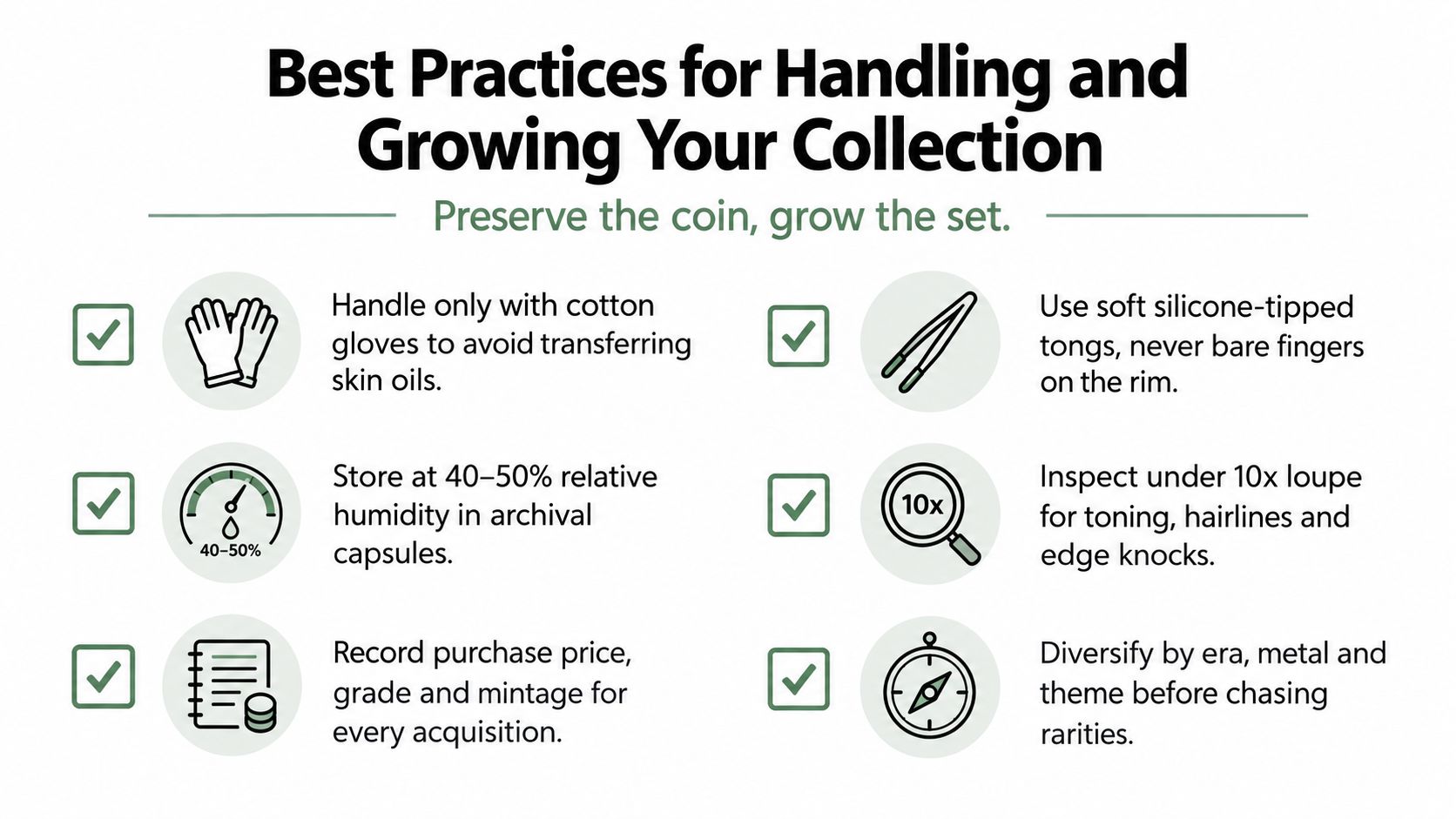
Hold a coin by its edge and avoid touching the main surfaces. If you use gloves, choose a clean pair that won't catch on the edge or transfer loose fibres. Soft silicone-tipped tongs can help with delicate pieces, but don't clamp hard or drag the tool across the finish.
Never clean a coin with household products, metal polish or an abrasive cloth. The original surface is part of the object collectors evaluate, and an artificial shine can make the coin less desirable than gentle, untouched toning or ordinary signs of age.
Store each issue for its condition
Use a suitable capsule, tray or archival album that keeps the coin stable without pressing against its surfaces. Keep original boxes, certificates and mint inserts together with the coin, and label loose pieces immediately so designs don't become mixed.
A simple collection record should include:
- Identification: Denomination, date, design and issuing authority.
- Format: Circulation, BU, proof or precious-metal edition.
- Condition: A plain description of marks, wear and packaging.
- Purchase record: Seller, date and price paid.
- Research notes: Relevant mintage information and comparable listings.
That record gives you a reliable history when you add more pieces or decide to sell. It also discourages impulse buying because every acquisition has to earn a clear place in the collection.
Buy with a collector's judgement
Choose dealers who describe the exact coin rather than relying on promotional language. Ask whether the image shows the actual item, whether the packaging is included and whether the description identifies the finish. For higher-value purchases, compare more than one source and check whether the price reflects a completed sale or merely an optimistic listing.
Auction buying can reveal active demand, but it also requires attention to fees, postage, condition descriptions and competition. Fixed-price listings make comparison easier, although a high asking price still isn't evidence that buyers agree with it. A specialist retailer such as Cavalier Coins Ltd offers commemorative coins alongside rare and unusual coins, themed sets and auction listings, giving collectors another place to compare formats and availability.
Start your collection with a theme you can sustain, such as British circulating commemoratives, royal crowns, sporting issues or international silver pieces. A clear focus will help you learn the details that influence value while leaving room to broaden into new eras, metals and subjects.
If you're ready to examine commemorative coins beyond the headline design, browse Cavalier Coins Ltd for individual issues, themed sets and auction opportunities. Use the identification and condition checks in this guide before choosing a piece, and contact the team about bulk purchases or collections that need a careful new home.