
Deciding on the best place to sell your rare coins really comes down to what you're trying to achieve. Are you after a quick, guaranteed sale? Or is squeezing every last drop of value from a high-demand piece your main goal?
For a swift and certain transaction, a specialist coin dealer is usually your best bet. On the other hand, a prestigious auction house can often bring in the highest price for exceptionally rare items. Then you have online marketplaces like eBay, which give you a huge audience but demand a lot more of your own time and come with a few more risks.
Choosing Your Best Coin Selling Option
Before you make a final decision, it's worth getting to grips with the different avenues available. Each one is tailored to different sellers, different coins, and different outcomes. The choice you make will influence everything from the final price in your pocket to how long you’ll be waiting for the money.
Someone selling a single, certified gold Sovereign has a very different set of priorities from a person who's inherited a large collection of mixed-quality silver coins.
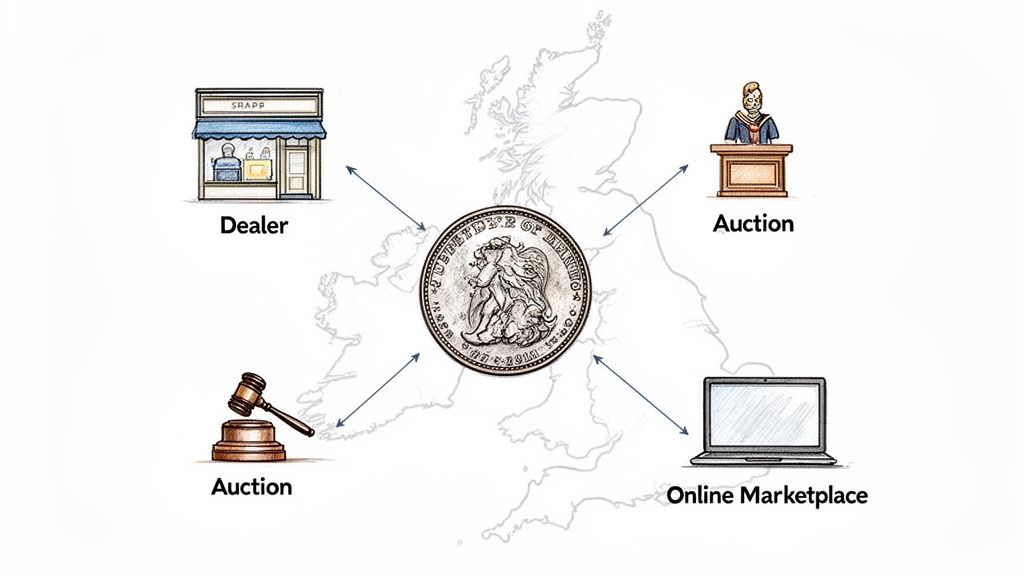
Understanding the trade-offs is the first and most important step. You need to think carefully about:
- Speed of Sale: How quickly do you need the cash? A dealer can pay you on the spot, whereas an auction can take months from consignment to payout.
- Value Potential: Are you determined to achieve the highest possible market price, or would a fair, immediate offer be more attractive?
- Convenience and Effort: Just how much work are you prepared to put in? Cataloguing, photographing, and listing coins yourself takes considerable effort.
- Fees and Commissions: Selling costs can take a big bite out of your final profit. These range from nothing at all with some dealers to over 20% at major auction houses.
To help you weigh up these choices, we've put together a direct comparison of the most common selling venues here in the UK.
At-a-Glance Comparison of Coin Selling Options
To make things a bit clearer, this table breaks down the key differences between the most popular selling options. Think of it as a quick reference guide to help you match your situation to the right venue.
| Selling Venue | Ideal For | Typical Payout Speed | Associated Fees | Value Potential |
|---|---|---|---|---|
| Specialist Dealer | Quick, guaranteed sales; large collections | Immediate to 24 hours | Often None | Good to Very Good |
| Auction House | Certified, high-value, rare coins | 30-90 days post-auction | 15%-25% commission | Potentially Highest |
| Online Marketplace | Common to mid-value coins; DIY sellers | 7-14 days post-sale | 10%-15% platform fees | Variable |
| Pawn Shop | Urgent cash needs for bullion coins | Immediate | N/A (lower offer price) | Low |
As you can see, there’s no single "best" place—it all depends on your specific coins and your personal priorities as a seller.
How to Prepare Your Coins for a Successful Sale
Before you even start thinking about where to sell your rare coins, a bit of prep work is essential. Getting this right can dramatically increase the final sale price, while one simple misstep could slash its value in an instant. The groundwork for a great sale is laid long before any buyer sees your collection.
The first and most important rule is surprisingly simple: do not clean your coins. It feels counterintuitive, I know. But trying to polish a rare coin, even with the softest cloth, can create microscopic scratches known as "hairlines". These tiny marks can knock a coin's grade down and wipe hundreds, sometimes even thousands, of pounds off its value.
Seasoned collectors and dealers prize a coin's original surface and the natural toning, or patina, that develops over many decades. This is seen as part of its story and authenticity. Wiping that away is like stripping the original finish from a piece of antique furniture—it's a mistake you can't undo.

Organise and Document Your Collection
A neatly organised collection makes life much easier for a potential buyer to give you a fair assessment. Start by putting together a simple inventory. You don’t need anything fancy; a basic spreadsheet is perfect for the job.
For each coin, try to log the following details:
- Country of Origin: Where the coin was struck.
- Denomination: The face value (e.g., Penny, Shilling, Sovereign).
- Year of Minting: The date on the coin.
- Mint Mark: A small letter or symbol showing which specific mint produced it.
- Observed Condition: A quick note from you (e.g., "sharp details," "some wear on high points").
- Provenance: Any history you know, like who owned it before or where it was bought.
This inventory doesn't just help you get your head around what you own; it also shows you’re a serious and organised seller. Make sure to keep any certificates of authenticity, original packaging, or old receipts with their matching coins. This kind of paperwork can add real value.
Should You Get Your Coins Professionally Graded?
For any coins you suspect might be particularly valuable, professional grading is a step worth serious consideration. Grading services like the Numismatic Guaranty Company (NGC) or Professional Coin Grading Service (PCGS) offer an impartial, expert opinion on a coin's condition, scoring it on a scale from 1 to 70.
A professionally graded coin takes all the guesswork out of the equation and gives buyers total confidence. A coin graded MS-65 (Mint State 65) can fetch many times more than an ungraded version simply because its quality is certified and guaranteed.
This certification process, often called "slabbing," seals the coin in a protective, tamper-proof holder. The slab includes a label detailing its grade and confirming its authenticity. While it does cost money, the boost in market value for a high-grade rare coin nearly always justifies the initial expense. You can learn more in our detailed guide on how to get coins graded to see if it’s the right move for you.
And if you're planning to sell online, high-quality photos are non-negotiable. Use a plain, neutral background, find some good lighting (natural daylight is always best), and use a camera that can capture fine details. You'll need clear shots of the obverse (front), reverse (back), and the edge. Good pictures allow buyers to assess the coin properly, which leads to more interest and better offers.
Selling Through The UK's Premier Auction Houses
When you're holding a truly exceptional coin—something with real historical weight, undeniable rarity, or simply in pristine condition—the world of premier auction houses beckons. This is where the most serious collectors and investors gather, and it's often the best path when wringing every last drop of value out of a coin is the only thing that matters.
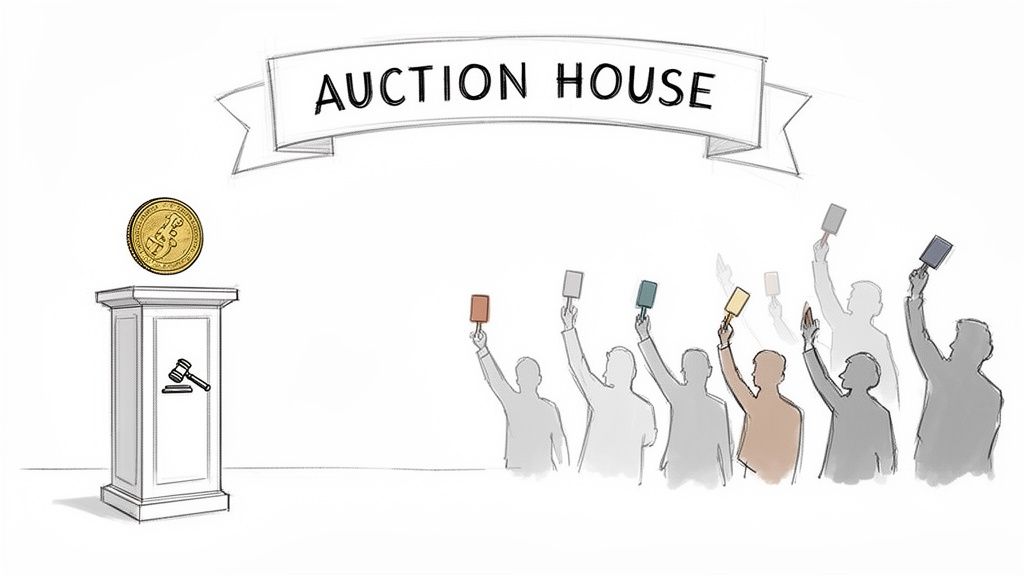
This route isn't for your average coin, though. Auction houses like Spink or Baldwin's are incredibly selective, carefully curating their catalogues with pieces that are guaranteed to stir up excitement. If you have a certified, high-grade coin or a collection with solid provenance, an auction provides a transparent, competitive stage designed to hit the highest possible market price. The buzz of the sale itself can often drive bids far beyond initial estimates.
But this potential for a massive payday comes with a catch. The entire auction process is a marathon, not a sprint. It can easily take several months from the day you hand over your coin to the moment the money lands in your account. That timeline makes it a non-starter for anyone needing a quick sale.
Understanding The Auction Process And Costs
Choosing an auction house means committing to a very structured process. Knowing the stages involved is key to keeping your expectations in check and deciding if it’s truly the right fit for you.
-
Initial Valuation and Consignment: It all starts with an expert appraisal. The auction house will scrutinise your coin's authenticity, condition, and market appeal to give you an estimated sale price. If you’re happy to go ahead, you'll sign a consignment agreement that lays out all the terms.
-
Cataloguing and Marketing: Next, your coin gets the star treatment. It's professionally photographed and described for the auction catalogue. This is a vital step, as the house uses its reputation and global marketing muscle to attract the right kind of bidders.
-
The Auction Event: This is the main event where your coin goes under the hammer, either live or online. The final bid is known as the 'hammer price'.
-
Settlement: Once the buyer has paid up, the auction house takes its cut and sends you the rest. This settlement period usually takes 30 to 45 days after the auction.
The biggest thing you need to wrap your head around is the cost. Auction houses charge a 'seller's commission' on the hammer price, which can run anywhere from 15% to over 25%. That fee, plus other potential costs for insurance and photography, needs to be factored into what you'll actually walk away with.
When Is An Auction The Right Choice?
For certain types of coins and sellers, an auction house is the undisputed champion. Their ability to achieve mind-boggling results in the UK coin market is well-known. A flawless 1955 sixpence, for instance, recently sold for an astonishing £2.53 million at a private auction, completely shattering expectations and showing just what's possible.
This method really shines in a few key scenarios:
- Certified High-Grade Coins: If you've got a coin graded MS-65 or higher by NGC or PCGS, an auction puts it in front of buyers who actively hunt for—and pay a premium for—certified quality.
- Coins with Historical Provenance: An item that was once part of a famous collection or has a direct link to a major historical event can see its value skyrocket when bidders start competing.
- Unique or 'Key Date' Coins: For coins that are the finest known example or a crucial piece needed to finish a major set, auctions attract passionate collectors who are prepared to pay top pound.
Yes, the fees are steep. But the expertise and marketing firepower of a top-tier auction house can produce a hammer price that makes the commission feel like a worthwhile investment. For a closer look at your options, you might find our guide on the best coin auction sites for sellers helpful. In the end, it all comes down to whether your coin’s rarity and appeal can justify the significant costs and long wait involved.
Selling Through Online Marketplaces and Specialist Retailers
The internet has completely changed the game for selling rare coins, connecting sellers directly with a global community of collectors. Big online marketplaces, especially eBay, offer a massive stage where your coins can get in front of thousands of potential buyers almost overnight.
This route puts you completely in control. You write the listing, you set the price, and you handle the sale from beginning to end. For common to mid-value coins, it's often a great way to tap into a huge market without needing a go-between.
But going it alone means you've got to put in the work. Creating a compelling listing with top-notch photos, writing a precise description, and fielding questions from buyers all demand time and a bit of know-how.
Going Solo vs Partnering with a Specialist
Deciding whether to list coins yourself or bring in a specialist retailer is a big call. While managing your own listings gives you total control, it also comes with certain risks and requires a genuine feel for the market to get the pricing right.
The alternative is to work with a specialist retailer who handles the online side for you. These experts take care of everything—from professional photography and cataloguing to listing the coin on platforms like eBay. They bring their established reputation and loyal following, which attracts serious bidders who trust their judgement.
This managed approach has some real upsides:
- Expertise: They know exactly how to describe a coin, highlighting the key features that collectors are looking for.
- Trust: Buyers are often willing to bid higher when a coin is listed by a well-known, reputable seller.
- Security: They manage all payments and deal with any disputes, shielding you from potential scams.
- Time-Saving: The entire headache of listing, managing, and shipping is taken off your plate.
Of course, this service isn't free; it usually involves a commission on the final sale price. You have to weigh that fee against the potential for a better price and the sheer convenience of it all.
Getting the Most from Your Online Sale
If you do decide to sell independently, an excellent listing is non-negotiable. Your job is to give potential buyers all the information and confidence they need to make a strong bid. A vague description or blurry photos will almost always result in a disappointing final price.
For instance, simply listing a coin as "Old Silver Shilling" won't cut it. A much stronger listing would be "1887 Victoria Jubilee Head Silver Shilling, EF Condition, Clear Details." This gives a collector the crucial details they need to judge its value and desirability in a heartbeat.
When you're selling online, honesty is your best friend. Always point out any minor flaws or imperfections in your description and back it up with clear, well-lit photos. Buyers respect transparency and are far more likely to trust a seller who gives them the full picture, which usually leads to more confident bidding.
The Power of a Managed Auction
Using a specialist can be particularly smart for modern rarities. Take eBay, for example. It has revolutionised the market for rare UK coins, with specialists like Cavalier Coins Ltd running weekly sales of limited-issue pieces that draw in both numismatists and resellers. The rare 2022 £1 coin, with a mintage of just 7.735 million—the lowest for any in circulation—fetches premium prices as the last to feature Queen Elizabeth II. To get a feel for the market, you can find out which £1 coins are worth collecting in 2025.
A specialist can frame these modern collectibles with the right historical context, catching the eye of seasoned collectors and new enthusiasts alike. Their established platform is a powerful signal of quality and authenticity.
In the end, choosing between selling online yourself or using a specialist comes down to your situation. This table should help you decide.
| Factor | Selling Independently (DIY) | Using a Specialist Retailer |
|---|---|---|
| Effort Required | High (photography, listing, shipping) | Low (specialist handles everything) |
| Reach | Potentially global, but depends on your listing | Global, boosted by the retailer's reputation |
| Fees | Lower (platform fees only, typically 10-15%) | Higher (platform fees plus commission) |
| Security Risk | Higher (risk of fraudulent buyers, disputes) | Low (retailer manages all buyer interactions) |
| Price Potential | Variable; depends heavily on your expertise | Often higher due to increased buyer trust |
If you have the time, knowledge, and confidence to manage your own sales, the DIY approach can be very rewarding. But for anyone looking to get the best value with the least risk and hassle, teaming up with a specialist retailer is often the smarter, less stressful move.
Selling Directly to Specialist Coin Dealers
While auction houses dangle the prospect of a record-breaking sale, it's a path of high risk and long waits. For many people, a faster, more direct, and certain sale is far more appealing. This is exactly where selling directly to a specialist coin dealer comes into its own.
A direct sale offers a blend of speed, convenience, and guaranteed payment that auctions simply can't promise. It’s an ideal route for anyone who has inherited a large collection, needs to turn assets into cash efficiently, or just wants a straightforward transaction without months of nail-biting uncertainty.
With a reputable dealer, you get a professional, one-to-one service and an immediate, fair market offer. The entire process can often be wrapped up in a single day. You bring in your coins, the dealer assesses them, and you walk out with a cheque. Simple as that.
The Professional Valuation Process
When you approach a dealer, you're tapping into their deep, real-world market knowledge. These experts assess hundreds of coins every week and have their finger on the pulse of what collectors are actually buying right now. Their valuation isn't just a guess; it's a careful calculation based on several key factors.
A professional dealer will meticulously examine:
- Rarity and Mintage: Just how many of a particular coin were ever made?
- Condition and Grade: This is paramount. They look at everything from the coin’s lustre to the sharpness of its fine details.
- Market Demand: Is this type of coin hot with collectors at the moment?
- Recent Sales Data: They’ll check prices achieved for similar coins in recent private sales and auctions to get a current market value.
Based on this hands-on analysis, the dealer will make a wholesale offer. This is the price they are willing to pay to add the coin to their inventory, which naturally includes their business margin. While it won't be the full retail price you might see a coin listed for, it is a guaranteed, immediate figure with zero fees or commissions taken off. You receive 100% of the amount offered.
An offer from a dealer provides absolute certainty. Unlike an auction, where a coin might fall short of its estimate or fail to sell entirely, a dealer's offer is a firm commitment to buy. This completely eliminates risk and is often the deciding factor for sellers who need a guaranteed outcome.
When a Direct Sale Makes the Most Sense
The question of "where to sell my rare coins" really comes down to your personal situation. Selling directly to a dealer is often the best choice in several common scenarios. For those managing an estate or inheritance, the simplicity of selling an entire collection in one go to a single, trusted buyer is invaluable. It sidesteps the headache of cataloguing and selling hundreds of items one by one.
Likewise, if you need funds quickly, no other method really compares. The ability to walk away with payment on the same day offers a level of convenience that the months-long auction consignment process just can't match.
Direct sales also offer a discreet and efficient way to sell, avoiding the very public nature of an auction. In a strengthening market where tangible assets are performing well, this is a major plus. In fact, the rare coin sector has seen a 20% value surge, outpacing even gold's 10% rise. You can discover insights into the rare coin investment market and see these trends for yourself.
For anyone unsure where to begin, a chat with some local rare coin dealers is a great first step. A no-obligation appraisal can give you a clear, realistic idea of your collection's worth and help you make an informed decision without any pressure.
Choosing The Right Selling Strategy for Your Coins
Deciding where to sell your coins really boils down to balancing what you have against what you want to achieve. There's no one-size-fits-all answer; the best route depends entirely on your coins, how quickly you need the money, and your ultimate goal. Let's pull everything together into some practical, real-world advice to help you make that final choice with confidence.
We'll move past the general pros and cons and look at specific scenarios. This should help you match your own situation to the most effective selling strategy, making sure you get the best possible result for your collection.
This decision tree gives you a quick visual guide, showing how the answers to a few key questions can point you in the right direction.
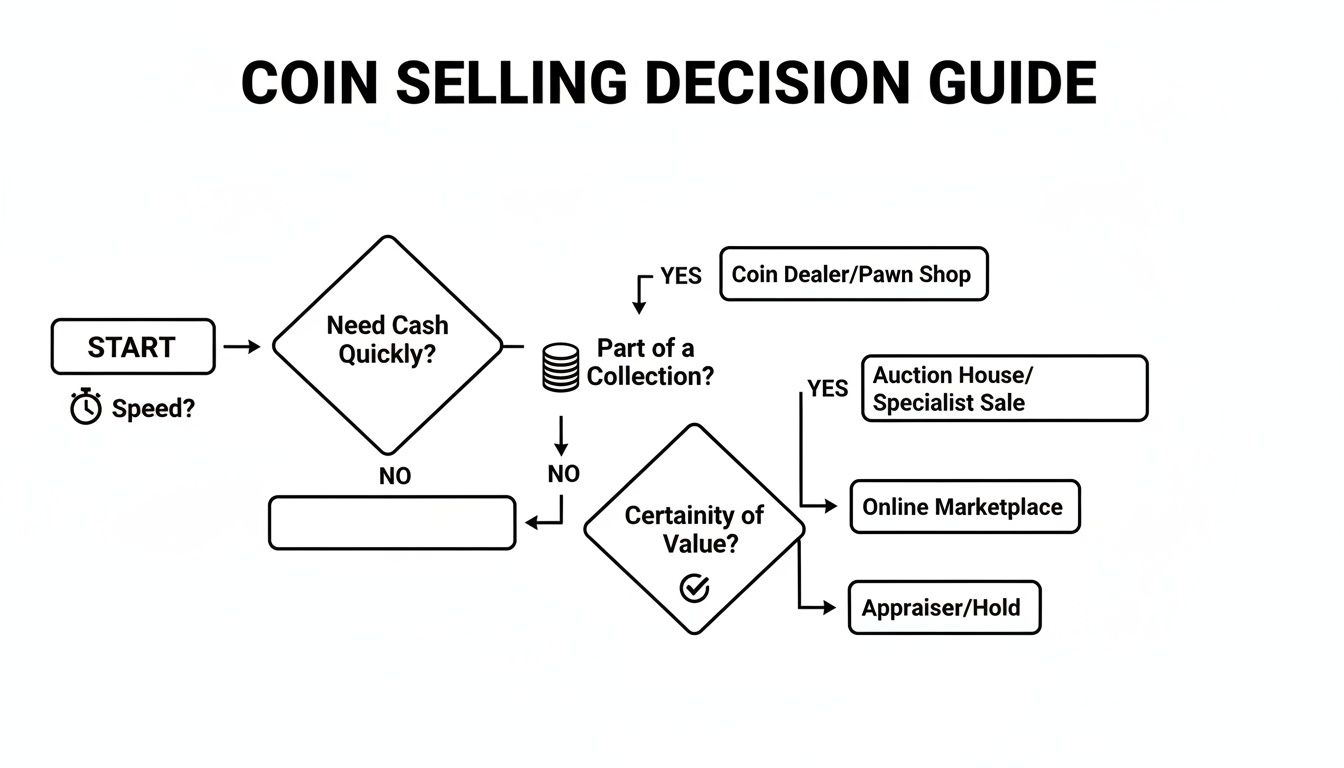
The main takeaway here is simple: your priorities—whether that’s speed, convenience, or getting top dollar—will almost always lead you to a specific type of buyer.
Scenarios for Selling a Single High-Value Coin
If you're sitting on a single, certified rare coin and your main aim is to squeeze every last drop of value out of it, an auction house is almost certainly your best bet. The big trade-off is time, as the whole process can easily take a few months. But for truly exceptional pieces, nothing beats the competitive bidding environment for maximising the final price.
On the other hand, if you need a guaranteed price for that same valuable coin without the uncertainty or long wait of an auction, approaching a specialist dealer for a direct offer is the smarter move. You’ll get a solid, immediate offer and completely sidestep the hefty seller's commissions that auction houses charge, which can be as high as 25%.
Navigating Inherited or Large Mixed Collections
Finding yourself with a large or inherited collection is a common scenario, and it can feel overwhelming. You might have a mix of common coins, some semi-rare pieces, and a few potentially valuable ones. In this situation, the most practical and efficient solution is often selling the entire collection to a specialist coin dealer.
A good dealer can assess the whole lot in one go and give you a single, fair offer for everything. This approach saves you the monumental task of sorting, cataloguing, and selling hundreds of coins one by one, giving you a clean and straightforward exit.
For inherited collections, the priority is often a simple, transparent, and respectful process. A reputable dealer provides exactly that, offering a professional service that turns a complex inheritance into a manageable and fair transaction.
Making a Decision Based on Your Priorities
Ultimately, the best place to sell your coins comes down to being honest about what matters most to you. Let's break down the final recommendations based on a few common seller profiles.
-
The Maximiser: You have a top-tier, certified coin and you're in no rush. Your goal is the absolute highest price the market will bear.
- Recommendation: A premier auction house is the clear winner here.
-
The Pragmatist: You have a valuable collection but prioritise a guaranteed, fair price and a fast, hassle-free transaction.
- Recommendation: Selling directly to a specialist coin dealer offers the perfect balance of speed, certainty, and value.
-
The DIY Enthusiast: You have common-to-mid-value coins and actually enjoy the process of selling. You have the time to photograph, list, and manage the sales yourself.
- Recommendation: Online marketplaces like eBay put you in control, though you might find partnering with a specialist retailer helps build trust and achieve better prices.
By figuring out which of these profiles best describes you, you can confidently pick the selling channel that lines up perfectly with your own objectives.
Your Coin Selling Questions Answered
Stepping into the world of coin selling can feel a bit daunting, and it's natural to have questions. We've put together answers to some of the most common queries we hear, hoping to give you a clearer picture as you figure out the best way to sell your rare coins.
How Can I Get My Rare Coins Valued for Free in The UK?
Many specialist coin dealers across the UK will happily offer a free, no-obligation valuation. A great way to start is by taking some high-quality photos of your coins and submitting them through the dealer's website. Alternatively, you can always arrange to pop into their shop for an in-person appraisal.
Auction houses also provide valuations, but they're typically looking for items they feel will do well under the hammer. For a quick, no-fuss initial idea of what your coins might be worth, a reputable dealer is your best bet.
Is It Better to Sell Rare Coins Individually or as a Collection?
This really comes down to what's in your collection. If you're sitting on several high-value 'key date' coins or certified rarities, you'll almost certainly get the best return by selling them one by one, either at auction or to a specialist. This way, each standout piece gets the individual attention it deserves.
On the other hand, if you have a mixed bag of common and semi-rare coins, selling the whole lot to a dealer is often much more straightforward and efficient. You might even find the total price is better than what you'd get trying to offload the lower-value coins individually.
Our Take: Have a good look at what you've got. Prized individual coins shine at auction, but for a mixed-quality collection, a single sale to a dealer is usually the simplest route to a strong overall price.
What Are The Tax Implications of Selling Rare Coins in The UK?
The tax rules for coins in the UK can be quite specific. Coins classed as legal tender, such as gold Sovereigns and Britannias, are usually exempt from Capital Gains Tax (CGT). This is one of the reasons they're so popular with investors.
For other rare coins you sell at a profit, you could be liable for CGT if your total gains in a tax year go over your annual exemption allowance. It can get complicated, so it’s always a good idea to chat with a financial advisor to understand exactly where you stand, particularly if you're dealing with high-value items.
How Do I Avoid Scams When Selling My Coins Online?
To keep yourself safe, stick to well-known, reputable platforms and be wary of any unsolicited offers that sound too good to be true—they usually are. If you're using a marketplace like eBay, always use secure, trackable payment methods and make sure you send items with fully insured postage.
Working with a specialist retailer to sell online adds a brilliant layer of security. They take care of everything: communicating with buyers, vetting bidders, managing payments securely, and handling any disputes. It’s a great way to avoid the common headaches and risks.
At Cavalier Coins Ltd, we pride ourselves on offering transparent valuations and fair, competitive offers for single coins and entire collections. Whether you're a seasoned numismatist or have just inherited a collection, our team is here to offer expert guidance and make the selling process simple. Contact us today to discuss your coins.