
You're at a UK stamp fair, turning the pages of a folder packed with colourful notes from countries you've never visited. One looks crisp, another has a soft fold, and a third carries a serial number that seems unusual. The seller gives you a price, but you're not sure whether you're looking at a genuine bargain, an ordinary circulated note, or something described as “rare” because it's old.
That uncertainty is normal. Buying world banknotes for sale in the UK becomes much easier once you separate four questions: what interests you, where to buy it, how to assess authenticity and condition, and how to protect the note after purchase. The UK market also has its own mechanics, particularly the replacement of paper Bank of England notes with polymer issues, which affects the supply of notes entering the secondary market.
This guide gives you a practical route from browsing to buying. It also covers auctions, marketplaces, bulk lots, HMRC considerations, shipping, storage and provenance, so you can build a collection with records rather than guesswork. For a gentle introduction to the hobby, this beginner's guide to collecting world banknotes is a useful companion.
Starting Your Search for World Banknotes in the UK
Start with three written goals before you spend anything. You might decide to collect one region, such as Asia or the Caribbean, focus on a historical period, or choose a theme such as animals, ships, architecture or famous people. Your third goal could be practical, perhaps building a small album of affordable circulated notes rather than chasing premium examples.
Writing those goals down matters because a fair or online marketplace can overwhelm you with choice. A collecting focus acts like a filter. It helps you compare two notes on meaningful grounds instead of buying whichever one has the brightest colour or most dramatic design.
Choose your first buying criteria
Set a budget before you open a dealer's catalogue. You don't need a large sum to begin, but you do need a limit that leaves room for postage, protective sleeves and the occasional purchase that needs more research. A fixed ceiling also makes it easier to walk away from a note whose description relies on excitement rather than evidence.
Then decide how much condition matters to you:
- Circulated notes show folds, handling and everyday history. They're often a good way to explore a country or theme without paying for pristine paper.
- Uncirculated notes retain sharper corners, cleaner surfaces and stronger visual detail. They suit collectors who want presentation quality.
- Mixed-condition collections can work well if you care more about coverage than uniformity, but label each note so future comparisons remain useful.
The UK market is receiving fresh material as older Bank of England issues are returned during the move from paper to polymer. The Bank says polymer £5 and £10 notes began entering circulation in September 2016 and September 2017, respectively, and its later update records returned notes and remaining circulation across polymer denominations in its official information on damaged polymer notes. That doesn't mean every returned paper note is scarce. It does mean replacement cycles influence what dealers, collectors and estates release.
Practical rule: Buy the note you can explain. You should be able to say why you chose its country, date, design, condition or serial number.
For your first search, shortlist three notes rather than browsing without an endpoint. Record the country, denomination, issuing authority, date, condition, asking price and seller. The next decision is where to buy, and each channel gives you a different balance of range, support, cost and risk.
Where to Buy, Dealers, Auctions and Marketplaces Compared
A specialist dealer is usually the simplest route for a first purchase. Dealers select stock, describe condition and often provide clearer return arrangements than an informal seller. You'll generally pay more for that service, but the premium can be worthwhile when you're still learning how folds, repairs, washed paper and altered serial numbers affect value.
Auction houses offer a different experience. Names such as Spink, Morton & Eden and Dix Noonan Webb can bring rare or historically important material to market, often with detailed lot descriptions. The displayed estimate isn't the complete cost, because successful bidders may also pay a buyer's premium and other charges. Read the conditions of sale before bidding, especially where the lot is sold as viewed.
Online marketplaces provide the broadest search experience. eBay UK, MA-Shops and Delcampe can help you locate countries or varieties that aren't available locally. The trade-off is that listing quality varies. Study photographs, ask for clear images of front and back, check seller history and confirm whether returns apply to authenticity concerns.
Bulk sourcing includes estate lots, job-lots and mixed collections. These can contain overlooked material, but they also contain duplicates, damaged notes and pieces with little resale demand. Treat a bulk purchase as an inventory exercise, not as a guaranteed treasure hunt.
UK world banknote purchase channels at a glance
| Channel | Typical Price Level | Authentication Support | Buyer Protection | Best For |
|---|---|---|---|---|
| Specialist dealer | Higher than informal listings | Usually strongest, with descriptions and invoices | Often clear returns, subject to terms | Beginners, focused purchases and quality examples |
| Auction house | Variable, plus auction charges | Catalogue descriptions and viewing arrangements | Governed by sale conditions | Rarities, specialist collections and competitive bidding |
| Online marketplace | Wide range | Mostly buyer-led, with seller evidence | Platform rules vary | Broad searches, comparisons and unusual designs |
| Bulk sourcing | Low per item, but mixed quality | Limited before sorting | Depends on seller and agreement | Resellers, researchers and collectors who enjoy attribution |
Ask one question before paying: what happens if the note isn't as described? A dealer should be able to explain the return process. An auction buyer should understand the inspection and dispute rules. A marketplace buyer should keep the listing, messages and payment record.
Cavalier Coins Ltd offers fixed-price world banknote listings and also handles direct discussions for bulk purchases, giving UK buyers another route when they want either individual collectable notes or larger quantities. Whatever channel you use, compare the note itself, the seller's documentation and the total delivered cost.
Grading and Pricing, What Makes a Banknote Worth More
Banknote grading works much like coin grading, but the evidence looks different. A coin collector studies surface marks, strike and lustre. A banknote collector studies crispness, folds, margins, centring, corner sharpness, stains, tears and repairs.
An uncirculated note should show no handling folds and should retain its original structure. An About Uncirculated example may have a light central crease or minimal handling, while a Fine note generally shows several softer folds and more obvious circulation. Don't rely on a grade abbreviation alone. Read the description and inspect the photographs under consistent lighting.
Separate condition from desirability
Condition is only one part of the price. A common note in perfect condition may remain easier to find than a scarce variety in a lower grade. Value can also rise when a note has an unusual signature combination, an attractive serial number, a radar pattern, a ladder sequence or a low number. Those features appeal to different buyers, so their importance depends on the note and the collecting community around it.
Third-party grading companies such as PMG and PCGS Banknote encapsulate notes and assign a grade after examination. Slabbing can help with resale because it gives buyers a standardised description and protects the note from handling. It isn't a substitute for research, though. Check that the holder matches the note, the label identifies the issue correctly and the certification details are consistent.
A useful pricing framework is:
- Identify the exact issue. Country, denomination, date, signatures and variety come first.
- Assess condition. Look for folds, pinholes, edge damage, stains, trimming and repairs.
- Check demand. A popular theme or country can attract more buyers than an obscure issue.
- Review provenance. An invoice, auction lot card or previous collection record can support confidence.
- Compare like with like. Compare the same issue and condition, not merely notes from the same country.
A high grade improves a note's presentation. It doesn't automatically make an ordinary issue rare.
Avoid price multipliers unless you have reliable comparable sales for the exact note. A seller's “rare” label is not a grading system, and a catalogue value isn't necessarily the amount a UK buyer will pay today.
How to Authenticate Before You Buy
A listing can look convincing on screen and still fail a hands-on check. Before you click “buy now” or raise a paddle, inspect the note through several independent tests. The Bank of England advises combining tactile features, tilt characteristics, metallic foil colour shifts and UV fluorescence for polymer notes. It also warns that detector pens do not work on polymer notes, as explained in its counterfeit banknote guidance.
Use a layered inspection
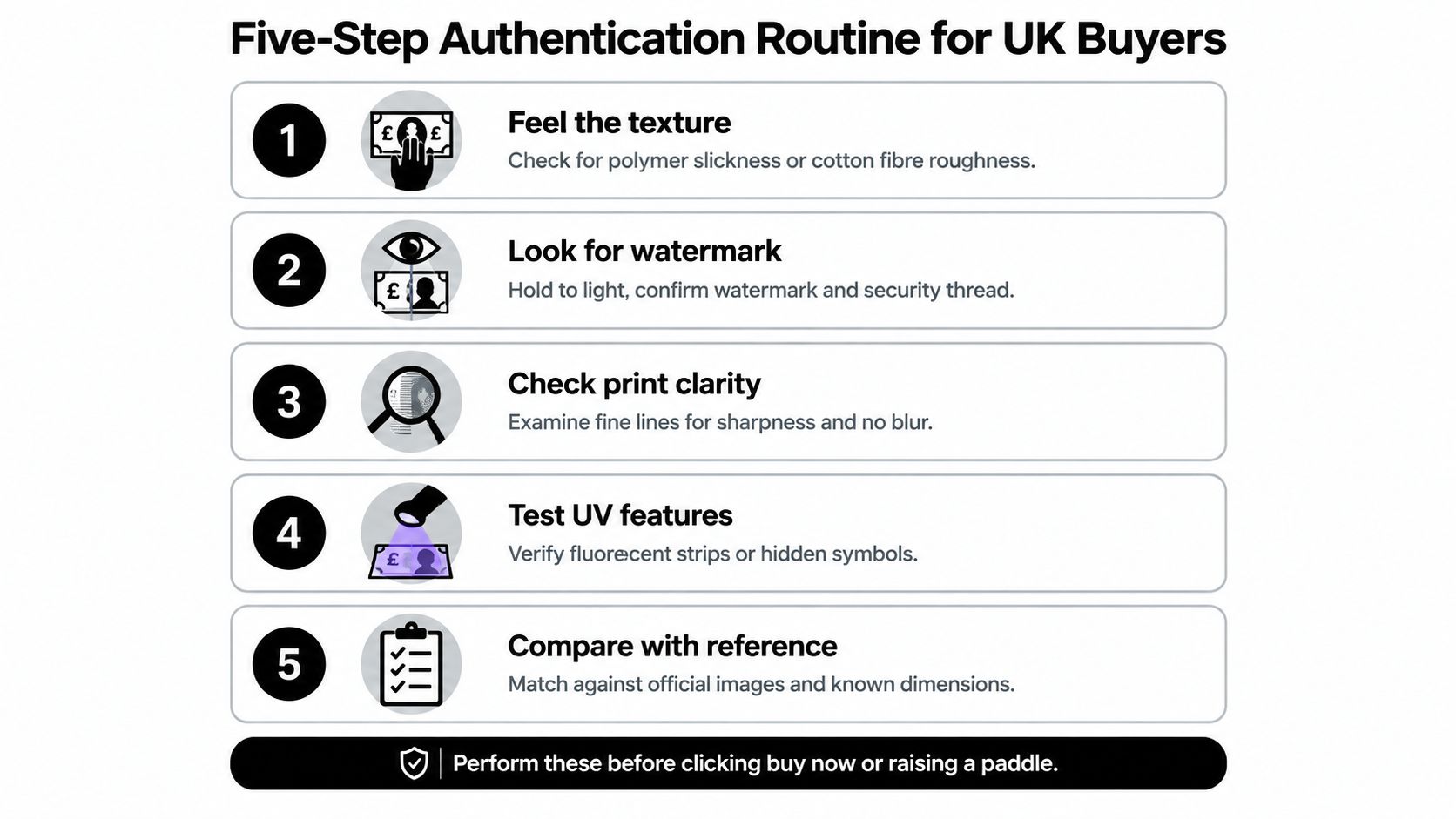
Start with the material. Polymer notes usually feel smooth and durable, while paper notes have a different fibre texture. Lightly run a finger over raised intaglio printing and embossed areas. A surface that feels flat, unusually soft or inconsistent needs closer examination.
Hold the note to a light. Check the watermark, security thread or transparent window appropriate to that issue. Their position and shape should match an official reference image, rather than only the seller's photograph. A listing image is evidence of appearance, not proof of authenticity.
Examine the printing. A 10x loupe can show whether fine lines, microtext and borders remain sharp. This guide to banknote security features explains what to inspect on modern issues. Blurred registration, uneven ink and crude detail may indicate a counterfeit, although genuine notes can lose clarity through wear.
Test UV features carefully. A small UV torch may reveal fluorescent fibres, strips or symbols designed to appear under the correct wavelength. Compare the result with a known genuine example where possible. UV light is one layer of the check, not a verdict on its own.
Finish with provenance and dimensions. Matching serial numbers, an old dealer tag, an auction lot card, a certificate and the note's measured size can support the listing's history. None proves authenticity alone. Together, they create a more convincing record and can expose discrepancies between the note and its description.
Photograph each note when it arrives. Capture both sides, serial numbers, the holder and visible defects, then save the images with the invoice. If you suspect a Bank of England counterfeit, follow the Bank's instructions for handing it to the police and retain the relevant record. Do not return it casually to circulation.
The safest buying rule is simple: if the price looks too good, pause the transaction until verification is complete. A bargain counts only when the note is genuine and accurately described.
UK Legal, Tax and Shipping Essentials
Most collectors can own foreign banknotes, but ownership and importation aren't identical questions. Country-specific restrictions, sanctions and customs rules can affect notes issued by sanctioned states, including North Korea, Iran and Syria. Very old emergency issues may also raise material or cultural-heritage questions, so check the relevant rules before importing an unusual item.
HMRC's chattels guidance says a collection of coins or banknotes is unlikely to be regarded as a set, which matters when you catalogue and sell items individually under HMRC's guidance on chattels. Keep an issue-by-issue record rather than treating a mixed album as one unexplained asset.
HMRC also says imported antiques and collectors' items can qualify for reduced-value import VAT treatment, with an effective 5% VAT rate at importation where the conditions apply in its guidance on imported collectors' items. Confirm the treatment for your specific transaction with HMRC or a tax adviser, especially if you buy regularly for resale.
Practical shipping decisions
For domestic purchases, ask how the seller will package the note. A rigid holder inside a protective mailer is safer than a loose note in an envelope. For valuable purchases, confirm the carrier's liability terms rather than assuming ordinary postage covers the full amount.
| Value Band | Recommended Service | Insurance | Declaration Required |
|---|---|---|---|
| Modest value | Tracked or signed domestic service | Check the carrier's limit | No customs declaration for a domestic shipment |
| Higher value | A service with suitable compensation or specialist cover | Match cover to the invoice value | No customs declaration for a domestic shipment |
| International shipment | Insured tracked courier or postal service | Confirm exclusions for currency and collectibles | Yes, complete an accurate customs declaration |
Don't under-declare a parcel. Use the correct description, value and destination details, and retain the receipt, tracking record and invoice. A tamper-evident sleeve can help show whether packaging was interfered with in transit.
A sound default is photograph, declare, insure and keep every receipt. If you sell frequently, separate personal collecting records from trading stock and obtain professional tax advice before relying on a general rule.
Bulk Buying, Selling and Donating Notes
A mixed lot looks attractive because the price applies to the bundle, not each note. That can conceal the work. Before deciding whether a job-lot is worthwhile, separate it by country and denomination, then identify the notes that might carry meaningful collector demand. Keep ordinary duplicates and damaged filler in a different pile.
Sort before you value
Start with the visible information: issuer, denomination, date, signatures, serial number and condition. Look for pick-out values such as an unusual variety, scarce signature pairing or appealing serial pattern, but don't assume every older note is scarce. The Bank of England's replacement data shows why age alone can mislead. Large numbers of returned paper notes can enter the secondary market during replacement cycles, while a note's actual scarcity depends on issue size, survival and demand.
Calculate your break-even point from the notes you can realistically sell, not from optimistic catalogue descriptions. Include sleeves, photographs, research time, postage, platform charges and the remainder that may never find a buyer. If a bundle contains several attractive notes and a large amount of low-demand material, price the unwanted portion before committing.
Selling routes suit different objectives. A dealer trade-in offers speed but may produce less than individual retail sales. Consignment through an auction house can reach specialist buyers, although you'll need to understand estimates, commissions and settlement timing. Fixed-price marketplace listings offer control over descriptions and prices, while specialist collector groups can provide a knowledgeable audience but require careful checking of group rules and payment protection.
Donation is another legitimate end point. Museums, specialist libraries and numismatic organisations may accept material that supports education or research. A significant collection can also be documented for a will or bequest, so heirs understand what exists and where records are kept.
Choose the exit before you buy the lot. Liquidity, exposure and legacy require different decisions, and a bundle rarely maximises all three.
Storage and Provenance Best Practices
Storage and paperwork belong together. A note that remains physically attractive but loses its invoice, grade record or acquisition history becomes harder to value, insure and sell. The practical aim is simple: protect the material and preserve the information that explains it.
Use Mylar or Melinex sleeves sized to the note, and choose PVC-free albums. PVC can cause chemical damage over time. Valuable notes benefit from rigid clear holders, while acid-free interleaving can separate pieces that might transfer colour or residue. Handle notes by their edges with clean, dry hands. Gloves can help in some settings, but poor grip can also cause handling accidents, so controlled edge handling matters most.
Control the home environment
Keep the collection flat in a closed cabinet, away from radiators, windows and direct sunlight. A small hygrometer lets you monitor changes rather than guessing about damp conditions. Silica gel packs in a sealable storage box can help manage moisture, but replace or recharge them as directed and don't let packs touch the notes.
Investment-grade pieces deserve stronger protection. A dedicated fire-resistant safe or safe-deposit box can reduce exposure to theft, fire and household accidents. Store certificates, invoices and photographs separately enough that one incident doesn't destroy both the note and its provenance.
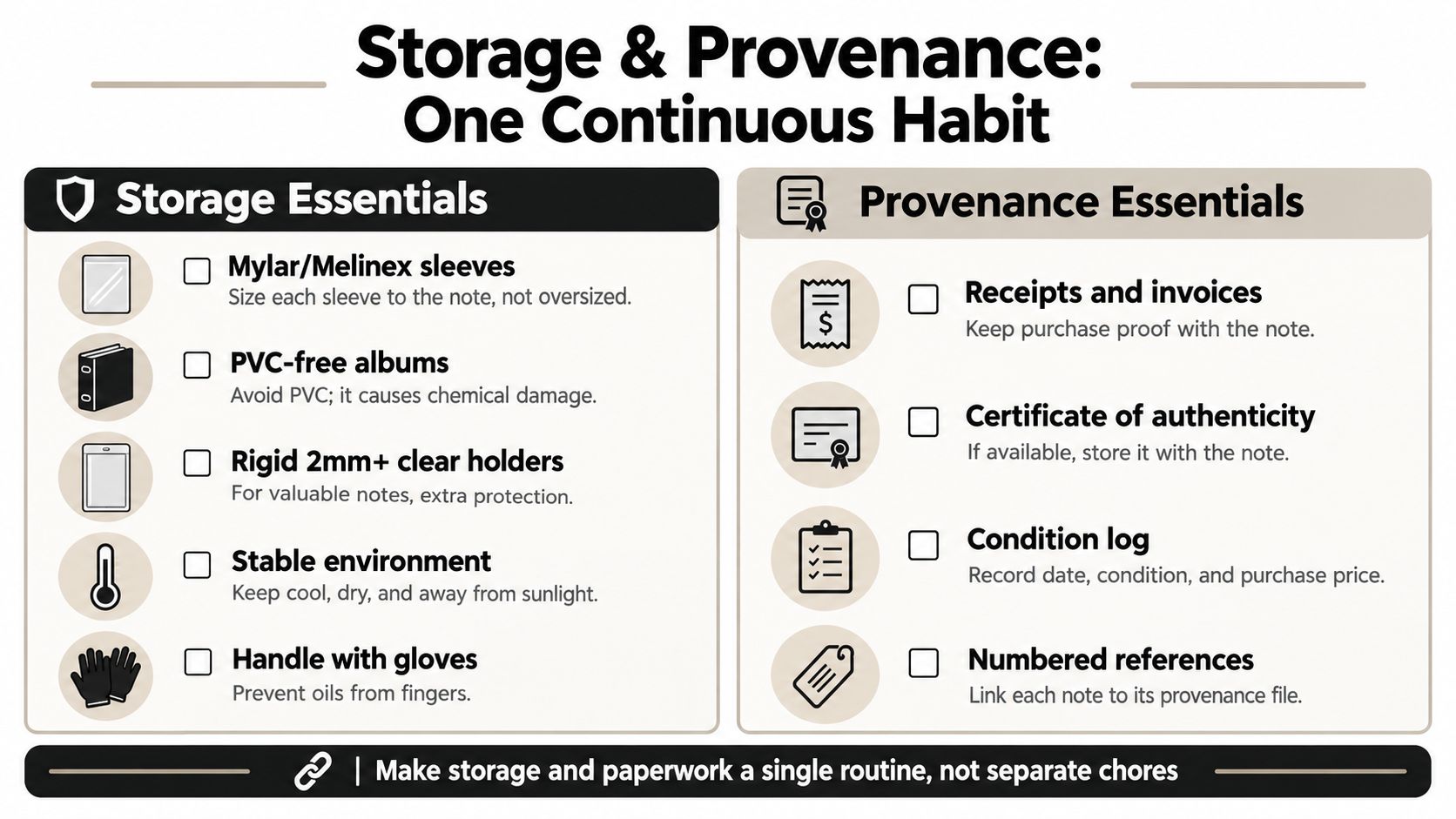
A one-page purchase log is more useful than vague pedigree claims. Record the date, seller, price, lot number, certificate details and condition, then photograph the note beside a ruler and the receipt. For broader advice on materials and handling, use this guide to storing a paper money collection.
Use this six-point routine after every purchase:
- Sleeve: Place the note in an appropriate archival sleeve.
- Label: Record country, denomination, date and catalogue reference.
- Photo: Photograph both sides and any notable feature.
- Log entry: Save the seller, price, lot and receipt details.
- Environment check: Review the cabinet, humidity and sunlight exposure.
- Insurance review: Update cover when the collection's value or location changes.
Putting It All Together
You can start this weekend without trying to master every country and catalogue. Choose one reputable channel for a trial purchase, set a £200 budget, shortlist three notes from different regions, apply the authentication routine and document each purchase as soon as it arrives. The budget is a boundary, not a target. If the right notes aren't available, waiting is better than filling the album with material you don't understand.
The habit that separates confident collectors from hesitant buyers is a purchase log updated within 24 hours of every transaction. Write down what you bought, why you bought it, what the seller stated, what you observed on arrival and where you stored the paperwork. Your future self will trust a dated record more than a memory of a busy fair.
Two decisions often get postponed. Pick a grading standard early, even if you use straightforward descriptions such as uncirculated, About Uncirculated, Fine or Poor rather than paying for third-party grading. Then write a clear note in your will or safe-deposit arrangements explaining where the collection, inventory and key documents are held. That small administrative step can prevent an estate from treating a valuable album as an anonymous box of paper.
The UK market rewards patient, documented buying. Whether you prefer colourful circulated notes, graded rarities, replacement-era issues or bulk research lots, use the same sequence: define the focus, assess the seller, authenticate the note, record the transaction and store it properly. Start with one well-understood purchase, then let your collection grow from evidence rather than impulse.
If you're looking for carefully described world banknotes, themed pieces or bulk purchasing options, visit Cavalier Coins Ltd to browse its collector listings and contact the team about larger requirements. Use your shortlist and authentication checklist while comparing each note, then record the purchase as soon as it arrives.