
You find it folded inside an old wallet, tucked in a drawer, or sitting among coins in a charity collection tin. At first glance, a 1 pound note looks like a modest piece of paper. Turn it over, however, and you may be holding a small record of Britain's monetary history, a regional banknote that still circulates, or a collectible whose value depends on details many overlook.
The Bank of England's paper £1 denomination lasted from its first issue in 1797 until it ceased to be legal tender in 1988, a recorded life span of 191 years from introduction to withdrawal in England and Wales. The story doesn't end there. Scottish banks still issue their own £1 notes, which is why collectors and cash handlers need to distinguish between Bank of England, Scottish, Northern Irish and island issues.
A Small Note with a Long Story
Suppose the note in your hand is green, slightly tired and marked with the portrait of Sir Isaac Newton. You might assume it has been forgotten in circulation. In fact, if it's a Bank of England issue, it belongs to a denomination that began during a serious shortage of gold and ended when the government decided that a coin was more practical for everyday use.
The Bank of England first issued a £1 note on 2 March 1797, during the French Revolutionary Wars. Gold shortages made low-denomination paper money necessary, so the note took the place of coins that couldn't readily be supplied. The denomination remained important for generations, even though its appearance, security features and signatures changed repeatedly. The Bank of England reintroduced the first modern post-war £1 note on 22 November 1928, and the final series featuring Newton was issued in 1978. The note was last issued in 1984 and ceased to be legal tender on 11 March 1988 (Bank of England note issues).
Why collectors still care
The £1 note sits between ordinary spending and serious numismatics. It was once used for small purchases, wages and change, but today its interest lies in the issuing bank, series, cashier signature, serial number and physical condition.
Scottish issuers followed a different path. The withdrawal of the Bank of England note didn't automatically remove every paper £1 note from Britain. Scottish banks continued issuing regional £1 notes, creating a practical distinction that confuses newcomers and occasionally causes mistakes in charity sorting rooms.
Collector's starting point: First identify the issuer. A note that looks British isn't necessarily a Bank of England note, and legal status doesn't determine collectible interest.
The pages that follow will help you read the history, identify the main series, understand which notes remain valid, judge condition, avoid overpaying and choose sensible places to buy or sell. A common Newton note can be an affordable introduction, while older or unusual issues require more careful examination.
From 1797 to 1988, A Timeline of the Bank of England £1 Note
The safest way to understand the Bank of England £1 note is to follow its sequence of issues. A series letter alone isn't enough. Collectors also compare the date, design, signature, reverse vignette and, for later notes, the serial prefix.
The early emergency issues
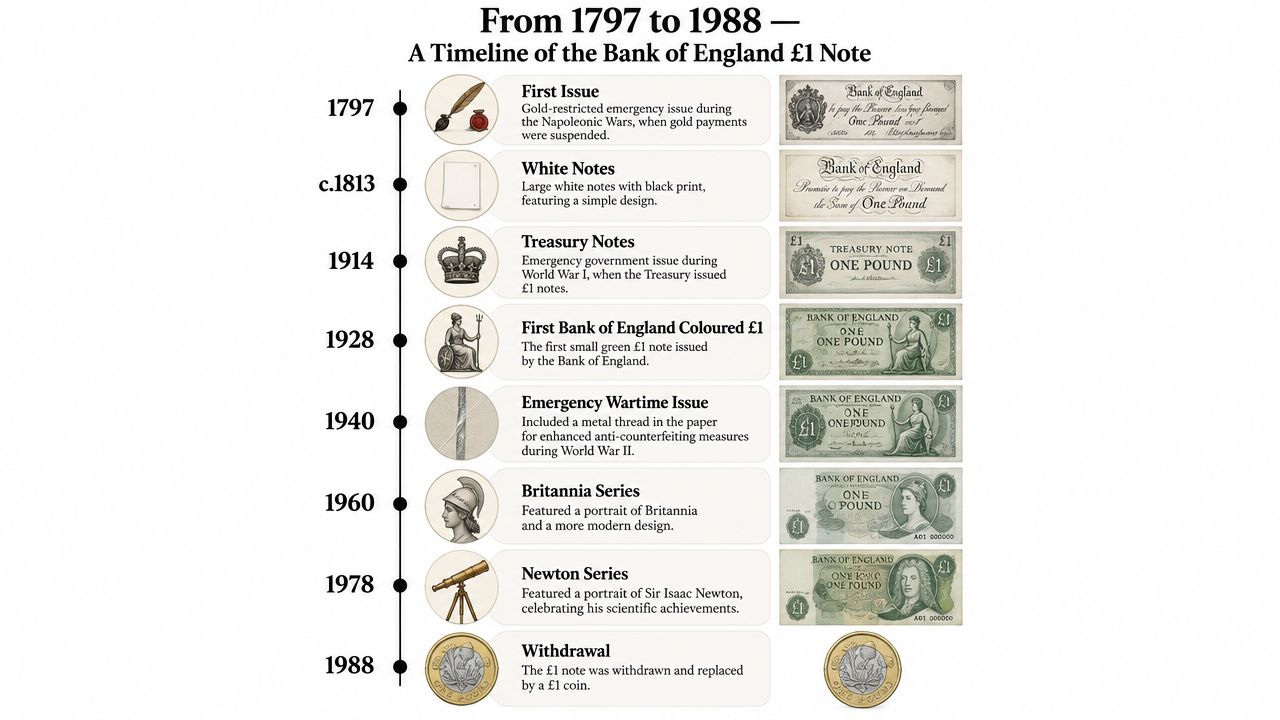
- 1797 first issue: The Bank of England introduced the £1 note on 2 March 1797, when gold shortages during the French Revolutionary Wars forced the use of low-denomination paper money (Bank of England note issues). These early notes are very different from the compact green notes commonly recognised.
- Around 1813, white notes: Large white notes with black printing followed. The design was functional rather than decorative, and the wording and handwritten or printed details matter greatly to specialists.
- 1914 Treasury notes: During the First World War, the government issued emergency Treasury currency. These notes are often included in the broader story of the £1 denomination, but they weren't ordinary Bank of England issues. The crown emblem and Treasury wording help separate them from later Bank of England notes.
The signature is more than decoration. It identifies the official responsible for the issue, and changes in chief cashier or Treasury authority created identifiable varieties. Wartime overprinting and emergency production also explain why some notes look less elaborate than later designs.
The modern Bank of England series
- 1928 Series A: This was the first modern post-war £1 note, reintroduced on 22 November 1928. It established the compact format and design language that later issues developed.
- 1940 Series B: Wartime concerns encouraged stronger anti-counterfeiting measures. The emergency issue is associated with a metal security thread, an important feature for identification.
- 1948 Series C: This series continued the modern small-note format and is recognised through its design, signatures and reverse details.
- 1960 Series D: Britannia became a prominent visual element, giving the notes a recognisable national character. A later Series D Replacement issue is also encountered by collectors.
- 1978 Newton series: Sir Isaac Newton replaced the earlier Britannia portrait arrangement. The reverse connects Newton with scientific imagery, making this the most familiar Bank of England £1 note to many modern collectors.
The £1 coin was introduced on 21 April 1983, following a consultation announced on 31 July 1981. The paper note continued briefly, with the final issue in 1984, but the coin gradually took over everyday £1 transactions (Bank of England £1 note).
The Bank of England withdrew the paper £1 from legal tender on 11 March 1988. From that date, Bank of England £1 notes became collectible objects rather than spendable money in England and Wales. The full recorded journey from the first issue to withdrawal covers 191 years.
Bank of England, Scottish and Regional £1 Notes Compared
Collectors often use “British £1 note” as if it described one family. It doesn't. The issuer determines the note's identity, while the place where it was issued helps explain its circulation history and collecting appeal.
Bank of England £1 notes are withdrawn and collectible only. They include the early emergency issues, the modern series and the final Newton notes. They shouldn't be treated as spendable currency because they remain in recognisable sterling denominations.
Scottish banks form a separate group. Notes from the Bank of Scotland, Royal Bank of Scotland and Clydesdale Bank have circulated alongside coins and other Scottish issues. Royal Bank of Scotland still issues £1 notes, which answers the question many newcomers ask after finding a current-looking Scottish paper pound. Acceptance can vary in practice, so a shop may still decline a note even where another party would accept it.
Northern Ireland has its own banknote tradition, including issues associated with the Bank of Ireland, First Trust, Northern Bank, Ulster Bank and Danske Bank. These notes are denominated in sterling but are not legal tender in mainland Britain. That doesn't make them worthless, but it does make issuer and location especially important.
Jersey, Guernsey and the Isle of Man should be kept separate again. Their £1 notes are island currencies, not sterling, although beginners often group them with UK banknotes because of their appearance and denomination.
| Issuer | Still Legal Tender? | Collectible Status |
|---|---|---|
| Bank of England | No, withdrawn | Historic and collectible |
| Royal Bank of Scotland | Regional paper £1 issues circulate | Collectible, with current and withdrawn varieties |
| Bank of Scotland | Regional issues | Collectible, with design and signature varieties |
| Clydesdale Bank | Regional issues and historic £1 notes | Collectible, including older paper varieties |
| Northern Irish issuers | Sterling-denominated, but not legal tender in mainland Britain | Collectible by issuer, design and condition |
| Jersey, Guernsey and Isle of Man | Not sterling | Collectible island currency |
The distinction matters when buying. Two notes marked £1 can have completely different legal histories, demand and market prices. A regional note may be common in its home area but unfamiliar elsewhere, while a withdrawn Bank of England note has purely historical value.
Identifying and Authenticating £1 Notes
The 1978 Newton £1 note makes a useful working example because many collectors encounter it first. Don't begin with the serial number or a seller's rarity claim. Start with the physical object and confirm that the note belongs to the claimed series.
Four checks that establish identity
Substrate comes first. The note is made from white cotton paper and includes a raised tactile bar marked £1. Paper should feel consistent with an older Bank of England note, not glossy, laminated or unusually smooth.
Printing reveals the design. The obverse carries an intaglio portrait of Isaac Newton, while the reverse features the Brunell “D” for Dagenham. Raised printing, fine line work and clean registration are more useful than colour alone.
Portraits and vignettes separate series. Compare the Newton portrait and reverse imagery with a reliable catalogue image. Earlier Britannia series notes can look broadly similar to an inexperienced eye, but the main portrait, layout and reverse vignette distinguish them.
Serial numbers provide another clue. Collectors record the prefix, number sequence and whether a note belongs to a replacement run. Replacement notes use a Z prefix, and unusual patterns may attract interest, but a striking number isn't proof of rarity by itself.
The signature sits in the lower-right area, between the title and the branch information. Read it alongside the series and serial prefix rather than treating it as an isolated feature. Prefixes can act as a date proxy within a series, but catalogue references remain safer than guessing from lettering alone.
| Feature | Location | What to Look For |
|---|---|---|
| Paper and tactile bar | Printed note surface | White cotton paper and raised £1 bar |
| Newton portrait | Obverse | Intaglio printing and correct portrait |
| Brunell “D” | Reverse | Correct Dagenham reference and fine detail |
| Serial number | Printed number areas | Matching format, prefix and replacement indicators |
| Signature | Lower-right area | Correct cashier and placement |
| Watermark | Visible against light | A coherent watermark when held to backlight |
A genuine note should also be checked for size, weight and watermark. The Newton note measures 134 × 67 mm, and a backlight examination can reveal whether the watermark is present and properly formed. Compare doubtful examples with a trusted reference rather than relying on a single security feature. For broader guidance on physical checks, see this banknote security features guide.
Rarity, Signature Varieties and Market Value
A £1 note's value doesn't come from age alone. Dealers usually weigh several factors together, and a modest note in exceptional condition can outperform an older note that has suffered heavy circulation.
Series and year establish the starting point
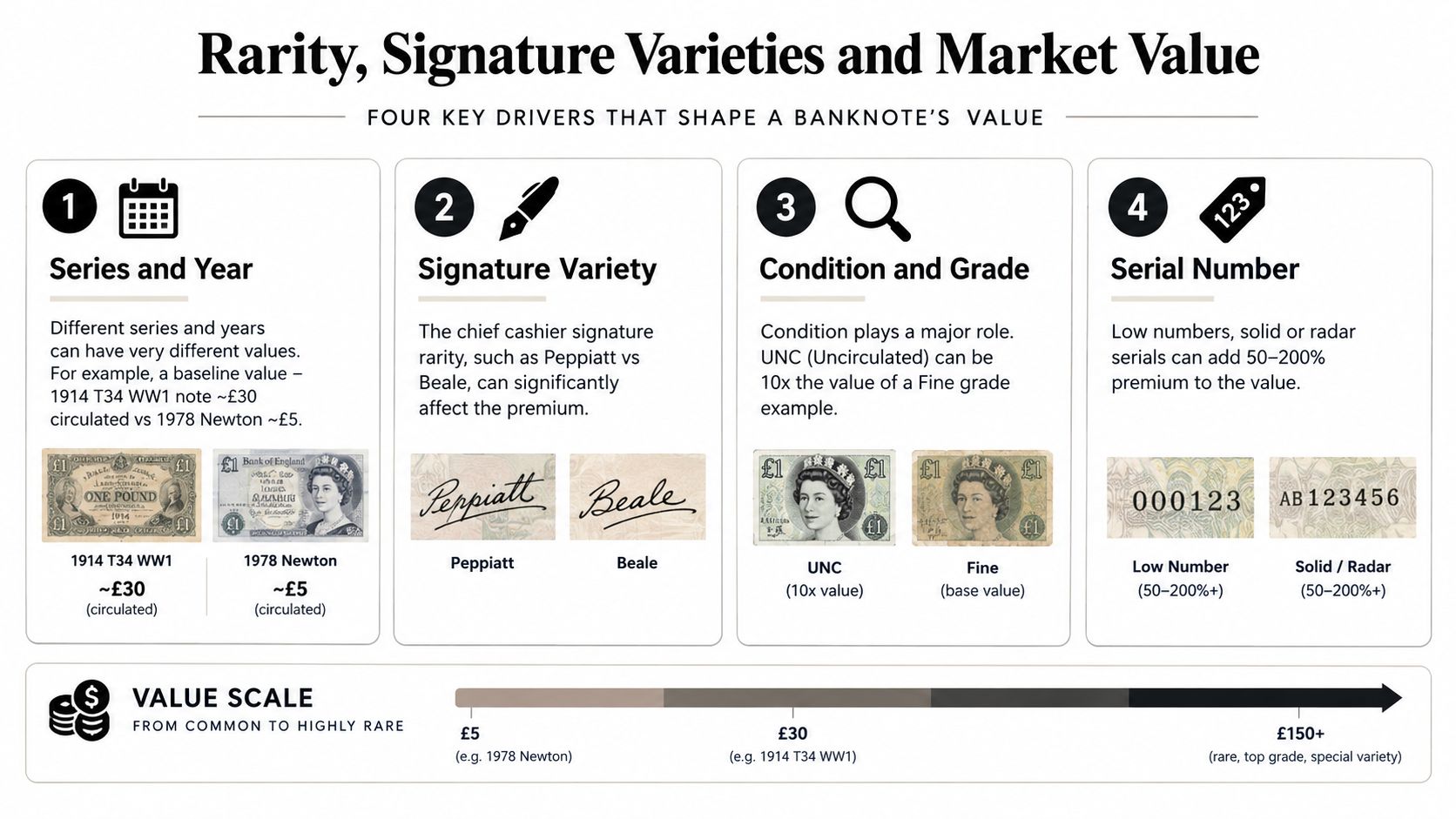
The contrast is clear in the supplied market examples. A 1914 T34 First World War emergency note in circulated condition is around £30, while a circulated 1978 Newton can sit under £5 (Bank of England £1 note). Those figures are guideposts, not guarantees. Date, issuer, design and condition must still be confirmed.
Signatures add another layer. Chief cashier pairings create varieties, including Newton Q-H, J-B and R-D combinations. Earlier signatures are generally scarcer, but scarcity only helps when collectors recognise the variety and can verify the note.
Condition changes the price dramatically
A circulated note may have folds, rounded corners and surface dirt, while an UNC example should retain its original crispness and show no handling. One supplied example places an UNC Newton J-B around £15, while the same variety at about UNC can fall below £10. Condition isn't a cosmetic footnote. It changes the buyer's assessment of how well the note has survived.
Serial numbers can provide a premium when the pattern has genuine appeal. Collectors look for low numbers such as 000001 to 001000, solid or repeating sequences such as 7777777, and experimental notes with an M prefix. The number must be read with the series and signature, because an attractive sequence on a common note may still have limited demand.
| Driver | Questions to ask |
|---|---|
| Series and year | Is the issue historically scarce or widely encountered? |
| Signature | Is the cashier pairing an established variety? |
| Serial number | Is the sequence unusual and properly documented? |
| Condition | Are folds, stains, pinholes or corner knocks present? |
Buying discipline: A seller's phrase such as “rare serial” isn't evidence. Ask for the full prefix, number, series and clear photographs of both sides.
Prices move with collector demand, so check current Spink catalogues and recent Auction Archive results before committing money. Auction estimates and completed sales are more useful than optimistic fixed prices. A specialist dealer can also explain why two apparently similar Newton notes sit in different price brackets.
Grading and Preserving Banknotes for the Long Term
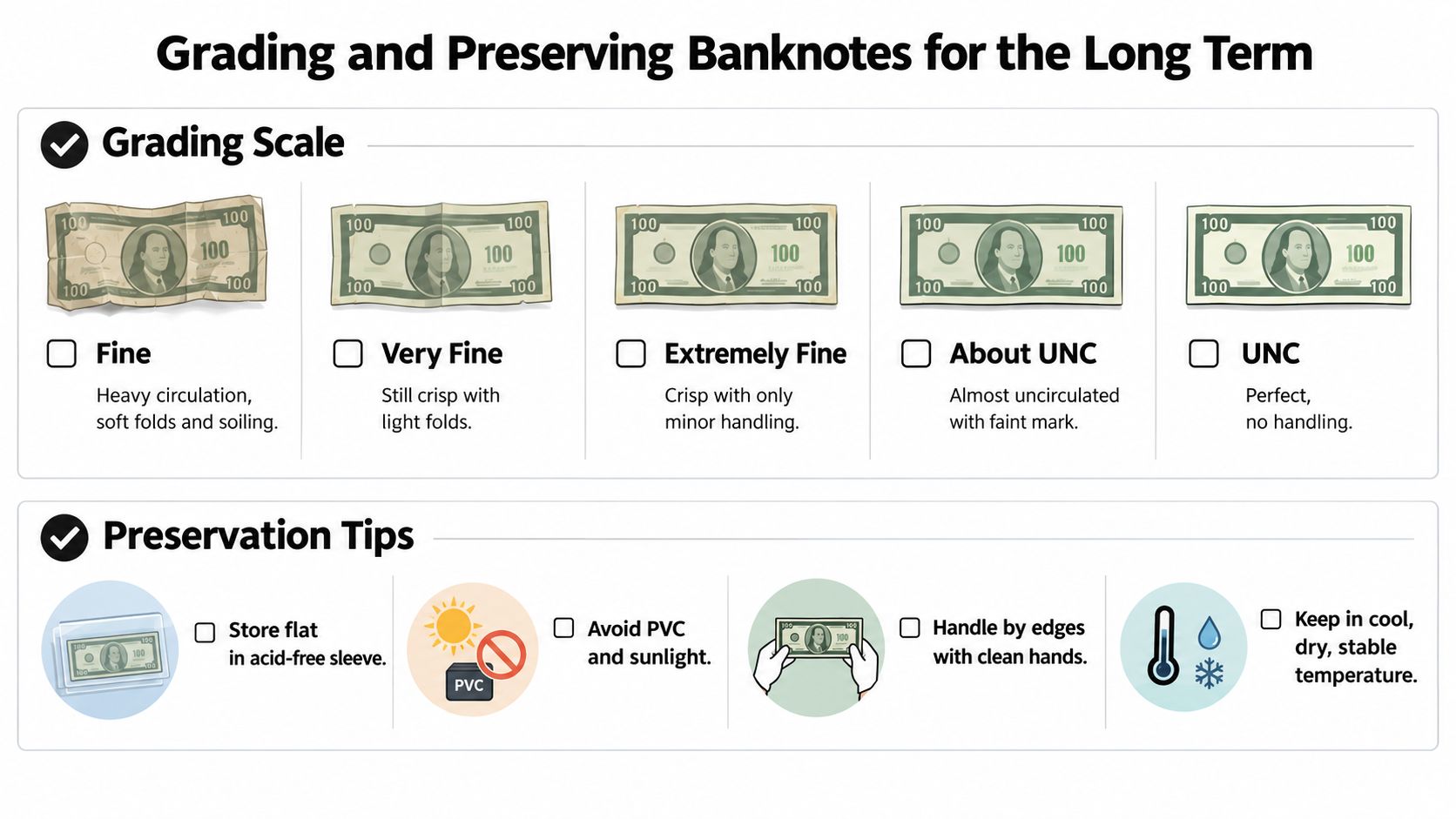
Dealers describe banknotes using a scale from Fine through Very Fine, Extremely Fine, About UNC and UNC. These terms describe preservation, not age. A circulated older note may be attractive and historically important while still grading only Fine.
Read the grade on the paper
- Fine: Heavy circulation, soft folds, soiling and visible handling.
- Very Fine: Noticeably used but with stronger paper and lighter folds.
- Extremely Fine: Crisp overall, with only minor handling and sharper corners.
- About UNC: Almost uncirculated, perhaps with a faint mark or slight imperfection.
- UNC: No meaningful handling, with original crispness and an undisturbed appearance.
Folds are particularly important. A note that has been pressed flat can look better in a photograph while losing evidence of its original state. Foxing, pinholes, tears, ink loss and corner knocks also lower the grade. Centring and retained embossing can support a premium, especially when the note otherwise appears fresh.
Storage protects future options
Handle notes by the edges with clean, dry hands. Cotton gloves can help during extended sorting, although freshly washed hands often provide better control than slippery fabric. Store each note flat in a Mylar or Tyvek sleeve, then place sleeves in an acid-free album.
Keep the collection in a cool, stable, dry environment. Avoid attics and cellars, where heat, damp and changing conditions encourage foxing and distortion. PVC pockets can damage paper and cause ink problems over time, while direct ultraviolet light fades printed colour.
Older thin paper, later ink and regional designs each have their own vulnerabilities. A 1914 T34 can tear easily, the 1978 to 1984 series may show ink flaking after PVC storage, and Britannia notes can fade under UV exposure. The safest treatment is preventive, not corrective.
For a fuller explanation of dealer grading terms, use this guide to grading banknotes.
Preservation checklist:
- Never laminate: Plastic and adhesive treatments can permanently reduce desirability.
- Don't press notes: Heavy books can flatten evidence and create fresh damage.
- Don't clean stains: Washing, bleaching or rubbing usually harms the surface.
- Keep records: Note the issuer, series, signature, serial number and purchase details.
Where to Buy and Sell £1 Notes
The right marketplace depends on what you're buying, how much you need to inspect and whether you're selling a common circulated note or a scarce variety.
Fixed-price dealers such as Cavendish Coins, AMC Banknotes and Spink suit beginners who want described stock and a published price. You generally pay for convenience and authentication, while the eventual sell-back offer may be lower than the retail price.
eBay offers the broadest selection and lets market demand set the result through fixed listings or auctions. It also leaves more responsibility with the buyer. Request clear photographs, check the seller's return policy, examine feedback for banknote sales and avoid listings that use only stock images.
Specialist auctions from Spink, DNW, Noonans and Bowker are better suited to higher-grade, scarcer or signature-variety pieces. Sellers need to allow for commission, which in the supplied guidance is commonly described as 15 to 25%, and settlement can take time after the sale. Read the full fee schedule before sending a note.
Banknote fairs and numismatic societies offer something online listings can't. You can handle the note, compare grades side by side and ask why a Scottish or Northern Irish issue has been catalogued in a particular way. Relationships with established dealers often help when you later need an opinion, valuation or consignment route.
Match the channel to the note
| Situation | Sensible first choice | Main caution |
|---|---|---|
| Common Newton note | Fixed-price dealer or local fair | Don't pay a rarity premium without a variety |
| Unusual signature or serial | Specialist auction or established dealer | Confirm catalogue references |
| Large mixed collection | Dealer appraisal or auction consignment | Separate issuers before valuation |
| Low-value circulated notes | Local collector sale or online bundle | Postage can outweigh the note value |
Cavalier Coins Ltd offers fixed-price banknotes and weekly eBay auctions, including Bank of England £1 examples and related regional material. For a broader explanation of dealer services and selling routes, read this guide to UK banknote dealers.
Frequent trading also deserves separate financial advice. Keep purchase invoices, sale records and fees, and ask an accountant how the tax rules apply to your circumstances, particularly if your activity goes beyond occasional disposal of personal collectibles.
Common Pitfalls and Collector Questions
The most expensive mistake is often misidentification. A Scottish £1 note may be mistaken for a withdrawn Bank of England note, while a Jersey note may be treated as sterling because it carries a familiar denomination. Separate notes by issuer before researching price.
Cleaning and pressing cause a second problem. A note that looks bright after treatment may be less desirable than a circulated example because collectors want original paper, surface and folds. Don't buy a raw note sight unseen if the seller offers weak returns or refuses to show corners, edges and both sides.
Charities should sort donations carefully. Some regional notes may have no practical spending use in the area where they were donated, and staff shouldn't convert questionable notes without checking the donor's instructions and applicable refund obligations. The 1978 Newton series is also a known target for imitation, so unusual sharpness, incorrect paper or poor fine-line printing deserves scrutiny.
Questions new collectors ask
Are Bank of England £1 notes still legal tender?
No. The Bank of England withdrew the relevant £1 notes from legal tender on 11 March 1988 (withdrawn Bank of England banknotes). They're collectible only.
Can Scottish £1 notes still be used?
Scottish paper £1 notes from issuers such as Royal Bank of Scotland, Bank of Scotland and Clydesdale remain regional circulating notes, although individual retailers may choose whether to accept them. Check the issuing bank and current guidance rather than assuming every Scottish design has the same status.
What is a common circulated Newton worth?
The supplied market guidance places a common circulated 1978 Newton around £2 to £8, while a crisp uncirculated prefix example may be around £25 to £60. Treat these as practical guide ranges, not guaranteed offers. Serial pattern, signature, centring and actual grade can move the result.
Final check before payment: Confirm the issuer, series, signature, serial number and condition. Those five details prevent most beginner overpayments.
If you've found a Bank of England, Scottish or regional £1 note, Cavalier Coins Ltd offers collector banknotes, fixed-price listings and weekly eBay auctions for researching, buying or selling comparable pieces. Visit the site with clear photographs and the note's issuer, signature and serial details ready, so you can make a more informed decision.